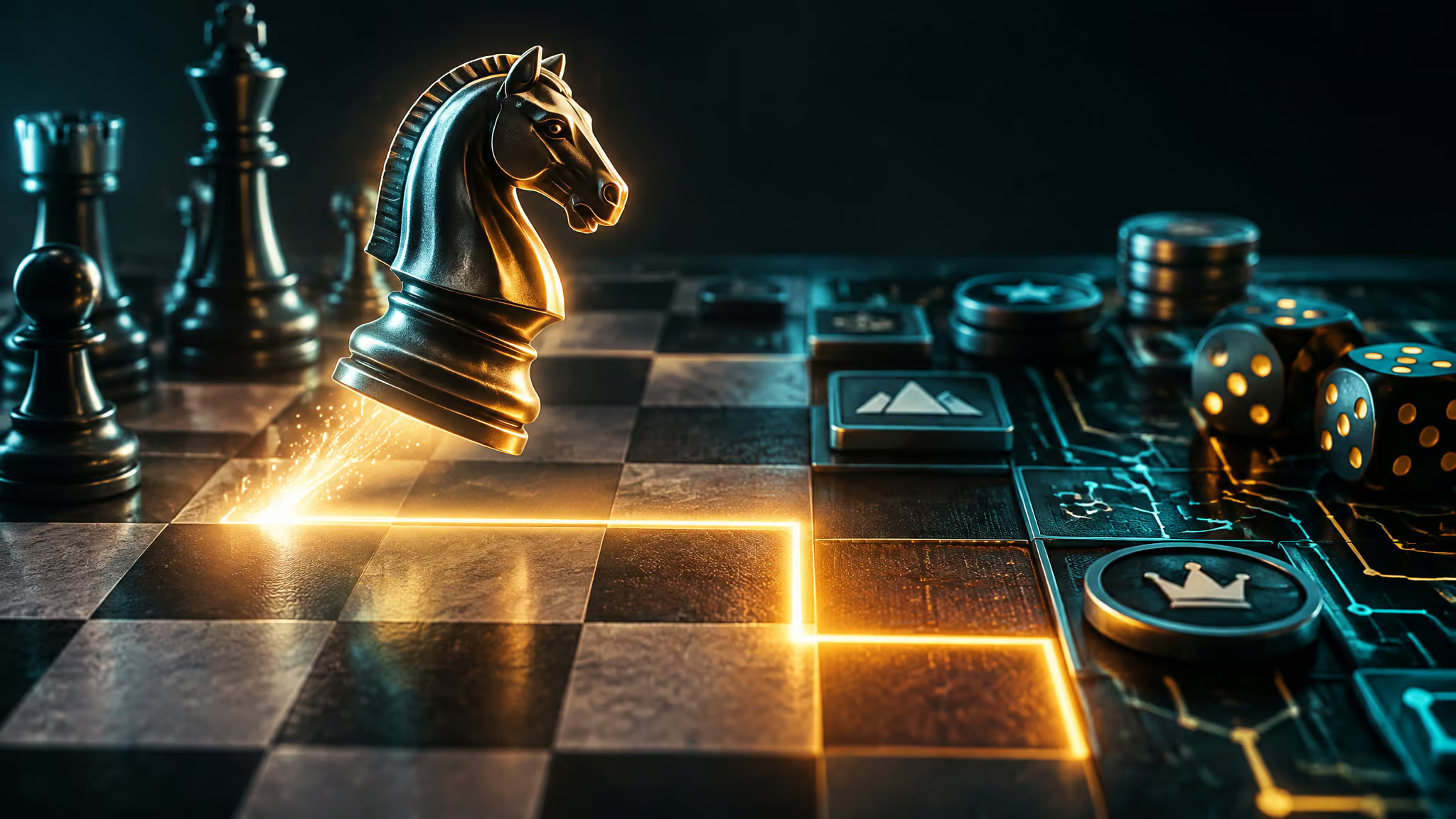
Game mechanics are the rules, or “ludemes”, that shape what a player can do and how the game responds. A rule tells you how to play; a ludeme is a unit of play, and the chess knight’s L-shaped move is the canonical example. And here’s the part that got me: even though that definition sounds crisp, there is no consensus on what a game mechanic actually is. Not among reviewers or designers, and not even among the scholars who study this for a living.
I went looking for a clean definition, the kind of thing you’d expect from a field with decades of theory behind it, and found an argument instead. The kind of term we like to take apart here. Depending on which theorist you ask, a mechanic is systems of interactions between the player and the game, or the rules and procedures that guide the player and the game response to the player’s moves or actions, or, at the loosest end, only those things that impact the play experience. That’s three working definitions, all in circulation, all different.
And yet mechanics themselves are everywhere once you know to look. Turn-taking, movement, set collection, and that’s before you get weird.
Bidding, capture, resource management. Every game you’ve ever played runs on some combination of these, whether it’s a eurogame about farming or a shooter about shooting. The theories disagree on how much mechanics matter and what exactly counts as one, which honestly makes the whole topic more interesting, not less.
So this is the past-the-marketing-fluff version: what mechanics are, why nobody can agree on a definition, how they differ from theme and gameplay, what the major named mechanics actually do, and why tuning them well or badly can make or break an entire game. The rabbit hole goes deeper than the spec sheets admit.
Key Takeaways
There’s no consensus definition of “game mechanics.” Three competing ones circulate, and the loosest end is the idea that only those things that impact the play experience count.
Mechanics are distinct from theme (Go has no theme at all) and from gameplay, which scholars define in at least four genuinely different ways.
Tuning beats novelty: Hades II hand-triggers enemy waves at roughly 50/70/90% kills, and I Am Your Beast pays out 0.3 seconds per kill (1 for headshots), and those exact parameters are what make each game feel like itself.
Table of Contents
Why there’s no single definition of game mechanics
There’s no canonical definition of game mechanics, and no canonical “four elements” model either. The actual literature offers either five categories of mechanics (Adams and Dormans) or thirteen-plus (Engelstein and Shalev). If a source confidently hands you four elements, it’s not coming from the frameworks I found.
The definitions that do exist stack up like this: mechanics are systems of interactions between the player and the game. Or they’re the rules and procedures that guide the player and the game response to the player’s moves or actions. Or, widest of all, anything that impacts the play experience, which is the eh, close enough end of the spectrum.
The distinction matters because it changes what you’re actually analyzing. If mechanics are rules, you study the rulebook. If they’re systems, you study the interaction. If they’re anything impacting play, you’re studying the experience, which is a different object entirely.
I’ve watched this exact confusion play out: two people arguing about the same mechanic for an hour before realizing one of them means the rule as written and the other means the system as experienced. The tell? One keeps citing the rulebook, the other keeps describing their last play session. They were never talking about the same thing.
Game mechanics vs. theme: ludonarrative dissonance and themeless games
Mechanics are not theme. Monopoly’s theme is buying and selling properties, but that’s a skin on the mechanics underneath, and mechanically similar games can wear wildly different themes, and the reverse holds too. Look at scratch card games: they share a core “reveal and match” mechanic with countless themes, yet they feel nothing like Monopoly. That’s the whole reason reskins and genre-hopping work.
The friction between the two even has a name with an origin story: Clint Hocking came up with “ludonarrative dissonance” in an October 7, 2007 analysis of BioShock, where the game’s mechanics were fighting its themes. Eric Swain wrote a defense of BioShock in response. The term gets thrown around as a synonym for “bad storytelling” now, but it really just names mechanics-theme tension.
Clean edge case: Go has no theme at all, because the action represents nothing. Mechanics and theme genuinely are separate axes, and Go proves it by deleting one entirely.
You can also spot the opposite failure in the wild: the theme-first pitch where you could swap the setting for a completely different one and nothing about the rules would change. If the game survives a total reskin untouched, the pitch was all theme and no mechanics.
Game mechanics vs. gameplay: four scholarly positions
Gameplay and game mechanics are distinct terms in game studies, though popular usage often conflates them. And here’s the thing: even the scholars don’t fully agree on what gameplay means. There are at least four real positions:
- Fabricatore (2007): gameplay is what the player can do, plus what the other entities do in response. Very concrete, very systems-y.
- Adams and Rollings: gameplay is causally linked challenges, plus the emergent synergy of many elements. “Emergent synergy” sounds corporate until you watch it happen in an actual game, and then it just feels like the game coming alive.
- Lindley, Nacke, and Sennersten: gameplay is interacting with a game design in the performance of cognitive tasks. This is objectively the driest of the four, but it’s pointing at something real: the mental work you’re actually doing while playing.
- Nacke et al. (DiGRA 2009): playability is an evaluative process aimed at games, while player experience is aimed at players. One tidy distinction, then we move on.
The popular version? Gamedesigning.org just defines gameplay as the core game mechanics. Honestly, fair enough. It’s a conflation, but an affectionate one, and you see exactly why it happens: mechanics and gameplay are so tangled up in a finished game that separating them feels a bit like separating a cake into flour and eggs after the fact.
How game mechanics are classified: two rival taxonomies
There’s no single official taxonomy of game mechanics. There are two rival frameworks, and neither one has won.

The bigger map is Geoffrey Engelstein and Isaac Shalev’s Building Blocks of Tabletop Game Design (2020, CRC Press, ISBN 978-1-138-36552-0). They sort mechanisms into thirteen-plus categories spanning game structure, turn order, actions, resolution, victory conditions, uncertainty, economics, auctions, worker placement, movement, area control, set collection, and card mechanisms.
Then there’s Ernest Adams and Joris Dormans’ Game Mechanics: Advanced Game Design (2012, ISBN 978-0-321-82027-3), one of the essential books on mechanics design, which proposes just five main categories: physics, internal economy, progression mechanisms, tactical maneuvering, and social interaction.
I read this as two smart takes rather than a right answer and a wrong one. Engelstein and Shalev are building an encyclopedia; Adams and Dormans are building a design toolkit. Different jobs, different maps.
A catalog of core game mechanics
Here’s a working vocabulary of common mechanics with examples. This is explicitly not a strict or complete taxonomy, and I’m not going to pretend it is. It’s the set of names you need to read patch notes, rulebooks, and forum arguments fluently.
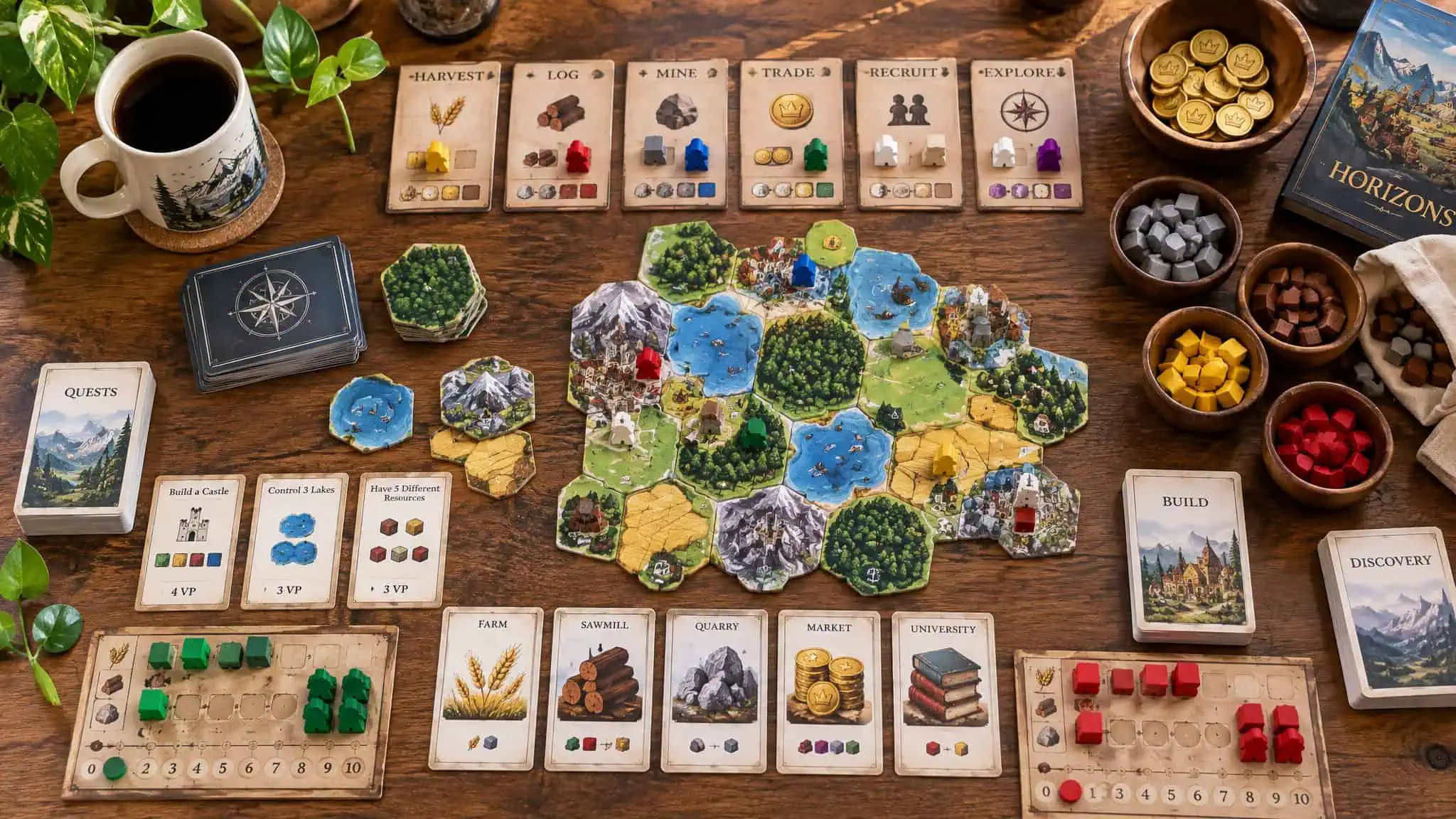
Action points
You get a budget of action points each turn, and you spend them on moving, drawing cards, collecting money. It’s a resource-allocation puzzle every single turn, which is exactly why it’s one of the most recognizable mechanics in the box. You’ve felt this one even if you never knew its name.
Alignment
Alignment encodes moral or ethical orientation (good vs. evil), but the clever part is mechanical, not philosophical: it can gate other mechanics on or off. In Shin Megami Tensei: Strange Journey Redux, your alignment decides which demons you can recruit. In KOTOR II, light- and dark-side players get different bonuses to attacks, healing, and speed. That’s alignment doing actual mechanical work, not just vibes.
Auction and bidding
Players compete with bids to win the right to act, and payment comes in two flavors: an actual game resource, like the bidding in Ra, or a promise of a future outcome with a penalty for failing, which is how contract bridge works. The second form is the weird-cool one. You’re wagering your own future performance, and the game holds you to it.
Movement
Movement governs how and when tokens move, and it defines how a game physically feels. Grid boards with equal areas, adjacency rules, dice for random movement: that’s the classic setup, rooted in the four elements of game mechanics. Miniatures games ditch marked areas entirely and go with free-form measurement, which changes the texture of play completely.
Resource management
Anything countable is a resource: tokens, money, land, people, points. Players assign relative value based on the game state and what winning requires, and the rules govern gaining, spending, and exchanging. This is where skill actually shows, because valuation under pressure is the whole game.
Set collection
Gathering matched sets of items. This one’s short, but it quietly powers other mechanics, most notably crafting.
Tile-laying
Tiles tessellate into mechanically significant combinations, often drawn at random, so you’re balancing luck against placement strategy. Two flavors: tiles that score directly, like Scrabble, and tiles that build the board itself, like the jungle tiles in Tikal.
Turns
The heartbeat of most games. Four structures: player turns (one player at a time, Monopoly, chess), game turns (everyone contributes to a single shared turn), combined (Civilization pairs player turns with an all-player trading round), and semi-simultaneous, where you can act on someone else’s turn. That last one is the “wait, I can do things when it’s not my turn?” mechanic, and it changes a game’s feel entirely.
Victory conditions
What “winning” even means. High score, quest completion, skill training in business games (the odd one out, but there it is). Loss conditions count too: checkmate, getting tagged. Conditions can stack.
And tabletop RPGs and sandboxes often skip victory conditions entirely, which is a feature, not a bug. No win screen required.
Modes
A game mode is a distinct configuration that changes gameplay and how other mechanics behave. Single vs. multiplayer, sandbox, Time Attack. Modes can restrict tools, alter rules (altered gravity, win-at-first-touch, face-up cards), or change the goal. Mid-game mode shifts can raise difficulty or reward success, which is the dynamic-difficulty angle. And power-ups are just short-lived modes: Pac-Man’s power pellets flip the predator/prey relationship for a few seconds, and it’s still the perfect example.
Catch-up mechanisms
Rubber-banding for fairness. These make progress harder for the leader so trailing players stay in it. Catan’s robber hobbles resource generation and naturally lands on whoever’s winning, which everyone has felt. And Chutes and Ladders demands the exact roll to finish; overshoot and your turn is wasted. The cruelest catch-up mechanic in the nursery, no contest.
Crafting
Crafting turns loot into possibility, and it’s everywhere: Minecraft, Palworld, Divinity: Original Sin, Stardew Valley, D&D, Mystic Vale. Underneath, it’s set collection: gather specific items, transform them. That dependency is not a coincidence, it’s the architecture.
Engine building
The mechanic people fall in love with. Adams and Dormans (pp. 311-313) define it as building and optimizing a system that generates a resource flow, a virtuous circle of increasingly productive turns. It also helps to keep mechanics and gameplay distinct, since one is the rules and the other the emergent experience. SimCity is the classic: money activates building mechanisms that unlock feedback loops among people, jobs, power, transport, and zones. Walk the loop once and it just clicks.
Risk and reward
Optional actions weigh risk against reward. Beowulf: The Legend nails the form: take a Risk, succeed and get cards; fail and take a “scratch,” a minor wound that can quietly sink your win. More on the math of risk below.
Capture mechanics: going one mechanic deep
Here’s the depth move the listicles never make: take one “simple” mechanic, capture, and watch it branch into a dozen named variants.
Displacement, where you move onto a piece’s square (chess, pachisi). Jump or leap (draughts). Custodian capture, sandwiching a piece between two of yours (tafl). Withdrawal, capturing by moving away (fanorona).
Enclosure (Go). Declared attacks (Stratego, Illuminati). Plus push, flying capture, intervention, and card/resource-based capture. One verb, twelve flavors.
And capture has three possible fates. The piece can be permanently removed (chess), returned to play (backgammon, pachisi), or converted to your side, which happens in Shogi, Reversi, and Illuminati and is honestly the delightful one. Your dead piece just switched teams.
Video games translate all of this into kill counts and “frags.” Same mechanic, new century.
Chance and fairness: dice curves and risk mechanics
A single die produces a linear probability distribution, while the sum of two or more dice produces a bell curve, and the more dice you add, the steeper it gets and the rarer the extreme results become. Players feel that difference. Linear curves read as “swingy.” Bell curves read as “fair.”
Which means curve shape is a design statement about how fair you want the game to feel, not just a math choice. Neither one is objectively better; a swingy curve can be exactly the right tension for a game about desperate gambles. But if a game feels unfair and you can’t articulate why, count the dice.
On top of randomness, press-your-luck mechanics stack choice. That’s the Beowulf: The Legend move again: the Risk is optional, and the “scratch” minor wound is the price of failure. The randomness is fixed; the gamble is yours.
More broadly, mechanics act as constraints and supports that promote play, fairness, engagement, and focus. Constraints as the feature, not the limit.
Field note: If a game keeps feeling unfair and you can’t say why, count the dice in its core rolls before blaming the design.
Worker placement: a mechanic with a traceable history
Worker placement allocates a limited number of worker tokens to stations providing defined actions, and the scarcity is the whole tension: every spot you take is a spot someone else can’t.
It has a genealogy, too. Keydom released in 1998 and originated the mechanic (it was later remade as Aladdin’s Dragons), per Stewart Woods. Caylus released in 2005 and popularized it. Then Stone Age and Agricola made it a Eurogame staple. Adams and Dormans point to StarCraft’s SCV task assignment as the RTS version of the same idea, cardboard to screen, and honestly a fun bridge.
The takeaway: mechanics have traceable histories. They’re evolving culture, not timeless categories. Someone invented “grabbing a spot first,” and it became a genre.
How mechanics interact: compound systems, not isolated parts
Mechanics don’t live alone, and the interactions are where complexity comes from. Crafting presupposes set collection. Modes rewrite other mechanics’ rules. And mixing simple mechanics produces emergent behavior: take Turn + Point spend + Counter, so that turns cost points earned by a counter.
Three boring words, one interesting game. Imagine what a fourth word does.
There’s also staged progression: new mechanics entering play over time, either for the players (skill growth) or the world (difficulty modes).
Here’s the underrated design question, posed directly: what can the NPCs, the creatures, and the world do mechanically, not just the player? Choices should have mechanical teeth. 13th Age reifies your character’s background into customizable stats up to a cap, which is a choice with real teeth.
One boundary to keep straight: mechanics aren’t games, and they aren’t design principles. What, how, and why are separate considerations.
Modern case studies: mechanics as tuned systems
The same mechanic on paper plays completely differently depending on tuning. Parameters, not labels, are where a game’s identity lives. The numbers make this vivid.
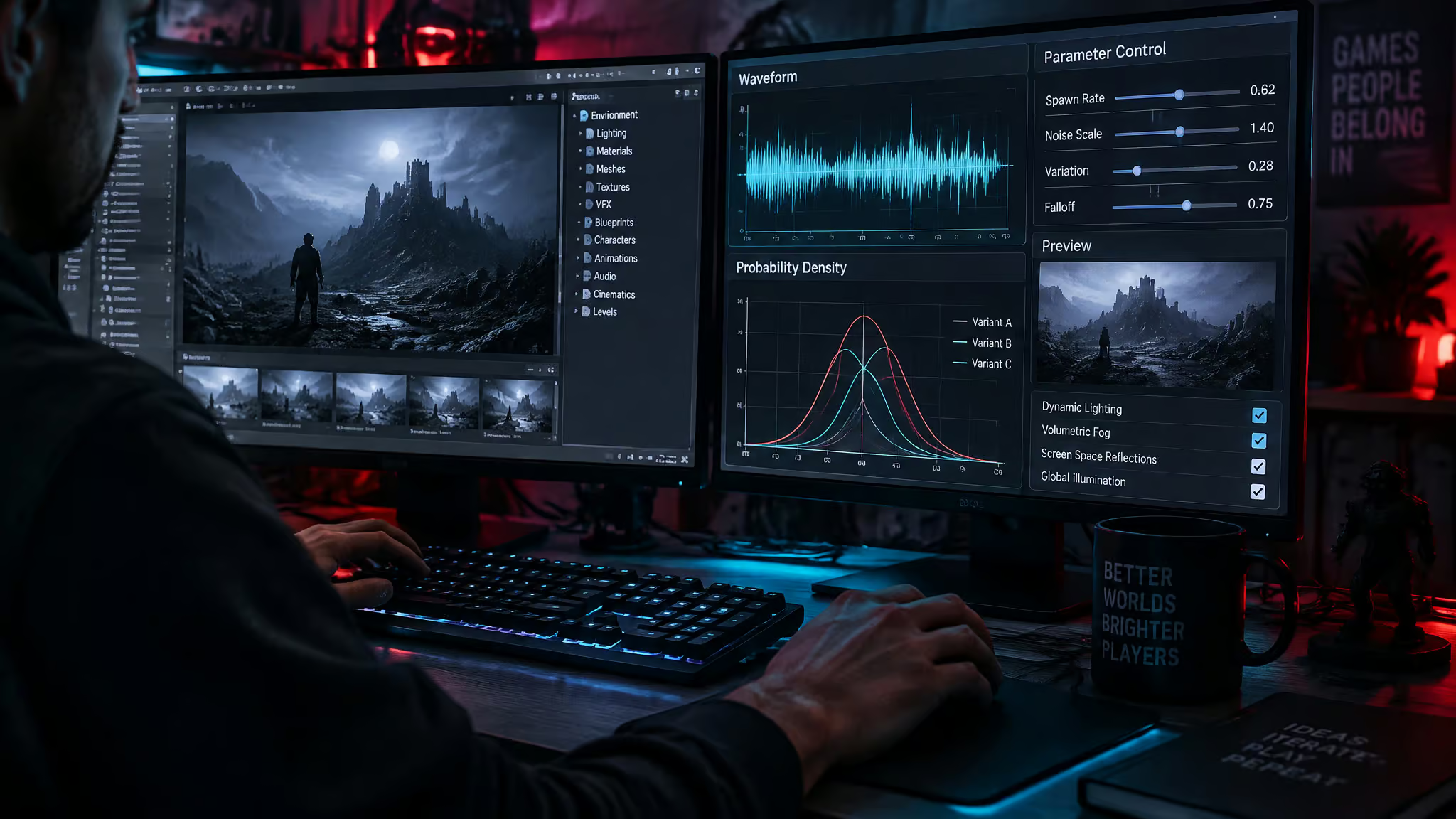
Hades II triggers its next enemy waves at roughly 50%, 70%, or 90% of enemies killed, varying hand-tuned per encounter, per third-party data logging (analysis, not developer statements). Someone sat with each fight and tuned it. I Am Your Beast shaves 0.3 seconds off mission time per kill (1 second for headshots), with bonuses for knife, explosion, beehive, and bear trap kills, and C-to-A rank tiers gate missions. Ghost Trick gives you a 4-minute rewind window before death; the tight window is what makes it tense and fair. Bag of Dreams turns leftover end-of-round red into nightmare fuel that persists across rounds, and exceeding a threshold of 85 adds unremovable terror cards.
Design rationales get even better. Inscryption’s death cards let you build a card from cost, health, damage, and one of three random deck abilities, so losing becomes authorship. Slay the Spire 2’s co-op card play, where players act at the same time, forces actual table talk. Paradise Killer lets you accuse almost anyone at almost any time, which is trust as a mechanic.
Doom the Dark Ages codes dodge-red/parry-green, and its three-laser fan alternates a parryable laser that forces you to move toward the bullets. Mirror’s Edge preserves momentum via rolls, slides, wall runs, and vaults; the whole game is about not breaking your flow. Baby Steps makes walking hard on purpose: left stick sets direction, triggers lift each leg, classic friction-as-design.
And implementation quality beats novelty. Red Dead Redemption’s cover system is polished, not new. Donkey Kong Bananza’s destruction is woven into every boss, enemy, and puzzle. Mouthwashing makes a single walking animation pull double duty as a horror device and a dev time-saver. All of this comes from the “66 Minutes of Cool Game Mechanics” video analysis, which covers 60+ mechanics across 60 games and is worth falling into if this section hooked you.
Bottom line: When two games share a mechanic, compare the numbers — thresholds, timers, and payouts — because that’s where the identity actually lives.
Tabletop RPG mechanics that cross media
The boundary between tabletop and video game mechanics is porous. PbtA games award XP on failure (fail forward). D&D has DM-granted inspiration and advantage/disadvantage. D20 Modern uses wealth checks. 13th Age turns backgrounds into stats.
And Call of Cthulhu and Darkest Dungeon model sanity and trauma. Persona translates real-world social skills into dream-world magic. And Metal Gear Solid made you plug your controller into a different port to beat a boss, physical control-transfer as a mechanic. It’s still delightful.
Why game mechanics make or break games
The answer is purposeful selection and audience fit, not novelty. The value of a mechanic comes from how well it’s chosen, how well it’s implemented, and how well it fits the game’s identity.
Jesse Schell puts it best in The Art of Game Design (2015, p116): You must know what your audience likes and does not like. You must know it better than they do. Hard-won advice, translated: do your homework on who’s actually playing.
Mechanics can foster fairness, motivation, exploration, learning, skill building, and focus. Educational design gets this exactly backwards from how marketing does: you pick the game for the content, not the other way around. The CTL guidance makes that point plainly, and Arnab et al. (2015) mapped parallels between successful game design and course building in the British Journal of Educational Technology (46(2), 391-411, doi:10.1111/bjet.12113). The research backs the instinct.
And the failure mode is real: a mechanic can be well-defined but badly tuned or mismatched to its audience. Diagnosing that starts with the Schell test.
Live case, carefully framed: per BlizzCon 2026 announcement coverage, Diablo V is claimed to experiment with Diablo II-style itemization in a game dated for 2029, meaning runes, runewords, and deep crafting, with safe towns replaced by caravans and unstable procedural terrain. Whether or not any of that ships, it’s the industry actively betting on itemization nostalgia as a mechanic choice right now, and that alone tells you the parameter-level argument is very much alive.
Where taxonomies break down, and where to go deeper
The standard categories start failing when mechanics emerge around accessibility, mindfulness, introspection, empathy, hybrid play, and identity. That’s not a settled takedown, it’s one practitioner’s open question: the author of a mechanics table with more than 46 entries (updated March 7, 2026, by someone with 20+ years in product design) doubts whether Adams and Dormans’ five categories actually cover those areas. That’s the interesting part. The map may no longer cover the territory.
If you want to go deeper, the browsable references are Building Blocks of Tabletop Game Design, Game Mechanics: Advanced Game Design, The Art of Game Design, and the big mechanics list itself, which is more reference than required reading. There are also dedicated deep-dives on iconic mechanics from real games and a categorized mechanics encyclopedia if you want the full catalog treatment.
To restate the core definition one more time, compactly: game mechanics are the rules or ludemes that shape player actions and the game’s response to them, where a rule tells you how to play and a ludeme is a unit of play. The rulebook and the lived system are genuinely different things, and the argument about which one “mechanics” means is the whole reason the field can’t agree on a definition.
So here’s the contrarian takeaway, earned: novelty is overrated. Parameters and audience fit are where a game’s identity lives. Everything else is skin.
Frequently Asked Questions
How are game mechanics different from a game’s theme?
Mechanics are the underlying systems; theme is the skin on top. Mechanically similar games can wear wildly different themes — scratch cards share a “reveal and match” core with countless themes yet feel nothing like Monopoly. Go proves the two are separate axes entirely: it has no theme at all, because the action represents nothing.
What is ludonarrative dissonance?
Ludonarrative dissonance names tension between a game’s mechanics and its themes. Clint Hocking coined the term in an October 7, 2007 analysis of BioShock, where the game’s mechanics were fighting its themes. It gets thrown around as a synonym for “bad storytelling” now, but it really just describes mechanics-theme friction.