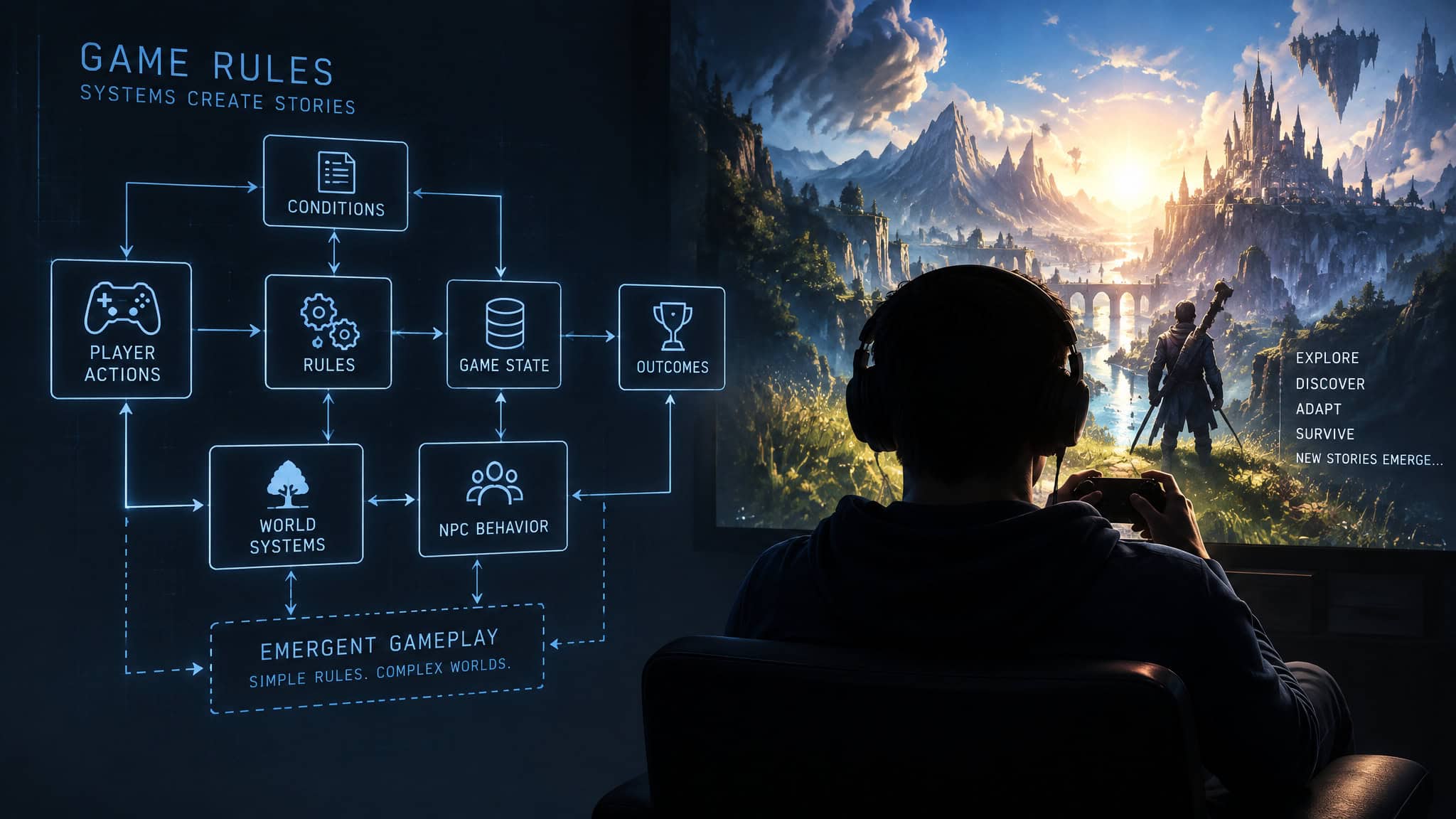
I went looking for a quick answer to what I thought was a dumb question, and it turned into a proper rabbit hole. Because here’s the thing: people use “mechanics” and “gameplay” interchangeably in forum arguments, and it turns out they shouldn’t, mostly. The working line I’ll defend here: mechanics are the rules and systems; gameplay is the experience that emerges when you play with those rules. And the proof isn’t a definition, it’s pairs of games like Command & Conquer and Total Annihilation, which share a mechanic and produce wildly different play. That’s the difference, and it’s real.
Key Takeaways
Game mechanics are the rules and systems of a game; gameplay is what emerges when a player interacts with them, and game studies has never agreed on one definition of “mechanics.”
The same mechanic produces different gameplay under different rules: resource collection in Command & Conquer (unit-based) versus Total Annihilation (automatic per-second income), or cover as the star of Gears of War versus a helper in GTA IV.
The distinction is a useful convention, not settled canon. Scholars, working developers, and popular web sources each use the words differently, and the boundary has honest grey areas, including Sicart’s own admitted rules-versus-mechanics problem.
Table of contents
Table of Contents
Game mechanics vs gameplay: the short answer
Game mechanics are the rules and systems a game is built from; gameplay is the experience that emerges when a player interacts with those rules. That’s the formulation this article adopts, and it’s worth being upfront that it’s a convention, not a fact the field has settled. Game studies has never agreed on a single definition of “mechanics,” which is part of why the forum arguments never end.
Here’s the compact version before we go deeper:
| Definition | Who it belongs to | Attributed framing | |
|---|---|---|---|
| Mechanics | Rules/ludemes governing actions | What designers build | Sicart: methods invoked by agents |
| Gameplay | Interactive process of play | What players experience | Fabricatore: what the player can do and what entities do in response |
Three camps explain why sources disagree. Scholars distinguish the two terms carefully. Working developers, at least per the Ask a Game Dev blog, treat gameplay as the aggregate of all the systems running together. And popular usage just merges them; gamedesigning.org literally defines gameplay as the core mechanics. So when you hit the next forum argument, know that all three usages are live at once.
What game mechanics are, and why no one agrees on a definition
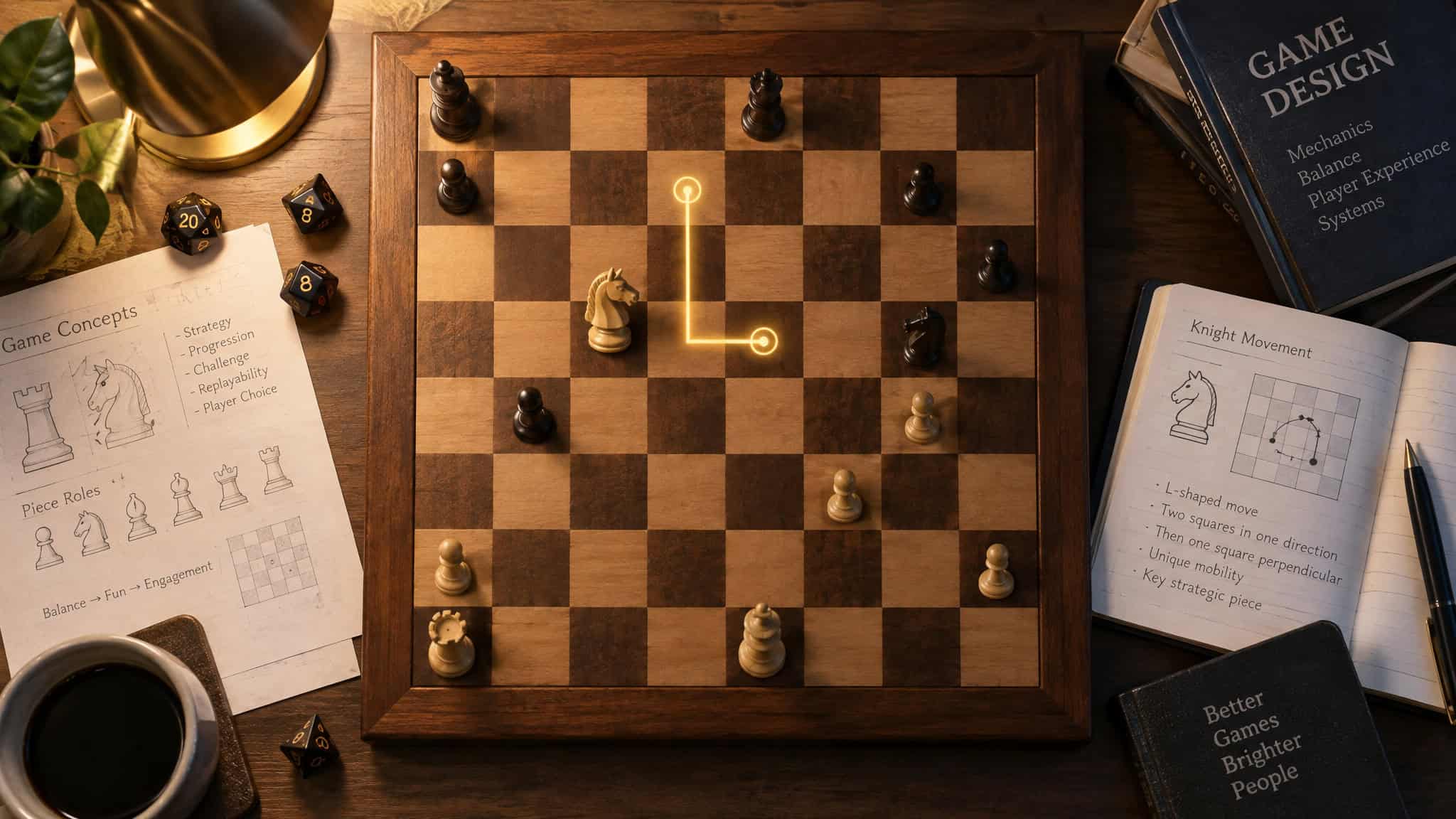
Game mechanics are the rules or ludemes that govern player actions and a game’s response to them. Yes, “ludeme.” It’s my favorite new vocabulary word: a rule is an instruction on how to play, while a ludeme is an element of play. The chess knight’s L-shaped move is the textbook example. It’s not an instruction so much as a chunk of play itself, and honestly the term is tidier than anything else in this field.
Common examples land fast: turn-taking, token movement, set collection, bidding, capture, resource management. D&D spell slots are a great one, a resource management mechanic where casting a spell spends a limited pool and a long rest refills it. If you’ve built systems, you already feel the shape of this.
But here’s the part nobody tells you: there’s no consensus definition of “mechanics.” None. The discourse is genuinely alive. Three competing takes float around: mechanics as systems of player-game interaction, as rules and procedures guiding play, or as only the things that actually impact the play experience.
Sicart, whose own definition we’ll get to, surveyed the field before building his, and the roll call is a fun one. Avedon in 1971 called mechanics a “procedure for action.” Lundgren and Björk in 2003 defined them as rule-system parts covering exactly one kind of interaction. Rouse, writing in 2005, said mechanics are “the guts of a design document,” which is a fantastic phrase.
Fullerton, Hoffman and Swain framed game procedures as the actions and methods of play the rules allow. Cook described rule-based systems for exploring a possibility space via feedback, and “possibility space” is vocabulary every systems person should steal. And the MDA framework, Hunicke, LeBlanc and Zubek’s 2004 classic, puts mechanics at the level of data representations and algorithms. If you know MDA already, treat it as an old friend; I’m not re-teaching it.
Sicart’s definition, and why devs will like it
Miguel Sicart’s formal definition, from his 2008 paper “Defining Game Mechanics,” is the deep cut this whole survey was building toward: mechanics are the methods invoked by agents, designed for interaction with the game state. If you’ve written object-oriented code, this lands instantly, methods invoked on objects. That’s the point, and it’s also the nuance: the OOP language is an analytical metaphor, not a claim that game logic literally looks like your Java class hierarchy. The definition’s neat trick is that “agents” covers human players and AI alike, which will matter later. And Sicart’s stated goal was connecting mechanics to input procedures and player emotions, the button to the feeling. It’s also the endpoint of a survey that included Järvinen’s take, mechanics as plan constraints describable with verbs, which honestly kind of elegant in how it frames what a mechanic lets you do.
Say it plainly: adopting his definition is choosing a rigorous working tool, not discovering canon. Before building his own, he surveyed every one of those prior definitions, which is exactly what a good maker does: read the existing implementations first.
What gameplay is: three communities, three definitions
Gameplay is the interactive process where a player engages with a game’s design; different communities use the word at three different levels. That’s the actual resolution to the terminology fight: the camps aren’t arguing about facts, they’re using one word at three scopes.
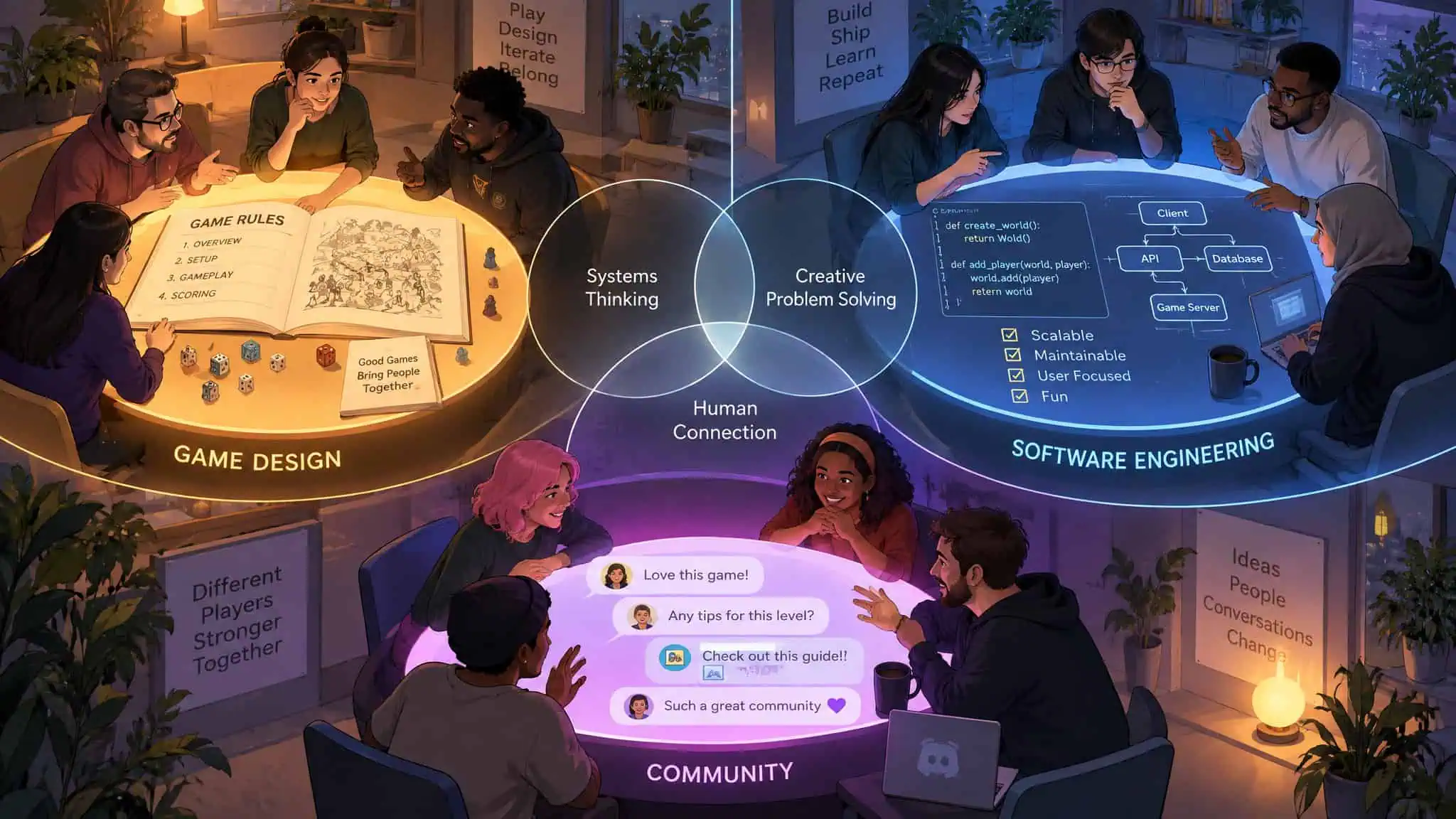
The scholarly layer first. In 2009 playability research, Nacke, Drachen, Kuikkaniemi and colleagues define gameplay as the interactive gaming process between player and game: gameplay is what happens while you play. Lindley, Nacke and Sennersten, in 2008, add that your brain is doing real work in there, framing gameplay as cognitive tasks performed against a game design. Fabricatore’s definition is the one I keep coming back to because it’s almost API-shaped: gameplay is what the player can do, plus what everything else in the game does in response. Requests and responses, at human scale.
Adams and Rollings round it out with gameplay as causally linked chains of challenges in a simulated environment, and they’re explicit that gameplay isn’t one thing. It’s a synergy of many elements, which is exactly why a good build feels better than the sum of its parts.
How developers use the words
The Ask a Game Dev framing is the practitioner’s answer, and it’s very codebase-shaped: mechanics are individually owned systems, gameplay is all of them running together, the kind of breakdown you’d find in a comprehensive encyclopedia of game mechanics. Modules versus the running product. It’s not claiming to be the correct definition, but it’s the one that matches how teams actually talk.
Why the terms get merged
Popular usage elides the distinction, and gamedesigning.org’s definition of gameplay as the core mechanics is the cleanest specimen, the internet flattens terms, and that’s not stupidity, it’s just how language works. There’s also a recurring pattern in review threads worth naming: someone pans “the gameplay” while actually describing one building block of game mechanics, the combat, the crafting, the traversal. The tell is one mechanic standing in for the whole. And there’s a spicier personal take floating around from a video creator I’ll credit but not adopt: gameplay as illusion, where what you feel you’re doing (dodge, parry, slay) differs from the literal mechanics underneath, combat being click-to-reduce-HP math plus XP milestones, inventory being block-tetris. Demystifying, but in the fun way.
Same mechanic, different games: proof the distinction is real
Yes. Same mechanic, different governing rules, completely different play, and this is the empirical heart of the article. Three pairs, no filler.
Resources. Command & Conquer and Total Annihilation both do resource collection, but C&C uses unit-based collection while Total Annihilation generates income automatically per second, forcing you to balance your spend rate against generation rate. The implementation detail is the whole difference, and it produces two very different games. Neither is the “better gameplay”; they’re different emergent results from the same mechanic label.
Cover. The cover mechanic is primary in Gears of War, which popularized it from kill.switch (2003), and merely secondary in GTA IV. Same mechanic, flipped role. Watch out for the classic error here: classifying a mechanic by its label rather than its role in that specific game.
Capture. One goal, six rule implementations: displacement capture in chess, jump capture in draughts, custodian capture in tafl, withdrawal capture in fanorona, enclosure in Go, and conversion in Shogi and Reversi. You thought capture was one thing. It’s a family.
The landing point: the mechanic label alone tells you almost nothing. Reading a game straight off its mechanic list is a category error, the way judging a codebase by its directory names would be.
Why the distinction matters: design work vs critique work
Designers tune mechanics toward a felt experience, Rez‘s hold-and-release being the cleanest case, and this is where the two jobs split. Design work is tuning systems, building on frameworks like the four elements of game mechanics, while critique work is judging the experience those systems produce.

The proof is a genuinely elegant trio. Shadow of the Colossus (2005) has the charging stab. Rez (2002) has the hold-and-release: lock the crosshair onto up to 8 enemies while holding, then fire, and that held tension before release is the entire emotional engine of the game. Every Extend Extra (2006) twists timed explosion chains into the same shape.
Three different games, three different core actions, one pattern: tension and release, aimed at awe, powerlessness, and epic achievement respectively. Mechanic design tied directly to intended feeling.
Critique work has its own named case: ludonarrative dissonance, when mechanics and story fight. Clint Hocking coined it in his 2007 critique of BioShock, and Eric Swain defended the concept in 2010. There’s also a hedged pattern worth noting: prototypes where one mechanic is individually fun but degrades the aggregate. The iLogos guidance is practical and testable: the psychology of game design mechanics suggests mechanics should be intuitive, feedback-rich, reward mastery, and be balanced against dominant strategies, and you tune the main systems first. The verdict I’d actually use: name the system when you’re designing, name the experience when you’re critiquing.
Quick test: In a review, name the specific system. In a design doc, name the feeling the system is tuned to produce.
The second axis: mechanics vs theme
Mechanics aren’t theme, and that’s a second axis entirely. Monopoly‘s events represent buying and selling property; the theme is a coat of paint over the mechanics. Go is the purest specimen here: an abstract game of territory where nothing on the board represents anything, and it works perfectly fine, which proves mechanics can stand alone. Reskinning is real, and if you’ve ever browsed modding communities you’ve watched the same engine wear different skins.
The implication is sharp: if mechanically similar games can be thematically different, and vice versa, then mechanics don’t determine theme. And if they don’t determine theme, they certainly can’t be collapsed into the felt experience of play. When mechanics and story do fight, that tension has a name, and it’s the one we just met: ludonarrative dissonance, Hocking’s term, Swain’s defense.
Where the boundary blurs: honest edge cases
The distinction matters most when you know where it fails. Two edges are worth respecting rather than papering over.
The rules-mechanics grey area
Rules are modeled after agency: they define what’s allowed, the normative possibility space. Mechanics are modeled for agency: what you actually do to the game state, the performative interaction. That after/for contrast sounds clean until you try to apply it, and here’s the honest part: Sicart himself calls this the biggest unresolved grey area in his own framework. The guy who wrote the definition shrugs here. That’s not a flaw in the article; that’s the field’s actual state.
Goalless games and toyplay
Sicart’s definition leans on systemically rewarded end states, and goalless games stress it. SimCity (Maxis, 1989) settles into an equilibrium and EverQuest‘s level cap acts as a desired state the system rewards, but SimCity and Crackdown (RealTime Worlds, 2007) both encourage action with no in-game goals, which challenges any goal-dependent definition of mechanics. Then there’s gameplay versus toyplay, which might be my favorite distinction in the whole stack. Bateman and Boon noted in 2006 that mechanics built for gameplay get repurposed as toyplay, playing with the thing rather than playing to win.
Shadow of the Colossus climbing is the canonical example: you’ll scale a random cliff just because the climbing is good, well beyond any goal the game set. And Sicart’s definition extends to AI agents invoking mechanics too, which sounds academic until you remember MMORPG bots wrecking server economies. Every MMO player carries that wound.
The thesis survives all of this as a functional tool, not a law.
How mechanics layer into gameplay: core, primary, and secondary
Core, primary, and secondary mechanics describe how much a given mechanic contributes to the play of a game, but two frameworks define the tiers differently, and keeping them separate is half the value here.
Sicart’s framing: primary mechanics are readily available and consistent throughout play, like GTA IV‘s shooting and driving. Secondary mechanics ease interaction but show up occasionally or in combination, like GTA IV‘s cover system. Under that framework, Salen and Zimmerman’s Rules of Play defines core mechanics as the essential repeated play activity, the thing you do again and again, and Sicart reformulates core mechanics as those repeatedly used to reach a systemically rewarded end state, with goalless games extending that to desired states.
The iLogos taxonomy is different, and it’s theirs, not a synonym: core mechanics define a game’s identity (think CoD shooting, Mario jumping), primary mechanics are used readily throughout (Minecraft resource gathering), and secondary ones are occasional (Stardew Valley fishing).
| Tier | Sicart framing | iLogos framing |
|---|---|---|
| Core | Repeatedly used toward a systemically rewarded end state | Identity-defining (CoD shooting, Mario jumping) |
| Primary | Consistently available (GTA IV shooting/driving) | Used throughout (Minecraft gathering) |
| Secondary | Occasional or combinational (GTA IV cover) | Occasional (Stardew Valley fishing) |
And the tier a mechanic occupies isn’t fixed: cover is primary in Gears of War and secondary in GTA IV. Context decides. When systems do click together, you get the good stuff: Breath of the Wild‘s physics and chemistry, Minecraft redstone, Super Mario 64 momentum boosts, Dwarf Fortress stories. There’s an input-mapping angle too.
Wario Ware maps a pile of mechanics to one button. Orbital, part of Nintendo’s Bit Generations collection of seven games from summer 2006, goes the opposite way with exactly two mechanics (attract and repel) to two GBA buttons. Assassin’s Creed went contextual instead: one button, context decides the action.
Examples of game mechanics: a sourced catalog, not a top-10
Common game mechanics include turn-taking, capture, set collection, bidding, resource management, and worker placement, and the best-organized version comes from scholars rather than a flat list. The reference here is Engelstein and Shalev’s Building Blocks of Tabletop Game Design (2020, CRC Press), which sorts mechanisms into categories like game structure, turn order, and actions; resolution, victory conditions, uncertainty, and economics; auctions, worker placement, movement, and area control; set collection; and card mechanisms, and is explicit that it’s not a strict or complete taxonomy. If you want a deeper system-level walkthrough, we’ve got a separate deep-dive into what game mechanics actually are. Here’s the catalog, with the one interesting fact each entry earns:
- Worker placement. Limited worker tokens go to stations that grant defined actions; scarcity is the point. The genealogy is traceable: Keydom (1998, identified by Stewart Woods as the first implementation) led to Caylus (2005), which made it a Eurogame staple, then Stone Age and Agricola joined the family. Adams and Dormans even call StarCraft‘s SCV task assignment worker placement, so the mechanic crosses media.
- Engine building. Build and optimize a system that produces a resource flow. SimCity‘s money triggers building mechanisms that open feedback loops across people, jobs, power, transport, and zones; in board games it’s the virtuous circle where each turn’s output powers a bigger next turn.
- Auctions. Resource-paid auctions where the winner pays in game money or points (Ra), versus promise auctions where the winner commits to a future outcome and pays a penalty for missing it (contract bridge).
- Capture. The six-implementation typology from earlier: displacement (chess), jump (draughts), custodian (tafl), withdrawal (fanorona), enclosure (Go), conversion (Shogi, Reversi). Resolution can be deterministic (Stratego) or random, and captured pieces have three fates: gone forever, returned, or converted to your side.
- Risk and reward. Optional actions weighing danger against payoff. Beowulf: The Legend‘s ‘Risk’ action pays out cards on success and hands you a ‘scratch’ wound on failure that undermines your victory chances. Nerve-racking by design.
- Crafting. It’s everywhere once you notice it: Minecraft, Palworld, Divinity: Original Sin, Stardew Valley, D&D tabletop, Mystic Vale. Under the hood it’s set collection wearing a costume: gather ingredients toward a recipe.
- Game modes and power-ups. Modes are config presets for the whole game: sandbox, Time Attack, mid-game rule shifts that change how other mechanics behave. Power-ups are short-lived modes, and Pac-Man‘s power pellet inverts the predator/prey relationship for ten seconds, the whole game flipped by one item.
- Movement, resource management, set collection. The bread-and-butter trio. Movement forks on grid versus free surface; resource management is budgeting as gameplay; set collection is gather matching sets for value.
- Tile-laying. More interesting than it sounds: randomly drawn tiles tessellate into mechanically significant combinations, and the placement either scores directly (Scrabble) or builds the board tokens interact with (Tikal).
- Turns. Player turns (Monopoly, chess), game turns where everyone shares one, Civilization‘s combination of both, and semi-simultaneous turns that let you interrupt someone else’s.
- Victory and losing conditions. Checkmate, getting tagged, high scores, quest completion. Tabletop RPGs and sandboxes often have none, which is its own design choice.
- Catch-up mechanisms. Making progress harder for the leader. Catan‘s robber hobbles resource generation and naturally gets aimed at whoever’s ahead (we’ve all been robber-targeted, it’s fine, we’re all fine), and Chutes and Ladders demands the exact number to finish, overshoot and you lose the turn. Cruel, honestly.
- Action points. A per-turn budget for moving, drawing, collecting. A resource-allocation puzzle in miniature.
- Alignment. The moral dial, which gates other mechanics rather than just flavoring them: SMT: Strange Journey Redux demon recruitment, KOTOR II‘s light/dark bonuses to attacks, healing, and speed.
One design nugget that explains a feeling: one die gives a flat linear distribution, which the community calls swingy. Summed dice give a bell curve; more dice steepens it, extremes get rare, and it feels fair. The math explains the feeling, which is deeply satisfying.
Two honesty beats while we’re here. First, there’s no source backing the popular “four elements of game mechanics” framing; the closest real taxonomy is Engelstein and Shalev’s, and we’ve unpacked the four-elements framework separately for the curious. Second, you’ll run across “2026 trends” claims like AI-driven dynamic difficulty, procedural generation, destructible environments, player-created mechanics, and cross-platform unified mechanics, attributed to iLogos. Take those with salt. That’s a studio promo, from the same people claiming a 300-plus game portfolio and 3 to 5 mechanic variations prototyped in two weeks. Not verified industry data.
I fell into this rabbit hole expecting a glossary entry and came out with a working toolkit instead, which is usually how the good ones go. Mechanics are the rules and systems; gameplay is what emerges when you play with them; no consensus definition exists and the boundary has honest grey areas that even Sicart acknowledges. What survives the mess is one rule I’d keep pinned: name the system you’re discussing, and the experience you’re judging. Everything else is implementation detail.
Frequently Asked Questions
gameplay vs game mechanics: what’s the actual difference?
Mechanics are what designers build — the rules, systems, and ludemes governing actions. Gameplay is what players experience — the interactive process that emerges from running those systems. A practical test: name the specific system when you’re designing or analyzing structure; name the feeling or experience when you’re critiquing the game.
Why do game developers and players use ‘gameplay’ and ‘mechanics’ interchangeably?
Three camps use the words at different scopes simultaneously. Scholars distinguish the two carefully; working developers (per the Ask a Game Dev framing) treat mechanics as individually owned systems and gameplay as all of them running together; and popular web sources flatly merge them — gamedesigning.org literally defines gameplay as the core mechanics. So the interchangeability isn’t stupidity, it’s three live usages colliding in forum arguments.
What is the difference between game mechanics and a game’s theme?
Mechanics and theme are separate axes. Monopoly’s mechanics represent buying and selling property, but the theme is essentially a coat of paint; Go proves mechanics can stand entirely alone, since nothing on its board represents anything. If mechanically similar games can wear different themes and vice versa, mechanics don’t determine theme — and certainly can’t be collapsed into the felt experience of play.
What is the difference between core, primary, and secondary game mechanics?
The tiers describe how much a mechanic contributes to play, but two frameworks define them differently. In Sicart’s framing, primary mechanics are consistently available throughout play (GTA IV’s shooting and driving) while secondary ones show up occasionally or in combination (GTA IV’s cover); core mechanics are repeatedly used toward a systemically rewarded end state. The iLogos taxonomy instead makes core mechanics identity-defining (CoD shooting, Mario jumping), primary mechanics used throughout (Minecraft gathering), and secondary ones occasional (Stardew Valley fishing). Tier isn’t fixed — context decides.