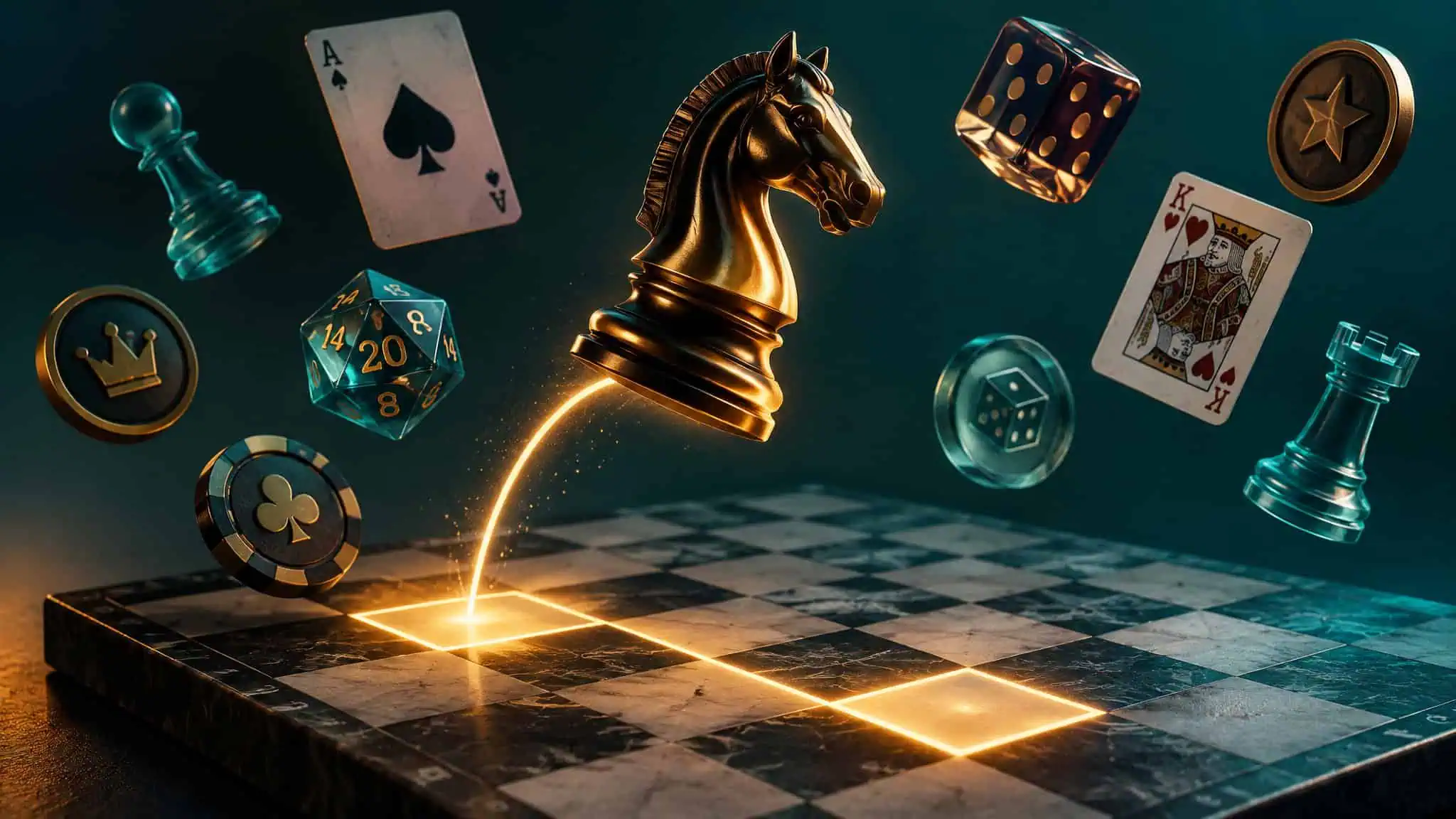
Every mechanics list on the internet claims to be complete, which is funny, because the field itself can’t agree on what counts as a mechanic. There’s no consensus definition. So instead of pretending otherwise, this catalog sorts the known parts into categories and explains why each piece works, naming games that use them well along the way. The best way to start, honestly, is chess: the knight doesn’t move in a straight line, it hops in an L, and that one L-shaped move is the whole personality of the piece.
That’s a mechanic in its purest form, an element of play. Everything below is more of that, organized so you can actually find it.
Key Takeaways
Game mechanics are the rules or “ludemes” governing what players do and how the game responds, and there’s no consensus definition; any list’s boundaries are editorial judgment.
The two big reference taxonomies disagree: Engelstein and Shalev sort tabletop mechanics into 13 categories, while Adams and Dormans use five (physics, internal economy, progression, tactical maneuvering, social interaction), and neither clearly covers accessibility, empathy, or identity.
Implementation beats novelty: Red Dead Redemption’s cover system and Arkham Asylum’s counter combat made “common” mechanics iconic, and Space Invaders’ famous speed-up was a hardware limitation turned into a genre-defining mechanic.
Table of contents
Table of Contents
| Exact model | Decisive documented advantage |
|---|---|
| Action points | Each player gets a budget of action points per turn, spendable on actions like moving pieces, drawing cards, collecting money. |
| Chance and randomization (dice) | Dice randomly determine interaction outcomes, including conflict resolution. |
| Crafting | Crafting depends on set collection: obtaining specific item sets then transforming them. |
| Capture/eliminate | Capture types include replacement/displacement (chess, pachisi), push capture, jump/leap (draughts), flying capture, custodian/interception (tafl), approach, withdrawal |
| Worker placement | Originates with Keydom (1998, per Stewart Woods), popularized by Caylus (2005), became a Eurogame staple (Stone Age, Agricola), applied beyond board games (StarCraft SCV task |
| Alignment | Represents moral/ethical orientation (good vs. evil) in tabletop and video RPGs. |
| Survival | Present in open-world survival games (Minecraft, Palworld), RPGs (Divinity: Original Sin, Stardew Valley), tabletop RPGs (Dungeons & Dragons), deck-building card games (Mystic |
Model details below derive from the cited sources; check the brand pages for current pricing.
What is a game mechanic? Definitions, ludemes, and fuzzy borders
Game mechanics are the rules or ludemes governing what players do and how the game responds. That word, ludeme, is worth keeping: a rule is just an instruction on how to play, while a ludeme is an element of play, and the knight’s L-shaped hop in chess is the classic example. Same game, same board, but the L is the part you’d copy into a different game and it would still feel like chess. It’s also worth knowing what a mechanic isn’t: mechanics are distinct from theme, think Monopoly’s property-trading skin versus the abstract purity of Go, and when the mechanics pull against the theme, that tension is what people call ludonarrative dissonance.
Where does a mechanic stop? Depends who you ask. One definition calls them systems of interactions between the player and the game. Another says rules and procedures that guide the player and the game response.
The loosest version: only those things that impact the play experience. Mechanics also aren’t games, and they aren’t design principles; a list like this won’t tell you what to build or why. That fuzziness is a feature, not a bug. What gets counted in any mechanics list is editorial judgment, so here’s ours, stated upfront.
Game mechanics vs. theme and gameplay
Before sorting mechanics into categories, it helps to clear away two common confusions. Mechanics get lumped in with theme on one side and gameplay on the other, and both smushes hide how these parts actually differ. Here’s the untangling.
Mechanics are not theme
Monopoly dresses up fairly dry property-trading rules in real-estate theme; Go is a pure abstract with no theme at all, and nobody misses it. Same distinction, louder example: ludonarrative dissonance, the term Clint Hocking coined analyzing BioShock, where the story says one thing and the mechanics say another. Chris Swain later defended BioShock against the charge, and there’s no settled verdict; both sides have a point. BioShock Infinite’s raffle scene is the live illustration: three choices, same outcome, different morality on your conscience. The theme said choice, the mechanics said nope.
And mechanics are not gameplay
Fabricatore defines gameplay as what the player can do plus how other entities respond. Adams and Rollings call it causally linked challenges with emergent synergy from many elements, which is the fun definition because it points at emergence. Lindley and colleagues frame it as interacting with a game design while performing cognitive tasks, and Nacke and colleagues split playability (game-side evaluation) from player experience (player-side evaluation). In casual usage, though, most people smush mechanics and gameplay together, and honestly, that’s fine.
We’re untangling them here because precision helps when you’re designing, not because anyone owes an apology at game night. (For the deeper cut, see our mechanics vs. gameplay breakdown.)
How game mechanics are categorized: two taxonomies and their gaps
The core game mechanics fall into a handful of major categories, and the count shifts with whoever is doing the sorting. And that’s not a cop-out; it’s the actual state of the field. Two serious reference works slice the same pie completely differently, and comparing them tells you something about how designers think.

Engelstein and Shalev, in Building Blocks of Tabletop Game Design, sort tabletop mechanisms into 13 categories:
| Category | What lives there |
|---|---|
| Game structure | The overall skeleton of play |
| Turn order | Who acts when, and in what sequence |
| Actions | What players can actually do |
| Resolution | How outcomes get decided |
| Victory conditions | What winning means |
| Uncertainty | Dice, hidden info, chance |
| Economics | Resources and their flows |
| Auctions | Bidding for the right to act |
| Worker placement | Contested action slots |
| Movement | How pieces get around |
| Area control | Holding territory |
| Set collection | Gathering the right combos |
| Card mechanisms | Everything deck-driven |
Adams and Dormans, in Game Mechanics: Advanced Game Design, take a five-way cut aimed at video game design: physics, internal economy, progression mechanisms, tactical maneuvering, and social interaction. Fewer buckets, different lens. Where Engelstein and Shalev sort by mechanism family, Adams and Dormans sort by system behavior, which makes their framework friendlier if you’re thinking in terms of simulations and feedback loops rather than card-driven conflict.
Now the open critique, because both books have a blind spot: neither clearly covers accessibility, mindfulness, introspection, empathy, hybrid play, or identity. Those are live design frontiers, not settled cataloging, and it’s genuinely interesting that the reference texts don’t have shelves for them yet. Games about managing anxiety, or built around empathy, or designed for players with different access needs, don’t slot cleanly into “area control” or “internal economy.”
One honesty note: the categories we use in this article are our own editorial organization, not a third authoritative taxonomy. Where mechanic, component, and mode borders blur, we made a judgment call and drew the line where it seemed most useful. Treat this as a well-organized parts bin, not scripture.
Structure and progression mechanics: turns, action points, victory, modes
The main game mechanics that define the shape of play itself, who acts, what they can spend, what winning means, and how the rules reconfigure mid-game, include action points, alignment (SMT: Strange Journey Redux, KOTOR II), auction/bidding (Ra, contract bridge), crafting, game modes and power-ups, engine building, tile-laying, turn structures, victory and loss conditions, catch-up mechanisms, resource management, and risk/press-your-luck. Pac-Man’s power pellets are the early anchor here, because they preview the whole idea of modes in one bite: a short-lived mode that lets the player eat enemies, and a preview of how modes can restrict tools, alter rules, or change overarching goals mid-game.
Turns
Player turns are the default: one player acts at a time, as in Monopoly or chess. Game turns are the less common sibling, where everyone contributes to one shared turn. Civilization mixes both, running player turns plus an all-player trading round. Semi-simultaneous turns let you act on someone else’s turn, which produces that great “wait, I can react?” moment.
Fair warning: “turn” is an overloaded word. It can mean a sequence, a count, a limit, or a number of rounds, so define it per game.
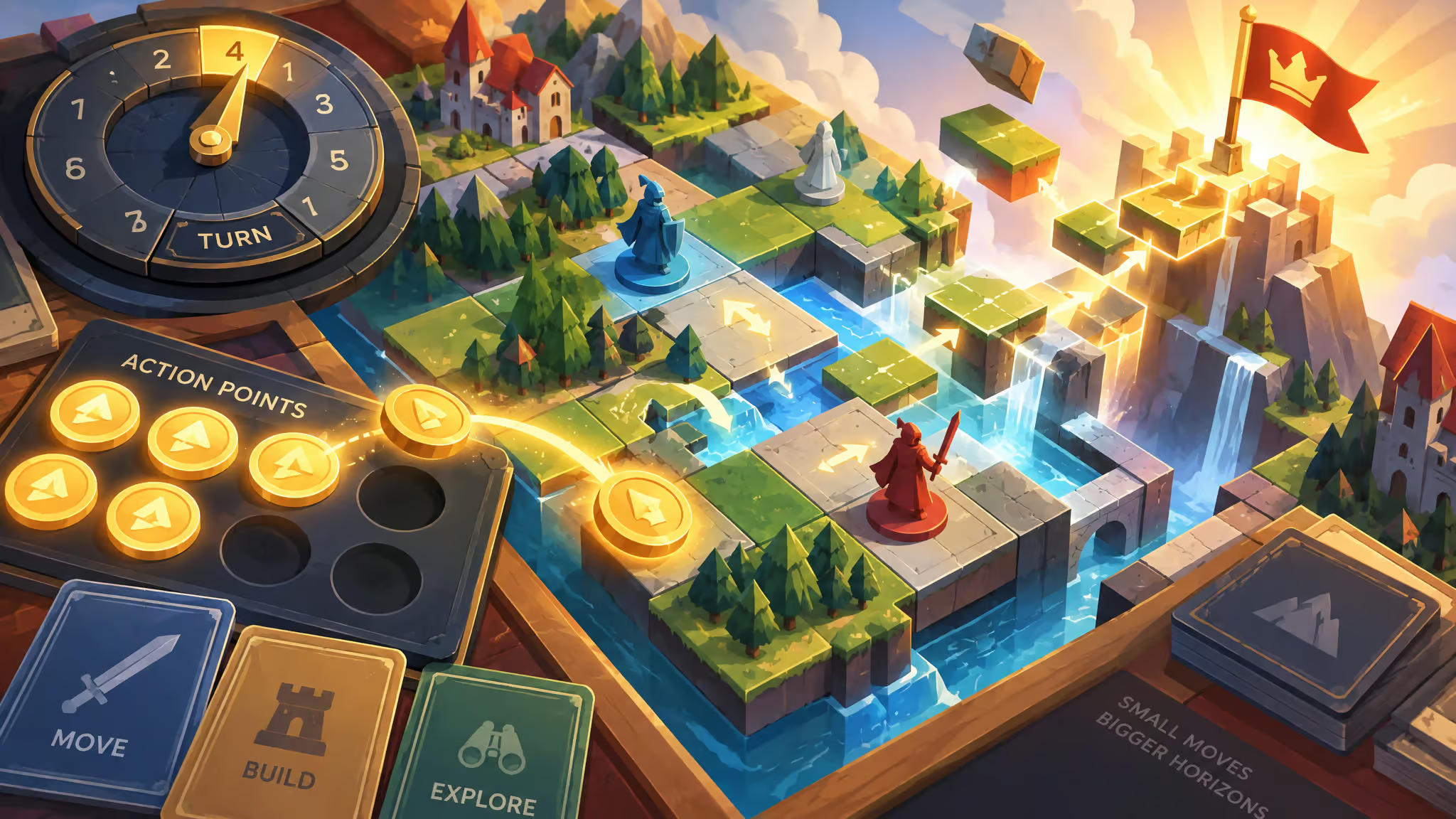
Action points and point spend
Action points give each player a per-turn budget to spend on moving, drawing cards, collecting money, whatever the game allows, and the tension is all in the budgeting. Point spend is really a whole family of mechanics: action points, mana, spell slots. They differ in how points are gained, spent, or lost, but the skeleton is the same.
Victory and loss conditions
Winning can mean a high score, beating an opponent’s score, quest completion in an RPG, or skill training in a business game. Loss conditions are just victory conditions wearing a bad guy costume: checkmate, getting tagged. Games can stack several conditions, and some have none at all. Tabletop RPGs and sandbox games routinely skip the finish line entirely, and that’s a legitimate design choice, not a missing feature.
Game modes and power-ups
A game mode is a distinct setup that alters play and reshapes how other mechanics behave: single vs. multiplayer, co-op, sandbox, Time Attack. Modes can restrict tools, tweak rules like gravity or face-up cards, or swap the goals entirely, and they can flip mid-game to raise difficulty or reward success. Power-ups are short-lived modes, and Pac-Man’s power pellets are the canonical example: eat one and the hunted becomes the hunter for a few precious seconds.
Catch-up and tension mechanics: catch-up, risk, and press your luck
Catch-up mechanics make progress harder for leaders so trailing players still have a shot, keeping the game actually fun for everyone at the table, the kind of engaging gameplay mechanics that separate hits from duds. The clean contrast: Catan’s robber hobbles the leading players’ resource generation, a proper rubber band. Meanwhile Chutes and Ladders hides a brutal one in a kids’ game: you need an exact roll to finish, and miss it and you forfeit the turn. That’s punishment, dressed up as a nursery game, and once you see it you can’t unsee it.
Press-your-luck is the other tension family: an optional action trades danger for reward, pure dopamine mechanics. Beowulf: The Legend nails it. Take a “Risk” and success earns you cards; failure hands you a “scratch” that weakens your victory chances. The optionality is the point. Nobody forces you to draw.
Chance and randomization: dice probability and design reasoning
Dice are the classic uncertainty engine, deciding interaction outcomes including conflict resolution. But the design reasoning is where it gets interesting. One die produces a linear distribution, which players read as “swingy.” Sum two or more dice and you get a bell curve, which players perceive as more fair, and the curve steepens with each die you add.
The luck amount doesn’t change. The shape of the outcomes does.
Playtesting shows it constantly: swap one die for two and complaints shift from “too much luck” to “feels fairer,” even though the randomness is the same. That’s tiny wizardry. The distribution shape changed, the players’ perception changed with it, and nobody had to touch the actual odds of success. If you’ve ever wondered why so many games roll 2d6 instead of d12, this is why.
Economy mechanics: resources, auctions, set collection, crafting, engines, upkeep
Auctions come in two different mechanic families, and the split is the most interesting thing in this whole section. In Ra, you pay with an actual game resource; the bid is concrete and gone. In contract bridge and trick-taking games, your bid is a promised future outcome with a penalty if you fail. Same word, “auction,” two entirely different animals, and the “right to act” framing matters in both.
The rest of the economy shelf:
- Resource management: tokens, money, land, people, points, spell slots. Players assign relative values based on game state and winning conditions, with rules governing gaining, spending, and exchanging. The player is doing valuation math constantly.
- Set collection and crafting: grab the right combos, and crafting inherits that tension always, because crafting is turn-collected-stuff-into-better-stuff. It shows up everywhere: Minecraft, Palworld, Divinity: Original Sin, Stardew Valley, D&D, Mystic Vale. The dependency link is the insight: no set collection, no crafting.
- Engine building: assemble a system that creates a self-reinforcing resource flow. Walk SimCity’s loop and it clicks: money activates buildings that unlock feedback between people, jobs, power, transport, and zones. The board game version is a virtuous circle of increasingly powerful outcomes. Snowballing, done right.
- Upkeep: having a resource requires a resource to maintain it. Population needs food. The tax on everything you own.
Combat, capture, and area mechanics
Capture is the oldest trick in the book, and chess wouldn’t be chess without it. But capture alone has around ten named sub-variants, which is why this section works as a two-level reference rather than a flat list:
- Replacement/displacement: your piece takes the square (chess, pachisi)
- Push: shove a piece out of the way
- Jump/leap: hop over to capture (draughts)
- Flying: capture from a distance
- Custodian: capture by flanking on two sides (tafl)
- Approach: move toward a piece to take it
- Withdrawal: move away to take it (fanorona)
- Intervention: squeeze in between two enemy pieces
- Enclosure: surround space to trap (Go)
- Declared attack: resolve by hidden comparison (Stratego, Illuminati)
Then the three fates of the captured: permanent removal (chess), return to play (backgammon, pachisi), or conversion to the captor’s side (Shogi, Reversi, Illuminati). The conversion twist is the delight point; in Shogi, the piece you took comes back fighting for you, which changes the entire emotional texture of losing a piece.
Video games turn capture into kill counts, the famous “frags”, that’s how tabletop vocabulary became FPS vocabulary. And some mechanics barely exist on the tabletop at all: alignment systems that track your choices (KOTOR II plays with this), crafting that leans on set collection, plus game modes and power-ups. Quick hits from around this section: movement runs from grids with adjacency rules to miniatures’ free-form measurement. Tile-laying comes in two flavors: placement itself scores (Scrabble tiles become words) or tiles build the board for tokens to move across (Tikal). And the Big List adds attrition (threshold triggers when one side has more than the other), control (hold an area for time and something happens), action blocking and modifying, area enclosure, and block (cancel or reduce damage, in whole or in part). Honestly kind of elegant how many ways there are to take a piece: push capture, jump/leap, custodian interception, enclosure, even declared attack via card (Stratego, Illuminati).
Worker placement and mechanic genealogy
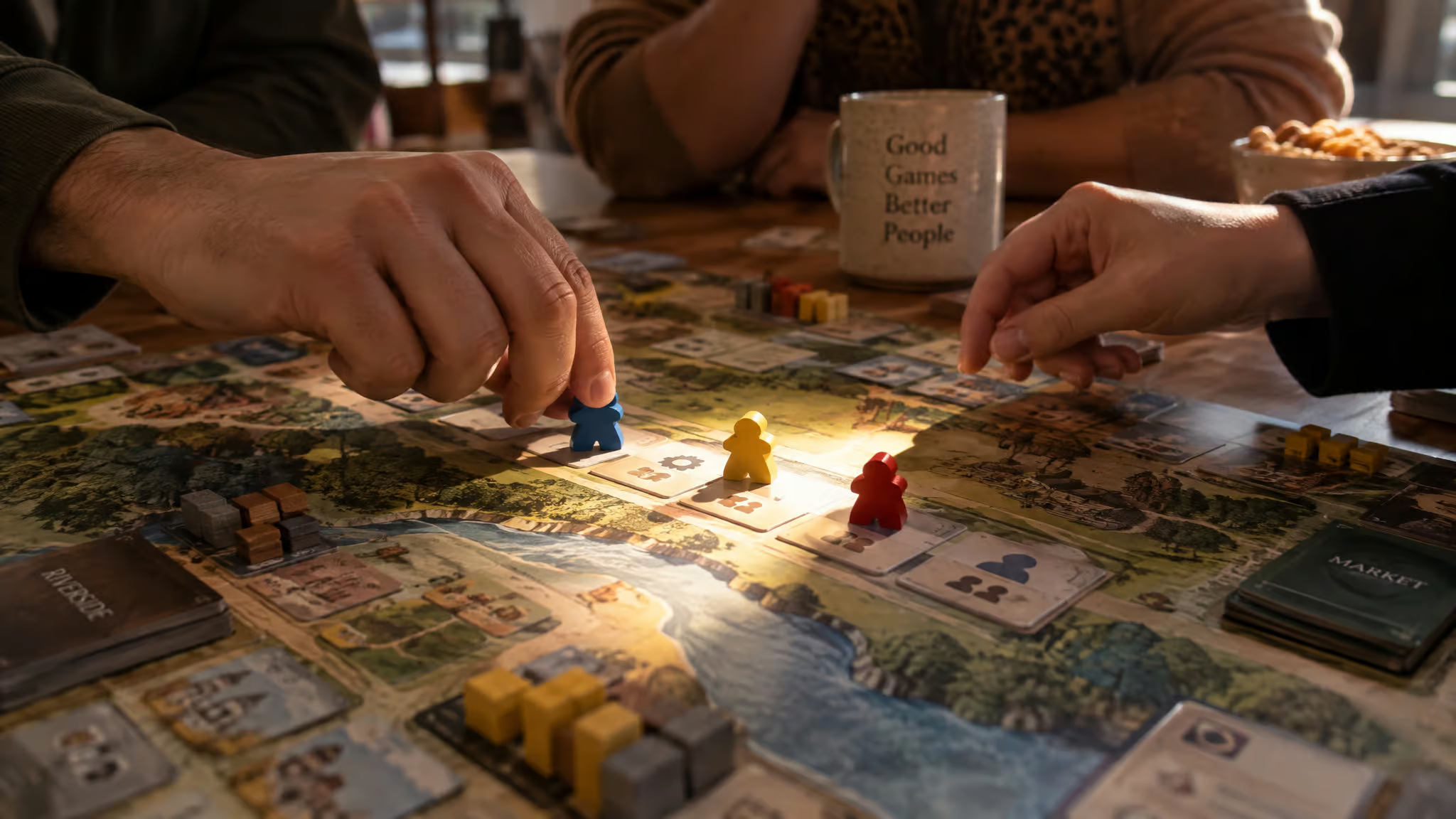
Worker placement is the allocation of limited worker tokens to action stations offering defined actions. Scarcity plus choice. If I take the good spot, you can’t, and the whole game becomes a scheduling puzzle your systems brain will love.
And this one has a genealogy, which most mechanics lists never bother tracing:
- 1998: Keydom does it first (per Stewart Woods)
- Then the Aladdin’s Dragons remake carries the idea forward
- 2005: Caylus popularizes it and the mechanic hits the mainstream
- Stone Age and Agricola turn it into a Eurogame staple
That’s a single mechanic’s lineage across more than 25 years, and it crosses mediums too: Adams and Dormans map worker placement onto StarCraft’s SCV task assignment. Send an SCV to build, and it occupies a slot; the RTS inherited the board game’s scarcity logic. For more genealogies of this kind, our iconic mechanics breakdown digs into how famous mechanics work under the hood.
There’s also a common failure pattern worth naming. Designers copy the surface rule, place a worker, block a spot, without the economy that made the slots scarce and tense in the first place. The borrowed mechanic plays inert. The rule is easy to copy; the pressure behind it isn’t.
Catch-all catalog: 25 more named mechanics from the Big List
The Big List of game mechanics catalogs dozens more, and these deserve names, not just mentions. Grouped by flavor:
Control, dominance, and interaction
- Attrition: things trigger when one side crosses a “more than the other side” threshold.
- Control: hold an area, item, or thing for a while; the waiting is part of the mechanic.
- Action blocking/modifying: performing an action can mutate it or lock others out of it.
- Area enclosure: surround a space to trigger an effect. The Go-adjacent satisfaction.
- Ability trade: give up one mechanic for more of another; the exchange rate is where design lives.
- Block: cancel or reduce a consequence, wholly or partially.
- React: act only when specific conditions fire. It’s basically an if-then at the table.
- Equip: what you wear or wield changes your capabilities, with trade-offs, not just bigger numbers.
- Sacrifice: pay something valuable for a usually temporary gain. Burn HP for a buff, overheat a mech core and risk the explosion.
Failure, retry, and dice extremes
- Fail forward: failure is rewarded or softened to keep momentum; in PbtA games, a failed roll earns small XP. Genuinely kind design.
- Mixed success: outcomes beyond pass/fail, layered as “yes, and” or “no, but.” Improv DNA in dice mechanics.
- Retry/Reroll/Redraw: a second chance, however the game grants it, free, bought, or earned. The cost of a do-over is the interesting part.
- Critical hit/miss: something great on the highest roll, something bad on the lowest. Nat 20 energy, both ends.
- Temporary boost and setback: a one-point bump or penalty to an attribute, or D&D’s advantage and disadvantage (roll two, take the higher or lower).
- Progress clock: a counter fills at set intervals, then something good or bad triggers. Doom-clock tension.
Narrative and choice
- Open world/Railroad: a design dial from fully open to one fixed route, a structural choice, not a moral one.
- Puzzle: progression requires providing the answer; knowledge is the key.
- Split path: pick one of several paths to proceed. Commitment is the mechanic, since you can’t take both.
- Body and world consequence: characters get scars, lose limbs, suffer trauma; the world itself can be damaged and responds.
- Mental health: Call of Cthulhu and Darkest Dungeon track sanity and breakdowns with real consequences, and both handle it with curiosity rather than edginess.
- Retcon: rewrite history mid-game to keep play moving. A pragmatic table tool, not a sin.
- Fortune teller: a mechanic for double-checking what the table knows or getting unstuck. The anti-frustration valve, but hints cost something, which is what makes it a mechanic instead of a help button.
Relationship and social
- Networking: connections provide points, lore, or benefits. Social capital as a mechanical resource.
- Relationships: friendships and their interactions as mechanical structures, same payoff logic as networking with warmer flavor.
- Player reward: incentives for playing well or roleplaying well, like DM-granted inspiration in D&D.
- Time management: juggling clocks and schedules as a resource, cousin to resource management.
Materials and crossovers
- Buying power: money isn’t the only gate. d20 Modern’s wealth checks require more than cash on hand.
- Tactile materials: stacking dice, houses of cards; something happens when they fall. Physical stakes are inherently tense.
- Hybrid rules: borrow mechanics from other game types. A wizard’s spell determined by the poker hand you drew from a limited deck is cursed in the best possible way.
- Fate/Luck: a character’s luck tilts results through dice, cards, or stats. Exploding dice, which keep rolling on max results, are the exemplar.
- Survival: emulating bodily needs: hunger, thirst, sleep, temperature, and yes, happiness.
- Dual and competing mechanics: in dual, progress in one translates to the other, like Persona’s school skills fueling dream-world magic; in competing, raising one stat lowers another. Zero-sum agony.
- Craft: spend earned resources to create useful gear. Not a shop; the earning is the point. It shows up everywhere once you look: Minecraft and Palworld, Divinity: Original Sin and Stardew Valley, Dungeons & Dragons, even Mystic Vale.
Meta and flavor
- Skip/Bypass: dodge areas, story, lore, or content of little or exhausted value. The game respects your time.
- Change/relieve control: someone else takes over your character. Which brings us to the legendary Metal Gear Solid boss you beat by physically moving your controller to the other controller port. Absolute reverence, plus a grin.
- Real-world influence, both directions: sunny weather means d20s, rainy means d12s; and game outcomes can flip your TV channel, change the radio station, blow out a candle, or turn off a light. The boundary dissolves. It’s uncanny and I love it.
- Pet dog: any dog in a game deserves a pet option. Cats and other animals count too. Non-negotiable.
Design tips: combining, pacing, and assigning mechanics
Start from the combination, because mechanics are mix-and-match, LEGO bricks for rules. Take Turn + Point spend + Counter: taking a turn costs points, and a counter accrues them. Now your pacing resource is itself a resource, and the loop feeds itself. Two more bricks worth knowing how to place:
Introduce mechanics progressively
Don’t dump everything at once. New mechanics arriving at set points create difficulty curves and let skill progression do real work. Unlock trees, basically, but said simply: the game teaches itself in stages.
Give mechanics beyond the player
NPCs, creatures, even the environment can carry mechanics, which is what makes choices actually matter. 13th Age does this cleanly: backgrounds reify character choices into stats, up to a cap, so what your character did before the adventure mechanically matters during it. When the world has rules, your decisions have weight.
Social mechanics and player-type design (Bartle taxonomy)
Bartle’s four player types, Socializers, Explorers, Achievers, and Killers, laid out on axes of players-vs-world and interacting-vs-acting, can guide which mechanics you pick. Achievers want points, badges, leaderboards, and boss battles; Explorers want branching choices, open maps, easter eggs, and hidden areas; Socializers want trading, gifting, chatting, and group incentives like Overwatch’s +20% exp bonus; Killers want mechanics that wreck opposing strategies, speed runs like GTA2’s Kill Frenzy, anarchy events, and anonymity like Payday 2’s masks. Immediate caveat: every player is a mix, and components can be rebalanced across types.
- Achiever: points, badges, leaderboards, boss battles. Clash of Clans achievements, the Super Mario flagpole bonus.
- Explorer: branching choices with distinct outcomes, because identical outcomes harm ownership; surface-dependent footprint sound effects; easter eggs that drive word-of-mouth; hidden areas.
- Socializer: trading (win-win even for Achievers), gifting with socially enforced reciprocity like Pokemon Go, Club Penguin’s pre-defined chat, Tower Bloxx friend-ladders, League of Legends ping wheels, and Overwatch’s +20% experience bonus for grouped players.
- Killer: mechanics that wreck opposing strategies, like PUBG and Hearthstone secrets, GTA2’s Kill Frenzy (35 kills in under 60 seconds) and +200% damage anarchy events, and Payday 2’s anonymity masks leaning on the disinhibition effect.
Alignment, consequence, and choice mechanics
Alignment encodes moral or ethical orientation, good vs. evil, and the good versions have teeth: in Shin Megami Tensei: Strange Journey Redux, alignment decides which demons you can recruit, and in Star Wars Knights of the Old Republic II, light and dark alignment grants different attack, healing, and speed bonuses. This family, alongside sanity, fail forward, and mixed success, sits right in that blind spot the taxonomies left open in the categorization section above.
Why the same mechanic succeeds or fails: implementation quality
Here’s the contrarian take, verdict first: implementation beats novelty. Red Dead Redemption’s cover system is a mechanic plenty of games had, but it excels via seamless lock/unlock, a slide-into-cover animation that never breaks flow, and encounter design that actually demands cover. Arkham Asylum’s counter combat is a timed-press mechanic, but the constant time dilation made it feel like choreography, and it influenced later games everywhere. The same mechanic is a commodity in one game and a signature in another.
Fighting games tell the same story: Street Fighter II and Mortal Kombat didn’t win on novelty so much as on execution that made common mechanics feel decisive. Sometimes it’s an accident, too. Space Invaders, 1978, Taito, designed by Nishikado: enemies speed up as they thin out, and that’s become a genre-defining mechanic, but it existed because a 2 MHz Intel 8080 could animate only 24 objects. Fewer enemies on screen meant each one could move faster.
A hardware constraint became legendary design. In practice, players routinely credit novelty when execution is the differentiator, and this list exists partly to correct that.
Standout single mechanics from recent games
Recent games keep proving that one sharply-implemented mechanic can carry a whole experience, and these are the standouts worth stealing from:
- Ghost Trick: a rewind window lasting four minutes, where lamp outcomes hinge on timing (pick it up vs. trip on it).
- Fright Train: one-hand-slot inventory friction with instant-cancel reloads. Deliberate friction as a feature.
- Paradise Killer: accuse anyone, anytime. Total player freedom over the case’s timing.
- The Ultas: auto-accelerating time at roughly 19.5 real minutes per day.
- Inscryption: death cards, built from your casualties and carried forward.
- Bag of Dreams: nightmare-fuel threshold at 85, and crossing it triggers the fail loop.
- Split Fiction: a bomb throw-catch that forces actual communication.
- Mirror’s Edge: momentum preservation as the entire verb set.
- Hades II: wave triggers at 50/70/90% of enemies killed, pacing each arena.
- I Am Your Beast: ranking at -0.3s per kill, -1s per headshot, from roughly C (slow) to ~A (very fast).
- Lonely Mountains: Downhill: persistent snow tracks that remember your lines.
- Black Ops 1: WMD command-then-execute, about 5 minutes of a 7-hour game doing one unforgettable thing.
- Shroom and Gloom: a bash card that prevents soft locks.
Mechanics beyond entertainment: books, classrooms, and genre survival
For a book-length reference, go to the two sources this article leans on. Building Blocks of Tabletop Game Design by Engelstein and Shalev fits tabletop designers who want a mechanism encyclopedia, and Game Mechanics: Advanced Game Design by Adams and Dormans fits video game designers thinking in systems and feedback loops.

The same literacy works in classrooms. At the intersection of game-based and design-based learning, student-led game design replaces exams with builds: Ecology Monopoly, Microbiology Catan, and Cancer Crusade all came out of a 15-week cumulative assignment, and every submission included a rulebook tying mechanics to course objectives. The approach is documented in a Journal of Microbiology and Biology Education article (Vol. 27, No. 1, DOI 10.1128/jmbe.00173-25, published 2026 with 2025 copyright, spanning 3 figures and 2 tables, and supported by NSF EEID grant 2243076). Short-format games (Jeopardy, Kahoot) engage mostly recall and aren’t consistently tied to exam improvement; long-format games (D&D, Pandemic) score higher on freedom-to-fail, rapid feedback, progression, and storytelling. The why: across 255 STEM courses, Freeman et al. found in 2014 that lecture-based students were 1.5 times more likely to fail than active-learning students (PNAS 111:8410-8415), and a wider literature lands the same way: Riopel et al. 2019 (Studies in Science Education 55:169-214), Gui et al. 2023 (IJ STEM Education), Huang et al. 2020 (ETR&D 68:1875-1901), Mao et al. 2022 (Journal of Educational Computing Research 59:1682-1708), and Hamari et al. 2016 (Computers in Human Behavior 54:170-179). One caution: leaderboards can raise anxiety, and untethered badges show mixed results.
And one closing lesson from the arcade: an analysis of 7,205 MAME games found imitation-driven genres stagnate, with trait diversity exponents around 0.28 to 0.36 for Maze/Shooter subgenres versus 1.54 to 1.94 for the combinatorial Fighter genre. Copying without recombination dilutes expertise in any system, which is exactly why a mechanics list should teach you parts, not templates.
| Model | Standout spec | Limitation |
|---|---|---|
| Action points | Point spend concept (action points, mana, spell slots) varies in how points are gained, spent, or lost. | Not published |
| Chance and randomization (dice) | Single die: linear probability distribution, perceived as ‘swingy’; two or more dice summed: bell curve, more dice steepens the curve. | Not published |
| Crafting | Present in open-world survival games (Minecraft, Palworld), RPGs (Divinity: Original Sin, Stardew Valley), tabletop RPGs (Dungeons & Dragons), deck-building (Mystic Vale). | Crafting is dependent on set collection, requiring acquisition of specific item sets before transformation. |
| Capture/eliminate | Video games express capture as kill counts (‘frags’). | Declared-attack capture randomizes in Illuminati: New World Order, introducing variance into capture outcomes. |
| Worker placement | Keydom released 1998; Caylus released 2005; genealogy runs Keydom ? Aladdin’s Dragons ? Caylus ? Stone Age/Agricola. | Classified under mechanism categories (game structure, actions, economics, worker placement); no independent victory conditions defined for it. |
| Alignment | SMT: Strange Journey Redux: alignment determines recruitable demon assistants; KOTOR II: light/dark side alignment grants different attack, healing, and speed bonuses. | Not published |
| Survival | Crafting within these titles depends on set collection: obtaining specific item sets then transforming them. | Not published |
The categorized quick-reference index
The core game mechanics fall into these categories:
- Structure: turns (player, game, combined, semi-simultaneous), action points/point spend, victory and loss conditions, game modes and power-ups
- Progression: engine building, progressive introduction, mechanics assigned to NPCs and the world
- Chance and tension: dice randomization (linear vs. bell curve), catch-up, press-your-luck, progress clock, fate/luck
- Economy: resource management, auctions (pay-with-resource vs. promise-with-penalty), set collection, crafting, upkeep, buying power
- Combat and area: capture (replacement/displacement, push, jump/leap, flying, custodian, approach, withdrawal, intervention, enclosure, declared attack), movement, tile-laying, area control, attrition, block
- Social and player-type: trading, gifting, networking, relationships, player reward, Bartle-mapped Achiever/Explorer/Socializer/Killer mechanics
- Narrative and choice: alignment, open world/railroad, split path, puzzle, body and world consequence, mental health, fail forward, mixed success, retcon, fortune teller
- Meta and flavor: skip/bypass, change/relieve control, real-world influence, tactile materials, hybrid rules, pet dog
Frequently Asked Questions
What are the basic game mechanics?
The basics include turns, action points, victory and loss conditions, dice-based uncertainty, resource management, capture, and movement. These are the structural building blocks nearly every game combines in some form. Chess, for example, runs on turns, movement, and capture — and that’s enough to carry the whole game.
What is a game mechanic and how is it different from gameplay?
A mechanic is a rule or element of play; gameplay is what the player can do plus how other entities respond — causally linked challenges with emergent synergy from many elements. In casual usage most people smush the two together, and that’s fine. Precision matters mainly when you’re designing, because a mechanic is a part while gameplay is the emergent whole.
Is a unique game mechanic or better implementation more important?
Implementation beats novelty. Red Dead Redemption’s cover system and Arkham Asylum’s counter combat were common mechanics made iconic through execution, and Space Invaders’ genre-defining speed-up was a hardware accident. Players routinely credit novelty when execution is the real differentiator.
Why do so many games roll 2d6 instead of a single d12?
Because the distribution shape changes perception. One die produces a linear, ‘swingy’ distribution; summing two or more dice produces a bell curve that players perceive as fairer, and the curve steepens with each added die. The actual luck amount doesn’t change — only the shape of the outcomes does, which is why playtest complaints shift from ‘too much luck’ to ‘feels fairer’ when you swap one die for two.
How should game mechanics be chosen for different player types?
Bartle’s four player types offer a map: Achievers respond to points, badges, and leaderboards; Explorers want branching choices with distinct outcomes and hidden areas; Socializers engage with trading, gifting, and communication tools; Killers want mechanics that wreck opposing strategies. The caveat: every player is a mix of types, and components can be rebalanced across them.