Game mechanics examples from popular video games read like a punch list of things you’ve done a thousand times: lock-on targeting came from Ocarina of Time in 1998, the minimap showed up in Rally-X back in 1980, WASD started in Dark Castle in 1986 before Dennis Fong’s Quake dominance made it universal, fast travel traces to Ultima 3: Exodus and its moongates in 1983, QTEs go back to Dragon’s Lair the same year (Yu Suzuki gave the term its name in Shenmue in 1999), permadeath is all Rogue, and matchmaking ladders came from StarCraft. These mechanics now span nearly every one of today’s interesting game genres. That’s the whole heritage tour in six lines.
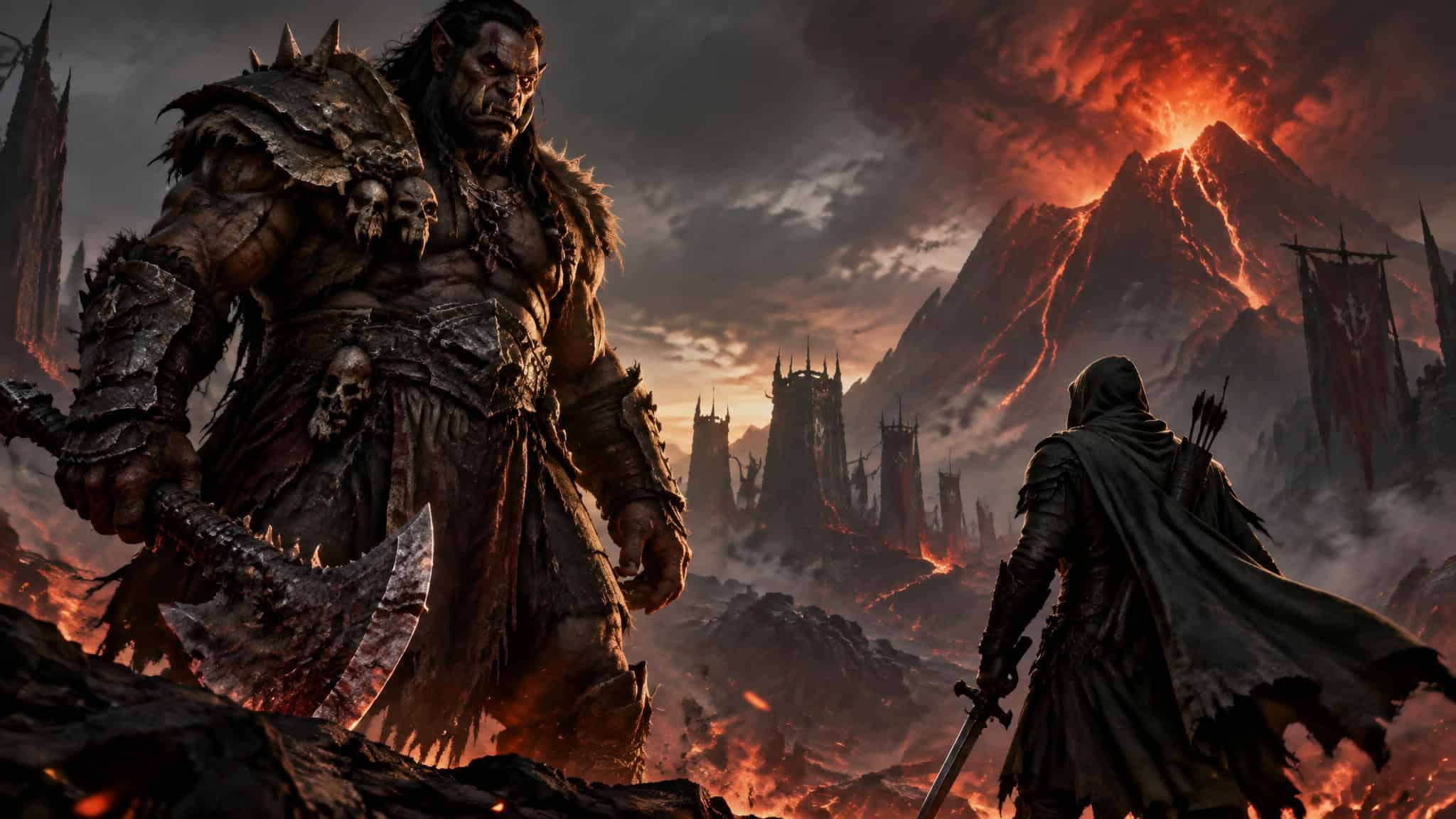
But here’s the pattern that got me digging: players remember a particular Orc rival from 2014’s Middle-earth: Shadow of Mordor, years later, while enemies from most open-world releases blur into anonymous furniture. That’s not nostalgia. That’s a sign a mechanic is doing something almost no other mechanic does, and this article is the teardown: one deep dive into how that system works, where the everyday mechanics came from, and the patent that explains why one of them never spread.
Key Takeaways
The Nemesis System generates roughly 100 unique Orc captains per game, each with hundreds of voice lines, and quietly logs everything you do to them so Orcs reference your history in later dialogue.
Warner Bros. holds a patent on the Nemesis System that doesn’t expire until 2036, which is the main reason Shadow of War remains the only other game with it.
Most mechanics everyone uses today spread by free copying: minimaps (Rally-X, 1980), WASD (Dark Castle, 1986), lock-on (Ocarina of Time, 1998), fast travel (Ultima 3: Exodus, 1983), QTEs (Dragon’s Lair, 1983).
Table of contents
Table of Contents
What a game mechanic is (and how it differs from gameplay)
Mechanics are the rules and systems defining how you interact with a game; gameplay is the experience those rules produce. The contrast that makes it click: a health bar is one mechanic. The Nemesis System bundles several mechanics that produce narrative, and without it Shadow of Mordor would be a capable but forgettable open-world game with Arkham-like combat and Assassin’s Creed-like parkour. (We break the terminology down further in game mechanics vs gameplay.)
How the Nemesis System in Shadow of Mordor actually works
The Nemesis System works by generating Orc villains procedurally and turning your ordinary play into story material. Monolith (published by Warner Bros.) debuted it in 2014 with Shadow of Mordor and expanded it in Shadow of War. Every game throws roughly 100 captains at you, each with a unique name, look, traits, and personality, and each backed by hundreds of voice lines. That last number is the scale that matters: this isn’t a name generator, it’s a script for a hundred individuals.
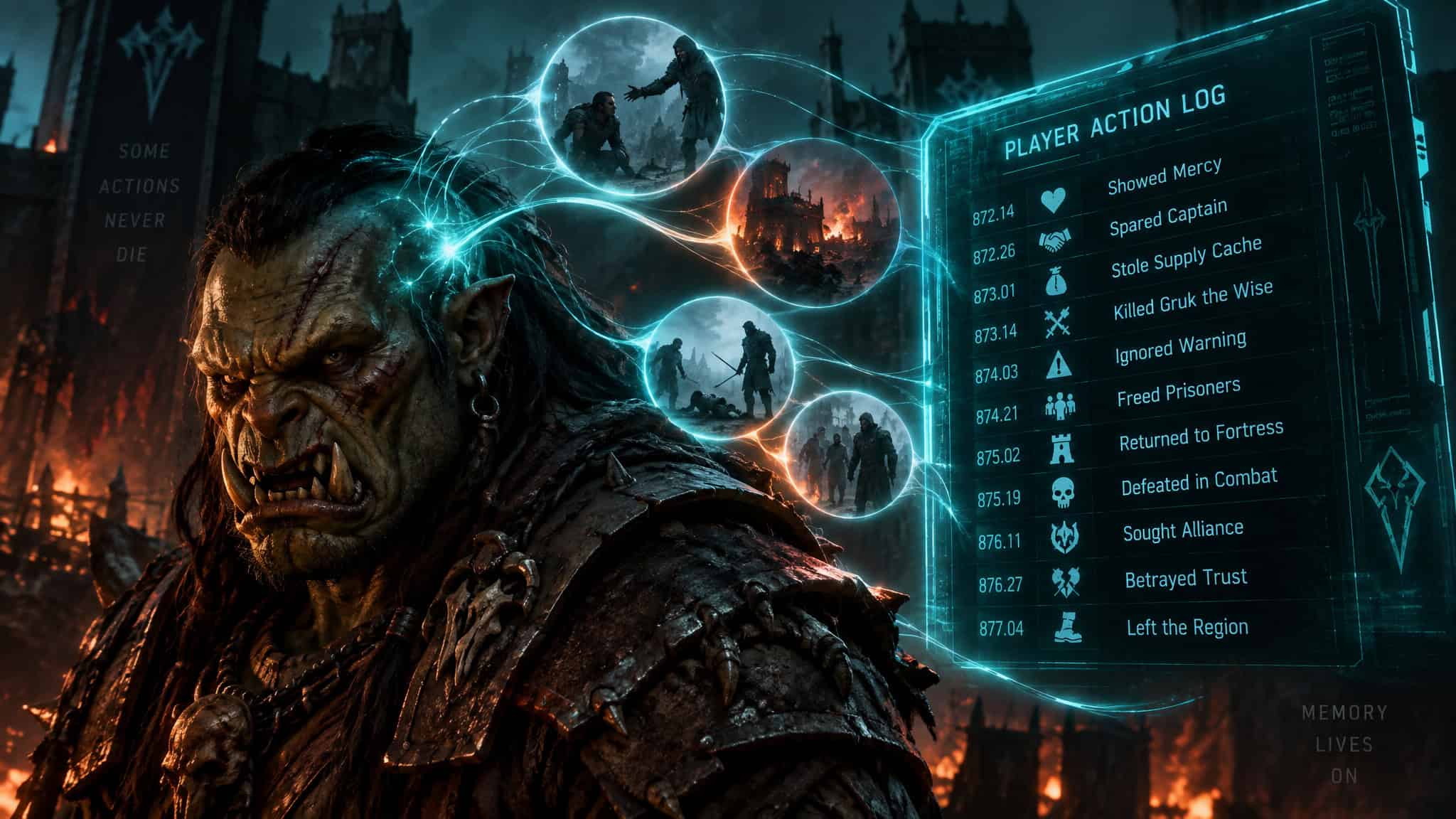
And check this out: it’s a villain generator and a story generator at the same time, which is honestly kind of wild.
The “Yes, And…” trick
The game secretly catalogues everything you do to an Orc: kill, flee, injure, heal, gather intel. Think of it as a hidden log file of your sins. Orcs read that log when picking dialogue in future encounters, so when one snarls about the time you ran, the game is talking back to your own history. It’s basically improv theatre’s “Yes, And…”: your basic survival verbs become prompts, you and the Orcs pass the story back and forth, and the storytelling costs you zero extra effort.
You were just trying to survive. The game was writing it all down.
Dying is a plot beat
Talion is a gravewalker, a ranger fused with the wraith Celebrimbor, stuck between life and death and respawning like a multiplayer character. That framing is the other half of the persistence trick: dying isn’t a fail state, it’s canon. Get murdered and the killer gets promoted, and now you have a revenge arc. Monolith cited Burnout crashes and the Call of Duty killcam as inspirations, which makes perfect sense the second you hear it: both are systems where the replay of your failure is the fun part.
Encounters don’t even have to end in a corpse for the story to keep going. You can flee, Orcs can retreat, a downed Orc can defy death (one, Prak, snarls I can’t go down like this. I won’t go down like this!), or a victor can humiliate you and just walk away. That’s Monolith’s fix for making stories outlast a single lethal encounter, and it’s a genuinely elegant one.
Orcs get written like characters, not generated like loot
The generation pipeline runs identity-first: a character’s identity gets defined first, then weapon, outfit, combat choices, and mannerisms are all built to support it, like writing a character sheet before the build. And a lot of handcrafted content sits alongside the procedural system, so procedural doesn’t mean soulless here.
The taunts are the charm. Horza musing I wonder which of us will kill you first… tells you more about a generated character in seven words than most games manage in a cutscene. Or ZUKA the poet announcing You face an Orc, who speaks in verse. The oddballs, the singers, the two different ZUKAs with wildly different vibes, are exactly the kind of weird output you want from a system like this.
The hierarchy and hidden stats that engineer memorable rivals
The machinery behind your favorite rival is a four-tier hierarchy plus a set of hidden dials. Shadow of War‘s pyramid runs:
- Overlord
- Warchiefs
- Captains
- Soldiers
The rule that changes how you think about dying: the Orc who kills you gets promoted with stat bonuses, resistances, and shed weaknesses. Your death literally levels up your enemy. Meanwhile the hierarchy runs itself: Uruks fight each other for promotion, shame demotes a Warchief back to captain, and classic fall-from-grace and rags-to-riches arcs emerge from pure systems with no writer in the room.
Underneath, the dials. Every Orc carries a hidden player interaction score that ticks up with each re-encounter, quietly rigging survival odds in favor of Orcs you know, so the spotlight drifts toward characters you actually care about. High nemesis-score captains cheat death and hunt you down on purpose. Only beheading guarantees permanent death, rare titles appear once per playthrough, rivals can teleport in at the worst possible moment, and Orcs run auto-resolving missions that shift the power balance while you’re off doing something else.
Design director Bob Roberts described story balancing as a tunable knob: if you’re doing too well, maybe somebody should betray you and give you a revenge target to chase. The game isn’t just simulating, it’s stage-managing.
Quick test: If an Orc keeps surviving your encounters, the game is rigging odds in its favor — behead it or it’s canon forever.
Rarity engineering keeps the drama special, too. Per Monolith, the vast majority of Orcs never cheat death in a typical playthrough, and some transformations happen only once per playthrough then lock. Repetition kills the magic, so they throttled it.
Ar-Karo the Stitch and Maku: emergent stories, start to finish
These arcs are why the system hooks people, and both come from documented playthroughs and player accounts rather than my own save file. The half-hour resurrection is the detail that sells it.
Ar-Karo
Ar-Karo beat the player and broke their sword, which is the kind of petty, personal touch that makes a grudge real. The player killed him. About half an hour later he was back as “Ar-Karo the Stitch,” with a stitched-up head, an iron helmet, and scars matching his earlier wounds. The player recruited him as a bodyguard, and he repaid the loyalty by declaring that death could not take the player that day.
Just as it cannot take me.” By the end of the arc, he was installed as Overlord. That’s a full redemption story, and no writer typed it.
Maku
Maku is the villain version. A wiry archer who repeatedly downed the player with poisonous arrows but refused to finish them, taunting “Pride of Gondor” the whole time. He overthrew the previous Overlord himself and stayed nearly untouchable until a full fortress assault finally dethroned him.
Much of the narrative here happens in the player’s head. Relationships get inferred from short dialogue stabs, not cutscenes, and when Stakûga avenges an unnamed blood brother, the player gets to invent the most interesting candidate for who that brother was. Then there’s the two-player divergence: the same captain is an easy first-meeting fight for one player and an unkillable recurring nemesis for another. No two playthroughs are the same, by design.
Shadow of War’s expansion: army-building, traits, and sieges
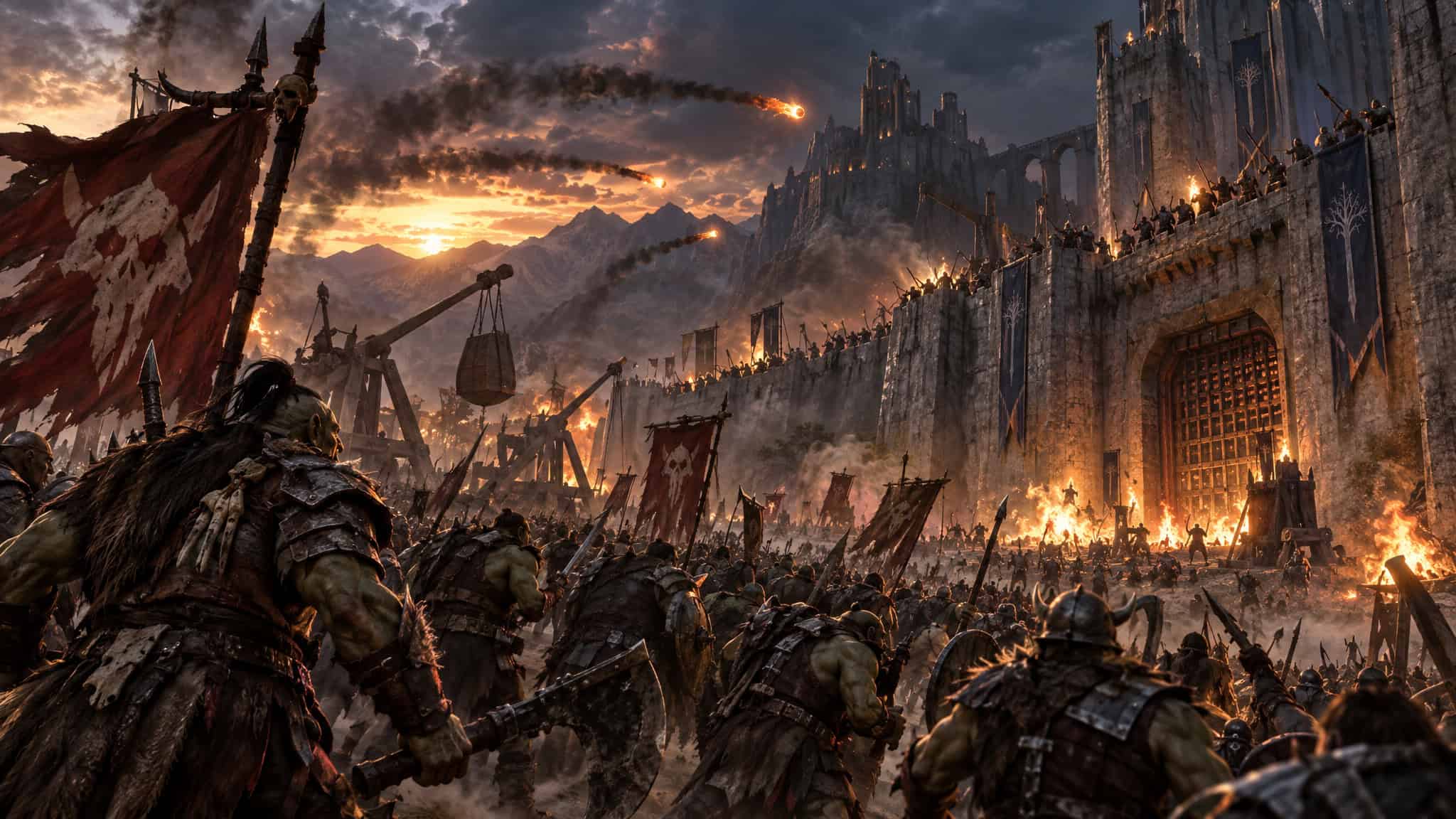
The sequel adds a two-sided trait system, betrayal, and fort sieges, and the key idea is that every captain trait is double-edged: strengths (immunities) help when they’re allied, weaknesses (mortal weaknesses, which allow instant kills) help when they’re an enemy. Captains must be broken before domination, only dominated at or below your level, and “iron will” captains can’t be dominated at all. Blood brothers avenge each other, and an avenger can show up roughly 10 levels above you, one such avenger, Bolg, snarls I won’t see my blood brother slain by such a useless little tark! before coming for you. Sieges run two ways: a “raw dog” assault with no prep, or “masterminding” with spies and wararchiefs installed via trial by combat.
Why no one else has a Nemesis System: the patent until 2036
The Nemesis System hasn’t been copied because Warner Bros.’ patent protects it until 2036, and because the existing imitations lack the thing that actually makes it work. That’s the plot twist of this whole story: a mechanic this good, legally fenced off, with WB never meaningfully reusing it outside the two Mordor games.
The stark fact first: Shadow of War is the only other game with the system. The canonical comparisons are Assassin’s Creed Odyssey‘s mercenary system and Watch Dogs: Legion‘s Play as Anyone. Both spawn leveled enemies with names and faces, but neither remembers what you did to a specific person. Odyssey‘s mercenaries are, honestly, a pale imitation. The relationship memory is the real moat, patent aside; that’s the part nobody has matched even without a lawyer in the room.
The origins are good trivia. Monolith’s canceled Batman game, Project Apollo, intended a Nemesis-like system before morphing into Shadow of Mordor, and rumors (explicitly incomplete speculation) place the system in future Batman and Harry Potter games. Gotham Knights gets suggested as a great fit, too. Imagine the dream pitch: a lowly thug kills Batman, comes back scarred and leveled, and themes a whole supervillain gimmick on how you fight.
That game doesn’t exist. The patent expires in 2036. Write it down.
The honest nuance: patents protect specific implementations, not concepts, and enforcement is notoriously difficult, so the lockout is real but not absolute. It’s still the main reason a system this beloved showed up exactly twice.
Mechanics that spread by free copying
Everything in the intro list became universal precisely because nothing stopped studios from copying it. No patents, no permission, just diffusion:
- Permadeath and procedural generation trace to Rogue, over 40 years old now, and spawned the entire roguelike genre. The recipe is simple: death is permanent and the dungeon regenerates, so every run is a fresh, stakes-heavy puzzle. Matchmaking ladders came from StarCraft.
- The controls nobody credits: lock-on from Ocarina of Time‘s Z-targeting in 1998, the minimap from Rally-X in 1980, WASD from Dark Castle in 1986 and standardized through Dennis Fong’s Quake dominance, fast travel from Ultima 3: Exodus‘s moongates in 1983 plus Zelda’s flute.
- QTEs go back to Dragon’s Lair in 1983; Yu Suzuki supplied the term itself for Shenmue in 1999.
This free-copying diffusion is exactly what the Nemesis patent blocked. Same industry, opposite outcome.
Game mechanic patents: gifted, stifling, and hard to enforce
Patents cut both ways. EA’s Ping system patent was made free under an accessibility pledge, with the technical details published openly for anyone to use, while Namco’s loading-screen minigame patent (approved 1995, expired 2015) froze an entire idea category for twenty years until indie developers held the Loading Screen Jam in defiance. One patent is a gift, the other is a 20-year freeze, and neither is inherently what patents do.
The legal sagas read like gossip. Sega won against Vivendi Universal over Crazy Taxi‘s navigation pointer; The Simpsons: Road Rage copied Crazy Taxi outright, and Hit and Run settled out of court. Bloober Team threatened lawsuits over dual-reality mechanics, then walked it all back in a Reddit AMA. And some “protection” isn’t legal at all: The Ultra Hand is guarded by technical complexity, which is very much a “good luck reimplementing this” strategy.
The rapid-fire tour, one line each: Ubisoft’s Mark and Execute started in Splinter Cell: Conviction and got reused across Assassin’s Creed, Ghost Recon, and Star Wars Outlaws. Square Enix’s Active Time Battle debuted in Final Fantasy 4 in the early 1990s and ran all the way to Final Fantasy 7 Rebirth. Sega’s Sonic corkscrew patent lapsed in 2012. Sony’s Mark of Kri right-stick targeting was a PS2-era precursor to Arkham’s freeflow.
BioWare’s dialogue wheel was applied for in 2007 and expires in 2029, and other studios sidestep it with plain white wheels, which is patents shaping aesthetics in the most literal way. And Nintendo patented the Eternal Darkness sanity system, because of course it did.
The honest tradeoffs
The Nemesis System’s documented downsides are monotony risk and a launch that poisoned its own reputation. Start with the practitioner view: a May 2017 Unity Discussions thread, 28 posts of developers picking the system apart (the shorthand was “like Batman meets Dragon Age”), noted the never-ending promotion loop can get monotonous, and made a point worth co-signing: videos alone can’t evaluate an emergent system. You have to play it. On easy settings, stories stagnate; the manual fix is raising the difficulty yourself, which is exactly what I ended up doing when the game got too comfortable.
Then the tarnish. Shadow of War launched overshadowed by microtransactions, lootboxes, and an overinflated endgame, the franchise’s reputation took the hit, and the mechanic’s quality got ignored in the process. All microtransactions have since been removed. Go replay it on Nemesis difficulty; that’s the version the system always deserved.
One more honest shortfall: follower relationships are less well defined than rival ones. Grudges are richer than loyalty here, and that’s a known tradeoff in emergent systems.
What makes a mechanic great
The Nemesis System is considered one of the best game mechanics because it passes the full checklist:
- Unique: nothing else on the market did this, story generation like Rimworld and Crusader Kings had, but never in real-time action with blockbuster graphics.
- Memorable: players name their Orcs years later.
- Replayability-adding: the two-player divergence proves it.
- Fun: obviously, and still compelling 8 years after release, which is more than most mechanics can say.
The core value isn’t enemy variety, it’s persistent relationships: grudges, mockery, kill reminders. The game remembers, and that’s the magic. And the greatness is levers, not vibes: memorability engineered through player death (aggressive kill animations, taunts, promotions, name changes themed on how you died, and revenge loot that literally pays better), Bob Roberts’ balancing knob, spawn stage-management, and player imagination filling the gaps the game leaves open. Story generation existed before in Rimworld and Crusader Kings, but never in real-time action with blockbuster graphics. That gap is what made Nemesis special, and it’s still compelling 8 years after release.
Worth saying for the indie devs reading this: that scale costs money. Nemesis-level drama demands hundreds of voice lines per character, which most small teams can’t afford, so simple mechanics like roguelite permadeath or well-placed narrative gaps do more with less. For a fuller toolbox, see our game mechanics list, and for the underlying theory, our game mechanics deep-dive.
WB has never meaningfully reused the system outside the two Mordor games, which is the frustrating footnote of this whole story, delivered with a shrug and a jab. The hope is that other developers pick it up once the patent expires in 2036. Either way, the lesson stands: the mechanics everyone takes for granted spread by copying, and now you know exactly what copying buys, and what a patent costs.
Frequently Asked Questions
What are the mechanics of a game?
A game’s mechanics are the rules and systems that define player interaction — how you move, fight, fail, and progress. Mechanics are distinct from gameplay, which is the experience those rules produce. A single mechanic like a health bar is simple; a system like the Nemesis System bundles many mechanics together to generate emergent narrative.
How does the Nemesis System in Shadow of Mordor actually work?
It procedurally generates roughly 100 unique Orc captains per game, each with a name, look, traits, and hundreds of voice lines. The game secretly logs everything you do to each Orc — kill, flee, injure, retreat — and Orcs reference that history in later dialogue. If an Orc kills you, it gets promoted with stat bonuses and a personal grudge against you, turning every death into a revenge arc.
Why hasn’t the Nemesis System been copied by other games?
Two reasons: Warner Bros.’ patent protects it until 2036, and would-be imitators lack the ingredient that actually makes it work — relationship memory. Assassin’s Creed Odyssey’s mercenary system and Watch Dogs: Legion’s Play as Anyone spawn named, leveled enemies, but neither remembers what you did to a specific person. Shadow of War remains the only other game with the full system.