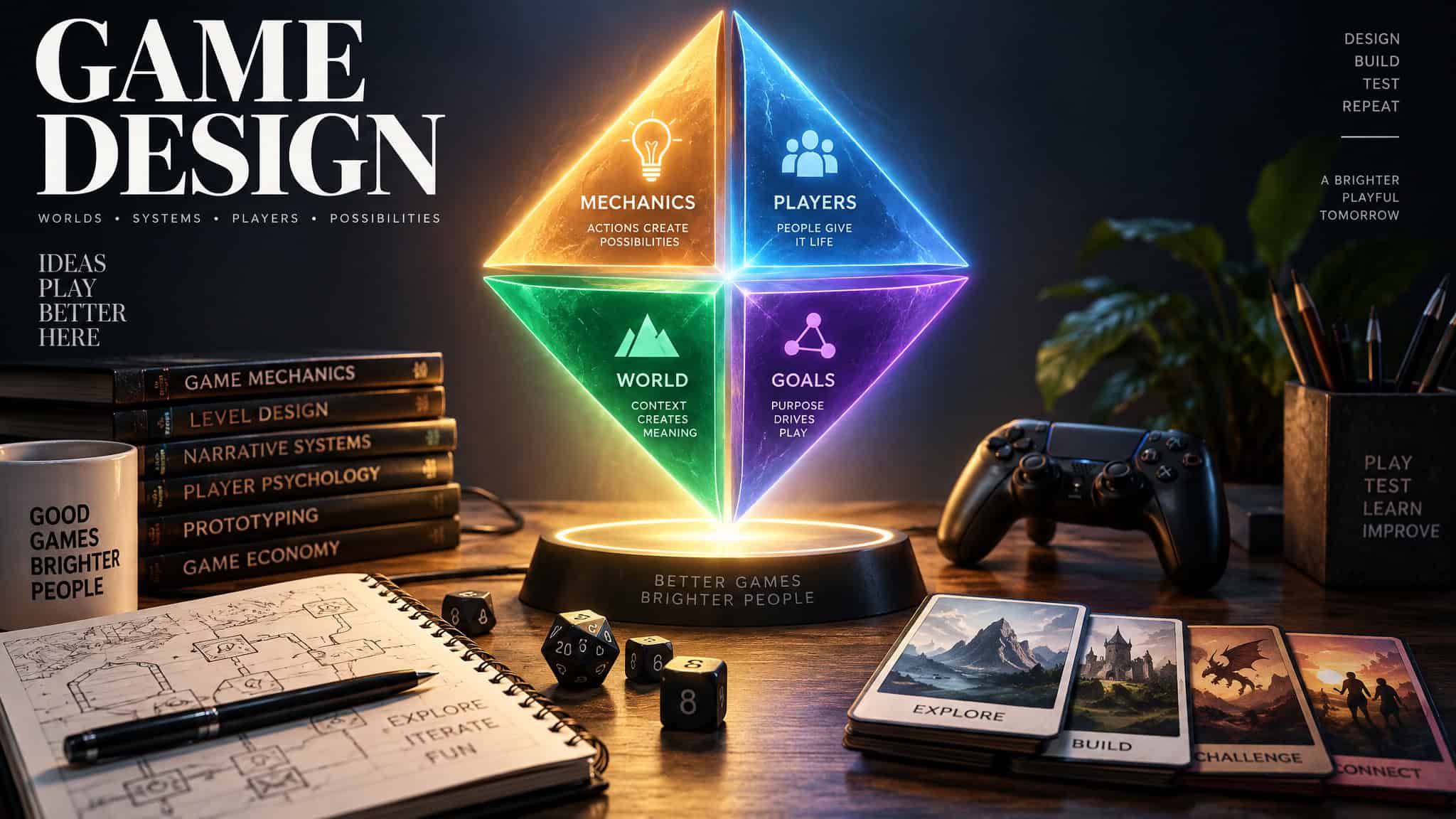
The four elements of game mechanics, in the most widely taught framework, are mechanics, aesthetics, story, and technology. That’s the Elemental Tetrad from Jesse Schell’s The Art of Game Design, where the four elements are balanced against your design goal rather than each other. But here’s the thing that probably sent you searching in the first place: another well-known textbook, Game Mechanics: Advanced Game Design, gives a completely different list of four, environment, objects, rules, and agents and skills. Both answers are correct.
They’re answering different questions, and they nest inside each other instead of competing. That’s the reconciliation nobody in the rankings bothers to explain, and it’s the angle I keep coming back to whenever this topic comes up.
Table of contents
Table of Contents
Two frameworks: MDA and the Elemental Tetrad
MDA is the Mechanics-Dynamics-Aesthetics framework, published by Robin Hunicke, Marc LeBlanc, and Robert Zubek in 2004 (pages 2 to 4 of the paper, if you’re the citing type). Quick translation: it maps to rules, system, fun. Mechanics are the rules, dynamics are the play those rules generate, aesthetics are the feelings that play produces.

And here’s the part I find honestly kind of elegant. Designers work in one direction: they build mechanics, which generate dynamics, which lead to aesthetics. Players experience it backwards. They feel the vibe first, then the system, and only if they dig do they hit the rules.
Which means when a game feels wrong, the designer has to reverse-engineer from an emotion down to a rule change, predicting feelings from edits they can’t directly observe. You can’t tune dynamics by blindly editing rules and hoping. Knowing which layer you’re actually touching is the difference between one informed change and three weeks of rework.
It’s a genuinely handy mental model, and it has a fanbase: tabletop designers tend to favor MDA. The Elemental Tetrad is the more widespread framework, and it comes from Jesse Schell’s The Art of Game Design, a book I’d recommend the way you’d recommend something that’s actually on your shelf. Schell’s four elements are mechanics, aesthetics, story, and technology, and his key point is that they should be balanced against the design goal. Tuned weights, not equal weights.
So which do you use? Both, honestly, because they’re different kinds of tools:
| MDA | Elemental Tetrad | |
|---|---|---|
| What it models | How design and experience flow (process) | What a game is made of (scope) |
| Elements | Mechanics, Dynamics, Aesthetics | Mechanics, Aesthetics, Story, Technology |
| Elements customizable? | No (fixed three layers) | Yes (tunable against your design goal) |
| Handles technology explicitly? | No (implicitly folds it into mechanics) | Yes (its own element) |
Complementary, not opposed. MDA tells you how design effort travels; the Tetrad tells you what you’re manipulating. Pick the one that matches the question you’re actually asking.
Mechanics: rules you use, not follow
Game mechanics are the rules you design: the actions, behaviors, and control mechanisms the player gets. Game dynamics are the styles of play those rules generate. That’s the mechanics-versus-dynamics distinction in one sentence.

The nuance worth getting excited about: mechanics imply an active player. Rules are something you use, not merely obey, and that’s exactly what separates games from film or books. It’s the same reading Andrei Marczewski brings to gamification mechanics: a mechanic only means something once a player picks it up and uses it. Card games make this concrete.
Shuffling, trick-taking, and betting are mechanics. Bluffing isn’t on the list anywhere; it emerges from them.
Quick test: If a behavior only shows up once players start using the rules, it’s a dynamic, not a mechanic.
If you want to go deep, there’s Parlett’s Rule Analysis, a deep-cut tool that sorts rules into eight categories: Operational, Foundational, Behavioural, Written, Laws, Official, Advisory, and House Rules. (List them, move on.) One gotcha, though: Parlett’s chart analyzes finished games, and that’s the tell. The typical pattern looks like this: a team treats their rule list as the finished design, then playtesters use those rules in ways that create a different game than the one on paper, which is why the distinction between planned game mechanics vs gameplay only shows up in play.
Dynamics only become distinct from mechanics at the playtesting stage, because rule-making is experimental by nature. You can’t design dynamics on paper.
Aesthetics: the feelings, not the looks
Aesthetics in game design does not mean how the game looks. It means the emotional states you experience as a consequence of playing, which is the reframing most explainers skip and the whole point of the term.
Those feelings get triggered by real things: art direction, music, pacing, animation, working alone or stacked together. MDA gives you a vocabulary of eight aesthetics: sensation, fantasy, narrative, challenge, fellowship, discovery, expression, and submission. And you can see the wiring: time pressure plus opponent play supports challenge; team info-sharing supports fellowship; building and earning systems support expression. The layers connect, they’re not parallel buckets.
One cross-media point that saves real rework: emotions are media-agnostic. An avatar dying frustrates you the way a beloved film character’s death does, but the systems that trigger the feeling differ per medium, this is central to what makes a good video game. So the design question isn’t “which surface treatment mimics film,” it’s which system in my game produces this feeling. Copying another medium’s method wholesale is a clumsy solution, and yes, watching some AAA developers port a film technique into a game and call it cinematic remains an affectionate eye-roll situation.
Story: fundamental element or subset of aesthetics?
In Schell’s framework, story is a fundamental element, defined deliberately broadly as the chain of events that plays out across your game. Broad on purpose: that definition covers scripted cutscenes and emergent chaos alike.
But there’s a spicy take worth chewing on, and it comes from the source essay’s author, not from consensus: story might be a subset of aesthetics, not a separate element. The proposed causal explanation is fun, Schell’s background is Disneyland, where narrative is king, so of course story gets its own pillar. To be fair, the split has practical utility, especially for level design, where you’re sequencing events on purpose.
The best tool here is from Valve’s Portal post-mortem, which distinguishes two stories in any game. The “Story-Story” is the designer-driven sequence of events. The “Gameplay Story” is the one the player generates by playing. And the punchline: Tetris has no plot and no characters, but every run is a player-driven story.
Falling blocks, one more line, the run that almost worked. That’s a Gameplay Story with zero authored narrative attached.
Technology: the element the MDA framework hides
Technology, in Tetrad terms, means any resource that brings the game to life. Paper and dice count. So do engines and consoles, and that breadth is the whole idea: it’s not a “tech stack” section, it’s everything physical and digital the game runs on.
Now the critique, and I’ll admit this one bugs me too: MDA implicitly folds technology into mechanics, and that’s a flaw, even when you look at the best-designed game mechanics of all time, the truly brilliant ones are inseparable from the technology that runs them. The concrete case is the tabletop Doom adaptation. Same aesthetics, the authors wanted Doom‘s feel, but the available resources are totally different, so the mechanics had to be reshaped to fit. Reshaping mechanics is a design problem.
Reshaping technology, swapping paper for an engine, is a genuinely different mental process. MDA has no slot for that difference. Schell gets credit for splitting technology out as its own body of knowledge; it’s revealing and, honestly, necessary.
Some designers take it further. One author proposed MTDA, Mechanics-Technology-Dynamics-Aesthetics, as a merge of technology into MDA. Side-project energy, explicitly not an established framework, offered for consideration rather than as gospel. But the tabletop Doom case shows why the idea has legs.
The other four elements: environment, objects, rules, agents and skills
So here’s the wedge, restated flat: Schell’s four elements are mechanics, aesthetics, story, and technology. Game Mechanics: Advanced Game Design lays out a different quartet: environment, objects, rules, and agents and skills. If you searched “four elements of game mechanics,” you got both answers and no reconciliation, a confusion that dissolves once you dig into what game mechanics actually are, trace each list to its source text, and ask what question it was written to answer.
Schell’s Tetrad answers: what is a game made of? It’s a design-level model, a spec sheet for a whole game. The quartet answers: what is a single mechanic made of? It’s a mechanics-level model. They nest. The four mechanic components describe the internals of the Tetrad’s single “mechanics” element.
Quick definitions so both lists are on the table:
- Mechanics (Schell): the rules and procedures of the game
- Aesthetics (Schell): how the game looks, sounds, feels, and smells as experienced by the senses
- Story (Schell): the sequence of events unfolding in your game
- Technology (Schell): any resource bringing the game to life
- Environment (quartet): the surroundings a mechanic operates in
- Objects (quartet): the things players act on and with
- Rules (quartet): the constraints governing what’s possible
- Agents and skills (quartet): who or what acts, and what capabilities they bring
Neither list is “correct.” They operate at different zoom levels, and picking the wrong one for your problem is like debugging an API when the bug is in the architecture. If your question is about a whole game’s composition, reach for the Tetrad. If you’re dissecting one mechanic to see why it works, the quartet is the microscope. The spec-sheet instinct I like here: read the framework’s source text first. Every framework was written to answer somebody’s specific question, and the confusion only looks like a contradiction when you lose the question.
How the four elements combine into functional systems
Simple rules generate complex behavior. Emergence is when a whole system shows behavior its parts can’t, and in games it shows up in three interacting forms, per The Game Overanalyser‘s typology: strategic, systemic, and narrative. The mapping to elements is one analytical take, not established theory, but it’s a neat one: systemic emergence comes from mechanics, strategic from dynamics, narrative from aesthetics. Emergence doesn’t happen on its own, though: it requires intentional players, which means choice, information, motivation, and time. Constraints force divergent thinking, and consistent rules are what reconcile linear progression with emergent playDishonored, Hitman, and Dark Souls all let you kill NPCs the designers would rather you didn’t, and the systems absorb it.
- Strategic (from dynamics): chess. A handful of rules, effectively unlimited depth.
- Systemic (from mechanics): Breath of the Wild‘s chemistry engine, where rain, fire, electricity, and wind interact multiplicatively. Or the Dwarf Fortress tavern, where rats, cats, and alcohol produce drunken cats. This is wild and I love it.
- Narrative (from aesthetics): Missile Command, protecting six cities, reading as a nuclear-war parable. Papers, Please, where border-agent moral dilemmas arise from the rules themselves, no cutscenes required.
The toolkit behind this: multiplicative design instead of additive, feedback loops (Machinations formalizes these nicely; it models Pac-Man as a resource-converter economy), and checking the target aesthetic before stacking another mechanic. Skip that check and you get the classic failure: mechanically rich, emotionally flat. Michael Sellers makes the same argument from the design side: the elements only function as a system, never as a parts list. Ian Bogost’s Persuasive Games pushes it further, the argument a game makes lives in its rules, which is why the elements have to fire together. And Frank Lantz has built a career on the same conviction, that the experience comes from the rules themselves. The elements don’t sit in parallel buckets; the feeling a game produces comes from them firing together.
Why mechanic checklists fail
Decontextualized mechanic lists can’t predict engagement, because they’re atheoretical. The evidence is right in the lists themselves. Deterding et al. define gamification cleanly, as the use of game design elements in non-game contexts (2011, MindTrek, doi:10.1145/2181037.2181040). Then look at what the industry ships: the Gamification Wiki, backed by Badgeville, lists 24 mechanics.
SCVNGR’s list, from Seth Priebatsch, contains 47 dynamics, 32 of which don’t appear on the Wiki’s list at all. Two authoritative-looking taxonomies, barely overlapping. Nah et al.’s education literature flattens the whole thing further, equating gamification with points, badges, and leaderboards. The mHealth evidence base runs into the same wall: Linardon et al. (2024) meta-analyzed 176 randomized controlled trials of mental health app efficacy, and the question keeps coming back to how the whole experience fits together, not which mechanics appear on a feature list.
The failure pattern has a name: chocolate-covered broccoli. Surface gamification bolts fun onto a boring thing without changing the core experience, and the thing stays boring. Habitica dresses a to-do list in RPG clothes; Headspace awarding a badge after ten mood entries is the pattern in miniature. Self-Determination Theory explains why real games sustain motivation and badge stickers don’t: they satisfy competence, autonomy, and relatedness. A badge after ten mood entries satisfies none of the three.
Red flag: If the badge, points, or leaderboard could be pasted onto any product without touching the core loop, nothing about the experience changed.
Real-world proof: element alignment in commercial and applied games
Alignment shows up wherever element choices carry money or stakes. In the casino market, the KPIs that matter are GGR per player, longevity, and share of wallet, not week-one spikes, against a market H2 Gambling Capital projects at $327.2bn in 2025 with a $130.9bn casino segment. Pirots succeeded without data support and grew into a five-version franchise, while Fishin’ Frenzy‘s 2014 collect mechanic spawned copycats across Europe and Asia. In applied settings, the M.A.G.I.C. framework (Broussard et al., Frontiers in Psychology, 2026, drawing on Mark Rosewater’s 2016 GDC lessons) distills Rosewater’s advice to align what players enjoy with what wins, with Magic: The Gathering‘s 30+ years since 1993 as the existence proof; the framework itself is theoretical and unvalidated, and these techniques carry real limits, from exploitation risk to excluding some users.
Now you can state both four-element lists, pick the right framework for the problem in front of you, and trace an emergent behavior back to the element that generated it. The decision rule, stated once: before listing elements, ask “what game is this made of?” (Tetrad) or “what is this mechanic made of?” (the quartet). The frameworks nest, and the feeling a game produces comes from elements aligned to a design goal.
Frequently Asked Questions
What are the four basic elements of game design according to Jesse Schell?
Schell’s Elemental Tetrad names mechanics, aesthetics, story, and technology. Mechanics are the rules and procedures, aesthetics is how the game looks, sounds, and feels, story is the sequence of events unfolding, and technology is any resource that brings the game to life — including paper and dice, not just engines and consoles. His key point is that the four should be balanced against your design goal, with tuned weights rather than equal weights.