
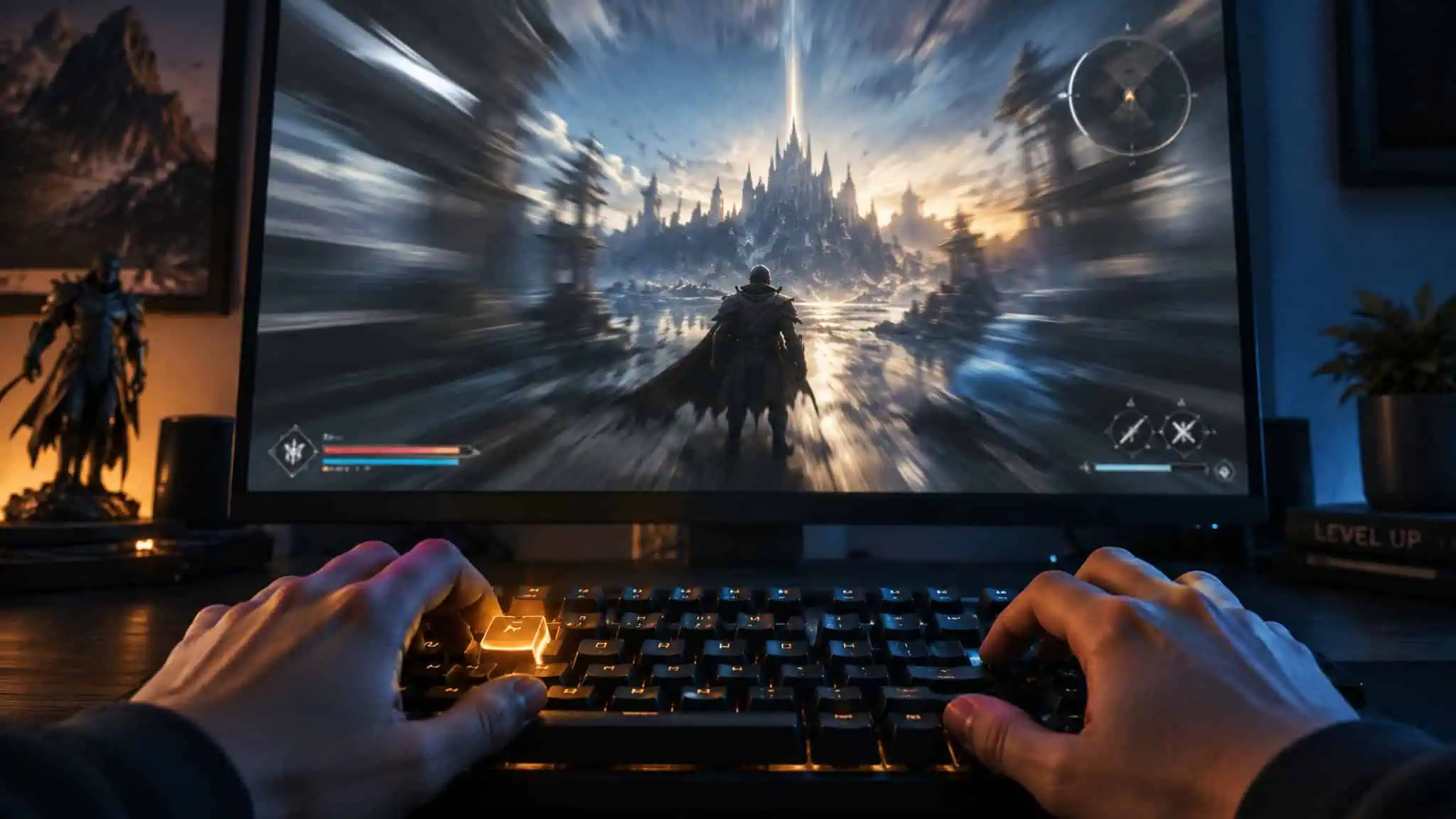
One button slows the world. You float through the air, picking off enemies who are suddenly crawling through molasses, and the whole firefight turns into something you directed rather than survived. That’s Bullet Time from Max Payne, and it’s a perfect example of why “best game mechanics” is such a contested phrase. Ask ten people and you’ll get ten different answers, because they’re ranking on different axes.
Doom founded the FPS genre outright. Half-Life revolutionized how shooters tell stories. Minecraft has sold over 350 million copies and still sometimes gets left off “foundational” lists, which is frankly absurd. So let’s declare the rules up front: this list ranks on industry and design influence, not sales or review scores. What follows is a ranked eight-to-one canon of mechanics that rewired gaming, deep dives into the landmark games that carried them, and then the genuinely brilliant mechanics nobody copied at all.
Key Takeaways
The ranking criterion here is impact, not sales: Minecraft’s 350M+ copies don’t automatically make it “foundational.”
The Nemesis System made Shadow of Mordor’s orcs feel like personal rivals, yet no major successor game ever adopted it, and sources don’t fully explain why.
Precision-heavy mechanics like Metal Gear Rising’s Blade Mode never spread, while forgiving one-button systems like Arkham’s Freeflow Combat became industry standard.
Table of Contents
| Exact model | Decisive documented advantage |
|---|---|
| Bullet Time (Max Payne) | One-button activation slows the world so the player can aim, making combat cinematic and preventing the player from being overwhelmed. |
| Freeflow Combat (Batman: Arkham Asylum) | One-button counters and chained attacks pioneered counter-based combat now common across action games. |
| Minecraft | Divergent criteria reconciled: Doom founded the FPS genre; Half-Life revolutionized FPS storytelling; Minecraft is best-selling but inconsistently ‘foundational’ |
| Gravity Gun (Half-Life 2) | Pick up and throw objects, such as throwing crates into explosive red barrels, with physics that still hold up. |
| Strand mechanic (Death Stranding) | Players earn ‘likes’ from NPCs to unlock structures built by other players, enabling social play without meeting anyone. |
| Grand Theft Auto III (GamePro #2) | GTA III inspired open-world successors including Mafia, Saints Row, Sleeping Dogs, and Watch Dogs. |
Model details below derive from the cited sources; check the brand pages for current pricing.
What game mechanics actually are (and why “best” is slippery)
Game mechanics are the rules and verbs a player acts through: the one button that slows time, the recipe table that turns raw materials into tools. They’re distinct from story, distinct from graphics, and distinct from gameplay as a whole. Gameplay is the whole experience of playing; mechanics are the specific systems underneath it. Max Payne’s Bullet Time is a mechanic. Max Payne’s gameplay is what it feels like to chain those slow-mo dives through a New York basement while the game pretends its writing isn’t over the top. And honestly, a mechanic can be valuable enough that a studio locks it behind a patent. WB Games did exactly that with one concept, keeping it out of anyone else’s hands until 2036.
Half-Life 2’s Gravity Gun makes the distinction even sharper. The mechanic is “pick up physics objects and throw them.” The gameplay is the emergent chaos when you realize a radiator is a better weapon than the actual weapons. One mechanic, dozens of gameplay outcomes. That’s the test for a great mechanic: it generates more play than the designers explicitly scripted.
The mechanics that earn “best ever” talk tend to share a few traits, and every one of them is easy to spot in a named example:
- Control synergy: the input feels native, like Arkham Asylum’s one-button counter that turns brawls into choreography.
- Player choice: the mechanic opens options instead of closing them, like Minecraft’s crafting table letting you decide what to build next.
- Environmental interaction: the world itself becomes a tool, like the Gravity Gun turning crates and barrels into ammo.
Here’s the other thing that makes “best” slippery: innovation happens on multiple axes, and different games won on completely different ones. Genre creation? That’s Doom, which coined the term “deathmatch” and pioneered the shareware distribution model. Storytelling?
That’s Half-Life, telling its tale in real time with a voiceless protagonist. Input hardware? Warcraft (1994) did much to establish the mouse as PC gaming’s signature controller. Distribution? Geometry Wars went digital-only on Xbox Live Arcade in 2005 and became one of the most-played Xbox games despite never being in a box.
Same word, “innovative,” four completely different achievements. Any list that pretends there’s one ranking axis is hiding the ball, so this article won’t.
Bullet Time (Max Payne): slow-mo aiming as a one-button system
Bullet Time is Max Payne’s one-button slow-motion aiming system, and before the game launched on July 23, 2001, nothing had captured slow-mo action that way. That’s the honest, specific claim: not “changed gaming forever,” just genuinely nobody had done this particular thing this well before. Which, in 2001, was enough to make every action game that followed feel a little bit like it was chasing you.
The mechanic itself is beautifully simple. Press one button, the world slows, you keep aiming at full speed while enemies crawl. Suddenly you’re diving sideways through a doorway, shotgun out, bullets drifting past your head like you’re the star of an action movie, except you’re also winning. The practical payoff was just as important as the spectacle: you never got swarmed into a corner. Outnumbered stopped meaning doomed, because time itself was the resource you could spend.
Okay, so check this out, because I fell down the wiki rabbit hole on this one. Max Payne came from Remedy Entertainment, was published by Gathering of Developers, and got ported absolutely everywhere: PC, PS2, Xbox, Game Boy Advance, even mobile. A hard-boiled noir shooter about a cop with nothing to lose, compressed onto a phone. The ports alone tell you how badly people wanted to play it.
On the ranked list this article counts down, Bullet Time sits at #8 of eight, which sounds like an insult and isn’t. The rank is context. The mechanic is the point.
And I can’t talk about Max Payne without the affectionate jab: this is a game as famous for Max’s overwrought noir monologues as for its mechanics. The man narrates his own misery like he’s being paid by the metaphor. It’s wonderful. It’s also completely unnecessary, which might be why it works. The mechanics never needed the poetry; the slow-mo dive says everything.
The Nemesis System (Shadow of Mordor): the game remembers
The Nemesis System is Shadow of Mordor’s orc-rivalry engine, and the first time it clicks, your reaction is “wait, the game remembers?” Monolith and Warner Bros. built it into their Lord of the Rings tie-in, and it’s the rare licensed game whose signature mechanic outshone the license.
The loop works like a living org chart. An orc kills you, that orc gets promoted. You beat one boss, and another orc relocates into the power vacuum. The chain of command reshuffles around your failures and victories, and enemies return as personal nemeses carrying injuries from your last fight.
The scars. They come back scarred, with the actual wound you gave them visible on the model. That’s tiny wizardry, and I’m not over it.
The payoff was instant. Forgettable mooks got personalities, players started picking targets strategically instead of just clearing camps, and the system was a hit right out of the gate. Here’s the honest caveat: despite all that, no major successor emerged. Sources document the non-adoption, but they don’t explain it. Why the most talked-about mechanic of its generation never spawned an imitator wave is a genuinely open question, and it comes back later in this article, because the pattern matters.
Freeflow Combat (Batman: Arkham Asylum): the counter that conquered action games
Counter-based combat, not Bullet Time’s cinematic spectacle, is what modern action games actually copied. Arkham Asylum’s Freeflow Combat, from Rocksteady, is the system that made you feel like Batman without a move list taped to your monitor.
The loop is one button. Batman senses the incoming hit, you tap to dodge and counter, and auto-targeting keeps the whole thing flowing between enemies. Kicks, punches, and cape flurries chain into brawls that look like choreographed cinema, and half the fun is watching yourself pull off a fight you’re not entirely sure you controlled. Simple input, incredible feel. That’s the entire pitch.
The lineage runs deeper than Rocksteady, though. Street Fighter II pioneered rapid combos and the Ryu/Ken fireball input motions back in 1991, and the input-lineage thread runs straight from that arcade cabinet to the Batcave.
The legacy is the headline. Counter-based combat is now standard across action games, and Arkham Asylum still ranks among the best superhero games ever made. It didn’t invent all modern combat, and nobody should claim it did. It invented the specific feel of confident, readable brawling, and the industry ate it whole.
Crafting (Minecraft and before): the popularizer’s credit
Crafting was popularized by Minecraft, but Minecraft didn’t invent it. The mechanic first showed up in early adventure games of the ’80s and ’90s, and it took Markus Persson’s blocky sandbox to make it mainstream. Classic originator-versus-popularizer story, and the popularizer earned every bit of the credit: half of Minecraft is standing at a crafting table, turning raw recipes into tools and items. It’s not a feature, it’s the loop you live in.
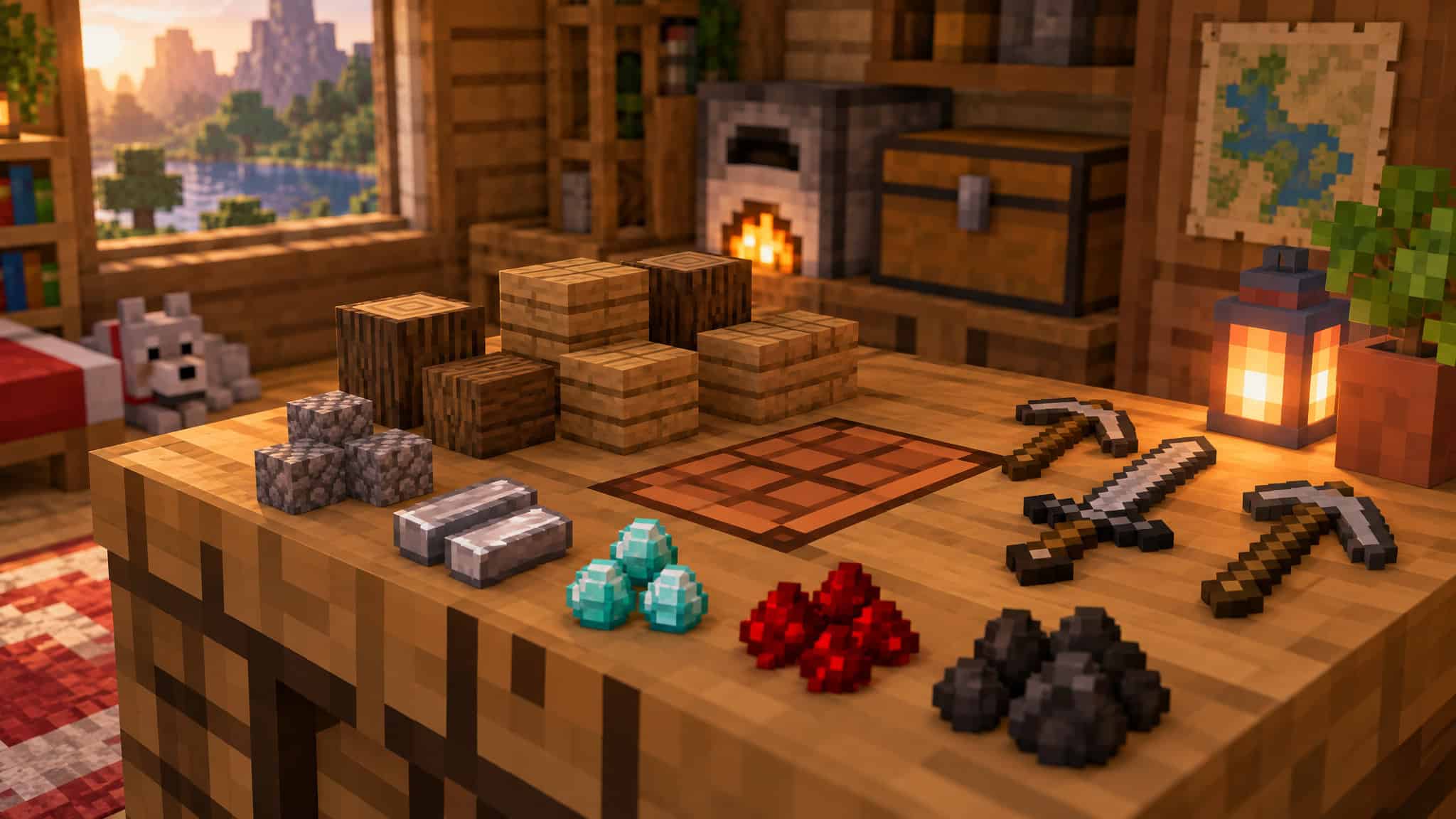
After Minecraft blew up, tons of games bolted crafting on, usually to push exploration or smooth out progression curves. And you can tell which games understood the mechanic and which ones didn’t. In a typical bolted-on setup, crafting becomes a progression gate: a menu you open once, craft the thing the game wanted you to craft, and never touch again. In Minecraft, the crafting table IS the game. The difference between those two outcomes is the difference between a mechanic and a checkbox, and a lot of post-2011 games picked the checkbox.
The Gravity Gun (Half-Life 2): engine physics as the star
The Gravity Gun is the toy that made Half-Life 2’s Source engine physics the star of the show. The vivid use case sells itself: grab a crate, hurl it into an explosive red barrel, enjoy. That’s the whole loop, and it never got old.
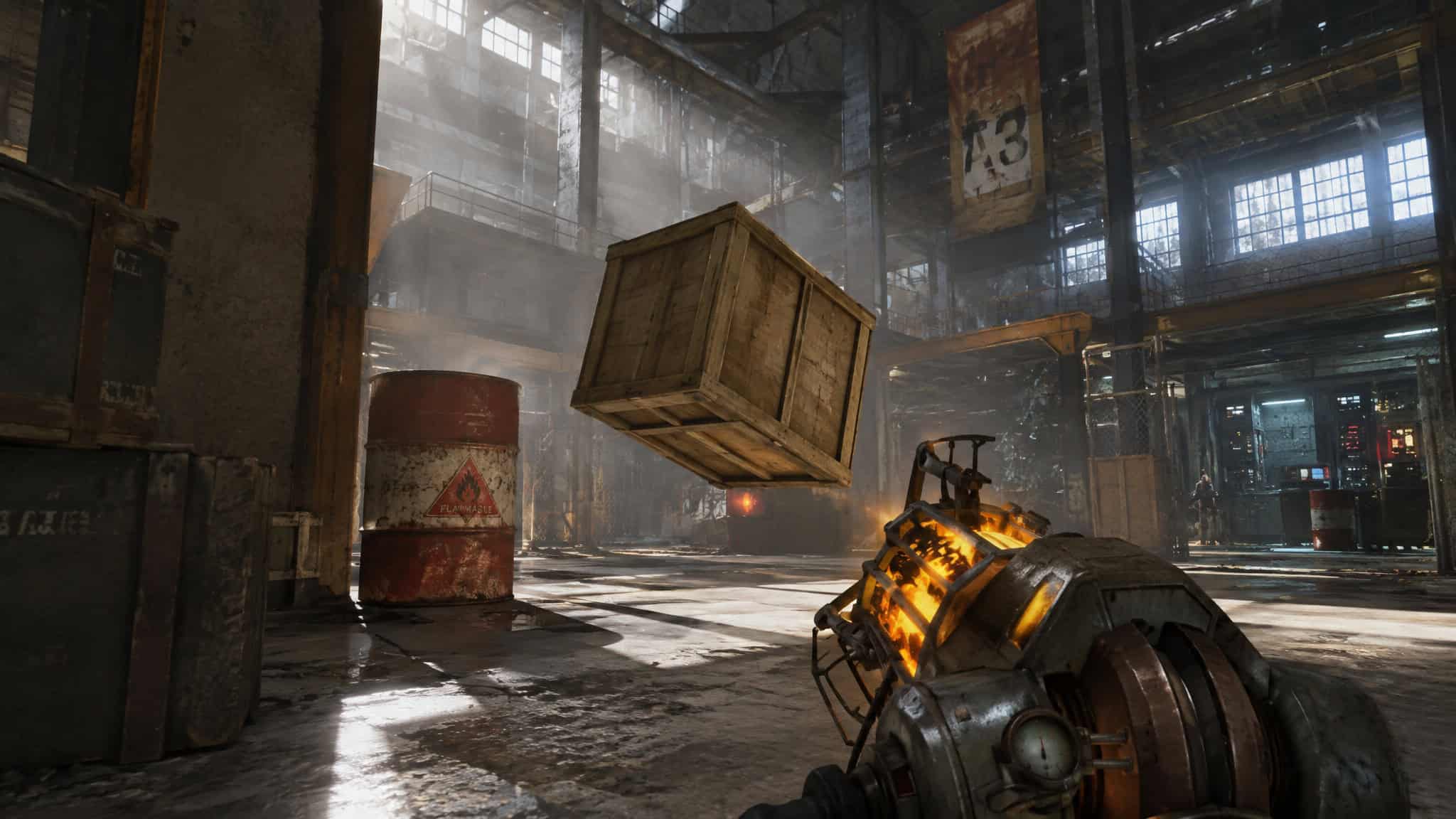
Valve was showing off, in the best way. The gun exists to demonstrate Source’s physics simulation, and honestly, they still hold up. Grab, lift, launch. It doubles as a puzzle tool too, with physics-based puzzles where the solution is objects and momentum rather than a key. That range, combat toy and puzzle instrument in one, is what makes it a great mechanic rather than a fun gimmick.
Weapon and engine are inseparable here, and that’s the lesson. Half-Life 2’s Gravity Gun lets players pick up, throw, and solve puzzles with everyday objects precisely because the engine underneath could take the abuse, a reminder that the best core gameplay mechanics are built on systems, not bolted on afterward. The mechanic is the demo reel.
The Portal Gun (Portal): prototype, product, and pop culture
Portal’s gun is the coolest mechanic ever built out of two colors. Shoot blue, shoot orange, walk through. Space becomes a suggestion. The elegance is the simplicity: two linked portals, and suddenly momentum, distance, and geometry are all negotiable. Valve shipped it in 2007 as a gun-free first-person puzzler, built entirely on the idea of thinking with portals, and the phrase earned its keep.
The origin story is the best part. Portal started as Narbacular Drop, a student project, and Valve hired the team and reworked it into the game we got. A student prototype becoming one of the most influential puzzle games ever is the kind of industry story that should happen more often. Fans are still building their own portal-puzzle games today, which is real staying power, and the Companion Cube and “Still Alive” escaped the game entirely into gaming pop culture.
Portal vs. Portal 2
The 2007 original is the innovation. Portal 2 (2011) is the refinement: dedicated two-player co-op levels built around linked-portal traversal, plus J.K. Simmons’ Cave Johnson monologues, which are some of the best game audio around, full stop. The honest framing is prototype-then-product, and it doesn’t diminish Portal 1 at all. Brilliant sketch, masterpiece painting. Both hang in the Half-Life universe, incidentally, for those keeping score at home.
Character Swap (GTA 5): innovation in the transition, not the concept
Multiple protagonists existed before GTA 5. What Rockstar North built in 2013’s open world (well, the mechanic’s home, anyway) was the seamless mid-mission swap between three protagonists: one button and you’re a different character mid-heist, camera whipping across Los Santos. Fans still call it one of the series’ best mechanics, and the praise holds up.
The cleverness was in the transition design, not the concept. Swapping characters in a menu is a feature; swapping mid-firefight so you reposition, change loadouts, and re-enter the action feels like directing your own action movie. GTA 5 expanded an existing idea so smoothly that people remember it as new. That’s expansion done so well it gets mistaken for invention, which is its own kind of achievement.
The Strand mechanic (Death Stranding): social play without meeting anyone
The Strand system is the weird Kojima idea that actually worked. Kojima Productions set Death Stranding in a post-apocalyptic America where you play a courier delivering supplies to scattered survivor communities. The asynchronous multiplayer layer works like this: you earn “likes” from NPCs to unlock structures other players built, and friending players lets you share more directly.
The payoff: someone else’s bridge makes your next delivery easier. You cooperate with strangers you will never see, never talk to, and probably never think about, and the game makes their generosity into your infrastructure. It’s asynchronous kindness as a core loop, and it’s genuinely clever design.
Here’s the analytical connective tissue: Mordor simulates personality procedurally so the world remembers you, while Death Stranding makes strangers’ bridges appear so the world helps you. Two opposite solutions to the same problem, and both prove social mechanics don’t require seeing another player. That’s why this one takes the #1 slot on the ranked list. It invented a form of company.
Knowledge as the mechanic: Outer Wilds’ 22-minute time loop
Outer Wilds turns dying into progress, which sounds impossible until you see how it’s wired. Every loop runs 22 minutes and ends when the sun explodes. Knowledge persists across loops, and the game saves only on death, so dying is inconsequential and learning is the win condition. Your save file is what you know. That’s the mechanic, and it’s honestly kind of elegant.
The physics simulation underneath deserves its own applause: always-on simplified orbital physics, a seamless walk-to-spaceship transition, small planets whose gravity tugs at you while you stand on the surface. The best comparison I’ve seen, and it’s a good one, is Myst inside Kerbal Space Program, with Riven as the closest analogue: one world-sized puzzle, spread across five islands.
A reviewer who put roughly 10 hours into it, falling into a black hole at least a dozen times along the way, came out calling it possibly their favorite game ever. That tracks.
If that pitch lands, the if-you-like-this list: Minit, The Sexy Brutale, Subnautica. Two honorable companions from the same design neighborhood. The Witness, from Jonathan Blow of Braid, is an island of line-tracing grid puzzles that keep reinventing their rules, learned purely by solving; our reviewer admired the minimalist one-rule design but burned out on grid payoff. And HexCells is the quiet craft pick: Minesweeper meets Sudoku on hex grids, handcrafted and guaranteed solvable without a 50/50 guess.
The final game in the trilogy adds a procedural generator that’s fun but less compelling than the handcrafted levels. Staying spoiler-free beyond the loop, because Outer Wilds deserves your first contact intact.
Simulation depth: Crusader Kings 2, Dwarf Fortress, and Factorio
Some mechanics aren’t a single verb, they’re an entire simulation running underneath the game what game mechanics actually are goes far deeper than marketing fluff. Three picks for the systems crowd.
Crusader Kings 2 and Dwarf Fortress
Crusader Kings 2 is the strategy game where you play a person, not a country. Your character grows old, dies, and you step into the heir’s shoes, inheriting a web of simulated individuals with their own personalities, ambitions, and relationships. The game doubles as an alternate-history generator, and saying that with a grin is the correct response.
Dwarf Fortress, released in 2006 and still cranking along (v0.44.12 shipped July 2018), is the history-generator-first cousin. Tarn Adams explained the worldgen approach in a 2008 Gamasutra interview: the game simulates temperature, rainfall, and drainage maps (drainage values 0 to 100) before you ever see a tile. Delivered with awe, not mockery. This level of simulated history in a free ASCII game is wild.
Factorio is software engineering made playable
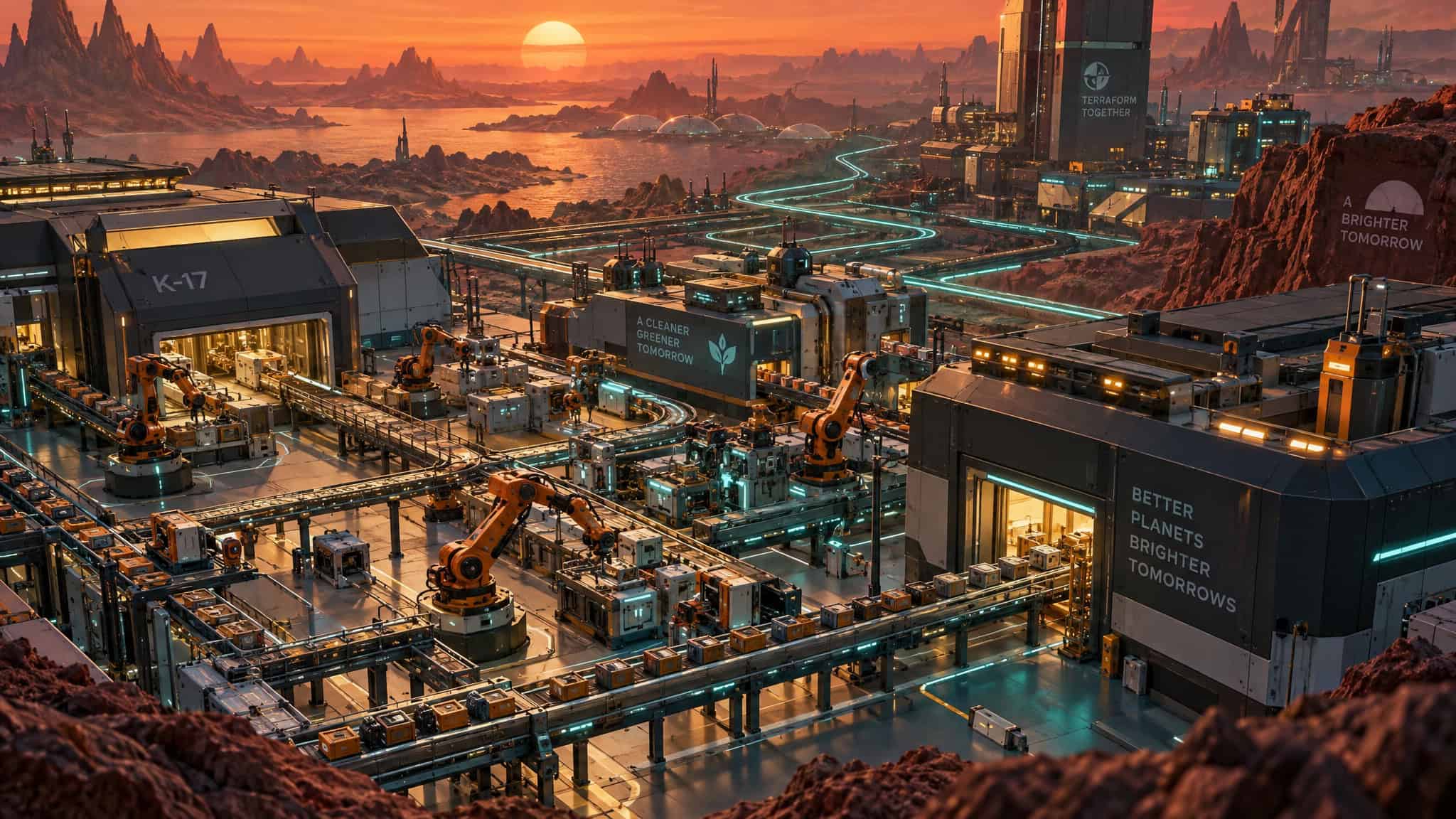
You crash-land on an alien planet and build supply chains from mining to rocket launch. That’s Factorio: a systems-design game in a survival skin, and a clean case study of the four elements of game mechanics combining into a functional whole. The programmer-brain parallels are almost embarrassingly direct: blueprints are copy-paste for machine configurations, building at a higher level of abstraction, like a standard library. Debugging a factory bottleneck is refactoring.
The combinator logic is literally Turing complete. Multiplayer even enables specialization, like a team splitting up a codebase.
I’ll admit it plainly: this was my biggest time sink ever, and I never reached the rocket launch. The factory must grow. The rocket, apparently, must not.
Input innovation: the layer that decides who can play
The least glamorous axis of innovation is also the one that decides who gets to play at all.
Street Fighter II and the beat bar
Street Fighter II hit arcades in 1991 and popularized one-on-one fighting, pioneering rapid combos, special moves, and the Ryu/Ken fireball input motion that shaped every fighting game since. Mortal Kombat, Virtua Fighter, and Tekken all stand on that foundation, and SFII’s depth and balance are still respected today.
Crypt of the NecroDancer mashes rhythm and roguelike: every key tap must land on the musical beat. Ridiculously hard, but meditative once the rhythm clicks, and hesitation gets punished. And a NetHack aside because it’s a gift: in development since 1987 (latest release May 7, 2019), the ASCII roguelike sometimes drops your previous run’s corpse in as lootable content. Your past self is literally part of the level.
DDR and Wii Sports
Dance Dance Revolution arrived in arcades in 1998 with a patented dance platform and a radical requirement: zero twitch skills. Konami pioneered the concept, it reached people twitch games never did, and it birthed the music-game genre Guitar Hero later popularized. Wii Sports (2006) did the same for living rooms: motion controls playable instantly, grandparents included.
Superhot is the time-bending cousin in this family: time moves only as fast as you move, so even bullets in flight slow down enough to dodge. Closest comparison for the time-manipulation feel is Prince of Persia: Sands of Time’s rewind.
The analog stick and the mouse
Super Mario 64 (N64, 1996) literally invented 3D platforming, and this is the rare superlative that’s just factual. It set the analog-stick movement and camera conventions that a hundred games after it copied. Warcraft (1994), on PC, did much to establish the mouse as PC gaming’s signature controller. Two input revolutions, and almost nobody thinks about them as mechanics, but they decided what playing a game could even feel like.
Originator vs. popularizer: why the credit lands on the wrong game
Credit usually lands on the game that made a mechanic iconic, not the one that created it, and the pattern is systematic. Nearly every “invented it” claim on a mainstream list is really a popularization credit. Run the pairs:
- Alone in the Dark pioneered survival horror; Resident Evil (PlayStation, 1996) made it iconic with scarce ammo, bullet-counting tension, cramped rooms, and claustrophobic camera angles. Resident Evil 4 later re-invented the series and set the stage for modern third-person shooters like Gears of War.
- DDR originated music-rhythm; Guitar Hero popularized it.
- Demon’s Souls preceded Dark Souls (2011, FromSoftware, Hidetaka Miyazaki), which popularized the formula and inspired Bloodborne, Sekiro, Elden Ring, Lies of P, and Lords of the Fallen. The “Git Gud” culture is a separate legacy, and we love the games anyway.
- Dune II preceded Warcraft, which made RTS a sensation instead of a genre tip.
It’s second-mover advantage, and once you see it, you can’t unsee it.
Doom, GTA III, and the games that changed the industry
Some games don’t just add a mechanic, they change what the industry is. Doom founded a genre, GTA III rewrote what a sandbox could be, and World of Warcraft turned an online world into a place people lived. This section is the heavy hitters, the games whose innovations stacked into whole new categories.
Doom’s full innovation stack
Doom (PC, 1993) gets credit over Half-Life for founding the FPS genre, and the résumé is stacked: true first-person immersion, adaptive enemies, reactive environments, online deathmatch (the game coined the term), and the shareware distribution model. The US Library of Congress picked it for preservation in 2007 as one of ten games, it spawned six more games and two films, and GamePro closed its review with a salute to the Dark One. Founding a genre and revolutionizing its storytelling are different achievements; Doom owns the first, Half-Life (PC, 1998) owns the second with real-time, cut-scene-free storytelling through voiceless Gordon Freeman, conventions that held for a decade-plus.
GTA III
GTA III (PS2, 2001) popularized the non-linear 3D sandbox and nearly single-handedly drove PS2 dominance, “nearly” doing real work in that sentence. Sid Shuman described first playing it as feeling struck by lightning, and players famously ignored missions to hunt Hidden Packages. Its descendants: Mafia, Saints Row, Sleeping Dogs, Watch Dogs.
World of Warcraft
World of Warcraft (PC, 2004) refined the MMO formula to near-perfection with cooperative raid content across Azeroth, and players formed lifelong friendships in there. No irony on that beat. Some of those friendships outlasted the subscription.
The rest, compressed
BioShock (2007) made you choose to harvest or save the Little Sisters of Rapture, with Objectivism in playable form. The Sims (2000) had no goals and no win condition; the absence of goals IS the mechanic, and it notably succeeded with female players. FFVII (1997) pushed music, story, and graphics to new heights, and its PlayStation exclusivity arguably gave Sony the edge. Geometry Wars (2005, Bizarre Creations) went digital-only on Xbox Live Arcade and became one of the most-played Xbox games never in a box.
COD4 (2007) brought RPG-style XP to multiplayer, plus the nuclear-bomb twist and the AC-130 mission. Halo (2001) made recharging shields and two-weapon limits universal FPS law, subtle tweaks compounding rather than one big idea. LittleBigPlanet (2008) brought user-created content into the mainstream. Metal Gear Solid (1998) defined cinematic stealth with Solid Snake. Shadow of the Colossus (2005) made boss-only combat into art, and made you doubt yourself before killing docile-seeming giants.
Before mechanics had names
Pong (1972) proved arcades commercially viable, which is the whole story and it’s a big one. Space Invaders (1978, Taito) introduced arcades to the high score, and promptly learned that three-letter profanity in the initials was part of the appeal. Pac-Man (1980) and Ms. Pac-Man (1982) expanded gaming’s audience with distinct ghost personalities. Tetris (1985, Alexey Pajitnov) legitimized puzzle games with nothing but elegant rules.
Super Mario Bros. (1985) sold 58M+ copies and revived the post-crash industry. Zelda started in 1986, popularized nonlinear exploration before “open world” was a term, and now spans 21 core games plus a Wes Ball film due in 2027.
Brilliant but abandoned: one-offs and the adoption tax
Not every great mechanic spreads. Some are genuinely brilliant and still die with the game that invented them, never imitated, never inherited. This section is about those one-offs, and about why brilliance alone doesn’t guarantee adoption.
The one-offs nobody copied
Rapid fire through the weird stuff: Metal Gear Rising: Revengeance’s Blade Mode, precision slashes you dial in mid-swing, unreused since 2013. Fight Night’s Total Punch Control, analog-stick punching carrying the Knockout Kings lineage. Lost Planet 3’s in-mech MP3 playlists, so your giant robot jams to your mix. Brilliant mechanics, all of them, and none got adopted. Don’t let anyone tell you they influenced anything, because they didn’t.
Mechanics that deserve wider adoption
Resident Evil’s grid inventory is Tetris-with-loot, and RE4’s attaché case is the best version of it; it’s really only been echoed in Dredge. Earthbound gave you instant wins against trivial enemies, respecting your time decades early. God Hand (Clover Studio) inverts dynamic difficulty: six levels, rising from 0 up to “Level Die” when YOU play well. It punishes showoffs. And the glue cannon: a non-damaging tool that enabled intentional stair-building skips, in a game offering 15+ hours of content that speedrunners finished in under seven minutes, Typhon monster skip included.
Sub-seven minutes. Let that land.
Here’s the contrarian close: precision is an adoption tax. Mechanics demanding analog or timing precision get praised by enthusiasts and skipped by the mainstream, so studios stop building them. Freeflow Combat won partly because it demanded less precision than Blade Mode. Ease of copying, not brilliance, predicts adoption. Which puts the Nemesis System’s non-adoption in the same bucket of open questions: nobody has a source-supported answer for why genuinely great mechanics stall, and pretending otherwise would be its own kind of fake.
So what does “best” actually measure here? Impact, not sales and not raw genius, and spreading turns out to be about copyability more than anything. Next time someone calls a mechanic innovative, run the one-question test: what rule changed, and on which axis, control, simulation, social, input, or distribution? If they can answer that, they’ve got a real claim. If they can’t, they’ve got a favorite game.
Frequently Asked Questions
What are the most innovative game mechanics of all time?
The strongest claims span different axes: Doom founded the FPS genre and coined ‘deathmatch,’ Half-Life revolutionized real-time storytelling, Super Mario 64 invented 3D platforming and set analog-stick conventions, Arkham’s Freeflow Combat became the industry-standard counter system, and Death Stranding’s Strand mechanic invented asynchronous cooperation with strangers. ‘Innovative’ means different things on each axis, which is why these lists always fight.
Bullet time vs freeflow combat: which game mechanic influenced modern action games more?
Freeflow Combat, and it’s not close. Counter-based combat from Batman: Arkham Asylum became standard across modern action games because its one-button, low-precision input was easy to copy. Bullet Time was cinematic and influential in its own way, but precision-heavy mechanics get praised by enthusiasts and skipped by mainstream studios — ease of copying, not brilliance, predicts adoption.
Why was the Nemesis system never reused in other games?
Honestly, nobody knows for sure. Shadow of Mordor’s orc-rivalry engine was a hit right out of the gate — enemies got promoted when they killed you, power vacuums reshuffled the chain of command, and defeated orcs returned scarred with your actual wounds. Yet no major successor ever adopted it, and available sources document the non-adoption without explaining it. It sits alongside precision-heavy one-offs like Metal Gear Rising’s Blade Mode as a genuinely open question.
How did Minecraft popularize crafting in video games?
Crafting first appeared in early adventure games of the ’80s and ’90s, but Markus Persson’s blocky sandbox made it mainstream. In Minecraft, the crafting table isn’t a feature — it’s the loop you live in, turning raw materials into tools as the core of play. After Minecraft blew up, tons of games bolted crafting on as a progression gate, which is exactly the checkbox approach the original avoided.
