
Outsourcing your thinking means [handing the thinking itself](#planned-you-can-outsource-your-thinking) to an external agent like ChatGPT, and yes, that’s different from using a tool to store or compute.nt from using a tool to store or compute. Here’s the concrete version: you sit down with a blank page and write your own outline, or you type “give me an outline for this essay” and get one back. The first is your brain working with a scratchpad. The second is your brain watching.
If the second one feels different from using a calculator, your intuition is correct, and most coverage of this stuff, including a Brookings policy report we’ll get to, blurs exactly the line your gut is detecting. We dig into how things work here at GeekExtreme, including the ones inside your skull, so let’s draw that line properly, look at what the evidence shows, and end with a practical rule for what to delegate and what to keep.
Key Takeaways
Offloading stores what you already thought (your outline, your grocery list); outsourcing transfers the thinking itself to ChatGPT. Edtech researcher Paul Kirschner’s line: tools that hold what you’ve already thought support cognition; tools that do the thinking for you replace it.
The numbers are real, not vibes: among 319 knowledge workers, higher confidence in generative AI tracked with less critical thinking (Lee et al., CHI 2025), and physicians’ unassisted polyp-detection fell from 28.4% to 22.4% within 3 months of AI joining colonoscopy workflows (Budzy? et al., 2025).
Structure is the variable: the same tool produced the worst and best essays depending on whether the human thought first. Gerlich’s 150-participant experiment found ChatGPT plus a structured prompt sequence earned the highest expert scores.
Table of Contents
Offloading vs. outsourcing: the distinction everyone gets wrong
The decisive difference: does the tool hold what you already thought, or do the thinking itself?Offloading is the grocery list, the math you scribble on paper, the outline you wrote yourself. It frees up working memory, which has limited capacity. Think of it as RAM management for your brain: useful, not cheating. Outsourcing is when the reasoning goes to ChatGPT and you receive the output.
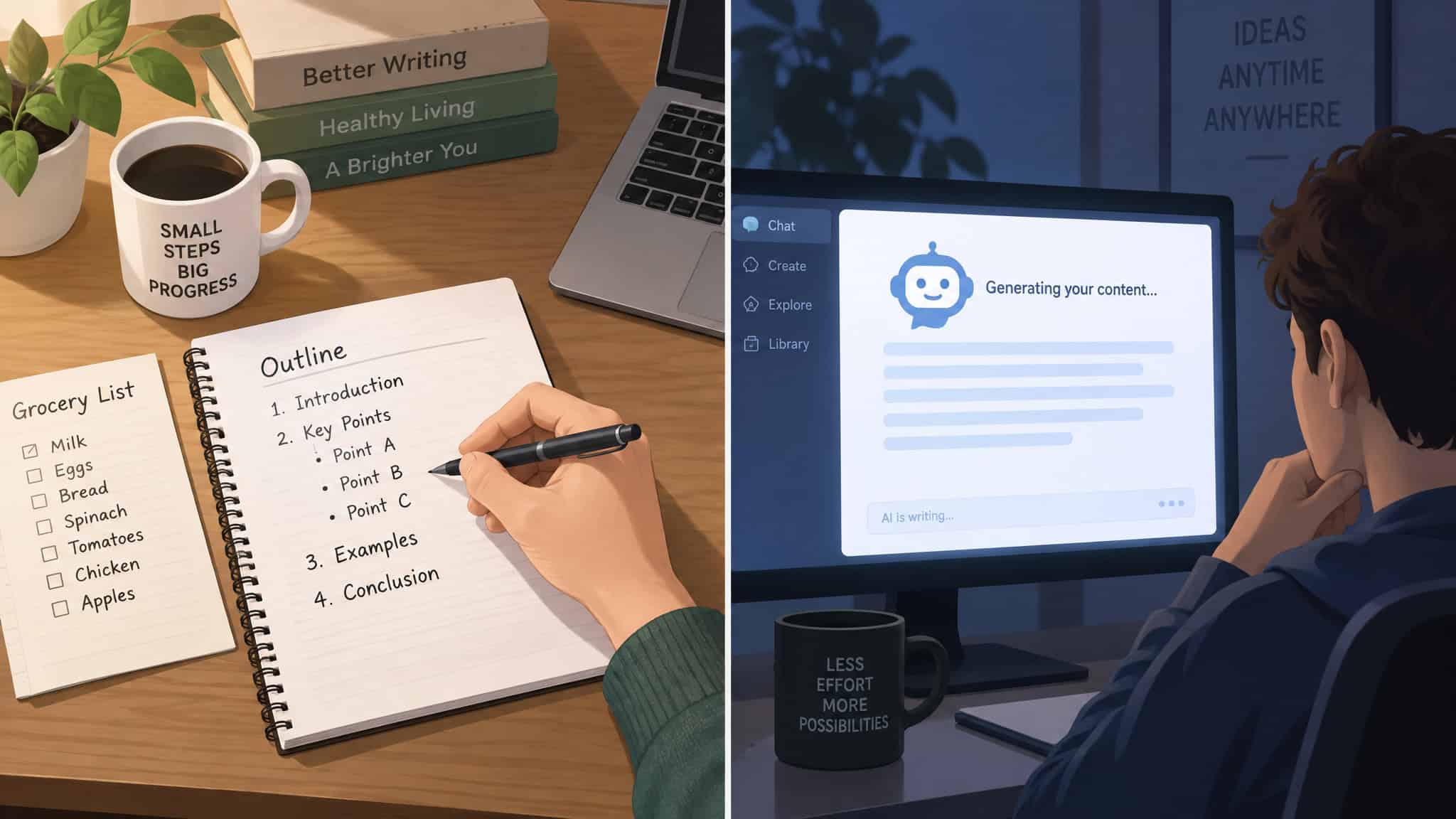
Edtech researcher Paul Kirschner, writing on his kirschnered.nl blog in January 2026, drew this line explicitly, and his hinge is quotable in spirit: tools that hold what you’ve already thought support cognition; tools that do the thinking for you replace it. And here’s the fun receipt, a Brookings policy report on AI in education used “cognitive offloading” 57 times and “cognitive outsourcing” 15 times, interchangeably, never distinguishing them. The hype framing blurs this because the distinction makes the product look bad. Why does delegation appeal so strongly in the first place?Cognitive miser theory: brains conserve effort by default. That’s firmware, not laziness.
Why AI isn’t just a calculator or notebook
Generative AI isn’t “just a tool” because it chooses relevance, structure, arguments, and tone, those are judgment calls, not hammer swings. A notebook and a calculator were scaffolds: they required your active thinking and enabled more internal processing. Generative AI operates as a cognitive surrogate, producing complete output with minimal ideation or reflection from you.That’s simultaneously the feature and the bug.

Side by side: outline software helps you generate and arrange your own ideas. An AI essay generator produces a full essay with no thought from you. The “calculators have always existed” rebuttal dies here, because a calculator waits for your input.
Kirschner has a business analogy that makes the creep visceral. Picture a costume jewelry company that rents a warehouse for inventory, then outsources manufacturing, then assembly, then marketing, then design, until it’s an empty shell with a logo. Each step felt reasonable. His caveat matters: outsourcing can make sense if you don’t overdo it.
And the slide is usually gradual, you polish sentences you wrote, then ask for an outline, then ask for the full draft. Each step is a small efficiency gain. Starting from AI output also skips the writing processes where learning lives: synthesizing new thoughts and revising existing ones. The source’s neural-pathways claim (heavy use might erode pathways for higher-order thought) is their low-confidence argument, not demonstrated neuroscience.
The assistive, substitutive, and disruptive spectrum
There’s a proposed three-tier taxonomy for where a tool lands: assistive offloading helps without interfering, substitutive offloading replaces cognition, and disruptive offloading is passive interaction that erodes mental control and reflection.
Assistive
Reminder apps and digital sticky notes. You keep monitoring and control; the tool just holds the list. Scaffolding that strengthens autonomy. The good tier.
Substitutive
Auto-suggest and predictive search: the tool does the encoding and retrieval for you, and this is where the illusion of competence begins, more on that below.
Disruptive
Passive interaction where self-monitoring fades, reflection loops collapse, and attention becomes externally driven and reward-seeking. Say it plainly: this is the doom tier.
The framework maps across four domains: memory, metacognition, attention, and learning autonomy. Full honesty: this is a proposal from a Frontiers in Psychology opinion article, not settled consensus. Cool framework, but it’s new. Either way, it converts neatly into a two-question self-diagnostic for any AI habit you have: how many internal operations did this habit replace, and could I still do them?
Everyday outsourcing: when delegation is fine and when it costs you
Yes, constant GPS reliance is linked to a weaker sense of direction and declining unassisted navigation (Miola et al., 2024; Dahmani and Bohbot, 2020). That’s a documented trade-off, not a moral judgment. GPS is still the right call for unfamiliar routes and traffic. It’s the precedent case: we’ve watched a tool erode a skill before, so AI effects aren’t unthinkable.
Low-stakes delegation
Your phone alphabetizes your contacts. Minimal risk, clear benefit, easy yes. Nobody’s losing cognitive muscle to sorted contacts.
GPS
The honest middle rung.Useful, with a real cost you’re probably fine paying most of the time.
When the tool disappears
Here’s the hidden failure mode: Grinschgl and colleagues found, in a 2021 study in the Quarterly Journal of Experimental Psychology, that offloaded memory beats memory-only while the store is accessible, but recall collapses below memory-only if the store is unexpectedly unavailable. Lauren Richmond’s framing is perfect: the grocery list helps if you bring it, and hurts recall if you leave it at home. The dead phone with unsynced notes is the relatable version.The trade is asymmetric: benefits are conditional on availability, costs are paid unconditionally.
That’s a single point of failure, for your brain. And offloading reshapes attention allocation, not just recall. Kelly and Risko (2022) found people engage less with information they expect to live externally, and Lu et al.(2020) found offloading increases false recall, which is the surprising one.

What the evidence shows: memory, attention, and the illusion of competence
The evidence is correlational but specific: among 319 knowledge workers studied by Microsoft and Carnegie Mellon researchers (Lee et al., CHI 2025), higher confidence in generative AI tracked with less critical thinking at work. More trust, less checking.Chiu (2024) adds the loop mechanism: better grades for little effort pulls students deeper into dependence, like an easy-mode spiral in a game.
Memory
The Google Effect (Sparrow, Liu, and Wegner, 2011, and replicated in the Social Sciences Replication Project (Camerer et al., 2016)): expect information to be available online and you remember where it lives, not what it says. You already feel this with phone numbers and URLs. “Digital amnesia” is the popular name.AI-specific shifts go further: Grinschgl and Neubauer (2022) found that encoding, problem-solving strategies, even goal formation change.
Goals drifting toward what the tool can do is the wild part. Teachers in the Brookings report’s interviews, spanning 50 countries, describe a digitally induced amnesia where students can’t recall what they submitted. Heavy AI-answer use in education correlates with surface learning and displaces retrieval practice, which Karpicke and Blunt (2011) identified as essential for durable learning.No retrieval, no consolidation.
Attention and skill
Constant multitasking and always-on availability impair sustained attention and cognitive flexibility (Lee and Schumacher, 2024), and heavy multitaskers make more mistakes (Figueroa et al., 2014). Benitez et al. (2017) raise the developmental stakes: sustained attention underpins cognitive flexibility, so early or prolonged distraction can have long-term effects.A useful self-check: if you’re struggling to formulate the question, that’s a signal you’ve already disengaged from high-level thinking.
Then the output-quality evidence: Shiri Melumad and colleagues (PNAS Nexus, Vol. 4, No. 10, 2025) found writers using ChatGPT or Google’s AI overview searched less, wrote shorter and less detailed summaries, and their advice rated less helpful, trustworthy, and adoptable than traditional-search writers’. The gut-punch: in a Polish natural experiment (Budzy? et al., Lancet Gastroenterology & Hepatology, Vol. 10, No. 10, 2025), physicians’ unassisted polyp-detection fell 6 percentage points, 28.4% to 22.4%, within 3 months of AI joining colonoscopy workflows.Experts aren’t immune. Macnamara’s NSF-funded work on AI-assisted radiology and laparoscopic surgery asks whether skills decay, whether AI-trained clinicians learn as deeply, and whether AI breeds overconfidence, open questions.
The metacognitive trap
Judgment of Learning studies (Hu et al., 2019; Hoch et al., 2023) find that people overestimate how well they know AI-produced output, and that miscalibration cuts feedback-loop revisions. You can’t fix what you wrongly think you know.A common sign: fluent output on demand, stumbling when asked to defend a specific claim in it. The ambiguity-intolerance idea, that removing ambiguity may make users intolerant of it, is a flagged hypothesis with no quantified data behind it. Argument, not evidence.
Who’s most at risk: adolescents and the developmental displacement effect
Risk is developmentally graded: an adult outsourcing a mature skill faces decay, but an adolescent whose executive functions (planning, impulse control, self-regulation) are still maturing faces displacement, internal processing externally displaced before internal mastery ever forms, the developmental displacement effect (Sun, 2024).Sun et al. (2024) linked heavy school-task AI use to lower self-monitoring and poorer metacognitive accuracy over time, cited as an instance of disruptive offloading. Meunier-Duperray et al.
(2025), Bai et al.(2023), and Iley and Medimorec (2024) all point to the immature-executive-function precondition. Today’s teens are the first cohort to grow up delegating cognition from the start, a live experiment, watched with fascination, not dread.
When AI actually helps you think: structure of use is the variable
“AI makes you lazy” is wrong in both directions. Same tool, worst and best essays, and the difference was whether the human thought first. The harms side: Lee, H. P., and colleagues at CHI 2025 found more AI confidence meant less critical thinking; Melumad’s experiments found AI-assisted writing was shorter and rated less helpful; and LLM essay writers showed weaker EEG connectivity (Kosmyna et al., 2025, an unreviewed arXiv preprint, so preliminary). So the honest verdict is: AI dulls your thinking when you let it replace the work, and sharpens it when you structure the use, think first, then delegate.
The benefits side is where Michael Gerlich’s experiment shines: 150 participants, three conditions, and the ChatGPT-plus-structured-prompting group, which thought independently first and only then used AI for targeted research, earned the highest expert scores against both no AI and unguided ChatGPT. Structured prompting mitigates anchoring.And Jackson G. Lu’s field experiment, run at a Chinese tech consulting firm, gave 250 employees one week of randomized ChatGPT access: their work rated more creative, with the effect strongest for people high in metacognitive skills who used AI deliberately, generating ideas, switching perspectives, retrieving info. Honest caveat: this evidence is short-term and task-specific, and structured use isn’t proven to preserve all skills long-term.
What can’t be outsourced: originality and the light-bulb limit
Outsourcing to algorithms costs you originality, because AI recombines existing knowledge. Gerlich’s analogy is crisp: AI can improve a candle’s brightness, cost, and design, but it can’t invent the light bulb.That’s the source’s argument, not settled fact, and the hedge stays, heavy outsourcing could gradually weaken creativity. Brooke Macnamara connects the mechanism: entirely original problems are the ones with no training data, which is exactly why human skills have to stay sharp for them.
There’s a second squeeze from the recommendation side, algorithmic feeds optimize engagement over novelty, an “invisible cage” narrowing your exposure, while creativity depends on accidental, diverse connections. Five productivity videos lead to more productivity videos.The remedies are experiments, not commandments: reintroduce friction, boredom, first-draft thinking, maybe a one-day manual-choice detox. The practical thesis deserves weight: use AI as a sparring partner, not a ghostwriter.
Guardrails: how to decide what to outsource and keep what matters
The useful question isn’t “should I use AI” but “which of my tasks are load-bearing for skills I need to keep.”
The task-analysis rule
Separate completion-only tasks from essential-learning tasks.Offload the former, keep the latter. Huff and Ulakçi (2024) frame the same split as de-skilling versus upskilling, and Hertzog and Dunlosky (2011) supply the underlying principle: use external aids deliberately, based on what you actually want your memory to do.
The expertise gradient matters too: experts evaluate AI output better than novices, which is a genuine catch-22, you need expertise to catch the mistakes. Nita Farahany’s contrast is clean: an experienced lawyer can audit AI legal output where a first-year law student can’t, so routine memos are offloadable while case-law analysis stays yours.Farahany herself offloaded email sorting to AI and used the recovered time for a sewing class with her daughter. David Evans, an economist at Microsoft, uses LLMs for literature reviews and deliberately swaps less-used skills for ones he wants to develop, portfolio management of your own abilities.
For students, Kirschner and the Brookings authors alike stop short of calling for bans on AI. They oppose supplanting, not supplementing. And the solution conspicuously absent from the report: explicit, sequenced writing instruction, because writing strengthens retention, understanding, and analysis, and it’s where AI is most seductive precisely because it’s hard.The difficulty is the feature. The Teach Like a Champion jotting-notes move is healthy assistive offloading: students jot thoughts before discussion, which guards against the transient information effect (info that vanishes before you can process it overloads working memory) and frees working memory to actually listen.
Works for meetings and standups too. One honest irony: the report’s own authors admit using AI somewhat while drafting it.Everyone’s in the pool. Synthesizing recommendations from Mutlu Cukurova, Nita Farahany, Mindy Shoss, Jackson G. Lu, and Michael Gerlich: clear norms, guardrails, and incentives prevent chaotic AI slop, and speed-focused incentives actively penalize critical thinking. Reward fast, get fast and shallow.
Design-level fixes and interventions
Constructive friction (Estaphan et al., 2025) means interface features that pause interaction to prompt reflection or recall: delayed AI responses, confidence-rating prompts, reflection prompts before AI content shows up.These pauses preserve engagement without hurting accessibility, and the research is early, future work should test them in education and health care. Two theory anchors ground it: Cognitive Load Theory says balance mental effort to optimize learning, and Self-Determination Theory says competence and autonomy drive motivation. Frictionless design risks favoring efficiency over growth.
The umbrella term is cognitive sustainability: designing tech and learning environments that preserve effortful processing, promote reflection, and foster agency.The interventions list is familiar learning-science, not novelty: metacognitive training, retrieval-based learning, productive struggle, and “AI aware cognition”, knowing when to reach for AI and when to keep pushing. Don Norman’s criterion (2024) is the right close: judge intelligent systems by their impact on the quality of human thought, not just their performance.
Keep Kirschner’s one-line test in your pocket: does this tool externalize something you already thought, or do the thinking for you?Then sit with the question the sources keep circling and never quite close: how much of our thinking deserves to stay in our own heads? Many answers are still open, the structured-use evidence is short-term, and the honest goal is digital literacy that builds reflection, not passive reliance.
Frequently Asked Questions
What does it mean to outsource your thinking to AI?
It means handing the reasoning itself to an external agent like ChatGPT — asking for an outline or full draft instead of producing one yourself. That’s different from offloading, which just stores what you already thought, like a grocery list or an outline you wrote. One supports cognition; the other replaces it.
What’s the difference between cognitive offloading and cognitive outsourcing?
Offloading is the grocery list, the scribbled math, the outline you wrote yourself — it frees up working memory without replacing your thinking. Outsourcing transfers the reasoning to the tool and you receive the output. Edtech researcher Paul Kirschner’s hinge: tools that hold what you’ve already thought support cognition; tools that do the thinking for you replace it. Policy coverage often blurs the two, using the terms interchangeably.
What is the Google effect and digital amnesia?
The Google Effect (Sparrow, Liu, and Wegner, 2011, since replicated) is the tendency to remember where information lives rather than what it says when you expect it to be available online. ‘Digital amnesia’ is the popular name for the same phenomenon. With AI it goes further: Grinschgl and Neubauer (2022) found that encoding, problem-solving strategies, and even goal formation shift toward what the tool can do.
What are the assistive, substitutive, and disruptive levels of cognitive offloading?
It’s a proposed three-tier taxonomy from a Frontiers in Psychology opinion article, not settled consensus. Assistive offloading helps without interfering — reminder apps where you keep monitoring and control. Substitutive offloading replaces cognition, like predictive search doing the encoding and retrieval for you. Disruptive offloading is passive interaction where self-monitoring fades and attention becomes externally driven — the doom tier.