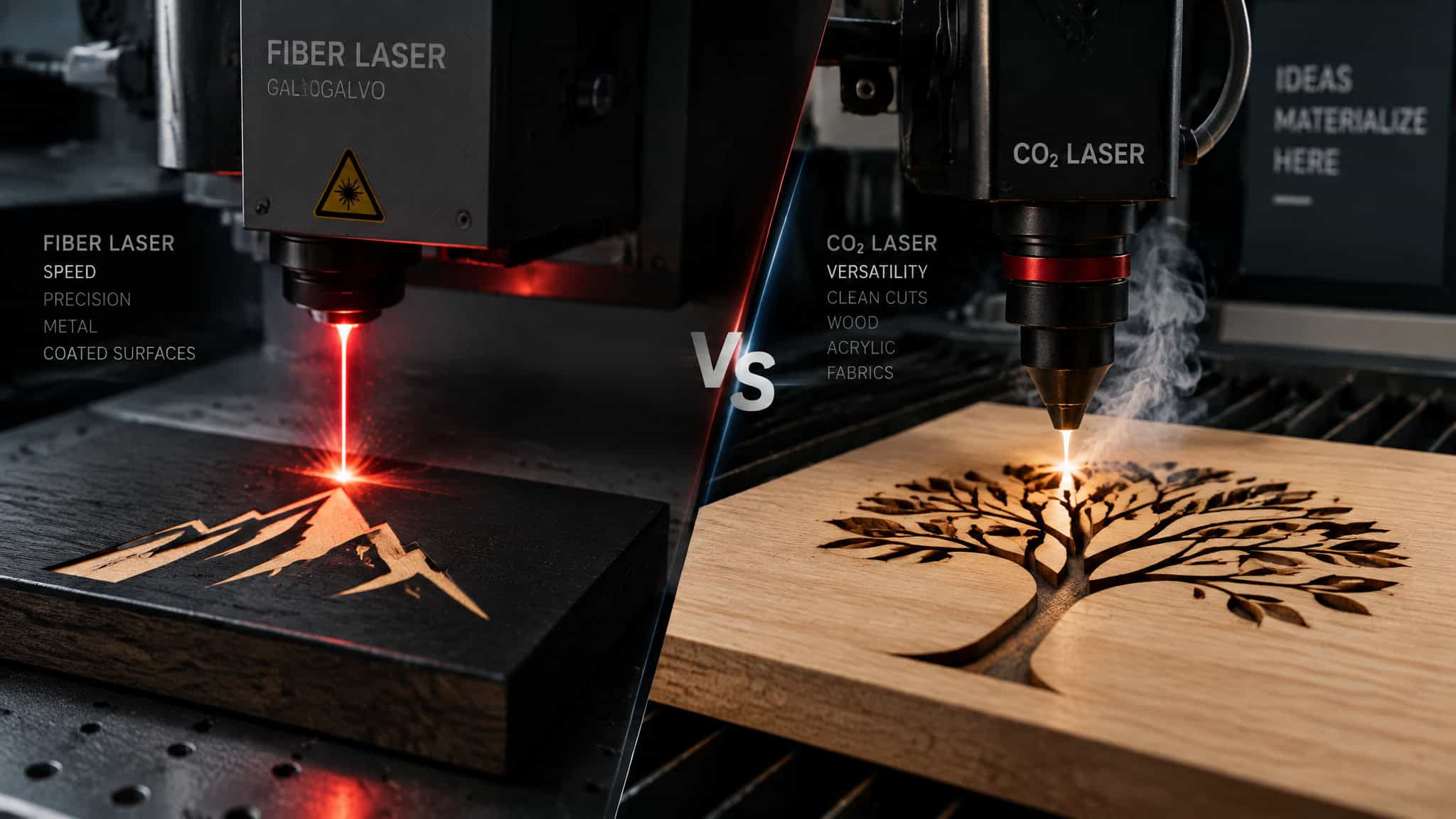
I went looking for fiber laser settings for wood, and the first thing I found wasn’t a chart. It was an industrial advisory from MECCO, dated February 3, 2021, that compares running a fiber laser over bare wood to starting a campfire. That’s not marketing hedging; that’s a company that builds marking systems for factories telling you the setup is a fire hazard. If you own a fiber or MOPA machine and you’ve been hunting for wood numbers, this article won’t hand you a fabricated table.
It’ll explain why the table can’t exist, then give you the workaround, the fire-risk framing, and a test protocol that actually works. (If you want the deeper parameter physics, our guide to [laser engraver settings](#planned-laser-engraver-settings) covers the full interaction map.)
Key Takeaways
Fiber lasers run at 1064nm, which wood partially transmits, so heat deposits unpredictably inside the material instead of at the surface. MECCO’s February 3, 2021 advisory calls fiber-on-wood a fire hazard and rates the resulting marks poor and uneven.
The only supported fiber-on-wood path is a dark coating: the beam marks the coating layer, not the wood, at lowest power, high speed, air assist on, small areas, constant attendance.
CO2 (10.6 µm) is the correct wavelength for wood and organics; fiber’s real home is metal, where a 30W unit black-anneals stainless at 40-60% power and 200-500 mm/s.
Table of Contents
Can a fiber laser engrave wood? The honest verdict
No, fiber lasers must not engrave bare wood, and the reason is baked into the physics rather than into any settings sheet. MECCO’s advisory is explicit about what happens: the 1064nm wavelength partially transmits through organic material, so heat builds up in places you can’t control, and wood being literal fuel means any fire spreads fast. Even when nothing ignites, the marks come out garbage. Some spots char black, others are barely identifiable, and the result looks random across the grain because, from the beam’s perspective, it is.
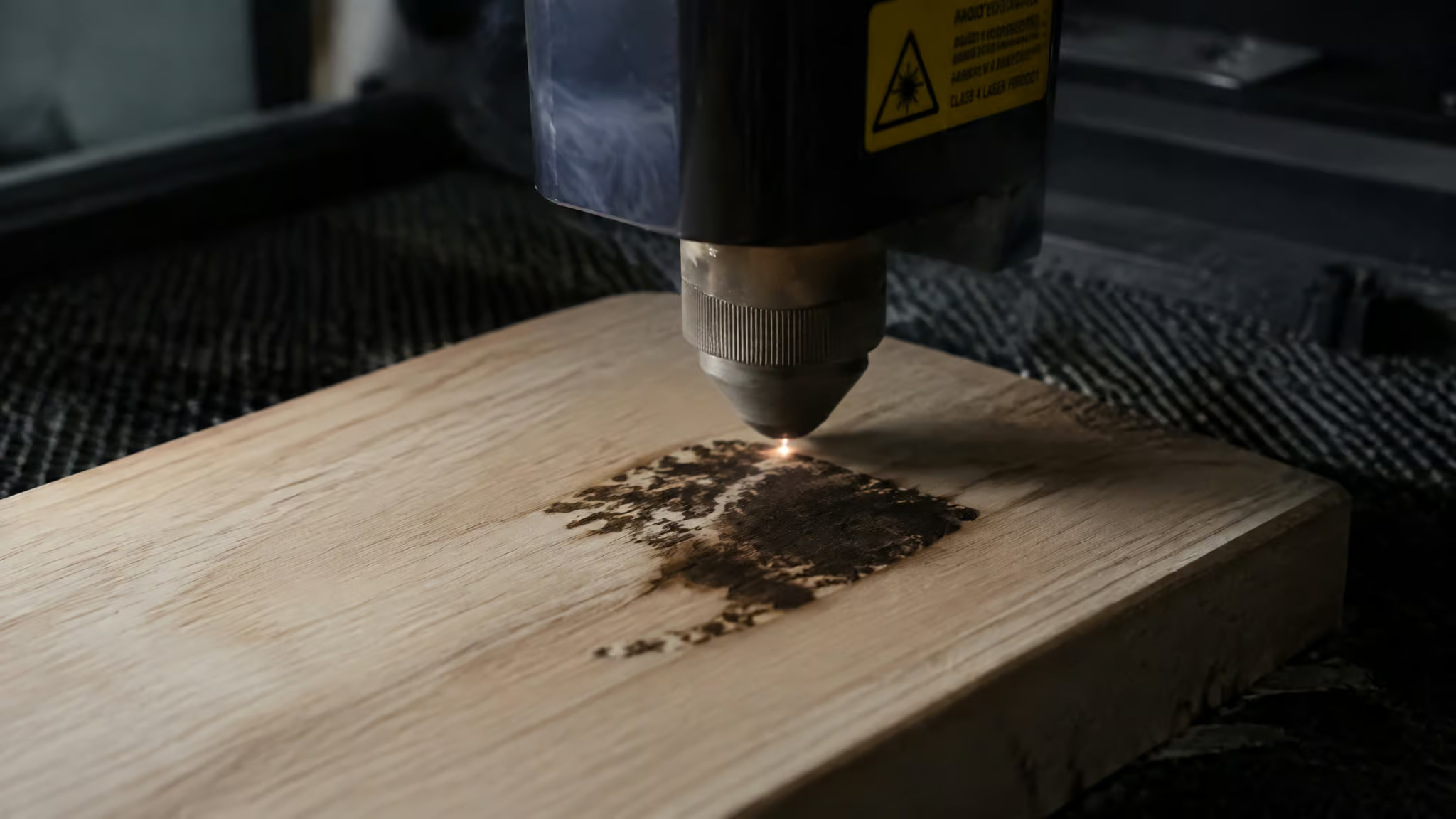
Here’s the part I find satisfying about this story.When Stanley Furniture needed permanent “Made in America” inscriptions on wood products at production scale, they didn’t go shopping for fiber parameters. MECCO test-marked wooden samples, picked a CO2 laser, and mounted it over a conveyor belt inside a Class 1 enclosure with openings at each end. Tight deadline, hit.
CEO Glenn Prillaman praised the work.The Stanley Furniture call came down to wavelength, not wattage.
The compatibility consensus across the hobby and industrial space says the same thing in three lines:
- Diode lasers: good on wood
- CO2 lasers: excellent on wood
- Fiber lasers: not suitable
That’s the verdict, and it’s not a “well, it depends” verdict. The prohibition is explicit, the physics backs it, and the one documented exception is the coated-wood workaround we’ll get to in a bit. If you take nothing else from this piece: the tool is the decision, not the settings.Which is annoying if you already own the fiber machine, I know. Keep reading anyway, because there’s a narrow lane where your machine can touch wood, and a whole universe where it’s the best tool on the bench.
Why the 1064nm wavelength fights wood (and CO2 doesn’t)
The 1064nm wavelength of a fiber laser is poorly absorbed by wood, and that single number explains the entire compatibility story. Fiber lasers run at 1064nm, which is 1.06 µm. Metals absorb that wavelength efficiently, which is why fiber does deep engraving and high-contrast marks on stainless, aluminum, brass, copper, and titanium so well. It’s what the machine is built for.
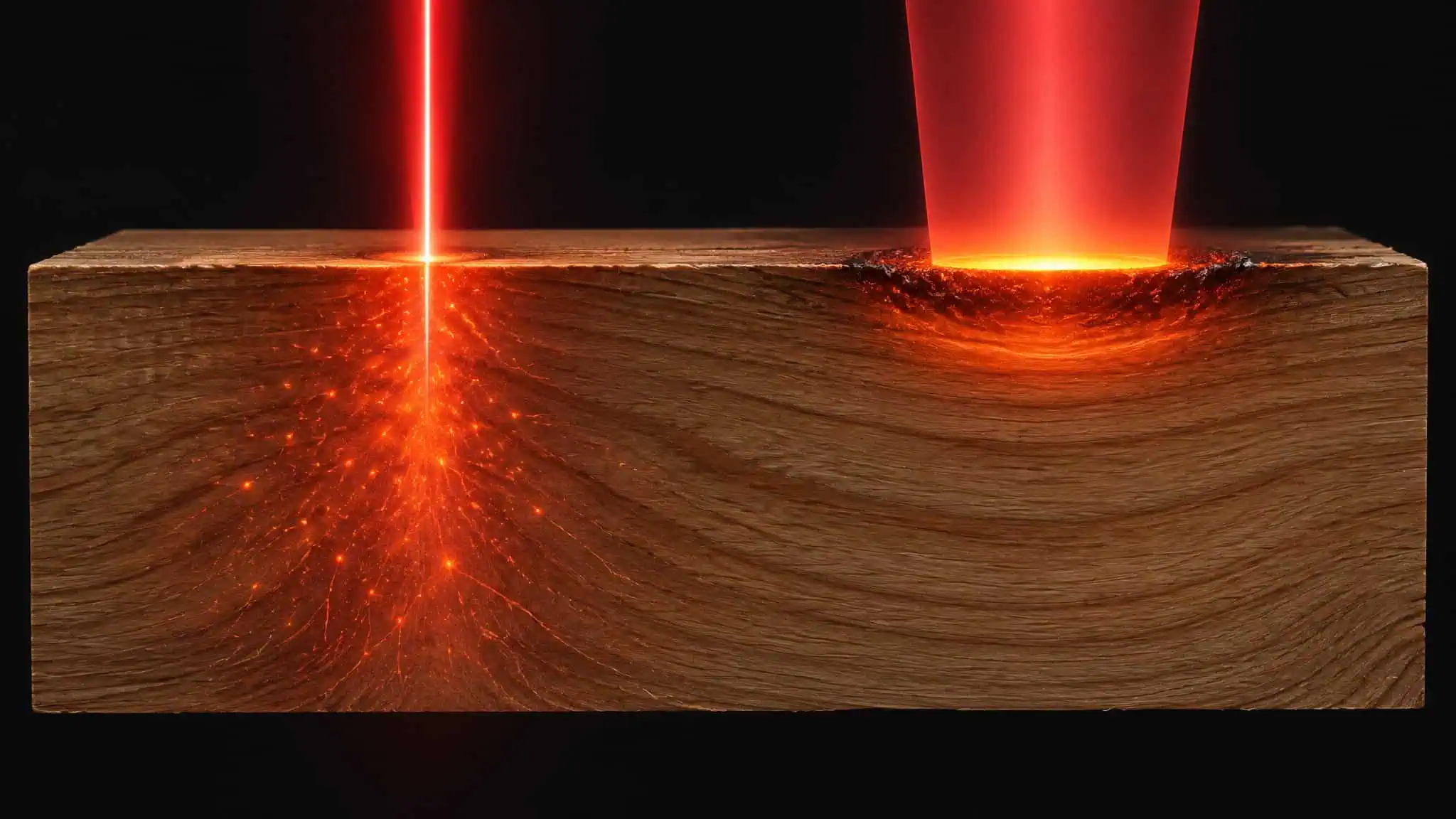
CO2 lasers run at 10600nm, or 10.6 µm. Ten times larger.That’s the aha moment of this whole article: the wavelength is ten times bigger, and organics absorb it right at the surface. Wood, leather, paper, fabric, clear acrylic, rubber, glass, stone. CO2 reacts with wood like an actual cutting tool because the energy lands where you put it.
The mechanism on fiber is sneakier.At 1064nm, the beam partially transmits through organic structures, so absorption can’t be controlled. Heat builds up inside the material instead of at the surface, and wood ignites when that happens. Notice what this means: the failure is structural, not a tuning problem.
The problem is where the energy goes, not how much.No power or speed combination fixes where a wavelength gets absorbed.
Why copied settings charts fail twice on a fiber machine
The first thing a galvo or fiber machine exposes that your diode friends never see: diode lasers typically expose only power and speed, while galvo and fiber machines add frequency and Q pulse on top, and interval (line density) is job-specific with no universal number. Two extra dials that don’t exist in diode tables at all. So when you paste a diode-wood chart into a fiber machine, it fails structurally before it even fails numerically. The knobs don’t align.
Then there’s the chart everyone finds first, the 60W CO2 wood table: 15-25% power at 300-500 mm/s for headline work, 15-40% for general wood. Those numbers are valid only for a wavelength wood absorbs at the surface. Say it with me: those are 60W CO2 settings.That label is the joke and the safety net at the same time.
Wattage scaling works only within the same laser type, and even then it drifts, because CO2 tubes degrade. A 60W tube may drop to 50W or lower after 2,000-4,000 hours, so old settings age right along with the machine.
For the record, the core knobs do the same things everywhere: more power burns deeper and darker, faster speed gives lighter marks, higher frequency smooths engraved lines while lower frequency suits vector cutting, DPI sets detail (250-300 for bold engravings, 400-600 for logos and text, 600+ for photographic work, where Stucki or Jarvis dithering earn their keep), air assist blows compressed air at the cut point to cut charring and flame-ups, and focus is just the lens-to-surface distance, nailing it gives you the smallest spot and sharpest detail.High power plus low speed overheats; low power plus high speed gives faint marks. Those tradeoffs are universal. The wavelength they’re applied to is not.
And a common failure pattern worth naming: a MOPA owner who black-anneals stainless every day runs wood at metal-like power.The mark comes out blotchy, darker and lighter randomly across the grain. The tell is that the inconsistency follows the grain structure, not the settings, because the beam is depositing energy wherever the wood’s internal structure happens to absorb it.
When fiber-on-wood works: the coated-wood workaround
Yes, when marking wood with a fiber laser you need a dark coating, and that’s not a tip, it’s the mechanism. Tom’s Hardware’s hands-on with the ComMarker B6 MOPA found that wood requires a dark coating before the fiber beam responds at all.Bare wood, nothing happens worth keeping.
Here’s the part mainstream coverage never spells out: the coating is the absorber layer. The beam marks the coating, not the wood underneath. Bare wood is still sitting there misbehaving the way it always does; you’ve just given the wavelength something it can interact with predictably.Which means every fiber-on-wood “success story” you’ve seen is secretly a coating story.
The risk-minimizing conditions, if you go this route: lowest power, high speed, air assist on, small areas, constant attendance. Treat this as a pattern from hands-on testing and community practice, with the B6 MOPA review as the documented instance, not a universal recipe. No tested coated-wood parameter values here, and no food-safe or permanence claims. One aside from that same review that puts the machines in perspective: overdriving the B6 can bend metal.These machines mean it.
Settings as fire-risk controls, not quality dials
The safest fiber laser settings for wood are the ones that minimize heat input, full stop. Once you reframe every dial as an ignition-risk lever instead of a quality dial, the whole parameter sheet reorders itself:
- Speed up, power down. And the counterintuitive corollary: for deeper marks, cut speed by 10-15% rather than adding power.
Slower exposure without more energy. - Air assist suppresses flame-ups and reduces charring. Masking or transfer tape acts as a sacrificial layer against smoke residue.
- Species matters as a risk factor: high-resin pine chars easily and is the worst-case fiber-on-wood candidate.
- Attendance is part of the settings. Never leave a running laser unattended with flammable or high-resin stock, keep a fire extinguisher within arm’s reach, and enable flame detection if your machine supports it.
The failure pattern to watch for is the one MECCO’s campfire comparison describes: a flash or a sudden deep char where the beam lingered, and blotchy marks that vary across the grain. If you see that, the wavelength is telling you where the energy went, and it wasn’t where you aimed.
Dial in your own settings: a fiber-safe test protocol
Since no honest fiber-on-wood chart exists, the protocol is the deliverable. Start at minimum power, always.
Build the grid
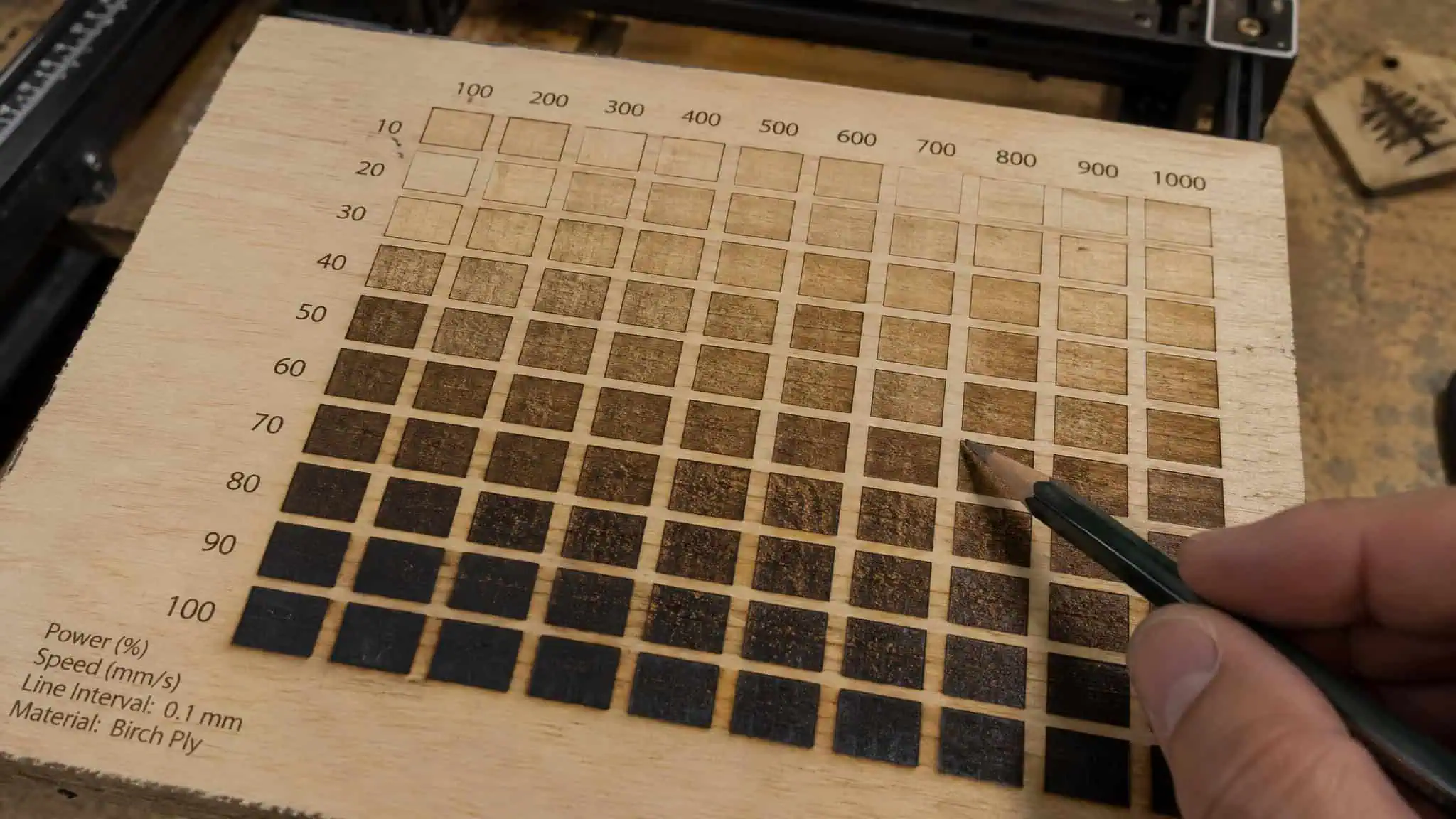
Lay out a grid of 10-15 mm squares on scrap, columns are speeds, rows are powers, and label the axes on the material itself. Label it or regret it; unlabeled test grids are archaeology within a week.Pass/fail criteria are simple: no flame, no deep char, mark legible. On a galvo or fiber machine, add frequency and Q pulse as grid axes too. Judge each square on contrast, depth, edge sharpness, and discoloration.
Converge and save
Run the grid, pick the best cell, nudge around it, repeat.Starting from LightBurn defaults, this converges in 2-3 test runs. Save the winning cell to a named material-library entry so you never run the same test twice. The demonstrated convergence I can point to: about 300 mm/s at roughly 75% power, frequency around 20, Q pulse around 130, on 3mm matte acrylic with a 60W MOPA galvo.
That’s a method illustration, not wood settings.The workflow itself came from a viewer named Jim, who was sick of ruining $20-25 tumblers by guessing, and it got verified with an octopus and a creepy clown test image, which is exactly the kind of QA methodology I respect.
The recurring bottleneck this solves: people burn expensive material guessing from charts made for a different machine, then re-run the identical failed test weeks later because nothing got saved. The library entry is the fix.
What fiber lasers are actually for, and what to do instead for wood
For wood engraving, use a CO2 laser.Fiber lasers are not suitable for bare wood, and everything above is why. But refusing the fake chart doesn’t mean leaving you empty-handed, so here’s both halves of the honest answer.
What a correct fiber table looks like
All of the following assume a 30W fiber unit, stated up front the same way the CO2 tables should be:
- Stainless: 40-60% power, 200-500 mm/s, 20-50 kHz, 1-3 passes, black anneal mark
- Aluminum: 30-50% power, 300-600 mm/s, 1-2 passes, white/gray mark
- Brass: 40-70% power, 150-400 mm/s, 2-4 passes, deep engraving possible
- Titanium: 30-50% power with color marking at low power, which is the cool one. Adjust the parameters and you get actual colors on titanium by oxide-film thickness.
Tiny wizardry.
Fiber also excels on plastics, and here’s the full-circle moment: laser plastic welding is growing in automotive and medical devices, with a predicted 8.3% CAGR for 2017-2025, precisely because plastic is non-organic. The same wavelength logic that disqualifies wood qualifies plastic.
The decision path for wood
- Bare wood, want the versatile answer: a 40-60W CO2 laser.
It cuts up to 5mm wood, marks cleanly at high speed, and handles leather, paper, fabric, clear acrylic, rubber, glass, and stone. (For cutting thicker stock, 80-100W handles up to 10mm and 150W+ industrial units reach 15-20mm, with air assist and multiple passes improving efficiency.) - Budget path: 10-20W diodes are affordable and good on wood, with fair tradeoffs. They can’t cut clear acrylic, the beam passes right through, and they need marking spray for metal. Cheaper isn’t wrong; just know the walls.
- Committed to the fiber machine you own: the coated-wood workaround, or marking-compound logic adapted to wood.
Small areas, attended, extraction on. - Mixed projects: split the project. Fiber for the metal hardware, CO2 or diode for the wood parts. Wavelength-fit logic beats any single-machine loyalty.
And the one-table summary, the compatibility matrix:
| Material | Diode | CO2 | Fiber |
|---|---|---|---|
| Wood | Yes (good) | Yes (excellent) | No (not suitable) |
| Cast acrylic | Partial (can’t cut clear acrylic) | Yes (excellent) | No (not suitable) |
| Leather | Yes (good) | Yes (excellent) | Partial (possible but may scorch) |
| Bare metal | Partial (surface-only with marking spray) | Partial (only with CerMark or Enduramark coating) | Yes (excellent) |
| Anodized metal | Partial (limited) | Yes (excellent) | Yes (excellent) |
That bare-metal CO2 cell is the recurring reality check in reverse: CO2 can’t touch bare metal because the wavelength reflects, but it marks anodized aluminum by removing the anodize layer, and bare metal with CerMark or Enduramark spray. Every machine has its wavelength-shaped lane.(If steel is your target, our fiber laser settings for steel guide goes deep on annealing and ablation parameters.)
Wood species risk ranking under a mismatched wavelength
Wood isn’t one material, and under a mismatched wavelength the species differences become risk differences. One honest label before we start: the species behavior below comes from CO2-source data. Fiber-specific species rankings are extrapolation from that data, and I’m framing them as exactly that.
How species behave
Hardwoods like maple, cherry, and walnut give crisp high-contrast marks but demand more energy, which under 1064nm means more uncontrolled heat. Softwoods like pine and basswood engrave easily but resin, knots, and grain cause uneven burning, and high-resin pine is the worst-case fiber-on-wood candidate. The quick tour: oak’s bold grain adds rustic texture but fights fine detail; cedar has distinctive grain and smells great while cutting, no notes; cherry engraves with a warm dark finish; Baltic birch plywood is consistent for beginners thanks to uniform layers, while cheap plywood’s glue layers cause patchy burns; MDF engraves smoothly but smokes heavily, so ventilation matters; veneer engraving exposes the core underneath, design around it; bamboo is technically a grass, yes really, and engraves with sharp contrast; teak’s natural oils can mess with precision; mahogany takes a reddish-brown finish.
Selection factors as risk factors
The standard selection factors, grain consistency, resin content, color contrast, and surface smoothness, map directly onto fire hazard under a mismatched wavelength: resin content is fuel load, and energy demand is how hard the beam has to work to make a mark at all.The cheat-sheet:
| Category | Detail | Cutting | Resin | Use case |
|---|---|---|---|---|
| Hardwood | Excellent | Harder | Low | Premium projects |
| Softwood | Moderate | Easy | High | Decorative pieces |
| Plywood | Good | Variable | Medium | Cost-effective bulk work |
| MDF | High | Moderate | Low | Uniform signage |
| Exotic | Exceptional | Difficult | Varies | Luxury applications |
Safety setup for a fiber-on-wood experiment
A fiber-on-wood experiment is only defensible with fume extraction, and that’s the one place this article doesn’t do jokes. Dedicated exhaust rated for your enclosure’s volume is non-negotiable; if there’s no exterior vent, inline filtration with activated carbon.
Class matters more than most listings make it look. An enclosed Class 1 machine, like an xTool F1 with the lid down, houses the beam and is safe around kids and pets.A Class 4 open-frame MOPA like the xTool F2 Ultra 60W demands full safety practices, and that’s the real dividing line here: the same fiber-on-wood experiment is a categorically different risk in an open Class 4 frame than in an enclosed Class 1 machine, because the enclosure itself is doing the safety work.
The never-laser list applies regardless of machine: PVC and vinyl release hydrochloric acid gas, polycarbonate discolors and gives off toxic fumes, ABS poses cyanide risk, and anything chlorine-containing or of unknown composition doesn’t go in the machine. Request the MSDS when in doubt; it’s one email.
So, home workshop? Only with extraction, extinguisher within reach, and constant attendance, ideally in an enclosed machine.
When to avoid fiber-on-wood entirely
Avoid fiber-on-wood entirely with bare wood of any species, high-resin woods, thick stock, unattended runs, or Class 4 open-frame exposure around a home. Those are hard conditions, not cautions.
To the low-power objection, the physics answer: even at low power, 1064nm partially transmits and heat deposits unpredictably. Low power narrows the window, it doesn’t close it. The tell of a bad fiber-on-wood mark is blotchy charring that varies across the grain, which is the beam showing you exactly where it dumped energy. The conditional path is narrow: coated or painted surfaces only, small areas, attended, extraction on.Otherwise switch to CO2 or diode.
Will a fiber laser scorch wood even at low power?
Yes, it can. At 1064nm the beam partially transmits through wood, so heat builds up inside the material no matter what the dial says, and low power narrows the window without closing it.For bare wood, the wavelength is the decision: CO2 or diode, and keep the fiber for metal and plastics. Where marking is legitimate, coated surfaces, the charring toolkit applies: speed up, power down, air assist, masking tape, damp-cloth cleanup, and never wet wood before engraving because it warps.
Frequently Asked Questions
Why does a fiber laser burn wood differently than a CO2 laser?
Wavelength. Fiber lasers run at 1064nm, which wood poorly absorbs and partially transmits, so energy lands inside the material where you can’t control it. CO2 lasers run at 10.6 µm — ten times larger — and organics absorb that right at the surface, so the energy lands exactly where you aim it.
Do I need to coat or paint wood before engraving it with a fiber laser?
Yes — the dark coating is the mechanism, not a tip. The coating acts as the absorber layer, so the beam marks the coating rather than the misbehaving wood underneath. Every legitimate fiber-on-wood success story is secretly a coating story.