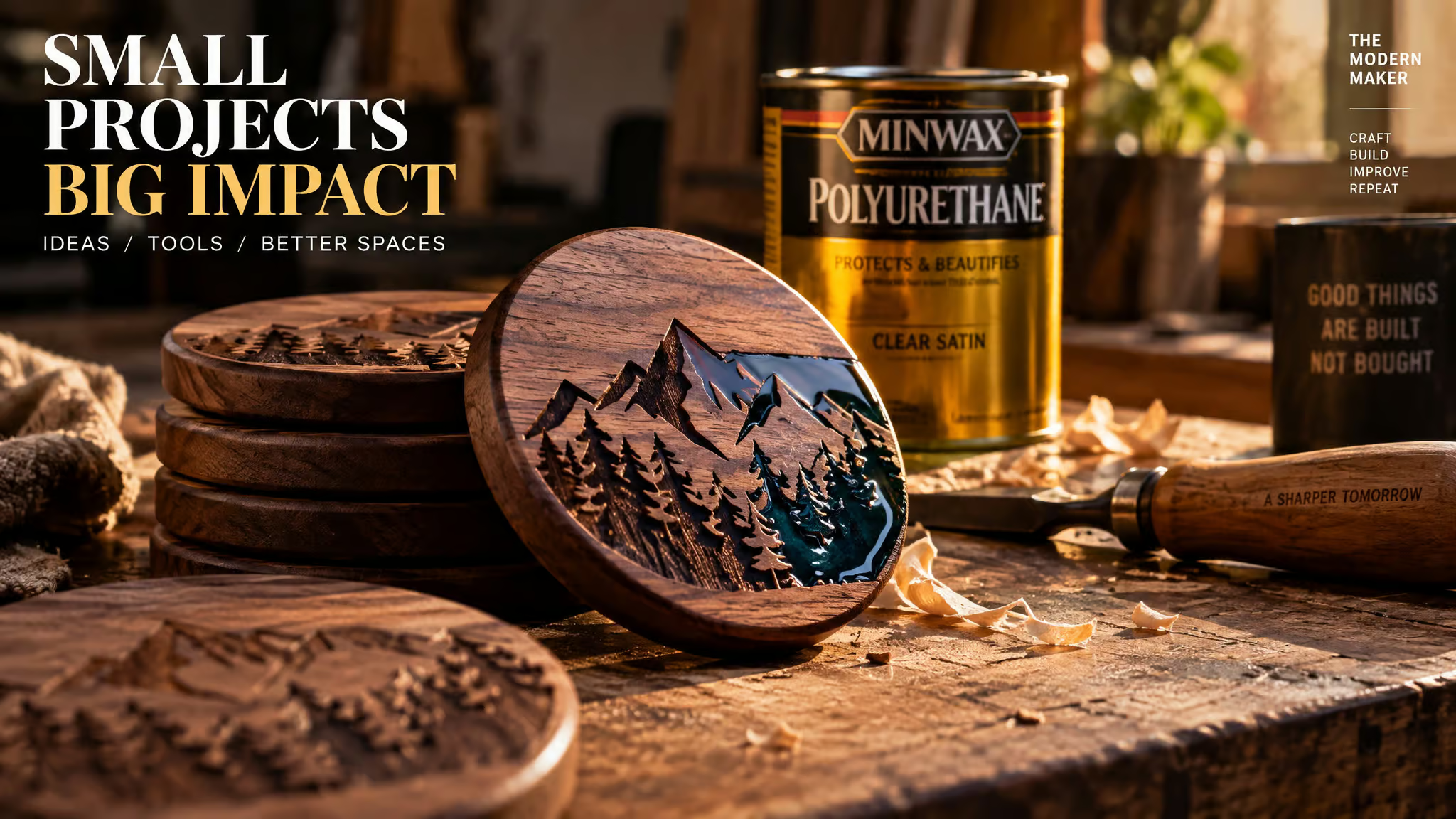
Hours of dialing in laser passes sit behind a single finish choice that decides whether a batch of coasters survives a season of pint glasses or warps, clouds, and comes back as a customer return. Sealing and finishing laser-engraved coasters is where post-production material science takes over from the laser bed. Matching the coating to the venue, hitting 220- and 320-grit sanding targets across at least three thin coats, waiting out full chemical cure times before stacking, and leaving absorbent stone or cork unsealed keeps batches flat and sellable.
Key Takeaways
Coat the top face, bottom face, and all edges in the same session after sanding bare wood to 220 grit, then apply at least 3 light coats of polyurethane, lacquer, or shellac (sanding with 320 grit between coats) or 2 to 3 pours of epoxy resin to stop one-sided moisture bowing.
Match the sealant to the venue and wait out full chemical cures before shipping: polyurethane is the restaurant and bar default, shellac dissolves on contact with alcohol, epoxy cures in roughly 7 days, varnish cures in 4 to 7 days, and polycrylic requires about 30 days for a full cure.
Invert your sealing rules on non-wood blanks by skipping spray lacquer on moisture-absorbing cork and diatomaceous earth stone, and pretreating slate with Rustoleum 2X flat black spray for sharper engraved shading and less lingering odor than clear coat.
Table of Contents
What moisture does to an unsealed engraved coaster
One-sided moisture expansion is the physical mechanism that causes a wooden coaster to warp or bow after sealing only one face. Wood coasters need protection from sweating cold glasses and hot mugs so burned engravings stay crisp, and sealing only the top of thin plywood or MDF lets the raw bottom drink in ambient humidity, swell faster than the sealed top, and bow the flat blank until it rocks on the tabletop.
How condensation ruins engraving and color fills
Wood’s cellular structure behaves like a sponge. As Kaelen noted in a February 6, 2026 guide for Qlychee Crafts, when condensation from a cold drink or a spill wicks into unsealed pores, repeated wet-and-dry cycles trigger swelling, shrinkage, hairline cracks, curled edges, warping, and permanent white water rings that no cleaning spray can undo. Moisture also creeps under paint films to lift color fills, blur fine laser lines, and dull bright pigments. A proper seal locks burned details and printed logos in place.
The rocker effect: why one-sided sealing bows thin plywood
Coating both faces and all edges evenly in the same session equalizes moisture uptake and stops a flat blank from turning into a little rocker, which matters even more when brushing on water-based polyurethane.
Best finishes for laser-engraved coasters, matched to where they live
Polyurethane is the best finish for wooden coasters that get daily use at a bar or restaurant. Choosing a coaster sealant depends on how the substrate reacts to moisture, heat, and spills, plus whether food touches the surface, making hard film finishes like polyurethane the default for commercial drink service while shellac dissolves under spilled cocktails. Strong film finishes (polyurethane, epoxy resin, and spar urethane) deliver top water resistance, whereas food-safe oils, waxes, and specialty lacquers fit light or food-contact use. Qlychee Crafts markets both pre-finished and unfinished blanks, citing its own claims of over a decade of experience, automated spray lines, eco-minded coatings, and batch quality control.
| Sealant Type | Best For | Typical Look | Key Points |
|---|---|---|---|
| Polyurethane | Restaurants, offices, home bars | Oil-based warm amber or water-based clear (matte, satin, gloss) | Yes for daily bar use (hard clear film with strong water and scratch resistance after full cure) |
| Epoxy resin | Premium sets, heavy moisture, deep engravings | Thick, glassy, mirror-flat shell | Yes for maximum waterproofing (two-part self-leveling pour; food safe once cured for roughly 7 days) |
| Spar urethane | Outdoor patios, pool areas, open-air bars | Flexible clear film | Yes for outdoor UV and moisture (moves with wood; requires equal coats on both sides) |
| Lacquer | Fast batch production, craft-show runs | Ultra-clear, smooth, scratch-resistant | Yes for one-day multi-coat speed (coats melt together for easy repair; strong solvent fumes) |
| Shellac | Coffee, tea, light home use | Warm, classic natural glow | No for bars or alcohol (dissolves in wine and spirits; can cloud some water-based acrylic paints) |
Polyurethane: the durable default for restaurants and offices
Polyurethane cures into a hard clear film that shrugs off water and scratches in busy cafés, offices, and home bars. Oil-based poly adds a warm amber tone while water-based poly dries completely clear, and both come in matte, satin, and gloss sheens. Plan on several thin coats with drying time between them and a full cure before heavy service.
Spar urethane for patios and outdoor use
To make wood coasters waterproof for outdoor or patio use, brush or spray on spar urethane in several light coats with sanding between them, matching the coat count on both sides so the coasters stay flat. Built for patios, pool areas, and open-air bars, this flexible polyurethane variant offers strong moisture and UV resistance by moving with the wood instead of cracking, though it dries slower than standard indoor poly.
Lacquer for fast batch production
Solvent-based lacquer dries fast enough to lay down several thin, smooth coats in a single day. Each fresh pass melts into the previous layer, making scratch repairs as simple as brushing on another coat. The tradeoff is serious fumes that require shop ventilation, plus light sanding or steel wool between coats.
Shellac: warm glow, fatal near alcohol
No, shellac isn’t a safe sealant for coasters used with wine, cocktails, or spirits because alcohol chemically dissolves the resin on contact. While this natural resin dries fast, sands easily, and gives wood grain a warm classic glow for coffee and tea mugs at home, bar spills will lift the finish, and applying it over some water-based acrylic paints turns them cloudy.
Epoxy resin for premium sets and deep engravings
Two-part epoxy resin self-levels into a thick, glassy shell that locks out heavy moisture on high-end sets.
Food-safe oils and waxes for food contact
When coasters double as small charcuterie toppers or touch food directly, skip standard petrochemical films and reach for food-grade mineral oil, coconut oil, olive oil, soy wax, paraffin wax, Walrus Oil, or specialty food-safe lacquers.
Polyurethane vs epoxy resin: which is more waterproof for coasters?
Epoxy resin is more waterproof than both polyurethane and spar urethane for wood coasters, self-leveling into a thick plastic shell that is the only finish capable of filling deep laser engravings completely flat. While everyday production favors fast multi-coat films, creator benchmark tests on wood coasters show that two-part epoxy builds an impervious barrier over deep inlays while polyurethane forms a thinner surface film for standard commercial volume.
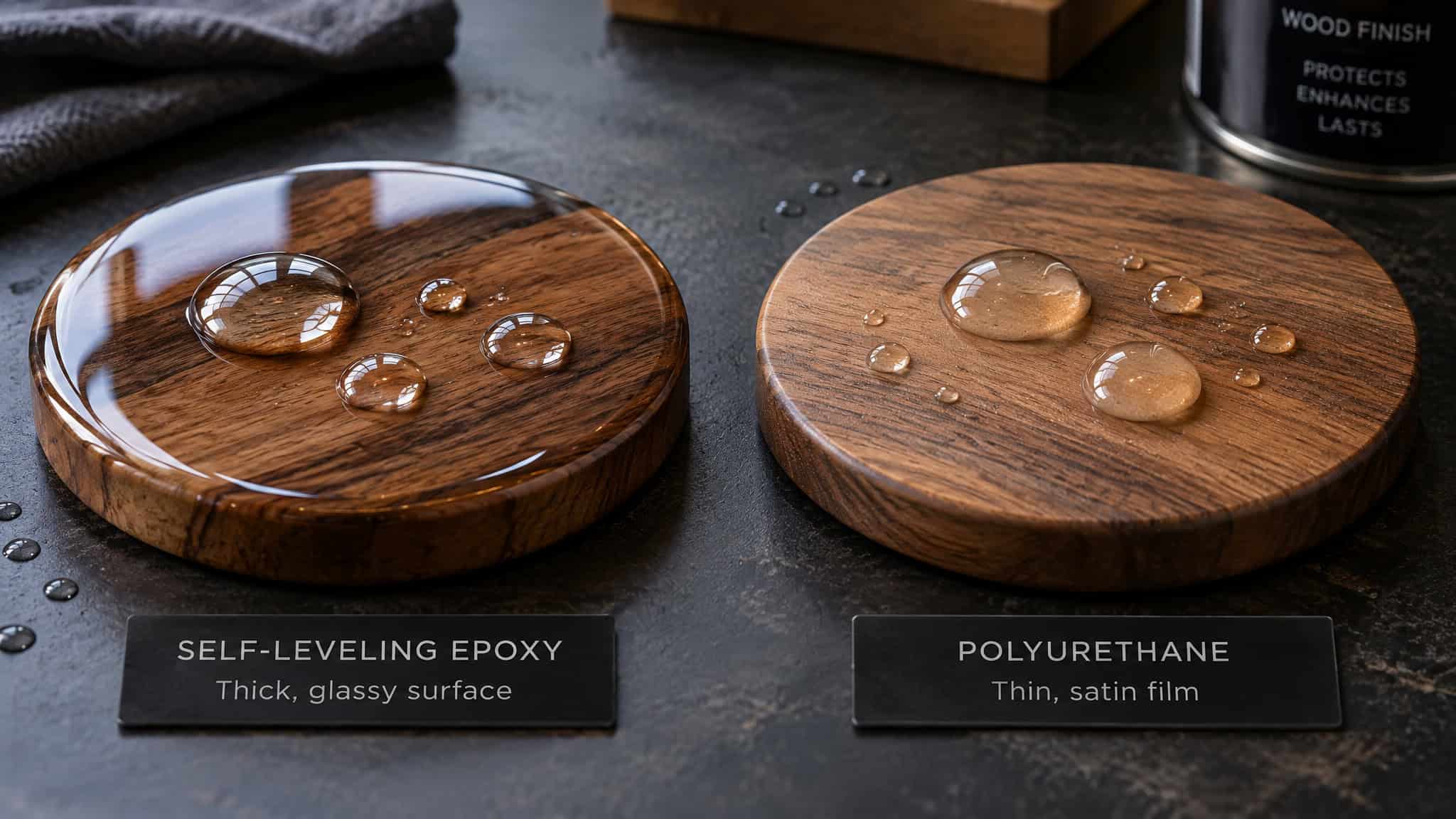
When you pour and spread a two-part system like TotalBoat MakerPoxy with a silicone tool, the resin floods every charred canyon left by the laser and levels itself to a glassy plane. Formulations with UV additives resist yellowing, and MakerPoxy gives you a generous pot life to work through a batch before the exothermic reaction stiffens the cup. Once fully cured, epoxy resin is also food safe.
You pay for that glass-flat armor in shop discipline and calendar days. Epoxy demands dead-accurate part-A-to-part-B mixing, solid ventilation, and higher material spend per blank. You also can’t bump or shift the coasters while the resin sets, or dust will settle into the slick surface and uneven leveling will warp the piece. Drying takes 24 to 48 hours, and full chemical cure takes roughly 7 days.
Polyurethane attacks the problem from the opposite angle. Instead of flooding the recess, it builds a hard, scratch-resistant skin in matte, satin, or gloss across three or more thin brushed or sprayed coats. It won’t bridge a deep pocket flat, and you still have to wait out inter-coat drying and final cure windows before stacking. However, the lower cost per ounce and straightforward application make polyurethane the practical workhorse for high-volume restaurant, office, and bar orders, leaving epoxy for premium gift sets and deep relief engravings.
How to seal wood coasters step by step
To seal wood coasters step by step with clear sealers like polyurethane, epoxy resin, lacquer, or shellac, first sand the bare wood to 220 grit, second coat the top, bottom, and all edges in the same session, third apply at least three thin coats (or two to three pours for epoxy), fourth sand between coats with 320 grit or extra-fine steel wool, and finally inspect the finish under good light. Laser-engraved wood needs clean preparation and thin layers to lock in detail without clouding, and following the 220-to-320 grit progression with per-finish coat minimums prevents both raised grain and warped blanks.
Step 1: Sand to 220 grit
Sand the bare engraved wood to roughly 220 grit to smooth the surface and clear stray char before opening a can of finish.
Step 2: Coat top, bottom, and edges in the same session
Apply your sealant to the top face, bottom face, and all edges in the same session so humidity absorption stays balanced and the blank can’t bow.
Step 3: Apply the minimum coat count for your finish
Lay down several thin coats rather than one thick flood that sags, traps solvent, and clouds: brush or spray at least 3 light coats for polyurethane, lacquer, or shellac, or pour 2 to 3 layers for epoxy resin.
Step 4: Sand between coats at 320 grit or steel wool
Once dry, sand lightly between coats using 320-grit paper (anywhere in the 220-to-320 range works) or extra-fine steel wool to knock down raised grain and dust nibs without cutting through to bare wood.
Step 5: Inspect under good light before the next coat
Hold every coaster under a bright bench light to spot missed edge pores, micro-bubbles, or uneven sheen before brushing on the next layer.
Drying vs curing: when coasters can be stacked and shipped
Wooden coasters require at least 3 light coats of polyurethane, lacquer, or shellac and must reach full chemical cure across 4 to 30 days depending on the finish before they’re stacked or shipped. Every coating goes through two separate chemical milestones: drying is when the surface feels touch-hard enough to handle or recoat, while curing is when cross-linking finishes so stacked coasters won’t fuse together, imprint wrapper rings, or scratch in transit.
| Finish Type | Drying / Recoat Time | Full Chemical Cure Time |
|---|---|---|
| Varnish | 1 hour to recoat | 4 to 7 days |
| Epoxy resin | 24 to 48 hours | 7 days |
| Polycrylic | 2 to 3 days (dries hard) | 30 days |
| Hard wax oil | 2 days | 7 days |
Finishing engraved and color-filled wood: polycrylic, varnish, and oil/wax looks
Film finishes like polyurethane, polycrylic, varnish, and epoxy deliver heavy water protection that locks in laser-engraved detail, whereas penetrating oils and waxes like tung oil and hard wax oil trade waterproofing for a matte, natural wood feel suited to light decorative use.
Polycrylic over gel stain makes color fills pop
Minwax polycrylic creates a satin-like hard shell that makes translucent wood gel stain colors pop inside laser-engraved recesses. In one wood-finishing creator’s workflow, splashing translucent pink gel stain into an engraving and sealing it with polycrylic beat both spar urethane and standard polyurethane on waterproofing. Stir the can gently instead of shaking so you don’t whip air bubbles into the liquid, brush or spray thin coats with a light 220-grit sanding between them, and give it 2 to 3 days to dry hard and roughly 30 days to fully cure.
Varnish and clear epoxy over engraved detail
When you want high-gloss water and UV protection over painted or color-filled surfaces indoors or out, self-leveling varnish cleans up with soap and water, recoats in about 1 hour, and cures in 4 to 7 days. For deep relief cuts, clear epoxy floods and levels the surface flat.
Hard wax oil and tung oil for a matte natural look
Hard wax and tung oil blends (often sold as furniture butter) sink into the grain for an all-natural matte look. Tung oil itself has protected wood for over 2,500 years.
Dale of Six Eight Woodworks demonstrated this workflow on quarter-inch white oak state-outline coasters and solid ash puzzle-piece coasters: condition the wood with hydrating serum first, apply the wax 15 to 20 minutes later, and hand-buff with a clean rag after 20 to 30 minutes across two coats (drying in about 2 days, curing in 7 days). To make adhesive cork backings stick, the creator waxed only the top and sides and sealed the bottom face with shellac, preferring the matte wax look over glossy epoxy in a side-by-side test.
Oil vs film finish: the protection tradeoff
Food-safe oils (food-grade mineral oil, tung oil, coconut oil, olive oil, and Walrus Oil), waxes (soy wax and paraffin wax), specialty food-safe lacquers, and fully cured epoxy resin are the right picks for coasters that touch food or drinks directly, though penetrating oils and waxes offer less moisture armor than film coats and belong on light-use sets.
Engrave first, finish second: workflow, wood choice, and machine limits
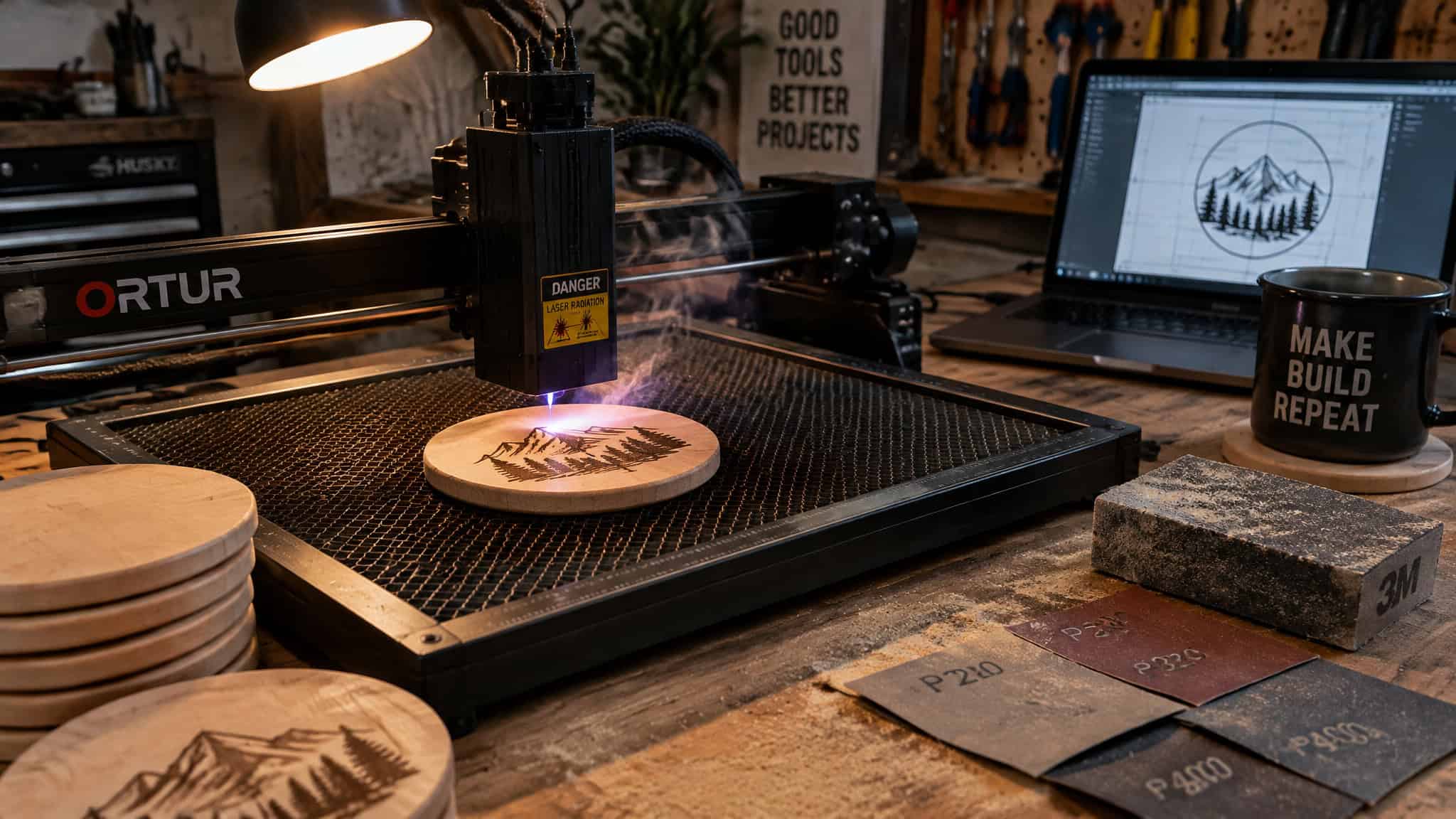
Always laser-engrave clean bare wood first, wipe away the soot, and apply stain or sealant second so you don’t vaporize cured coatings into toxic fumes or blotchy char. If you want to step back through the full shop pipeline, our guide to making laser-engraved coasters from blank selection to final finish maps the complete build.
Why engraving comes before finishing on wood
Pre-staining or pre-sealing demands scrap testing for fumes and discoloration; on real hardwood, skip transfer masking and knock down smoke residue afterward with a light foam-pad sander.
Choosing wood blanks: MDF, plywood, and solid hardwood
Thin MDF topped with faux laminate veneer peels under hot coffee mugs, whereas real wood veneer over plywood or MDF holds fast. Inexpensive basswood handles bulk corporate runs, while solid ash, walnut, cherry, white oak, and sapili mahogany veneer fit premium sets bonded with CA glue plus accelerator or 3M 300 LSE double-stick adhesive on cork backing.
What your laser can and can’t cut
Coasters are an easy starter project to learn XCS and pay off a machine, though creators sharing these specs disclose xTool and Creative Fabrica affiliate ties and note their hardware picks aren’t fully objective. Most diode lasers (even 40W+ heads, the 20W diode xTool F1 Ultra, 10W diode xTool F1G, xTool S1, and 5W infrared xTool F2) can’t cut thick solid wood, while the 55W CO2 xTool P2S and xTool P3 CO2 slice solid wood up to roughly 3/4 inch, UV galvo units like the xTool F2 Ultra UV cut at a slight angle, and conveyor machines speed up batches.
Slate, cork, stone, and other materials: where sealing rules invert
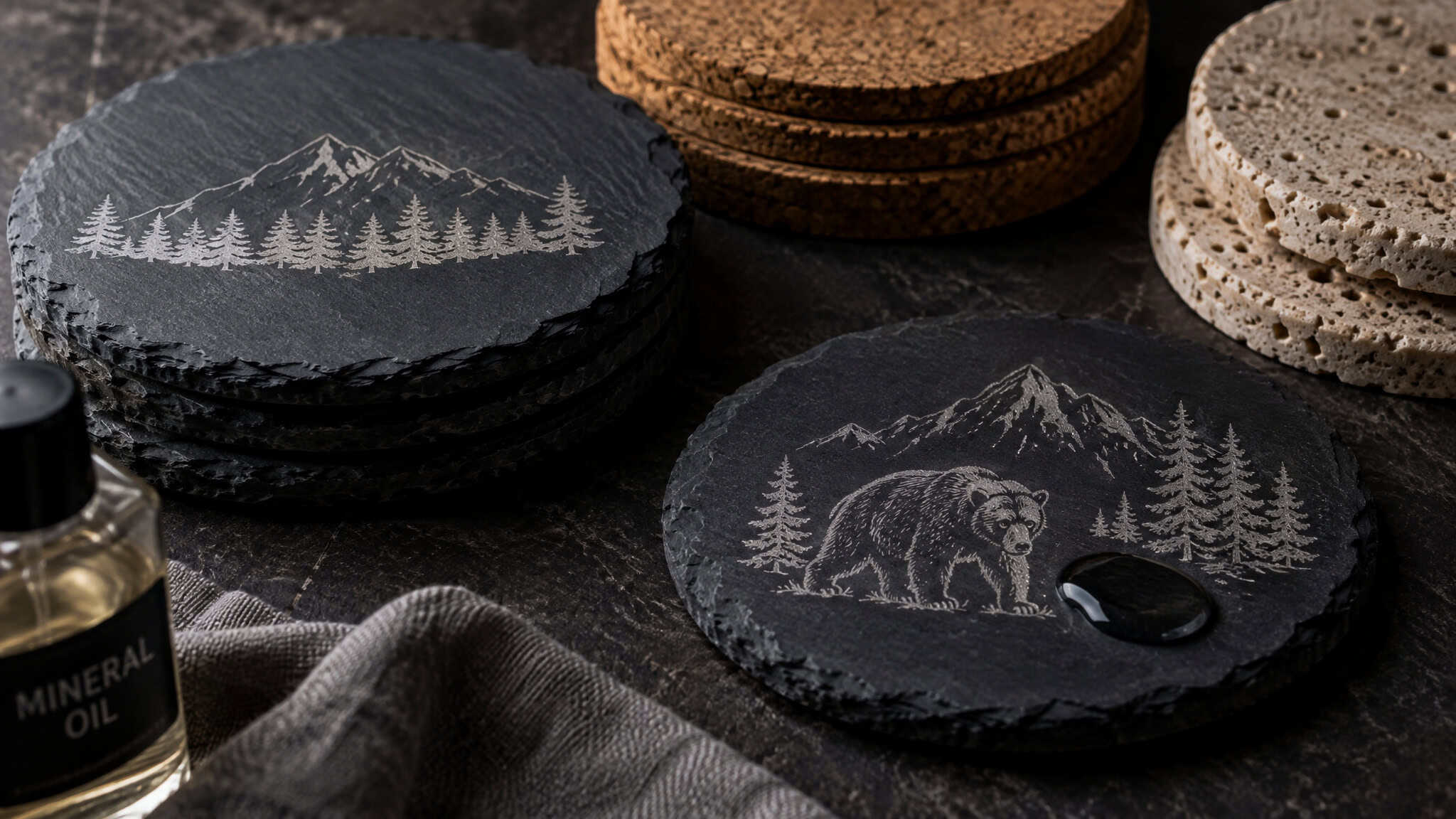
Across more than 15 coaster blank materials (including felt, rope, denim, tile, and silicone, tested by a creator who engraved over 1,000 coasters in a couple of years), sealing rules flip on porous stone and cork because heavy glossy clear coats stop moisture absorption and make condensation pool onto the table.
Slate: pretreat, invert files, and the black paint vs clear coat tradeoff
Pretreating slate coasters with Rustoleum 2X flat black spray paint before laser engraving produces sharper shading detail and less odor than spraying Rustoleum 2X satin clear coat, while untreated slate can be darkened with a drop of mineral oil or shellac. On an xTool F1, simple slate graphics take about 1 minute and intricate line drawings take 10 to 14 minutes.
Always invert your image files for dark stone, and run test grids because shifting laser power and speed settings on coasters pulls gold, silver, or gray tones from the same rock. In side-by-side deer engraving tests, flat black spray won on shading detail (especially on a Wecreat Lumos pushed from its default 55% to 80% power, while the F1 Ultra’s larger 20W diode beam needed fine-tuning), whereas satin clear coat made solid SVGs pop brighter but burned easier, cut natural moisture absorption, and left an odor hanging for 5 to 10 minutes.
Cork and diatomaceous earth: absorption is the product
- Cork: Absorbs condensation, shrugs off mug heat, costs pennies for single or layered topographic builds, and cuts cleanly without charred edges via cold processing on UV lasers, so skip spray lacquer whenever function matters.
- Diatomaceous earth stone: Drinks in sweating-glass runoff completely and evaporates it without leaving a puddle, often sold as high-end sets with velvet backing and zero sealer.
Granite, leather, and fabric
Granite engravings command premium prices without film coats, real top-grain leather cuts and engraves cleanly on UV lasers, PU leatherette reveals gold or silver beneath a black top layer, and rope coasters yield mixed results.
Acrylic, metal, and glass
Clear and mirrored acrylic require a CO2 laser (mask mirrored sheets before cutting so they don’t cloud, or engrave unmasked and lightly sand after; quarter-inch black acrylic cuts cleanly on the P3). Type 304 stainless steel pairs with a MOPA laser to prevent rust, brass and titanium engrave cleanly (with titanium firing vibrant colors), glass needs black tempera paint or marking spray first, and slick metal or glass bottoms take cork pads or cabinet bumpers.
What finish can’t fix: substrate failures and common sealing mistakes
No, you can’t clear-coat or shellac directly over painted, printed-transfer, or Mod Podge coaster designs without testing on a scrap piece first, because solvent and resin interactions frequently turn untested water-based acrylics and decoupaged graphics into cloudy patches.
Five sealing mistakes and their remedies
Most ruined batches come from fixating on product labels and skipping bench technique. Beyond clear-coating untested Mod Podge or acrylic paint, watch for four classic shop traps:
- Sealing only one side: Moisture bows thin plywood into a rocker. Coat the top, bottom, and all edges in the same session.
- Flooding on one thick coat: Heavy layers sag, trap solvents, and cloud over fine laser lines. Brush or spray at least 3 thin coats instead.
- Skipping inter-coat sanding: Dust nibs and raised grain ruin the feel. Knock them flat with 320-grit sandpaper or extra-fine steel wool between coats.
- Mismatching sealant to the venue: Shellac melts under bar cocktails and standard indoor poly cracks on sunny patios. Match the chemistry to the drink and UV exposure.
Bad blanks: wet wood and peeling laminate no coating can save
Even flawless finishing can’t rescue a defective blank. Natural tree-slice wood cookies shipped by most distributors arrive still wet with the center pith intact; as they dry out in your shop, internal tension splits them wide open, a trap illustrated by one creator’s cautionary run of roughly 1,000 engraved church ornaments where pieces cracked after production. Similarly, thin MDF cores with faux walnut laminate tops delaminate and peel when hit with hot coffee cups, whereas real walnut veneer over plywood survives.
Keeping finished coasters alive: cleaning, resealing, and care cards
Wooden coasters should be cleaned only with a damp cloth and resealed every 6 to 12 months when in heavy rotation, especially if they’re protected with food-grade mineral oil or wax finishes that wear down with regular wiping. Never soak wood coasters in a sink or run them through a dishwasher, as standing heat and detergent strip coatings and swell the core.
In the workshop, store spare blanks and finished sets flat in a dry, temperature-stable room so humidity swings can’t warp inventory before it sells. Slipping a small printed care card into every retail box or bulk corporate shipment spells out these damp-wipe and 6-to-12-month refresh rules, turning basic maintenance into a professional touch that prevents dishwasher disasters and customer returns.
Finishing as a business decision: pricing, bulk clients, and what sells safely
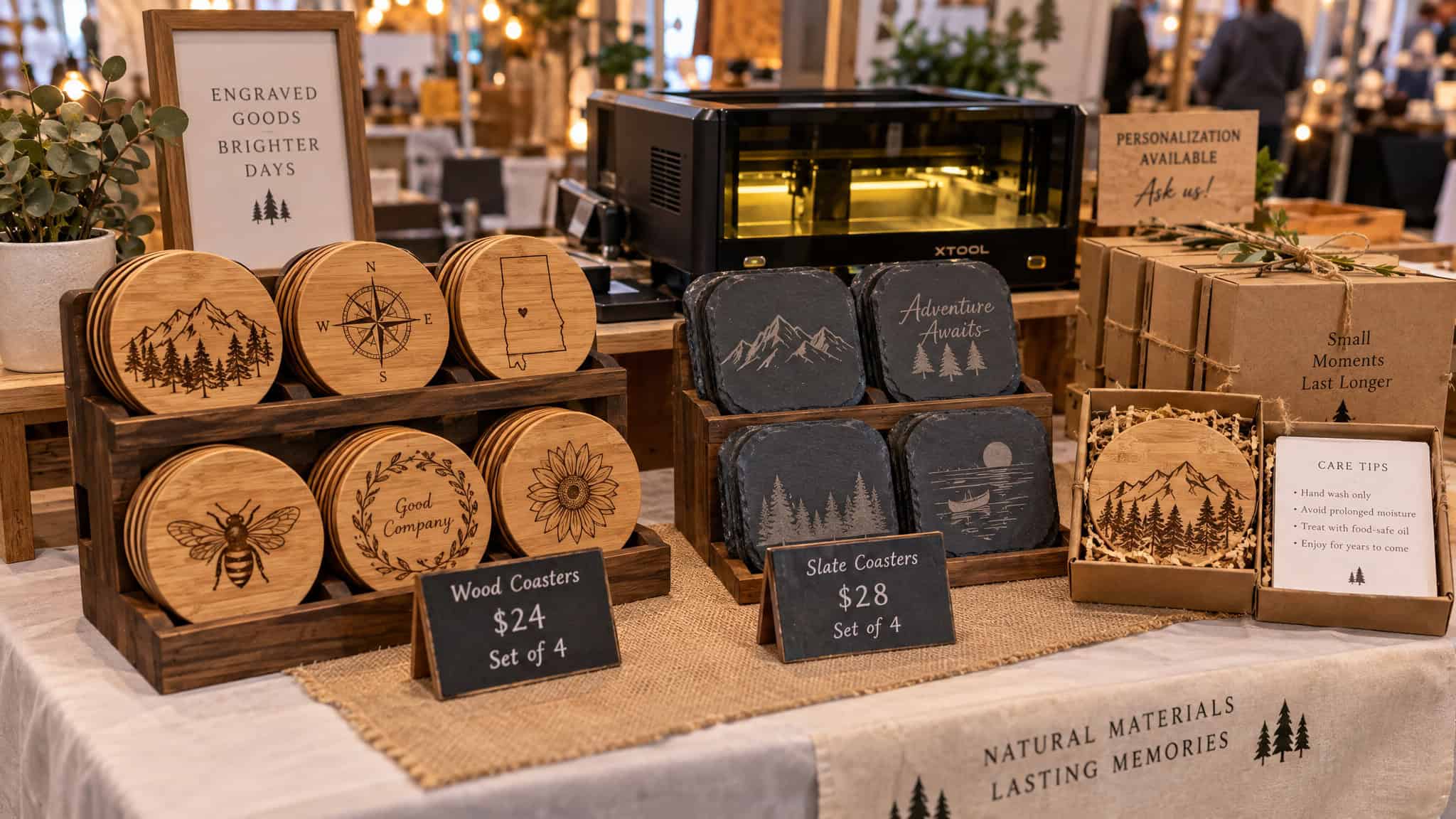
Spray lacquer is the fastest, most economical way to seal high-volume batches of laser-engraved coasters for craft shows because it dries fast enough to take three thin coats in a single day, keeping labor margins intact on coasters priced at $7 each or 4 for $25 (and regionally as low as $5).
What durable finishes are worth at the craft show and in B2B
Letting craft-show shoppers mix and match $7 singles moves volume, and makers often batch-produce slate coasters in a dining room with an air purifier running before packing an xTool F1 for on-the-spot show customization. When pitching B2B bulk clients like realtors and mortgage companies, or assembling high-end whiskey-glass and coaster gift sets that sell near $60 (such as a tumbler engraved with a mortgage company logo), stepping up to a 7-day cured epoxy pour or multi-coat polyurethane protects your brand from commercial returns.
Designs that sell: regional artwork over trademarked logos
Commercial booths can’t legally sell trademarked IP like Nintendo, Disney, sports teams, or Harley-Davidson, which keeps builds like NES cartridge coasters (cut on an xTool P3 and scored on an F2 Ultra UV) strictly personal-use projects. Local Pacific Northwest themes outsell generic clip art without legal risk: a five-coaster Washington volcano set engraved with each peak’s name, stats, and native name, Diablo Lake coasters pairing turquoise mirrored/clear acrylic cut on the P3 with walnut plywood engraved on the F2 Ultra UV, or motifs like the San Juan Islands, Sasquatch, the Space Needle, Blue Angels for Seafair, a husky against a PNW backdrop, and pickleball.
Sourcing designs: AI tools and file subscriptions
When preparing vector and line-art files for coaster engraving, AI generators like Microsoft Bing Image Creator, xTool xArt, and XTool Studio AI can spin up usable line drawings, though they mangle text and carry training-data controversy. For clean vectors, Creative Fabrica‘s $4/month unlimited download plan (often paired with 10 free downloads via creator affiliate links) beats paying $2 to $4 per individual line-drawing or ~$2 split-monogram file on Etsy, where ornament and sign SVGs resize easily onto coaster blanks.
Frequently Asked Questions
What is the best finish for coasters that get daily use at a bar or restaurant?
Polyurethane is the go-to workhorse for commercial drink service because it cures into a tough, clear film that shrugs off constant water rings and scratches. You can run oil-based poly for a warm amber tint or water-based poly for a crystal-clear look in matte, satin, or gloss, and its lower material cost beats epoxy on high-volume bar orders.
Polyurethane vs epoxy resin for wood coasters: which is more waterproof?
Two-part epoxy resin takes the crown for waterproofing because it self-levels into a thick, plastic armor that completely floods and flattens deep laser-engraved pockets. Polyurethane only builds a thin surface skin across three or more coats, which handles everyday bar spills fine but cannot bridge deep relief cuts like a poured resin shell.
Is shellac a good sealant for coasters used with wine or cocktails?
Not at all—alcohol chemically dissolves shellac on contact, meaning a single spilled cocktail or wine ring will strip the finish right off the wood. Save shellac for dry home desks dealing strictly with coffee or tea mugs, and keep it away from certain water-based acrylic color fills that it can turn cloudy.
Why did my wooden coaster warp or bow after sealing one side?
Coating only the top face leaves the raw underside exposed to room humidity, causing the bottom wood fibers to drink in moisture and expand faster than the sealed top. That uneven expansion pulls thin plywood or MDF into a curved rocker that wobbles on the table, which is why you always have to coat both faces and all edges in the very same session.
What food safe finish can I use on coasters that touch food or drinks?
When coasters double as mini charcuterie toppers or touch food directly, reach for food-grade mineral oil, tung oil, coconut oil, olive oil, Walrus Oil, soy wax, paraffin wax, or specialty food-safe lacquers. Two-part epoxy resin is also food safe once it completes its full seven-day chemical cure, giving you heavy waterproofing where penetrating oils and waxes only offer light moisture protection.
How many coats of polyurethane do coasters need and how long to cure?
Plan on brushing or spraying at least three thin coats of polyurethane, lightly sanding with 320-grit paper between passes so the film builds smoothly without trapping solvents. While a finish might feel dry to the touch in hours or a couple of days, full chemical cross-linking across coaster finishes takes anywhere from 4 to 30 days—and rushing pieces into a stack before that cure window finishes will fuse them together.
