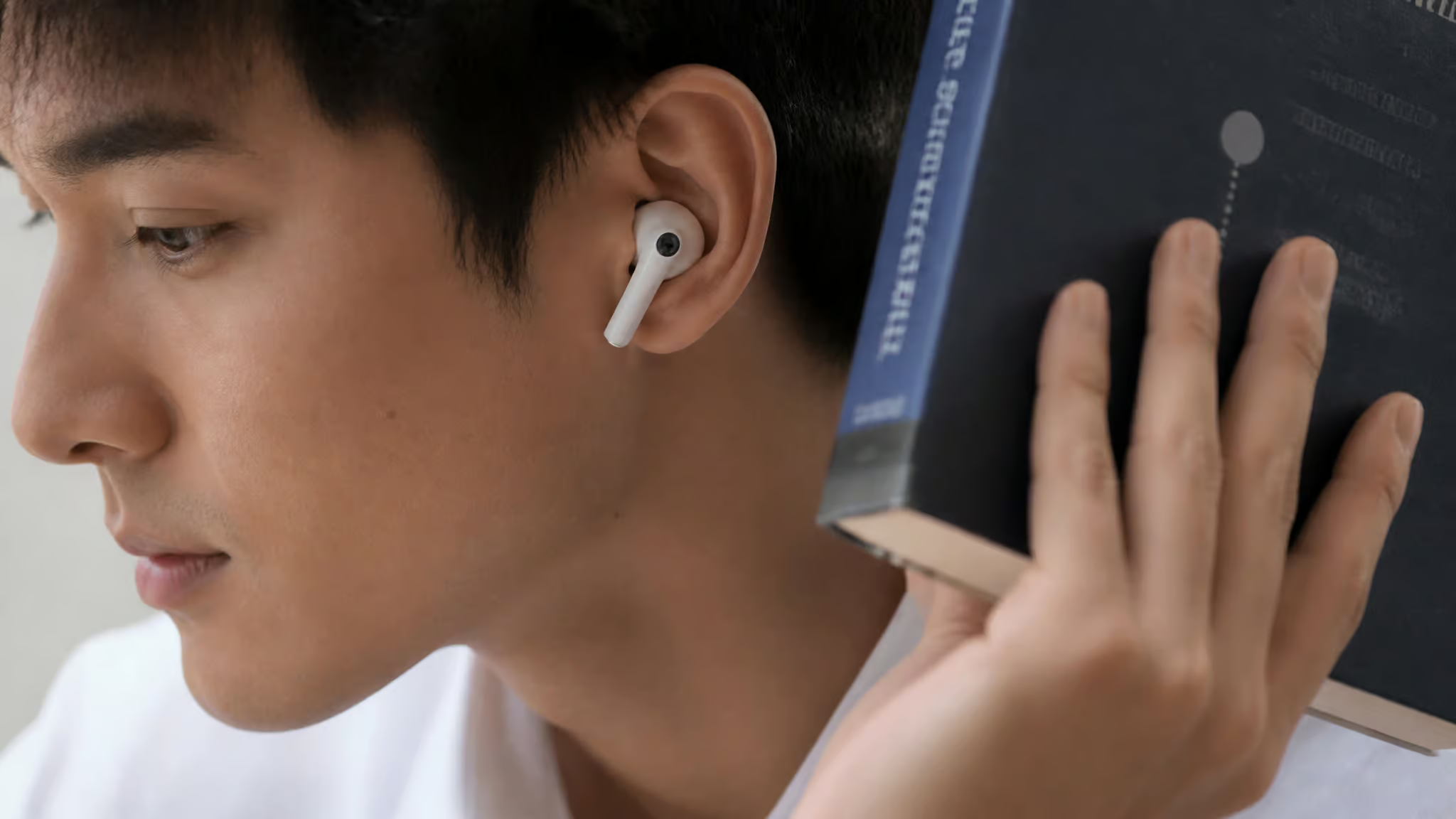
So here’s the thing about the macOS Tahoe 26.7 release candidate: it had a lot more in it than updated system settings. Somebody at Apple forgot to flip the “hide internal testing” switch before shipping the RC, and now the entire product roadmap for the next twelve-plus months is sitting in a feature flag file. There’s a working demo video of AirPods with cameras, like, a real person holding a real book up to real earbuds while Siri tells them what they’re looking at. And there are twenty-four product codes in there that nobody can match to anything yet. Let’s walk through all of it.
Key Takeaways
A working demo video embedded in the RC shows camera-equipped AirPods (codename B790) using Visual Intelligence to identify objects and log information via Siri, complete with a hair-covering alert and an actual error code from a left-bud camera failure.
The RC reveals Apple’s entire next-gen iPhone lineup split across two launch waves: Pro models and the foldable iPhone Ultra (V68) land September 2026, while the standard iPhone 18 and iPhone Air 2 arrive spring 2027.
Sixteen A-series product identifiers (A3436-A3577) and nine Device1,8xxx codes have no known product assignment, a level of mystery hardware that strongly suggests Apple is testing far more than what’s been publicly rumored.
Table of Contents
Camera-Equipped AirPods (B790): Visual Intelligence in Your Ears
The demo video is the reason this leak feels different from the usual codename dump. Aaron (@aaronp613) shared it on August 18, and it’s not a concept render or an animation, it’s a real function preview, the kind Apple uses for internal training. A man holds a book up to the AirPods. No tapping, no phone.
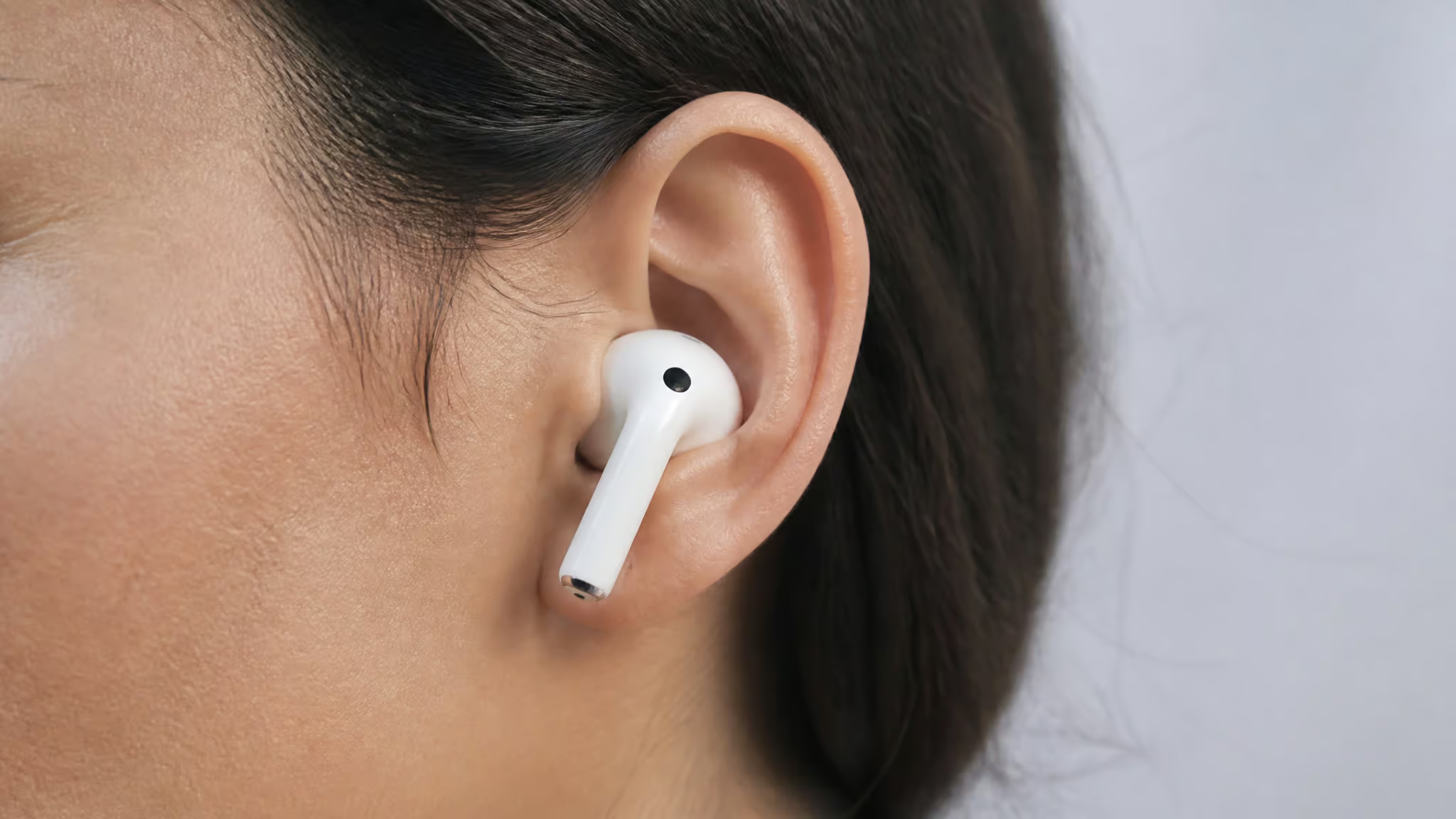
The camera feeds Visual Intelligence, and Siri starts talking: With Visual Intelligence, your world becomes savable. See something you like? Just ask me to save it for later. That’s the pitch, point, ask, log.
The Demo. What We Actually Saw
The video is clean and deliberate. Single hand gesture, the AirPods camera captures the scene, Visual Intelligence processes it, Siri answers questions and records the information. It’s not an abstract “AI in your ear” concept, it’s a real-world capture tool. The fact that it’s embedded in the RC as an actual interactive demo, not a mockup, means this feature is past the prototype phase.
The Hair Alert. Solving a Real-World Usability Problem
Here’s where you can tell Apple thought about the daily-wear friction. The code includes a proactive alert: To receive the most accurate information about things around you, ensure AirPods are not covered. That’s a field-pattern observation from years of camera wearables, early devices from other manufacturers silently produce garbage results when hair or clothing blocks the lens. Apple built a direct, non-alarming nudge rather than letting users wonder why Siri suddenly can’t see anything.
There’s also an error-log reference: “B790 start image stream failed for left bud,” which confirms real hardware testing and that the left bud also carries a camera. This is production-grade UX thinking.
Naming and Pricing. Ultra or Pro 4?
The code also references naming patterns like AirPodsPro1,4 and AirPod3,5 alongside the B790 codename. That suggests Apple hasn’t finalized the brand. Bloomberg’s Mark Gurman has reported “AirPods Ultra” as a possibility, and if that name sticks, you’re looking at a $299-349 price point, the Ultra label historically adds a $100+ premium over the Pro tier. The AirPods Pro 3 currently sit at $249. A camera-equipped version will almost certainly cost more.
Launch Timing. September 2026
Gurman’s September timeline lines up with Apple’s iPhone event cycle. If you’re in the market for AirPods Pro right now, waiting through next month could save you buyer’s remorse, this isn’t a spec bump, it’s a new wearable sensor platform.
Apple Home Overhaul: Hub, Mini, Camera, and TV
The smart home gets the biggest cluster of new identifiers in this leak. Juli Clover at MacRumors detailed two Home Hub SKUs. J490 (base version) and J491 (wall-mounted). That distinction matters more than it sounds: smart home hubs have always faced a placement dilemma.
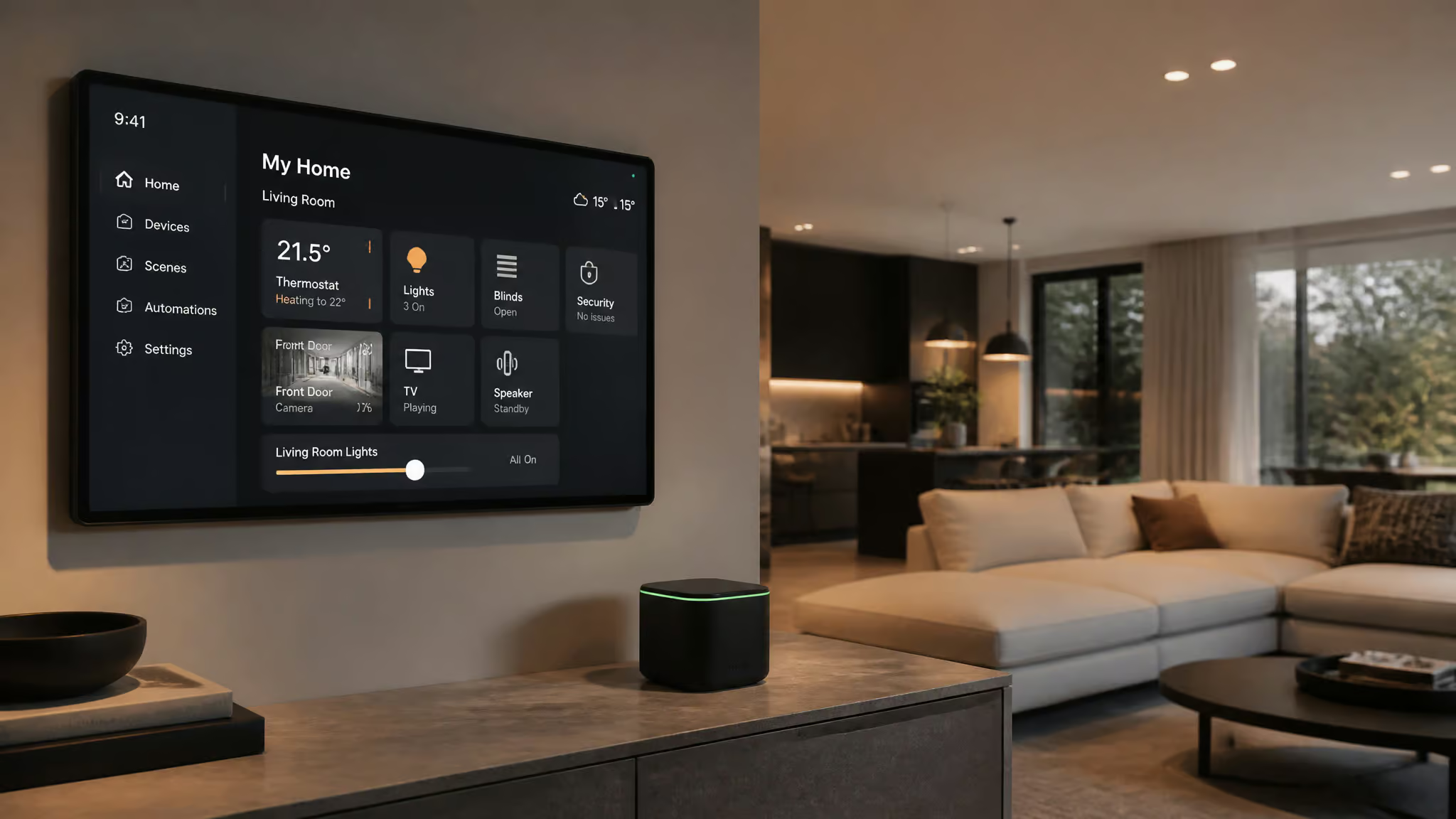
Counter-top vs. wall changes installation complexity and whether renters can even use the thing. Apple is offering both.
Home Hub (J490 and J491): Base and Wall-Mounted
- J490 sits on a desk or counter, plug-and-play, no drilling.
- J491 is wall-mounted, likely near a power outlet, like a smart panel by the front door.
- Both run homeOS, codenamed Pebble. It’s a dedicated OS, not a tweaked iPadOS. That’s significant: Apple is building this from the ground up for a smart home brain.
- Reader takeaway: If you rent, go J490. If you own and want a permanent hub near the entrance, J491 is your pick.
HomePod mini 2 (B525): Argentium and the Next Generation
The current HomePod mini carries codename B520. The successor is B525, a clean one-step bump. The interesting part is the software: “Argentium” is installed on this device. Latin for silver, Argentium could be a new audio processing platform or a multi-room intelligence layer.
Whatever it is, it’s specific to the mini 2. This is primarily a speaker upgrade, not a replacement for the Home Hub, they’ll coexist.
Apple Security Camera (J229)
J229 is likely Apple’s first-party security camera. Different from the rumored video doorbell (which doesn’t appear in this code). A first-party camera tightens the HomeKit ecosystem, local visual processing could be handled by the Home Hub, tying into that audio_accessory_visual_reasoning string we’ll get to in a moment. If you’re deep in HomeKit, this could be the missing piece, much like the Apple AR/VR headset macOS 26.7 leak reveals driver and framework references pointing toward launch readiness and OS integration.
Apple TV 4K and New Siri Remote (ATVRemote1,5)
A new Apple TV 4K is expected, and the leak includes an updated Siri Remote model: ATVRemote1,5, the fifth iteration of the first-gen design. That’s iterative, not a form-factor overhaul. Likely bundled together as a package.
Unidentified Home Devices and Mystery Code Strings
Two new Home identifiers appear with no confirmed product: HomeAccessory17,2 and HomeAccessory17,3. Alongside them, the code string audio_accessory_visual_reasoning, with that unusual grammar, suggests a device that’s both an audio accessory and capable of visual reasoning. Strong hint for a Home Hub with camera features. There’s also a color palette for an unspecified Home accessory: Rose Pink, Silver, Space Gray, Starlight. That matches the current HomePod mini lineup, so it could be the HomePod mini 2’s colors, but we don’t know for sure.
iPhone Lineup: Two Launch Waves for 2026-2027
Apple is doing something they’ve never done before, splitting the entire next-gen iPhone generation across two launch windows. Analyzing build numbers, internal deadlines, and historical patterns from the macOS 26.7 leak release date helps predict the exact launch window for both the OS and new hardware, and the codename cluster (V62, V63, V64, V67, V68) covers every model.
Fall 2026: iPhone 18 Pro, Pro Max, and Foldable Ultra
- V63, iPhone 18 Pro (September 2026)
- V64, iPhone 18 Pro Max (September 2026)
- V68. Foldable iPhone Ultra (autumn 2026, note “autumn” vs “September”, suggesting a possible slight delay for the foldable)
Three flagship-tier models in one event makes this Apple’s largest iPhone launch ever. The foldable Ultra debuts alongside the Pro models, which suggests confidence in foldable durability, first-gen foldables from other manufacturers often launch late or separately.
Spring 2027: iPhone 18 and iPhone Air 2
- V67. Standard iPhone 18 (spring 2027)
- V62, iPhone Air 2 (spring 2027)
The gap between fall and spring hints at component constraints, likely foldable screens and thin chassis, rather than a deliberate staggered strategy. Reader takeaway: If you want a standard iPhone 18, it ships six months after the Pro models. Buying a non-Pro iPhone between September and March means getting a model that’s already “last generation” for half its lifecycle.
Codename Summary
- V62
- iPhone Air 2
- Spring 2027
- V63
- iPhone 18 Pro
- September 2026
- V64
- iPhone 18 Pro Max
- September 2026
- V67
- iPhone 18
- Spring 2027
- V68
- Foldable iPhone Ultra
- Autumn 2026
Mac and iPad: M6, OLED, and Next-Generation Upgrades
Four product families, each with distinct codename patterns that reveal Apple’s internal thinking.
MacBook Pro with M6 (J804)
The 14-inch MacBook Pro gets an entry-level M6 chip. A single codename (J804) is unusual. Apple typically uses multiple SKUs per chip tier. A recent Apple display leak macOS 26.7 hints at new external display firmware, and this may be the baseline config, with higher-end M6 Pro/Max models still separate.
Next-Generation iMac (J833, J834)
Two codenames, likely chip-tier variants (M6 vs M6 Pro), not screen sizes. Apple has kept to one iMac size since the M1 redesign, expect the same 24-inch chassis. The iMac isn’t dead.
MacBook Pro with OLED (K114c, K114s, K116c, K116s)
Four codenames: two screen sizes (14-inch / 16-inch) × two configurations (c = cellular/standard, s = high-end?). The K prefix is new for MacBook Pro, it suggests a fundamentally different architecture, not just a display swap. Could include a “MacBook Ultra” tier, which would be a new product tier entirely. These are likely 12-about 12-18 months out based on codename maturity.
iPad Mini with OLED and A19 Pro (J510, J511)
Two codenames = Wi-Fi and cellular variants. OLED display plus A19 Pro chip, the same chip expected in iPhone 18 Pro. Apple isn’t treating the iPad mini as a budget tablet; it gets flagship-tier silicon. The most powerful and most portable iPad yet, worth waiting for if you can.
Other Products: Vision Pro, Beats, and What Else
Beyond the major product families, the leak also includes a handful of smaller or less-defined hardware entries. Details are sparse for most, but they include a next-generation headset and new audio accessories.
Next-Generation Apple Vision Pro (N109)
Codename N109 has appeared in multiple betas but with no hardware details. It could be a second-generation or a lower-priced version. No timeline, likely years from launch. If you’re considering Vision Pro now, this leak doesn’t suggest a near-term replacement. Current model is safe for at least two more years.
Beats Headphones (B518, B522)
Two codenames for upcoming Beats products. No details on form factor, over-ear, earbuds, or something else? Lowest-confidence product references in the leak. Beats fans will note them, but there’s nothing concrete to share.
The Mystery Identifiers: 24 Unpinned Product Codes
Most roundups skip this part, but it’s where the leak earns its depth. There are 16 A-series identifiers (A3436-A3577) and 9 Device1,8xxx identifiers (8234-8248) with no known product assignment. The gaps in the A-series numbering, for example, A3442 through A3455 are missing, suggest Apple’s internal testing pipeline is wider than what leaked.
A-Series Identifiers (A3436-A3577)
A3436, A3437, A3438, A3439, A3440, A3441, A3456, A3457, A3465, A3529, A3530, plus several more in the range. These are real Apple model numbers, in the past, A-series codes have correlated with accessories, but the volume here is unusually high.
Device1,8xxx Identifiers
Nine codes with the rare Device1 prefix, which in prior instances corresponded to platforms that became HomePod or test-bed iPhones. These nine are completely unpinned.
What does this mean? Apple’s beta code routinely contains identifiers for test fixtures, prototype components, and accessories that never ship. But 24 unknowns in a single RC is a strong signal that internal testing is broad. We can’t assign products, anything would be guessing, but the sheer number tells you Apple is experimenting with a lot of hardware right now.
What This Leak Tells Us About Apple’s Launch Timeline
Using codename maturity as a readiness indicator, here’s the likely sequence:
- September 2026 (highest confidence): Camera AirPods (B790, appeared in previous betas + working demo), iPhone 18 Pro/Max, foldable iPhone Ultra, new Apple TV 4K with Siri Remote
- Late 2026-Early 2027 (medium confidence): Home Hub (J490/J491), HomePod mini 2, Apple security camera
- Spring 2027 (medium-high confidence): iPhone 18, iPhone Air 2, MacBook Pro M6, OLED iPad mini
- Distant / unclear (low confidence): OLED MacBook Pro (K-series, new codenames), next-gen iMac, Vision Pro N109, Beats B518/B522
The heuristic: products that appeared in multiple betas are closer. Entirely new codenames (K-series) are further out. Products with no timing signal (N109) are lowest confidence.
Closing: What to Watch for Next
This leak is enormous, but leaks aren’t guarantees. Product plans change. That said, the concrete purchase guidance is pretty clear:
- AirPods Pro now? Wait through September, the camera version is real.
- Non-Pro iPhone now? Wait through spring 2027 unless you need a phone sooner.
- HomeKit gear now? The Home Hub ecosystem is coming, hold off on major purchases.
- MacBook Pro or iPad mini now? The models worth waiting for are the OLED variants (distant) and M6 models (closer).
The 24 mystery codes are the ones to watch in future builds. Every time Apple drops a new beta, some of those identifiers may shift categories, and a few might finally match something you can hold in your hand. Keep an eye on the RC. Somebody at Apple is bound to forget the switch again.
Frequently Asked Questions
Will there be a new HomePod mini 2 and what’s different about it?
Yes, the HomePod mini 2 (codename B525) is a clean one-step upgrade from the current B520 model. It runs a new software platform called Argentium, which could be an audio processing or multi-room intelligence layer. It’s primarily a speaker upgrade and will coexist with the Home Hub, not replace it.
Is Apple making its own security camera?
Yes, the leak includes a product identifier (J229) that is likely Apple’s first-party security camera. It would tighten the HomeKit ecosystem and could use local visual processing handled by the Home Hub, making it a potentially missing piece for serious HomeKit users.