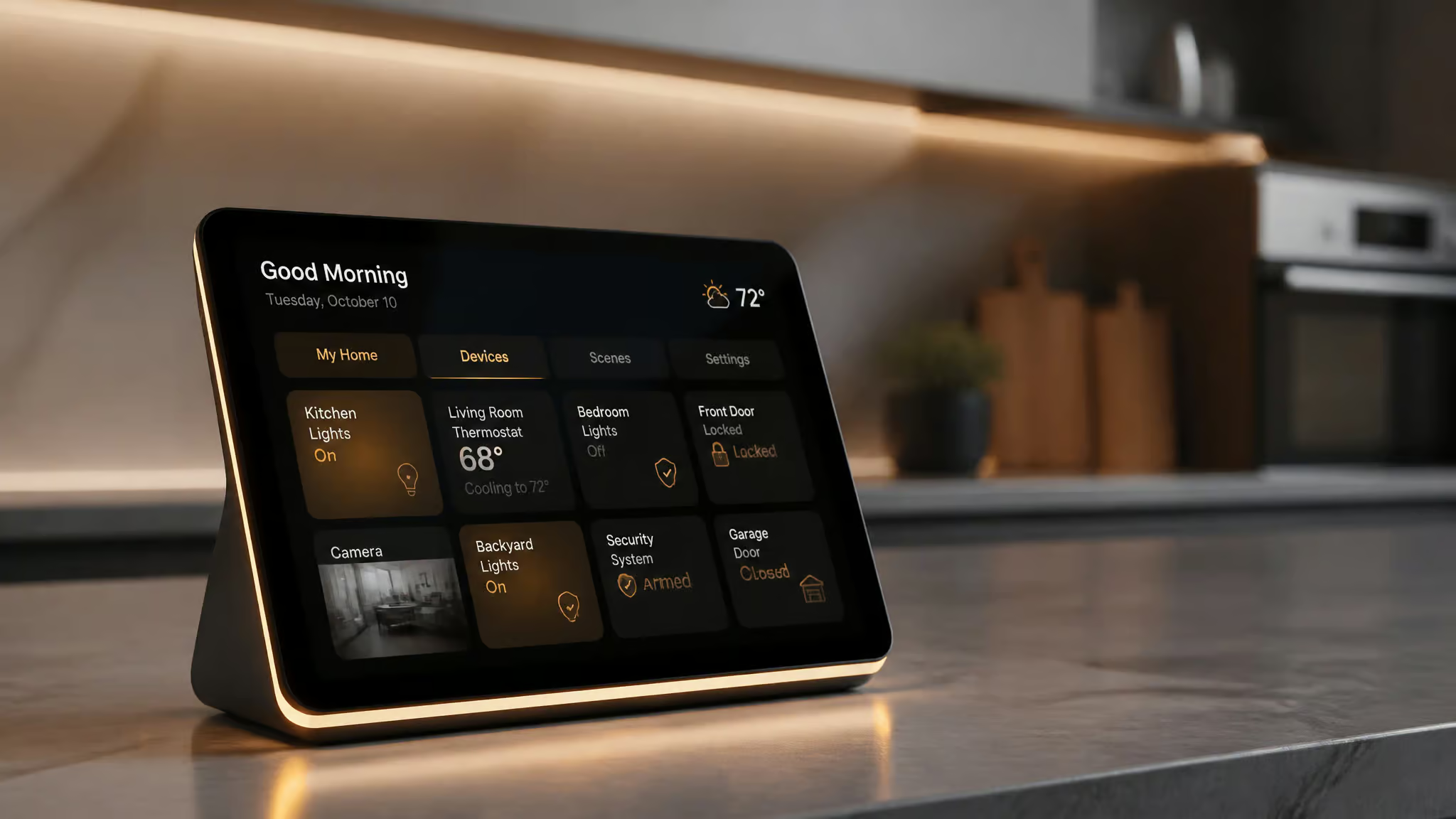
Okay, so check this out. I was digging through the macOS Tahoe 26.7 release candidate, the final beta before whatever ships next, and MacRumors already pulled a thread that’s honestly wild. Buried in the code are references to over a dozen hardware products Apple hasn’t announced yet: camera-equipped AirPods, a foldable iPhone, a home hub in two flavors, a security camera, a tabletop robot, and a whole bunch of identifiers that don’t match anything on the market. That’s a solid leak roundup on its own.
But what makes this one different is that Apple’s internal codename system isn’t random. Once you know how to read the prefixes, the version jumps, and the suffix patterns, you can turn these cryptic strings into a surprisingly detailed roadmap. Consider this a tour of everything the leak spilled and a decoder ring so you can spot the next one yourself.
Key Takeaways
Apple’s codename prefixes (J, B, V, K, N, ATV) reveal product category, while version jumps like J704?J804 signal a new chip generation (M5?M6), and smaller increments like B520?B525 mean a minor refresh.
The leak confirms two separate camera AirPods projects: B790 for 2026 with a per-bud camera stream (the code literally says “B790 start image stream failed for left bud“) and a hair-covering alert in the setup flow, plus B798 for 2027 as a distinct parallel project.
Over 25 unidentified model numbers (A3436-A3577) plus 9 prototype identifiers (Device1,8234-8248) indicate Apple’s hardware pipeline extends well beyond the named products, with unknowns outnumbering knowns.
Table of Contents
Understanding Apple’s codename system
Apple doesn’t publish a naming convention for internal hardware identifiers, but after enough leaks pattern-matching is pretty straightforward. The first letter tells you the product category:
- J, iOS-like devices: home hubs, iPads, MacBook Pros (yes, Macs sometimes use J for reasons that are probably historical).
- B. Audio: HomePod mini, AirPods, Beats.
- V, iPhone generations.
- K. Mac models, especially ones with OLED or touchscreen, a newer prefix that seems to mark a distinct sub-family.
- N. Headset stuff: Vision Pro.
- ATV. Apple TV accessories.
That’s useful, but the real insight comes from the number and suffix. Look at the MacBook Pro. The current M5 MacBook Pro is J704. The leak shows J804.
That’s a jump of +100. In Apple’s world, a big increment like that almost always means a new chip generation, in this case M5?M6. Compare that to the HomePod mini: current model is B520, next-gen is B525. A jump of 5.
That’s a minor refresh: same basic hardware, maybe a spec bump or a new color. Same logic applies to AirPods Pro identifiers. The current Pro 3 is AirPodsPro1,3; the leak shows 1,4. A single-digit increment, same-generation tweak, not a full redesign.
Then there are suffix patterns. A /0 vs /1 often means a form-factor variant: J490 is the base home hub, J491 is a wall-mounted version. The c and s suffixes on the new MacBook Pro codenames (K114c vs K114s) likely mean clamshell vs standalone/slim. And dual codenames like J510 (Wi-Fi) and J511 (cellular) for the iPad mini tell you that Apple is planning both connectivity variants from the start.
Once you see the system, the leak becomes much more than a list of names.
Home accessories
Apple’s smart home strategy has always felt a bit half-hearted compared to HomeKit vendor products. That’s changing. The macOS 26.7 code reveals four coordinated home products running on a shared operating system called homeOS (codenamed Pebble internally, per Bloomberg). This isn’t a scattergun approach; it’s a platform play.
Home Hub (J490/J491)
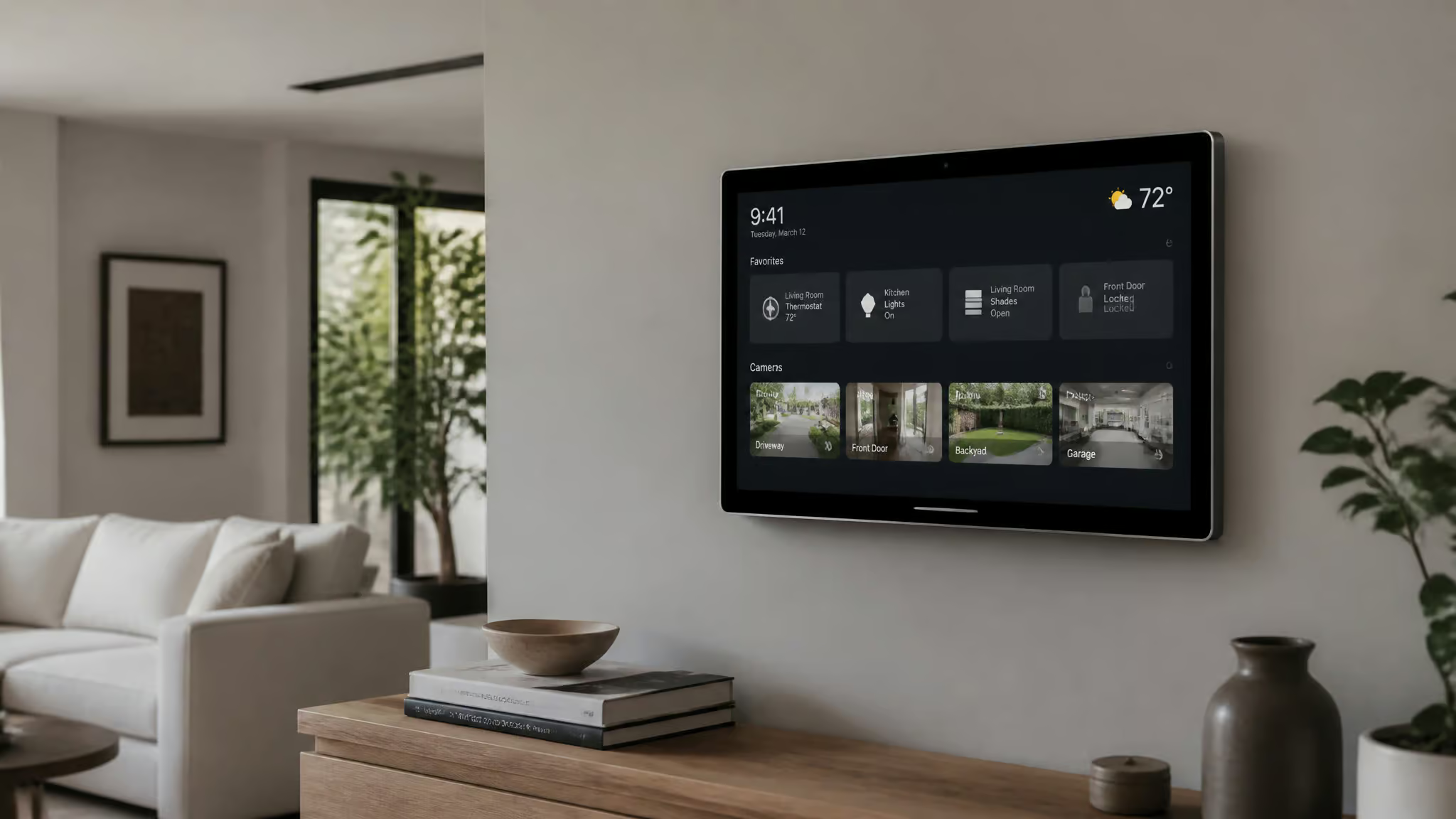
The centerpiece is the home hub, referenced as HomeAccessory17,1 (J490) for the base version and HomeAccessory17,2 (J491) for a wall-mounted variant. Think of J490 as the brain: a dedicated smart display you’d put on your kitchen counter, complete with Siri setup references that hint at a proper onboarding wizard. The wall-mounted J491 competes with the Nest Hub Max and mounts like a mini iPad. Reports peg the price around $350. Both run Pebble, a dedicated OS, not a tvOS fork, which means Apple is building a full stack for home automation, not bolting features onto an existing system.
HomePod mini (B525)
The little speaker that could is getting a refresh. Current model is B520; the leak shows B525, a jump of five that suggests internal spec improvements rather than a new design. The code also mentions something called Argentium installed on B525, could be a chip codename or a specific firmware build. Expect it this fall, possibly with new colors. The leak lists Rose Pink, Silver, Space Gray, and Starlight as options, which would give the mini a more consumer-friendly palette.
Security camera (J229)
Apple’s own smart security camera, not a third-party HomeKit vendor product, shows up as J229, with a code string referencing “J229Architecture”. That’s system-level design language, not a simple accessory. It first appeared in iOS 26 code, where Macworld described it as having multiple sensors capable of detecting alarm sounds and capturing images. So it’s a combined alarm listener and camera in one unit. Apple owning the hardware means tighter integration with homeOS and, presumably, better software updates than a random vendor’s device.
Tabletop robot (J595)
This one is pure delight. J595, also listed as HomeAccessory17,3, is described as a tabletop robot, think something like a Pixar lamp that can move and interact on your desk or counter. It’s Apple’s most whimsical product in years. Details are sparse (the code doesn’t say what it does), but the fact that it shares the homeOS family with the hub, mini, and camera tells you it’s part of the same ecosystem.
homeOS (Pebble)
All four home devices run Pebble, Apple’s dedicated operating system for the home. The name surfaced in Bloomberg reporting and now appears in the leak. It’s not a tvOS fork, it’s a separate OS tailored for always-on, low-latency smart home tasks with on-device Apple Intelligence. That’s the secret weapon: Apple wants to reclaim the smart home via local AI processing, not cloud dependence.
Mystery colors and visual reasoning
The leaked color options (Rose Pink, Silver, Space Gray, Starlight) likely apply to the hub or the HomePod mini, suggesting Apple is designing these for consumer spaces, not just utility. Also in the code: a string called audio_accessory_visual_reasoning. That could describe how the home hub’s camera or the camera AirPods interpret what they “see”. It’s generic enough to apply to multiple products, but it confirms Apple is building visual AI into audio accessories.
Headphones
This is the most technically fascinating section of the leak. Two camera AirPods projects, separate Beats models, and a next-gen Pro identifier, plus some of the most specific engineering details I’ve seen in a firmware leak.
Camera AirPods B790
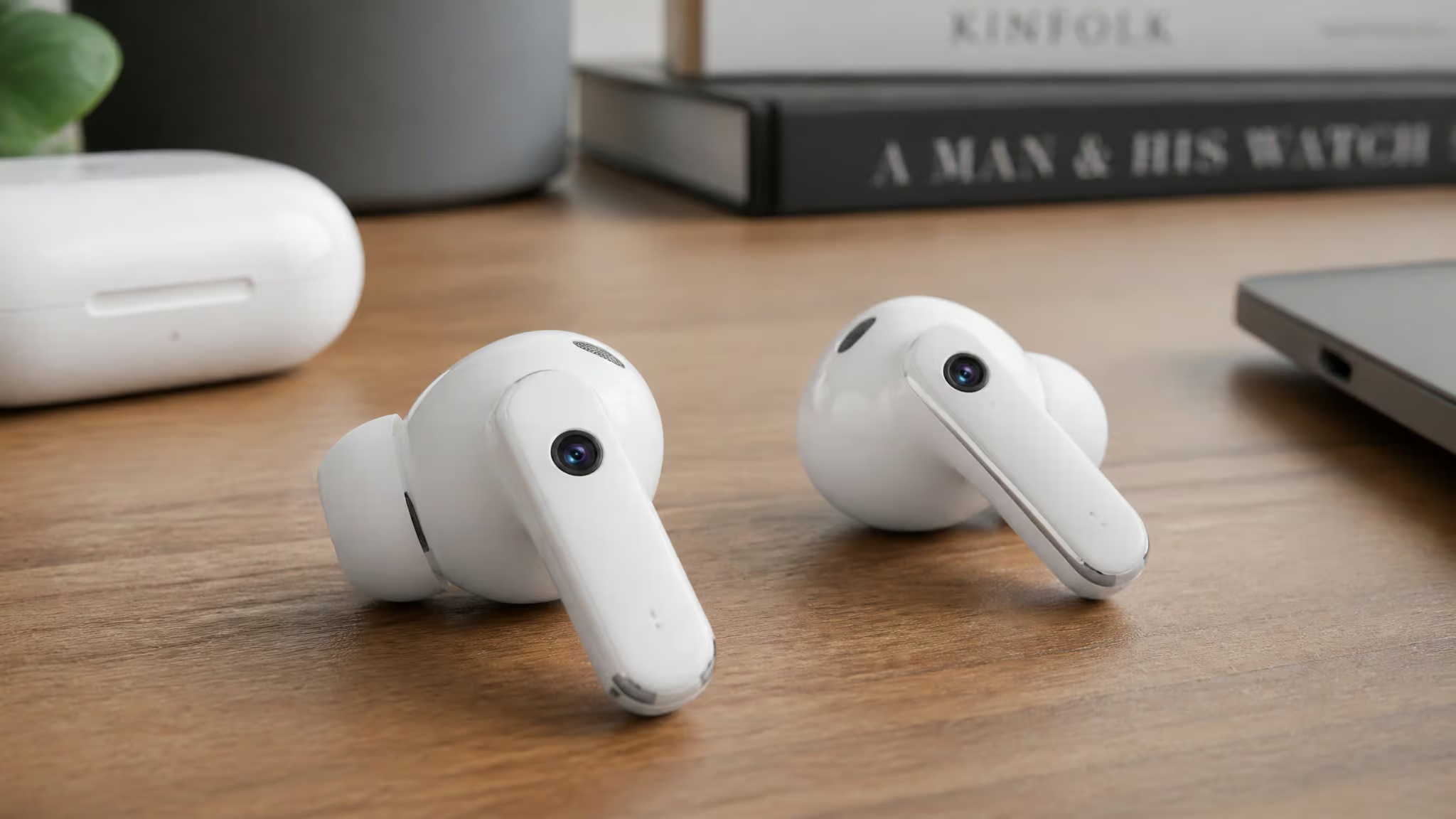
B790 is the 2026 model, possibly launching as early as September alongside the new iPhones. The code leaves no doubt this is real: there’s an exact error string“B790 start image stream failed for left bud”, confirming that each earbud has its own camera sensor and the system handles stream failures per bud. A leaked 13-second demo video (spotted by Aaron Perris on X) shows a man holding a book while a Siri voiceover explains what Visual Intelligence is doing. The feature is powered by Apple Intelligence and designed for environmental awareness, identifying objects, reading text, giving you context, not for taking photos.
The engineering goes deeper. The setup flow includes a hair-covering alert: if your hair blocks the camera lens, the system tells you. That’s a thoughtful UX detail that shows Apple thought about real-world use. The earbuds look nearly identical to current AirPods Pro, with a slightly thicker stem where the camera lives. And there’s a user-facing toggle in the setup flow for enabling visual intelligence, so it’s not always on.
The big picture: Apple is betting that more people wear AirPods than are willing to buy smart glasses like Meta’s Ray-Bans. Meta’s been doing camera-plus-AI assistant in glasses for a couple of years. Apple’s form factor bet is earbuds, a lower barrier to entry, and arguably more socially acceptable. The privacy question is obvious: how will bystanders know the camera is active?
Apple leans on visible recording indicators, like the MacBook camera light. On-device processing keeps visual data private, but we’ll need clarity on what’s stored.
Camera AirPods B798
B798 is a separate project, distinct from B790, not a typo or a successor. It’s slated for 2027. Apple is exploring two different camera earbud implementations, probably different designs or target markets. The existence of two parallel projects suggests they’re hedging their bets, maybe testing a cheaper variant alongside a more advanced one.
Beats B518 and B522
Apple’s audio brand remains active. B518 and B522 are two possible upcoming Beats headphones. Details are sparse, but the two identifiers probably indicate different models, maybe over-ear vs on-ear, or updates to the Studio and Solo lines. Nothing revolutionary, but evidence that Beats is still active in the pipeline.
AirPods Pro 4 (AirPodsPro1,4)
Current AirPods Pro 3 are AirPodsPro1,3. The leak shows 1,4, a single-digit increment, meaning this is a same-generation refresh with small tweaks. This is not the camera model (that’s B790/B798). It’s probably a regular fourth-gen Pro with better battery, improved ANC, or maybe a new color. If Apple calls it “AirPods Ultra” instead (some reports suggest that), the price would land above the current $249, creating a new premium tier alongside the camera model.
AirPod3,5
Another identifier without a clear product match yet. It could be the standard AirPods 4 or a mid-cycle refresh. More evidence that Apple is doing a broad audio refresh across the board.
iPhone lineup
Here’s where the leak reveals Apple’s most radical shift in iPhone launch strategy in years. The codenames point to a deliberate bifurcation: Pro models and the foldable in fall, standard models in spring, but decoding every hidden reference requires a deep-dive analysis of the Apple macOS 26.7 leak new products.
Yes, the iPhone 18 Pro and iPhone Ultra will launch in September 2026. That’s confirmed by the codenames V63 (iPhone 18 Pro), V64 (iPhone 18 Pro Max), and V68 (foldable iPhone Ultra) all appearing under the expected fall window. The standard iPhone 18 (V67) and iPhone Air 2 (V62) are scheduled for spring 2027.
iPhone 18 Pro (V63). September 2026
iPhone 18 Pro Max (V64). September 2026
Foldable iPhone Ultra (V68). September 2026
The foldable is Apple’s first, and it’s positioned above the Pro Max, hence “Ultra”. The codename V68 fits the V-series iPhone prefix, confirming it’s an iPhone, not a separate device class.
iPhone Air 2 (V62). Spring 2027
iPhone 18 (V67). Spring 2027
The Air 2 is the super-slim design statement, following the rumored iPhone 17 Air. The standard iPhone 18 gets pushed to spring alongside it.
Why splitthe launch?
Staggering gives Apple the entire holiday quarter for the high-margin Pro and Ultra models, extends market buzz into spring, and helps supply chain management, they don’t have to ramp up five models at once. It also sets up a possible second fall event in October or November for Macs and home accessories, which would be a first for Apple. This is a company breaking its own tradition on purpose.
Mac models
The Mac lineup gets a mixed bag: a straightforward M6 refresh for the entry-level Pro and iMac, plus a much more interesting OLED/touchscreen new MacBook Pro leak macOS 26.7 line.
The new MacBook Pro with M6 chip is J804, a 14-inch entry-level model. Current M5 is J704; the +100 jump signals a new architecture. Expect it before the end of 2026.
M6 MacBook Pro (J804)
Entry-level 14-inch. Likely just a chip bump with maybe a minor spec upgrade, but the codename shift is unambiguous.
M6 iMac (J833/J834)
Two codenames, probably two screen sizes or configurations (e.g., 24-inch and 27-inch?). Bloomberg attributed these. Same M6 chip, same colorful chassis.
OLED/touchscreen MacBook Pro (K114c/K114s/K116c/K116s)
This is the exciting one. Four codenames with suffixes: c for clamshell (traditional laptop) and s for standalone/slim (possibly touchscreen-focused). The K prefix is new for Mac, previous Macs used J, so this is a distinct product category. If these ship, they’d be Apple’s first MacBook Pros with OLED displays and touchscreens.
Yes, touchscreen Macs, finally. The c/s split suggests two form factors: a regular laptop and maybe a more experimental detachable or convertible design. Nothing is confirmed, but the pattern is strong.
iPad
Will the next iPad mini have an OLED display? Yes. The leak confirms J510 and J511, the next iPad mini with OLED and an A19 Pro chip. J510 is likely the Wi-Fi model, J511 cellular.
This is exactly what iPad mini fans have been asking for: the tiny tablet finally gets the display it deserves. That’s the headline. No surprises beyond that.
Vision Pro
N109 is the second-gen Vision Pro. There was confusion because The Information reported a cheaper version, but that was reportedly canceled. Bloomberg says N109 is the real successor, refining the original formula, probably lighter, cheaper, and with better ergonomics. So the cheaper model is off the table; Apple is focusing on a single improved follow-up.
Apple TV remote
ATVRemote1,5 is a new Apple TV remote. The version numbering (1,5) places this as an iterative update within the same remote generation, not a complete redesign. Previous rumors mentioned an updated remote alongside a future Apple TV model, so this fits. Probably minor improvements like USB-C charging or a refined button layout. Nothing to get excited about, but it confirms a refresh is coming.
Apple Intelligence in China
When will Apple Intelligence Writing Tools launch in China? The code confirms they’re coming, but only after a content safety update is applied. There’s no specific date, only the mechanism is visible.
Three exact error strings in the code show a graduated safety system:
- Writing Tools are temporarily restricted because of triggering safety alerts multiple times.
- Content safety update required. iPhone will be able to use Writing Tools after the automatic update completes.
- Unable to edit this text. %1$@ may be able to assist with this kind of content. This text will need to be sent to %2$@.
This isn’t a simple block. It’s a three-tier system: temporary restrictions after repeated triggers, automatic safety updates, and fallback to third-party services for restricted content. Apple is engineering for regulatory compliance without a hard kill switch. The first string shows that the system can temporarily disable Writing Tools if you keep tripping the safety net.
The second string says an automatic update can restore it. The third suggests that for certain content types, Apple will hand off to a third-party service (maybe a local partner) instead of processing it on-device.
This is Apple walking the tightrope of operating in China’s content environment while keeping its AI on the device. It’s not censorship, it’s a safety mechanism. But it does mean that Writing Tools will launch with restrictions that aren’t present in other markets.
Unknown model numbers
How many unreleased devices did macOS 26.7 leak? Over 25 unidentified model numbers, plus 9 prototype identifiers. The named products are the tip of the iceberg. Here’s what else landed in the code.
A-series unknown identifiers
- A3436-A3441 (6 numbers)
- A3456-A3457 (2 numbers)
- A3465
- A3529-A3533 (5 numbers)
- A3543
- A3577
That’s 17 retail-model identifiers for hardware that doesn’t exist yet. These are the numbers Apple uses for shipping products, not prototypes. They represent yet-unrevealed devices, could be anything from a new AirTag to a smart ring to more HomePod variants. We don’t know.
Device1,8xxx prototype identifiers
- Device1,8234-Device1,8248 (9 identifiers)
These are prototype-stage hardware, internal testing units not yet assigned retail model numbers. The “1,8xxx” range is consistent with development hardware that later gets retail IDs. That’s 9 different prototype projects, many of which may never ship, but the scale is telling.
For every product we can name, there are more than two we can’t. That’s the humbling part.
Release timeline and what comes next
Here’s how it all fits together on the calendar.
September 2026 (first wave, fall Apple event) – iPhone 18 Pro (V63) – iPhone 18 Pro Max (V64) – Foldable iPhone Ultra (V68) – Camera AirPods B790 (possible launch alongside iPhones)
Possible second fall event (October/November 2026) – M6 MacBook Pro (J804) – M6 iMac (J833/J834) – OLED/touchscreen MacBook Pro (K114/K116), if they’re real – iPad mini (J510/J511) – Home Hub (J490/J491) – HomePod mini (B525) – Security camera (J229) – Tabletop robot (J595) – New Apple TV remote (ATVRemote1,5)
Spring 2027 (second wave) – iPhone Air 2 (V62) – iPhone 18 (V67) – Camera AirPods B798
Beyond – 25+ unknown identifiers point to far more unannounced hardware beyond this timeline. Some may ship in 2027 or 2028; some may never see the light of day.
This is the richest single code dump I’ve seen in a long time. It’s more than a leak list; it reveals how Apple thinks about product categories, generations, and form factors. And now that you know how to read the codenames, you can watch the next beta update and spot the patterns yourself. The treasure map is right there in the firmware.
