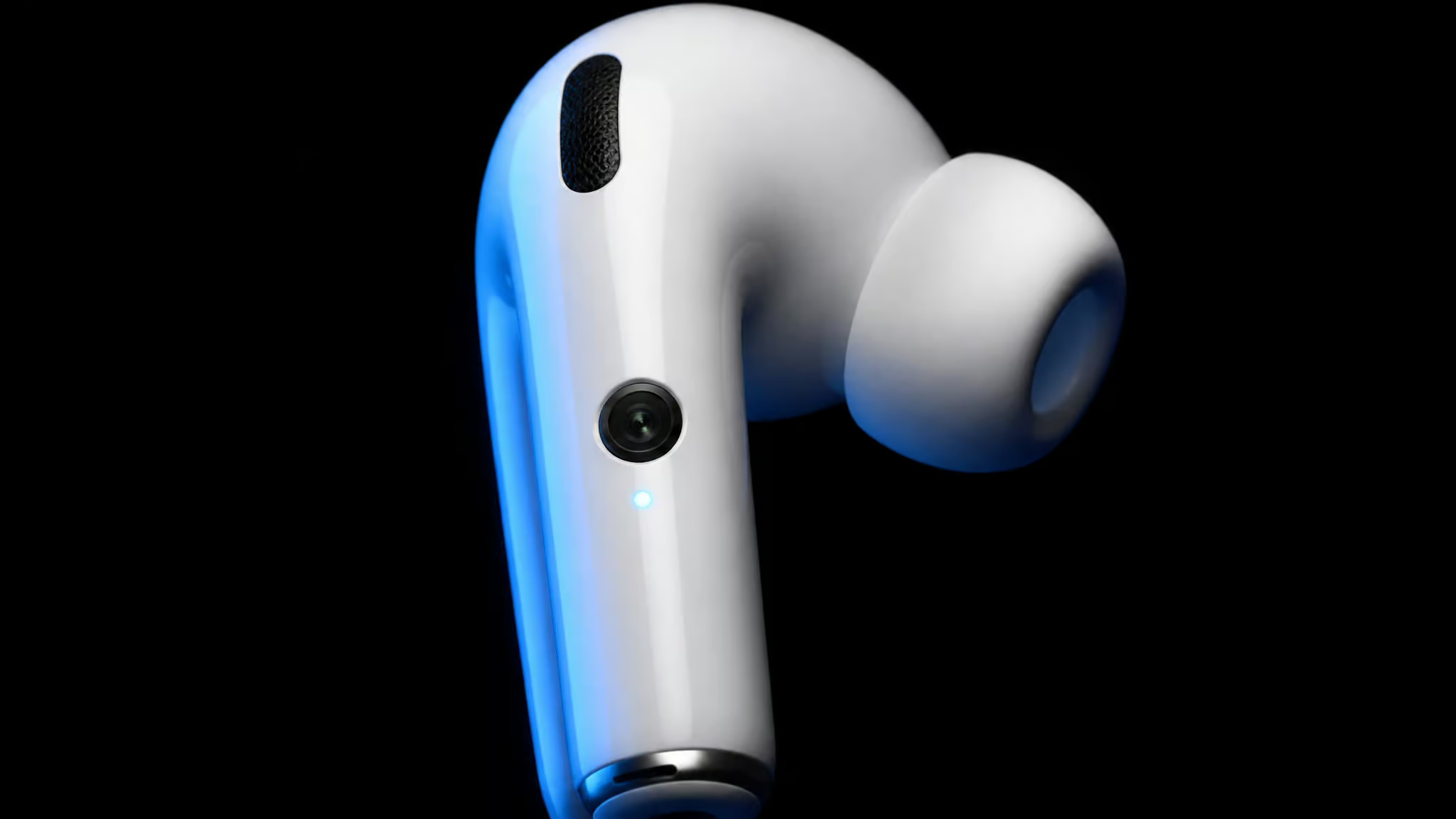
Apple seeded the macOS 26.7 Release Candidate today, build 25G220, and the official release notes say exactly what you’d expect: security fixes. Which is true. It is a security release. But developers who cracked open the code found way more than just patch notes. We’re talking hardware roadmap level stuff: new AirPods with cameras, a family of smart home devices, foldable iPhones, and a whole bunch of model numbers that don’t match anything Apple has ever shipped.
I track these builds pretty closely, and this one stood out immediately. The cadence alone is unusual, macOS 26.6.2 landed on August 17, and the 26.7 RC dropped just one day later, on August 18. That’s fast even by Apple standards, and it’s not random. The accelerated pace appears to be tied to AI-discovered vulnerabilities, which is shifting how Apple thinks about security patching. But the real story is what got buried inside the RC itself.
Key Takeaways
The macOS 26.7 RC (build 25G220) includes a code string confirming camera-equipped AirPods: “B790 start image stream failed for left bud,” alongside a demo video showing Visual Intelligence in action on the earbuds
The RC contains code references to a unified smart home platform powered by homeOS (codename Pebble), including a Home Hub, next-gen HomePod mini, a sensor device, and a tabletop robot with a display
Fall 2026 hardware timeline is mapped out: three iPhones (including a foldable Ultra) in September, with M6 MacBook Pros, OLED iPad mini, and new home accessories likely arriving in October or November
Table of Contents
Confirming the macOS 26.7 Leak: What We Actually Know
Let’s start with what’s real and verifiable. The macOS Tahoe 26.7 Release Candidate exists. Build 25G220, and both developer and public RC builds dropped simultaneously with matching numbers. The release notes are minimal: security fixes, full stop.
No new features, no user-facing changes. That’s normal for a point release this late in Tahoe’s life cycle.
But here’s the thing about Apple’s software: the code is rarely as boring as the release notes suggest. MacRumors dug into the RC and found references to unreleased products scattered throughout. These aren’t anonymous leaks from supply chain whispers, they’re literal code strings, model identifiers, and firmware references baked into a build that Apple seeded to thousands of developers.
The RC also landed with macOS Sequoia 15.8 RC (build 24H16) on the same day, which is a coordinated cadence for the last-gen OS. For context, macOS Tahoe is the twenty-second major macOS release and the final version that supports Intel Macs. macOS 27 Golden Gate, which only runs on Apple Silicon, is expected in a few weeks. That’s where the real feature work is happening.
So yes, the leak is real. But it’s not a person leaking documents, it’s Apple’s own software telling us what’s coming next.
The Smart Home Leaks: Apple’s homeOS Ambitions
The most coherent story in the RC is Apple’s smart home play. There are multiple device references in the code, and they all point to a unified platform running a new operating system: homeOS, codenamed Pebble internally. Bloomberg has previously reported on Pebble, so this isn’t out of nowhere, but seeing the actual device codenames in a shipping build is a different level of confirmation.
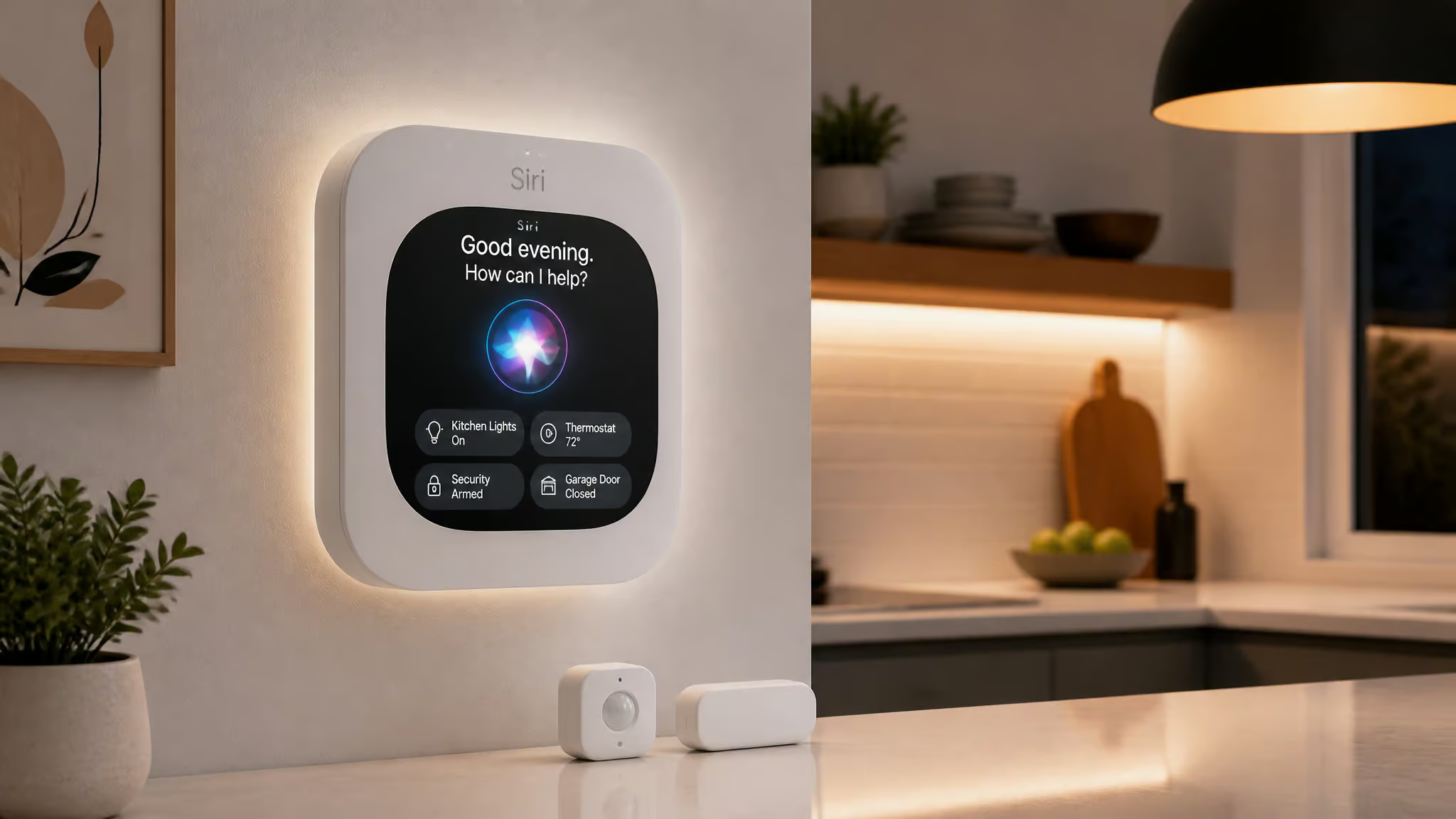
The Home Hub (J490 and J491)
The centerpiece is the Home Hub, split into two variants. J490 is the base model, a smart home accessory with Siri setup references, designed to sit on your counter and control your house. J491 is a wall-mounted version of the same hub, which is a form factor Apple hasn’t tried before. Think of it as a permanent fixture that lives on your wall, similar to how you’d mount a thermostat or an intercom.
Next-Gen HomePod Mini (B525)
The current HomePod mini is B520 internally. The RC references B525, which is a clear generational bump. What makes this interesting is the code mentions “Argentium” being installed on B525, that could be a new OS or a framework layer, but the name alone suggests Apple is building something more ambitious than a simple speaker refresh. Color references in the code. Rose Pink, Silver, Space Gray, Starlight, show up for an unnamed home accessory, and they could apply to a second-generation HomePod mini, the Home Hub, or some other device entirely.
The Sensor Device (J229)
J229 is a codename that’s appeared before. Macworld found references to “J229Architecture” in iOS 26 last December. This time, the RC reveals more: the device has multiple sensors, detects alarm sounds, and captures images. That sounds like a security camera or a sensor hub that pairs with the Home Hub.
It’s still speculative, but the sensor array description is specific enough to rule out a simple motion detector. This is Apple building an indoor security presence, likely tied into the same homeOS ecosystem.
The Tabletop Robot (J595)
And then there’s J595, also called HomeAccessory17,3. This is the rumored tabletop robot with a display mounted on a moving arm. It sounds like science fiction, and honestly, it kind of is, but the code reference is real. The idea is a device that follows you around your kitchen or workspace, showing information on a screen that pivots to face you. It’s weird, ambitious, and very much in development.
What ties all of these together is homeOS/Pebble, plus a code string in the RC: audio_accessory_visual_reasoning. That suggests Apple is evaluating visual understanding for audio devices, the Home Hub, HomePod mini, or the robot could use cameras or sensors to understand their physical environment and react intelligently. Smart home devices that actually see the room they’re in, much like the macOS 26.7 leak new accessories hints at updated Magic Keyboard, Magic Mouse, and Magic Trackpad with USB-C.
AirPods with Cameras: The B790 Project
Okay, let’s talk about the headphones with cameras. This isn’t a persistent rumor anymore, the RC contains direct evidence.
The codename is B790. The specific evidence in the RC is a code string: “B790 start image stream failed for left bud.” That confirms the left earbud has a camera, because you can’t start an image stream from a bud that doesn’t have one. And there’s more: a video file embedded in the RC, posted by Aaron (@aaronp613) on August 18, 2026, shows these AirPods running Visual Intelligence. Apple’s AI-powered environment analysis.
Before the obvious question comes up: no, these are not designed for recording video or snapping photos. The use case is basic environment analysis for AI features. Your AirPods would be able to understand the space around you, recognizing objects, reading signs, identifying what’s in front of you, without you pulling out your phone. Privacy is built in: there are indicator lights that activate when the cameras are in use, and there’s no continuous recording capability.
Importantly, B790 is a separate project from B798, which is the camera AirPods rumored for a 2027 launch. That means Apple is working on two different generations simultaneously, which suggests they see real potential here. B790 could ship as soon as September 2026.
iPhone, Mac, and iPad Roadmap: Fall 2026 Hardware Timeline
The RC also gives us a clean picture of Apple’s hardware plans through early 2027. None of this is officially confirmed, but the codenames are consistent with what’s appeared in previous iOS and macOS builds, including those detailed in our Apple macOS 26.7 leak new products analysis.
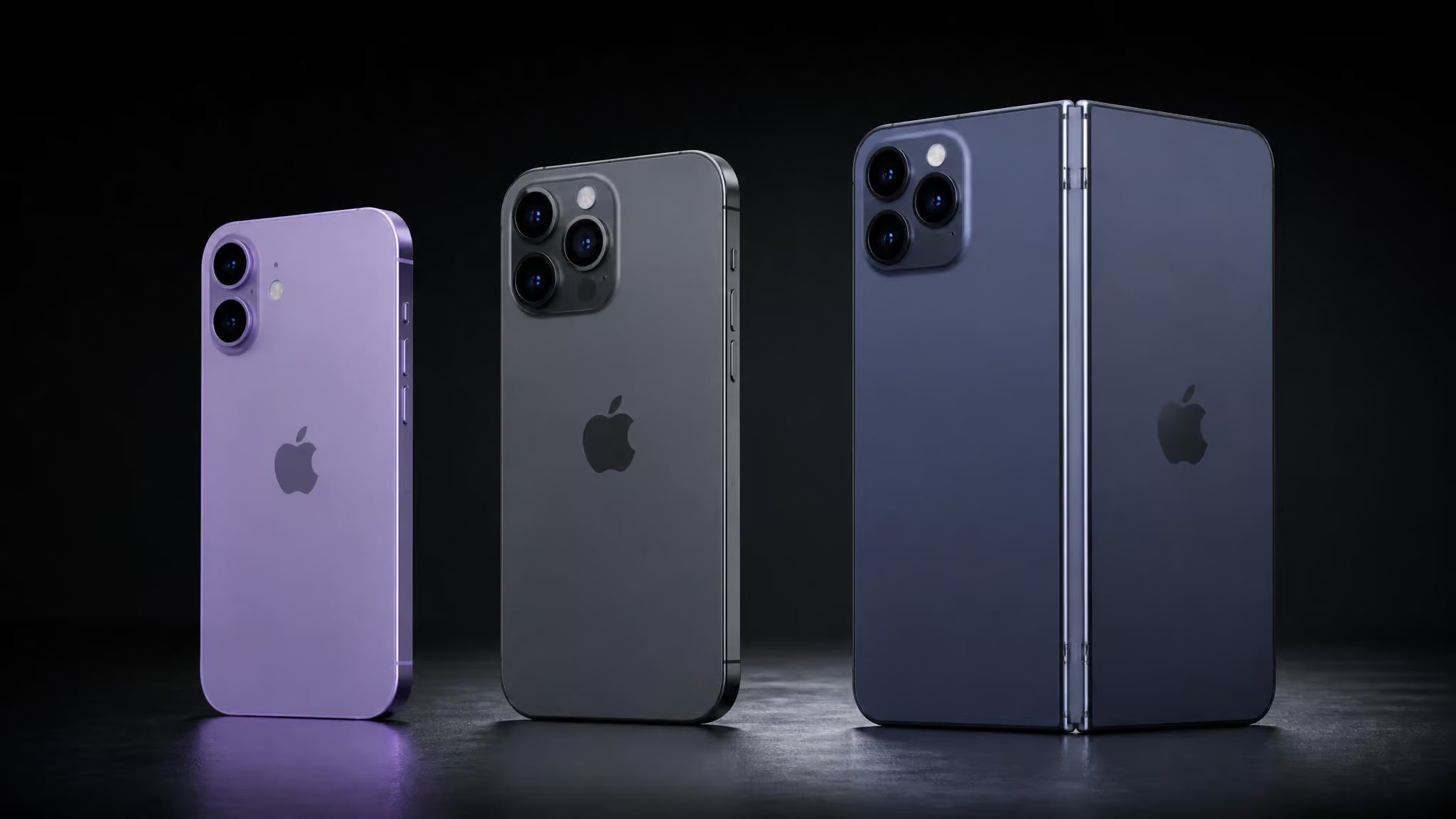
September 2026: The iPhone Event
Three iPhones are expected: the iPhone 18 Pro (V63), iPhone 18 Pro Max (V64), and the foldable iPhone Ultra (V68). V63 and V64 have been seen in iOS 27 code before, so they’ve been in development for a while. V68 is the big one. Apple’s first foldable, and the “Ultra” naming suggests a premium tier above the Pro models.
October/November 2026: Macs and Home Accessories
Apple typically holds a second fall event for Macs and iPads, and the RC points to several products landing then. The baseline 14-inch MacBook Pro with an M6 chip (J804) is a notable addition, this would be a more accessible Pro model compared to the high-end M5 Max versions currently shipping as J704. New iMacs with codenames J833 and J834 are likely coming alongside it, and a recent Apple display leak macOS 26.7 references new external display firmware that could hint at a potential Apple Studio Display 2 or Pro Display XDR successor.
The iPad mini is getting a serious upgrade: OLED display and an A19 Pro chip, under codenames J510 and J511. The current iPad mini is great, but it’s been due for a display upgrade, and OLED would be a massive leap for that form factor.re‘s also a new Apple TV remote in the RC: ATVRemote1,5, which suggests the next Apple TV hardware refresh is imminent.
Spring 2027
The iPhone Air 2 (V62) and the standard iPhone 18 (V67) are expected in spring 2027, not this fall. If you’re not in the market for a Pro or foldable this year, those are the ones to watch.
Why the Rush? Apple’s Accelerated Update Cycle
The one-day gap between macOS 26.6.2 and the 26.7 RC isn’t a fluke. Apple has been speeding up its macOS release cycle, and the pattern suggests AI-discovered vulnerabilities are driving the pace. Security researchers and automated tools are finding bugs faster than ever, so Apple is patching faster to keep up.
In practice, this accelerated cadence means that while critical security fixes arrive quickly, some users prefer to wait a few days after an update to check for reported issues before installing. The 26.6.2 release that preceded the RC, for instance, fixed a serious Screen Sharing bug that had been causing problems. The 26.7 RC likely bundles more of those fixes alongside the security patches.
This is a genuine shift in Apple’s security patching philosophy. Historically, Apple has been deliberate about bundling fixes into larger updates. Now they’re shipping point releases more frequently, which is better for security but means users face a slightly higher chance of encountering minor regressions. macOS 27 Golden Gate remains scheduled for release in a few weeks, so Tahoe 26.7 may be the last major security update for Intel Mac users.
Apple Intelligence Goes Global: Writing Tools in China
Not everything in the RC is about hardware. There are code strings revealing Apple’s plans to bring Writing Tools, the Apple Intelligence feature that rewrites, summarizes, and proofreads text, to China, complete with a regulatory compliance system.
The relevant code strings are: A content safety update is required. Once the automatic update finishes, the iPhone will gain access to Writing Tools, and Writing Tools have been temporarily restricted because safety alerts were triggered multiple times.ltiple times.
The pattern here is a safety update mechanism that gates access to Writing Tools until an automatic compliance check runs. If the feature triggers safety alerts repeatedly, it gets temporarily restricted. This is Apple’s approach to balancing AI features with local regulations, the feature is available, but with guardrails that enforce content safety rules before and during use.
It’s not censorship in the pure sense; it’s a technical compliance strategy. But it’s also Apple acknowledging that AI writing tools can’t operate everywhere with the same freedom they have in less regulated markets. The mechanism itself is novel, an automatic update requirement before first use, rather than a simple on/off toggle based on region.
The Mystery of the Unknown Model Numbers
Every leak has loose ends, and this RC has more than most. The code contains sixteen model numbers. A3436 through A3441, A3456, A3457, A3465, A3529 through A3533, A3543, A3577, plus eight device identifiers labeled Device1,8234 through Device1,8248. None of these match any known Apple product.
The sheer volume of unknown identifiers is a notable aspect of these leaks. Sixteen in this case is unusual and suggests a substantial hardware refresh, or possibly an entirely new product category Apple hasn’t hinted at publicly. Some of these could be placeholder identifiers for future devices still in early prototyping. Others might be internal testing units or prototypes that never ship. A few could be from canceled projects.
What stands out is that this volume appeared in a single RC, not spread across multiple betas. That’s a signal that Apple is preparing for a broad hardware launch, and some of those identifiers will likely get matched to actual products in the coming weeks.
What to Expect Next
So here’s where we land. The macOS 26.7 public release should arrive within a week, that’s the standard gap between RC and general availability. macOS 27 Golden Gate follows in a few weeks, which is where the real software features land. After that, the fall hardware events: three iPhones in September, including the foldable Ultra, followed by Macs, iPads, and home accessories in October or November. The AirPods with cameras could debut alongside the iPhones in September.
All of this comes from code analysis and release pattern observations, not from Apple’s official roadmap. None of it is confirmed until Apple stands on a stage and announces it. But the evidence in this RC is stronger than most rumors: code strings don’t lie about what’s being developed, and the sheer breadth of references, from homeOS to camera earbuds to a tabletop robot, points to a company about to ship a lot of hardware in a short window.hat’s about to ship a lot of hardware in a short window.
The unknown model numbers are the cherry on top. Sixteen identifiers that don’t match anything yet. That’s a lot of empty seats at the table, and Apple hasn’t told us who’s sitting in them.
This article is part of a series analyzing the macOS 26.7 RC findings. For a deeper look at the home hub, robot, and smart home ecosystem, see Apple macOS 26.7 leak new products. For details on the Bluetooth and input device identifiers that suggest updated Magic accessories, check macOS 26.7 leak new accessories. And for analysis of the external display firmware references that point to a potential Studio Display 2 or Pro Display XDR successor, read Apple display leak macOS 26.7.
Frequently Asked Questions
Is macOS 26 stable now?
macOS 26.7 is a security-focused release candidate, so it should be stable for most users. The accelerated update cycle means fixes arrive faster, but some users prefer waiting a few days after public release to check for any minor regressions before installing.