
If you’ve spent any time in r/webdev or r/web_design, you’ve seen the same debate pop up: Who does the heavy lifting? Who gets paid more? And — which one should you become?
We analyzed discussions on r/webdev and r/web_design to surface what practitioners argue about, recommend, and warn newcomers about.
Key Takeaways
The median total pay gap between designers ($85,000) and developers ($100,000) exists, but it’s modest — senior designers average $104,000, and senior developers range up to $129,000+. Not as extreme as lore suggests.
Designers do code (HTML/CSS at minimum), developers do think about design — the strict separation is a myth perpetuated by people who haven’t worked in a production team.
AI-assisted tools like Claude Agent Skills are changing workflows, but Snyk’s ToxicSkills research found prompt injection in 36% of tested skills and 1,467 malicious payloads across the ecosystem — useful technology, serious security caveat.
Table of Contents
Web Designer vs Web Developer — The Core Difference
Web designers own how a site looks and feels — the layout, colors, typography, brand, and user flow. Web developers own whether the thing actually works, the structure, interactivity, performance, security, and cross-device behavior.
HubSpot has a neat analogy: the designer is the architect who sketches the floor plan and the user journey; the developer is the builder who pours the foundation and frames the walls. The designer figures out where the kitchen goes; the developer makes sure the plumbing works.
It’s a complementary relationship, not a hierarchy. Practitioners argue about who does the work, where the line blurs, and whether a designer who doesn’t understand responsive breakpoints is doing their job.
Day-to-Day Responsibilities — What Each Role Actually Does
Designer specializations
Not all designers are the same. The job splits into three pillars:
- Visual design — graphics, layout, composition. The pretty stuff.
- UX (user experience) — navigation, feedback loops, usability testing. Does the user get lost?
- UI (user interface) — individual interactions. What happens when you click that button? How does the menu slide out?
Interaction designers zoom in on the details: hover states, color theory application, micro-animations. Meanwhile, designers talk to clients, run usability tests, keep up with trends, and make mood boards that don’t look like mood boards. Their north star: make it look good and make it easy to use.
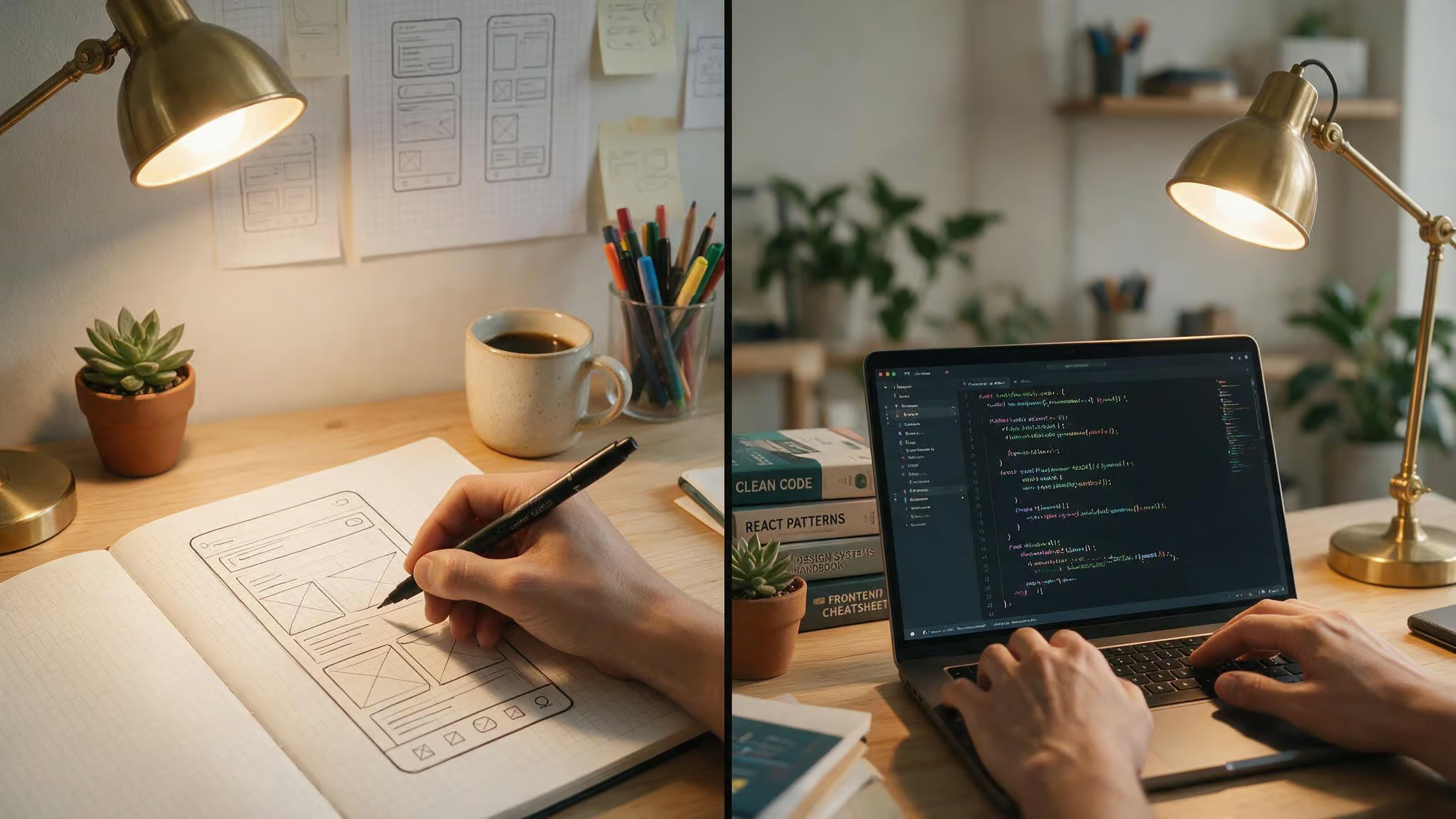
Developer specializations
Developers also have flavors, and Reddit argues about which one is development:
- Front-end — everything the user sees and touches. HTML, CSS, JavaScript, React, Angular. They sweat the responsive breakpoints and animation performance.
- Back-end — servers, databases, APIs. Python, Java, SQL, Node.js. The plumbing you don’t see.
- Full-stack — does both. The Swiss Army knife who sees the whole picture.
How they work together (and where friction happens)
Two main collaboration models. In a linear model, the developer builds the product, then the designer makes it engaging. Some back-and-forth, but generally a straight line. In a closed-loop model, the designer provides brand guidelines and continuously runs usability tests, feeding data back to the dev team for iteration. That’s the gold standard.
A common Reddit vent topic: a designer delivers a pixel-perfect mockup that doesn’t account for responsive breakpoints or loading performance. The developer has to push back, and it’s “why won’t you build what I designed?” The mature teams understand this is a collaboration, not a handoff.
Skills & Tools — What You Need to Know
Designer toolkit
Adobe suite is an entry point — Photoshop, Illustrator, InDesign, Dreamweaver (which blends visual design and code editing), and XD. Figma enables real-time collaboration, and Sketch remains a Mac-native staple.
Beyond the software, you need color theory, typography, composition — the fundamentals that separate a competent designer from an exceptional one. Designers code. HTML and CSS at minimum, some JavaScript. You don’t need to be a full-stack dev, but you should be able to speak the language. SEO basics and CMS familiarity (WordPress, Content Hub) are common.
Developer toolkit
The holy trinity: HTML, CSS, JavaScript. Then the frameworks — React, Angular, Vue.js for front-end; Django, Flask, Node.js for back-end. Databases (SQL, NoSQL), APIs, version control (Git). Code editors and the occasional mockup tool when you need to prototype something quickly.
The developer’s job is to build the structure and functionality. They think about load times, security vulnerabilities, and whether that animation will cause a repaint issue on a mid-range phone.
Soft skills both need
Attention to detail is required. Logical thinking, problem-solving, creativity, communication, curiosity — table stakes.
A word about the myths
Myth: Designers don’t code. Many know HTML/CSS and can build accessible pages. They might not ship production JavaScript, but they’re not code-illiterate.
Myth: Developers don’t design. Developers think end-to-end about the user experience. They’ll suggest tweaks that make the site faster or more usable. It’s a partnership, not a silo.
Myth: Development is harder to learn. Both have steep learning curves, in different directions. Design involves user research, psychology, color theory, and accessibility — it’s not “just making it pretty.”
Salary Comparison — Designer vs Developer
| Role | Median total pay (Glassdoor, current) | Typical range | Senior-level average/range |
|---|---|---|---|
| Web Designer | $85,000 | $64K–$117K | $104,000 (average) |
| Web Developer | $100,000 | $77K–$132K | $61K–$129K+ |
For a no-BS breakdown of these roles — from daily tasks and tools to salary and career paths, see our comparison of web designer vs web developer.
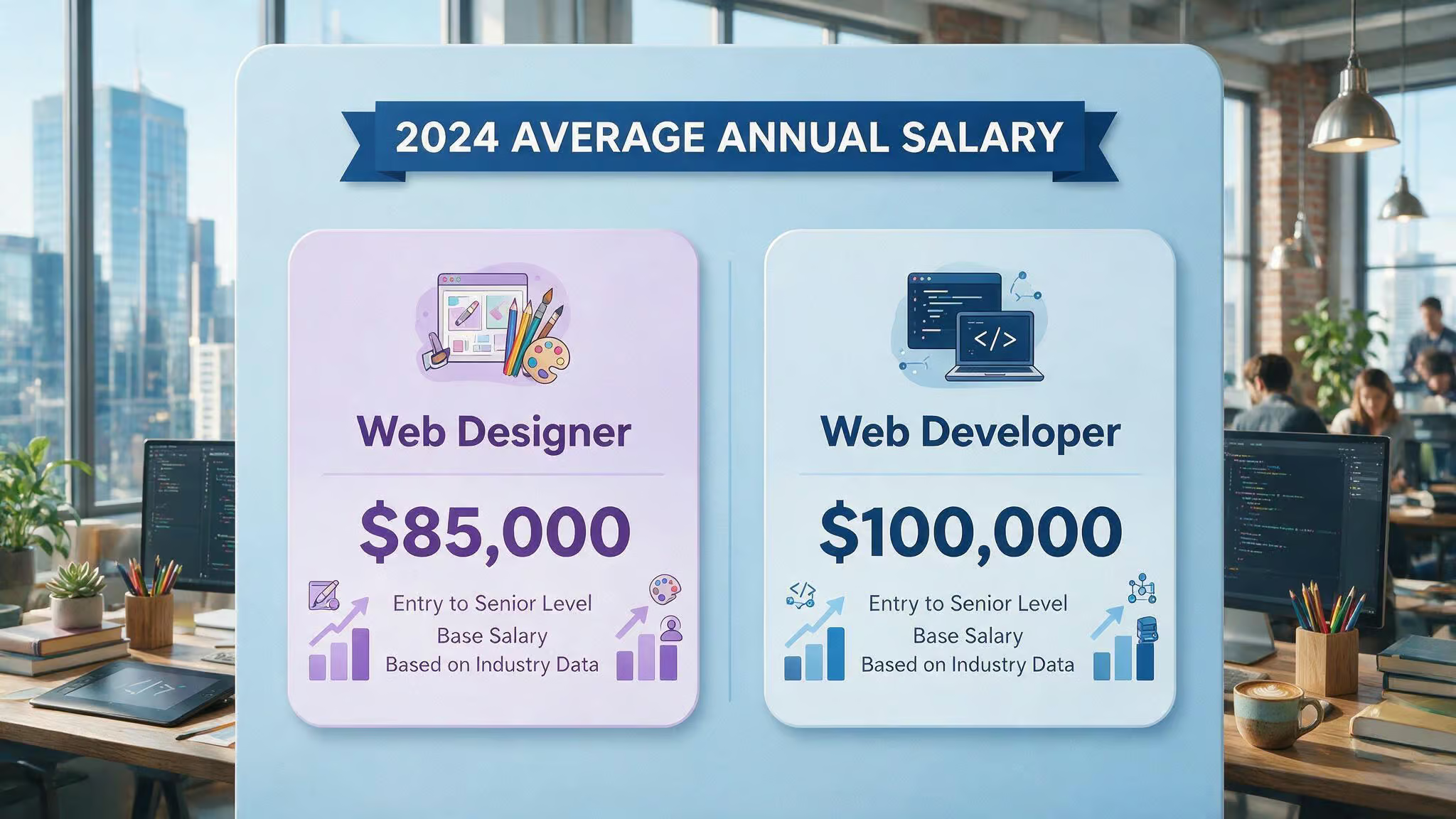
Average compensation for a web designer in 2023 is $57,915 per year (Glassdoor); average salary for a web developer in 2023 is $82,615 per year (Glassdoor). Web designers in the United States make between $35,000 to $78,000 per year (Payscale); web developers make an average of $40,000 to $90,000 per year (Payscale) — wider spreads that reflect entry-level and geography differences.
Freelance web designers charge an average of $60 per hour; freelance web developers charge an average of $75 per hour. In the United States, the average web designer is paid about $35 per hour; the average web developer is paid $42 per hour.
Key caveat: These figures include base pay plus bonuses, commissions, and profit-sharing. Geography matters enormously — NYC, San Francisco, and Toronto pay higher, but cost of living eats that premium. Remote work is gradually shrinking the geography gap, but it hasn’t disappeared yet.
The US Bureau of Labor Statistics (BLS) anticipates this kind of work to grow by 7 percent between 2024 and 2034 — faster than average. They lump both roles together in the data, so it’s hard to separate growth rates for jobs for each role, but demand isn’t going anywhere.
The myth: Developers don’t make “tons more” than designers. The gap is real — roughly $15K median, but it’s not a Silicon Valley fantasy. Senior designers can hit $104K. Choosing design doesn’t cap your earning potential.
Career Paths — How to Grow in Each Role
Designer career ladder
Entry-level ? advanced (~2 years) ? senior ? specialist (UX, UI, visual, interaction) or team lead. From there you can go freelance, co-found a startup, join a large enterprise, or move into UX strategy. The Chief Design Officer role exists at big companies. A senior web designer pulls in an average salary of $104,000.
Developer career ladder
Entry-level ? senior ? lead ? director of web development. You can specialize into software architect or full-stack, go freelance, move into management, or become a niche expert in something like real-time systems or database architecture. A senior web developer in the United States can command $61,000 to $129,000+ annually.
Mari Batilando (Meta) has solid advice that applies to both paths: Make sure you’re surrounded by people who push you and inspire you to grow. Do the type of work that you find rewarding and mentally engaging. Stick with that mantra and the promotions and compensation just come naturally.
How to Become a Web Designer or Web Developer
Designers often come from graphic design, photography, video production, programming, or digital writing backgrounds. Targeted certificates can get you there faster: Coursera’s Graphic Design Specialization (from CalArts) and the Google UX Design Professional Certificate are both well-regarded.
Developers frequently hold CS degrees, but bootcamps and self-study are common. The Meta Front-End Developer Professional Certificate and the IBM Full Stack Software Developer Professional Certificate are solid options. Certifications from Red Hat or Oracle (database design, Java, app development) can give you an edge.
How Designers and Developers Work Together (and Common Myths)
Collaboration models
- Linear: developer builds, designer makes it engaging. Some back-and-forth, but relatively straightforward.
- Closed-loop: designer provides brand guidelines and runs usability tests, feeding data back to the dev team. Continuous improvement.
Both roles work alongside scrum masters, QA, IT, management, sales, and marketing teams. Developers teach the sales team what the product does. Designers provide copy and art for marketing campaigns.
The five myths that clog Reddit threads
- Developers make way more money. The gap exists but isn’t extreme. See the salary section above.
- Designers don’t code. Most know HTML/CSS at minimum.
- Developers don’t design. Good developers think end-to-end and often prototype functionality with design in mind.
- Development is harder to learn. Both have deep complexity. Design involves user research, psychology, color theory, accessibility.
- No-code tools will kill these careers. Great for prototyping, but they hit limits at scale. Tools like Webflow, Canva, Bubble, and Adalo are powerful, but they’re not replacing skilled professionals.
When to hire which
- Basic site ? a designer may be enough.
- Complex site with advanced functionality ? developer needed.
- Best result ? hire both.
The AI-Assisted Future — How Agent Tools Are Changing Things
Claude Agent Skills use a three-tier progressive disclosure system that only loads what’s needed at each step, keeping the context window lean. Each skill uses roughly 100 tokens for YAML frontmatter when it starts up. You can invoke a skill with a slash command, or the system can activate it contextually.
Here are the notable skills that are blurring the designer-developer line:
- Anthropic Frontend Design (65,847 stars) — pushes for distinctive, non-generic design. Bans common fonts like Inter, Roboto, Arial, and Space Grotesk. Encourages unexpected font pairings.
- UI/UX Pro Max (29,636 stars) — 50+ UI styles, 97 color palettes, 57 font pairings, 99 UX guidelines, 25 chart types across 9 stacks. Includes a Python CLI tool for searching.
- AccessLint (8 stars) — checks WCAG 2.1 Level A and AA conformance with a 4.5:1 contrast ratio minimum. Includes MCP tools for contrast calculation.
- Vercel React Best Practices (19,487 stars) — 57 performance optimization rules across 8 categories, ranked by real-world impact.
- Bencium UX Designer (72 stars) — 28,000+ characters on design thinking, visual standards, interaction design, and accessibility.
But here’s the important part: Snyk’s ToxicSkills research found prompt injection in 36% of tested skills. They discovered 1,467 malicious payloads across the ecosystem, and 13% of the skills tested contained critical security flaws. AI coding assistants produce generic output without proper context; well-crafted skills package that context efficiently, but you need to verify outputs before using them in production. This isn’t fear-mongering — it’s a security concern from original research.
Should You Become a Web Designer or Web Developer? A Decision Framework
The Reddit consensus recommends “do what you enjoy” — be realistic about the tradeoffs.
Factors to weigh:
- Creative freedom vs technical problem-solving. Designers deal with visual ambiguity; developers deal with logical certainty. Which kind of challenge energizes you?
- Salary ceiling. The gap is real but not life-changing. Both paths can pay well at senior levels.
- Learning curve. Both are steep, but in different directions. Try a free intro course in each and see which clicks.
- Remote work availability. Both are strong.
- Job security. 7% growth for the combined category through 2034 — positive outlook.
- Personality fit. Do you enjoy polishing a button’s hover state for an hour, or do you get lost in optimizing a database query?
Designer-to-developer is a common pivot path.
Practical next steps:
- Take a free intro course on Coursera or freeCodeCamp.
- Build a small portfolio project — design a landing page or build a simple site.
- Talk to practitioners. Reddit is good for this if you ask specific, respectful questions.
- Try both. You can start as a designer and learn development, or start as a developer and pick up design skills.
Ultimately, the web needs both designers and developers. The lines between the roles are blurrier than job titles suggest, and the best teams don’t treat it as a competition.
People Also Ask
What’s the career growth potential for a web designer?
Web designers can progress from entry-level to senior, then specialize into UX, UI, visual, or interaction design, or move into team lead roles. From there, options include freelance work, co-founding a startup, joining a large enterprise, or moving into UX strategy. Senior web designers average around $104,000 annually.