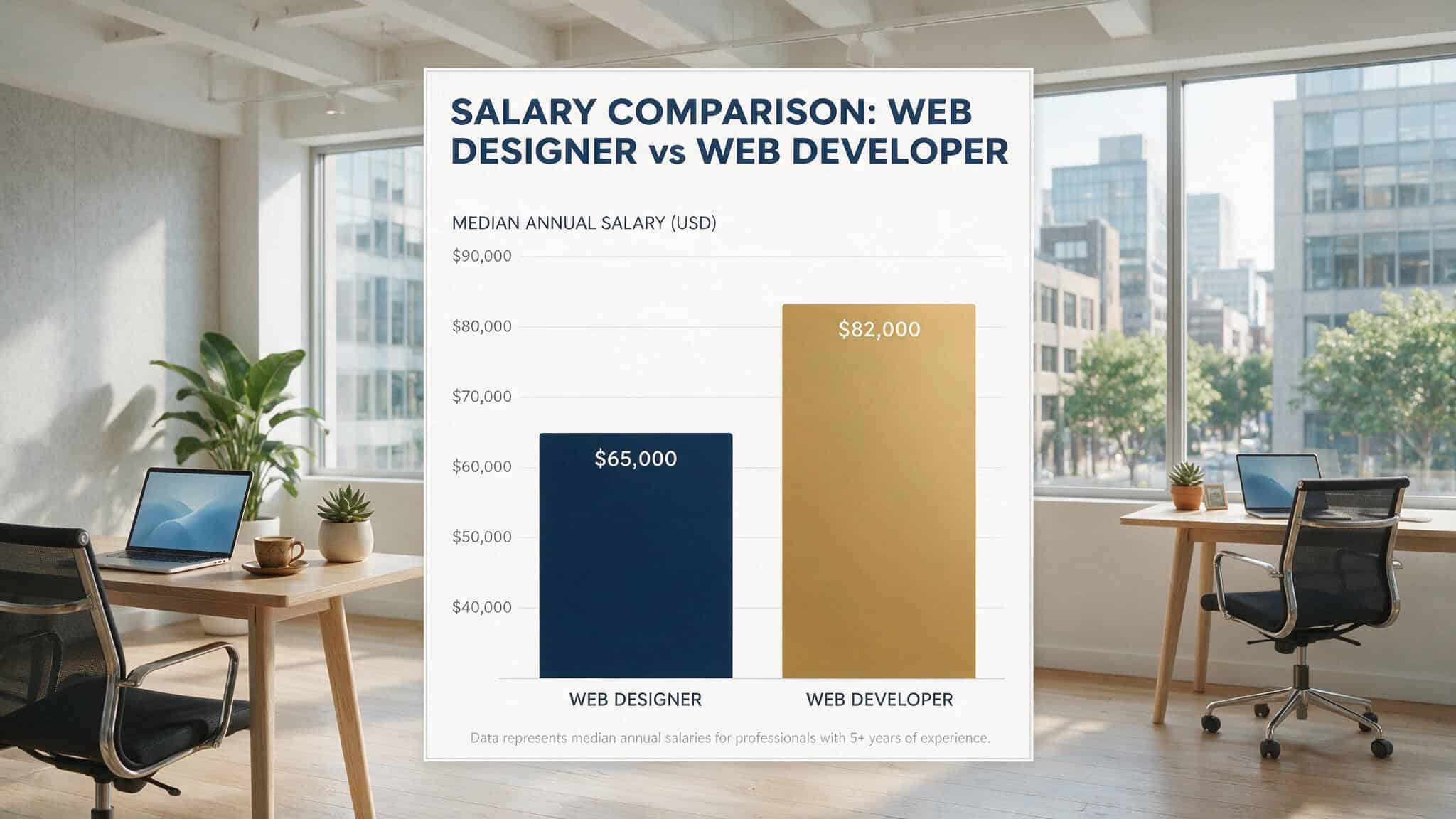
Digital designers out-earn web developers at the median — $98,090 for designers versus $90,930 for developers in 2024. $98,090 for designers versus $90,930 for developers in 2024. This flips the conventional wisdom that “developers always make more.” Both roles pay roughly double the national all-occupations median of $49,500.
By the end of this, you’ll know which path fits you based on the tradeoffs in skills, pay progression, and day-to-day work that the BLS data reveals.
Key Takeaways
Digital designers posted a higher BLS median salary ($98,090) than web developers ($90,930) in 2024, but developers start higher at entry level ($80k vs $56k) and climb faster to senior roles ($135k vs $100k).
Employment is growing at 7–8% through 2034, with about 14,500 annual openings — most from replacement needs (retirements, career changes), not just new job creation.
The core decision comes down to one question: do you want to make it look good (design) or make it work (development)? The skills overlap in HTML/CSS, Git, and communication, but the daily tools and mindset diverge sharply.
Table of Contents
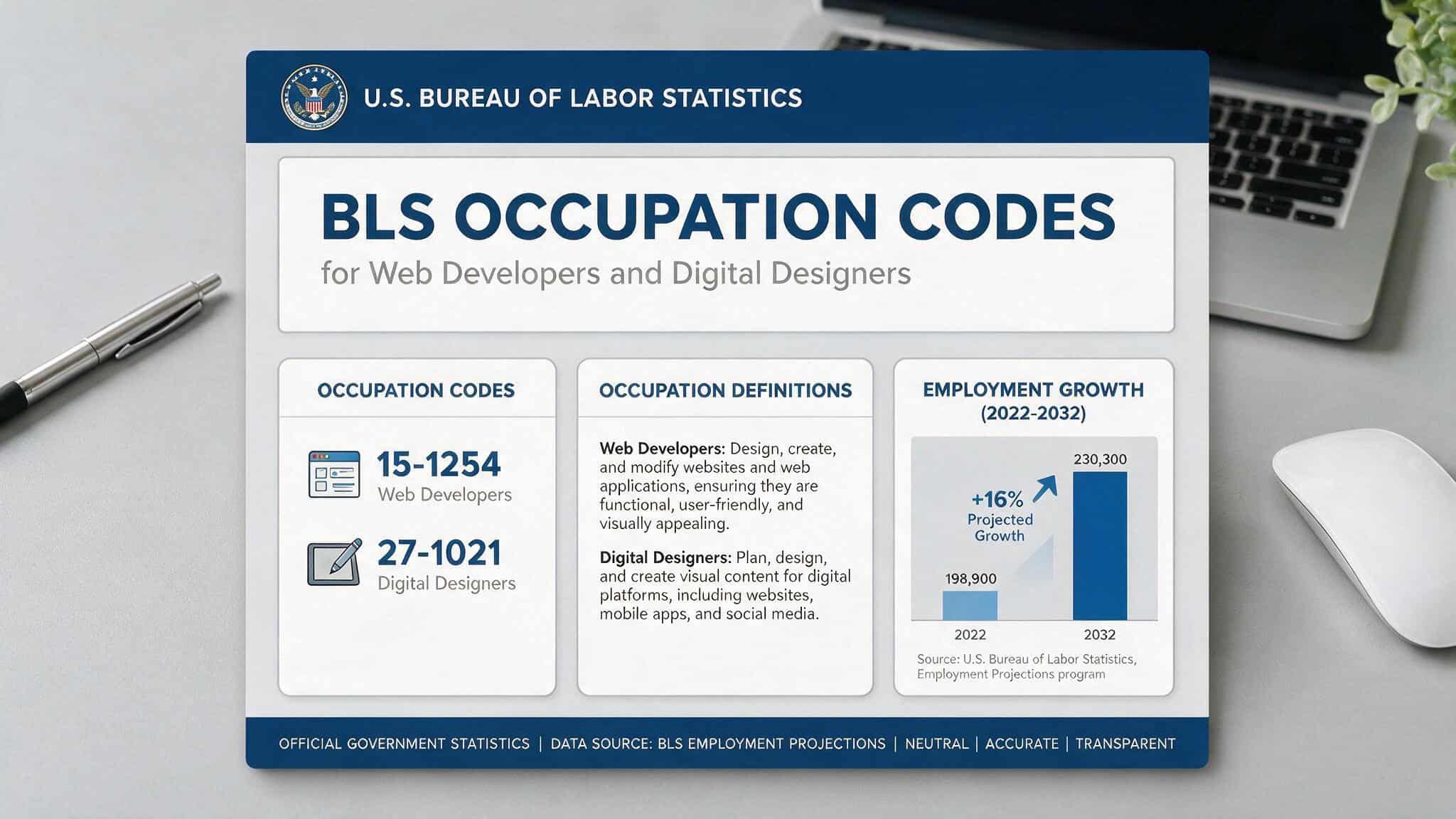
What the BLS Says — Web Developer vs Digital Designer Definitions
The Bureau of Labor Statistics officially tracks these as separate occupations, which gives us a clean foundation before we talk about how real-world job listings blur the lines.
Web developers: the builders
The BLS defines web developers as the people who “create and maintain websites.” That’s the baseline. But the role splits into two main flavors:
- Back-end developers handle the technical construction — the server-side skeleton, database schemas, API routes, core logic. They handle what users never see: load times, server response, handling a traffic spike without the site collapsing. They lay down the foundation everything else sits on.
- Front-end developers create the technical features for the site’s look, write HTML and JavaScript, and turn a designer’s mockup into a living interface. They build the structure — where the header goes, how the grid collapses on mobile, and wire up the interactive bits like checkout widgets, image carousels, and video players.
In our workflow at GeekExtreme, these two roles hand off to each other. The back-end dev builds the CMS that lets editors drop in articles; the front-end dev makes sure that article reads well on a phone.
Digital designers: the creators
Digital designers, per the BLS, build and evaluate how a website or interface looks, works, and guides users. They own the visual and functional feel — the photos, color palette, typography, graphics, layout. They’re the ones asking “does this make sense?” before the dev asks “can I build this?”
Designers also check whether the site actually works for the user — cross-browser behavior, usability testing, the whole experience. It’s not just about pretty pixels.
Webmasters and other specialized roles
Webmasters maintain and update websites — testing for broken links, responding to comments, keeping the lights on. They are the first line of defense when a plugin update breaks the contact form. Often a customer-facing role in disguise.
The BLS categories are helpful frameworks, but real job listings constantly mix these boundaries — especially at smaller companies where one person wears multiple hats. That tension makes the decision confusing for someone trying to pick a direction.
Job Titles and Specializations — What the Listings Actually Say
When scanning job boards, you need to know what titles show up.
Web development specializations
- Front-end developer – specializes in the browser-side interface. Core tools: HTML, CSS, JavaScript, React, Angular, or Vue. They’re the bridge between design mockups and live code.
- Back-end developer – works on servers, databases, and application logic. Languages like Python, Ruby, Node.js, or Java, frameworks like Django or Rails, and SQL for data.
- Full-stack developer – does both. Usually means front-end plus some back-end, sometimes a deeper split depending on the team.
Job listings also use titles like Web Application Developer, JavaScript Developer, or even just “Web Developer” when they want someone who can do everything.
Web design specializations
The designer role has three main components that often get mixed:
- UI designer – focuses on the interface itself: buttons, menus, forms, the visual layout.
- UX designer – focuses on the experience: user flows, wireframes, research, usability testing.
- Visual designer – the aesthetic layer: color, typography, brand consistency.
Job titles include Visual Designer, UX Designer, UI/UX Designer, Digital Designer, or simply “Web Designer.” Smaller companies often combine all three into one role, while larger orgs split them into specialist positions.
The core distinction when you’re reading listings: designers focus on creative aspects (user experience, color scheme, graphic design); developers convert that vision into code and ensure functionality.
Skills and Tools — What You Actually Need to Know
Here is the toolkit inventory for each side.
Web development tech stack: languages and frameworks
Non-negotiable: HTML, CSS, and JavaScript. If you don’t know HTML, you’re not a web developer.
Pick up at least a couple of these, depending on your direction:
- Front-end frameworks: React, Angular, Vue.js – pick one and get comfortable.
- Back-end languages: Python, Node.js, Ruby, Java, or PHP.
- Frameworks: Django (Python), Ruby on Rails (Ruby), Express (Node.js).
- Databases: SQL (PostgreSQL, MySQL) plus maybe a NoSQL option like MongoDB.
- Version control: Git and GitHub – universal, non-negotiable for both devs and designers.
- Other tools: testing frameworks, command line basics, cloud deployment (AWS, Netlify, Vercel).
Web design toolkit: from wireframes to prototypes
Designers live in visual tools:
- Prototyping and UI design: Figma, Adobe XD, Sketch.
- Asset creation and editing: Photoshop, Illustrator.
- Wireframing: Figma covers this, but some teams still use Balsamiq or similar tools.
Designers are expected to know basic HTML and CSS. Understanding what’s possible in code helps you design things that developers can build.
Overlapping skills that give you an edge
Git/GitHub, strong communication, creativity, attention to detail, and problem-solving help both roles. The BLS explicitly lists these soft skills: communication, creativity, customer-service orientation, detail orientation, and problem-solving, but if you’re weighing career options, this web designer vs web developer [#planned-web-designer-vs-web-developer] breakdown clarifies the daily tasks, tools, salary, and career paths for each role.
At GeekExtreme, the designers who understand the developer’s constraints and the developers who appreciate the designer’s intent produce the best work — a dynamic debated in web designer vs web developer reddit threads.
Salary Showdown — Web Designer vs Web Developer Pay
Here are the headline numbers, then what they mean.
Median salaries: the full picture from BLS
| Factor | Web Designer | Web Developer |
|---|---|---|
| BLS median salary (2024) | $98,090 | $90,930 |
| Entry-level average | $56,000 | $80,000 |
| Senior average | $100,000 | $135,000 |
| Top 10% earning | >$192,000 | >$162,000 |
| Job growth (2024-2034) | 7% | 8% |
| Current jobs (2024) | 128,900 | 86,000 |
| Common education | Bachelor’s (graphic/digital design) | Bachelor’s (CS) or certificate |
| Primary tools | Figma, Adobe XD, Sketch | HTML, CSS, JS, React, Node.js |
| Self-employed rate | 10% | 5% |
| Top-paying industry | Finance ($121k) | Computer systems design ($90k) |
For a comprehensive breakdown of web designer salary by skill level, industry, and geography, the finance sector offers the top earnings at $121,000.
That table is your quick-reference. Now what the numbers don’t show.
The BLS combined median for web developers and digital designers is $95,380 – a solid living. But the designer median ($98,090) is higher than the developer median ($90,930). That holds up when you dig into the BLS data. However, Glassdoor reports a different picture: $85k for designers and $100k for developers.
Different methodology (Glassdoor samples self-reported salaries from users, BLS uses employer-survey data from the Department of Labor), but the gap direction flips.
Entry-level vs senior: how earnings grow over time
Here is the tradeoff:
- Designers start lower ($56k entry-level) but climb to $100k at senior level. The bottom 10% make under $47k; the top 10% clear $192k. That is a wide range.
- Developers start significantly higher ($80k entry-level) and climb to $135k at senior level. The bottom 10% make under $48k; the top 10% top out around $162k.
Designers have a higher median but a lower floor and a higher ceiling. Developers start stronger and have steeper mid-career growth, but their top end is lower. If you reach the upper tier, design may pay off more. If you want a reliable salary from year one, dev is the safer bet.
Where location and industry make the biggest difference
Location matters. Top-paying metros for developers:
- San Jose – $160k
- San Francisco – $149k
- Washington, DC – $128k
- Seattle – $125k
- Rochester, MN – $122k (Mayo Clinic and healthcare tech)
Top-paying states: DC ($123k), California ($122k), Washington ($121k), Virginia ($119k), Hawaii ($115k).
Industry also shifts the numbers. For designers, finance and insurance pays $121k; computer systems design pays $98k. For developers, computer systems design pays $90k; management/consulting pays $83k. Choose your industry as carefully as your role.
Job Outlook — Which Role Has More Opportunities?
The combined field is projected to grow 7% from 2024 to 2034 — the BLS calls that “much faster than average.” That is about 14,500 annual openings over the decade.
Growth projections: 7% for the combined field
Breaking it down:
- Web developers: 8% growth, from 86,000 jobs in 2024 to 92,500 in 2034.
- Digital designers: 7% growth, from 128,900 jobs in 2024 to 137,900 in 2034.
Both are solid. Designers have a larger current workforce (128,900 vs 86,000), so there are more total jobs. Developers have a slightly faster growth rate, so the pool is catching up, reflecting the demand for the coolest jobs in tech.
Where the openings are coming from
Most openings aren’t from new job creation. They’re replacement openings from people retiring or moving to other careers. That is steady churn, not explosive growth.
Two drivers: e-commerce expansion and mobile device usage. More sites, more apps, more demand for people who can build and design them.
Education and Training — Degree vs Certificate Paths
The BLS says education requirements range from high school diploma to bachelor’s degree. But “typical entry-level education” is a bachelor’s degree.
Traditional degree pathways
- Developers often have computer science degrees, though it’s not universal (especially at smaller companies or startups).
- Designers often have degrees in graphic design or digital arts.
- With a bachelor’s degree, you can advance to project management — a common career progression from either role.
The real credential is what you can build. Show them the project, not the diploma.
Certificate programs: faster, cheaper alternatives
Certificate programs are a legitimate path, and several named options give you specifics to evaluate:
- Meta Front-End Developer (on Coursera): 16 weeks, $49/month or free to audit. Beginner-friendly.
- Meta Back-End Developer: 20 weeks, same pricing.
- IBM Full Stack Developer: 15 courses, under 6 months at 10 hours/week, $20–33/month.
- eCornell: 3 months, 6 courses, noncredit.
- W3C at edX: 5 courses, 7 months at 5–7 hours/week.
- NYU Full-Stack: at least two semesters.
- Self-paced programs range from 2 to 12 months, costing $1,000–$5,000.
For designers, programs like CalArts Graphic Design Specialization (Coursera), Google’s UX Design Professional Certificate, and University of Michigan’s “Web Design for Everybody” are starting points.
Certificates vs certifications: important distinction
Don’t confuse them. A certificate comes from a training program such as a bootcamp. A certification comes from a professional association like Red Hat (Red Hat Certified Engineer) or Oracle (Java certifications). They are different tools for different situations. Certifications carry more weight for specialized roles; certificates are broader credentials for breaking in.ader credentials for breaking in.
Where You’ll Work — Industries and Work Environments
Web designers and developers find work across many of the same industries, but the distribution differs.
Top employers for web designers
- Computer systems design (12%)
- Self-employed (10%) – freelancing is a real option here, twice as common as for developers
- Finance and insurance (5%)
- Advertising (4%)
- Retail (4%)
Top employers for web developers
- Computer systems design (24%)
- Educational services (9%)
- Management/consulting (7%)
- Self-employed (5%)
- Advertising (5%)
Most work full-time. The self-employment gap: if you want to freelance, design gives you more opportunities. Developers are more concentrated in tech services and education.
Both roles involve client and management meetings.
Making the Choice — Which Path Fits Your Personality and Goals?
Here is the single clarifying question: do you want to make it look good, or make it work?
The creative path: when to choose web design
Choose design if you enjoy visual problems: color harmony, typography, user flow, the moment when a layout finally clicks. You’ll spend your days in Figma or Adobe XD, prototyping and iterating. The work involves client variety and creative expression. The entry barrier is lower — a strong portfolio can open doors without a degree.
Pros: creative satisfaction, client variety, more freelance flexibility, higher top-end salary if you hit senior/lead roles.
Cons: lower entry-level pay, steeper climb to senior, need to justify design decisions to non-designers.
The technical path: when to choose web development
Choose development if you love logic puzzles: debugging, architecture decisions, the dopamine hit of making something compile and run. You’ll live in code editors and databases. The problem-solving is clear and satisfying. Salary progression is sharper — you start higher and climb faster.
Pros: high demand, strong entry-level pay, clear career growth, lots of job boards listing “software engineer” (which includes web dev).
Cons: can be intense, need to keep up with a fast-changing tech stack, less direct creative expression.
Transition paths: designer to developer is common
Many people start in design and move into front-end development as they pick up HTML/CSS/JS skills. The skills overlap makes it viable — bootcamps and certificate programs facilitate the shift. Conversely, developers who pick up design skills become unicorns, but that path is less common.
Mari Batilando, an engineer at Meta, put it this way (paraphrasing): surround yourself with people who push you, and do work you find rewarding.
Both roles collaborate. Designers create wireframes, mockups, and prototypes; developers implement them in code. At GeekExtreme, that handoff is where the magic — or the friction, happens. A designer who knows basic CSS can save a dev hours of back-and-forth.
Conclusion — A Decision Framework
Both web design and web development offer growth and salaries well above the national median. Web Developer ranked #9 in Best Technology Jobs by U.S. News, and either path can lead to project management with a bachelor’s degree.
You have all the data now. The tradeoffs are:
- Do you want to make it look good? ? Web design.
- Do you want to make it work? ? Web development.
- Do you want to do both? ? Full-stack development, or designer who codes.
Pick the one that makes you want to sit down and build something on a Saturday afternoon.
People Also Ask
Do I need a web designer or developer?
You need a designer if your site needs a visual identity, layout, and user experience that makes sense. You need a developer if you need someone to actually build that vision into working code, handle databases, and make sure the site loads fast and doesn’t crash. Many small teams hire one person who does both, but specialists usually produce better results.
Can a web designer be a web developer?
Yes, and it’s a common transition — many designers pick up HTML, CSS, and JavaScript to move into front-end development. The skills overlap in Git, communication, and basic coding, so bootcamps and certificate programs make the shift viable. Developers who learn design are rarer but highly valued as unicorns.
What’s the difference between a UI designer and a UX designer?
UI (user interface) designers focus on the visual elements — buttons, menus, forms, and layout. UX (user experience) designers focus on the overall flow, wireframes, user research, and usability testing. In smaller companies, one person often handles both; larger organizations split them into specialist roles.
How much do web designers and developers actually earn at entry level?
Entry-level web developers average around $80,000, while entry-level designers average about $56,000 — a significant gap. However, designers have a higher median salary overall ($98,090 vs $90,930) and a higher top-end potential (over $192,000 vs $162,000). Developers start stronger; designers can catch up and surpass at senior levels.
Do I need a degree to become a web designer or developer?
No — the real credential is what you can build. Many employers accept certificate programs, bootcamps, or a strong portfolio in place of a bachelor’s degree. Developers often have computer science degrees, and designers often have graphic design degrees, but self-taught professionals with impressive projects regularly land jobs in both fields.
