
Okay, so you’ve seen the numbers: $85,000 median total pay (Glassdoor, Sep 2025) and $98,090 median (BLS, May 2024). A senior web designer in San Francisco earns $129,000 median total pay (Glassdoor, Sep 2025). An entry-level web designer in Ohio may earn $71,000 median total pay (Glassdoor). Glassdoor says the average is $85k, but the Bureau of Labor Statistics says $98k. Which one is your number?
The lowest 10% of web and digital interface designers earn under $47,840, while the highest 10% earn over $192,180 (BLS, May 2024). That’s not a typo. That’s a four-fold difference driven by experience, specialization, location, and industry.
Key Takeaways
Entry-level web designers start at $71k median total pay, but the jump to senior ($129k) represents a $40k leap — the biggest single salary increase in the career track
Specialization matters: UI designers ($114k) and UX designers ($109k) out-earn generalist front-end developers ($101k) and HTML developers ($93k)
Industry choice adds $50k+ without changing your skills: finance companies pay web designers $121k while retail pays $69k
Table of Contents
Why the $85k average is just the starting point
Let’s get the baseline out of the way. Glassdoor’s September 2025 data puts the total median pay for web designers at $85,000. The BLS, which uses a broader “web and digital interface designers” category, reports a $98,090 median as of May 2024. Both track above the all-occupation average of $49,500 — so yes, you’re already in a field that pays well above the national norm.
The BLS percentiles show the real range:
- Lowest 10%: under $47,840
- Highest 10%: over $192,180
It’s about where you sit on four specific levers: experience, title, location, and the industry you work in. Most web designers are clustered somewhere in the middle, but the ceiling is high if you know how to climb toward it.
How experience level changes your paycheck
Experience pays, but not in a straight line. Glassdoor’s breakdown by career stage tells a clear story:
| Experience Level | Median Total Pay |
|---|---|
| Entry-level (up to 1 year) | $71,000 |
| Junior | $85,000 |
| Experienced (4-6 years) | $89,000 |
| Senior | $129,000 |
That first year bump — from $71,000 to $85,000, is a $14,000 reward for getting through your first year without breaking anything important. Then from junior to experienced, you gain $4,000 total. That’s steady, but not exciting.
Then comes the jump that changes the salary trajectory.
The $40k leap that separates seniors from everyone else
Going from experienced ($89k) to senior ($129k) is a $40,000 increase. That’s not just another year of experience. It’s a role shift. Senior designers aren’t just better at the same job — they’re leading projects, making architectural decisions, mentoring juniors, and often working directly with stakeholders. The BLS data confirms that the top 25% of web and digital interface designers earn over $131,930, which lines up neatly with that senior level.
The jump comes when you step into leadership or deep specialization.
Which job title pays the most?
Titles aren’t just vanity labels. They directly map to pay brackets. Glassdoor’s median total pay across eight related titles shows a clear hierarchy:
- Chief web designer: $141,000
- Senior web designer: $129,000
- Lead web designer: $119,000
- UI designer: $114,000
- UX designer: $109,000
- Front-end developer/engineer: $101,000
- Full-stack web developer: $94,000
- HTML developer: $93,000
First, design specialization carries a premium: a UI designer ($114,000) earns $21,000 more than an HTML developer ($93,000) (Glassdoor, Sep 2025). That’s the difference between “I can write markup” and “I can design interfaces people enjoy using.” From our team’s experience working across UI, UX, and visual design roles, we’ve seen this play out in job postings — but what happens when you combine both skills? We analyzed web designer and developer salary premiums for hybrid roles over specialists, and the roles that expect visual thinking plus some coding pay better than the roles that are mostly coding.
Second, UX designer median pay ($109,000) trails UI designer median pay ($114,000) by $5,000 (Glassdoor, Sep 2025). That’s interesting because UX is often talked about as the “higher level” discipline. The data suggests that the ability to execute visually carries a slight premium, at least at the median. But both beat front-end dev, which reinforces something we’ve noticed: pure coding roles without a design eye cap out lower than design roles with some coding ability.
Third, “senior” out-earns “lead” here ($129k vs $119k). That might seem counterintuitive, but it reflects that senior roles often come with deep technical or creative expertise, while lead roles sometimes have a management component that doesn’t translate to higher base pay.
Freelance vs. contract vs. full-time: the real trade-off
The employment type you choose directly affects your take-home pay — but not necessarily in the way you’d expect.
Glassdoor’s data shows a clear split:
- Freelance: $67,000 median total pay
- Contract: $88,000 median total pay
- Full-time: (implied by overall median of $85k)
Freelancers earn the least at the median, which surprises nobody who’s dealt with the feast-or-famine cycle, self-employment taxes, and unpaid time spent on business development. Contract workers, on the other hand, earn more than the overall median. That makes sense — companies pay a premium for short-term commitment without the overhead of a full-time employee.
The best freelancers — the ones who specialize in a high-demand niche, maintain strong referral networks, and charge premium hourly rates, out-earn both contract and full-time workers. The median is pulled down by freelancers who struggle with inconsistent work and undercharging. Contract roles offer a middle path: higher median pay than full-time, with more flexibility than permanent employment, but less autonomy than freelance.
It’s a strategic choice between stability, flexibility, and earning ceiling. Don’t assume “freelance = more money” — the median says the opposite.
Where you live and work matters
Two external factors can change your salary: location and industry.

Location: state averages vs. metro premiums
State-level data from Zippia gives a wide range:
- Washington: $84,645
- Massachusetts: $83,957
- District of Columbia: $81,022
- Virginia: $79,373
- Oregon: $70,323
The user note provides context about web developer salaries, which aligns with the paragraph’s focus on pay data. The paragraph discusses metro-level averages, so it can naturally incorporate a question about whether learning web development is worth it given these higher figures. Here is the revised paragraph:
State averages include rural areas and smaller cities, which drag the number down. Metro area data from BLS tells a different tale. But is it worth learning web dev? The top-paying metro for web developers and digital designers is San Jose-Sunnyvale-Santa Clara, with an average of $160,290.
San Jose, California, specifically pays $160,060, while San Francisco, California, pays $149,520. Rochester, Minnesota, offers $122,380.
San Francisco comes in at $139,610. Seattle hits $120,580. At the state level, California pays $122,900, Washington pays $121,590, Virginia pays $119,920, and Hawaii pays $115,850.
The gap between a state average ($84k in Washington) and its top metro ($120k in Seattle) is $36k. You get paid for density. Being in or near a major tech hub can add $30k to $70k to your salary. That’s the same skills, same experience, same portfolio — different ZIP code.
If you’re considering a move, the metro-level data is more useful than state averages. The Bay Area, Seattle, New York, and Boston all pay significant premiums. But remember: cost of living eats into that premium. $160k in San Jose doesn’t go as far as $85k in Oregon.
Industry: from $69k to $121k with the same skills
This is the lever most designers don’t think about enough. The BLS breaks down median wages for web and digital interface designers by industry:
- Finance and insurance: $121,710
- Computer systems design: $98,610
- Advertising and PR: $74,510
- Retail trade: $69,280
That’s a $52,000 spread between finance and retail — for the same job title. Moving from a retail company’s web team to a financial services firm’s digital team is a 75% raise. You don’t need new skills. You need a new industry.
The largest employers of web and digital interface designers are computer systems design firms (12% of all such workers) and self-employed designers (10%). Finance employs about 5%, which is smaller but pays significantly more. If you’re optimizing for salary, finance and insurance is the clear winner among major industries. If you’re optimizing for job availability, computer systems design has the most openings.
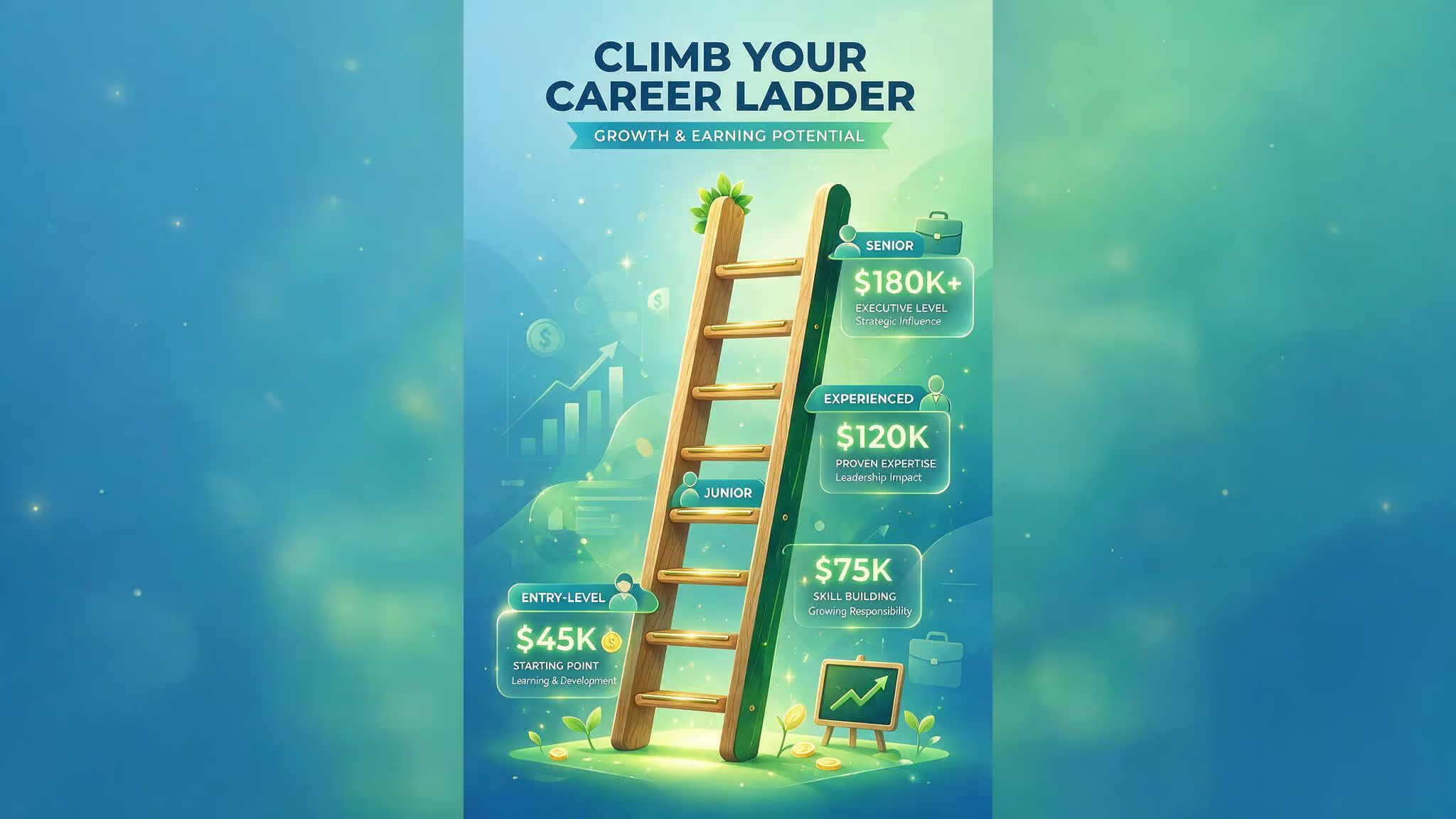
The education and skill map: from $71k to $129k+
Here’s the path from lowest to highest pay, mapped to concrete skills.
Where most designers start
According to Zippia, 67% of web designers hold a bachelor’s degree. Another 18% have an associate degree, and only 4% have just a high school diploma. The BLS confirms that while a bachelor’s is typical, it’s not required — employers care more about your portfolio and demonstrated ability. The standard entry point is $71k (entry-level median).
Level 1: Add coding skills
If you’re an entry-level designer making $71k and you build solid front-end coding skills (HTML, CSS, JavaScript, maybe React), you’re targeting the front-end developer median ($101k) or the HTML developer median ($93k). The IBM Front-End Developer Professional Certificate — which covers HTML, CSS, JavaScript, and React and can be completed in about four months, is one concrete path here.
Level 2: Add UX/UI specialization
If you lean into design rather than coding, the UX designer ($109k) and UI designer ($114k) roles pay more than general front-end work. The Google UX Design Professional Certificate covers user-centered design and accessibility, and includes building a portfolio with three projects: a mobile app, a responsive website, and a cross-platform experience. That kind of portfolio is exactly what hiring managers want to see.
Level 3: Add leadership or deep expertise
Getting from $89k (experienced) to $129k (senior) requires more than just time. Senior designers lead projects, mentor others, and make strategic decisions about design systems and direction. Leadership skills aren’t something you can get from a single certificate, but the combination of strong technical/design skills plus demonstrated leadership is what opens that $40k door.
Certifications worth knowing about
Beyond the IBM and Google certificates mentioned above, there are other solid options depending on your direction:
- IBM Full-Stack Software Developer Professional Certificate — more coding-focused, covers both front-end and back-end
- Meta Back-End Developer Professional Certificate — for server-side specialization, designed by Meta’s engineering team
If you’re planning to take multiple certificates, Coursera Plus (over 10,000 courses, monthly or annual subscription) is worth considering. But there are plenty of free resources too — your portfolio matters more than any credential. For foundational knowledge, check out the Web Development Terms: A to Z Glossary (free resource). For career strategy, watch How to Pivot Industries as a Web Developer (YouTube video).
The key insight: every $10k increment on the salary ladder corresponds to a specific skill or role shift. It’s not about “learning more.” It’s about learning the right thing for the next level.
Is this a good career? (Job outlook)
The BLS projects 7% growth for web developers and digital designers from 2024 to 2034 — much faster than the 3% average across all occupations. That translates to about 14,500 job openings each year, most of them from replacing workers who move to other careers or retire.
The growth is driven by e-commerce expansion and the increasing use of mobile devices. Companies in every industry need websites that work well on phones, load fast, and convert visitors into customers.
In 2024, there were 214,900 web developer and digital designer jobs in the US. By 2034, that’s projected to grow to 230,400. Broken down further: digital designers (the ones focused on look and feel) accounted for 128,900 jobs in 2024, while web developers (more coding-focused) accounted for 86,000. Both are growing at similar rates.
The competition will be strongest for the specialized, high-paying roles we’ve been talking about. The $71k entry-level jobs will always be there. The $129k+ senior roles require deliberate skill-building and career moves, so a deep dive into web designer vs web developer jobs reveals what the listings actually say about job titles, required skills, and hiring demand for both. But the field itself is healthy, growing, and paying well above the national average.
People Also Ask
Is web design a high paying job?
Yes, web design pays well above the national average. The median total pay is around $85k to $98k depending on the source, and the top 10% of designers earn over $192k. Your actual salary depends heavily on experience, specialization, location, and industry.
What qualifications do I need to be a web designer?
A bachelor’s degree is typical — about 67% of web designers have one — but it’s not strictly required. Employers care more about your portfolio and demonstrated ability. Coding skills (HTML, CSS, JavaScript) and UX/UI specialization can push your salary from entry-level $71k toward $100k+.
How much more do senior web designers make than experienced designers?
The jump from experienced ($89k) to senior ($129k) is a $40k increase — the biggest single leap in the career track. That’s not just another year of experience; it’s a role shift into leading projects, mentoring juniors, and making architectural decisions.
Which industry pays web designers the most?
Finance and insurance pays the highest median wage at $121,710 — a $52k premium over retail trade ($69,280) for the same job title. Computer systems design pays $98,610 and has the most job openings. You don’t need new skills to switch industries, just a new employer.