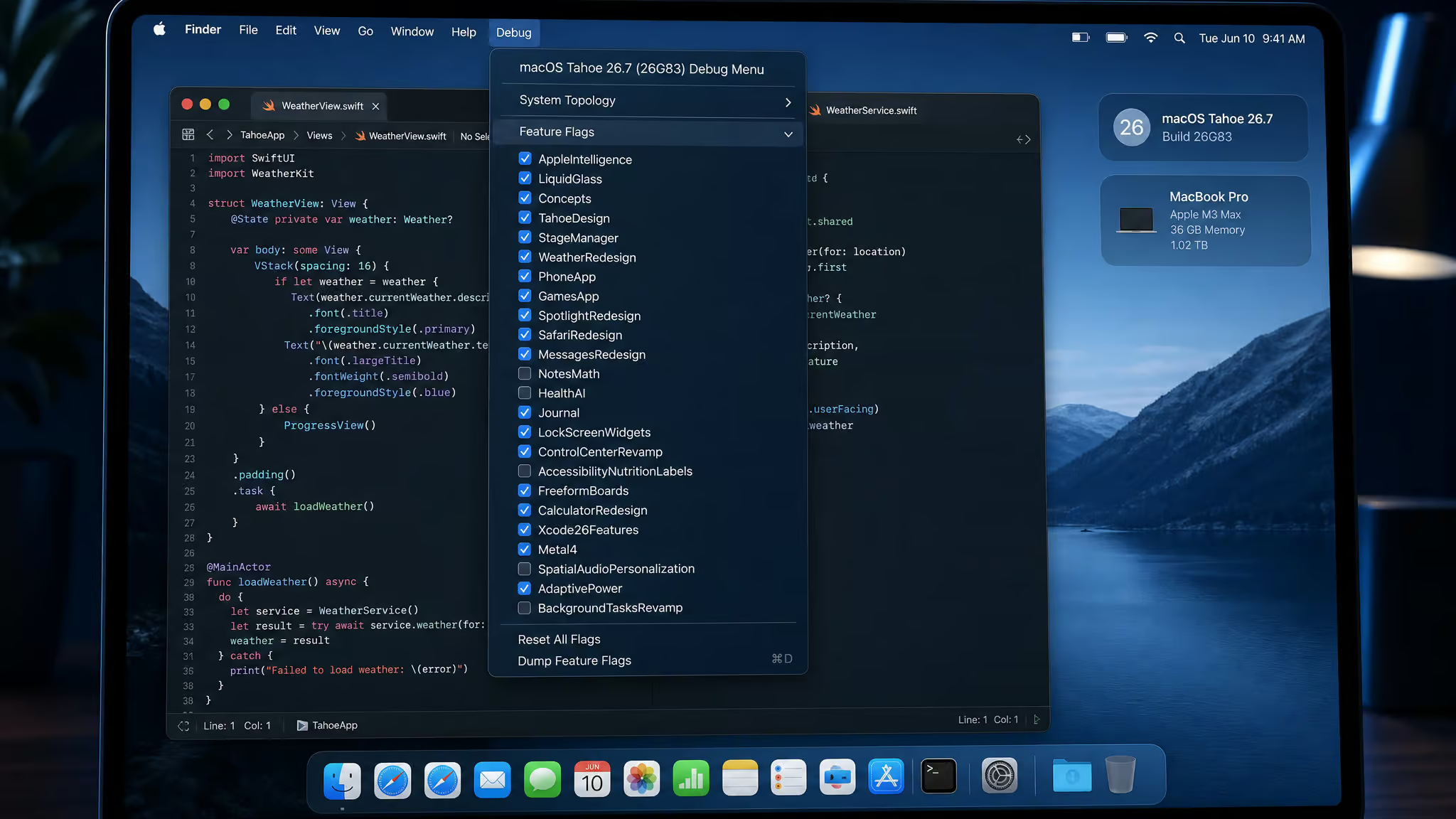
So Apple did it again. Someone at Cupertino shipped a release candidate build of macOS Tahoe 26.7 without remembering to lock the debug menu, and MacRumors, who caught this one first, found the feature flags still hanging out in plain sight. It’s the same kind of oops that happened during iOS 26 testing, and it happened again this Monday, so at this point it’s practically a tradition. The flags spill beans all over the place: AirPods with cameras, a foldable iPhone, an OLED iPad mini, the whole roadmap.
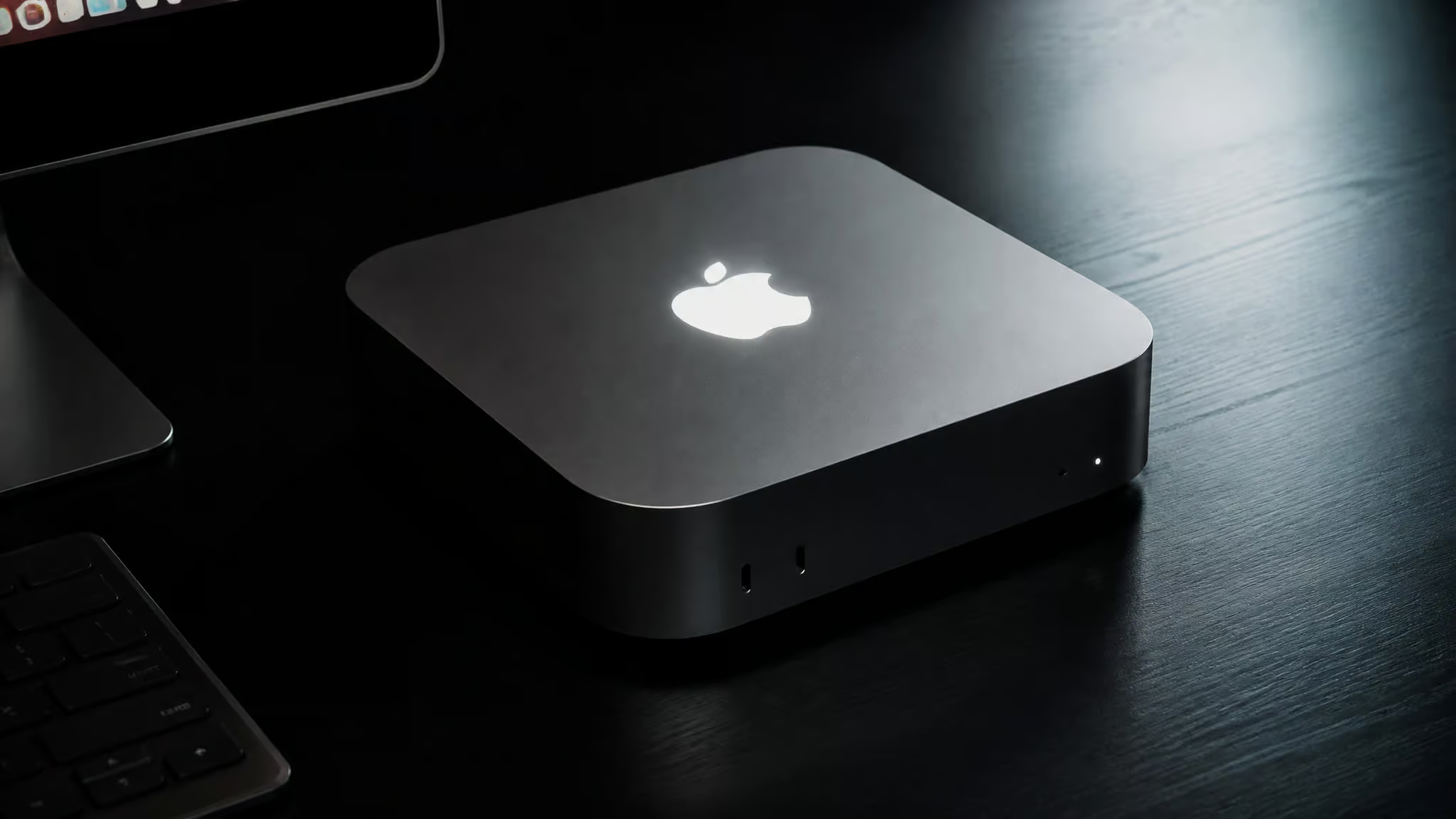
But buried in all that noise is a puzzle that most coverage has glossed over. A refreshed Mac mini with an M4 Pro chip looks like it’s in the pipeline, but it’s not where you’d expect to find it among the Mac identifiers. In fact, there’s no explicit Mac mini identifier in the list at all. That absence is the clue.
And once you start looking at the unassigned model numbers, the A3436 range, the Device1 series, a clearer picture emerges. Here’s what the evidence actually says, where the Mac mini probably lives in the identifier chaos, and whether you should pull the trigger on a current model or hold out.
Key Takeaways
The Mac mini does not appear among the explicit Mac identifiers in the macOS 26.7 leak (J804, J833/J834, K114c/K116s), suggesting it uses a different numbering scheme, likely one of the over 20 unassigned A-series or Device1 identifiers with no clear product mapping.
The M4 Pro chip for the Mac mini is implied by the gap in the chip roadmap: the leak shows an M6 MacBook Pro and next-gen iMacs, but nothing at the M4 Pro tier, which is the Mac mini’s expected slot based on Apple’s pattern of chip generations.
A systemic price hike, already applied to Macs and iPads in June 2026, and projected to hit all iPhone models by September 8, means the M4 Pro Mac mini will almost certainly cost more at launch than current models, reinforcing the buy now if you need it, wait if you can absorb the increase calculus.
Table of Contents
How the macOS Tahoe 26.7 Leak Happened, and Why It Matters
Understanding how the leak happened helps clarify why the feature flags carry real weight for Apple’s product roadmap.
Why feature flags matter
Developer betas and release candidates are where Apple’s future product plans accidentally peek out. It’s almost a tradition at this point. The same thing happened during iOS 26 testing and again this Monday. Feature flags are development toggles, they control which features are visible in a build, and they’re supposed to be turned off before the RC ships.
Leaving them visible is like publishing a config file that says “here’s everything we’re working on.” Past leaks from this exact pattern have been accurate, which gives the data surprising weight.
The Mac mini’s ambiguous status in the leak
The explicit Mac identifiers found in the flags are: J804 (MacBook Pro with M6), J833 and J834 (next-generation iMac), and K114c, K114s, K116c, K116s (possible OLED MacBook Pros). That’s it. No identifier in that list maps to a Mac mini. You look for a J-series or K-series number that screams “headless desktop” and come up empty.
Now here’s where it gets interesting. The absence isn’t a sign that the Mac mini is getting dropped. It’s a signal that the Mac mini probably uses a different numbering scheme than the laptop and all-in-one lines. The current Mac mini models. A2777 and A2686, are A-series identifiers, not J/K. So if the next Mac mini follows that pattern, it wouldn’t show up where everyone’s looking.
It’d be hiding among the unassigned identifiers. And there are plenty of those: A3436 through A3441, A3456 and A3457, A3465, A3529 through A3533, A3543, A3577, and the genuinely weird Device1,8234 through Device1,8248. Over 20 identifiers with no clear product mapping. That’s where the Mac mini probably lives.
Decoding the Leaked Mac Mini. What the Evidence Suggests
The evidence points to a specific chip and performance profile for the next Mac mini, based on the identifiers and Apple’s silicon roadmap.
M4 Pro chip and expected performance gains
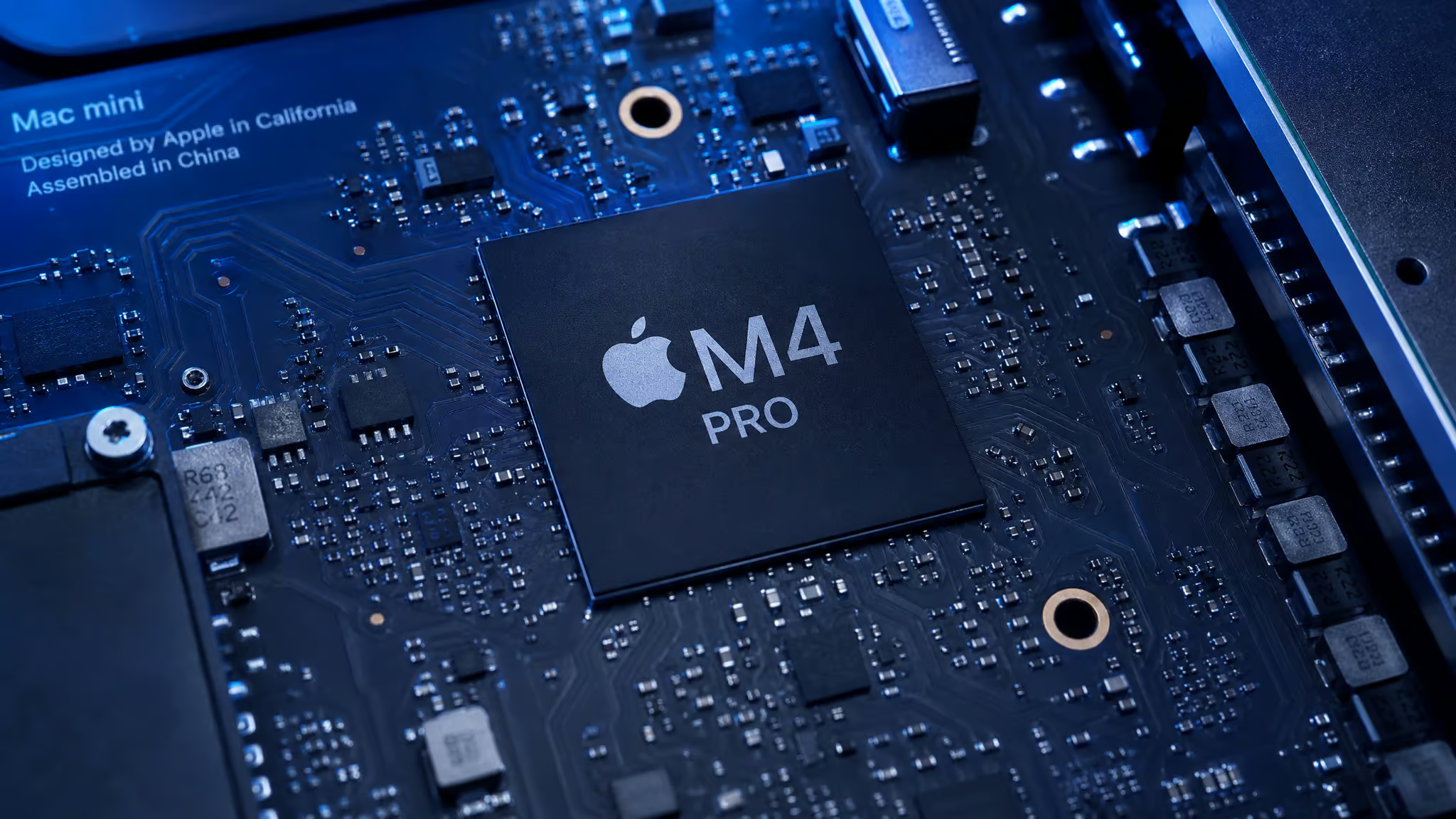
The user angle on this leak specifically points to the M4 Pro, and the roadmap supports it. The current Mac mini already has a base M4 model, it launched and got a price hike back in June 2026. The MacBook Pro in the leak is getting M6, which is a generation beyond. So the desk space between those two is where M4 Pro slots in.
If Apple’s chip trajectory holds. M3 Pro, M4 Pro, M5 Pro, we’re looking at a meaningful CPU and GPU core count leap over the current M2 Pro Mac mini. Twelve CPU cores and 18 GPU cores is a reasonable expectation based on the pattern, along with improved memory bandwidth and almost certainly Thunderbolt 5 support. The performance jump for anyone sitting on an Intel Mac mini or even an M1 model would be dramatic.
Port layout and design clues
No direct port confirmation came out of the feature flags, but educated speculation based on Apple’s established I/O philosophy is fair game. The current Mac mini layout. HDMI, dual Thunderbolt, USB-C, headphone jack, will likely carry forward with Thunderbolt 5 replacing Thunderbolt 4 on the Pro model. The bigger question is whether the form factor changes. A different identifier scheme might mean a different chassis.
The Mac mini has been a compact square for years, but there’s room for Apple to shift the design, maybe a slightly taller profile for better thermal headroom with the M4 Pro, or a magnetic power connector that frees up the Thunderbolt ports. Nothing is confirmed, but the identifier mystery makes a redesign plausible.
Field note: The J/K vs. A-series split in identifiers is Apple’s internal product taxonomy — tracking it can reveal new Macs before they’re officially announced.
Where the Mac mini might be hiding among the unassigned identifiers
This is where the fun detective work happens. Apple uses A-series identifiers for standalone products that don’t fit neatly into the laptop or all-in-one categories. The current Mac mini is A2777 (M2 Pro) and A2686 (M2). The iPad mini, HomePod, and Apple TV also use A-series numbers. So when you see a batch of unassigned A-series identifiers with no obvious product mapping, and especially when the Device1 series shows up, which is unusual and doesn’t match standard Apple naming, the Mac mini is one of the strongest candidates.
A3436 through A3441 is six identifiers. That could cover multiple configurations of the same model: base and Pro chips, different storage tiers, or regional variants. The Device1,8234-8248 range is more mysterious, it might be a prototype identifier or an entirely new product category. But if the Mac mini is among them, it means Apple is already testing multiple hardware configurations, which is a good sign for a relatively near-term launch.
The Other Macs in the Leak. Full Mac Lineup Refresh
The Mac mini doesn’t exist in a vacuum. The other Mac identifiers in the leak define the chip roadmap and give the Mac mini its place in the timing order.
MacBook Pro with M6 (J804)
J804 is a future generation beyond M4. The M6 chip signals that Apple’s silicon investment isn’t slowing down, but it also means the MacBook Pro refresh is further out than the Mac mini’s M4 Pro update. The Mac mini could arrive before the M6 laptops.
Next-generation iMac (J833, J834)
The iMac is getting a refresh, but not with the M6 yet, likely a late 2026 or early 2027 launch based on the identifier gap, just as NuvioDesktop for macOS enters alpha. Again, the Mac mini’s M4 Pro slot sits earlier in the cadence.
OLED MacBook Pro early indicators (K114c, K114s, K116c, K116s)
The ‘c’ and ‘s’ suffixes probably indicate different sizes or configurations, possibly 14-inch and 16-inch with OLED. This would be a massive display upgrade for the Pro line, but it’s clearly further out than the Mac mini’s incremental chip update. The takeaway: the Mac mini is actually earlier in the refresh cycle than most of the other Macs in the leak, and a new Apple display leak macOS 26.7 references potential firmware for a Studio Display 2 or Pro Display XDR successor.
iPhone Roadmap. From iPhone 18 Pro to the Foldable iPhone Ultra
The iPhone identifiers in the leak connect to the Mac mini story through pricing, not specs. Here’s what the Apple macOS 26.7 leak new products revealed:
- V62: iPhone Air 2, due in the spring
- V63: iPhone 18 Pro
- V64: iPhone 18 Pro Max
- V67: iPhone 18, due in the spring
- V68: the foldable iPhone, sometimes called iPhone Ultra
The iPhone 18 Pro and Pro Max are expected to launch early next month as of this article’s date. But the price story is what matters for Mac mini buyers.

Tipster Yogesh Brar posted on X that Apple will increase prices of all iPhone models by $100 (roughly Rs. 10,000) on September 8. The claim covers iPhone 17, iPhone Air, iPhone 17e, and will coincide with the iPhone 18 Pro launch. Apple CEO Tim Cook hinted at these increases in a June conversation with The Wall Street Journal, saying price hikes are unavoidable due to rising manufacturing costs. Apple already raised prices on Macs and iPads in June, the current M4 Mac mini got that hike.
The pattern is systemic. Component cost inflation doesn’t stop at one product line. When the M4 Pro Mac mini launches, it’ll carry a higher starting price than the M2 Pro model did at launch.
Smart Home and Audio. Home Hub, AirPods with Cameras, and More
This section of the leak is genuinely wild, and it points to a broader strategy where a powerful desktop Mac, like a Mac mini, could serve as a local processing hub, as revealed by the Apple AR/VR headset macOS 26.7 leak.
Home Hub and homeOS
J490 is a speaker base variant of the Home Hub, think a smart display that sits on a counter. J491 is a wall-mounted version, more like a home control panel. The operating system behind both is Pebble, the codename for homeOS. The audio_accessory_visual_reasoning code string suggests a Home Hub with a camera for visual scene understanding. J229 may be Apple’s first security camera.
B525 is a next-gen HomePod mini running something called “Argentium,” which could be an OS variant or a software stack for the Home line. Color options found in the leak: rose, pink, silver, space gray, and starlight.
AirPods with cameras and next-gen audio
B790 is the codename for AirPods with cameras, expected later in 2026. The leak includes an error message, B790 start image stream failed for left bud, which is a dead giveaway that this thing has a camera pipeline real enough to have debug messages. AirPodsPro1,4 references a fourth-generation AirPods Pro. B518 and B522 are possible upcoming Beats headphones.
ATVRemote1,5 suggests a new Apple TV could drop at any time with an updated remote. HomeAccessory17,2 and HomeAccessory17,3 were spotted but no clear product tied to them yet.
The Mac mini’s potential role here is obvious: a powerful local hub for this camera-enabled smart home ecosystem, processing visual data and running homeOS infrastructure without sending everything to the cloud. That’s not a claim the leak makes directly, but it’s a natural fit given the hardware.
Other Products in the Leak, iPad Mini OLED, Vision Pro, and the Mystery Identifiers
Beyond the Mac lineup, the leak reveals several other products in Apple’s pipeline, including a long-awaited iPad mini upgrade.
OLED iPad mini with A19 Pro (J510, J511)
The next-generation iPad mini gets OLED and an A19 Pro chip. That’s a serious spec bump for the small tablet, a market that’s been waiting for a display upgrade for years.
Next-generation Apple Vision Pro (N109)
Second-gen headset is on the roadmap, despite mixed reception for the first one. The Vision Pro line continues.
The unassigned identifiers. Apple’s hidden pipeline
Here’s the full list of identifiers with no clear product match: A3436, A3437, A3438, A3439, A3440, A3441, A3456, A3457, A3465, A3529, A3530, A3531, A3532, A3533, A3543, A3577, Device1,8234, Device1,8236, Device1,8238. Over 20 identifiers. No idea what all of these are yet, but they’re in there. The Mac mini is one plausible explanation for a subset of them.
Others could be internal development boards, regional variants of existing products, or entirely new categories Apple hasn’t teased yet. The Device1 series is especially unusual, it doesn’t match standard Apple naming for any known product line. Whatever they are, Apple has more in its pipeline than the named products alone suggest.
Should You Buy a Mac Mini Now or Wait for the M4 Pro?
The decision hinges on how much you value the expected performance gains versus the certainty of current pricing and availability.
The case for waiting
The M4 Pro will deliver significant gains over the current M2 Pro and even the base M4. If you’re still on Intel or M1, the leap will be dramatic, more cores, faster memory bandwidth, Thunderbolt 5, and likely a design that handles sustained workloads better. The Mac mini’s potential role as a local hub for Apple’s smart home ecosystem, processing camera feeds from the Home Hub and security cameras, adds value beyond just raw compute. And there’s a real chance the identifier mystery signals a redesign, not just a chip swap.
The case for buying now
Here’s the honest tradeoff. The Mac mini’s absence from the explicit Mac list could mean a late 2026 or early 2027 launch. That’s a long wait if you need a desktop now. More importantly, Apple’s systemic price hikes are already in motion.
Macs and iPads got more expensive in June. The projected iPhone hike is $100 across all models. The M4 Pro Mac mini will almost certainly cost more at launch than the current M4 model did. If you can find a current M4 Mac mini at a post-June price that works for you, and the price hike scares you, that might be the best deal you’ll see on a new Mac mini for a while. The current machine is still strong, especially the M4 Pro configuration if you can find one in stock.
The leak says a new Mac mini is coming. But it also says it may be a while, and it’ll cost more. Your call depends on whether the wait and the price increase are worth the performance jump.
Frequently Asked Questions
Is Apple discontinuing the Mac mini?
No, the Mac mini is almost certainly not being discontinued. Its absence from the explicit Mac identifiers in the leak is actually a clue that it uses a different numbering scheme (A-series identifiers) than the laptop and all-in-one lines, not that it’s being dropped. The current Mac mini models use A-series numbers, and the unassigned identifiers in the leak strongly suggest a refreshed model is in development.
What’s the difference between the current Mac mini and the upcoming M4 Pro model?
The current Mac mini already has a base M4 model, while the upcoming version is expected to feature the M4 Pro chip with a meaningful CPU and GPU core count leap, likely 12 CPU cores and 18 GPU cores, plus Thunderbolt 5 support and improved memory bandwidth. The identifier mystery also suggests a possible redesign, perhaps a slightly taller chassis for better thermal headroom, whereas the current model keeps the familiar compact square form factor.