
Flavio Copes got two emails — and they sum up the anxiety that’s rattling through every developer forum, Twitter thread, and Slack channel right now. Two aspiring developers, both asking the same thing in 2025: Is it even worth learning web development anymore? Should I just ask ChatGPT to build my website?
Homestead launched in June 1998 as an automated website builder, and the exact same extinction fears rippled through the industry. Then WordPress did it. Then Wix. Then Bubble.
Then Webflow. Each one was supposed to be the end of web development as we knew it. Each one turned out to be another tool that raised the floor.
AI, as of 2025, is the latest in that long line. And if you want the receipts — the actual numbers, experiments, and industry shifts, here they are.
Key Takeaways
In a documented study, GPT-4 solved only 1.7% of real-world GitHub issues, showing AI’s current ceiling on complex, context-rich problems
AI coding tools default to React and Next.js because of training data bias — OpenAI’s own GPT-5 guide explicitly recommends Next.js, React, and HTML, confirmed as a popularity-based choice by OpenAI researcher Ishaan Singal
Web development is splitting into two evolved paths: hybrid roles blending dev with UX and strategy, and specialist roles requiring deep expertise in cutting-edge technologies and AI integration
Table of Contents
What AI Actually Does (and Where It Falls Apart)
Let’s start with the hard numbers, because the hype is loud and the signal is buried.
Here’s a key statistic: GPT-4 solved only 1.7% of real-world GitHub problems.
Give it a common pattern — a login form, a CRUD endpoint, a standard React component, and it’ll nail it. It’s useful for code snippets, template-based tasks, testing, and maintenance. Tools like Codiga give you real-time feedback as you type, catching bugs before you even hit save. That’s legitimately useful.
Flavio Copes ran a fascinating experiment: he built the same project twice. Once by hand, the old-fashioned way. Once entirely with AI. The AI version? Outdated dependencies.
Security vulnerabilities. Poor performance. Straight-up bad code in places. It looked okay on the surface, but crumbled under any pressure.
AI can produce enormous amounts of viable code quickly, but it struggles with complex tasks requiring a ‘general overview’ of the system. It can’t understand business context. It can’t make judgment calls about trade-offs.
The React Bias Problem
AI has a documented bias toward React and Next.js due to training data popularity.
OpenAI’s GPT-5 prompting guide recommends Next.js (with TypeScript), React, and HTML as the three frameworks to use. When Ishaan Singal, an OpenAI researcher, was asked about this, the explanation was straightforward: they picked those frameworks based on popularity.
Vercel, by the way, called GPT-5 “the best frontend AI model.” There’s a nice quid pro quo happening — GPT-5 became proficient in Next.js due to its widespread use, which likely boosts its adoption further.
While AI is pulling developers toward React and Next.js, the native web platform is quietly getting more capable. The View Transition API became part of the Baseline 2025 index, ensuring cross-browser support is solid. CSS has improved through 2025, and new trends like AI and no-code development are reshaping whether WordPress is dying, making it more user-friendly for everyone without coding skills. You can do things without a framework now.
Jeremy Keith has been making this argument for years — that frameworks limit the possibility space of what you can do in the browser.
The New Roles AI Is Creating
The ‘learn HTML in 2 weeks and get hired’ era is over. That’s not the same as the field dying — it’s the bar getting higher.
AI is pushing web development toward two distinct paths.
First, hybrid roles. Developers who also handle UX design, project management, and strategic thinking. The lines between web designer vs web developer (#planned-web-designer-vs-web-developer) are blurring, and that’s not a bad thing.
Second, specialist roles. Deep expertise in cutting-edge technologies that AI can’t keep up with. Remember, AI only knows what it was trained on. Ask it about a framework released last week and it’ll hallucinate. New technologies appear in web development every year — that’s the part of web dev, and it’s the part AI can’t touch, making the question of whether it’s worth learning web dev more relevant than ever as the field evolves with AI and quantum computing.
The more AI gets used, the more you need people who can integrate it into projects. Someone has to configure it, maintain it, and know when not to use it. That’s a new specialty that didn’t exist before 2020.
How Developers and AI Actually Work Together
AI writes the boilerplate code and generates initial designs. It handles the grunt work — the stuff that’s tedious but necessary. As AI automation reshapes web development, humans handle the business logic, edge cases, performance refactoring, compliance, architectural decisions, and strategic trade-offs.
Senior developers review AI output for performance, accessibility, and alignment with existing patterns.
Developers save 35-40% of coding time, with 20-30% coming from refactoring alone, per industry reports.
The Hidden Risks Nobody’s Talking About
Skill erosion is real. Junior developers who rely too heavily on AI never learn the fundamentals. They can’t spot problems in AI-generated code because they don’t know what good code looks like.

Code ownership is a legal minefield. If Copilot wrote 60% of your proprietary algorithm, who owns it?
Compliance is getting harder. Deloitte’s data shows 38% of organizations report that regulatory compliance is a leading concern with generative AI according to Deloitte’s data AI. Code generated by AI introduces vulnerabilities, outdated dependencies, and potential security holes that traditional review processes weren’t designed to catch.
The security model is shifting toward zero-trust architecture — never implicitly trust anything. That applies to your AI tools as much as your external vendors.
Building the Agentic Web
In 2025, mini-web applications started appearing inside AI chatbots. MCP-UI uses the Model Context Protocol to let AI tools display rich HTML interfaces inside chat applications. It aims to standardize how AI models request and display web UIs.
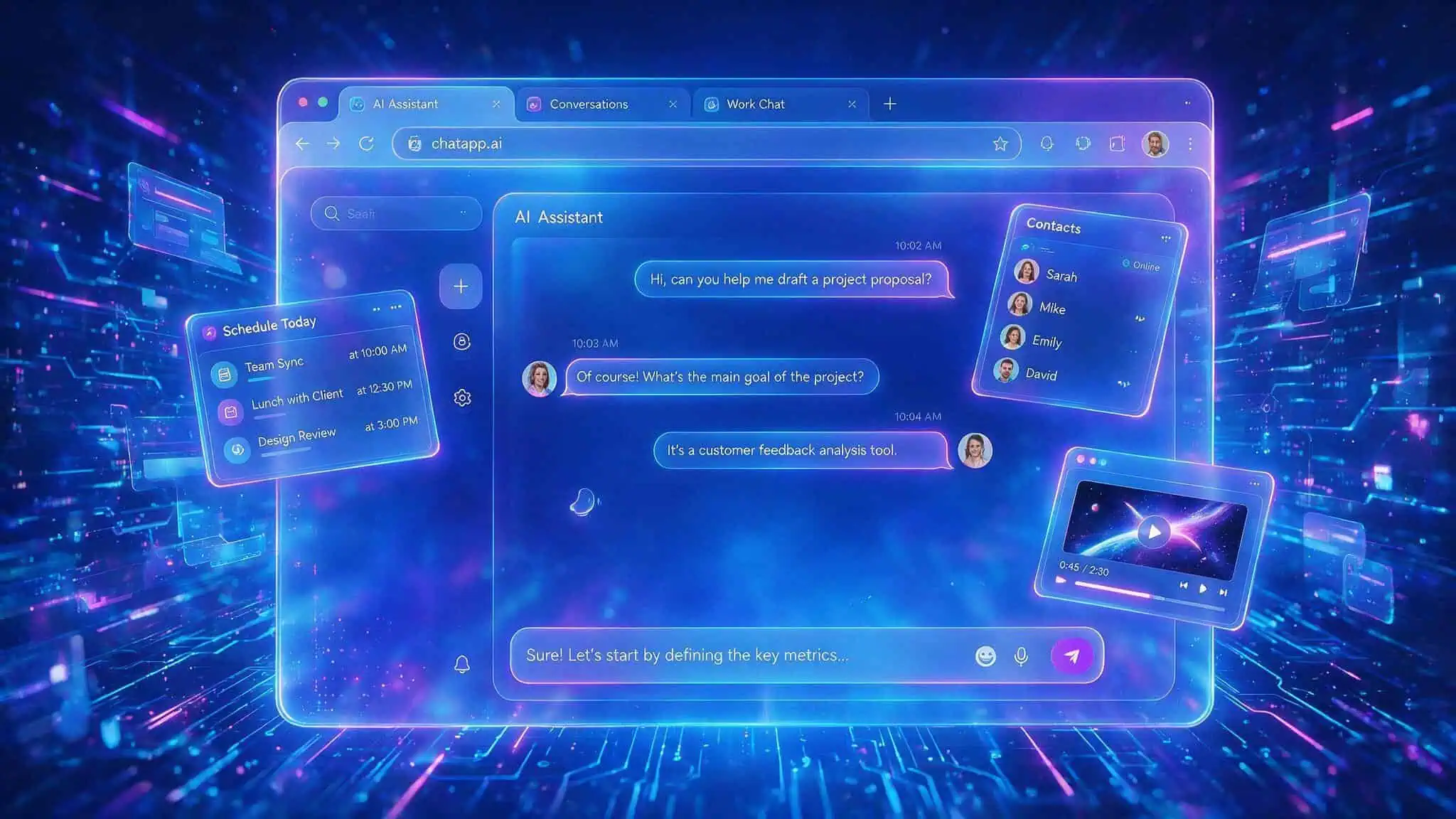
Then OpenAI’s Apps SDK launched, letting third-party developers build web web apps that function as interactive elements within ChatGPT conversations. People are comparing it to the Apple App Store launch in 2008.
Google’s “Web AI” initiative includes LiteRT.js for running AI models in the browser — production-ready, not just a demo. WebMCP, a collaboration between Google and Microsoft, lets developers manage how AI agents interact with websites through client-side JavaScript. Jason Mayes, who leads these initiatives at Google, defines Web AI as a way to bring intelligence directly to the browser.
The W3C is actively exploring building blocks for what they’re calling “the agentic web” — MCP-UI, WebMCP, NLWeb. When the standards body is on it, you know this is real.
For web developers, this means a whole new distribution channel. You’re not just building for humans anymore — you’re building the UIs that AI agents and chatbots will display.
Skills to Future-Proof Your Career
Flavio Copes has a three-step strategy that makes more sense than anything else I’ve seen:
Step one: AI as Mentor. Use it to explain concepts, debug your code, and show you best practices.
Step two: AI as Coworker. Write the core logic yourself, hand off the repetitive stuff to AI, then carefully review what it produced.
Step three: AI as Manager. Architect the solution, let AI write the code, and manage the AI bots. Gartner predicts Gartner predicts that by 2026-27, 90% of software engineers will move from hands-on coding to managing AI processes.
The market data backs this up. Stack Overflow’s 2026 survey found 84% of developers are already using or planning to use AI tools.
The skills that matter now: prompt engineering, code evaluation and auditing, AI tool integration, and — most importantly, knowing when not to use AI. Full-stack developers who can handle front-end, back-end, and databases are more valuable than ever, because they can see the whole picture that AI can’t.
Not Dead, Evolving
Web development is evolving, not dying. It’s entering a new phase, as it always has.
AI is like a fast junior developer who needs supervision but no mentoring.
People Also Ask
Will AI replace web developer jobs?
AI won’t replace web developers, but developers who use AI will replace those who don’t. AI handles boilerplate code and repetitive tasks, saving 35-40% of coding time, but it struggles with business context, architectural decisions, and edge cases. The industry is shifting toward roles where humans manage AI tools, review their output, and handle the strategic thinking AI can’t do.
Are websites dying because of AI?
No, websites aren’t dying — they’re evolving into interfaces for both humans and AI agents. The W3C is actively building standards for the ‘agentic web,’ where mini web apps appear inside AI chatbots and browsers run AI models directly. This creates a new distribution channel: developers now build UIs that AI agents display, which is a growing frontier that requires human expertise.