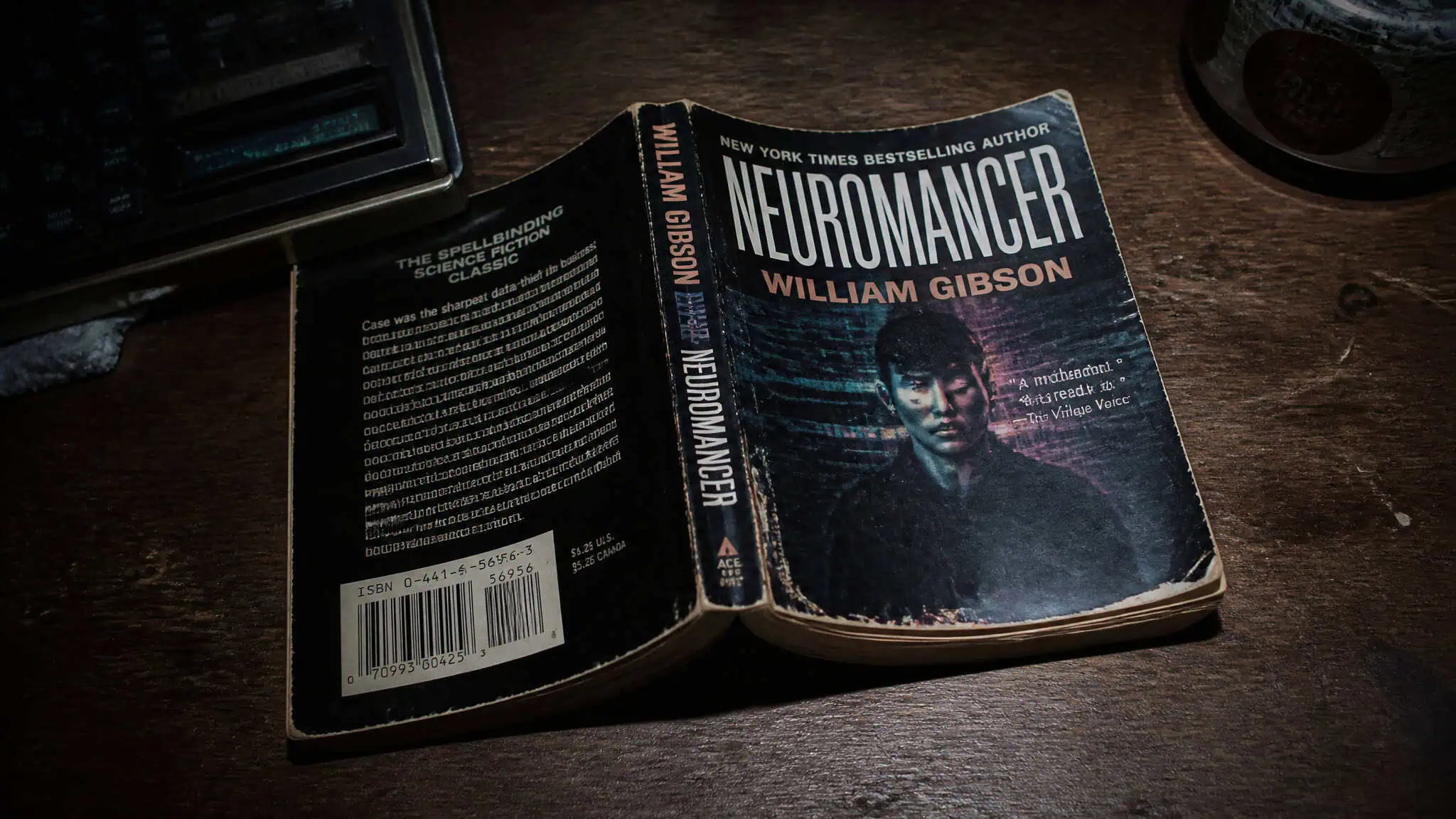
I was about 50 pages in and I had no idea what “simstim” meant. I’d reread sentences three times and still couldn’t picture what was happening. I felt like I was failing at reading. Then I found a Goodreads post from 2015 that asked: that Is this book generally hard to follow, or am they just not trying hard enough?
The thread is still active, and the answer is complicated. Here at GeekExtreme, we love digging into why the classics that shaped modern sci-fi also feel like a wall of concrete. This is my attempt to explain why Neuromancer is so famously hard to read — and why you should probably keep going.
Key Takeaways
Gibson deliberately withholds exposition, forcing readers to decode terms like “ICE,” “simstim,” and “the matrix” from context alone — a craft choice that mirrors the protagonist’s disorientation.
The novel’s 1984 tech assumptions (no mobile phones, payphone stalking, Japanese/German brand dominance) and the aging of its famous opening line (the color of television tuned to a dead channel) add a layer of historical friction for modern readers.
Despite the difficulty, the book’s last third is widely considered the best part, and a documented “restart strategy” — one reader got lost, started over, then finished the entire Sprawl trilogy, suggests the effort pays off.
Table of Contents
The deliberate disorientation of Gibson’s prose
Yes, it gets easier after the first 50–70 pages — here’s the evidence. One reader described those opening chapters as “quite badly written,” with a noticeable improvement in flow afterward. Another forum user put it simply: Gibson doesn’t explain anything — he throws you in deep. That’s not sloppiness; it’s a deliberate craft choice.
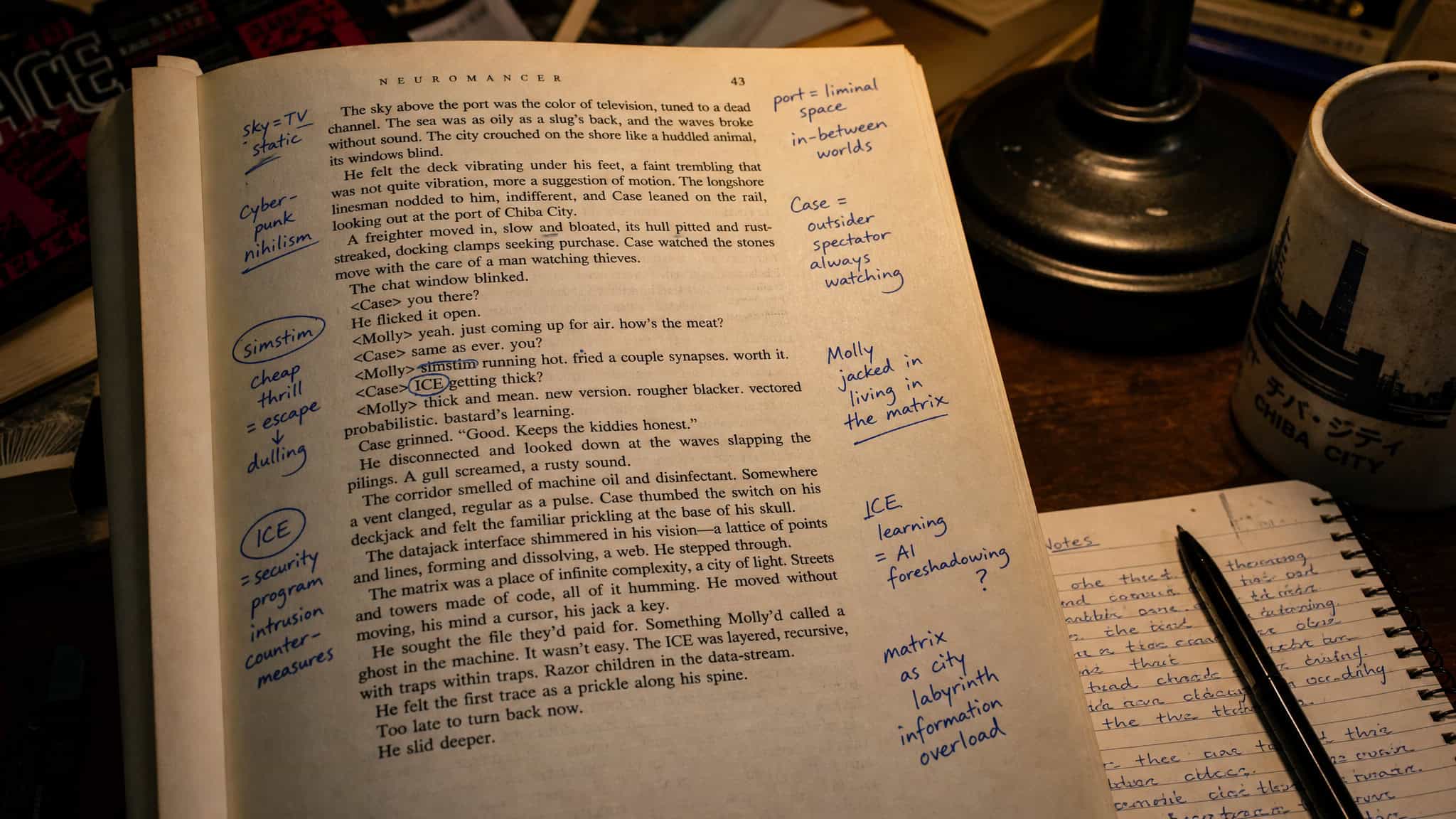
The book’s first quarter is a sensory overload of names, brands, and jargon you absorb by immersion, not by a glossary. The payoff is that by the last third, the prose settles into a rhythm that many readers call the best part of the book.
Why Gibson throws you in the deep end
Gibson offers zero exposition. No as you know, Case is a console cowboy. No footnote explaining that “ICE” stands for Intrusion Countermeasures Electronics. You land in a world where people talk about “simstim” and “Tessier-Ashpool” like you’ve always known what those words mean.
One forum user summed it up: Gibson does not explain abbreviations, background, or terminology; he throws the reader in deep. This mirrors the protagonist Case’s own disorientation — he’s been cut off from cyberspace, and the reader is equally cut off from a familiar narrative anchor. It’s a feature, not a bug.
The rough first 50–70 pages and the improvement afterward
The first 50–70 pages are a slog. I’m not going to sugarcoat it. One reader called them “quite badly written,” and the criticism is common enough that it’s a known pattern. But then something shifts.
The prose gains clarity, the pacing tightens, and the last third of the book is widely considered the best part. The style remains dense — it’s “absolutely bleeding with style and atmosphere,” as another forum user put it, but the rough edges get sanded down. The trade-off is intentional: making it reader-friendly would sand off the texture that gives it its power.
Learning the language of the Sprawl
Because Gibson was inventing the future and needed new words for it. That’s the short answer. The longer answer involves a writer in 1984 trying to describe concepts that didn’t yet have names — “cyberspace,” “the matrix,” “the sprawl.” He coined terms that later entered everyday tech vocabulary. He also repurposed existing words in strange ways, like “slivers of Microsoft”, a phrase that feels like a puzzle box until you realize he’s describing a software interface in a world where Microsoft is a relic.
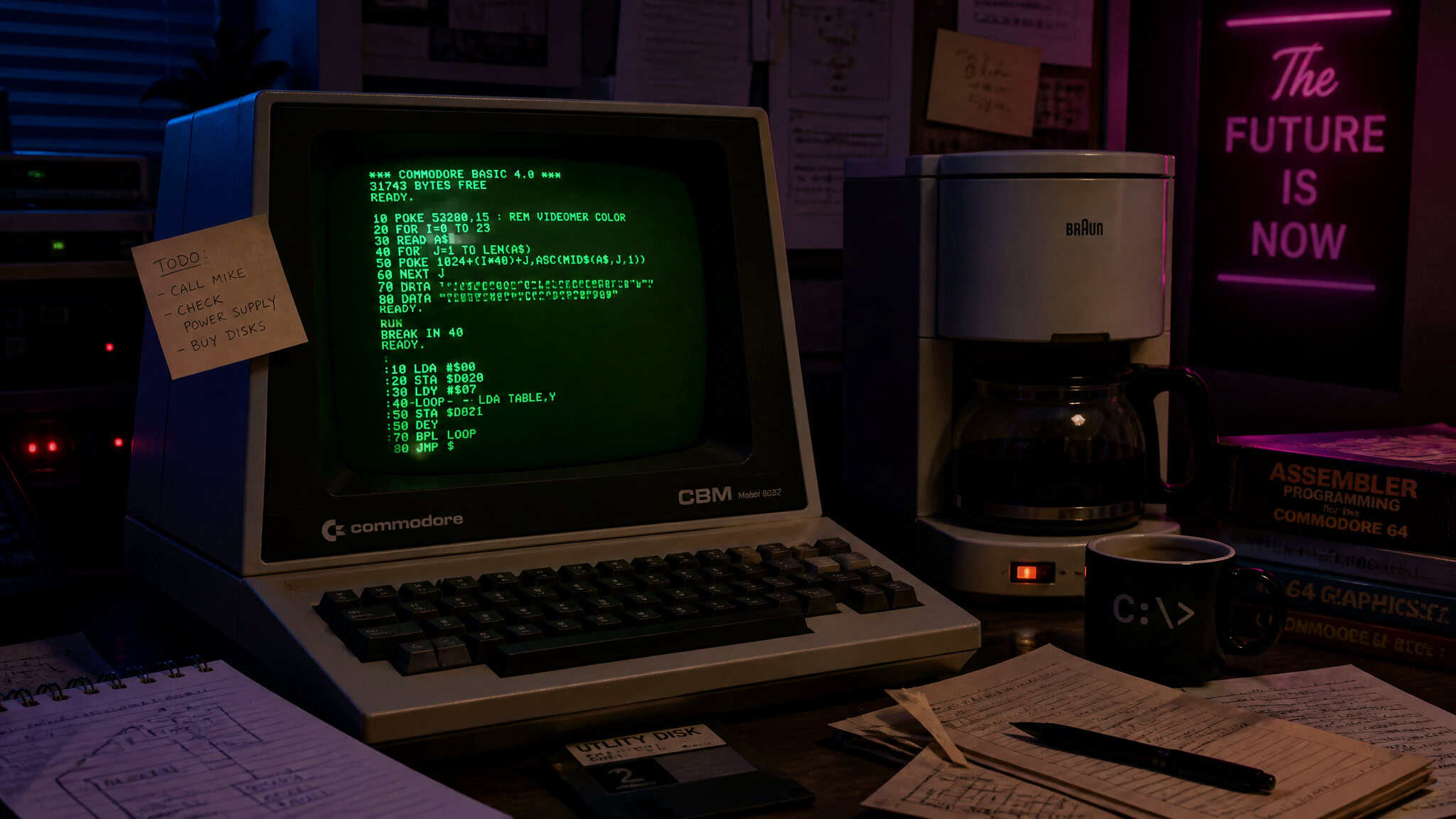
Gibson’s invented lexicon and its real-world legacy
Gibson didn’t just make up words for fun; he needed a vocabulary for things that didn’t exist. “Cyberspace” is the obvious one, but “the matrix” (the digital realm, not the movie) and “the sprawl” (the Boston-Atlanta megacity) are his creations too. Some of his neologisms later got real-world names — “ICE” feels like a precursor to firewalls, “simstim” is basically VR. The density is high, and you’ll find yourself rereading paragraphs to decode what a “deck” is (it’s a computer) or what “Ono-Sendai” means (it’s a brand of cyberspace console). It’s like learning a new dialect.
How to decipher the terminology: the Pullman analogy
Think of it like reading Philip Pullman’s His Dark Materials, where everything electric is called “anbaric.” It’s an alternate-universe naming convention. You don’t get a glossary; you figure it out from context. Gibson does the same thing: “simstim” is a sensory feed, “ICE” is security software, “the matrix” is the digital space.
So, did Neuromancer predict the internet? Once you accept that these are just renamed versions of familiar concepts, the book stops feeling like a foreign language.
A time capsule of 1980s futurism
The opening line means the sky was gray, snowy static, like a TV with no signal. That’s the concise answer. But the line only works if you remember analog TV snow — the flickering gray noise on a dead channel. Gibson later admitted, “It took at least a decade for me to realize that many of my readers, even in 1984, could never have experienced Neuromancer’s opening line as I’d intended them to.”
If you’re under 30, you’ve probably never seen that. The whole book is full of these quiet time bombs, and it remains one of the most important works of cyberpunk literature, frequently appearing on lists like the best books for geeks.
Field note: Gibson’s “dead channel” was analog snow in 1984. If you’ve never seen it, that single line already requires a historical footnote to decode.
No cell phones, no internet: the pre-digital communication gap
Levitating trains but no mobile phones. That’s the kind of asymmetry that makes a modern reader blink. Not a single character uses a cell phone. Communication happens via payphones and landlines.
At one point, the main character is stalked by ringing payphones — a scene that feels absurd until you realize it’s peak pre-mobile paranoia. The tech is overwhelmingly Japanese and German: Hitachi, Braun, Ono-Sendai, Hosaka, Dornier-Fujitsu. It reflects 1980s economic anxieties about Japan and Germany overtaking the US. For a reader in 2025, it’s a fascinating historical artifact.
The opening line that aged faster than the rest
The sky above the port was the color of television tuned to a dead channel. That line is iconic, but it’s also a measure of how quickly tech changes. In 1984, a dead channel meant gray, snowy static. By the time I read it, I had to stop and think: “Oh, right, analog TV. No blue screen.”
Gibson’s own admission — that he didn’t realize the problem for a decade, is a perfect example of how the book’s dated assumptions create extra friction. It’s not a flaw, but it is a hurdle. Given the decades of failed attempts to adapt the novel, the question Is Neuromancer getting a show? now has a surprising answer.
Riding the chaos: the non-linear plot
It depends on how you read it — here’s what we know. The plot jumps between locations and characters without much hand-holding. You have to work to track who’s who and why they matter. One reader posted a specific confusion: “Case seems to see the matrix without being plugged into a console — doesn’t that contradict the rules?” That ambiguity frustrates some readers and delights others, and it helps to separate fact from fiction by checking the definitive guide to all Neuromancer rumors.
A specific confusion point: can Case see the matrix without a console?
Forum user PizzaCaviar asked exactly this: how Case can see the matrix when he isn’t jacked in. The book doesn’t make it clear. Is it a plot hole? Intentional ambiguity?
A misunderstanding of the scene? The answer is: it’s not resolved. The narrative ambiguity is part of the experience. Some readers see it as a flaw; others see it as a deliberate choice to keep the world mysterious. The fact that people still argue about it online is proof that the book rewards — or frustrates, close reading.
The “enemy gate is down” turning point
During the Sense/Net heist, one reader described an “enemy gate is down” moment — a reference to Ender’s Game where the protagonist realizes the rules of the game are different than he thought. Suddenly, the confusion receded, and they just went along for the ride. That’s the mindset shift that many readers who ultimately enjoy the book describe. You stop trying to understand every detail and let the atmosphere carry you. The heist scene is a milestone where the pace picks up and the pieces start to click into place.
Is it bad writing or brilliant atmosphere?
Because the difficulty is part of what makes it a classic — here’s why. The book is “absolutely bleeding with style and atmosphere,” as one forum user put it. But that atmosphere comes at a cost: clarity. This is similar to Dune or A Scanner Darkly — books that reward persistence but punish casual reading. Some readers find the prose itself clunky or overwritten in the first 70 pages.
Others argue that the density is the whole point — that making it reader-friendly would sand off the rough edges that give it texture. There’s no right answer. You have to decide which side you fall on. But the fact that the book still has a massive cult following, the Folio Society limited edition sold out in four hours, suggests that for many, the trade-off is worth it.
How to survive (and enjoy) Neuromancer
Try the restart strategy: one reader got lost halfway, started over, and finished the entire trilogy. The density is real. But there are documented strategies that real readers have used to get through it.
The restart strategy that worked for one reader
One forum user got lost halfway through, put the book down, and then started over from the beginning. The second time, everything clicked. They ended up reading the entire Sprawl trilogy — Neuromancer, Count Zero, and Mona Lisa Overdrive — because the first book had set up the world so well. It’s not a guarantee, but it’s a specific tactic worth trying.
Use the audiobook
The audiobook, narrated by Robertson Dean, helps. Hearing the prose read aloud smooths out the dense passages and makes the noir cadence click. You’ll still get tripped up by the jargon — you’ll probably need to Google “Ono-Sendai”, but the overall flow is better.
Read the Sprawl trilogy for fuller context
Neuromancer is the first act of three. The story feels more complete when you read Count Zero and Mona Lisa Overdrive after it. The sequels fill in gaps and expand the world. Committing to the trilogy pays off, but you don’t have to read them to enjoy the first book.
Start with easier Gibson works
If you bounce off Neuromancer, try Johnny Mnemonic first — it’s a short story, fun, and easy to digest. The Bridge trilogy (starting with Virtual Light) is also much more accessible. It’s not a matter of quality; it’s a matter of entry point.
Why the struggle is worth it
Yes, if you’re willing to meet it on its own terms — and here’s what you’ll get in return. Neuromancer defined the cyberpunk genre. Its influence runs through The Matrix, Ghost in the Shell, Elysium, Ready Player One, Altered Carbon, Mr. Robot, Black Mirror, Cowboy Bebop, and Cyberpunk 2077. The ideas about AI and virtual reality feel uncanny for a book written in 1984. The Folio Society’s limited edition selling out in four hours is proof that its cult status is alive and well.
But beyond the cultural impact, the book is a lens for understanding humanity — not predicting tech. The struggle to read it is part of the experience. You’re not supposed to glide through it. You’re supposed to wrestle with it. Films like Tron (1984) offered a contemporary comparison, while later works such as The Peripheral, A Scanner Darkly, Strange Days, and Alita: Battle Angel each explore similar themes of identity and technology.
And when you do, the payoff is real. Stick with it.
Frequently Asked Questions
Is Neuromancer a difficult read?
Yes, especially the first 50–70 pages. Gibson deliberately withholds exposition, forcing you to decode jargon like ‘ICE,’ ‘simstim,’ and ‘the matrix’ from context alone. Most readers find it gets significantly easier after that initial slog, with the last third widely considered the best part.
What level of reading is Neuromancer?
It’s not about grade level—it’s about tolerance for ambiguity. The prose is dense and atmospheric, packed with neologisms and 1980s tech references that require historical footnotes and context-clue detective work. If you can handle learning a new dialect by immersion, you’ll manage.
Is Neuromancer spicy?
There are a few explicit scenes, but ‘spicy’ isn’t the word most readers reach for. Gibson’s tone is more noir and surgical than erotic—the sex scenes serve the gritty, dystopian atmosphere rather than titillation. You won’t find romance-novel heat here.
How does Gibson’s prose style make the book harder to read?
Gibson uses a technique called ‘deliberate disorientation’—he throws you into the Sprawl without explaining anything, mirroring the protagonist Case’s own confusion. There are no footnotes, no ‘as you know’ exposition dumps. You absorb the world’s vocabulary by immersion, like learning a new language.
What does ‘the sky was the color of television tuned to a dead channel’ actually mean?
It meant gray, snowy static in 1984—the flickering noise on analog TV with no signal. Gibson later admitted it took him a decade to realize younger readers wouldn’t recognize that reference. If you’ve only seen a blue or black screen on digital TV, that line requires a historical footnote to decode.