Apple TV+ just dropped the first trailer for the long-awaited Neuromancer adaptation, and the internet is already buzzing with conflicting claims. Late 2026 debut, expansion beyond the novel, a full Sprawl trilogy — it’s a lot to untangle.
But here’s what I found after digging through the sources: some of what you’re seeing is confirmed, some is speculation, and at least one popular rumor is already contradicted by official data. Let’s sort through it — starting with what we actually know for sure.
Key Takeaways
The series premieres January 22, 2027 on Apple TV+ — that date has independent confirmation from both IMDb and Empire, contradicting the widespread late-2026 rumor.
10 episodes are confirmed for season one, with Graham Roland (Dark Winds) as showrunner and William Gibson himself serving as executive producer and creative consultant.
The teaser’s “the next chapter” description is the only hint of expansion beyond the novel, but absolutely nothing has been confirmed about adapting the Sprawl trilogy.
Table of Contents
Neuromancer rumors: what’s confirmed about the Apple TV+ series
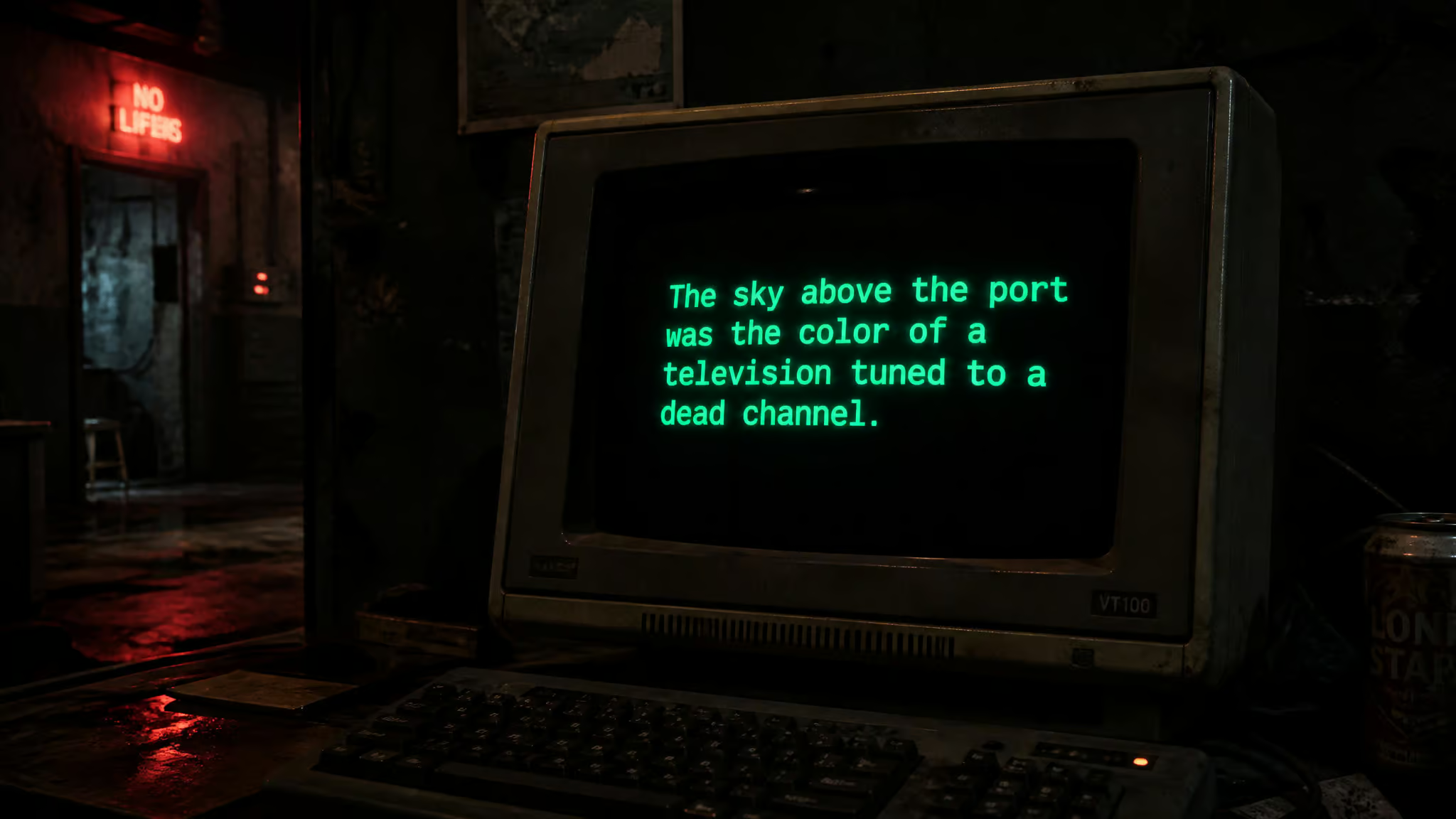
The teaser trailer shows a retro monitor displaying the novel’s opening line: “The sky above the port was the color of a television tuned to a dead channel.” That’s it. A blurry interior shot, that line on a CRT, and the Apple TV+ logo. No characters, no plot beats, no release date in the visuals themselves.
But already there’s conflicting information circulating, and not all of it checks out. Some outlets reported a late 2026 premiere. Others are pointing to January 2027. The Sprawl trilogy talk is everywhere, and that “next chapter” phrase in the teaser description has people reading into every possibility.
This guide walks through what’s confirmed, what’s still speculative, and where the critical conversations about this adaptation actually get interesting. Confirmed facts first, then the active rumors, then the deeper context that most coverage skips.
The teaser that broke the news
Apple dropped the first look on social media and YouTube — and honestly, it’s a teaser in the truest sense. A retro monitor, a single line of text, a blurred room in the background. That’s the whole thing.
The trailer doesn’t give an awful lot away. But that’s kind of the point. For a novel that’s been called “unfilmable” for decades, leading with the most iconic sentence in cyberpunk fiction is a smart signal of fidelity. It tells fans: we know what matters, and we’re leaning into it. The show is currently in post-production, which fits the timeline toward a 2027 release.
Where the adaptation rumors started
The rumor mill didn’t take long to spin up. It started with two words in the teaser description: “the next chapter.”
That phrase triggered three main rumors:
- The adaptation will expand beyond the novel — possible, but unconfirmed. The description says “the next chapter,” which could mean the show covers the Sprawl trilogy, or it could simply mean the next chapter of the story begins here. Genuinely ambiguous.
- The series will debut in late 2026 — this one is directly contradicted by the confirmed January 22, 2027 date. That rumor circulated alongside the teaser but hasn’t been corroborated by any official source or reliable outlet.
- The show will adapt the entire Sprawl trilogy — a natural assumption if season one succeeds, but explicitly unconfirmed. More on that in a minute.
So which of these have legs, and which have been closed? Let’s start with the bedrock facts.
Neuromancer release date and episode count: the confirmed details
Here’s what’s not up for debate: The series premieres January 22, 2027, on Apple TV+. Ten episodes. One season confirmed so far. The show is currently in post-production, which lines up with that timeline.
So where did the late 2026 date come from? It seems to have been speculation based on production timelines and a vague “coming soon” vibe. The January 22, 2027 date has independent confirmation from both Empire magazine and IMDb’s release info section. That’s two separate, credible sources pointing to the same date. The late 2026 rumor has none of that backing.
Red flag: The late-2026 rumor has zero official sourcing or independent corroboration, while the January 22, 2027 date is backed by both IMDb and Empire magazine.
If you’re planning your viewing calendar, put January 22, 2027 on it. That’s the real date.
Neuromancer TV show cast and characters: who plays who
The lead pairing is the headline here: Callum Turner as Case and Briana Middleton as Molly. That’s your damaged super-hacker and your razor-girl assassin. Together they drive the heist plot.
Beyond the leads, the announced cast includes:
- Mark Strong as Armitage — the mysterious benefactor who hires Case and Molly
- Clémence Poésy as Lady 3Jane — part of the Tessier-Ashpool corporate dynasty
- Peter Sarsgaard as John Ashpool — another key member of that dynasty
But the full IMDb cast list reveals some deeper cuts that most announcements miss.
The creators behind the adaptation
Graham Roland (Dark Winds) is the showrunner, co-creating with J.D. Dillard (Sweetheart), who directs the pilot. Roland’s work on Dark Winds — an indigenous noir series, signals a grounded, character-driven approach rather than pure spectacle. That matters for Neuromancer, a novel that’s heavy on internal monologue and atmosphere.
William Gibson is on board as executive producer and creative consultant. The original author has a seat at the table, which is a good sign for faithfulness — though not a guarantee.
The production team includes Anonymous Content (the studio behind True Detective and Mr. Robot) and DreamCrew Entertainment (Drake’s production company). Filming took place in Tokyo, Japan, which is a perfect fit for the Sprawl’s grimy, neon-lit cyberpunk aesthetic.
The full cast list and character roles
One detail that jumped out at me from the IMDb listing: the presence of young-version castings. You’ve got William Franklyn-Miller as Young John Ashpool and Tilly Walker as Young 3Jane. There’s also Junia Rees as 3Jane Tessier-Ashpool — a different iteration from Clémence Poésy’s Lady 3Jane.
That trio of roles strongly suggests the show will include flashback or multigenerational storytelling that extends beyond the novel’s present tense. The novel itself hints at the Tessier-Ashpool family history, but never dramatizes it in flashback. The show might fill in those gaps.
Other notable castings include Marc Menchaca as The Dixie Flatline (a fan-favorite character from the novel — a dead hacker’s personality construct stored in a computer) and André De Shields as Julius Deane, Case’s fixer in the underground.
The full IMDb roster lists 33 cast members, including small roles like Sales Lady and Gate Agent, which suggests a well-populated world that won’t feel empty.
Neuromancer plot: the heist that defines the story
The official synopsis: Case is a damaged, top-rung super-hacker thrust into digital espionage with partner Molly, a razor-girl assassin, tasked with robbing a corporate dynasty.
That matches the novel’s core plot closely — a McGuffin chase with a damaged protagonist, a mysterious benefactor, and a lot of double-crosses. The genre tags are Drama, Sci-Fi, Thriller, which fits the novel’s tone.
If you’ve read the book, you know the beats. If you haven’t, that summary gives you the essentials: hacker + assassin + corporate dynasty = cyberpunk heist. The primary language of the series is English, as listed on the show’s IMDb page.
Why Neuromancer was never “unfilmable”
For decades, Neuromancer carried the label “unfilmable.” People said you couldn’t translate Gibson’s dense prose, his cyberspace sequences, his internal monologue-heavy narrative to screen. Multiple film adaptations were attempted and died in development hell, but now, is Neuromancer getting a show? Yes, it’s finally happening after all those failed attempts.
The novel’s plot is actually a straightforward McGuffin chase with a passive protagonist. Mechanically, it’s simple to adapt. A man with unlimited resources hires a ragtag group to obtain an object under false pretenses. They travel to different locations, pick up pieces of the puzzle, and eventually confront the benefactor.
The real challenge isn’t plot complexity. It’s capturing Gibson’s atmosphere and world-building. But calling it “unfilmable” was always more about the difficulty of translating a unique literary voice than any structural impossibility.
The real challenge: Gibson’s prose and world-building
The teaser confirms the show will feature that rough, retro tech the novel is famous for — CRT monitors, analog interfaces, the whole grimy cyberpunk toolkit. And that’s exactly right.
The novel’s sometimes crude technology wasn’t a limitation of Gibson’s imagination. It became a defining element of the narrative and modern cyberpunk worldbuilding. The idea that the future wouldn’t be all sleek chrome and holograms, but a messy mix of high-tech and low-life — that’s the aesthetic Neuromancer codified.
The retro monitor in the teaser isn’t nostalgia-bait. It’s a fidelity signal. The show is telling us, right from the first frame, that it’s leaning into that original vision rather than modernizing it.
Is the series faithful to the book?
So which is it — faithful adaptation or expansion? Let’s weigh the evidence.
For fidelity: The teaser opens with the novel’s most iconic line. The official synopsis sticks close to the novel’s major events. Gibson is a creative consultant. The retro-tech aesthetic honors the source material.
For expansion: The teaser description includes the phrase “the next chapter.” The young-version castings suggest flashbacks or expanded backstory. The 10-episode format gives room for material not in the book.
The honest answer: we don’t know yet. Neither reading has been officially confirmed.
Neuromancer rumors: what’s still unconfirmed
Here’s what’s still up in the air:
- The “next chapter” hint — may mean the show goes beyond the novel, but this is not officially confirmed.
- The Sprawl trilogy adaptation — Count Zero and Mona Lisa Overdrive might follow if season one succeeds, but the source text explicitly states that has also not been confirmed at this time.
- The late 2026 debut — contradicted by the confirmed January 22, 2027 date. This one’s closed.
Will the Sprawl trilogy be adapted?
It’s a natural assumption: if the first season of Neuromancer succeeds, Apple will adapt the rest of the Sprawl trilogy. But this is explicitly unconfirmed. No official announcement exists, and everything we know about Neuromancer on Apple TV remains speculative. The “next chapter” phrase might hint at it, or it might just mean the show’s own first chapter begins.
For now, treat it as fan hope, not news.
Is Neuromancer a movie or a TV show?
It’s a TV series on Apple TV+, not a feature film. The first season has 10 episodes. This format makes a lot of sense — the novel’s world is dense enough that a single film would struggle to contain it. The decade-long history of failed film adaptations suggests the movie format was never going to work, so the question remains: when is the Neuromancer release date?
The Neuromancer teaser trailer, decoded
Let’s walk through that teaser with a critical eye.
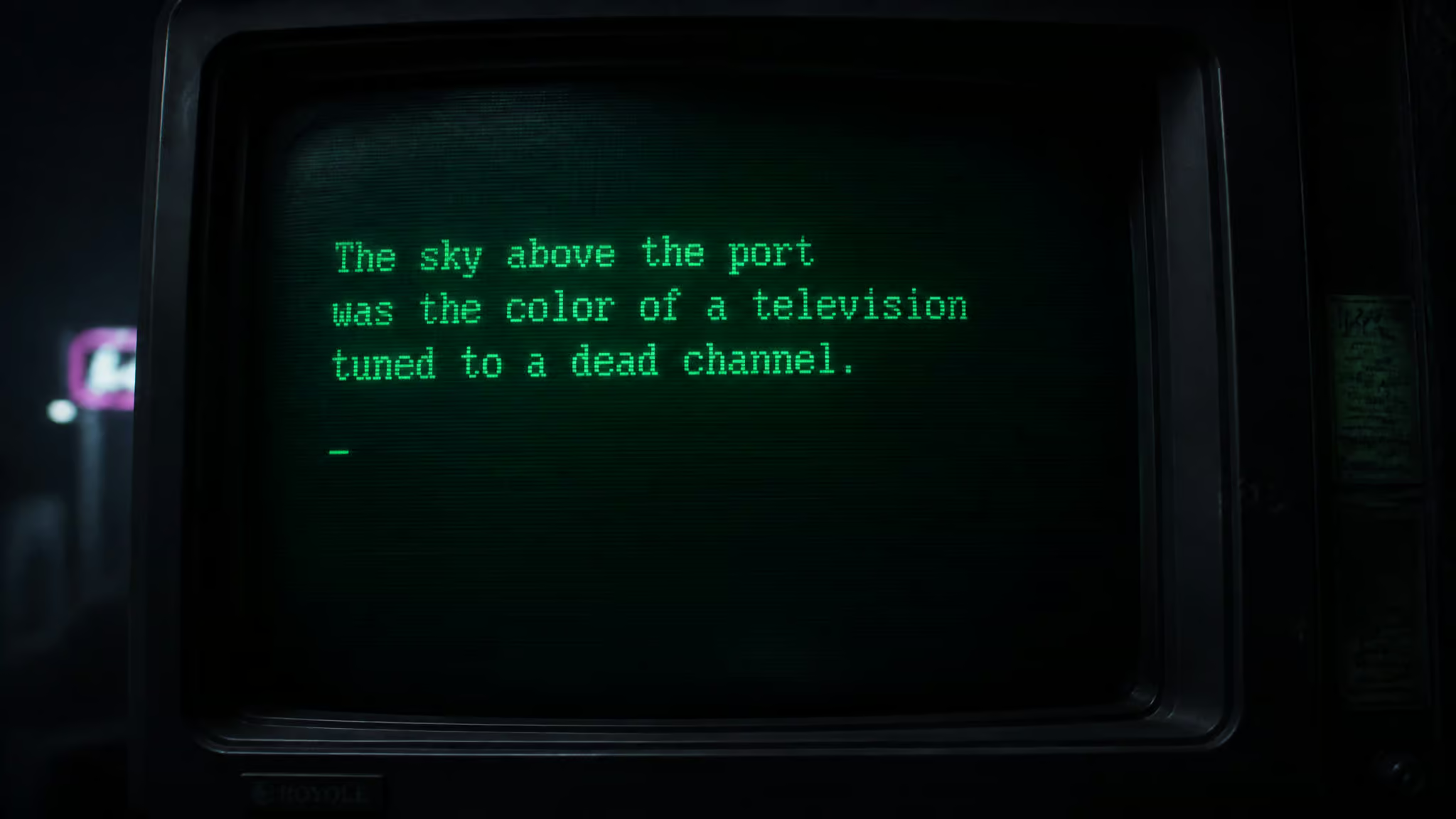
A retro monitor, the opening line, and a blurred interior shot. That’s everything in roughly 30 seconds.
Teasers for highly anticipated adaptations often use iconic source material as a fidelity signal. They’re not trying to show you footage — they’re telling you we get it. The Neuromancer teaser is a textbook example. It’s saying: “We know the opening line is sacred. We know the retro tech matters. Trust us.”
What the teaser reveals about the show’s aesthetic
The retro monitor isn’t just a nostalgic callback — it’s a fidelity signal. The novel’s sometimes crude technology ended up defining the narrative and modern cyberpunk worldbuilding. The show is telling us, right from the first frame, that it’s leaning into that original vision rather than modernizing it.
That’s a smart move. Gibson’s gritty, analog cyberpunk stood in deliberate contrast to the sleek futures of earlier sci-fi. Updating the tech to modern sleekness would miss the point entirely.
The “next chapter” hint and what it could mean
The teaser description includes the phrase “the next chapter.” That’s it. Two words. And they’ve sparked a lot of speculation.
Does it mean the show covers the full Sprawl trilogy? Does it mean the series picks up after the novel’s events? Or does it just mean the next chapter of the story begins here?
The honest answer: we don’t know. No official confirmation exists. But it’s worth noting that the young-version castings suggest the show is already looking beyond the novel’s present tense. Whether that means flashbacks or genuine sequel material is anyone’s guess.
Neuromancer’s legacy: why the adaptation matters
Let’s zoom out for a second. Neuromancer isn’t just a novel — it’s the birthplace of cyberpunk. Published in 1984, it coined the term “cyberspace” and defined the aesthetic and thematic vocabulary of an entire genre.
And here’s a fun coincidence: the same week the Neuromancer teaser dropped, the Blade Runner 2099 teaser also appeared. It’s been a big few days for fans of 1980s speculative fiction.
How Neuromancer shaped modern cyberpunk
The novel’s influence isn’t abstract. The sub-genre has exploded since 1984, giving us works like Blade Runner, Akira, Minority Report, and Cyberpunk 2077. Each of those traces a direct lineage back to Neuromancer — its gritty, analog world, its anti-hero hackers, its corporate dystopia.
The term “cyberspace” first appeared in fiction in Gibson’s writing. That alone makes this adaptation culturally significant.
Apple TV+’s sci-fi niche
Apple TV+ has quietly become the destination for critically acclaimed sci-fi and fantasy. Severance, Silo, Foundation, For All Mankind — they’ve built a reputation for high-quality, thoughtful genre television. Neuromancer is its next big offering, and given the platform’s track record, there’s reason for cautious optimism.
Critical analysis: Gibson’s recurring plot formula
Let’s talk about the elephant in the room — or at least, the elephant that comes up in every serious conversation about Gibson’s work. There’s a critical perspective worth surfacing here: the argument that every Gibson plot follows the same pattern.
A mysterious man with unlimited resources hires a ragtag group to obtain a McGuffin under false pretenses. The protagonists are passive observers, being manipulated into doing what they do. They travel to new locations, pick up pieces of the puzzle, and eventually confront the benefactor.
This critique comes from a Hacker News thread, but it’s not an uncommon take among literary critics. And it’s worth considering in the context of the adaptation.
Case as the passive protagonist
Case is almost entirely a passive observer in the novel. He follows the gang as they travel to new locations to pick up McGuffins for the mysterious man with unlimited resources. He steps in with his hacker skills for brief missions in cyberspace, but he’s not driving the plot.
And that’s actually the point. Case serves as a stand-in for the audience, letting us see the cyberpunk world through an outsider’s eyes. We discover the story alongside him. This works brilliantly in prose, where first-person immersion hides the passivity. On screen, it’s a different challenge — a passive protagonist can feel frustrating or boring.
The Peripheral, Agency, and Gibson’s later work
The critique gets specific. The Peripheral is called a “classic witness protection plot” where the heroine does nothing. Agency is “awful” with even less agency — an ironically titled book. Virtual Light is a “stupid caper story” but both Chevette and Berry are great characters, hard-luck protagonists trying to make it in a crapsack world. The Bigend books are disappointments featuring “bougie insiders getting VC money.”
Even the Burning Chrome collection is described as “fantastic” — so the praise isn’t absent. The criticism is about structure, not quality of characters or prose.
Gibson, Iain Banks, and J. G. Ballard
The critique draws two interesting comparisons. First, Iain Banks: both are immensely plot-driven and McGuffin-based, but with “very different results.” Banks’ Culture series uses the McGuffin structure to explore utopian ideas; Gibson uses it to build atmosphere.
Second, J.G. Ballard: both started in sci-fi, were amazing prose stylists, moved mainstream, but struggled to escape a certain plot mold. Ballard’s later novels are variations on the same theme — wealthy people seeking outlets for their base instincts. Gibson’s later works are variations on the McGuffin chase.
One specific counterpoint: the use of Joseph Cornell boxes in Count Zero serves a real plot point as a trap for an art buyer. It’s a moment where the art and the plot genuinely intersect. That’s not just decoration — it’s clever integration.
What to expect from the Neuromancer adaptation
So what does it all add up to?
The confirmed details are solid: January 22, 2027, ten episodes, a strong cast, Gibson’s involvement, a showrunner with real genre cred (Roland from Dark Winds), and a teaser that signals fidelity to the novel’s iconic tech aesthetic.
The rumors are manageable: the “next chapter” hint might mean expansion, but nothing is confirmed. The Sprawl trilogy is a plausible hope, not an announced plan.
The critical context is worth keeping in mind: the “unfilmable” label was likely overblown — the plot is a simple McGuffin chase that ten episodes can contain. The real challenge is capturing Gibson’s atmosphere and world-building. If the show leans into that, the retro tech, the dense prose, the gritty cyberpunk vibe, it has a strong shot at being what fans have been waiting for.
I’m cautiously optimistic. Apple TV+ has the track record, the creative team is solid, and the teaser says the right things. Now we wait until January 2027 to see if they pull it off.
For more on the adaptation, check out our deep dives on the Neuromancer release date, the full cast and crew, and why the novel was never really unfilmable.
Frequently Asked Questions
Why is Neuromancer unfilmable?
The ‘unfilmable’ label stuck because the novel is dense with internal monologue, atmosphere, and Gibson’s unique prose style — things that don’t easily translate to screen. But the plot itself is a straightforward heist story, so the real challenge was always capturing the world-building, not the narrative structure.
Is Neuromancer getting a show?
Yes, it’s finally happening. Apple TV+ is producing a 10-episode series premiering January 22, 2027, with Graham Roland as showrunner and William Gibson on board as executive producer and creative consultant.
Why is Neuromancer hard to read?
Gibson drops you into the deep end with no hand-holding — dense prose, slang that’s never explained, and a protagonist who’s more observer than actor. The plot is a simple heist, but the writing style and world-building demand your full attention.
Who is playing Case and Molly in the Neuromancer series?
Callum Turner is playing Case, the damaged super-hacker, and Briana Middleton is playing Molly, the razor-girl assassin. They’re the lead duo driving the heist plot.
What is the release date for the Neuromancer TV show?
The series premieres on January 22, 2027, on Apple TV+. That date is confirmed by both IMDb and Empire magazine, contradicting earlier rumors of a late 2026 debut.