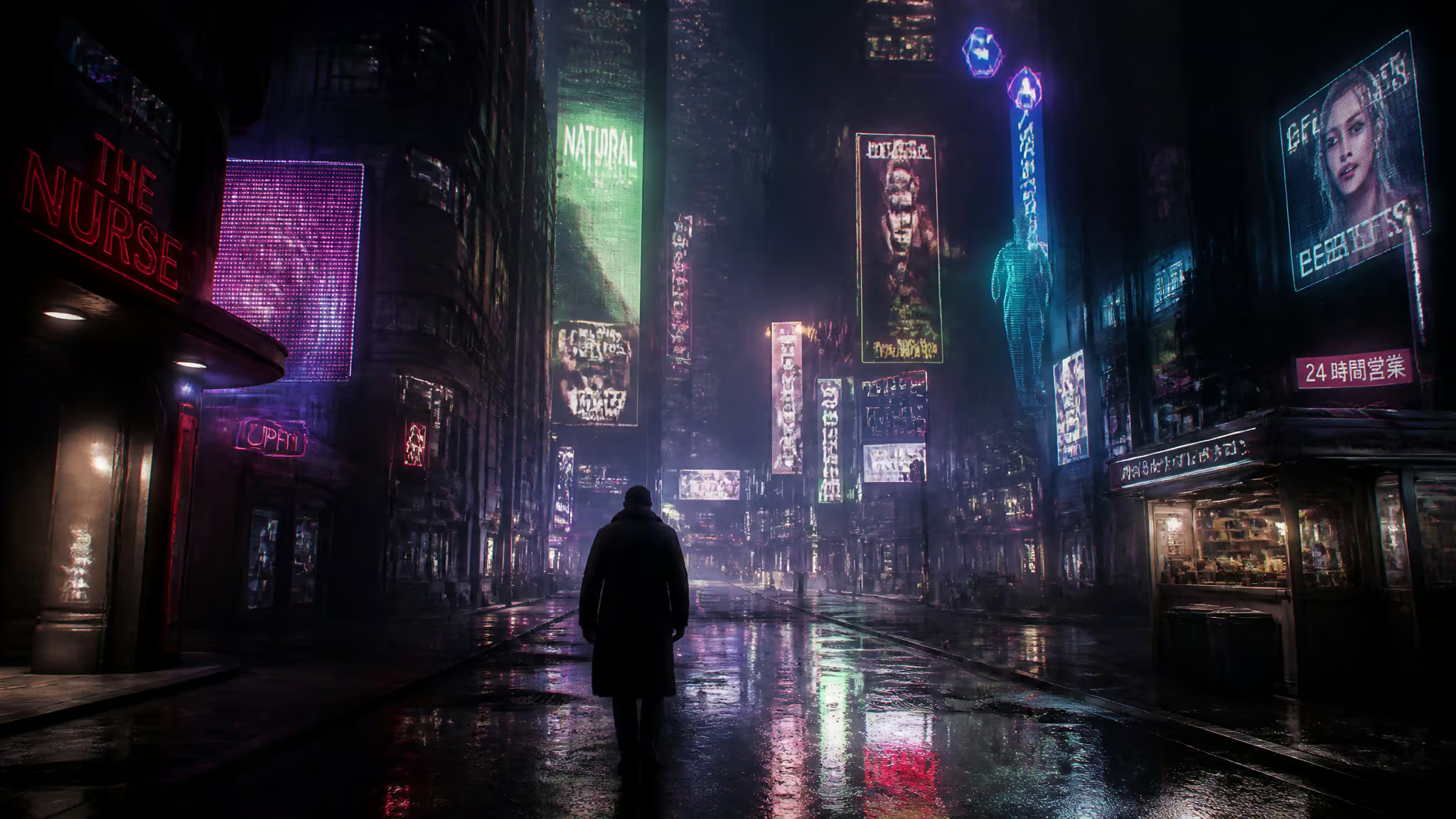
For forty years, the standard Hollywood reaction to Neuromancer has been a confident “I got this,” followed by a quiet retreat. Joseph Kahn, Vincenzo Natali, and Tim Miller all tried. The novel’s 10-episode adaptation finally breaks that cycle.
William Gibson’s 1984 novel — the one that named cyberspace, defined cyberpunk, and inspired The Matrix — kept refusing to fit inside a two-hour movie. So the fact that a Neuromancer Apple TV+ series is sitting on a premiere date feels like a small miracle. I’ve been tracking this project since Apple ordered it back in February 2024, and I still have to double-check the dates. It’s real: 10 episodes, premieres January 22, 2027, with a two-episode opening night and weekly drops after that.
Gibson is on board as executive producer and consultant, reading drafts and sending notes. The book that every filmmaker bounced off for four decades is finally getting a proper adaptation.
Key Takeaways
Neuromancer is set to arrive on Apple TV+ on January 22, 2027, with a two-episode premiere and weekly releases running through March 19, 2027.
Callum Turner plays Case, Briana Middleton plays Molly, and Mark Strong plays Armitage, with deep-cut novel characters like Peter Riviera, Julius Deane, and Dixie Flatline filling out the supporting cast.
William Gibson is executive producer and consultant, reviewing drafts, and the teaser signals a grounded, physical-set approach that deliberately holds cyberspace back for the show.
Table of Contents
What is the Neuromancer Apple TV+ series about?
A damaged super-hacker named Case, played by Callum Turner, teams up with a razor-girl assassin named Molly, played by Briana Middleton, for a high-stakes heist against the Tessier-Ashpool corporate dynasty and its untold secrets. That’s the engine of the whole story: digital espionage, corpo secrets, and a world that’s gone sideways.
IMDb classifies the show as Drama, Sci-Fi, Thriller, and that mix matters. This isn’t being pitched as pure spectacle. It’s a grounded heist narrative with real stakes, which is the right read on the novel. Gibson’s book is less about laser fights and more about a broken guy trying to get back to the only place he ever felt alive: cyberspace.
That’s also why the novel was so hard to adapt. The story lives inside Case’s head, and the central visual concept — cyberspace itself, had no existing visual language when the book appeared. The word “cyberspace” first showed up in fiction in Gibson’s work. Every film adaptation had to invent a look for it from scratch, then cram an entire fictional world’s worth of context into two hours.
A 10-episode season doesn’t have that problem. It can build the world slowly and let viewers live inside Case’s headspace instead of summarizing it.
Cast and characters
Callum Turner plays Case, Briana Middleton plays Molly, and Mark Strong plays Armitage — and the rest of the cast list reads like someone actually went through the novel with a highlighter. The supporting roles include deep-cut characters from later in the book, which is the quietest possible promise that this adaptation plans to cover the whole story, not just the opening chapters.
Callum Turner as Case
Case is a top-tier super-hacker who’s been damaged — he can’t access cyberspace anymore. That’s his entire arc in one sentence: a guy who lost the thing that defined him, trying to get back in the game. Turner, known for Masters of the Air, is playing a protagonist who’s both brilliant and deeply broken, and the whole novel depends on that combination working.
Briana Middleton as Molly
Molly is a razor-girl assassin with retractable blades under her fingernails, augmented reflexes, and mirrored eyes. She’s one of the most iconic characters in cyberpunk canon — the muscle, the cool factor, and the person who keeps Case alive while he fumbles through the real world. Middleton has big shoes to fill here; fans have been waiting decades to see Molly done right.
Main supporting cast
Mark Strong plays Armitage, the mysterious fixer who assembles the team — and Strong is very good at playing intense, morally ambiguous types, which is exactly what Armitage requires. Joseph Lee plays Hideo, a security specialist with an enigmatic past. Clémence Poésy plays Marie-France Tessier and Peter Sarsgaard plays John Ashpool, both key figures in the Tessier-Ashpool dynasty at the center of the heist. Emma Laird plays Linda Lee, a presence from Case’s past with a tragic arc.
Notable guest and recurring roles
This is where the casting list gets interesting. Dane DeHaan plays Peter Riviera, the holographic performer with a dark side. André De Shields plays Julius Deane, a fixer and information broker. Marc Menchaca plays Dixie Flatline, a legendary hacker who exists as a ROM construct. Max Irons plays Jean Tessier-Ashpool.
The depth here matters. Riviera, Deane, and Dixie Flatline aren’t characters you cast for a season that only adapts the opening chapters. Their presence suggests the show is aiming at the entire novel — all the major players, all the major set-pieces, in one 10-episode run.
Full supporting cast
The rest of the list fills out the world: Isabella Pappas as Mitchell, Prasanna Puwanarajah as Darvin Mitnik, Junia Rees as 3Jane Tessier-Ashpool, William Franklyn-Miller as Young John Ashpool, Sam Woolf as Persson, Christian Ochoa Lavernia as Angelo, Sofia Jin as Bryn, Clea Martin, Tilly Walker as Young 3Jane, Ahmed Abbas as Sketchy, Matthew Jeffers as Waldorf, Meghna Lall as Sales Lady, and Jake Alun as Gate Agent. Some of these are likely minor roles or original additions, but casting a young John Ashpool and a young 3Jane tells you the flashback structure is already baked into the season.
Creative team and production timeline
Graham Roland is the showrunner and co-creator. J.D. Dillard co-created the series with him and directs the first three episodes, including the pilot, which means Dillard is the one establishing the visual tone and pacing for the entire season. Wayne Yip and Debs Paterson direct additional episodes, and the writers’ room includes Naledi Jackson, Lenore Zion, Zu Quirke, and Rah Johnson. Executive producers include David Levine, Garrett Kemble, and Zack Hayden from Anonymous Content, Aubrey “Drake” Graham, Adel “Future” Nur, and Jason Shrier from DreamCrew Entertainment, plus Jennifer Haley.

Skydance Media is also involved in the production. Filming started in January 2025 on location in Tokyo, with additional filming in London, Canada, and Istanbul.
Showrunner and director
Roland has genre-TV credentials that make sense here — he worked on Jack Ryan and created Dark Winds. Dillard directed Devotion and knows how to handle both spectacle and character. The partnership is clean: Roland steers the ship, Dillard sets the look. That’s a solid division of labor for an adaptation this dense.
William Gibson’s role
Gibson is executive producer and consultant, and by all reports he’s actually doing the job — reviewing drafts, offering suggestions. That’s not a figurehead credit. For a fan base that has watched four decades of failed adaptations, knowing the author is in the room reading pages is a genuinely reassuring signal. It doesn’t guarantee the show will work, but it means the person who created this world gets to catch problems before they reach the screen.
Field note: Gibson’s active consulting role — not a ceremonial credit — is the single strongest signal that the adaptation respects its source material.
Production timeline
The project came together quickly after Apple ordered the series in February 2024. Turner was cast as Case in April 2024, Middleton joined as Molly in June, and Joseph Lee signed on as Hideo that December. Mark Strong came aboard as Armitage in January 2025. Then came a wave of casting in March 2025 — Poésy, Laird, and Sarsgaard in main roles, with DeHaan, Irons, De Shields, and Menchaca joining in recurring roles.
Filming began in January 2025 on location in Tokyo, which is the heart of the novel’s Chiba City — the neon-drenched opening act every cyberpunk fan has been picturing for decades. Additional filming happened in London, Canada, and Istanbul, standing in for other locations from the book. Then, in August 2025, Paramount Television Studios took over production after Skydance and Paramount Global merged into Paramount Skydance. Mid-production corporate reshuffles usually make you nervous; here, the show kept its schedule.
The first teaser dropped on July 6, 2026 — the 42nd anniversary of the novel’s publication. That date is a deliberate nod, and it tells you the team knows exactly what it’s adapting.
Episode guide and release schedule
The series opens with a two-episode premiere on January 22, 2027, then settles into weekly Friday releases through the season finale on March 19, 2027. No binge drop here — it’s a slow burn, two months of weekly episodes.
The episode credits are worth a look. Episode 1 has a story by Roland and Dillard with a teleplay by Roland. Episode 2 is written by Naledi Jackson and Lenore Zion. Episode 3 is credited to Zu Quirke and J.D. Dillard. Episodes 4 through 10 rotate through Zion, Jackson, Quirke, and Rah Johnson, with Roland and Dillard co-writing the finale.
That structure tells you something about the season’s architecture. The same two guys who wrote the pilot also wrote the ending, which is a strong signal that the narrative arc was planned from the top rather than improvised in the room. And Dillard directing the first three episodes means the show’s visual language is locked in early. For a deeper look at how Apple landed on this release window, our Neuromancer release date guide walks through the full production timeline.
Decoding the teaser: visual style and atmosphere
The teaser, released July 6, 2026, is a deliberate piece of misdirection. It uses physical sets rather than CGI environments, and it does not show cyberspace at all.
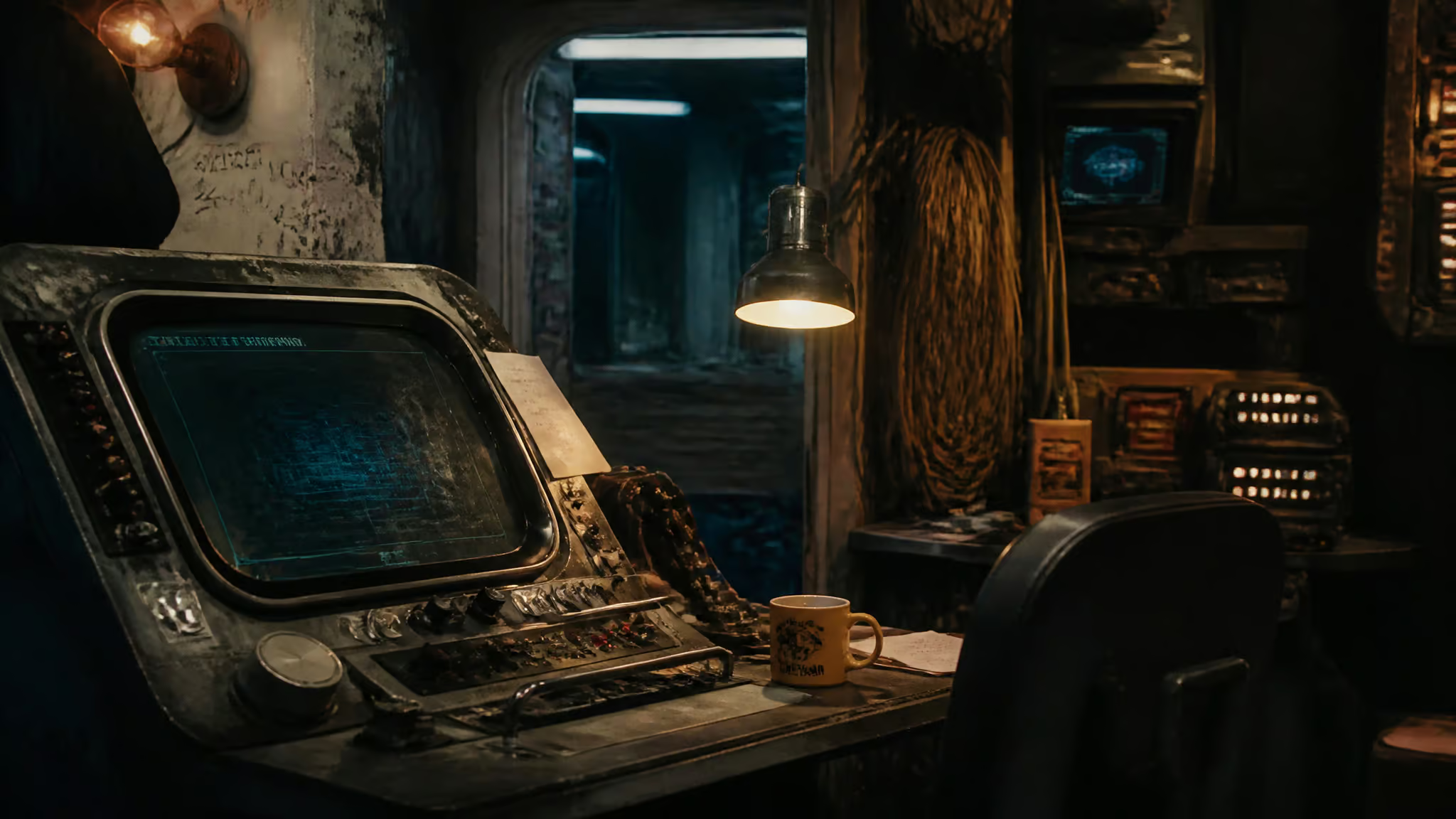
That’s a bold choice for a cyberpunk property. Most marketing for this genre leads with neon, rain, and VR spectacle — the stuff that reads instantly as “cyberpunk.” This teaser shows none of that. It’s grounded, tactile, character-focused. The physical-set approach signals a commitment to atmosphere and authenticity, drawing on the same tactile grit that makes Neuromancer such an important work of cyberpunk literature, and it sidesteps the video-game-cutscene look that CGI-heavy sci-fi can fall into.
The absence of cyberspace is the real tease. They’re saving the virtual world for the actual show, building anticipation instead of giving away the payoff. It’s a tradeoff: it could build trust with viewers who want a mature, character-driven adaptation, or frustrate fans who came to see the famous “matrix” rendered on screen. The teaser is betting on atmosphere and character over spectacle. Dropping it on the anniversary of the book’s publication, no less, is a nod that shows the marketing team respects what they’re adapting.
Cultural impact, genre positioning, and Apple’s sci-fi empire
Neuromancer isn’t just an influential novel — it’s the foundational text of cyberpunk. The Matrix was directly inspired by its concept of virtual-reality cyberspace, and Cyberpunk 2077 shares a remarkably similar premise: a heist, a digitized human mind, and a world run by corporations. If you’ve enjoyed either of those, you already recognize this story’s DNA.
The novel that defined cyberpunk
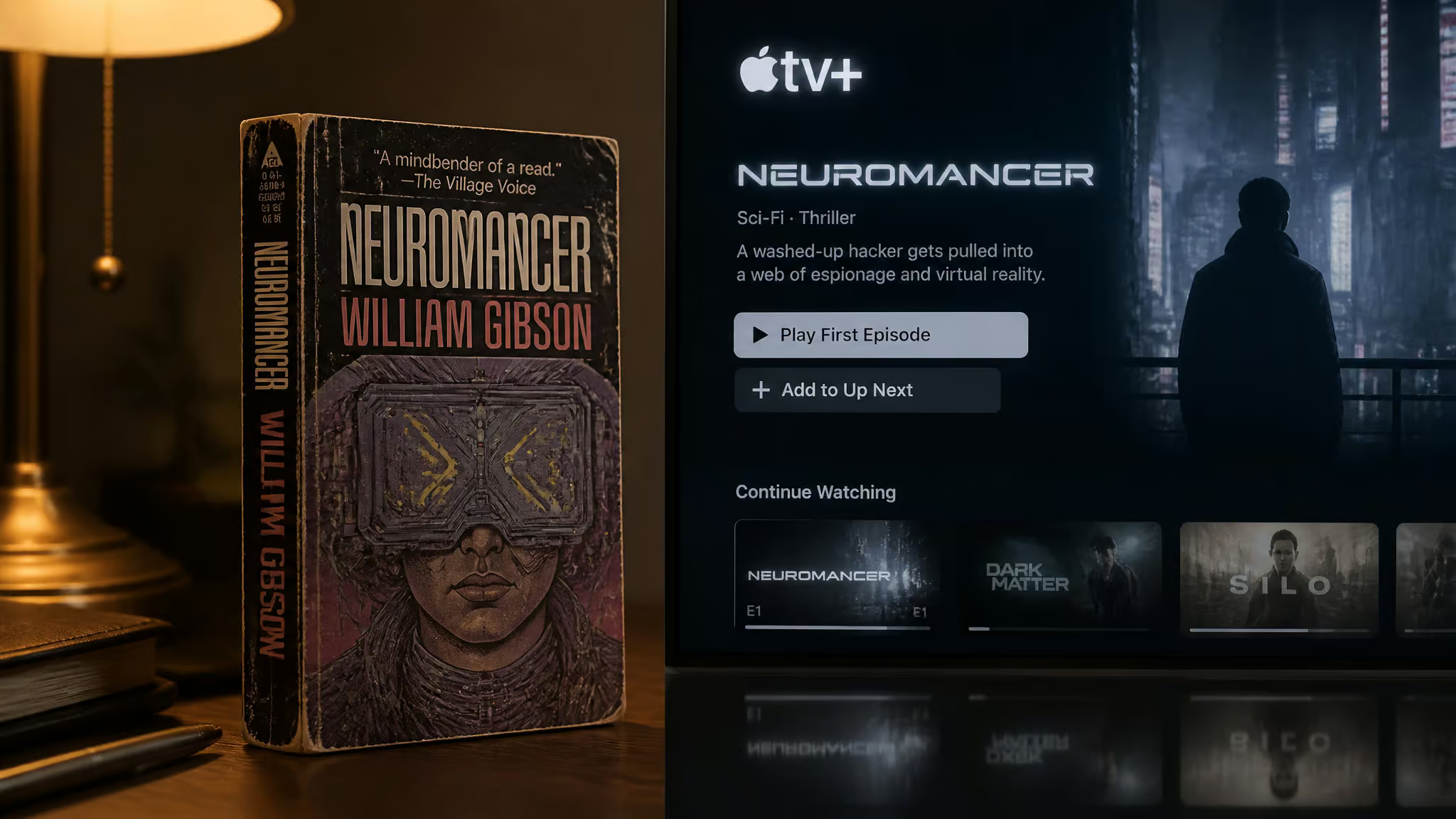
The term “cyberspace” first appeared in fiction in Gibson’s work, and Neuromancer sits alongside Blade Runner and Ghost in the Shell as one of the genre’s founding pillars. What’s interesting about this adaptation is that it has a chance to reclaim cyberpunk’s literary noir roots — the original, before the action-movie interpretations took over. The book is paranoid, cerebral, and weirdly romantic. A 10-hour series is the right format to let all of that breathe.
Direct line to The Matrix and Cyberpunk 2077
The Wachowskis have cited Neuromancer as inspiration for The Matrix — the simulated world, the hacker-with-a-calling arc, the sense that reality itself is negotiable all trace back to Gibson’s vision. CD Projekt Red’s Cyberpunk 2077 is less direct but unmistakable: a down-on-his-luck protagonist, an early heist gone wrong, and a digitized mind that changes everything. Both are excellent reference points for what this show might feel like.
Apple TV+’s most ambitious sci-fi project
I’ve been tracking Apple’s sci-fi lineup for GeekExtreme, and Neuromancer is the project that stands out. Apple has been quietly building a prestige genre brand with Foundation, Silo, and For All Mankind. Each has its own production challenges, but none carries the weight of this one. This is the stress-test: can Apple’s infrastructure handle the densest source text in the genre?
It’s also the platform’s first cyberpunk project, which is notable for a slate that has favored grand-scale space opera and dystopian mystery. If this works, it positions Apple as the place where difficult sci-fi adaptations actually get made.
The “unfilmable” reputation and adaptation challenges
Previous attempts to adapt Neuromancer failed with some impressive names attached. Joseph Kahn, Vincenzo Natali, and Tim Miller all took a swing and missed. The novel earned its “unfilmable” reputation not because the story is too complicated, but because it’s told from inside a character’s head — and the central digital space had no visual precedent when the book appeared. Filmmakers kept trying to compress the whole thing into two hours, which meant sacrificing the world-building and characterization that make the novel work. The long, strange history of those near-misses is worth its own rabbit hole; our Neuromancer rumors rundown rounds up the full story.
The 10-episode format is the real innovation here. It gives the show room to explore Case’s headspace, build out the world, and let the audience inhabit the story instead of just summarizing it. Gibson’s involvement as consultant is the safety net: the person who created this world is reading drafts and giving notes. There’s a common pitfall in adapting dense sci-fi — the tell is when fans immediately point to missing subplots or rushed arcs. This format is designed to avoid exactly that.
That’s not a guarantee. The show could still stumble in execution. But the structural advantages are real, and for the first time in 40 years, the format actually fits the source material.
Bottom line: Previous two-hour adaptations failed because they had to compress Case’s interior arc. Ten episodes is the format the novel always needed.
Future seasons and the Sprawl trilogy
There’s no official season 2 confirmation yet. Apple has ordered one season of Neuromancer — 10 episodes, and that’s the announced scope. But the casting decisions strongly suggest the season is designed to cover the entire novel, and the book itself ends in a way that leaves room for its sequels.
The potential path forward is obvious: Gibson’s Sprawl trilogy continues with Count Zero and Mona Lisa Overdrive, and three books map naturally to three seasons. It’s the same arc-based structure that worked for His Dark Materials. The fan conversation about what a sequel could look like has been running hot already; our Reddit roundup collects the best theories and the skepticism. But this is speculation.
Apple hasn’t said anything beyond season 1, and a lot depends on how the first season lands. What’s clear is that the source material provides a clean runway if the show gets the chance to use it.
Conclusion
For four decades, Neuromancer has been the novel that filmmakers circled and abandoned — dense, interior, and stubbornly resistant to a two-hour running time. The convergence here is different. Gibson is in the room. The cast runs deep into the book’s most iconic characters.
The teaser signals a grounded, tactile approach. And the 10-episode format finally gives the story enough room to be itself.
The series premieres on January 22, 2027, on Apple TV+, with a two-episode opening night and weekly episodes through March 19. Mark the calendar. After 40 years of “unfilmable,” this is the version that actually got made — and it’s the best shot this book has ever had.
Frequently Asked Questions
Is Neuromancer coming to Apple TV?
Yes, the 10-episode adaptation of Neuromancer is an Apple TV+ original series, premiering on January 22, 2027. It’s the first time the novel has been adapted for television after decades of failed film attempts.
Why was Neuromancer considered ‘unfilmable’ for so long?
The novel lives inside the protagonist Case’s head, and its central visual concept — cyberspace — had no existing visual language when the book debuted. Previous filmmakers tried to cram the entire world into two hours, which meant sacrificing the world-building and interior arc that make the story work. The 10-episode format finally gives it room to breathe.