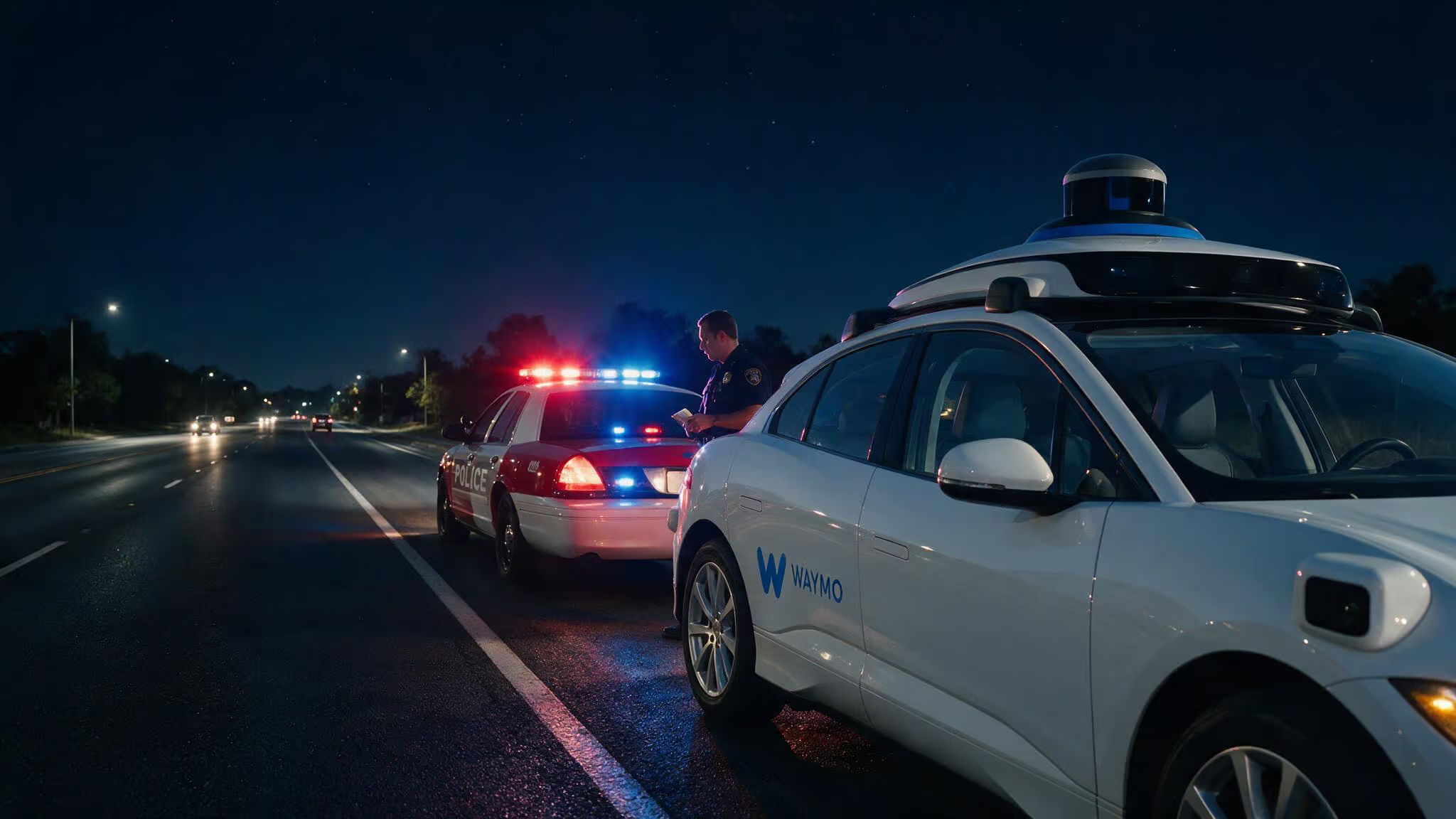
It’s a Friday night in San Bruno, California. Cops are running a DUI crackdown. A Waymo makes an illegal U-turn right in front of a patrol car. An officer walks up, ready to write a citation.
There’s no one in the driver’s seat. The car is a Waymo, and it’s empty.
The officer stood there for a moment, ticket book in hand, before realizing: as of 2025, California law mandates that a moving violation citation be issued to a human driver. You can’t ticket a ghost.
San Bruno Police Sergeant Scott Smithmatungol put it bluntly: Our citation books don’t have a box for ‘robot.’
That moment in San Bruno — a city of 40,000 residents with just 50 officers — became a viral snapshot of a much bigger problem. The department’s Facebook post about the incident generated more than 500 comments, many from frustrated residents who couldn’t believe the car simply got away with it. And it wasn’t just San Bruno. The same scene has played out in Los Angeles (July 2025), Phoenix (June 2024), San Francisco, and Atlanta (February 2026).
The technology to pull over a driverless car is mature. The legal infrastructure to penalize it? That’s still being built from scratch.
Key Takeaways
When a Waymo detects emergency lights or sirens, it pulls over, rolls down the windows, unlocks the doors, and connects the officer to a remote human operator — a compliance sequence that works every time
As of 2025, California cops cannot issue moving violation tickets to driverless AVs because there’s no human driver to cite; parking tickets (nearly 600 in San Francisco in one year) are still possible because they’re issued to the vehicle itself
A new California law taking effect July 2025 will close the gap by allowing citations to the vehicle’s operator, while 25 states have already introduced 67 AV-related bills, and the Atlanta Police Department created a 6-page standard operating procedure specifically for Waymo interactions
Table of Contents
When a robotaxi makes an illegal left turn in front of cops
Let’s start with the most straightforward case. In July 2025, a Waymo in Los Angeles made an illegal left turn directly in front of police officers. The car was pulled over. No ticket was issued. No driver meant no citation.
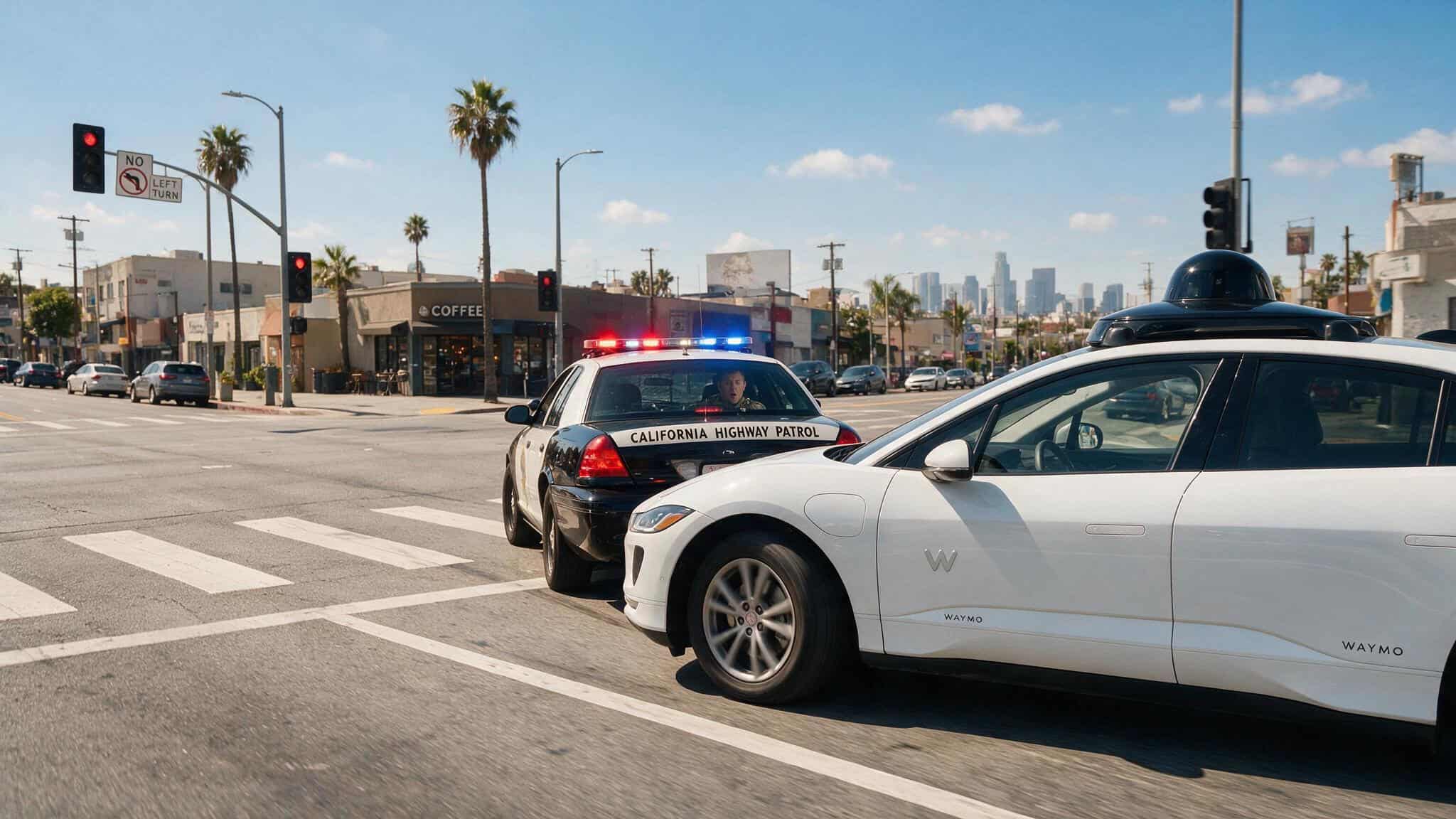
This is a version of the problem: a violation, observed by law enforcement, with zero enforcement outcome. It’s not that the officer chose not to write a ticket — as of 2025, they legally couldn’t. California’s vehicle code, written long before anyone imagined empty cars on public roads, simply doesn’t accommodate a “driver” that’s a software stack running on Alphabet-owned servers.
Phoenix: swerving to avoid construction, pulling over to talk to a remote rep
In June 2024, a Waymo was pulled over by a Phoenix officer after it swerved into oncoming traffic to avoid a construction zone. The car made a decision (don’t hit construction equipment) that happened to violate traffic law.
The car pulled over safely. The officer walked up. Through the in-car communication system, they were connected to a remote Waymo representative. The rep explained the situation. No ticket was issued.
The standard protocol: the car handles the physical stop, then hands off to a human for the conversation. It’s a solution to a problem nobody anticipated.
Field note: The remote-handoff protocol is already standard across Waymo’s fleet — the car manages the pullover, then a human handles the explanation. No officer has to talk to an empty seat.
San Bruno: the illegal U-turn during a DUI crackdown
The San Bruno Waymo wasn’t just making an illegal turn — it did so during an active DUI operation, of all times. The irony of a robot getting pulled over during drunk driving enforcement is notable.
The car’s mapping system failed to account for a temporary one-way street restriction, which is a geofencing issue rather than a policy failure. Officers contacted Waymo to report what they called a “glitch,” hoping the company would reprogram the car to avoid similar violations in the future.
Police officers aren’t treating these as criminal matters. They’re treating them as software bugs. When you can’t write a ticket, the remaining leverage is a polite phone call to the manufacturer.
Cruise in San Francisco: no headlights, hazards on, doors unlocked
It’s not just Waymo. In early 2022, a Cruise autonomous vehicle in San Francisco was flagged for driving without headlights at night. The car pulled over, activated its hazard lights, and unlocked its doors — a slightly different approach to the same problem, but with the same cooperative intent.
Officers were impressed by its cooperation. It pulled over promptly, didn’t argue, and made itself easy to approach. These vehicles are designed to be compliant drivers, and that design philosophy extends to police interactions.
How a Waymo knows you’re getting pulled over
A Waymo doesn’t see a patrol car the way you or I do. Instead, it uses its full sensor suite — cameras, radar, and lidar — to detect the specific patterns of emergency lights and sirens.
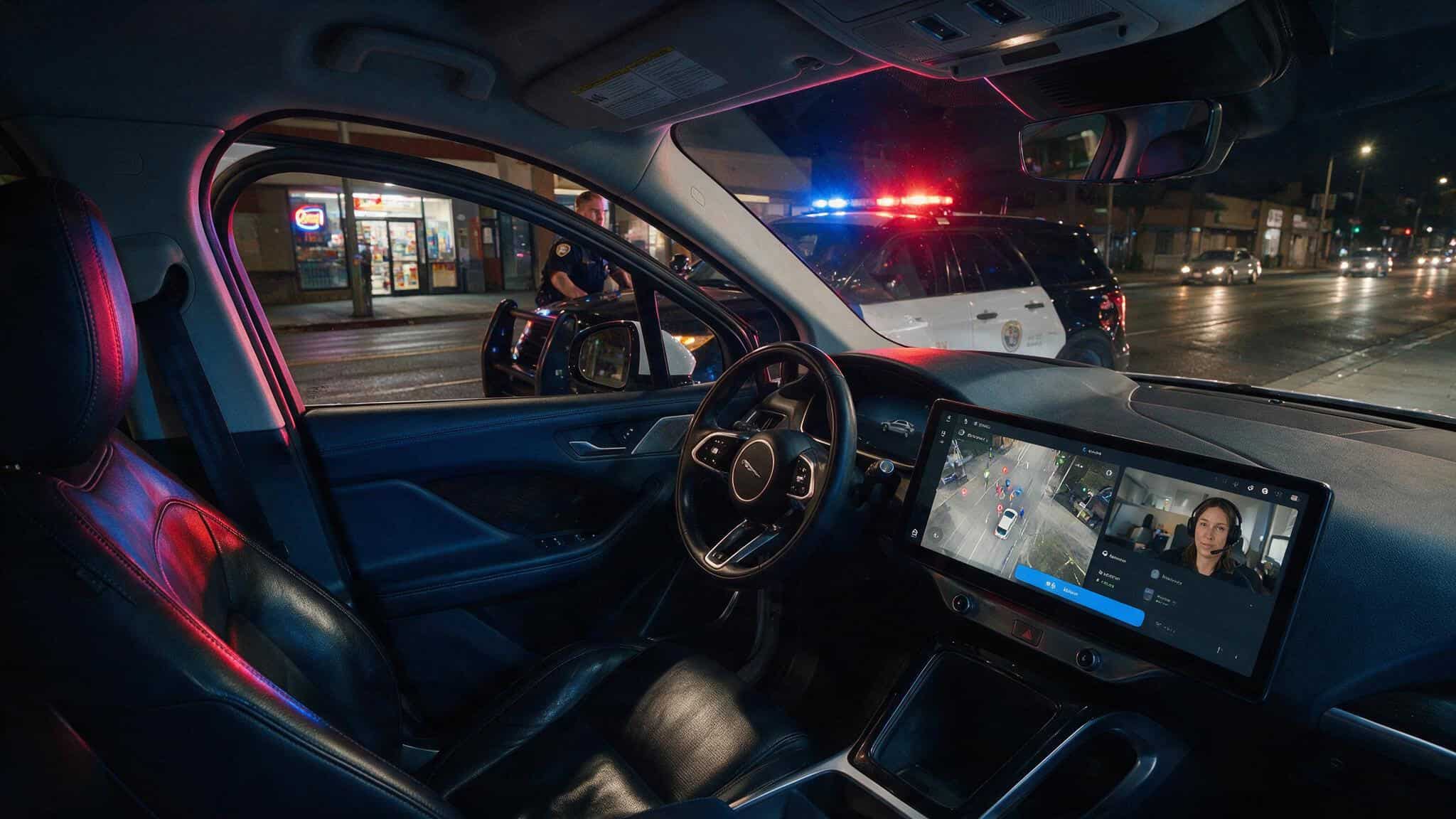
Once the car identifies that it’s being pulled over, it doesn’t just slam on the brakes. It runs a route-planning algorithm to find a safe, legal spot to stop. Early versions of this system sometimes appeared to “flee” briefly as the car hunted for a suitable location, which confused officers expecting an immediate stop. The current protocol is much faster and more predictable.
Then comes the sequence that’s now standard across Waymo’s fleet:
- The car stops in a safe location
- It rolls down the windows
- It unlocks the doors
- It connects the officer to a remote Waymo representative through the in-car communication system
That remote rep can explain what the car was doing, provide information about the trip, and — if needed, dispatch someone to physically retrieve the vehicle. It’s a full support chain, executed without anyone in the driver’s seat.
Cruise takes a slightly different approach — hazards on, doors unlocked, while Tesla‘s robotaxis (still mostly in demo phase) have been shown yielding to emergency vehicles. The destination is the same: these cars are designed to cooperate, not resist.
Why can’t a cop ticket a driverless car?
Here’s the core of the problem.
The legal impossibility
As of 2025, California law requires a human driver to be issued a moving violation citation. No driver means no ticket. This isn’t an officer choosing not to enforce the law — it’s a legal impossibility. The citation form itself doesn’t have a field for “Waymo LLC” or “software version 6.4.”
Parking tickets are different. Those are issued to the vehicle itself, and Waymo has racked up nearly 600 of them in San Francisco in a single year. The cars are apparently not great at parallel parking.
The court system bottleneck
Even if an officer somehow wrote a citation, the court system can’t process it. The Atlanta Police Department’s 6-page SOP explicitly states that the court system currently cannot process traffic citations for autonomous vehicles with no human operator. The “defendant” field requires a human name.
So instead of a ticket, officers write a report. It documents the violation, the law that was broken, and the circumstances — but it goes nowhere. It’s paperwork, not enforcement.
How Texas and Arizona hold companies responsible
Texas and Arizona treat the company as the responsible party. If a Waymo or Cruise vehicle violates traffic law, the operator — meaning the company, gets the fine.
A Waymo running a red light in California gets a report. Same car, same violation in Arizona? The company gets a ticket. The inconsistency is a direct result of writing laws for a technology that didn’t exist when the original vehicle codes were drafted.
The loophole is closing (slowly)
A new California law taking effect in July 2025 will change the game. Starting next year, police can report moving violations to the Department of Motor Vehicles, and citations can be issued to the operator of the driverless vehicle. The DMV is still working out specifics — including potential penalties, but the direction is clear: the “no driver, no ticket” era is ending.
When a Waymo becomes a law enforcement partner
Beyond traffic stops, things get surreal.
The robber who learned that robot cars snitch
In January 2025, a robber in Los Angeles hopped into a Waymo after a store heist. It must have seemed like a getaway — an empty car, no driver to ID, no witness to describe. Until the car detected police sirens, pulled over, and the thief was arrested.
The robot turned itself in. The flip side of the compliance protocol: the same system that lets cops pull over an empty car also means the car won’t participate in a getaway.
The San Mateo teen joy ride
Two 15-year-olds in San Mateo had another idea. They hopped into a Waymo, started drinking, and began shooting Orbeez (those water bead toys) out the windows. Photos showed the teens hanging out of the Waymo’s windows.
Waymo didn’t find this amusing. The company alerted law enforcement and remotely forced the vehicle into a parking lot. Officers communicated with a Waymo representative through the car’s system, and the teens were detained. Notably, they weren’t locked in — they could have left at any point but chose to stay.
The San Mateo Police Department social media post garnered more than 150 comments, with some people raising concerns about the surveillance implications.
Crime scene confusion and the geofence workaround
Waymo may not recognize crime scene tape across a roadway. In February 2026, a Waymo stalled on Atlanta’s Cheshire Bridge Road and slowly rolled toward a closed crime scene. The car couldn’t understand the tape.
The Atlanta PD’s SOP advises officers to request a geofence — a virtual boundary that keeps AVs out, or simply park a patrol vehicle to block the road. If you’re blocking a road for a significant amount of time, the car won’t figure it out on its own.
Red flag: The car can’t interpret crime scene tape. Atlanta PD’s solution is a manual geofence request or a patrol car as a physical barrier — technology that’s sophisticated enough to drive itself still can’t read a basic visual cue.
The surveillance question
Waymo’s camera policy: the company says cameras are used for cleanliness, lost items, and emergency help — not surveillance. No facial recognition is used to identify individuals. Support may review video after an issue is brought to their attention, and in urgent circumstances, they can access live video during a trip.
Waymo can remotely view what’s happening inside its cars and forcibly park them. The company presents this as a safety feature, and the San Mateo incident shows how it can be used. But it’s also a privacy question that hasn’t been resolved. The San Mateo case illustrates the tradeoff: remote video access and forced parking enabled a swift safety intervention, but they also mean a private company can effectively detain individuals and share footage with police — blurring the line between a transportation provider and a law enforcement partner. This raises unresolved questions about how much surveillance is acceptable in the name of safety.
How laws and police procedures are catching up
The gap between technology and regulation is closing.
The legislative wave of 2025
In 2025 alone, 25 states introduced 67 bills related to autonomous vehicles, according to the National Conference of State Legislatures. Some states — California and DC, have already added robotaxi-specific rules. The activity is a signal that the “no ticket” outcome is politically unsustainable.
Companies like Waymo are pushing for federal uniformity. The current state-by-state patchwork creates operational complexity, and a proposed federal bill would mandate that AVs report how often they block emergency vehicles. Companies want to avoid operating in a legal gray area where regulations change at state lines.
The Atlanta PD playbook
The Atlanta Police Department has a 6-page standard operating procedure specifically for Waymo interactions. It covers how to stop, disable, move, or geofence around a driverless car. It includes specific guidance for stalled, damaged, or malfunctioning vehicles.
The SOP advises officers to request a geofence or to park a patrol vehicle to block roads, because the car may not understand crime scene tape. It tells them how to communicate with remote operators. It’s a detailed document for something that didn’t exist five years ago.
The robot loophole is closing
The “no driver, no ticket” outcome isn’t a bug in the system. It’s a legal vacuum created by the gap between what technology can do and what the law was written to handle.
Waymo spokesperson Julia Ilina states that regulators closely monitor the company’s autonomous driving system and that Waymo is committed to improving road safety through ongoing learnings and experience. The technology to cooperate with police is already mature. The legal infrastructure to penalize violations is what’s being built now.
Police will interact with empty cars as a routine part of patrol. AV companies will function as remote operators and, in some cases, de facto law enforcement partners. The surveillance questions will need answers. And the legal patchwork will eventually give way to something more consistent.
The “robot loophole” may have functioned as a pressure mechanism. The impossibility of ticketing driverless cars forced states to legislate. If cops could have written tickets to a human driver, the urgency for new laws would have been lower.
We’re in a transitional moment. The cars work. The cops are ready. The laws are catching up. And in San Bruno, a sergeant is still waiting for a citation book with a box for “robot.”
People Also Ask
What happens if you pull over on Waymo?
If you mean a Waymo being pulled over by police, the car handles the physical stop by finding a safe spot, then hands off to a remote human representative who explains the situation to the officer. If you mean a passenger asking the car to pull over, Waymo’s system can find a safe drop-off location, though it may not always comply with spontaneous requests.
Can a Waymo be used as a getaway car?
Not effectively. In January 2025, a robber in Los Angeles hopped into a Waymo after a store heist, but the car detected police sirens, pulled over, and the thief was arrested. The same compliance protocol that lets cops pull over an empty car means the vehicle won’t participate in a getaway — it essentially turns itself in.
How do police procedures for Waymo stops differ from regular traffic stops?
Police have to adapt because there’s no driver to talk to. The Atlanta Police Department created a 6-page standard operating procedure specifically for Waymo interactions, covering how to stop, disable, move, or geofence around a driverless car. Officers communicate with a remote operator through the car’s in-car system rather than speaking to a person in the driver’s seat.