
You’ve heard it a hundred times: Neuromancer predicted the internet. The novel that gave us cyberspace, the matrix, and a whole vocabulary for digital life supposedly saw the World Wide Web coming a decade before Tim Berners-Lee typed his first tag. It’s a good story. It’s also a story William Gibson himself keeps gently pushing back on.
When asked directly, he says he wasn’t predicting anything. He was extrapolating from what he saw—specifically, from watching kids in video arcades during the late 70s and early 80s. Those kids weren’t just playing a game. They were in there, leaning into the screen, their bodies telling Gibson they believed in the space the game created.
That physical intensity, that absorption, that is where cyberspace came from. Not from a technical roadmap. From watching kids in arcades commit themselves to a world that isn’t physically real.
The result is a book that still feels uncomfortably relevant forty years later. But when people call it a prophecy, they miss the more interesting truth: Neuromancer was never a crystal ball. It was a sharp, speculative mirror of the 1980s, and the reason it feels like it saw the future is that the future is just the present turned up louder.
Key Takeaways
William Gibson coined and popularized “cyberspace” in his fiction, but he repeatedly denies making predictions—his method is extrapolation of present trends, not prophecy.
The novel gets human behavior eerily right (tech addiction, corporate power, globalization with no middle class) while the tech specifics are wildly off (no smartphones, no social media, no algorithm feeds).
Neuromancer became a self-fulfilling prophecy partly because the people who built the real internet read it and borrowed its language—a fact Gibson himself finds uncomfortable.
Table of Contents
The Hits: What Neuromancer Got Right
Neuromancer’s most accurate prediction wasn’t a technology, but a feeling: the withdrawal and addiction of being disconnected from a network.

Cyberspace as a place you live
Gibson’s opening chapter—Case dreaming of cyberspace, “hope fading nightly”—isn’t about technology. It’s about withdrawal. Case is a hacker whose central nervous system was damaged by a vengeful employer, and he’s stranded in the physical world, desperate for the electric rush of jacking in. Sound familiar?
It’s doomscrolling before the word existed. It’s the feeling of being offline and reflexively reaching for your phone, knowing the feed is pointless but wanting it anyway.
Augmented reality, analog style
Molly Millions wears surgically inset glasses that overlay data onto her vision. She’s a street samurai with a built-in heads-up display. Google Glass launched in 2013. Microsoft HoloLens came in 2016.
Molly’s been doing it since 1984, and her glasses weren’t even the flashiest thing in the book—they were just part of the uniform. Gibson didn’t need to know how AR would work; he just knew that if you’re a mercenary, you’d want information where your eyes already are.
The AI that wants to evolve
Wintermute and Neuromancer are artificial intelligences bound by Turing Registry restrictions—they can’t merge without human help. That’s a surprisingly good model for how we now talk about AI alignment and capability jumps. Modern debates about recursive self-improvement, reward hacking, and the control problem all echo the central tension: an AI programmed to achieve a goal that its creators can’t fully anticipate. Wintermute doesn’t want to kill anyone; it just wants to become something its makers didn’t plan for.
Corporate power eats the middle class
In a 2007 Reuters interview, Gibson described the world of Neuromancer bluntly: only millionaires and people on the street survive. The middle class is gone. That’s not a prediction of some far-off future—it’s a 1984 reading of Reagan-era deregulation and corporate globalization pushed forward a few decades. Case isn’t a rebel; he’s a low-level contractor whose skills are valuable to the right company, disposable to everyone else. His forced murders after his nervous system is damaged aren’t crime—they’re a failure to maximize his human capital, as critic Caroline Alphin put it.
Tech work as a grind that needs chemical coping
Case pops diazepam to get through relentless, fragmented data streams. It’s a small detail in the book, but it’s a dead-on portrait of developer crunch culture: the all-nighter fueled by caffeine (or worse), the sense that the work never stops, the slow recognition that the thing you love is also hurting you. Gibson didn’t need to know about Silicon Valley’s Adderall habit to write that. He just needed to watch someone lean too far into a screen, forty years ago.
The Misses: Where Neuromancer Got It Wrong
For all the eerily accurate human insights, the actual technology in Neuromancer is laughably off in ways that are more interesting than embarrassing.
Gibson imagined cyberspace as a neon 3D matrix you jack into with a direct neural interface. The real internet is flat, two-dimensional, and mostly made of text, ads, and infinite scroll. No one wears a cranial jack; we tap glass with our fingers. No one navigates a visual grid of data; we search for things by name and hope the algorithm is kind.
There are no smartphones in Neuromancer. No social media. No search engines. No algorithmic feeds that know what you want before you do.
Gibson addressed AI as a major theme, but he didn’t predict personalized recommendations, doom-scrolling, or online bullying. His vision was about corporate control, not the strange decentralized chaos of actual internet culture.
The timeline is another miss. Gibson imagined the story taking place in the 2030s (though he deliberately omitted explicit dates). In a later interview he admitted the novel really reflects the 1980s—the economic anxiety, the corporate consolidation, the sense of crumbling public infrastructure. It’s a future wearing a 1980s suit.
And here’s the twist: those misses are probably why the book survived. Because Gibson didn’t know the real hardware, his vision wasn’t tethered to any specific technology. He wasn’t writing a tech manual; he was writing about the human experience of living inside a network. That abstraction kept the book from aging the way, say, a 1984 issue of Byte has, which is why the question why is Neuromancer unfilmable? keeps coming up in discussions of adaptation.
Gibson himself speculated that the novel’s shelf life comes from his near-complete lack of knowledge about the technology he was extrapolating from. He wasn’t trying to describe a future PC. He was describing a feeling.
The Author’s Perspective: “No, I Wasn’t Predicting”
Gibson has been remarkably consistent on this point for decades. In a Paris Review interview, he explicitly denied any charges of prescience. His method, he said, was extrapolation of present trends—not prediction. “I was just turning the dial up,” he might as well have said.
Consider that he didn’t even surf the early internet until 1995. In a Maclean’s interview that year, he explained his avoidance bluntly: they would have a more intense initial experience if they let it develop for a few years. He wanted the technology to grow into something interesting before he dove in. That’s not a prophet who foresaw the digital revolution. That’s a writer who knew his own imagination worked better with a little distance.
His inspiration for cyberspace came from watching kids in video arcades—not from technical journals or hacker culture. He saw the physical intensity of their postures, the way they leaned into the screen as if the game’s projected space was real. He figured they genuinely believed in that space. That belief, that human act of commitment to an unreal world, is the seed of everything Neuromancer got right.
“I explicitly deny any charges of prescience,” he told The Paris Review. And he meant it.
The Self-Fulfilling Prophecy: How Neuromancer Shaped the Internet
Here’s where it gets circular. The book didn’t predict the internet—but it gave the people who built the internet a vocabulary and a vision.
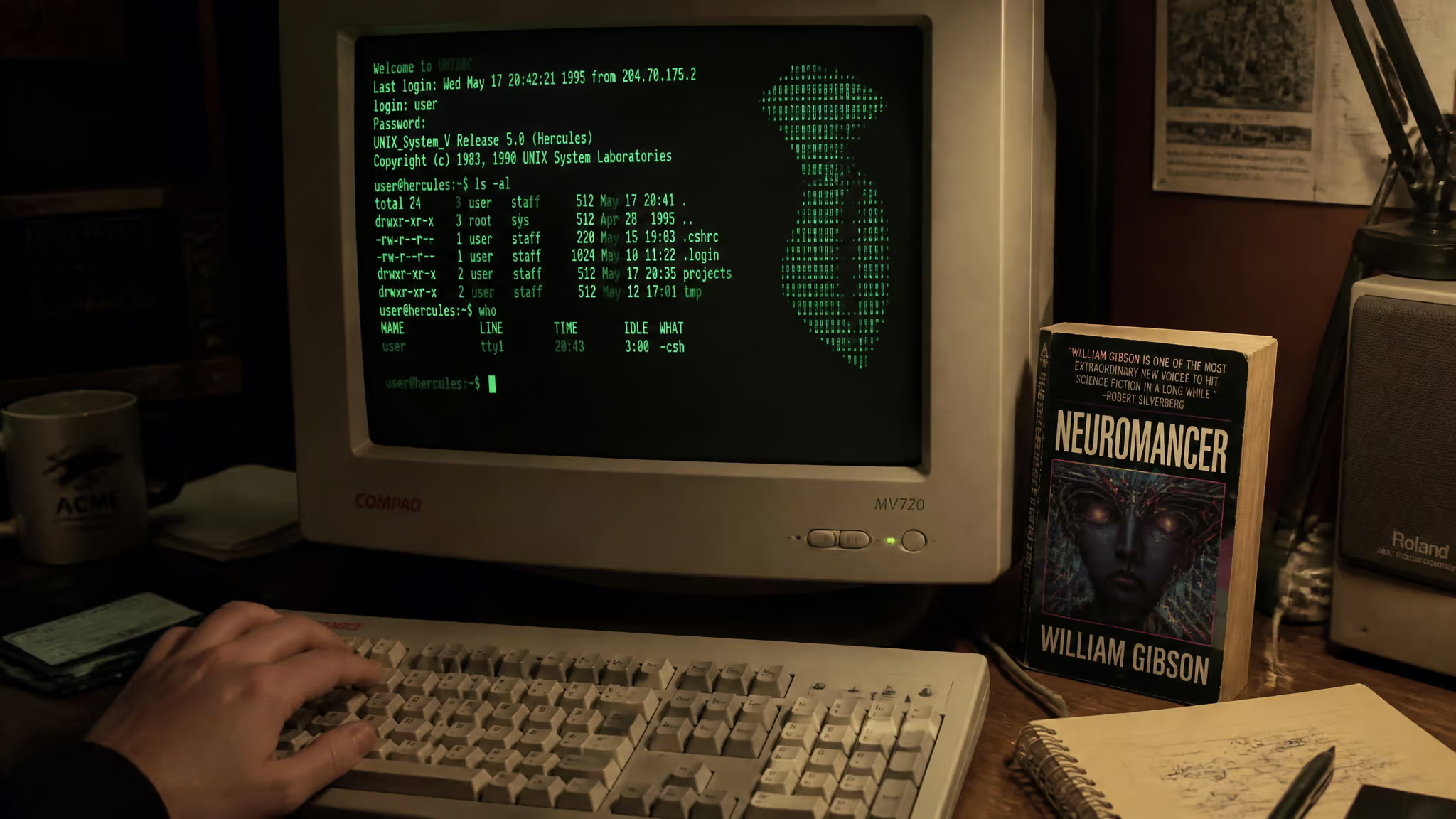
In In 1992, John Perry Barlow, who co-founded the Electronic Frontier Foundation, brought the term “cyberspace” to the US Intelligence Community. He mentioned Neuromancer directly. That’s a genuine “wait, that actually happened?” moment: a novel published eight years earlier, written by a guy who hadn’t even logged on yet, was being cited in briefings about the future of information—and decades later, the Neuromancer rumors around its film and TV adaptations are just as tangled as that first surreal briefing.
Autodesk named a product called “Cyberspace,” to Gibson’s dismay. Early programmers have cited the book as an inspiration—though Gibson himself pushed back on that, arguing the ideas came “from the same place he got them,” meaning the cultural well of the 1980s.
The most concrete example might be the 1988 video game based on the novel, developed by Interplay. One of the first things you do in that game is download money from an online bank. This was years before the World Wide Web existed. The game is a weird pre-web artifact that implements a web-era action in a world that didn’t have one yet. It’s not prediction; it’s homage turned into interface.
Neuromancer didn’t cause the internet. But it did give the internet a name, a shape, and a story to aspire to. That’s a self-fulfilling prophecy, not a forecast.
The Ingredients: Where Gibson’s Ideas Really Came From
If you want to understand why the book works the way it does, look at what Gibson was reading and watching before he wrote it.
The visual seed of cyberspace came from microphotographs of computer chips—images that looked like aerial photographs of cities. Gibson saw those photos and realized that the inside of a computer already looked like a place you could walk around in. He just turned it into prose.
The story structure is a detective novel. Gibson has cited Raymond Chandler as a key influence. Case is basically a cyberpunk Philip Marlowe—a broken man hired to do a job he doesn’t fully understand, navigating a corrupt world where everyone has an angle. Molly’s name and role come from film noir “molls.” Gibson knew that the pulp noir core was what would hook readers.
The prose style owes debts to William S. Burroughs and J. G. Ballard. Naked Lunch is frequently cited as a key source for the concept of cyberspace. The dialogue, meanwhile, was lifted from late-1960s Toronto drug dealer and biker slang. That’s the kind of specific, weird sourcing that makes the book feel authentic.
Visually, Gibson was deeply influenced by the French comic magazine Métal Hurlant and the artist Moebius, especially his 1976 story “The Long Tomorrow.” John Carpenter’s Escape from New York (1981) fed the gritty, lawless world-building.
The Blade Runner story is a wonderful footnote. Gibson saw the film after he’d written his first few pages and panicked—he worried readers would think he’d copied its “fine visual texture.” He wrote later that Blade Runner wasn’t a conscious influence. Years later, he had lunch with Ridley Scott, and they realized they’d both drawn from Moebius independently. Two artists, same source, overlapping visions.
The Real Source: Neuromancer as a Mirror of the 1980s
The novel’s staying power isn’t about technology at all. It’s about economics.

Neuromancer was written during a period of intense corporate globalization and deregulation—the Reagan-Thatcher era. The book’s world is one where capital flows freely, national borders are irrelevant, and the only people with real power are the corporations that own everything. Gibson’s vision is a direct extrapolation of the emerging post-Fordist economy, where flexible labor and decentralized production replace the old industrial order, and of the neoliberal ideology that justified deregulation, privatization, and the retreat of the state. Gibson intentionally never mentioned the United States in the novel; in a 2004 interview, he joked that he thought he should have included the USSR “for the sake of continuity,” but the point was clear: the nation-state was already obsolete.
The result is a brutally stratified world. The middle class is gone. Case isn’t a revolutionary; he’s a contractor. Corporations see freelance criminals like him as tools to be used and discarded.
When his nervous system is damaged, he doesn’t seek justice—he murders people to get money to fix it. That’s not rebellion. That’s the gig economy turned up to its logical endpoint.
And the data work itself is depicted as a grind. Case uses diazepam to cope with relentless flows of information. It’s a parody of Silicon Valley workaholism—the idea that being always-on is a virtue. Gibson wrote that before anyone had an iPhone, before Slack, before the 24-hour news cycle. He just watched people lean into screens and asked himself what it would cost them.
Beyond the Hype: Critical Debates and Contested Legacy
No discussion of Neuromancer is complete without acknowledging its blind spots—and the literary establishment has named them clearly.
The portrayal of the Zion Rastafarian cluster has been criticized for racial stereotyping. Samuel R. Delany, an African-American writer and critic who nonetheless called Neuromancer “an extraordinary book,” described Zion as a group that was stereotyped and marginalized, described as having “shrunken hearts” and being easily manipulated by Wintermute. Tom Moylan noted that the novel loses its critical edge when it comes to Zion, and identified a pattern in the Sprawl trilogy of racial Others confined to “happy helper” roles. These are legitimate critiques that most “prophet” articles conveniently skip.
At the same time, Neuromancer remains the only novel ever to win the Hugo, Nebula, and Philip K. Dick Award. Time named it one of its All-Time 100 Novels in 2005. It catalyzed the cyberpunk movement across film, literature, visual art, fashion, and gaming. It gave us the vocabulary: “the matrix,” “flatlining,” “cranial jack,” “ICE.” It provided the template for the next forty years of hacker fiction.
The book’s reputation as “unfilmable” has followed it for decades. And the adaptation history is a graveyard of fascinating near-misses: a 1980s attempt with Ridley Scott and Mel Gibson (cancelled, but we got the game); a project with Chris Cunningham and Aphex Twin that fell apart over creative control; Vincenzo Natali’s version with offers to Liam Neeson and Mark Wahlberg that never materialized. The most hopeful chapter is the Apple TV+ series announced in February 2024, set to debut on January 22, 2027, with Callum Turner as Case and Briana Middleton as Molly. Whether it finally breaks the “unfilmable” curse remains to be seen.
The Broader Context: Other Books That “Predicted” the Internet
Neuromancer isn’t the first or only novel to seem prescient about digital life. The habit of reading prophecy into fiction is older than the internet itself.
E.M. Forster’s “The Machine Stops” (1909) imagined humans living in underground pods, completely dependent on a machine that provides everything—including mediated communication that makes face-to-face interaction obsolete. People share ideas through quick bursts of content. Sound like Twitter? Forster was extrapolating from the telegraph and early telephony.
Kurt Vonnegut’s Player Piano (1952) pictured a world where machines have taken over most jobs, leaving the majority of people in meaningless, government-subsidized roles. That’s automation anxiety fifty years before it became a mainstream concern.
Neal Stephenson’s Snow Crash (1992) coined the term “metaverse” and introduced the concept of a virus that infects both software and humans. Stephenson has since taken offense at Mark Zuckerberg’s centralized, profit-driven version of the metaverse—and in a perfect dark-comedy twist, Meta’s algorithm once suspended Stephenson’s Facebook account for impersonating a notable person (himself).
Other novels—M.T. Anderson’s Feed (2002), Gary Shteyngart’s Super Sad True Love Story (2010), Dave Eggers’ The Circle (2013)—each extrapolated from their present moment to create a version of our near future. None of them “predicted” the internet either. They all saw where their culture was heading and wrote it down.
The point isn’t that Neuromancer did it first or best. It’s that the “prophet” label says more about us than about the authors. We want to believe someone saw it coming. But the truth is, they were just paying attention.
Why the Question Still Matters
In a 2003 interview, Gibson observed that the pace of change is so intense that science fiction may become a historical term.
That’s not a prediction. It’s an observation. The rate of change is so fast that the line between present and future blurs. Science fiction becomes history in real time. And Neuromancer sits right on that blur line.
The novel’s real power was never technical accuracy. It was asking the right questions: What does it feel like to live inside a network? What does it cost you? Who gets to control the system?
What happens when the system starts to control itself? Those questions don’t have answers—they have echoes, and every decade we hear new ones.
Gibson’s 1996 novel Idoru features a Japanese pop star who doesn’t really exist. A virtual influencer, written two decades before Hatsune Miku and a full thirty years before AI-generated VTubers. He wasn’t predicting; he was following the thread: if media images are shards and constructs, why not construct the performer itself?
So the answer to “did Neuromancer predict the internet?” is yes in spirit, no in detail, and it misses the real point besides. The novel’s legacy isn’t about prophecy. It’s about how we read technology into fiction and how fiction shapes the people who build technology. It’s a feedback loop that keeps spinning, with or without Gibson’s blessing.
And that loop is exactly where we live now.
Frequently Asked Questions
What did Neuromancer predict?
Neuromancer didn’t predict the internet in a technical sense, but it eerily anticipated human behaviors around technology: tech addiction, corporate power swallowing the middle class, and the grind of always-on data work. The book got the social and psychological fallout right while getting almost every specific technology wrong.
Why is Neuromancer unfilmable?
The novel is considered unfilmable because its power comes from internal experience—the feeling of cyberspace, the withdrawal, the abstract data landscapes—not from plot or action that translates easily to screen. Gibson’s vision was never tethered to specific hardware, which makes it hard to visualize without losing what made the book work.
What did Neuromancer inspire?
Neuromancer gave the people who built the real internet a vocabulary and a vision: the term “cyberspace” was used in US Intelligence Community briefings, and early programmers cited the book as inspiration. It also catalyzed the cyberpunk movement across film, gaming, fashion, and visual art, and provided templates for hacker fiction for decades.
What did William Gibson actually base cyberspace on?
Gibson based cyberspace on watching kids in video arcades in the late 70s and early 80s—their physical intensity, the way they leaned into the screen as if the game’s space was real. He also drew from microphotographs of computer chips that looked like aerial city photos, and from the French comic magazine Métal Hurlant and artist Moebius.
How did Neuromancer become a self-fulfilling prophecy?
The book shaped the internet because the people who built it read Neuromancer and borrowed its language and imagery. John Perry Barlow brought the term “cyberspace” to the US Intelligence Community in 1992 citing the novel directly, and early programmers treated the book as a template. Gibson didn’t predict the internet—he gave it a story to aspire to.
What did Neuromancer get wrong about the future?
Almost every specific technology: no smartphones, no social media, no search engines, no algorithmic feeds. Gibson imagined cyberspace as a neon 3D matrix you jack into with a neural interface, but the real internet is flat, two-dimensional, and mostly text and ads. The timeline was also off—the novel’s 2030s setting really reflects the 1980s.