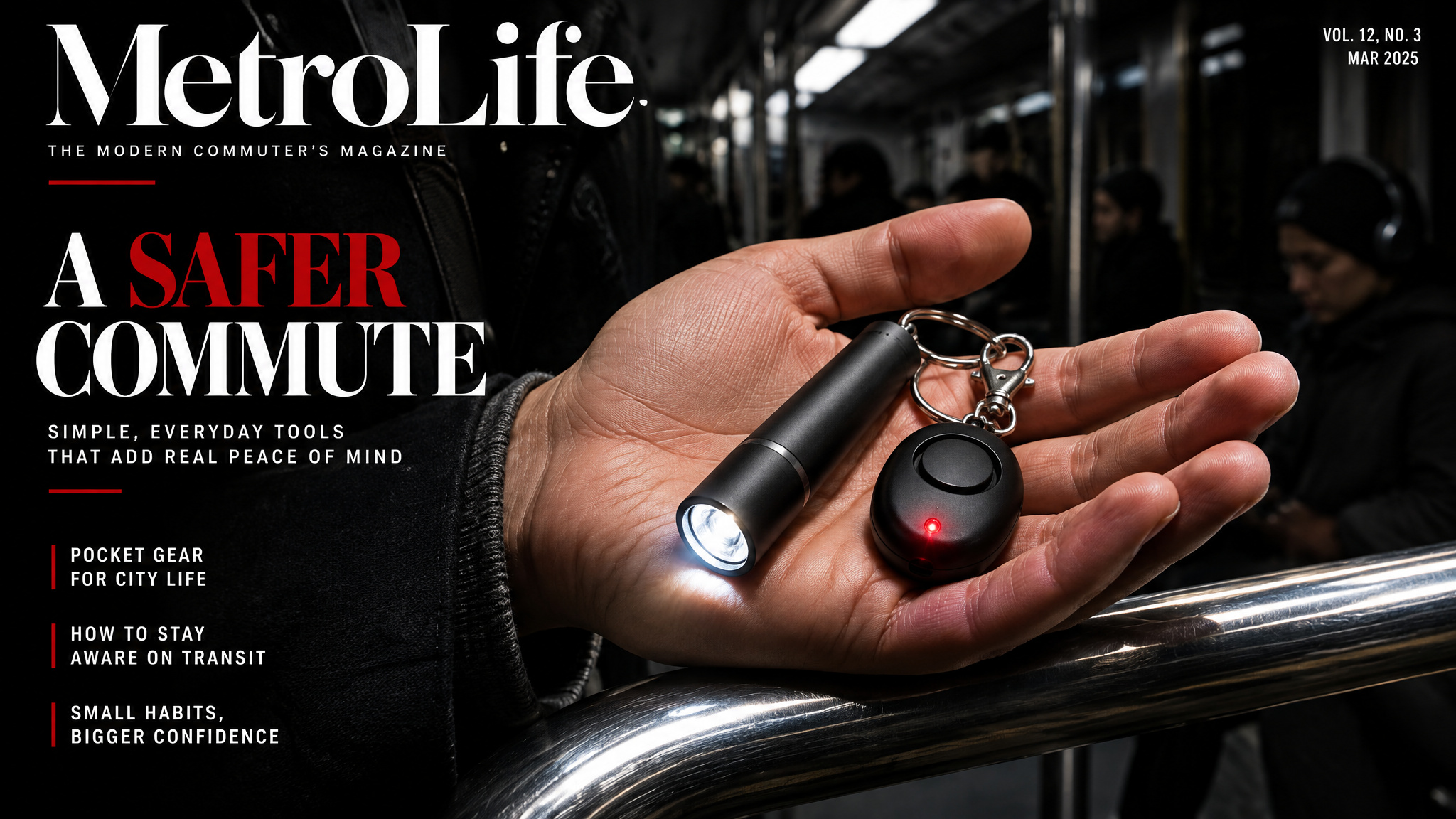
I stopped listening to music on the subway and bus after seeing too many reports of riders assaulted or killed on public transit. Cutting out headphones changed how I ride: instead of tuning out the car, I keep my eyes up and my hands free. That shift also forced a harder look at self defense equipment for commuters, because most “best gear” roundups assume you’re walking across an empty parking lot rather than squeezing through turnstiles, holding a rail with one hand, and passing through metal detectors at work.
Key Takeaways
A plain-bezel pocket flashlight putting out several hundred lumens ranks as the anchor commuter carry, paired with a 120-130 dB personal alarm clipped where one finger can pull the pin.
Plain metal twist pens pass airport and courthouse screening where $30-$100+ tactical pens get confiscated, and keys belong on a 6-8 inch lanyard rather than laced between your fingers.
Budget multi-mode gadgets tend to break at the switch or hinge under stress, while unmodified everyday items like a solid-shaft stick umbrella ($20-$40) or a hardwood cane outrank them.
Table of contents
Table of Contents
What makes self defense equipment work for commuters
Commuting changes what you need from a tool. Stopping power matters less than three things: it has to fit in a pocket, stay legal across every transit jurisdiction on your route, and come out one-handed while your other hand is on a rail or a bag. Staying aware without headphones is the first layer of that system, because no tool helps if you don’t see trouble coming.
Less-lethal tools are often more practical than firearms or knives when your goal is stopping an attacker rather than maiming them. Guns, knives, and sprays carry heavy legal risk, which is why Amazon’s self-defense category excludes firearms entirely. Pressure-point targeting lets a smaller person deter a much larger attacker long enough to break contact, and martial arts training acts as a force multiplier alongside any gear you carry. Every item in your pocket is an escape-enabler rather than a fight-winner; even among concealed carriers, some people draw a firearm in moments where de-escalation was the right call.
Tactical flashlight: the anchor carry for commuters
Flashlights rank as the number one self-defense tool for commuters because you can carry one anywhere and it reads as completely harmless. Shining a bright beam into dark-adjusted eyes triggers an immediate flinch and forces an attacker to shield his face, taking one hand out of the fight.
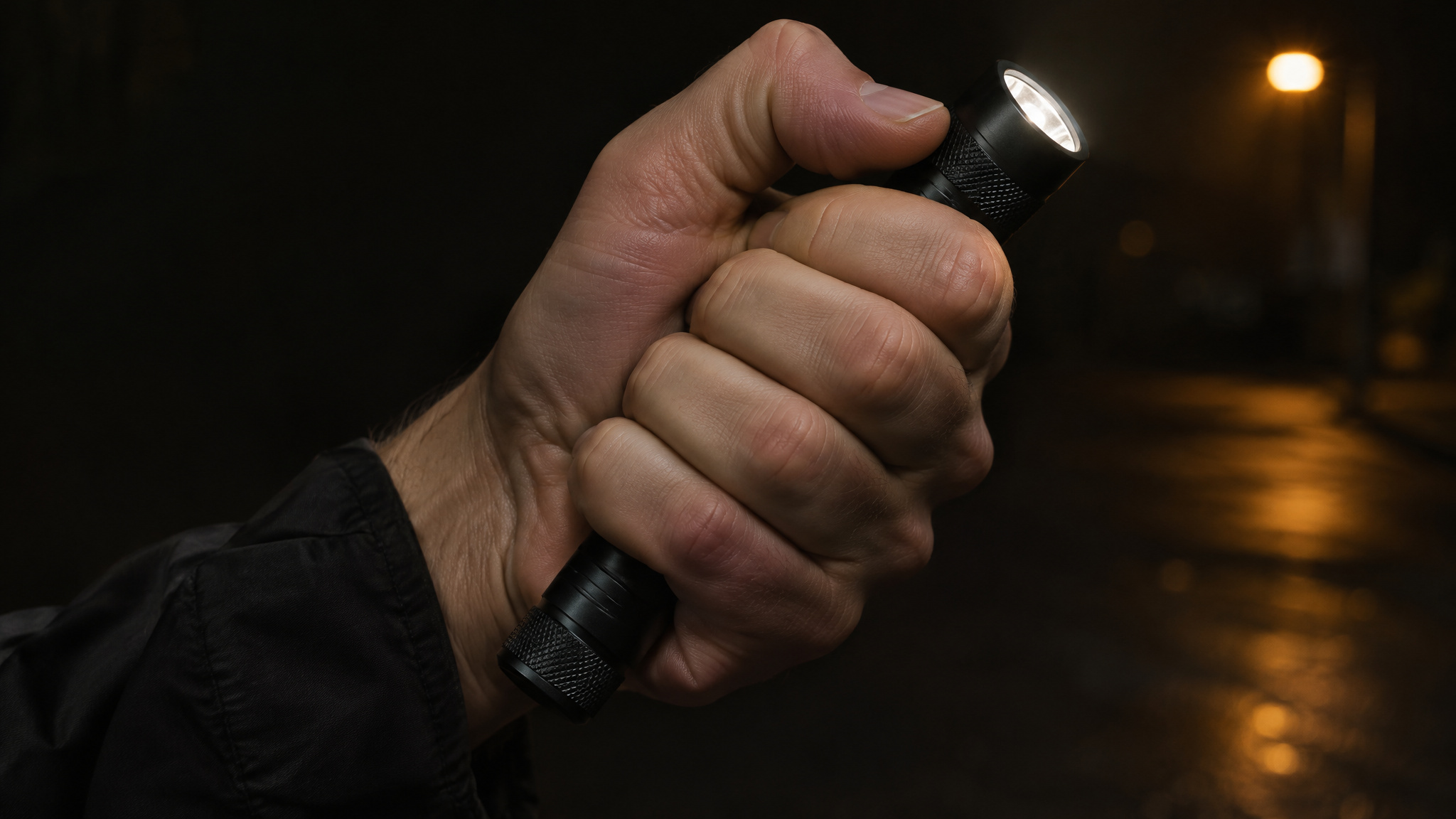
Plain bezel vs. spiked bezel
Skip flashlights with crenulated or spiked bezels. A plain bezel keeps the light innocuous in your pocket or hand, whereas aggressive teeth around the lens draw unwanted attention and read as an intentional weapon to police or a jury.
Night-commuting carry and the Wuben pick
For riding or walking at night, I carry a tactical flashlight everywhere and recommend Wuben brand flashlights. Aiming at an attacker’s shirt pocket only reveals your position, so the beam needs to go straight into the eyes, keeping in mind that bright daylight is the flashlight’s weakest condition. Look for a pocket light putting out several hundred lumens with a tail button rather than a twist head, check the batteries monthly, and carry a spare.
Hammer-fist grip and the Olight i5T option
When you need physical distance, hold the light in a closed fist with the tail cap sticking out past your pinky and strike tail-first onto the collarbone, a grabbing hand, or the face. Even an AA-powered pen light like the Olight i5T, though never designed as a defensive weapon, can serve as a makeshift striking tool if you grip it ice-pick style with your thumb braced for leverage. Any impact tool should protrude beyond your fist and target the throat, face, hands, or pressure points, so handle different flashlights in person before buying to check the fit.
Personal alarm: buying attention for a dollar
A personal alarm works well for commuters because a robber wants quiet. Blasting 120-130 decibels kills that quiet and takes away most of his plan. Standard keychain alarms typically run $10-$25 (retail prices vary) and hit roughly the volume of a chainsaw up close.
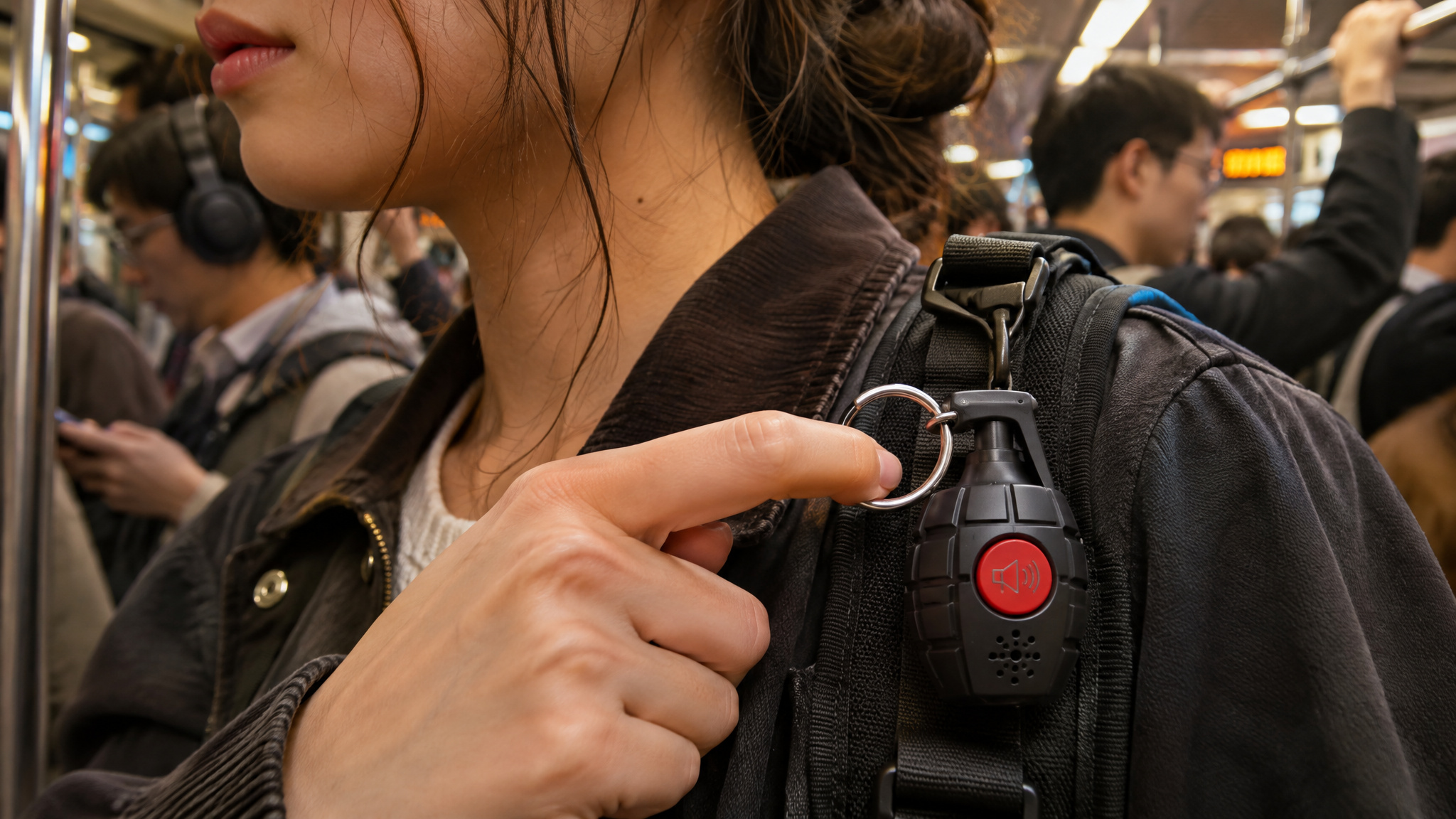
In a hands-on test of affordable Amazon self-defense gear, a YouTube reviewer tested a ~$1 grenade-style pull-pin alarm with a built-in flashlight in a role-played robbery. It deterred the mock attacker and scored 10/10 for ease of use and 10/10 for robbery avoidance. The catch is mechanical: that ~$1 alarm’s pull pin requires very little force and could easily yank out accidentally when you get jostled on a crowded train.
Carry position also decides whether an alarm works at all. As June Marsh’s church-lot story showed, an alarm zipped inside a purse is useless; clip it where one finger hook pulls the pin, then toss it and break contact, and test the button batteries monthly so it doesn’t become dead key-ring weight.
Pepper spray: range with a plan to run
Pepper spray is the only tool here that works at long distance, even when an attacker already has hands on you. Just verify state laws and local transit-agency rules for every city and line on your route before clipping it to a bag.
Sweep the spray in a circle across the face for maximum coverage, then immediately run, getting away is the whole point, not winning a brawl. Two real-world caveats apply before you press the nozzle. In tight quarters, cross-contamination can hit both of you, and some people barely react to pepper spray. Pick your escape route before you ever spray.
Why a plain pen beats a tactical pen on a commute
Airport screeners list dedicated tactical pens, which run $30-$100+ with 5-6 inch solid metal barrels, as banned from carry-on bags while plain metal-barrel pens pass right through. Commuters who spend extra on aggressive pens regularly lose them at checkpoints.
Plain metal pen and checkpoint access
Churches, courthouses, hospitals, and airplanes all block sprays and blades, yet a plain metal pen walks straight through screening alongside car fob panic buttons and personal alarms. Mechanically, twist pens beat clickers because cheap clicker springs fail under load; even a standard plastic Uni-ball Onyx works as an improvised pressure-point tool in a pinch, though with less stiffness than metal. Grip the barrel in a fist with about an inch of tip showing and your thumb flat on top, striking short and downward.
Tactical pen variants
If you aren’t crossing metal detectors, tactical pens rank third on an everyday-carry countdown and come in several distinct builds. The Boker SID caliber 45 bolt-action pen skips an aggressive self-defense tip in favor of a flat thumb rest for pressing into pressure points, while other models add carbide window-breaker tips for escaping a trapped vehicle. Heavy brass pens can be curled in the palm like improvised brass knuckles, and a sparkly grenade-shaped pen is even pitched as a way to dazzle an attacker or make negotiation counterparties more reasonable.
Mingo Sharpie tool
For commuters who want non-metallic durability without the tactical look, Mingo, an AR-15 magazine maker, sells a discreet tool disguised as a black Sharpie with a strong carbon-fiber tip. It carries in a pocket or bag without drawing a second glance.
Kubotan: the keychain rod police adopted
A kubotan is a grooved, keychain-mountable rod made of hollow plastic, resin, or metal that works as a close-range pressure-point tool. First developed in the 1960s and adopted by police agencies, it offers a compact, hard-hitting anchor on a key ring. It’s effective when held slightly past the hand to target pressure points and faces few US legal restrictions, though some limits may exist in Europe, whereas a substitute dowel rod may break under stress.
Origin and legality
Because of its simple geometry and law-enforcement history, the kubotan faces few legal restrictions in the United States, though some limits may exist in Europe. Always check local rules before clipping one to your commuter keys.
Pressure-point mechanics and the training tool
In use, hold the rod slightly past your fist and press it into an attacker’s ear to trigger instinctive pain compliance and force a hand to release. If someone grabs you, counter with a strike to the groin or reverse the swing toward the attacker’s face; in an emergency, a wooden dowel rod works as a stand-in, though it risks snapping under stress. An oversized Delrin kubotan-style training tool ordered from eBay works effectively in practice, even if its bulk makes it impractical for daily pocket carry.
Spiked tools: where keychain carry turns lethal
Once a keychain tool trades blunt pressure for a sharp point, you cross out of pain-compliance territory into lethal, legally risky carry. Four reviewed examples show where that line sits.
Railroad spike tool
A spike tool purchased at Blade Show in Atlanta pairs a finger hole with a sharp edge and is reportedly forged from a repurposed railroad spike. That shape turns a pocket tool into a dedicated stabbing weapon.
Marlin spike
A pointed marlin spike wrapped in bank line, bought in Atlanta from a former US Marine who called it a marine spike, is highly effective at close range. Because it’s lethal, it may also be illegal to carry in public.
Tire-deflation tool
Sold by G&G sales as a tire-deflation device, this item sits in the same high-risk bucket as a last-resort item. It isn’t recommended for routine carry.
Keychain spike 10-packs
Even mass-market self-defense keychain spikes sold in 10-packs cross that same legal boundary. Pointed spikes invite severe scrutiny at checkpoints and in court if you ever have to use them.
Koga and the layered-carry philosophy
The koga is a very hard piece of wood, with one solid-metal gripped version also made, used by police for joint and wrist locks. It strikes just like a tactical pen: brace your thumb on top, strike the face or throat, get to safety, and call 911. Its biggest commuter advantage is how innocuous it looks, letting you walk through rough blocks with it in hand without drawing legal scrutiny.
Former CIA officer Jason Hanson puts that kind of everyday item inside a layered-carry approach: always carry a weapon, a concealed gun where legal, a knife, or a tactical pen. His students have even used tactical pens to break car windows during rescues. His rule for real street fights skips fancy joint locks altogether: end the encounter fast and escape.
Gimmick gear that fails commuters
Cheap purpose-built self-defense gadgets on Amazon routinely underperform because of poor build quality, and in the same YouTube reviewer’s hands-on tests, a roughly $100 item was the only one he would actually trust for defense. Multi-mode gimmicks tend to fail at the switch or hinge long before they run out of theoretical force.
Combination keychain bat, taser, and flashlight
This combo unit was the most expensive tool tested besides a standalone taser, packing a small bat, taser, and flashlight behind a very fiddly three-position switch for off, flashlight, and full tase. Tested on a dummy, the taser subdued the target rather than dropping it dead, and the reviewer warned against tucking the unit down your pants given the live taser electrodes.
Stinger tactical whip
The Stinger pairs a belt clip and a Wiimote-like grip with a braided cable inside a plastic sleeve, topped with a removable rubber tip meant for eye gouging in emergencies or breaking car windows underwater. Self-testing showed that its pain escalates unpredictably compared to the clean, predictable whap of a solid baton.
Weaponized wallet
Designed to fold into a paddle you hand to a robber, with more cash inside supposedly adding impact, this wallet runs straight into Newton’s laws. On impact, it suffers from a bounce-back recoil problem that steals energy from the strike.
Hammock cinch multi-tool
Priced around $30, this cram-everything-in multi-tool squeezes in a knife, saw blade, axe blade, and pliers alongside a nail file, allen wrench, screw tip, and bottle opener. In practice it rated lame, with no real-world situation where it beats proper tools.
Pink bracelet knife
This was the tester’s first outright fail. The blade is tiny and dull, the paracord is untieable, and getting it off your wrist is dangerous.
Collapsible staff
The collapsible staff bent right in the middle of the demonstration despite looking impressive at first glance. It shipped with no instructions, and plenty of videos show users injuring themselves with these staffs.
Across the reviewer’s final pass/fail tally, the Stinger, wallet, alarm, and multi-tool earned passes for deterring a robbery, while the bracelet knife failed completely. The pattern is clear: discounted multi-mode gadgets break down at the mode switch or folding mechanism rather than lacking brute force.
Keys between the fingers: injury risk and the lanyard fix
Lacing keys between your fingers is unsafe because the key head presses directly against the soft sides of your fingers with nothing solid behind it, causing immediate self-injury on impact. Dean Hobbs, a pseudonym for a retired mail carrier, split two knuckles and needed stitches after punching with keys laced between his fingers at a Pueblo, Colorado bus stop; the only blood on the bench was his.
The safe fix puts 8-10 keys, weighing just a few ounces, together with an alarm on a 6-8 inch lanyard. Snapped fast like a wet towel, that bundle creates about 2 seconds of opening to break contact, though you should never add extra weight to the cord because doing so crosses a legal line and turns your keys into a named weapon.
Car fob panic button
A standard car fob panic button ranks fifth on the everyday list because it triggers your car’s horn and lights from 40-50 feet away at zero extra cost. It’s light and short-range, making it a useful parking-lot backup for commuters who drive to a park-and-ride station.
Improvised everyday objects that buy two seconds
Everyday items earn a spot in your commute if they buy 2 seconds to break contact and get away. An 11-item countdown of ordinary objects ranks them from the alarm (11th) and belt (10th) up through coffee (9th), water bottle (8th), coat (7th), rolled magazine (6th), keys or fob (5th), flashlight (4th), pen (3rd), umbrella (2nd), and cane (1st).
Hex nut on paracord
For roughly $5 total at Lowe’s or Home Depot, you can pair a $0.62-$0.80 hex nut with about 3 feet of $2.50 white paracord, chosen over $2.58 orange so it stands out less, with the ends melted by a lighter and no fancy knots. In smash tests it blew through a ~$2 plastic bin in one hit and held up against a $1.98 concrete block, and an instructor claims to have smashed a windshield with one, flying internationally with the nut and cord packed separately and assembled under his shirt only when needed.
Hot cup of coffee
Ranked ninth, a hot coffee works as a one-shot tool before it cools into a warm drink in 10-15 minutes. Thumb the lid off, snap the hot liquid toward the attacker’s face with one brisk flick, and run. Leaving the lid on turns the cup into a soft package that just bounces off. The 1994 New Mexico drive-through coffee lawsuit, involving 180-190 degree F coffee that caused third-degree burns, skin grafts, and 8 hospital days, showed just how hot commute coffee really is.
L water bottle
Ranked eighth, a full 1 L bottle weighs just over 2 lb, more than twice the head of a 16 oz claw hammer. Choose a rigid stainless-steel or heavy-duty plastic bottle with a screw-on lid, and keep it filled to the top. Half-full bottles slosh, thin gas-station bottles fold, and flip-tops pop open. Hold it by the neck and throw short chopping strikes to the grabbing hand, forearm, or collarbone instead of a big overhand swing that ruins your balance.
Heavy coat
Ranked seventh, a heavy coat wraps 2-3 turns from wrist to elbow with the sleeve clamped in your fist to absorb a dog bite. It’s the same trick 1500s Italian fencing books taught with a cloak around the off arm. Propane deliverer Hank Dorsey learned the hard way when he held his coat loose against a shepherd mix and got bitten on the back of the leg; past age 60, a ground fight is the one you lose, so plant one foot well behind you before a dog lands and lean your weight into it.
Tightly rolled magazine
Ranked sixth, a magazine rolled tightly to 9-10 inches gives you a stiff cylinder for a short thrust straight into the breastbone or face.
Leather belt
Ranked tenth, a thick plain leather belt over 3 feet long needs a sturdy brass or steel buckle with a continuous through-pin, since pot-metal buckles shear on the first hard knock. Wrap the tongue twice around your palm, never around your fingers where an attacker grabbing the buckle owns your hand, leave about 1.5 feet hanging, and snap fast like a wet dish towel; it’s slow to deploy, so save it for trouble spotted across a lot.
Stick umbrella: why the solid shaft matters
Folding umbrellas fail under impact because their telescoping shafts collapse, whereas a $20-$40 full-length stick umbrella with a solid wood or steel shaft holds its line and ranks second overall. Retired marine Gil Price, who sharpened mower blades on the side, demonstrated the technique across a counter with a big black stick umbrella: deliver short bayonet-style thrusts about a foot long powered from your legs and hips rather than golf-club swings. Popping the canopy open also throws up a quick visual wall, though the tip can slide off heavy winter coats and you only get one or two solid thrusts.
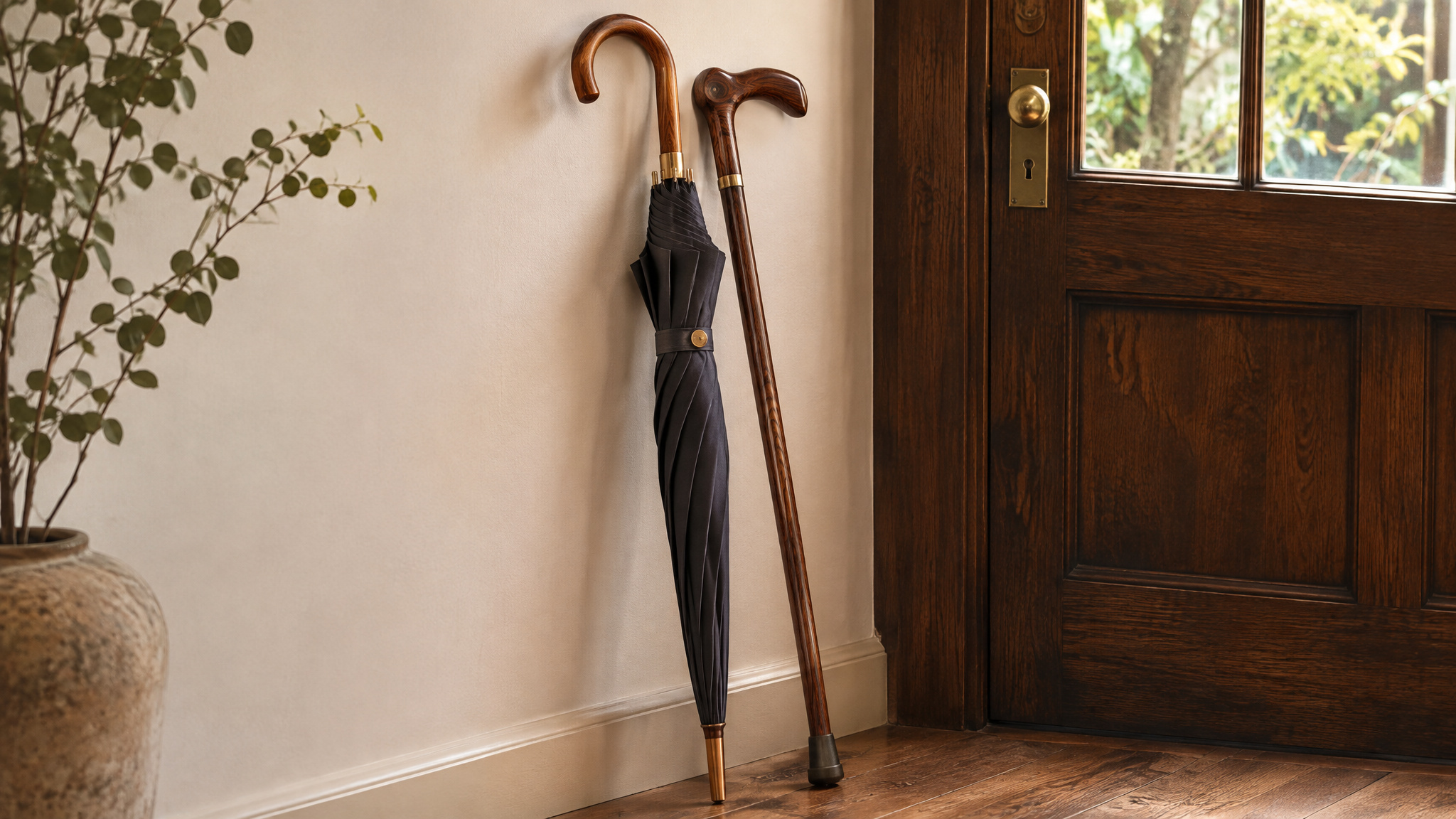
Heavy walking cane: the number one carry
A hickory, oak, or ash walking cane with a rubber foot ranks first because it’s the only impact tool you can carry openly everywhere without question. Skip adjustable aluminum drugstore canes: their push-button pins can snap under heavy load.
Hold the cane with both hands, keeping the tip low and aimed forward, with one a third of the way down the shaft, thrust short into the belly or thigh and return the tip to the ground, shove a grabbed shaft forward to unbalance the attacker, and use the crook to hook a wrist or elbow. Never raise a cane overhead, because lifting it removes your support and exposes your ribs, a lesson learned after a knee replacement when raising an ash cane at a loose heeler nearly put the carrier on the gravel.
Legal to carry versus legal to use
Just because you can legally carry something doesn’t mean you can legally use it, statutes care about your intent and any modifications, not the object sitting in your bag. Courts weigh your force against the threat you faced, so review your state’s self-defense statutes well ahead of an emergency.
Modifying an ordinary object into a weapon immediately ends its ordinary legal status. Spiked flashlight bezels and weighted key cords read as intentional weapons to police or a jury, and a hardware-store hex nut stops being innocent hardware the moment you tie it to paracord. State statutes name specific tools: California statutes explicitly group leaded canes with saps and blackjacks, while California, Oklahoma, and Massachusetts laws all name the slung shot, such as a padlock in a bandana or a steel nut on a rope. Review the specific transit-authority regulations for each city and line you ride alongside state law rather than assuming blanket legality.
Building the commuter loadout
The cleanest way to organize commuter gear is by the job each piece does rather than by product category:
- Flinch: Personal alarm and hot coffee force an attacker to hesitate or shield his eyes.
- Hands-off: Belt, water bottle, rolled magazine, and lanyard keys keep grabbing hands at bay.
- Armor: A wrapped heavy coat takes a dog bite so your arm doesn’t.
- Escape: Flashlight, plain pen, stick umbrella, and hardwood cane clear your path home.
Ordinary-looking tools walk into places a carry gun cannot, such as a post office or federal courthouse. That mirrors Edo-era bakuto gamblers, whose losing hand ya-ku-za gave the yakuza its name, who carried an iron or brass kiseru fighting pipe 1-1.5 feet long openly on their belts past guards because the advantage lived in the grip and the habit rather than the metal. A $10, 5-minute unmodified kit pairs a small steel flashlight like my Wuben daily carry, a plain metal pen, and your keys plus an alarm with a tested pin on one short lanyard, backed up by an ash stick waiting by the back door.
Frequently Asked Questions
What self defense tools can you legally carry on public transit?
Unmodified everyday items like a plain-bezel pocket flashlight, a personal alarm, a plain metal twist pen, a solid-shaft stick umbrella, or a hardwood walking cane are your safest bets because they draw zero attention at checkpoints. Guns, knives, and sprays carry heavy legal risk, and laws vary by state and by the specific transit authority on your route. Just don’t modify ordinary gear—adding weighted cords or spiked bezels turns an innocent object into an intentional weapon in the eyes of police and courts.
Is a personal alarm a good self defense tool for commuting?
Yes, because muggers rely on silence, and blasting 120 to 130 decibels—roughly chainsaw volume up close—shatters their plan and buys you a moment to escape. Skip ultra-cheap ~$1 pull-pin alarms that can pop open accidentally when you get jostled on a crowded train, and stick to reliable $10–$25 keychain models (prices vary). Clip it where a single finger can hook the pin rather than burying it inside a bag, and check the button batteries once a month.
What is the difference between a tactical flashlight and a plain flashlight for self defense?
The main difference comes down to the bezel: a plain bezel looks completely harmless in your hand, while spiked or crenulated teeth scream ‘intentional weapon’ to cops and juries. Both give you the same blinding beam to force an attacker to shield his eyes, and both can deliver a hammer-fist or ice-pick strike to the collarbone, hands, or face as long as the tail cap sticks out past your fist. Even a small AA light like the Olight i5T works as a makeshift impact tool without looking tactical.
What flashlight should I carry for commuting at night?
I carry a Wuben flashlight everywhere on my night commutes and recommend them as a reliable anchor carry. Look for a plain-bezel pocket model putting out several hundred lumens with a tail switch instead of a twist head so you can activate it instantly one-handed. Check the batteries every month, keep a spare handy, and aim straight for the eyes rather than the chest.
Can you bring pepper spray on a bus or train?
That depends entirely on your state laws and the specific transit-authority rules for every bus or rail line you ride, and many secured workplaces, courthouses, and airplanes ban sprays outright. Even when it’s legal, spraying inside a cramped train car or bus risks blowing back into your own face, and some people barely flinch from it. Always map your exit first so you can sweep the nozzle across the attacker’s face and immediately bolt.
Why do tactical pens get confiscated at airport security while regular pens do not?
Airport screeners explicitly list dedicated tactical pens—the $30–$100+ models with 5-to-6-inch solid metal barrels, aggressive strike bezels, or carbide window-breakers—as prohibited in carry-ons. A plain metal twist pen sails straight through airport, courthouse, and hospital security because it looks like ordinary office gear. Twist designs are also tougher than clickers, whose cheap springs buckle when you actually brace a thumb on top to strike.
Is it safe to carry keys between your fingers for self defense?
No—jamming keys between your fingers is a great way to injure yourself, because the key heads mash straight into the soft sides of your fingers on impact. That’s how retired mail carrier Dean Hobbs ended up splitting two knuckles and needing stitches at a Pueblo, Colorado bus stop while his attacker walked away unharmed. Instead, put 8 to 10 keys and an alarm on a 6-to-8-inch lanyard you can snap like a wet towel, and never add extra weight to the cord.