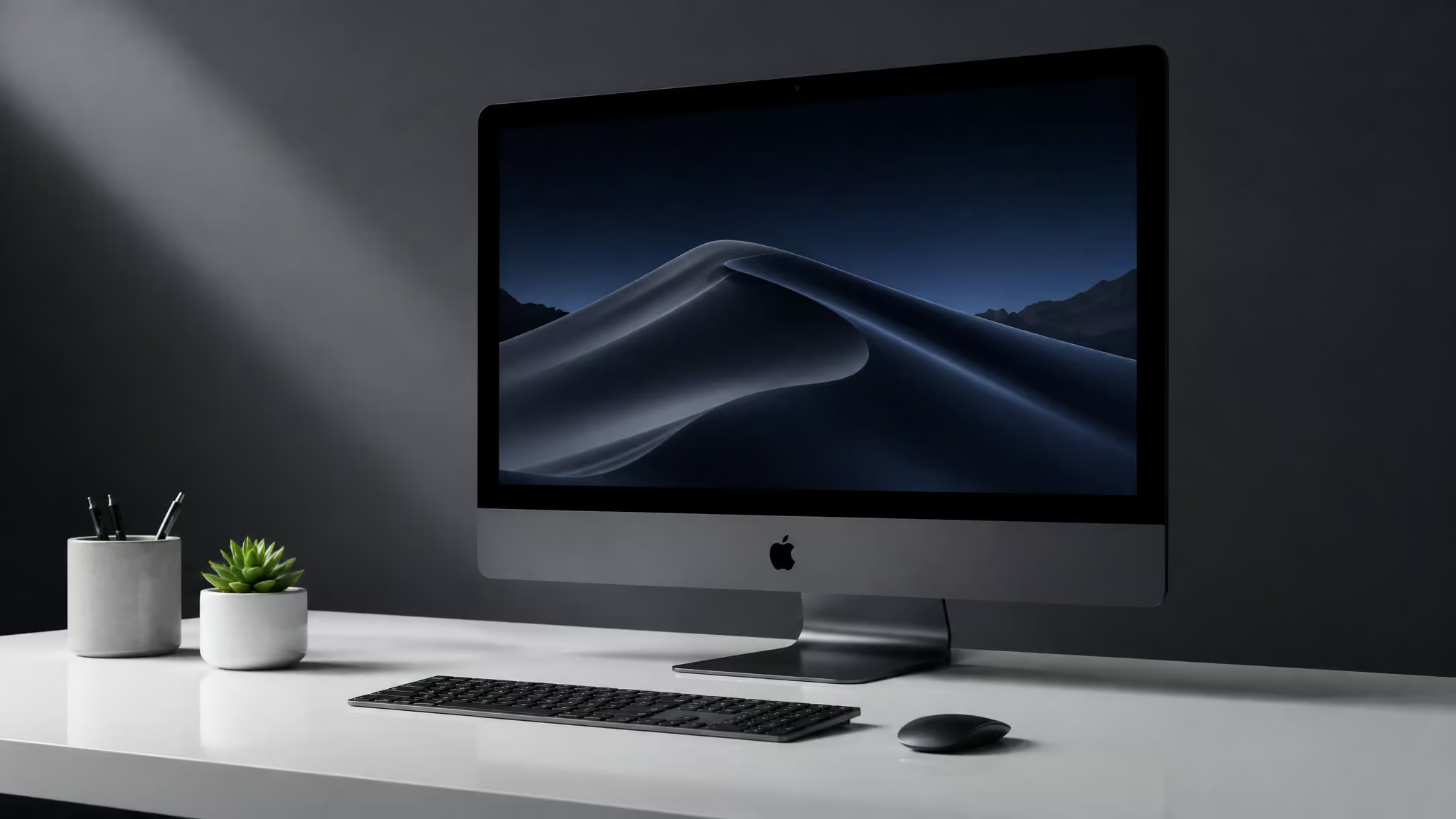
I was digging through the macOS Tahoe 26.7 RC (build 25G220, seeded August 17, 2026) when I noticed something that didn’t belong. Hidden inside the release candidate, the version that’s supposed to be nearly final, were references to over twenty unreleased products across every hardware line Apple makes. Phones, Macs, home hubs, iPads, even a tabletop robot. But the most interesting thing I found in the mess? The iMac Pro is coming back.
Specifically, the codenames are J833 and J834. Bloomberg confirmed these are the next generation of iMacs. Two codenames instead of one, which tells us this isn’t a simple refresh of the 24-inch consumer model. This is a revived pro desktop, years after Apple killed the original.
And the timing couldn’t be more telling: macOS 26 (Cheer) drops support for the 2017 iMac Pro. If you’re still running one of those machines, you’re facing an upgrade either way. The question is whether you should hold out for this new one.
Key Takeaways
J833 and J834 are the codenames for Apple’s revived iMac Pro, confirmed by Bloomberg, two variants likely coming with different display sizes or chip configurations.
The original iMac Pro (2017-2021) is explicitly dropped from macOS 26’s compatibility list, which means anyone still on that machine needs to upgrade to stay on the latest OS.
The new iMac Pro is expected to launch as part of Apple’s fall 2026 lineup, alongside M6 MacBook Pros, an OLED iPad mini, and a foldable iPhone Ultra.
Table of Contents
The Original iMac Pro: A Brief History and Why It Was Discontinued
The original iMac Pro was a beast. Launched in 2017, it packed a 27-inch 5K display, Xeon W processors, and Radeon Pro Vega graphics into a sleek all-in-one aimed squarely at creative professionals who needed more than the consumer iMac but didn’t want to jump to the Mac Pro. Apple discontinued it in March 2021, and for years the Pro segment of the iMac line simply vanished. The 24-inch iMac with M1 (and later M3) took its place, but it was a very different machine, consumer-oriented, smaller screen, fewer ports, and not designed for sustained heavy workloads.
If you were a pro user who bought the original iMac Pro, the discontinuation left you stranded. Your options were the consumer iMac, not enough power, too small a screen, or the Mac Pro, way more expensive than most people needed. Many users held onto those 2017 machines for years, hoping for a replacement. They’re still waiting.
Now macOS 26 (Cheer) arrives on June 9 at WWDC, and the compatibility list makes the situation urgent. The 2017 iMac Pro is explicitly dropped, along with the 2018 MacBook Pro, the 2020 Intel MacBook Air, and the 2018 Mac mini. Pre-release macOS 26 will support MacBook Pro 2019 and later, MacBook Air M1 and later, iMac 2020 and later, Mac Pro 2019 and later, Mac mini M1 and later, and all Mac Studio models. The cut line is clear: Apple is done with Intel-based pro machines.
If you want to run the latest OS, you need Apple Silicon. And for pros who need a powerful all-in-one, the new iMac Pro is the natural upgrade path.
What J833 and J834 Reveal About the New iMac Pro
The current 24-inch iMac uses a single codename (J433 or J456 depending on the generation). So when you see two codenames. J833 and J834, it strongly suggests two variants. Bloomberg reported these as the next generation of iMac models, and the dual codename pattern is the strongest signal we have that this isn’t just a spec bump of the existing 24-inch.
Two Variants, One Pro Mission
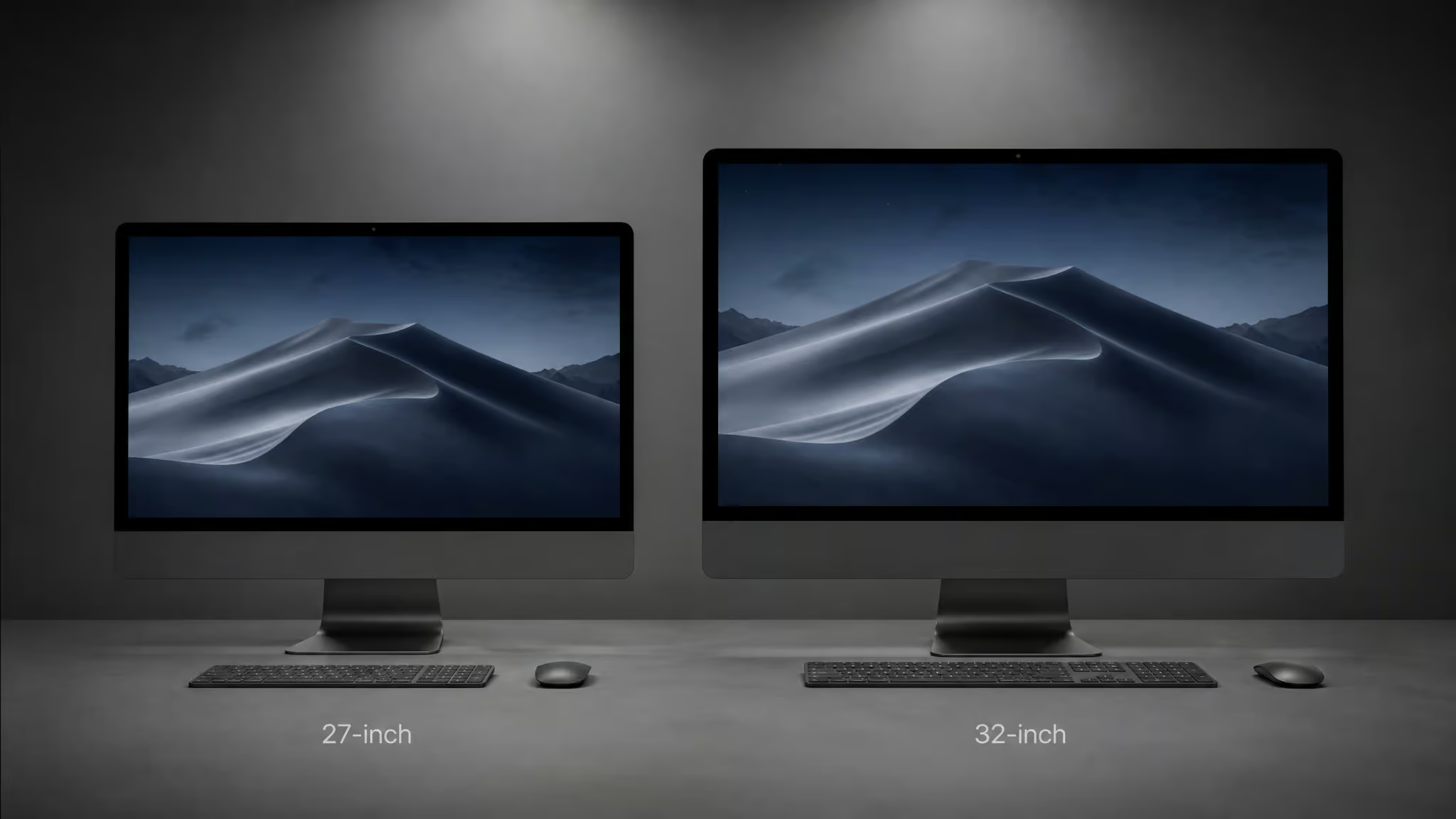
The most likely interpretations are straightforward: either two display sizes, think 27-inch as the baseline and maybe a 32-inch as the high-end option, or two chip configurations, an M6 Max model and an M6 Ultra model. It could even be both, a 27-inch with M6 Max and a 32-inch with M6 Ultra. Apple has a history of using two codenames for size variants of the same product (the current MacBook Pro uses separate codenames for 14-inch and 16-inch). So that’s the safe bet.
Expected Display Size and Pro-Grade Features
Let’s be clear: we don’t know the exact screen size yet. But given the original iMac Pro was 27 inches and the current consumer iMac is stuck at 24 inches, too small for many pro workflows, a 27-inch comeback makes sense. A 32-inch option would directly compete with displays like Apple’s own Pro Display XDR, but that’s pure speculation.
What’s more certain is the chip. The new iMac Pro will likely use one of the M6 variants. M6 Max or M6 Ultra, based on the broader fall lineup (the entry-level 14-inch MacBook Pro gets M6, so the pro desktop would get the higher-end silicon). That would mean support for up to 128GB or even 256GB of unified memory, which is what professionals doing video editing, 3D rendering, or AI work actually need.
Expect pro-grade features the current iMac deliberately lacks: more ports (HDMI, SD card slot, 10Gb Ethernet), a better thermal design that can sustain high loads without throttling, and possibly a mini-LED or OLED display upgrade. The 24-inch iMac is a great all-around computer, but it’s not a workstation. This new machine is meant to fill that gap.
Bottom line: If you need more than two Thunderbolt ports or a larger display than 24 inches, the new iMac Pro is your only all-in-one upgrade path.
Why the iMac Pro Matters Again: The macOS 26 Compatibility Axe
Here’s the thing: the 2017 iMac Pro is explicitly dropped from macOS 26. That’s not a side note, it’s the whole reason this revival matters now. If you’re a pro user still running that machine, the new iMac Pro isn’t just an interesting option, it’s the only way to stay on the latest operating system in that form factor.
The compatibility list is Apple forcing the final push from Intel to Apple Silicon. The 2018 MacBook Pro and 2020 Intel MacBook Air are gone too, but those users have plenty of upgrade options. For iMac Pro owners, the choices have been limited. The consumer iMac is still supported, but it doesn’t have the power or the screen size.
The Mac Pro is still supported but it’s a different category entirely. A revived iMac Pro is exactly what this audience needs.
And it’s not like Apple is being cruel, the transition has been coming for years. But if you’ve been holding onto your 2017 iMac Pro because you didn’t want to compromise on screen size or performance, the new iMac Pro is your sign to wait a little longer.
What Else the Code Reveals: Apple’s Fall 2026 Product Roadmap
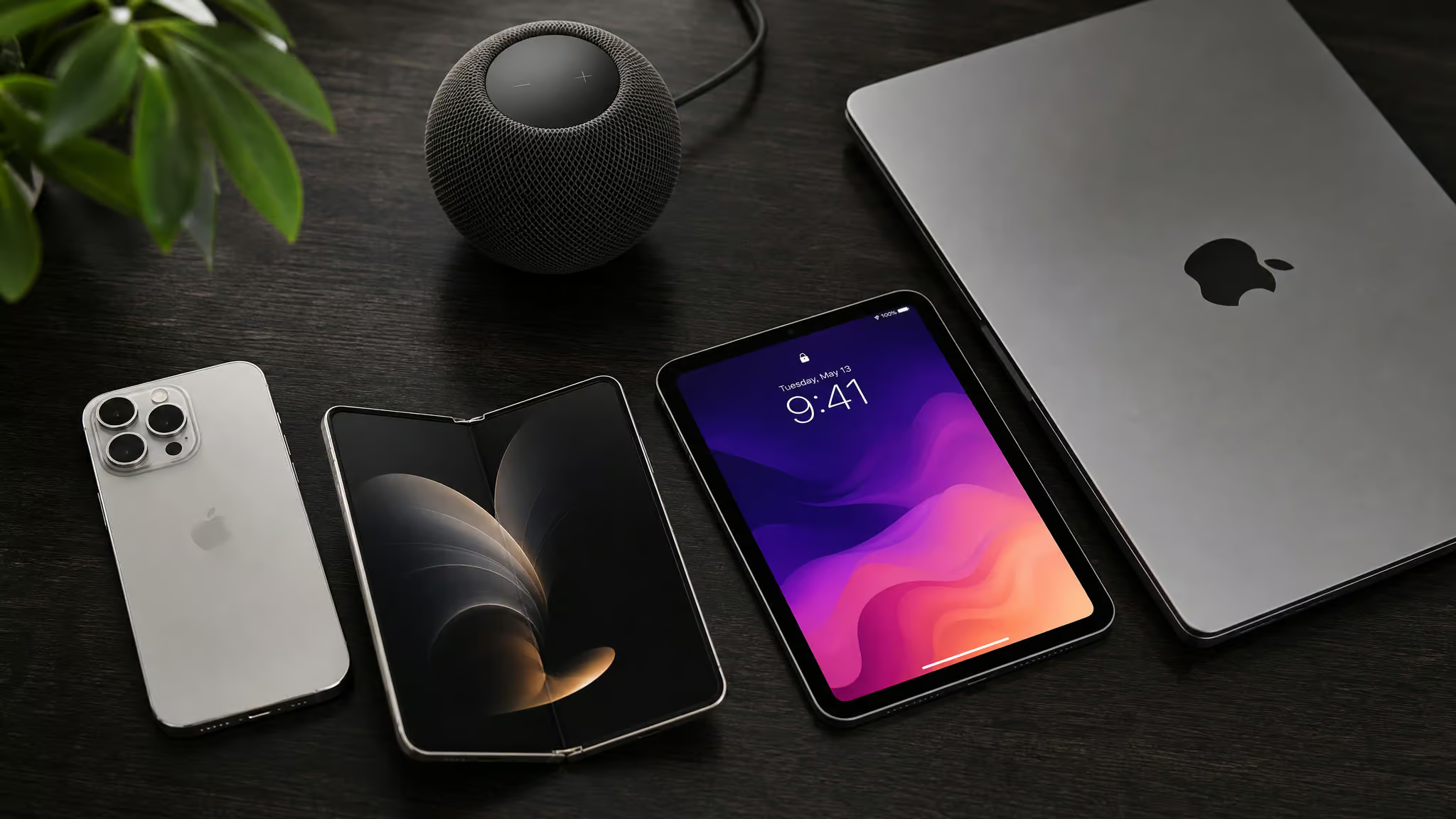
The iMac Pro isn’t alone in the RC. The same build reveals over twenty unreleased products, including those detailed in this Apple macOS 26.7 leak new products, painting a picture of a massive coordinated launch wave starting in September and stretching through early 2027.
Home Accessories
The home hub is real: J490 (desktop base) and J491 (wall-mountable) are both in the code, running a dedicated OS codenamed Pebble (homeOS, per Bloomberg). There’s also a next-gen HomePod mini (B525, up from B520) with “Argentium” firmware, and a sensor-rich device J229 that can detect alarm sounds and capture images, likely a security camera or home hub accessory. The wildest find is J595, a tabletop robot that fits in the HomeAccessory family. Apple is building a robotic home device.
Headphones
This is where it gets spicy. The code contains B790, the codename for camera-equipped AirPods, which we’ll get to in a moment. Also present: Beats B518/B522 (upcoming headphones), AirPods Pro 4 (AirPodsPro1,4), and a standard AirPods update (AirPod3,5). Apple is refreshing the entire audio lineup, and the Apple AR/VR headset macOS 26.7 leak reveals driver and framework references for its mixed-reality headset.
iPhones
The iPhone 18 lineup is here: iPhone 18 Pro (V63), Pro Max (V64), and standard iPhone 18 (V67) expected for September. The foldable iPhone Ultra (V68) is also confirmed for a September launch. And there’s iPhone Air 2 (V62) for spring 2027.
Macs
Beyond the iMac Pro, we have J804 (entry-level 14-inch MacBook Pro with M6, a direct upgrade from the current J704 with M5) and four high-end codenames. K114c, K114s, K116c, K116s, which are likely the higher-tier 14-inch and 16-inch MacBook Pros with M6 Pro/Max chips and possibly OLED displays, but that’s not the only recent Apple silicon rumor, the Apple silicon M4 Ultra leak macOS 26.7 confirms M4 Ultra and M4 Max chip configurations with every core count, GPU spec, and memory bandwidth detail we can extract.
iPad
The iPad mini is getting a long-awaited upgrade: J510/J511 with an OLED display and A19 Pro chip. Two model numbers means Wi-Fi and cellular variants.
Headset
Vision Pro N109 is in the code, confirming the project is still alive. Bloomberg says it’s the second-gen model, not the cheaper version previously reported as canceled.
Apple TV
A new Apple TV remote (ATVRemote1,5) is coming, likely with a hardware refresh.
Apple Intelligence in China
The code reveals Writing Tools coming to China with safety restrictions: content that triggers safety alerts will be blocked from AI editing, with user-facing error strings like “Content safety update required” and “Writing Tools are temporarily restricted.”
Unknown Model Numbers
A batch of unknown model numbers (A3436-A3441, A3456-A3457, A3465, A3529-A3533, A3543, A3577, and others) don’t match any existing product. Could be new audio accessories, watch bands, or something else entirely.
Launch Timeline
The first wave hits in September: iPhone 18 Pro, Pro Max, and the foldable iPhone Ultra. A possible second event in October or November would bring the MacBook Pro, iMac, iPad mini, and home accessories. The camera AirPods could debut as early as September, per Gurman, possibly under the “AirPods Ultra” name.
Camera AirPods: Apple’s First True AI Wearable and the Privacy Backlash
Okay, this is the dramatic subplot that’s going to generate a lot of the buzz. The most dramatic find in the RC wasn’t a codename, it was a 13-second demo video.

The Demo Video and What It Shows
MacRumors found the video inside the Tahoe 26.7 RC. In it, a man holds up a book, and the AirPods camera reads the title. A voiceover says says: that With Visual Intelligence, your world becomes savable. See something you like? Just ask them to save it for later.
The camera feeds data to Visual Intelligence, and Siri answers questions. There’s even a system reminder when hair covers the headset.
This is the clearest evidence yet that Apple is putting cameras in AirPods. The codename B790 lines up with Bloomberg‘s earlier reporting. The demo is rough, shot on an iPhone, inconsistent exposure, which makes it look like an internal test video rather than a polished ad.
Is It a Placeholder?
Tom Bedford at TechRadar points out the clip doesn’t look like Apple marketing material. It could be a placeholder or internal video. No visible cameras in the demo, the earbuds look like current AirPods Pro with a slightly thicker stem. Engadget cautions that codes can be placeholders, nothing is certain. But the voiceover is specific enough that this seems like a real feature demo, even if the final hardware looks different.
The Privacy Backlash
Already the backlash has a name: “PervertPods.” Zack Whittaker coined it, and it’s sticky. People are calling the camera AirPods “pervert earbuds” before they even exist. The stigma around always-watching gadgets is real. UK locations like courts, restaurants, theatres, and Wetherspoons have banned smart glasses. Meta’s Ray-Ban glasses were banned from UK pubs in August, and Instagram banned related accounts in July.
Bedford notes the privacy revolt against always-watching gadgets “has run its course,” but that doesn’t mean the concern has vanished. Apple will need a clear privacy story: a visible indicator when the camera is live, like the MacBook camera LED, and assurance that images aren’t stored locally.
M.G. Siegler’s Take: Why Earbuds, Not Glasses
M.G. Siegler makes the most compelling argument for why this form factor wins: the first thing you’ll notice is that there is no phone. The camera AirPods function independently from the iPhone screen, making them Apple’s first true AI wearable. The Apple Watch is a health/sport/screen wearable. These are an AI sensing device.
Compare the installed base: Ray-Ban Meta glasses sold about 10 million units. Apple has sold over 400 million AirPods, some estimates say 500 million. The form factor is already socially accepted, everyone wears AirPods. Google Glass failed because it looked alien.
Meta solved that by making glasses look like Ray-Bans. Apple can solve the same problem by making camera AirPods look like normal AirPods. Better to start with old design and new technology.
Caveats and What We Still Don’t Know
Engadget‘s caution is worth repeating: codes in release candidates can be placeholders. Apple sometimes leaves dead code in betas. Nothing is certain until the products are announced.
For the iMac Pro specifically, we still don’t know:
- Exact display size (27-inch? 32-inch? something else?)
- Which chip (M6 Max? M6 Ultra? Could be M6 in the base configuration)
- Pricing (will it be competitive with the Mac Studio?)
- Launch date (fall 2026 is likely, but exact event timing is unknown)
For the camera AirPods, three things would settle the argument:
- Whether the shipping product can capture a still image (the demo suggests yes, earlier reports said real-time only)
- Whether it has a visible indicator when the camera is live (Apple has done this before with MacBook camera LEDs)
- Whether Apple names it at the September event
There’s also confusion between B790 and B798MacRumors ties B790 to Gurman’s reporting, but Engadget reports B798 is a separate 2027 project. And the Vision Pro N109 could be either the second-gen model or the previously canceled cheaper version.
Conclusion: Should You Buy a Current iMac Now or Wait for the New iMac Pro?
The short answer: if you’re a pro user, someone who needs more than the 24-inch iMac’s M3 chip, more than two Thunderbolt ports, or a larger display, wait for the new iMac Pro. The evidence is strong: J833 and J834 are real codenames, Bloomberg backs them, and the macOS 26 compatibility list makes the upgrade necessary for 2017 iMac Pro owners anyway.
If you’re a general consumer happy with the 24-inch iMac’s performance and size, there’s no reason to wait. The current iMac is a great machine, and it’s still supported in macOS 26. The new iMac Pro will be significantly more expensive and aimed at a different buyer.
For everyone else, if you’re running a 2017 iMac Pro and wondering what to do, hold tight. The revival is real, the evidence is in the code, and the launch is likely this fall. Just make sure you factor in the macOS 26 deadline. You don’t want to be stuck on an unsupported OS while waiting for a machine that’s coming any month now.
Frequently Asked Questions
Is Apple phasing out the Mac Pro?
No, the Mac Pro is still supported in macOS 26 and remains a separate product category. The revived iMac Pro fills the gap for professionals who want a powerful all-in-one without jumping to the Mac Pro’s higher price and modular tower design.