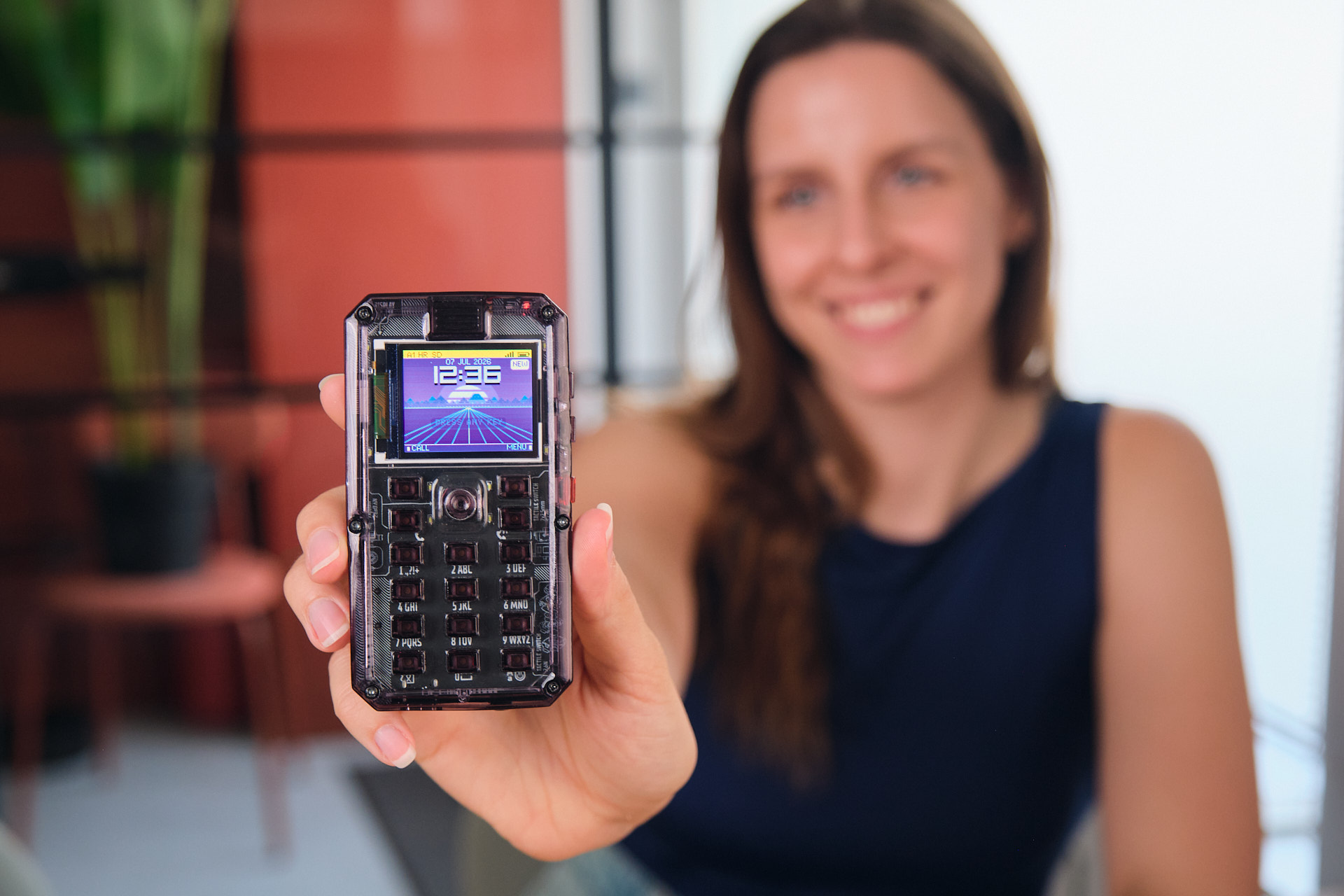
I would have loved a phone like this when I was a kid. Not a toy phone. A real one, with a SIM slot and an antenna and a numpad, that I put together myself and then actually called someone on. That thing exists now.
It’s called MAKERphone 2.0, a solder-free, open, modular DIY 4G phone from CircuitMess, live on Kickstarter right now with a Project We Love badge. Here’s the decision you’re making: a $129 pledge on a phone expected to ship in July or August 2027, against a campaign deadline of Saturday, October 10, 2026, 2:59 PM UTC. It is not a smartphone replacement, and that’s the point. What follows is my read on the specs, the tiers, and the track record.
Key Takeaways
MAKERphone 2.0 is a no-solder DIY 4G phone you assemble in about two hours; a nano-SIM enables real voice calls and SMS over 4G LTE Cat-1 with 2G fallback.
Solo pledges run $109 to $129 against a planned $169 retail, but shipping and taxes are charged after the campaign through the pledge manager, so $129 is not the checkout price.
CircuitMess has delivered five Kickstarter projects and shipped 300,000+ kits since 2017, yet shipping is expected July to August 2027 and Kickstarter rewards are never guaranteed.
Table of Contents
What is MAKERphone 2.0 and who makes it?
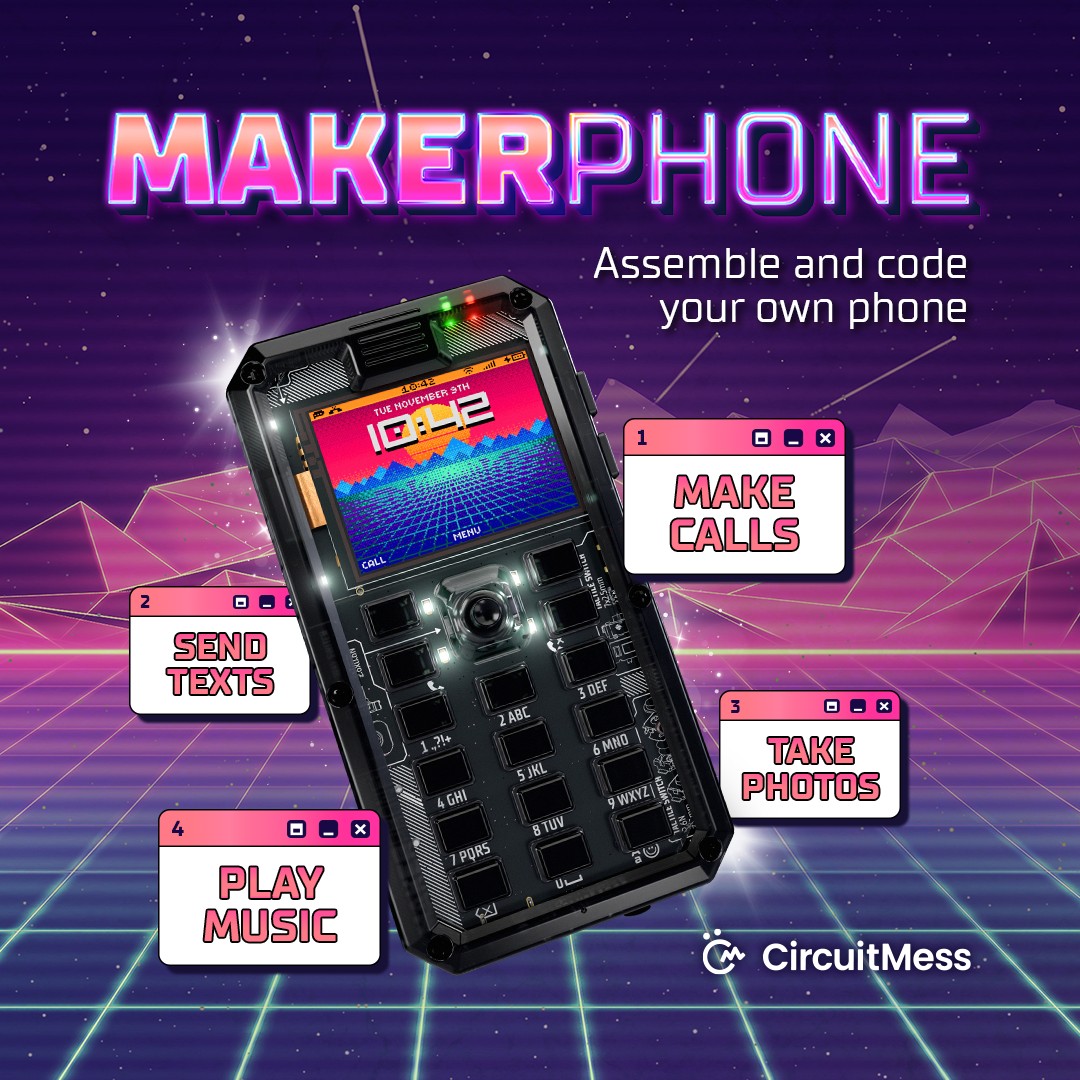
MAKERphone 2.0 is a no-solder, open, modular DIY 4G phone from CircuitMess that you assemble in about two hours, and it’s live on Kickstarter as a Project We Love campaign. The company behind it is a Croatian electronics kit maker founded by Albert Gajšak, with more than 300,000 STEM kits sold and press in Forbes, TechCrunch, and Wired along the way. The product page headline calls it the world’s first modular DIY phone. That’s a vendor claim, not a verified fact, so treat it as a slogan to evaluate rather than a certificate.
The listing trivia, lightly: Project We Love badge, DIY Electronics category, listed from Middletown, Delaware, which is almost certainly a listing formality rather than the company’s home. It’s FOSS puts the device on the same shelf as the Flipper Zero, retro handhelds, and pocket computers, and that’s the right mental shelf. The job it competes for is maker gear you use, not a phone that replaces your phone.
MAKERphone 2.0 specs: real phone hardware, deliberately not smartphone hardware
The spec sheet reads like a 2010 feature phone crossed with a maker board, and that’s deliberate. Start with the part people doubt first.
Yes, it’s a real phone
Pop in a nano-SIM and you get voice calls and SMS over 4G LTE Cat-1, with 2G fallback where LTE isn’t available. Out of the box it ships with more than 10 retro-style games, and the built-in software covers the feature-phone basics: a calendar, alarms and notes, your call history and contacts, music playback, file management, and viewing photos and videos. That’s feature-phone software, not an app store, and it covers the basics.
The spec sheet, translated
Under the hood is a dual-core ESP32-S3 with 4 MB flash and 4 MB PSRAM, a real upgrade from the original’s plain ESP32 for anyone who knows that chip family. It is never comparable to a Snapdragon or an Apple Bionic, and the campaign doesn’t pretend otherwise. The rest, straight:
- 1.77-inch 160×128 color display
- 12-key numpad, nav joystick, four function keys
- DAC, speaker, I²S mic, 3.5 mm headphone jack
- 1,000 mAh battery, USB-C for charging and programming
- microSD slot, Wi-Fi, Bluetooth
- 11.5 × 6 × 1.8 cm, 104 g
The 4G-not-5G modem and the tiny screen aren’t downgrades. They’re the use case: a numpad feature phone for connectivity without the attention economy. The 1,000 mAh battery is modest by any current standard, and that comes back later.
MAKERphone 2.0 vs the original MAKERphone: what 6,000 users changed
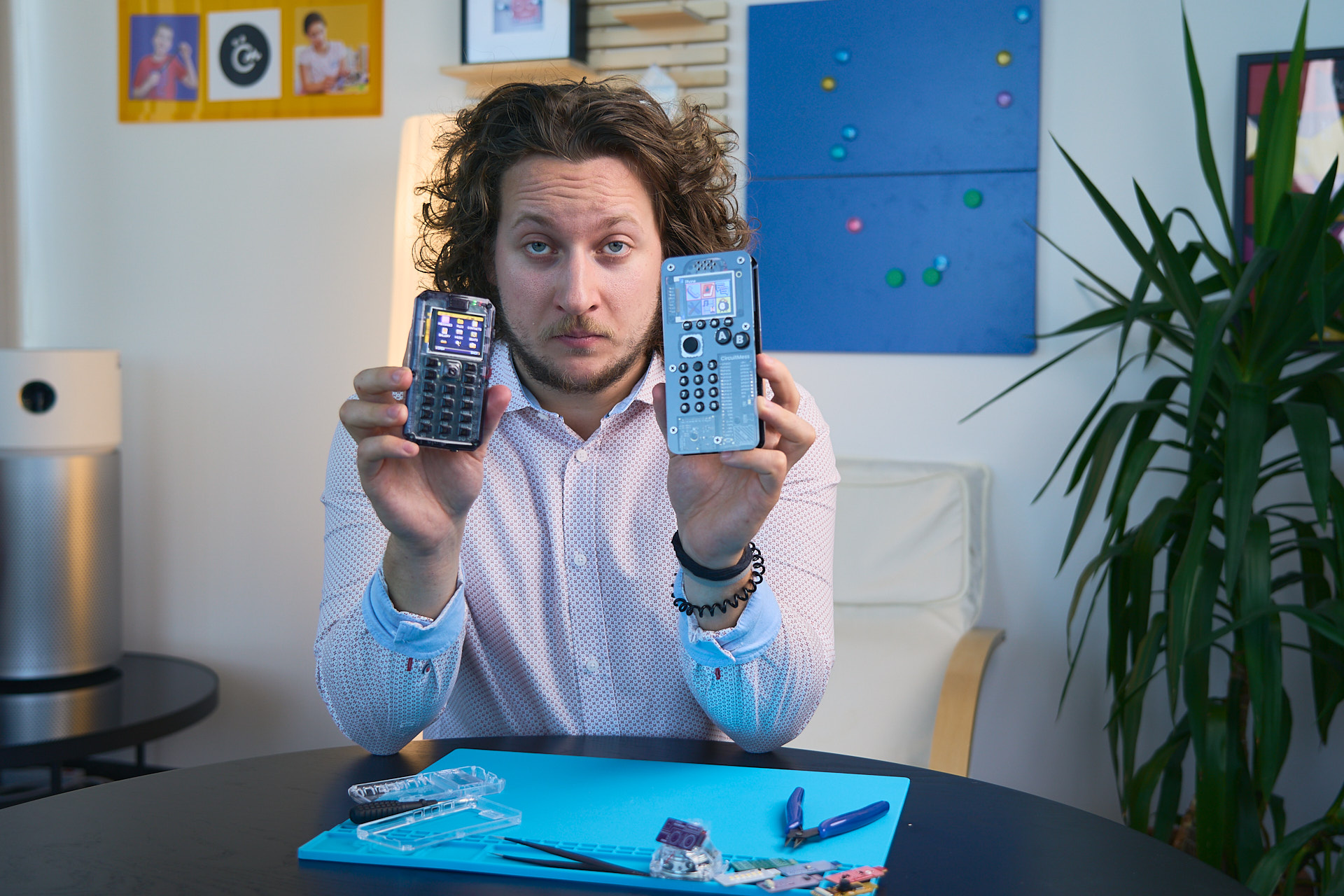
MAKERphone 2.0 changes five things over the 2018 original: assembly, price, processor, expandability, and design. The headline is the first one. The original shipped as a kit called Ringo, and building it meant roughly seven hours with a soldering iron. The 2.0 kit drops that to about two hours of clicking, screwing, and plugging parts together, with illustrated instructions and video guides backing you up. That single change opened the kit to kids around age 11 and up, a different audience from the 2018 one.
The history matters. The 2018 campaign raised over $324,000 and shipped to more than 6,000 people, and CircuitMess designed 2.0 from that user base’s feedback. You can see that feedback in the table:
| MAKERphone (2018, shipped as Ringo) | MAKERphone 2.0 | |
|---|---|---|
| Assembly | Soldering required, about 7 hours | No soldering, about 2 hours of click, screw, and plug assembly |
| Price | $159 | $129 campaign price |
| Processor | ESP32 | Dual-core ESP32-S3 with more RAM (4 MB flash, 4 MB PSRAM) |
| Expandability | Limited | Yes, a dedicated UMAX modular slot |
| Aesthetics | Raw PCB | Sleek nostalgic design |
Some people will miss the raw-board look, and that’s a fair aesthetic call, not a defect.
The contrarian take: was the soldering the lesson?
One reviewer argues that the soldering WAS the learning experience. Seven hours at the iron teaches you what a solder joint is and why electronics are physical objects. Under that reading, 2.0’s no-solder build trades a rite of passage for accessibility. CircuitMess is betting the other way, that assembly itself, figuring out how the pieces become a phone, is the lesson, and that the iron was just the barrier 2018 technology forced on them.
The 2.0 bet gets a phone into the hands of an 11-year-old who’d bounce off a soldering project; the original bet produced 6,000 people who know their way around a solder joint. I don’t think either side loses.
UMAX expansion modules: what plugs into MAKERphone 2.0
UMAX is one expansion port that accepts six auto-detected modules. Plug one in and its app shows up in the menu on its own, which is a satisfying bit of plug-and-play. The connector is also documented for third-party designs, so if you’re the hardware-hacker type, that’s your door in. It’s one port at a time, six module types, and the Expansion Module Pack bundles all six:
- Infrared: control your TV or AC from a phone you built. Universal-remote energy, fun demo.
- Camera: retro-style photos. Charming lo-fi, not computational photography, and better for it.
- Boombox: a 2W speaker. It’s a pocket amp, not a PA system.
- Flashlight: an LED array that is almost comically bright. Silly in the fun way.
- Environment: temperature and humidity sensor. Home-lab dashboard readers are already planning the graph.
- DIY perf board: invent your own sensor, and the phone treats it like an official module.
It turns UMAX from an accessory upsell into an open hardware invitation.
Confirmed versus speculation
Confirmed: the six modules above. Speculation, labeled as reviewer takes: a LoRa module shown in coverage implies possible Meshtastic or Mesh Core support, a GPS module would enable wardriving, and a QWERTY keyboard module appears in campaign materials. None of that is confirmed shipping hardware.
Coding MAKERphone 2.0: MicroPython, Arduino C++, and the VibeBoy AI question
Yes, you can code your own apps on this thing without prior experience. Three paths exist, and the phone works fully without any AI feature. The STEM framing is simple: you learn how smartphones work by building one, then program your own apps, games, and interfaces, and design your own UI faces and menus.
Three doors into the same device
MicroPython is the friendly scripting route. Arduino C++ runs on an Arduino-compatible open platform with no consumer smartphone restrictions, which is the no-walled-garden pitch stated plainly. And VibeBoy, on the Byte Board, is the AI-assisted route: describe an idea in plain English and it becomes running code, with four skill tiers from Pixel Rookie to Vibe Coder. A scaffolded difficulty ladder, not magic.
The anti-hype part, which I respect
VibeBoy’s output can be inspected, modified, and eventually replaced with hand-written Python or C++. It’s a scaffold designed to be outgrown. The campaign itself states AI is an educational subject, not a funded dependency, precisely because the hardware, firmware, and toolchain are open. Every phone includes three months of unlimited AI features plus a permanent free tier, and three months of VibeBoy Pro come bundled in the $129 and $189 tiers.
MAKERband: the companion smartwatch you have to buy separately
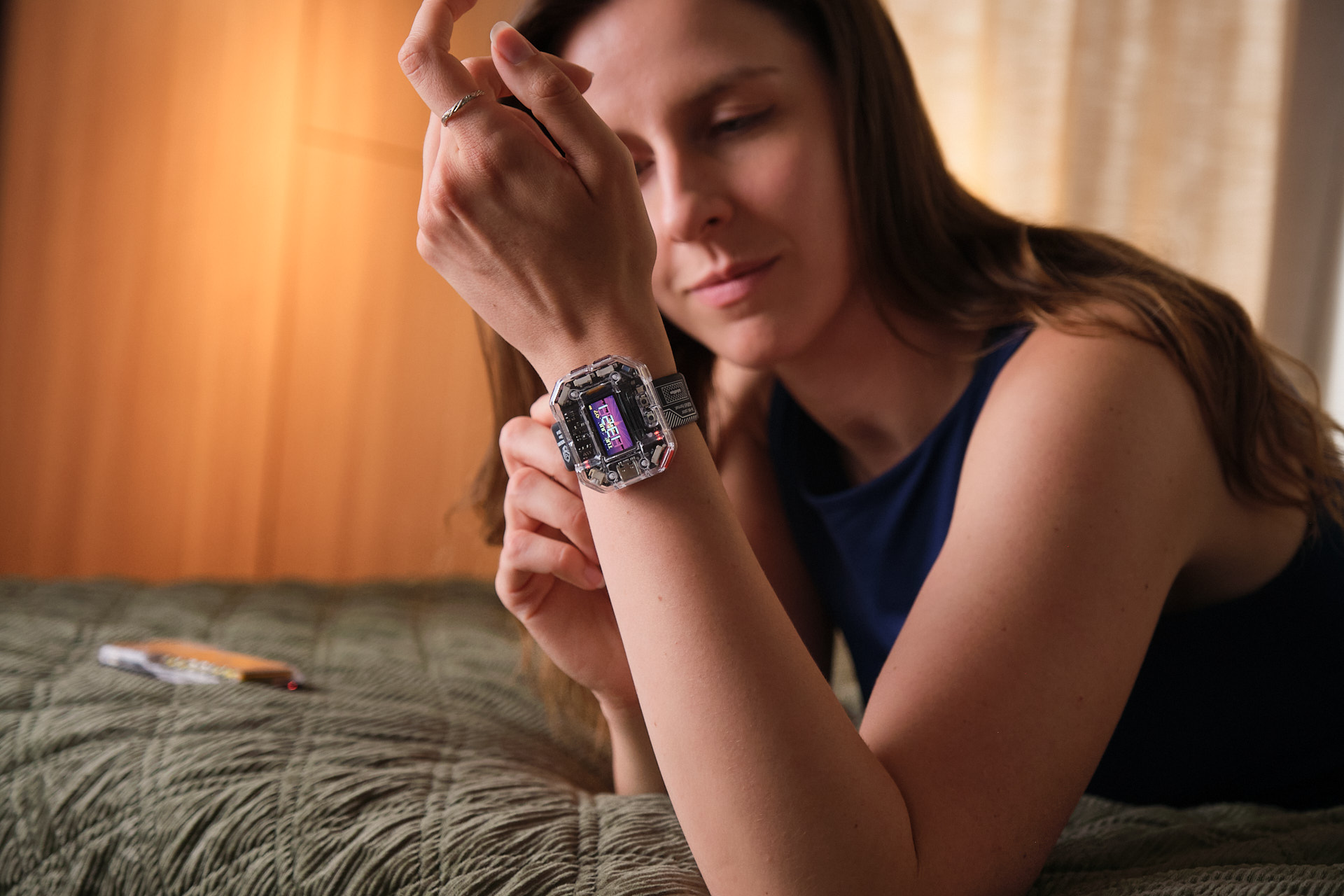
The MAKERband is not included in the $109 to $129 solo tiers. It’s an add-on, bundled from the $149 phone+MAKERband tier up, available during the campaign only. It’s a programmable smartwatch on an ESP32-C3 RISC-V chip, deliberately lower-power silicon than the phone’s S3, it’s a sidekick, not a shrunken phone. It pairs over Bluetooth with the phone and with Android/iOS for custom watch faces, mini-games, notifications, music controls, camera shutter, and a real-time clock. No health or activity sensors, per It’s FOSS.
How much does MAKERphone 2.0 cost? Every pledge tier, decoded
MAKERphone 2.0 starts at $129 on Kickstarter, $40 under its planned $169 retail. The ladder is sequential early-bird waves, not fixed prices, so the real decision is which wave, not which tier.
Cost check: The pledge price is not the checkout price — shipping and taxes come later through the pledge manager.
One caveat for every table below: all tier prices, quantities, and backer counts are point-in-time captures of a live campaign. Prices escalate as waves sell out, and the highest-discount tiers often go in minutes.
Solo tiers
| Tier | Price | Notes at capture |
|---|---|---|
| Super Early Bird | $109 | Days 1 and 2 only; 334 of 500 left |
| Early Bird | $119 | Early Bird wave |
| Kickstarter-only | $129 | 143 backers; includes 3 months of VibeBoy Pro |
Bundles and collector’s tiers
| Tier | Price | Notes at capture |
|---|---|---|
| Phone + MAKERband Super Early Bird | $149 | 101 backers, 399 of 500 left |
| MAKERpack Early Bird | $169 | Early Bird wave |
| Inventor’s Pack Super Early Bird | $179 | 206 backers, 94 of 300 left |
| MAKERpack special | $189 | VibeBoy Pro included |
| Inventor’s Pack Early Bird | $199 | 21 backers, 79 of 100 left |
| Inventor’s Pack special | $219 | Sold out |
| Full Inventor’s Pack | $229 | All backplates and straps included |
| Master Pack Early Bird | $249 | Early Bird wave |
| Inventor’s Kickstarter-only | $279 | 14 items |
| Collector’s tiers | $699 / $799 / $899 | Bundle ByteBoi 2.0, Wheelson 2.0, Synthia 2.0, Jay-D 2.0, and Bit 2.0 |
Family, institutional, and novelty tiers
| Tier | Price | Notes |
|---|---|---|
| Family Pack | $299 / $339 / $369 | Three phones for a household |
| Family MAKERpack | $419 / $479 / $539 | Family Pack plus extras |
| Classroom Pack | $1,999 | $199.90 per student, 10 complete sets |
| Distributor Pack | $4,455 | $148.50 per kit, 30 sets |
| Final Boss Pack | $7,777 | 5 of 5 left; the backer becomes a final boss in a built-in game other backers must beat |
That last one is exactly as delightful as it sounds, and it’s nearly gone.
Decoding the strategy: paying $20 more often buys a bundle worth far more than $20, and the $129 and $189 tiers quietly include VibeBoy Pro that cheaper waves don’t. The How Mobile Phones Work book is available as a reward or add-on, a nice pairing with the build-it-yourself premise.
How to back the campaign: deadline, real cost, and the 2027 wait
Backing a Kickstarter is mechanically simple.
Pick a tier before October 10
Pick a tier on Kickstarter before Saturday, October 10, 2026, 2:59 PM UTC. Funding is all-or-nothing, so you’re charged only if the goal is met. The goal is $30,000, and the campaign had raised $385,335 from 1,937 backers when sources reported. If you see different percentage figures floating around, that’s because sources caught the live campaign at different moments, not because someone’s lying. The page itself carries 30 FAQs, 4 updates, and 125 comments.
The checkout price isn’t $129
Shipping and taxes are charged after the campaign through the pledge manager, so the $129 headline is not the checkout price. That’s the step late backers get wrong, as a pattern: they budget the pledge and forget the second charge. There are no import fees for US, EU, UK, and Canada residents, and VAT is likely extra depending on your location. Shipping is expected July to August 2027, and the kit suits kids around 11 and up.
There’s also a Kickbooster referral program: referrers get 20% of each referred pledge in cash after the campaign wraps, with a media kit available for press. The campaign promotes third-party backer communities as its own social proof, which is worth knowing when you’re reading it.
Is CircuitMess trustworthy? The delivery-risk math
The track record is strong, with one condition that never goes away: five Kickstarter projects delivered, $2,244,789 raised across them, and 300,000+ kits shipped since 2017 across 40 SKUs in three collections. But Kickstarter rewards are never guaranteed, and that notice still stands no matter how good the record is.
Hardware design is complete with final production hardware in hand, and software is feature-complete and in final testing. The campaign funds manufacturing at scale, not R&D, which is a categorically different bet than a prototype-stage campaign where you’re funding the idea itself. The campaign also publishes dedicated Risks, Use of AI, and Environmental commitments pages, with named mitigations including trusted suppliers, on-site QA, an experienced logistics team, and transparent communication.
Those are the campaign’s own claims, not third-party audits. Read them yourself; that’s what they’re for.
What MAKERphone 2.0 is not
The most common disappointment with devices like this is buyers expecting smartphone-class battery life or performance from a product that was never positioned that way. Name the mismatch before purchase, not after.
The honest critiques
Reviewers flag the 1,000 mAh battery as small, which is fair; it’s the most practical concern on the list. There’s no NFC module, and one reviewer suggests an ST25R-based module as a missed opportunity. And one reviewer wishes there was some soldering, which is a funny, honest take I keep coming back to.
Hands-on color from prototype coverage, not a final unit: it recalls Nokia-style feature phones with numpad texting, and reviewers call it a fully functional phone, not a gimmick. The module compartment is held by one screw, there’s a removable e-paper sub-screen, and rumble, compass, and laser module options were shown. The community is expected to produce custom firmware, though that’s an expectation, not a promise.
Against a regular smartphone
The ESP32-S3 will never rival a Snapdragon or an Apple Bionic, it’s 4G LTE Cat-1 not 5G, and the display is 1.77 inches. If you want an inexpensive smartphone, this isn’t your device. Buy only if the budget and the 2027 wait are acceptable to you.
A first phone without social media
Yes, MAKERphone 2.0 works as a first phone for kids around 11 and up, when the parent accepts the 2027 delivery and builds it with the child. I would have loved a phone like this when I was a kid, and the Nokia-style numpad design hits that nerve exactly. A phone the parent physically builds WITH the child changes the first-phone conversation. The restriction is baked into the hardware the kid assembled and can tinker with.
Connectivity without social media serves kids around 11 and up and also adults deliberately avoiding the internet, and 4G-not-5G is the detox use case working as designed. One reviewer said they’d consider giving one to future children with restricted functionality, which is their personal call and a credible signal, not parenting advice from me.
Building it together
The Family Pack pitches it as three phones, one build weekend: household members build, code, and call each other. The Classroom Pack scales that up, with every student building a real 4G phone and smartwatch, coding them, and expanding with six modules.
Openness, repairability, and whether it still works in five years
Hardware design files, including the enclosure, are published, spare parts are sold individually, and the factory is contractually obliged to keep making spares for years. That’s a concrete answer to the five-year question, though these are campaign claims not yet proven over time. You can print replacement or modified enclosures, which beats the industry default of glued-shut phones, serial-matched parts, and air-freighted parcels. The manufacturing specifics: factory vetted via site visits, EU restricted-substances compliance, per-batch inspection reports, consolidated freight to warehouses in the EU, UK, US, Canada, and Australia, and six years of DHL GoGreen Plus paid.
Should you back MAKERphone 2.0?
Back it if you want a buildable, hackable first or second phone for a kid around 11 or older, or for yourself, if the $129 versus $169 gap and wave pricing matter to you, and if the July to August 2027 wait plus deferred pledge-manager charges are acceptable. Skip it if you want an inexpensive smartphone replacement. That’s the whole decision.
The campaign ends Saturday, October 10, 2026, 2:59 PM UTC, the highest-discount tiers often sell out in minutes, and Kickstarter rewards are never guaranteed. CircuitMess’s record reduces that risk. It doesn’t remove it.
Three tests: use-case fit, meaning a numpad DIY 4G phone fits your life; total-cost acceptance, meaning the pledge price plus post-campaign shipping and taxes; and risk tolerance, meaning you’re comfortable waiting until 2027 on a platform where rewards aren’t guaranteed. If all three pass, the $109 or $119 wave is where the math is best. If any of them fails, no early-bird discount fixes that.
Frequently Asked Questions
What is MAKERphone 2.0 and who makes it?
MAKERphone 2.0 is a no-solder, open, modular DIY 4G phone you assemble yourself in about two hours. It’s made by CircuitMess, a Croatian electronics kit company founded by Albert Gajšak that has sold over 300,000 STEM kits since 2017. The Kickstarter campaign carries a Project We Love badge.
Is MAKERphone 2.0 a real phone or just a STEM toy?
It’s a real phone: insert a nano-SIM and you get voice calls and SMS over 4G LTE Cat-1, with 2G fallback where LTE isn’t available. Reviewers who handled a prototype called it a fully functional phone, not a gimmick. It’s just deliberately not a smartphone — no app store, a 1.77-inch display, and feature-phone software instead.
What are the limitations and drawbacks of MAKERphone 2.0?
The most practical concern is the small 1,000 mAh battery, which is modest by any current standard. There’s no NFC module, the ESP32-S3 will never rival a Snapdragon or Apple Bionic, and it’s 4G LTE Cat-1 rather than 5G. If you want an inexpensive smartphone replacement, this isn’t your device — that’s by design, not an oversight.
How do I back the MAKERphone 2.0 Kickstarter campaign?
Pick a tier on Kickstarter before Saturday, October 10, 2026, 2:59 PM UTC. Funding is all-or-nothing, so you’re only charged if the $30,000 goal is met — the campaign had already raised $385,335 from 1,937 backers when sources reported. After the campaign ends, you’ll complete your pledge through the pledge manager, where shipping and taxes are charged.
What plugs into the MAKERphone 2.0’s UMAX expansion port?
The single UMAX port accepts six auto-detected modules: infrared (universal remote), camera, a 2W boombox speaker, flashlight, a temperature/humidity environment sensor, and a DIY perf board for inventing your own module. Plug one in and its app appears in the menu automatically. The connector is documented for third-party designs, though rumored LoRa, GPS, and QWERTY modules are speculation, not confirmed hardware.