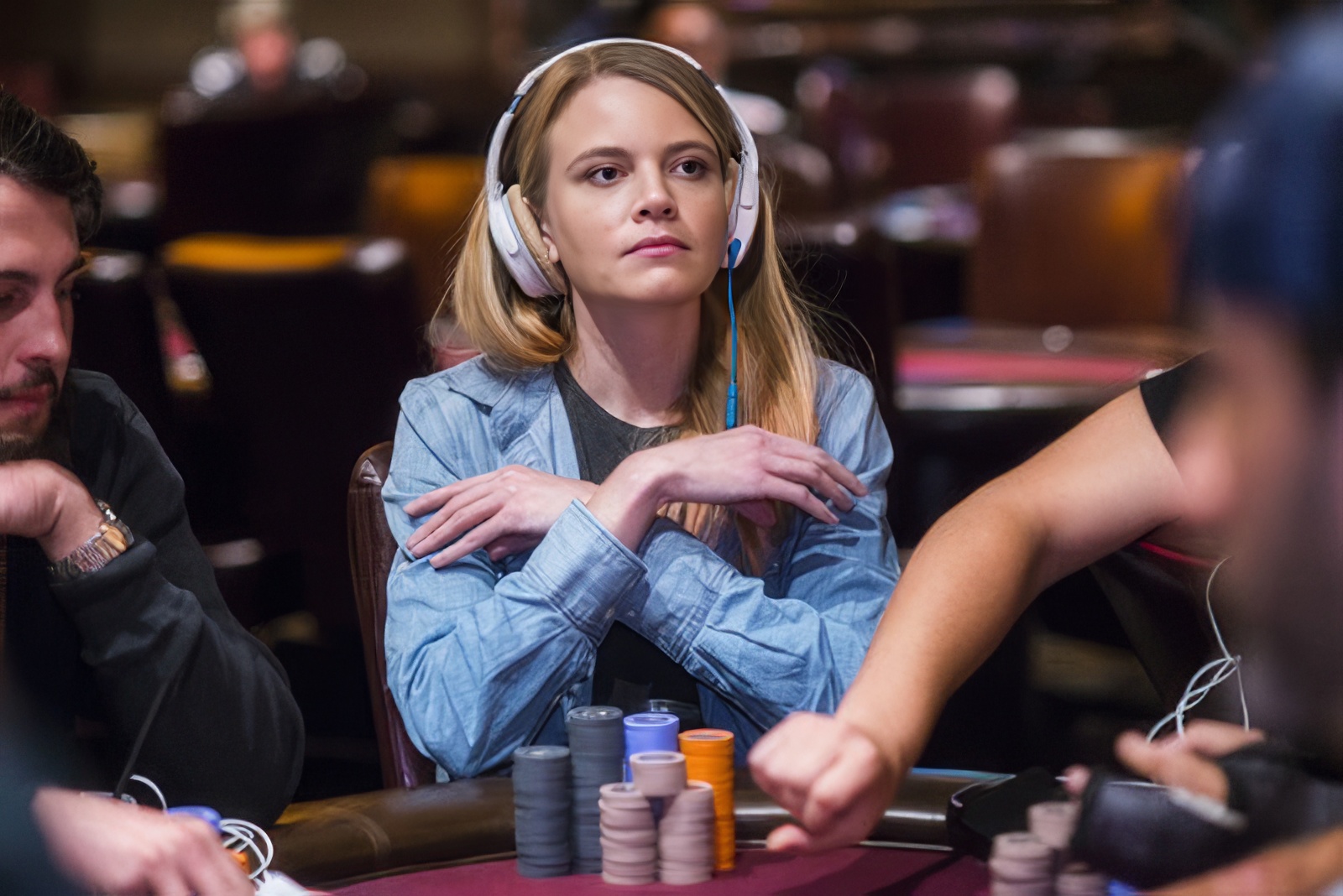
Cate Hall’s career arc reads like someone dared her to do it. Yale Law School graduate. Supreme Court advocate. Corporate lawyer on track to make partner.
Then she quit all of it to play poker professionally, and now she runs a science foundation. The strange part is how well each act fed the next, and how little of that story exists in any one place. Coverage of her is scattered across poker news sites, podcast interviews, and her own essays, and the pieces don’t agree on everything. So I fell down the rabbit hole, and this is the summary I wish had existed. For context on the professional online poker world she was part of, According to WPT Global poker site, it is a licensed and regulated real-money online poker platform available in over 135 countries.One ground rule, borrowed from how we’d normally audit a gadget’s spec sheet: where a claim about her is verifiable, I’ll say so, and where it’s something she says about herself, I’ll flag that too.
Key Takeaways
Hall quit corporate law roughly a year before expected partnership specifically because the money was about to make leaving too hard, then flew straight to the World Series of Poker.
Her most documented poker event is a $30,000 best-of-three grudge match against Mike Dentale, born from a Twitter feud, which she won 2-0 in front of 8,000+ concurrent Twitch viewers.
The “number one female poker player in the world” claim is self-reported; the closest verifiable signal is pokerstrategy identifying her as GPI Female Player of the Year.
Table of Contents
Who is Cate Hall?
Cate Hall is a former Supreme Court advocate and corporate lawyer who became a professional poker player and is now CEO of the Astera Institute, a private foundation supporting high-leverage science and technology projects. She grew up in Tucson, Arizona, and graduated from Yale Law School. Somewhere in there she also started an art company and a perfume company, because apparently law school was just the warm-up.She later co-founded Alvea, a pandemic medicine company, and ran its operations. Astera gets described as multi-billion dollar in talk framing, but that scale is self-reported, not independently verified.
On poker: she describes herself in her own writing as having once been the top-ranked female poker player in the world. Hold that thought; we’ll get to what the record actually backs later in this piece.
Some honest gaps, since search demand clearly exists: nothing in the material about her pins down her age, birthdate, or net worth. The only indirect age signals are hers, that she developed a sense of agency in her 30s and was terrified of rejection for her first 30 years.
Personal life
Her husband is Sasha, a writing coach. When she hit a blogging block, he suggested she write about pizza as an exercise, which is the kind of assignment that sounds useless until it works.Their elopement is her own go-to example of exercising narrow personal agency, the small-scale version of the philosophy she’s now known for. An Avett Brothers line she returns to every day: Decide what to be and go be it. And her first blog post, a “10 things” list that could just as easily have been 20 things, performed so well that she now worries nothing she writes will top it.
How Cate Hall went from corporate law to professional poker
Here’s the detail that makes her story more than a career-change anecdote: she quit roughly a year before expected partnership, and she quit because it was working.The money she’d earn as a partner was exactly the thing she didn’t want, because it would become too hard to walk away from. Most high-credential professionals wait for the next rung, then the next, until the golden handcuffs actually lock. Hall watched older colleagues stuck in the “one more year” loop and treated it as the warning, not the plan.The firm even offered her a one-year sabbatical instead of accepting the resignation, she took it and never came back. After her last court case, she spent six months to a year confirming the decision, then flew straight to the World Series of Poker, feeling absolute freedom for the first time. And the lawyer savings mattered too: they made poker’s variance financially tolerable.
Her reasoning, from her own essays: success in multiple fields is only possible if you’re willing to quit multiple fields.She also ran a personal ambition threshold, pursuing something only if the odds were better than one in a hundred that, ten years on, she’d judge it the very best thing she could be doing. Almost no job she reviewed met that bar. These are her heuristics, not universal advice, but they explain the whole path.
The firm did not simply wave goodbye.It warned her she would regret the decision, and rather than accept her resignation, put a one-year sabbatical on the table. She took the sabbatical and never came back. Colleagues attributed the departure to her divorce, though the decision predated it, which tells you something about the stories people tell themselves when someone else makes a big move.
She didn’t quit on a whim, either.After her last court case, she spent somewhere between six months and a year confirming the decision. Then she flew straight to the World Series of Poker, and has described feeling absolute freedom for the first time. The unromantic infrastructure underneath: lawyer savings. Poker’s variance is brutal, and a pile of boring savings is what made that uncertainty financially tolerable.
She wrote her parents a long email explaining the change, braced for resistance, and got unexpected support instead. Her mother’s lingering worry about a gambling addiction faded once Hall’s first poker season went well, a success Hall privately attributed to luck. Keep that in your pocket; it matters later.
Was Cate Hall really the number one female poker player?
The “number one female player in the world” claim comes from Hall herself, in the introduction to her own article, so treat it like a vendor’s README, not a benchmark result. The closest thing to independent confirmation is pokerstrategy identifying her as the GPI Female Player of the Year, specifically, she was the 2016 GPI Female Player of the Year, with over $1.1 million in career earnings. That’s the verifiable spine. Beyond that, no win rates, bankroll figures, or tournament cash records exist in the material, and no ranking of famous female players is supportable, so if you came here for a leaderboard, the honest answer is that the record doesn’t back one.
What makes her case interesting is her own calibration. “I was never exceptional at the level of the mechanics of the game,” she has said. Her actual edge was learning velocity: asking better players stupid questions and borrowing their compiled experience instead of recompiling it from scratch. And timing.
“Basically every poker pro today is better than every pro 20 years ago, and plenty of people in 2005 believed they were good at poker!” In her telling, poker in 2005 was basically pre-competitive; people had no idea how much better they could be, and the theory becoming learnable from online content is part of what professionalized the field. Her broader point outlives poker: settling for adequate performance can hide massive improvement opportunities that great performance would surface.
The Mike Dentale grudge match: her most documented poker event
A bad-natured Twitter feud between Hall and fellow pro Mike Dentale simmered for a year, and instead of fizzling out the way Twitter feuds usually do, it escalated into a $30,000 best-of-three heads-up match at SugarHouse in Philadelphia.Hall won 2-0 without much major resistance.
Even the market had her favored: pre-match odds ran 1.2-to-1 in her direction. The match config, for the spec-sheet readers: both players started with 15,000 chips, blinds at 75/150, rising every 90 minutes. It ran on Poker Night in America, sponsored by Kimo Sabe Mezcal and Sit & Go 2.0, with Doug Polk and Shaun Deeb on commentary, and it drew 8,000+ concurrent viewers, making it one of the night’s biggest draws on Twitch and earning a homepage slot.Those numbers are the proof this was a genuine event, not two people arguing into the void.
The hand-level color is where it gets delightful, with one caveat: per-hand details have minor discrepancies across sources in order and amounts, so treat them as texture and trust the headline figures. My favorite hand: Hall raised $400 holding 10-8 suited and flopped trips, after which Dentale thanked her for not raising, since her restraint had saved him $4,000. Poker gratitude is a strange emotion.Bet sizes swung between a few hundred dollars and $2,000 across the night; Dentale’s first pot came when Hall folded to a $1,000 turn bet.
At one point Hall told him that something about his body language told her he was full of it, and honestly it’s nice to know human-sensor reads still work in a solver era. During commentary downtime, Polk and Deeb played a $41,000 side flip, which is exactly the kind of convention-floor weirdness you’d expect.
Dentale provided theater throughout: showing his cards after bets, taunting “Good fold, Cate,” then blaming luck afterward in the booth.Hall mostly stayed composed, which was the contrast that defined the match. And here’s the reframing detail: Hall played for the Committee to Protect Journalists, Dentale for Community Volunteers and Medicine in Philadelphia, and both encouraged donations throughout the stream. A grudge match that turns into a charity drive is oddly wholesome.
What Cate Hall learned from poker
Poker trained her epistemics, not just her risk tolerance, and the honest data point comes first: she worked hard and studied hard and still lost money for a month straight.Effort doesn’t guarantee short-term results, because short-term results are luck. That’s the exact error her mother made reading the winning first season, which Hall privately attributed to luck, so her own family demonstrated the interpretation mistake poker trains you to avoid.
The discipline she names is overfitting avoidance for humans.
“A central challenge in poker is that to become any good at all, you have to avoid hastily forming new rules based on lessons you think you’ve learned in a few high-stakes pots,”
she writes in “Until you get punched in the face.”Lessons learned in emotionally charged situations come out overly strong and overly general, and she calls that a central axiom of personal development. People do this in poker and MMA and everywhere else: concoct misleading rules from limited experiences, and the rules corrode their own agency.
Her variance-of-opinion heuristic is the compact tool worth stealing: “Lots of variance in opinion about whether an idea is good means there’s a good chance the idea is good; lots of variance in opinion about whether a person is good is a warning sign.” Her starter advice for anyone struggling to sharpen their opinions: just hold fewer of them.One more piece, carried on quote-collection fragments so treat it lightly: casting yourself as the victim lets you keep feeling like the hero, especially when you’ve decided the game is rigged, and acknowledging what’s true is psychologically cleaner than avoiding it.
Cate Hall’s agency philosophy: what poker fed into
Her definition: “It was developing a sense of personal agency, which I think about as the capacity to both see and act on all of the degrees of freedom we actually have.” In other words: noticing the doors that are actually there. She argues agency matters more than intelligence and hard work, which are next to useless if misapplied and increasingly outsourced to machines.Gary Tan, CEO of Y Combinator, put the same point bluntly: “Intelligence is on tap now, so agency is even more important.”
Agency isn’t innate; Hall developed hers in her 30s, mostly through luck, and argues it stays learnable at 30 or 40. Having higher-agency peers is “undefeated” for developing it, and she credits poker players and the rationality and effective-altruism communities by name.
Her agency essay lays out six principles, each with poker fingerprints:
- Don’t work too hard. Effort is a resource to allocate, not a virtue to maximize.
- Learn to love the moat of low status. Literally her practice of asking better players stupid questions.
- Court rejection. After 30 years of only applying for things she knew she’d get, she asked two organization leaders whether she could run theirs instead of starting a similar one. You only need one yes.
- Seek real feedback. Reading opponents and the world honestly. An anonymous email from a subordinate that painted her as harsh, cold, intimidating, and hard to read forced a genuine personality change.
- Assume everything is learnable. Her stated exception: general intelligence is near-fixed, and she doesn’t pretend otherwise.
- Increase your surface area for luck. She believed she invented the concept until she found it in a Paul Graham essay from roughly a decade earlier and concluded she’d absorbed it unconsciously, which is itself the concept working.
The mechanics underneath: a dozen inquisitive conversations gets you the beginnings of a network, curiosity-driven conversation with no agenda is the slow way that is the fast way, and if you’re dropped into a life with no professional connections, starting a blog is one of her first moves, which is a bit ironic from where I’m sitting.She also argues that if good-hearted people borrowed even 10 percent of the courage of ruthless powermaxxers, everyone would be better off, and that most people prove inventive when asked for ten ideas to improve their zip code or country. Try it.
What Cate Hall does now: Alvea and Astera
Today she’s CEO of the Astera Institute, a private foundation supporting high-leverage science and technology projects, described as multi-billion dollar in talk framing. That scale is self-reported; treat it as her framing, not an audited figure.
Before Astera came Alvea, the pandemic medicine company she co-founded, inspired by watching low-income countries struggle with COVID vaccinations because of inadequate cold-chain storage. Alvea set the record for the fastest startup ever to take a drug to clinical trials: under six months. Sit with that number for a second. Drug development timelines are measured in years by default, and her company did it in less than half of one.
She attributes the risk tolerance that made this possible to poker. After playing professionally, a salaried startup job felt “incredibly stable” to her, which is a fun inversion: the safe job reads as safe because of what she’d already survived. That’s her own attribution, not a claimed causal chain from poker to startup success.
The gift of desperation: addiction and recovery
Hall has written that she lost more than three years of her life to a drug addiction, one that cost her her job, her savings, most of her friends, and for a time the ability to walk.Five years before her Big Think talk, she was hopelessly addicted, spending whole days barely conscious and watching normal people do normal things with awe and resentment. What she took from it is what recovery communities call the gift of desperation: having nothing left to lose made her fearless and hungry, and losing her pride let her learn fast by saying she didn’t understand what people had just said, the same stupid-questions principle that carried her in poker. For four years after rehab, she accepted every connection that came her way, going for volume, and met most of her collaborators that way. Her argument is that you don’t need to ruin your life to learn the same authenticity.
Why she left the deterministic path: credentials, burnout, and willpower
Hall’s honest accounting is that Yale Law worked mainly as a legible external signal, buying her instant credibility for a decade and letting her co-found companies and take senior roles without a matching resume, while the useful leftovers were narrower: fast contract review and legal-risk assessment. She cried with happiness at her acceptance, which feels silly to her in retrospect; law school was a safe default, her comparison being “nobody gets fired for hiring IBM.” Her sharper claim is that law definitely selects for low-agency people, aggressively selecting against willingness to look dumb. Donald Super’s career model, which she references, maps exploration to ages 15-24 and establishment until 44, then maintenance, then decline, and she stepped off that track. Burnout, in her framing via the rider-and-elephant metaphor, is a broken reward pact: the rider keeps demanding tremendous energy from the elephant without delivering the expected reward, recovery can take years, and some people never do.
She left law after burnout and still avoids law work reflexively and eyes high-paying opportunities suspiciously. The Myth of Willpower ties it together: “To win against addiction, you have to make the fight as easy as possible by totally remaking your life.” Environment design, not grit. And rest resists being forced: “If you are trying to make rest happen, then you ruin all of its benefits: sanity, inspiration, wholeness.”The context she gives for the leap: traditional prestigious paths peaked in respect 40 to 80 years ago, prestige has migrated toward probabilistic, VC-economy careers with 1,000x outcomes, and a friend of hers became a millionaire as a normal employee through one lucky equity stake.
Where to read Cate Hall’s essays and watch her interviews
Start with her Big Think talk, which delivers the agency thesis in one sitting, then read the poker-adjacent essays for the throughline this article traces. The primary sources, by title: “Embrace Your Agency in Life,” “In praise of quitting,” Learn to love the Moat of Low Status, How to increase your surface area for luck, “Until you get punched in the face,” “50 things I know,” “Fuck willpower,” “Burnout is breaking a sacred pact,” “Agency is for sociopaths,” and “Do Less,” plus the talk’s transcript, “A Practical Guide to Taking Control of Your Life.”
For the interview side, her appearance on Paul Millerd’s Pathless Path podcast is the one that covers the law-to-poker-to-agency arc best. Millerd’s own context frames the conversation: he burned out seven years ago after leaving consulting, took three to four years to recover, and provocatively says he doesn’t trust anyone who hasn’t burned out, since they don’t know an activity’s limits.He runs his own luck-surface-area experiments, with 400 curiosity conversations before writing his book and over 1,000 books gifted, and he has speculated that befriending YouTubers with 5 million followers would beat writing well, a bet that looks reasonable given that Ali Abdaal sharing his book drove 10,000 to 15,000 sales. That’s the host’s framing, not Hall’s material, but it tells you what kind of conversation she walked into, and it’s a good one.
Frequently Asked Questions
Who is the richest poker player in the world?
Net worth figures for poker players, including Cate Hall’s, aren’t reliably documented — her age, birthdate, and net worth are all unknown in the public record. What is documented is her career arc: Supreme Court advocate, then professional poker player, then co-founder of Alvea and now CEO of the Astera Institute.
Who is the #1 poker player in the world?
Cate Hall has described herself as having once been the top-ranked female poker player in the world, but that claim comes from her own writing and should be treated like a vendor’s README rather than a benchmark result. The verifiable spine is her GPI Female Player of the Year recognition, and her most documented event is a 2-0 grudge match win over Mike Dentale.
Who are some famous female celebrity poker players?
Cate Hall is one of the more unusual names in the mix — a Yale Law graduate and Supreme Court advocate who quit corporate law to play poker professionally. Her fame spike came from a $30,000 best-of-three heads-up grudge match against Mike Dentale that drew 8,000+ concurrent Twitch viewers. No verifiable ranking of famous female players exists in the record.
Was Cate Hall really the number one female poker player in the world?
The claim is self-reported, from the introduction to her own article. The closest independent confirmation is pokerstrategy identifying her as GPI Female Player of the Year. She has also said she was never exceptional at the mechanics of the game — her edge was learning velocity, asking better players stupid questions and borrowing their compiled experience.
What did Cate Hall learn from poker that she applies to her career?
Poker trained her epistemics, not just risk tolerance: short-term results are luck, so effort doesn’t guarantee them, and lessons drawn from emotionally charged situations come out overly strong and overly general. Her compact heuristic: lots of variance in opinion about whether an idea is good suggests it might be good, but lots of variance about whether a person is good is a warning sign. She credits poker for the risk tolerance that later made founding a pandemic medicine company feel feasible.
What does Cate Hall do now?
She’s CEO of the Astera Institute, a private foundation supporting high-leverage science and technology projects, described as multi-billion dollar in talk framing — though that scale is self-reported, not independently verified. Before Astera, she co-founded and ran operations at Alvea, a pandemic medicine company that set the record for the fastest startup ever to take a drug to clinical trials, at under six months.