
It hit me properly last month when I realized I had a sportsbook app and an esports betting app sitting in the same folder on my phone, and I’d used both without thinking anything of it. Betting on Sunday’s football slate and betting on a Counter-Strike major are, at this point, the same habit wearing two jerseys: same wallet, same odds formats, and the same need for safe play and responsible gambling, whether the wager is on pitch or server. That’s the tell. So when I sat down to answer the question of what sports and video games have in common, I didn’t want another “they’re more alike than you think” listicle.
I wanted a map: where the analogy is structurally true, where it deliberately breaks, and proof for every claim in the form of a named game, a dated milestone, or a clinical number. GeekExtreme readers deserve an argument you can win at a bar, not vibes. Here’s the map.
Key Takeaways
Competitive gamers hit 400 mouse interactions per minute with heart rates of 160-180 bpm, marathon-runner territory, and novices average roughly 50 keypress actions per minute versus 500-600 for advanced players.
Sports were video games’ founding subject: Tennis for Two ran on an oscilloscope in 1958, and Konami’s Track & Field drew over a million players to a 1984 tournament decades before “esports” was a word.
The analogy breaks on purpose in two places: Madden quietly dropped concussions after Madden 12 (2011), and FIFA Ultimate Team‘s randomized packs drew a 2018 gambling ban from Belgium.
Table of Contents
Rules are the shared genome
The sports game genre’s own definition spells out the shared trait: rule-bound competition. A sports game, by definition, tests precision, timing, and decision-making within the rules of the sport it represents. That’s the same constraint structure that defines athletic competition: official regulations, clear objectives, fair play, and consequences when you break the rules, written or unwritten. Rage-quitting and unsportsmanlike conduct are the same sin in different uniforms.
Simulation games lean hard on official regulations, and honestly, that’s the part I respect most. The rulebook is the product. A sim that lets you goaltend is a different game. The shared trait is constraint-bound mastery, which is why sports games have been one of the oldest and most consistently popular genres in the medium. The game respects the source material, or it fails.
Precision, timing, and decision-making
The transferable skills are specific: precision, timing, decision-making, accuracy, coordination, and team leadership. Timing is where the parallel gets fun. A golf swing, landing a punch, a well-timed jump shot, a frame-perfect input: all of them are the same problem, which is doing the right thing inside a window measured in fractions of a second. And the input side isn’t hypothetical: competitive gamers average around 400 mouse interactions per minute, with enough precision to steer characters and time their movements mid-fight. Gamers build hand-eye coordination, fine motor skills, muscle and mental memory, and quick thinking, and I’d defend that at any dinner table with specifics.
Then there’s the team layer. A fast-paced team contest with clear objectives and complementary strengths describes a basketball game and a Call of Duty match equally well, and that’s the money line of this whole section. Five people solving in-game problems in real time, learning leadership and cooperation mid-match because the match demands it. The court and the lobby teach the same lesson by the same method: doing.
Are video games considered sports? The numbers say the question changed
The question stopped being an opinion fight once people started measuring. Skeptics assume gaming is passive until they see a competitive player’s hands and the heart-rate data.
| Measurement | Value | What it measures |
|---|---|---|
| Mouse interactions | 400 per minute | Input rate with high precision in competitive play |
| Heart rate | 160-180 bpm | Measured during live competition, marathon-runner territory |
| Action moves (keypresses) | ~50 novices vs. 500-600 advanced | Actions per minute, the skill curve nobody cites |
| Daily training | 5.5-10 hours | Top players, plus coaching, mentorship, and multi-faceted study |
| College programs | 100+ | US colleges fielding esports teams, with scholarships and sponsorships |
Two things to keep honest here. First, the 400 mouse interactions figure and the 50-versus-600 keypress figure measure different things in different contexts; don’t merge them, they’re separate evidence. Second, the novice-to-advanced gap is skill-curve evidence that almost nobody brings up, and it’s the strongest of the lot: a 10x spread in actions per minute between beginners and pros is exactly what a learned physical skill looks like.
The training infrastructure matches, too. Esports training camps exist, the same way athletic camps do, and top players put in 5.5 to 10 hours a day. Natural talent still matters, same as athletes contending for championships; the grind doesn’t replace the gift, it compounds it. The body gets involved anyway.
The Sega Activator (1993), built on Assaf Gurner’s Light Harp MIDI controller, was the first full-body motion-sensing controller, and it flopped commercially like the Power Glove. Wii Sports (2006) made motion-controlled sports mainstream and was the second-highest selling video game of all time as of 2013. VR titles now use head-mounted displays and motion controls to increase embodiment. None of this makes gaming equivalent exercise. But 160 bpm sitting down is not the number of a passive hobby.
What the body pays: esports injuries and athlete-style medicine
The clinical evidence is the strongest medical case that gamers are athletes physiologically, not metaphorically. Mayo Clinic findings from Dr. Jane Konidis put eyestrain prevalence in esports players at up to 56%, alongside overuse injuries, postural pain, metabolic risks, and mental health symptoms. Her recommendation is athlete-style medical screening: treat gamers as athletes physiologically, because their bodies are paying an athlete’s bill. Tournaments demand stamina and focus to the point where you can lose by being outlasted, which any long boss fight veteran will recognize immediately. The sitting doesn’t cancel the cost.
Red flag: Eyestrain prevalence that high is a screening problem, not a willpower problem — gamers need the same baseline checkups athletes get.
Arcade, simulation, management: games copied sport’s whole social structure
The sub-genre split mirrors how people actually relate to real sports: playing, coaching and managing, spectating. After all, sports and video games share the same competitive core, games didn’t just copy the sports, they copied sport’s entire social structure of participation.
Arcade: exaggerated physics and high-score sessions
NBA Jam and NFL Blitz run on exaggerated physics, simplified rules, fast play, and high-score objectives. Nobody mistook NBA Jam for basketball, and that was the point: it was basketball turned up until the players caught fire.
Simulation: licensed realism and statistical modelling
EA Sports FC and NBA 2K reproduce real rules, pacing, and physical constraints with licensed teams. This is rule-nerd craftsmanship, and I mean that as the highest compliment. The tradeoff is real, though: the closer a game hews to official regulations, the more it’s testing you inside the sport’s own rules, and the further it drifts, the less the sport analogy holds. When the game stops simulating the sport’s rules, exaggerated physics, simplified rules, fast-paced play, high-score objectives, it stops being sport-like in the same way, which is exactly where satirical titles like Arch Rivals and Punch-Out!! live: the analogy loosens on purpose.
Management and multi-sport: the executive and the all-rounder
Football Manager and Out of the Park Baseball cast you as the executive handling transfers, finances, and training, where bad spending sinks you faster than a bad defense. Multi-sport titles run from Track & Field (1983) through Wii Sports and Nintendo Switch Sports, with Olympic games as their own sub-genre. Three flavors plus a lineage, not a taxonomy.
Sports were gaming’s founding subject, not a later crossover
The convergence narrative gets history backwards: sports were video games’ founding subject, and the 1980s jocks-versus-nerds divide was the anomaly. Sports games originated in electro-mechanical arcades between the 1940s and 1970s, with K.O. Champ (1955), Bally Bowler (1966), and a wave running through Air Hockey (1972). Then William Higinbotham’s Tennis for Two (1958) ran two-player tennis on an oscilloscope, which is lab equipment doing sports commentary before television knew what esports was, a lineage that still fuels the debate over whether video games should be considered a sport.
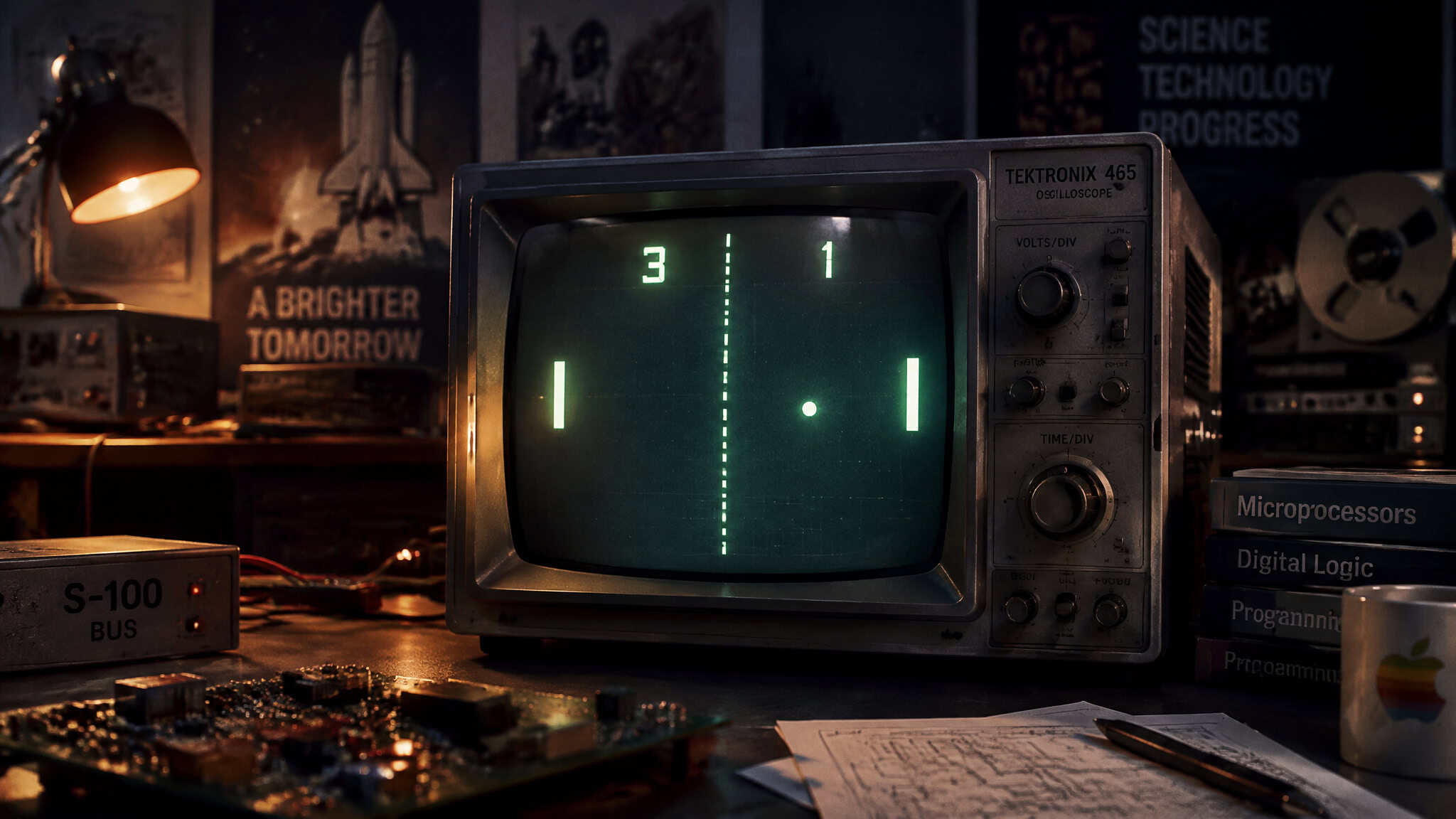
Ralph Baer’s Table Tennis on the Magnavox Odyssey (1972) was the only fully electronic, no-overlay Odyssey game, and it introduced ball-and-paddle console design. Pong (1972, Atari) became the first commercially successful video game and the best-selling US arcade game of 1973. Two lines and a dot, and you knew it was tennis. No manual required. What followed was a clone-flooded ball-and-paddle era from 1973 to 1975, and it crashed the market mid-decade.
Tomohiro Nishikado’s TV Basketball (April 1974) introduced the first human character sprites in any video game, and Atari Football (October 1978) first accurately emulated American football and popularized the trackball, with Atari staff likely inspired by Sega’s World Cup rather than Taito’s Soccer, per Kent (2001). And IWSB’s broadcast-style camera system and Intellivoice speech were innovative but a commercial failure, proof that even the genre’s cleverest ideas could still lose at the register.
Tournaments before Twitch: competition as shared architecture
Competitive spectator gaming predates esports by decades, and two dated proofs carry the argument. The shared architecture is competition, clear winners and losers, rewards for the winners, and where esports vs gaming splits is the stakes: esports tournaments pay cash prizes to the winners, while casual gaming pays nothing.
Proof one: Track & Field (September 1983, Konami) sold 38,000 Japanese arcade units, catalyzed worldwide arcade sports popularity, and launched the world’s biggest video game tournament with over a million players in 1984. Sit with that. A million people competing at a video game in 1984, the same year the Macintosh shipped. The genre’s first mass esports moment happened before the genre had a name for it.
Proof two: NBA Jam (1993, Midway) generated over $1 billion in its first twelve months, the highest-grossing arcade sports game ever. A billion dollars, in quarters, from a game where players catch fire. I still find that absurd in the best way, and the game itself still holds up 30 years later. Its “on fire” fantasy showed something important: games amplify sport while keeping the competitive core intact.
Around those two anchors, the architecture was already shared. Arcade high-score culture was competition in miniature: a leaderboard, a three-letter initials ritual, a crowd. Esports now fills Wembley Arena and Staples Center, smaller events stream on Twitch, and the impact of esports on traditional sports shows in fans rooting for teams and players in both domains with the same jersey-wearing energy, just different merch. What esports did not do is invent gaming competition.
The bracket, the prize, the crowd, and the heartbreak were all in arcades forty years ago. Twitch just added the chat.
The two-way fandom funnel
The funnel runs through controllers in both directions, and there’s evidence on each side.
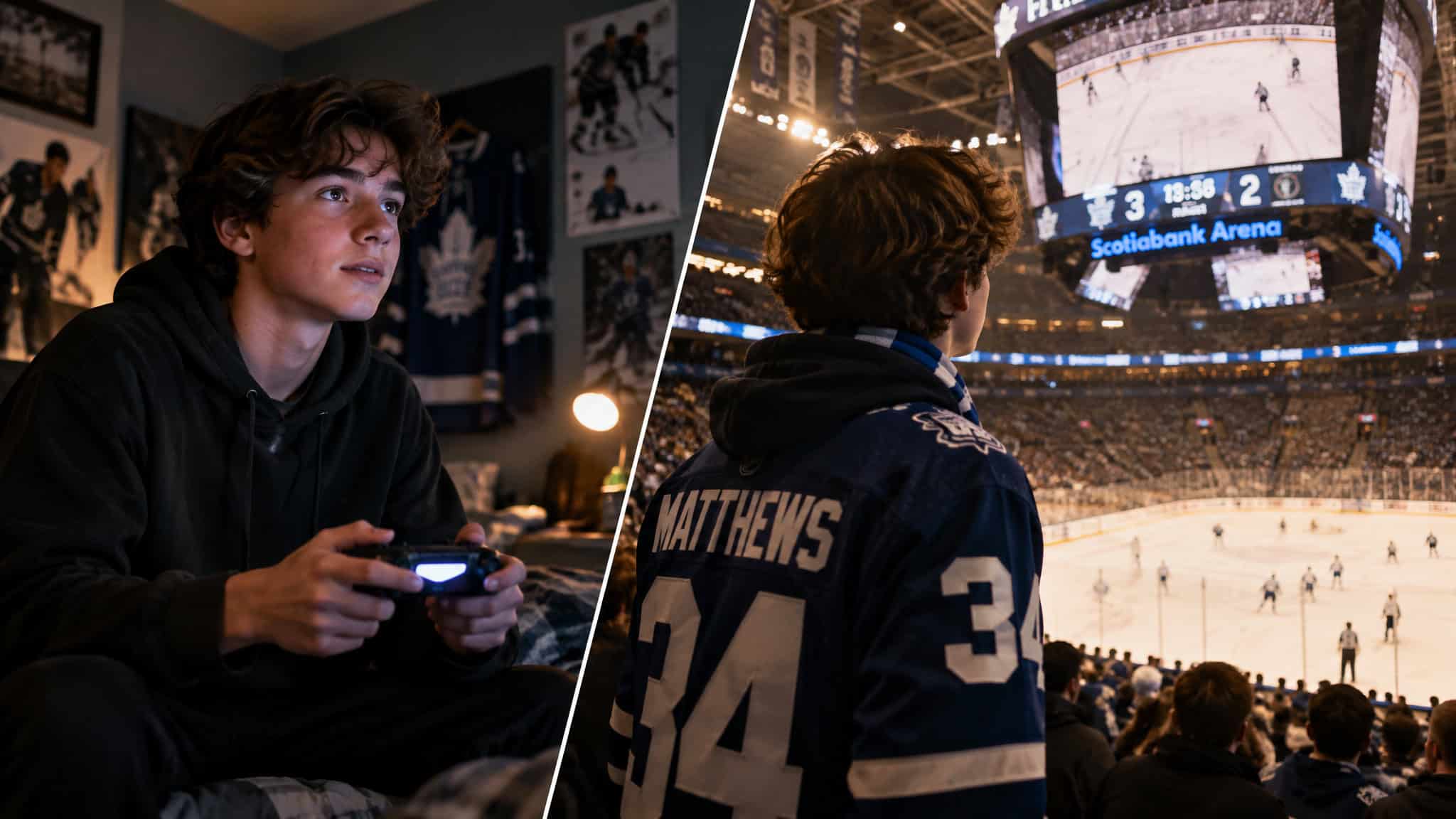
Games create fans: the 38% study and the Roenick effect
A 2010 study found 38% of under-21 male gamers played games featuring sports they played in real life, a number scoped to that group and that year, not a universal claim. Bob Cook’s son learned baseball’s rules from a kid-friendly game before competing in high school basketball, having already played NBA 2K, and that pattern (young fans arriving at real games already fluent tactically) is a well-worn path. There’s also a documented example of the mechanism in miniature: a fan roughly 1,000 miles from Chicago became a Blackhawks fan through Jeremy Roenick’s overpowered 1994 game character. Video games teach player names, team names, rules, and league dynamics as accidental onboarding, which is honestly kind of elegant.
Athletes are gamers: LeBron, Booker, and the dissolved divide
Fortnite features LeBron James, Naomi Osaka, Patrick Mahomes, and Neymar Jr. Call of Duty features Kevin Durant, Lionel Messi, and Neymar Jr. Gordon Hayward signed with HyperX, Karl-Anthony Towns is a Lumosity Games creator, and Devin Booker took part in Call of Duty’s 20th-anniversary celebrations. Some sports titles even include athlete motion capture and dialog. The 1980s “No-Friend-O” jocks-versus-nerds divide has dissolved: MLB sped up its games for video-game-raised audiences, TGL is building “arena golf,” and advertisers still treating these audiences as distinct are missing the overlap in an industry estimated at $242 billion. For marketers, the practical takeaway is simple: since the line between sports fan and video game fan is largely non-existent, plan campaigns for one converged audience instead of two separate buys.
Licensing: why games needed real sports to feel real
Games needed real-world sports legitimacy to function, and the dependency runs both directions. The chain: Mattel Basketball (1980) was the first NBA-licensed game. Dr. J and Larry Bird Go One on One (1983) was the first athlete-licensed sports game, selling 400,000 copies by late 1988. Tecmo Bowl (1989) was the first console game with real NFL players, and Tecmo Super Bowl (1991) was the first with dual league and player licenses; ESPN ranked it the greatest sports game ever.
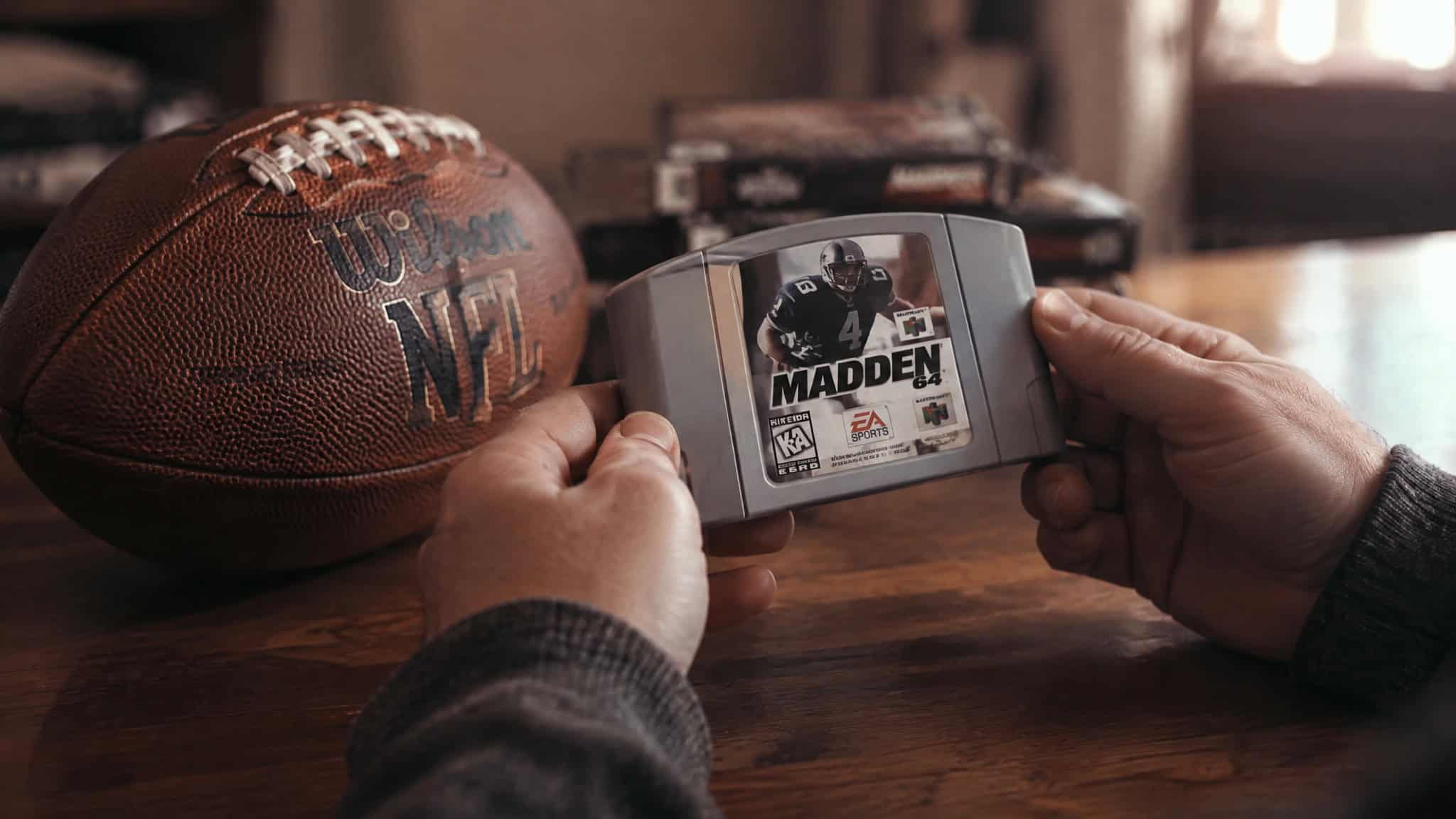
A sports game didn’t need to look like TV; it needed to capture how the sport felt to the people who cared about it. And famously dominant video game athletes (Bo Jackson in Tecmo Bowl, Michael Vick in Madden 2004, Sergei Fedorov in NHL ’95) became part of fan memory, the kind of player who ruined sleepovers.
Annual roster updates mirroring real-world changes make sports games dependent on live leagues, a dependency no other genre has. EA’s exclusive NFL deal (December 13, 2004, $300 million) consolidated the market and turned licensing into a moat, with expansion into NCAA rights in April 2005 and AFL/ESPN in January 2008. Games also simulated sport’s surrounding apparatus: Joe Montana II (1991) brought the first football audio commentary, and modern live-service design (ranked matchmaking, cross-platform play, seasonal content, broadcast-style presentation, AI-generated commentary research, dynamic difficulty adjustment, career and franchise modes, VR interfaces) replicates league calendars and broadcast conventions. If you subscribe to one of these, you know: it’s a service, not a product.
Rivalry as the shared innovation engine
Competition drives improvement in both worlds, the genre’s post-2004 stagnation is the controlled experiment. FIFA versus PES is considered the greatest rivalry in sports game history: PES had the tactics, FIFA had the licenses, a clean trade-off with no declared winner. Madden versus NFL 2K5: Visual Concepts priced NFL 2K5 at $19.99 with ESPN broadcast presentation, and for twenty bucks you got a football game that looked like Sunday television and outsold Madden in 2004. Madden Football itself had sold roughly 400,000 units in 1990 against about 75,000 expected, numbers first, meaning second: the genre had an audience nobody predicted.
Then the counterfactual. After EA’s 2004 exclusivity, year-over-year improvement slowed, NFL 2K ended, and experimental spin-offs like NFL Street, NBA Street, and The Bigs were discontinued. The early-2000s peak (split-screen couch play, Jordan mode, NFL Street freeing football from rules, MLB Power Pros) showed simulation and experimental tracks pushing each other. Later, the leaps got smaller, cost more, and features disappeared. Competition is the trait both worlds share, and both need.
Duopoly, monopoly, and the fans who kept a dead game alive
The North American market is an EA Sports/2K Sports duopoly built on league licenses, with Sony’s MLB The Show holding a baseball monopoly after 2K withdrew following MLB 2K13, management games surviving via small independents and fantasy sports like Yahoo, and Nintendo’s Mario sports titles selling exclusively on Nintendo consoles. Emerging competition (Pro Yakyu Baseball, Play by Play Studios’ NBA The Run) is testing the consolidated order. The grounding detail: volunteer communities (MVP Mods) sustained MVP Baseball 2005 for 20 years after EA abandoned it, ending via server failure rather than legal action. For 20 years, volunteers with no funding and no institutional support did for free what EA stopped doing for money, the PS3 and PS4 came and went, and the game was still going because an online community wanted to keep the spirit of the best baseball video game ever alive. Fan devotion behaving exactly like sports fandom loyalty, and the good kind of overengineering.
The convergence nobody wanted: betting on both
So back to my phone folder. The two wagering experiences have quietly merged into one habit, often the same apps, odds formats, and vocabulary: someone who bets on Sunday football casually places a small wager on a game tournament without noticing they crossed a line that didn’t exist a decade ago. The structural cause is that gambling-adjacent logic was already inside the games years before esports betting went mainstream. FIFA Ultimate Team (2009) sold randomized card packs with undisclosed odds and generated over $1 billion annually within five years, and team-building and loot-box modes spread across Madden, NBA 2K, NHL, and MLB The Show.
Regulators treated it as gambling: Belgium banned loot boxes in 2018, the Netherlands and UK Gambling Commission acted, and EA told US Congress they were “surprise mechanics” that were “enjoyable and quite ethical.” Let that one hang. To be precise about the boundary: loot boxes are gambling-adjacent, not legally the same thing as sports betting. But the two worlds converged on wagering from opposite directions, and now it’s one habit.
Where the similarity breaks: the concussion EA left out
The analogy breaks where simulation chose not to simulate. Madden depicted dislocated shoulders, broken ribs, and ankle sprains, but concussions vanished after Madden 12 (2011) amid NFL licensing-department reviews, while the NFL paid more than $1.5 billion in concussion lawsuit claims. In August 2026, Klick Health and the Derek Sheely Foundation released a free PC mod for Madden 26 reintroducing concussion symptoms (blurred vision, nausea, tinnitus, screen shaking), ending with a memorial banner of Derek Sheely’s No. 40 jersey. Sheely died at 22 in 2011 after a college practice brain injury, with a $1.2 million NCAA settlement.
Frequently Asked Questions
How are esports similar to traditional sports competition?
The architecture is identical: brackets, prizes, crowds, and heartbreak. Esports fills Wembley Arena and Staples Center, smaller events stream on Twitch, and top players train like athletes with daily practice hours and mentorship. Competitive spectator gaming isn’t new either — Konami’s Track & Field drew over a million players to a tournament in 1984, decades before ‘esports’ was a word.
Can you bet on esports like traditional sports?
Yes, and the two wagering experiences have merged into one habit — often the same apps, odds formats, and vocabulary. The convergence started inside the games themselves: FIFA Ultimate Team sold randomized card packs generating over $1 billion annually within five years, and Belgium banned loot boxes in 2018 as gambling. Loot boxes are gambling-adjacent rather than legally sports betting, but the line between betting on a pitch and a server has effectively disappeared.