There’s a specific file that lives in everyone’s downloads folder: a game mechanics PDF, grabbed in two clicks from some search result and then opened exactly once, ninety seconds of skimming, then back to the folder forever. Nobody checked where it came from. Nobody has a plan for reading it. It just… sits there, joining the other PDFs.
This article exists to break that pattern. What follows isn’t a link dump; it’s a filtered shortlist of genuinely free, legitimately hosted material organized by type, plus a reading order that turns the folder of half-skimmed PDFs into actual study. The curation standard here is inherited from a vetted list: Robert O. Duncan’s resource roundup on the CUNY Academic Commons, published August 16, 2015. That vintage cuts both ways.
It’s a list that has held up, and it’s also old enough that some things have changed (Gamasutra got renamed, for one). We’ll flag what’s evolved at the end and keep the filter rule front and center: this is how the list below was built, and it’s how you should filter anything else you find.
Key Takeaways
Legitimate free game design material comes from author sites, publisher sample pages, open-access academic hosts, and .edu course pages; a searched PDF of a paid book like Schell’s The Art of Game Design is not a legal free copy.
University syllabi are the underrated find: UConn’s DMD 2500 (Ken Thompson, Fall 2021) is a real course PDF with a workload-tested reading list including Valve’s “The Cabal” and the Dead Space UI case study.
The reading order that works: the MIT game-state definition first, then one full book (Schell), then one deep paper (Itay Keren’s Scroll Back), then one MDA worked example applied to a game you know.
Table of Contents
What game mechanics actually are (before you download anything)
Game mechanics are a set of rules (usually more than one) that let a player change the game state. That’s the definition from an MIT OpenCourseWare lecture, and it’s the flat-open answer worth carrying into every PDF you download: mechanics are the rules; the game state is everything else. There’s a fuller deep-dive on what game mechanics actually are, but here’s the version you need before downloading anything.
The game-state definition and the reproducibility test
Game state is all the changeable information you’d need to reproduce and continue a game in progress. It’s also why games are interesting in the first place: the philosopher Bernard Suits used golf as his example of a voluntary unnecessary obstacle, a game where you accept rules that make hitting a ball harder purely for the satisfaction of overcoming them. The lecture’s thought experiment is a telegraph test: if you described the game to someone remotely, what would they need to keep playing? Whatever you’d transmit, that’s the state.
Monopoly’s board layout doesn’t qualify, it never changes, so it’s static, not state. Edge cases get genuinely fun: cricket’s time-wasting tactics, or weather and fatigue in multi-day races, get handled through start-time handicaps, which is exactly the kind of mess that makes the definition interesting instead of academic.
The MDA chain, via Texas Hold ’em
MDA stands for Mechanics, Dynamics, Aesthetics, and the shortest way to get it is poker. Card-draw and turn rules are mechanics. Bluffing and all-in moments, which arise because some information is private and some is public, are dynamics. The emotional swings are aesthetics.
The chain runs one way: designers control mechanics, mechanics drive dynamics, dynamics produce the feelings. A short PDF covering MDA exists and is a perfect low-commitment first download. Bonus: the framework generalizes past games. Pick the target emotion first (dating = thrill, travel = escape), design the rules backward from it, and note that Match.com gets cited as a thrill counterexample, which is the gentlest jab in design literature.
Core mechanic vs. core dynamic
These terms sound interchangeable and aren’t. From the Challenges for Game Designers discussion: dynamics shape player experience more than mechanics do, but mechanics are the only lever designers directly hold. Blokus proves it: piece locations, played pieces, and turn order are the state; corner-touching placement is the core mechanic. You can change the mechanic, but you feel the dynamic.
Full game design books you can legitimately download
Here’s the decisive split before anything else: a small set of genuinely author-released free books exists, and a much larger set of paid books is exactly what everyone searches for as PDFs. Only the first group is free; the second is legitimately accessible through excerpts, publisher sample pages, and libraries, and we’ll say that plainly rather than pretend otherwise.
The free one that earns its reputation first: Game Programming Patterns. It’s free as in beer, which matters because pattern books usually aren’t. Each chapter covers one pattern and opens from a concrete problem rather than abstract theory, which is precisely why it teaches well: you see the problem before the solution. The examples are short, simple C++ that stays readable even if C++ isn’t your daily driver, and the margin comments carry complementary asides that reward close reading. It’s also honest in the anti-hype way: it covers where patterns fall short and how they evolved, instead of treating them as dogma.
The story-structure pick is Christopher Vogler’s The Writer’s Journey, which expands Joseph Campbell’s The Hero with a Thousand Faces. The claim that most stories share a broad structure is a useful lens, not a law. The genuinely free bonus: Vogler’s earlier practical guide, written for Disney employees, sits on his own website. Author-released, fully legit, and free before the book even existed.
The paid canon, labeled paid
These are the books people hunt as PDFs, and the honest answer is library access, publisher samples, or excerpts:
| Book | Free full PDF? | Legitimate access |
|---|---|---|
| The Art of Game Design (Schell) | No | Library, publisher samples |
| Level Up! (Rogers) | No | Library, publisher samples |
| Rules of Play | No | Library, excerpts |
| The Game Design Reader | No | Library, excerpts |
| Challenges for Game Designers | No | Library, excerpts |
| The Design of Everyday Things | No | Library, excerpts |
| Game Mechanics: Advanced Game Design | No | Library, publisher samples |
| Game Development Essentials: Gameplay Mechanics | No | Library, publisher samples |
That last pair is what search traffic targets most directly, and the supported answer is the library/sample path, not a magic URL. Which brings us to the verdict: if you buy one book, make it Schell’s The Art of Game Design. One deep book beats fifty random websites, and that’s not anti-internet zealotry, it’s arithmetic about your attention, though a focused piece on what makes a good casual game can sharpen how you read it. We’ve got a full breakdown of the mechanics design books worth owning if you want the comparative detail.
University course PDFs: the syllabus is the reading list
University syllabi and lecture notes are a findable, free resource class, and a syllabus is arguably the most honest reading list you’ll encounter: it’s curated, workload-tested, and written by someone accountable for whether students actually finish. The worked example is UConn’s DMD 2500, Introduction to Digital Game Design.
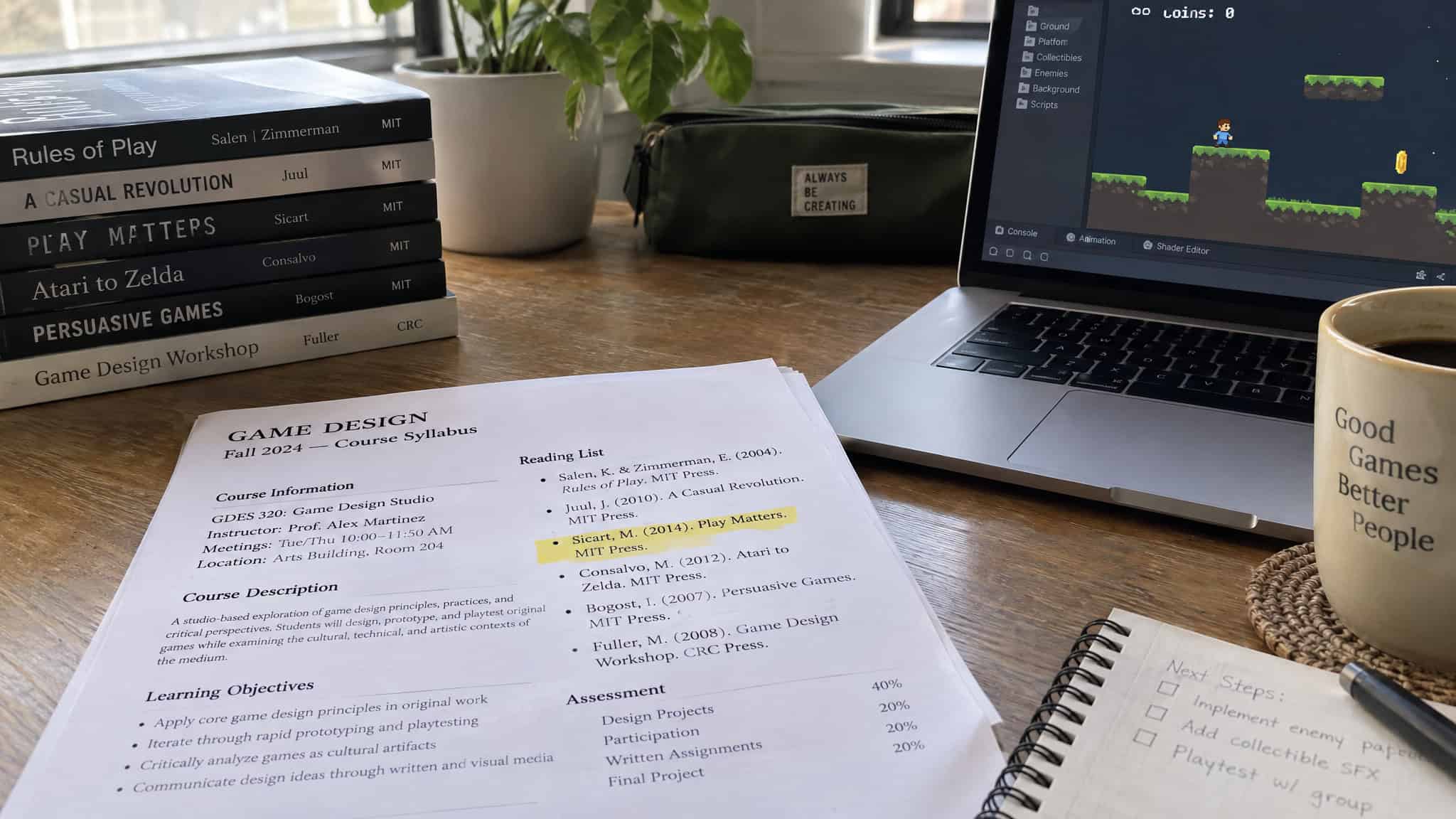
UConn DMD 2500 as the worked example
It’s a real course PDF, taught by Ken Thompson in Fall 2021, culminating in students designing and building a 2D game in response to an RFP using the Corgi Engine, with Rogers’ Level Up! as the assigned text. Expected workload: about 10 hours a week. The gold is the reading list: Valve’s “The Cabal,” the Dead Space UI case study, a The Stanley Parable play session, assignments like a Mario 1-1 remake and an FPS mod, and the Three A’s critique framework (Answer questions, Ask questions, Add detail), a peer-feedback rubric you can steal for your own game-jam Discord today. Worth knowing honestly: student games go public on Github.uconn.edu with names shown by default, and privacy requests have to be raised in the first two weeks.
The discovery pattern
filetype:pdf searches surface syllabi and lecture notes, and MIT OpenCourseWare provides the academic treatment of mechanics definitions. That’s a discovery pattern, not a guarantee that every syllabus is public. But the point stands: a syllabus is more honest about difficulty than commercial blog posts, because an instructor has to make it work for real students with real workloads. If you’d rather take a structured route than self-study from PDFs, we’ve compared mechanics design courses side by side.
GDC talks, slide decks, and the one paper worth your time
Yes, GDC Vault talks and slides are a legitimate substitute for a mechanics book, and the slide decks are the closest free thing to professional design documents. The free section of the Vault is the classic “wait, this is free?” midnight rabbit hole: well-known industry developers giving talks in video and slide format, and you didn’t pay for any of it. The slides option deserves a deliberate mention, because deck-skimming is a legitimate speedrun for busy devs. More content lives on the GDC Vault YouTube channel, which releases a few videos weekly; that’s a feed actually worth a slot in your subscriptions tab.
If you’d rather read than watch, Gamasutra is the text-based counterpart: text you can search, copy from, and read at 2am without headphones. No format-superiority verdict here; pick your medium.
And the single paper that earns a reading-time slot instead of indefinite archive browsing: Scroll Back: The Theory and Practice of Cameras in Side-Scrollers by Itay Keren. It’s a deep analysis of side-scroller camera design and player controls, covering techniques for tight game feel (that’s the exact vocabulary for what it solves). Keren himself describes it as one of a kind and wishes there were more like it, and that affectionate confidence is earned.
Where to see mechanics design in progress
Documented mechanics repositories, where you can watch the design process rather than just learn vocabulary, do exist, and Three Hundred Mechanics is the flagship.
Three Hundred Mechanics (squidi.net)
- Three Hundred Mechanics (squidi.net) is Sean Howard’s project to design and write up 300 game concepts, the entries document ideas, sometimes with full algorithms and design-process notes. It’s a designer’s public idea journal you can raid.
- The delight moment: the companion site, Three Hundred Prototypes, has HTML5 test games for some of the concepts, so you can literally play the ideas.
- The procedural generation category is the standout, genuinely hard to find elsewhere. Start there.
Ludum Dare
The jams run multiple times a year, and here’s the wild part: source code and assets from main-event entries are public. Nobody lectures you; you learn by reading real shipped jam code. Concretely: if you want to learn project organization, reading the Haxe project structure of Deepnight’s Ludum Dare 30 sources is honestly a good way to do it.
Donjon
A generator toolbox covering dungeons, shops with randomized descriptions, names, and calendars, with toolsets for fantasy, D&D-inspired, and sci-fi settings. Tiny wizardry energy. Originally built for tabletop players, and video game devs can repurpose it just as easily.
GitHub Education Pack
Normally paid developer services, including cloud hosting and private GitHub repos, free with a school email and student ID verification. Students-only, flag it plainly: if you’re not a student, don’t chase it.
Supporting skills: art, storytelling, and reference resources
The original list also covered the skills around mechanics design, and each of these earns its slot on the same filter standard: one deep trusted pick per category.
- Ctrl+Paint (Ctrlpaint.com) is our single art pick: 200+ free videos, about 5 minutes each, by freelance concept artist Matt Kohr. Commit to one; this is it.
- Proko covers human figure drawing and technique, with well-edited, sometimes animated videos.
- 2D Game Art Guru is Chris Hildenbrand, 20 years of vector drawing, writing tutorials for programmers and non-artists; recent ones use free Inkscape.
- GDquest offers around 30 polished tutorials, a new one every Thursday, in English and French, mostly 2D game art plus some design insight.
- Game art Tricks (simonschreibt.de) reverse-engineers commercial visuals: Diablo 3, Assassin’s Creed 3, The Binding of Isaac, parallax in Don’t Starve, Bioshock Infinite’s faked window interiors. The lesson throughout: smart fakery beats brute force.
- Android Arts is Niklas Jansson’s archive of art tricks and principles, with pages that show his design thought process in images. Older-web gem energy.
- Seven Camels is Disney storyboard artist Mark Kennedy (Frozen, Tangled, Tarzan) writing on visual storytelling since 2006, directly transferable to game framing and cinematics.
- Reddit’s reference subreddits and Creative Uncut round out reference imagery. The network’s actual name is the delightfully awkward “SFW Porn Network” (yes, SFW, safe for work; the name is as awkward as it sounds). Creative Uncut collects watermark-free art from Odin Sphere, Breath of Fire V, Dark Souls III, great for study, not for lifting into your game.
General learning indexes
Two generalist indexes complete the inventory honestly. No Excuse List is free learning links across music, languages, programming and more, including Coursera and Khan Academy; the name is the pitch. University of Reddit is community-run free courses across social sciences, games, CS, and philosophy, with categorized posts and voting surfacing the good lectures. One grounding detail each, and that’s all they need.
Is that PDF legit? How to tell free from pirated
No: a PDF of a paid book like The Art of Game Design found through search is not a legal free copy. The legitimate free material comes from authors, publishers, universities, and open-access hosts. The hosting-domain tell is the practical filter: author sites, publisher sample pages, open-access academic hosts, and.edu course pages are legitimate; random file-locker mirrors are not. Library access is the honest path to the paid canon.
The norm anchor comes from a real course policy. UConn’s DMD 2500 permits reusing code and assets with appropriate licensing, with freesound.org cited as the model, but treats copyright infringement as never acceptable, and notes that web crawlers detect infringing material. Frame that as “borrow legally, it’s easy,” not as a scolding. We’re not naming pirate sites, not ruling on any specific searched PDF, and not offering legal advice; this is a practical heuristic, not counsel.
The reading path: what to read first, and why long lists fail
Start with one deep book, Jesse Schell’s The Art of Game Design, over fifty random websites. That’s the whole verdict, and here’s why it holds: the failure pattern with long lists is real and universal. You bookmark a 50-link roundup, skim it once, favorite two things, and never return. The fix is a filter: one or two deep, accessible, trusted sources per category, then stick with them.
Schell over 50 websites. Ctrl+Paint over dozens of cheap Gumroad trainings. The selection criteria are dense content and trustworthy authors, nothing more exotic than that. It’s the same logic behind Bautista’s Friday peer-help sessions, where faster students assist the others: a small, trusted set of supports beats an overwhelming pile of options.
The sequenced path, with extraction goals
Four steps, each with a goal:
- The game-state definition (MIT lecture): learn what mechanics are and how to test definitions against the reproducibility test.
- One full book (Schell, or Level Up! if you’re more hands-on and engine-minded): vocabulary and breadth.
- One deep paper (Scroll Back): what a professional design deep-dive actually looks like, so you know the shape of good analysis.
- One MDA worked example (Texas Hold ’em) applied to a game you know: reason backward from the feeling to the rules that produce it.
The extraction rule that ties it together: extract the rules you control, predict the dynamics you can’t. That mirrors how DMD 2500 sequences its readings, critique (the Three A’s), and play, which is a decent signal that the ordering works under real workloads.
Freshness and context caveats
The anchor list dates to August 16, 2015, so say it once and plainly: it’s vintage, links decay, and Gamasutra has since been renamed Game Developer. None of that invalidates the curation standard, but don’t assume every link was checked this week.
Context, not an engine war: Owen Peery switched from Unity to Godot after two years, citing an incomplete Create with Code curriculum, weak 2D resources, and admin-permission popups, and spotty Silicon Mac support. Garth Flint stayed with Unity 2D, arguing the real cost of switching is relearning time for a working teacher, which outweighs the benefits, and he points to a specific Unity 2D YouTube tutorial (youtu.be/8qciEnDt-n8) as a reason to stay put. Both positions are context-dependent calls; neither is wrong. For structured Godot instruction, GDquest’s Learn to Code from Zero counts as complete programming instruction.
As a past data point on how these community resources evolve: the CUNY Games Conference 8.0 ran February 27-28, 2022, a reminder that this ecosystem keeps moving, and yesterday’s canonical list is always one rename away from needing an update. Which is exactly why the filter rule, one or two deep trusted sources per category, outlives any individual link on it.
Frequently Asked Questions
What are the basic game mechanics?
Game mechanics are a set of rules — usually more than one — that let a player change the game state, which is all the changeable information needed to reproduce and continue a game in progress. In Texas Hold ’em, the card-draw and turn rules are the mechanics. A quick reproducibility test: if you described the game to someone over a telegraph, whatever they’d need to keep playing is the state the mechanics manipulate.
What should I read first to learn game design: Jesse Schell’s The Art of Game Design or free online resources?
If you buy one book, make it Schell’s The Art of Game Design — one deep book beats fifty random websites. The full sequence: the MIT game-state definition first, then Schell (or Level Up! if you’re more hands-on and engine-minded), then one deep paper like Itay Keren’s Scroll Back, then an MDA worked example applied to a game you know. Long lists fail because you bookmark fifty links, skim once, and never return; one or two deep trusted sources per category is the fix.
What’s the hardest part of learning game mechanics from free PDFs?
The real difficulty isn’t finding material — it’s that downloaded PDFs get opened once, skimmed for ninety seconds, and abandoned. The fix is a reading plan with extraction goals, not more downloads. A practical rule that ties it together: extract the rules you control, and predict the dynamics you can’t, applying each concept to a game you already know.