
Here’s the annoying truth I ran into while digging through roughly 923 game design and development course listings across Coursera, Udemy, MasterClass, edX, University of the People, and CourseHorse: almost none of them say “game mechanics.” They all say “game design.” And that word swap matters, because design is the umbrella, art and storytelling included, while mechanics is the rules-and-systems-and-balancing subset you’re actually searching for, the stuff that gets endlessly litigated in the best Reddit threads on game mechanics, where designers argue over progression systems and RNG. Pick wrong and you spend three months learning art history when you wanted to learn why your jump feels floaty. So I did what we do to graphics cards here at GeekExtreme: tore the listings down.
So I scored everything. The big one: how much actual mechanics/systems content the published skill lists show. Then what you really pay once subscriptions and sales enter the picture. And whether completing the thing produces a playable game or just a board-game exercise. And I read the ratings skeptically, because a 5.0 from nineteen people is not the same animal as a 4.7 from four thousand.
Table of Contents
What a game mechanics course actually covers
These courses teach the rules, systems, goals, feedback loops, and balancing that make a game tick, plus the tools that turn rules into something playable: Unity, Unreal, C#, and prototyping and playtesting workflows. Game design is the bigger tent, covering stories, pacing, concept, and the player-challenge interaction alongside mechanics. Mechanics are the subset. Most “game design” courses aren’t mechanics-specific, so the skill list is where you do the real work: if you see game theory, systems design, prototyping, or playtesting, that listing is mechanics-dense.

If it leads with art history, storytelling, or UI, it’s adjacent at best. Compare CalArts’ Game Design: Art and Concepts (game theory, conceptual design) against Wiley’s Foundations of Video Game Design (systems design, AR/VR) and you can see the density difference before spending a dollar. And yes, the engines are real: Unity powered Pokémon Go and Among Us; Unreal powered Fortnite and, per the sources, the upcoming S.T.A.L.K.E.R. 2. Learning the tools the industry actually ships on is the whole point.
CalArts game design courses: creative track, low mechanics density
Depends on what you want: the California Institute of the Arts courses are the gentlest on-ramps on Coursera, and also the lowest on actual mechanics content, so the fit test matters more than the ratings.
Introduction to Game Design
Taught by CalArts professor Fran Krause, this one carries a 4.7 from around 2,900 learner reviews, runs about six hours, is non-technical, and here’s the wrinkle: the first exercise is creating a board game. That same board-game opener is what a 3/5 editorial critique flagged as too generic to feel like video-game training. Both signals are real. Thousands of learners liked it; the editorial view found the material drifting away from video games. The truth is probably that it’s exactly what each audience expected it to be.
Game Design: Art and Concepts
This is the more mechanics-adjacent of the pair: 4.7 from 4.2K reviews, 3 to 6 months, and a skill list that includes game theory, prototyping, and conceptual design. That review count is the real story here. Four thousand-plus people finished enough of it to rate it, and they liked it. It’s the art-school-brain option: less code, more “what should this game feel like.”
The board-game-first exercise turns out to be the cheapest fit test in the market. If paper prototyping sounds like a fun Friday night, this is your track. If you wanted playable output, you just dodged the most expensive mistake in this section.
Epic Games Game Design Professional Certificate
The fork you’re choosing at is creative design versus technical engine skills: CalArts for creative learners, this certificate for Unreal-leaning beginners, and the MSU/C# tracks for build-first people. The listing reads 4.3 from 655 reviews, Beginner level, 3 to 6 months. And the geek appeal is real: you’re learning Unreal from the people who build the engine. It’s a multi-course Professional Certificate, so you finish with a named credential, not a single video dump. What actually sets it apart is that it ties design thinking to production workflows, which is how you dodge tutorial hell where you keep rebuilding “how to start.”
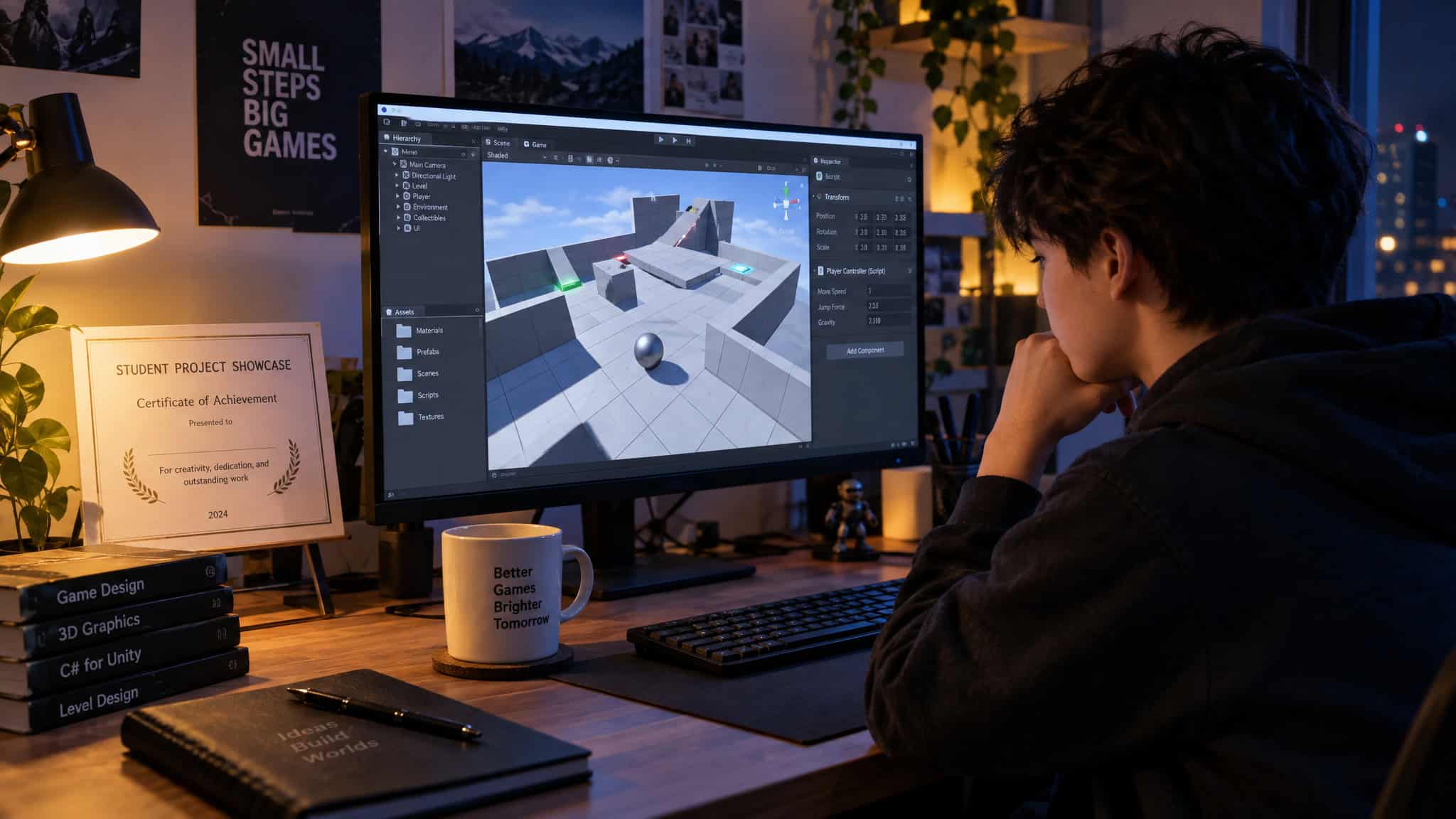
The honest tradeoff: the skill list leans engine and production (3D modeling, UI/UX, prototyping), so pure mechanics and systems content gets diluted compared to CalArts. If you’re credential-first, you get a named certificate plus Unreal exposure. If you’re build-first, you get production breadth over mechanics depth. Both are fine answers to different questions.
Inside Michigan State’s Unity specialization: what completion actually looks like
Game Design and Development with Unity Specialization (Michigan State) is worth $79 per course for learners who want playable Unity output from real university faculty, with caveats about format and timeline. That’s the verdict, and the strongest supporting detail is this: the same professors teach it as MSU’s top-rated on-campus game design program. Five courses, nominally one month each, 4.7 from 673 reviews. The timeline is a suggestion, by the way.
Blogger Nadya Primak, who completed the specialization and wrote about it on the Game Developer blog, did one course per week instead of one per month. Speedrunners, the door is open.
Her capstone sequence is the best window into what you actually build, in order:
- Roller Madness, a 3D Roll-A-Ball Box Shooter. Your first 3D thing that moves.
- A 3D FPS. Yes, a little first-person shooter, each project bigger than the last.
- Queen Dungeon Escape, a 2D platformer she described as the most fun of the three, with unique mechanics. The finish line, and by her account the enjoyable one.
The course-by-course path
Intro to Game Development has you make a couple of basic Unity games, and per Primak’s writeup it alone suffices if your goal is simple first-person games. Her honest skip-list for technical-only learners: Business of Game Development and Principles of Game Design. Advanced Game Development is where platformers come in. Save the money where your goals allow.
Structure, value, and the 500-section problem
Certificates cost $79 per course and share to LinkedIn, and per Primak, paid certificates double as self-discipline motivators as much as credentials. The structural thing she praised is that the coursework comes in digestible chunks, which she contrasted with a roughly 500-section Udemy Blender course she described as overwhelming. The tell of a completable course is section structure, not total hours. Small bites beat a firehose, and MSU is the small-bites option.
One more caveat while we’re in Coursera territory: some assignments there require peer review to finish, and peer reviews can be slow or low quality, which inflates your completion time. Pad your timeline accordingly.
Field note: Peer-review assignments on Coursera can stall your finish date, so build slack into any specialization timeline.
Michigan State’s standalone game design course
Heads up: this is a separate listing, not the 5-course specialization, and conflating them is the classic “check the URL” mistake. It’s 4.4 from 540 reviews at Beginner level, and as a single course it runs 1 to 4 weeks. The skills list leans conceptual, ideation, interactive design, conceptual design, design docs, plus software development methodologies and collaborative software tooling, so it’s teaching you how design work is structured, not how to ship code. Think of it as the snack-size taste of MSU teaching before committing to the specialization buffet, a quick toe-dip you could finish over a long weekend or stretch across a month. Just don’t assume the certificate carries the same weight as the full specialization’s, because it doesn’t claim to.
John Wiley & Sons courses: structure and UI specializations
Foundations of Video Game Design: From Concept to Narrative is one of the few listings that names Systems Design explicitly, alongside AR/VR and UI skills, in a 3-6 month Beginner specialization. No rating shown anywhere, which makes this one early adopter territory. The Wiley Unreal UI course is a small-sample case study in itself: it shows two different ratings across listings, 4.1 from 24 reviews and 3.4 from 23. For the mechanics-design side of that skill set, there’s a solid guide to free game mechanics PDFs and papers covering university course notes, GDC talks, and classic design documents worth reading.
Intermediate and small-sample Unity and Unreal listings
The lesson here is rating literacy: a 5.0 from 19 reviews (Unity Engine Specialization) carries less information than a 4.7 from 4.2K. Quick rundown: the Unity Engine Course is Intermediate, 4.7 from 125 reviews, with an unnamed provider in the listing, so vet before buying. And if the goal is to level up your game and truly beat the competition, knowing your core gameplay mechanics like character stats, weapon classes, and map layouts matters as much as the credential, the Unreal Engine Specialization covering AI, physics, and simulation runs 4.8 from 25 reviews, Intermediate. Check the denominator before the rating. That’s it, that’s the section.
Technical engine tracks: Unity with C# or Unreal with C++
$149.99 is not the real price of Unreal Engine 5 C++ Developer. It routinely sells for $25 or less, and at that sale price it’s the cheapest deep option in the catalog. The engine choice underneath it is really a language choice: Unity with C# or Unreal with C++. C++ handles memory allocation and talks to hardware and graphics processes, which is exactly why it’s powerful, and also why CISA has scrutinized it for not being memory-safe. It’s also a language that consistently sits near the top of the TIOBE Index, the industry’s long-running measure of programming language popularity.
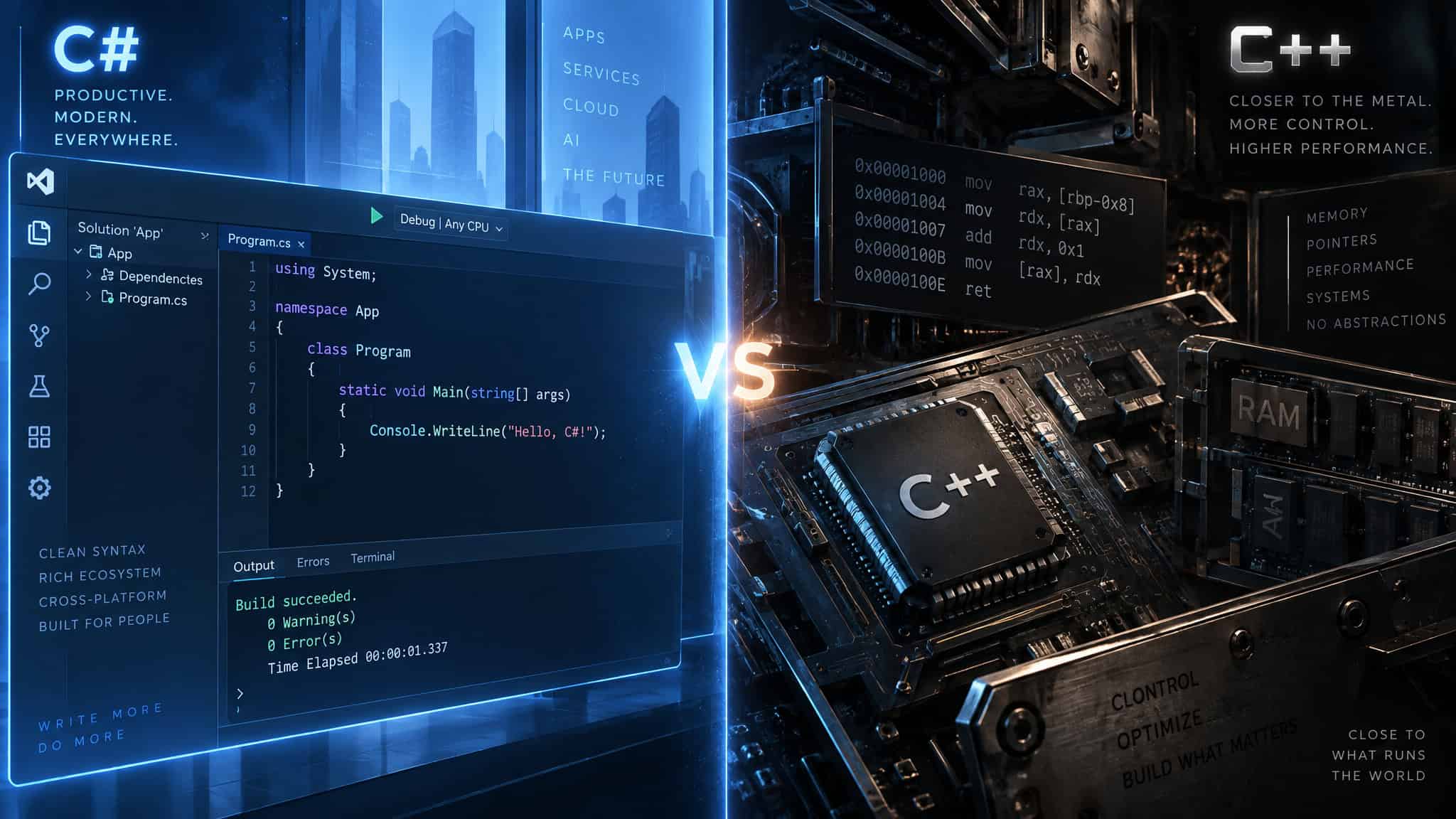
Powerful and slightly dangerous. Moving on.
C# Programming for Unity Game Development Specialization
Taught by a University of Colorado professor, this is roughly 120 hours (approximate; the source figure was truncated), and it mirrors actual freshman Game Design and Development classes: scripts, data storage, classes and objects, looping, sound and music. Beginner level despite the hour count. The college course without the tuition, minus the credit.
Unreal Engine 5 C++ Developer
29.5 hours of video across five practice modules, 4.6 on Udemy and a 4/5 editorial rating. The caveat that matters: the course is missing Enhanced Input content, and the instructors replied on August 15 promising a remaster. That dated reply tells you two things at once: the content lags the current engine, and the instructors respond. Content staleness is a priced-in risk here, and every Udemy course carries a 30-day money-back guarantee, which is your insurance: buy on sale, refund if it’s stale. Nadya Primak built her earlier games in JavaScript on Udemy before moving to Unity, for what it’s worth about winding paths.
Short bridge and low-commitment options
The honest duration sequence is 2-hour guided projects, then 1-4 week courses, then 3-6 month specializations, then the roughly 120-hour C# track, and hours spent tell you nothing about how much you gain. Some of the shortest courses deliver the most delightful payoff per hour, and some of the longest deliver credentials.
Introduction to Basic Game Development using Scratch
Two hours, drag-and-drop coding, and you end with a playable game you can send to a friend. That’s genuinely delightful. The 3/5 editorial review judged it too simple for job-search purposes and noted it works best for North America-based learners. It’s a toy, and as long as you walk in expecting a toy, it delivers.
Game Development: HTML to Unreal Engine Mastery
Two hours, updated May 2024, 5/5 editorial rating. It covers HTML5 game loops, graphics, and sound, then bridges to Unreal, which is a weirdly clever on-ramp: you understand what the engine does for you by doing it manually first. And the May 2024 update date is exactly the kind of signal you should check on any short course.
MasterClass, CourseHorse, and the AI wildcard
MasterClass runs 4 hours 16 minutes with a free trial: inspiration, not curriculum, one movie night and change. CourseHorse offers 9 hours for $100, a cheap experiment. And AI CERTs has a Beginner course on AI-powered creativity and agentic workflows, 1-3 months, no rating. Judge the content, not the buzzword.
The real cost math: free, subscription, per-course, and degree paths
Coursera Plus is worth it for game design courses when you’re taking more than one program on a completion timeline under roughly six months. Here’s the frame: paying per course means $49-$79 per month per program, while Coursera Plus runs $59/month with unlimited certificates, and a current offer gives 40% off the first 3 months, which works out to $35.40/month. Now the proof: Michigan State’s specialization costs $79 per course for a certificate, so all five come to $395. Anyone finishing the specialization inside about six months comes out ahead on Plus. Prices and promos move, so check before you commit; everything above is the listed figure, not a guarantee.
Cost check: Five MSU certificates total $395; Coursera Plus under six months at $35.40/month beats that if you finish on schedule.
Is Coursera Plus worth it vs paying per course?
If you’re taking exactly one short course and stopping, per-course pricing can win. The moment your plan looks like “the whole MSU specialization” or “several CalArts courses on a deadline,” the subscription math flips hard in Plus’s favor.
Can you learn game mechanics for free?
Two Coursera free paths exist: course previews, and the 7-day Coursera Plus trial. The trial is the real free path, because short courses like the Scratch project and HTML-to-Unreal are fully completable inside 7 days. Certificates require upgrading or getting financial aid. And for the record: a multi-course specialization carries more resume weight than a lone class, and paid certificates do double duty as motivator and signal. Both halves of that are fine.
The full spectrum
To lay out the whole range: CourseHorse does 9 hours for $100. Udemy sale prices hover around $25 for deep content. Coursera runs the tiers above. University of the People anchors the top with a 10-month self-paced program at $1,980.
And the punchline of the whole cost section: Udemy’s $149.99 list price is fiction. Nobody pays it. Any cost comparison built on list prices is comparing numbers that aren’t real.
Matching a course to your goal, and the degree question
Online courses can replace a game design degree for motivated learners. That’s the contrarian position, and once you see the price anchors, it becomes a math question rather than an ideology question. Nadya Primak argues a game development degree isn’t worth it and that quality specializations substitute, and University of the People’s 10-month, $1,980 self-paced program anchors the middle ground between a $25 Udemy sale and a traditional degree. Worth noting: game development overlaps significantly with computer science, so specialize versus broader CS is a genuine fork to think about, not a quiz with a right answer.
Which course first?
Four profiles cover most people. Paper-design first: CalArts. Build-first: MSU, the Colorado C# track, or UE5 C++. Credential-first: the Epic certificate.
Budget degree: University of the People. The recurring mistake is starting with a conceptual course and realizing you wanted playable output, or the reverse. Her practical advice bears repeating: skip business and design-principle courses if you’re technical-only.
Career-wise, the roles this path touches include game designer, level designer, narrative designer, gameplay designer, systems designer, producer, and interactive media creator, plus adjacent fields like education, training simulations, UX, and digital storytelling. Coursera’s related-skills guidance also points to the complementary skills that round out a mechanics-focused learner: storytelling, visual art, animation, programming, UX design, project management, and playtesting. And the entry barrier is low: curiosity, basic digital literacy, and willingness to test and revise. If you already DM a D&D table or sketch, you’re closer than you think. No salary figures exist in the reviewed sources, so I won’t invent any.
Quick answers: mechanics fundamentals, difficulty, pay, and starting age
What are the four elements of game mechanics? Honestly? No reviewed source defines a canonical four-element framework, and providers define the fundamentals inconsistently. What’s supported across the sources: mechanics cover rules, systems, goals, feedback, pacing, and the player-challenge interaction. If a course promises a tidy four-element breakdown, treat that as the provider’s framing, not industry canon.
Is game design high paying? No salary data exists in the reviewed sources, so I’ll say that plainly instead of making numbers up. The sources do support the breadth of roles, though: gameplay and systems design up through producer, with the skills carrying over into education, training sims, UX, and digital storytelling.
Am I too old to start? Prerequisites are minimal: curiosity, digital literacy, willingness to revise. No age-specific data exists in the sources. What actually decides your starting point is whether you lean design or build.
How to evaluate any game mechanics course before paying
Coursera and Udemy each fit different learners, and structure decides it for many people: Coursera’s chunked monthly courses versus Udemy’s massive section lists (that ~500-section Blender course again), with Udemy’s 30-day money-back guarantee as the safety net. Quick orientation: on Udemy, Game Development lives under Development (with 10 subcategories), while Game Design gets its own shelf under Design. Different shelves, literally.
Five checks before any payment:
- Review count before rating. 4.7 from 4.2K beats 5.0 from 19, every time.
- Skill-list mechanics density. Game theory, systems design, prototyping, playtesting: dense. Art history, storytelling, UI: adjacent.
- Update date and version-specific syllabus. The UE5 course’s missing Enhanced Input content and the HTML-to-Unreal course’s May 2024 update are both checkable signals.
- Project deliverables. Playable output like MSU’s capstone sequence beats a board-game exercise if building is the goal.
- True cost path. Subscription vs per-course vs sale, refund windows, and the peer-review caveat on Coursera: pad your timeline, because slow reviews can stall completion.
If you want a structured path, Udemy Business (used by Nasdaq, Volkswagen, NetApp, and Eventbrite) and the Game Developer Career Accelerator exist as guided routes.
Closing verdict
Paid game design courses are worth it when the course type matches your goal and your completion timeline matches your payment model. Everything else is sticker theater. Free paths work for short courses inside the 7-day trial and for previews; paid certificates add resume weight, with specializations reading better than single classes, and, honestly, motivation. Three trust tests travel with you from here: check the review denominator, run the subscription math, verify update currency.
And if you’re stuck on where to start, the cheapest self-test in the market is still CalArts’ board-game exercise. If paper prototyping sounds like fun, you know your track. If it sounds like homework, you just saved yourself several hundred dollars.
Frequently Asked Questions
What are the hardest game mechanics to learn?
The systems-level stuff is the hard part: balancing rules, progression systems, feedback loops, and the player-challenge interaction — not any single mechanic in isolation. That’s why mechanics-dense courses lean on game theory, systems design, prototyping, and playtesting rather than tutorials. Engine work adds a second difficulty layer, which is why tracks like C# for Unity or Unreal C++ take roughly 120 hours or 29.5 hours respectively.
Is a paid game design course worth it, or can you learn game mechanics for free?
Free works for short courses: Coursera’s 7-day Plus trial fully covers completions like the 2-hour Scratch project and the HTML-to-Unreal bridge, and course previews cost nothing. But certificates require upgrading or financial aid, and multi-course specializations carry more resume weight than a lone class. Paid courses are worth it when the course type matches your goal — everything else is sticker theater.
How do I tell if a game design course actually covers mechanics?
Read the published skill list, not the title — almost no listing says ‘game mechanics,’ they all say ‘game design.’ If you see game theory, systems design, prototyping, or playtesting, it’s mechanics-dense; if it leads with art history, storytelling, or UI, it’s adjacent at best. Then check the review count before the rating (4.7 from 4.2K beats 5.0 from 19) and verify the update date, since the UE5 course’s missing Enhanced Input content shows how fast engine content can lag.