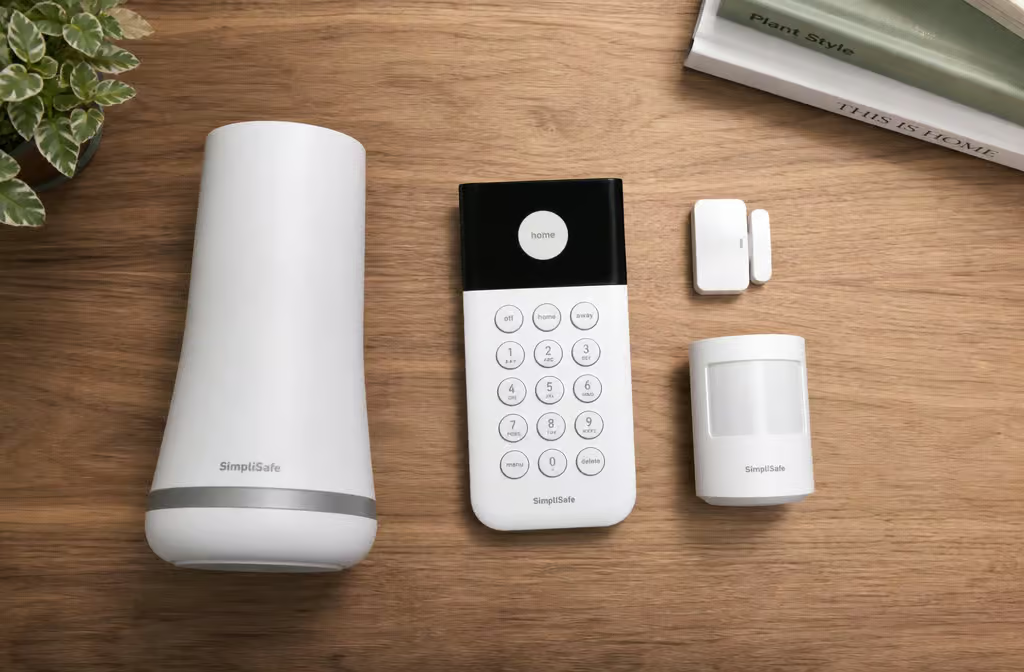
You want professional monitoring — the kind where someone actually calls the cops when your alarm goes off, but you refuse to sign a multi-year contract that chains you to one company. That’s the tension, and it’s why the DIY security system market has exploded. You can get a starter kit for a couple hundred bucks, set it up yourself in under an hour, and still have a real person watching your back. No commitment, no early termination fees, no nonsense.
I dug through the test data from SafeHome.org, Wirecutter, U.S. News, PCMag, and Consumer Reports — real homes, real sensors, real response times, and found that the differences between the top systems are bigger than the marketing pages let on. Some respond in 10 seconds. Others take 45. Some glass-break sensors fail every single time. And “no contract” doesn’t always mean you can walk away for free.
Bottom line: SimpliSafe is the best overall pick for its 10-second response time, genuinely free self-monitoring option, and flexible plans. But the right system depends on what you care about most — speed, cameras, automation, or price. Here’s what the tests actually revealed.
Key Takeaways
SimpliSafe’s monitoring agents contacted homeowners via two-way camera within 10 seconds — the fastest response time of any system tested, while Ring and ADT Blu averaged 45 and 29 seconds respectively.
Glass-break sensors from SimpliSafe and Cove failed every test across multiple reviews; don’t rely on them — invest in extra entry sensors and motion detectors instead.
Cove’s $150 starter kit is the cheapest, but you cannot use the mobile app without a $22.99/month subscription, making its “no-contract” label misleading compared to SimpliSafe’s truly free self-monitoring tier.
Table of Contents
Comparison table: Top DIY systems with monitoring at a glance
| System | SecureScore | Equipment starting price | Monthly monitoring starting price | Self-monitoring option? | Response time | Standout feature | Notable drawback |
|---|---|---|---|---|---|---|---|
| SimpliSafe | 9.2 | $250 | $9.99 (self) / $22.99 (pro) | Yes | 10 seconds | Fastest response | Glass-break sensor failures |
| Cove | 8.8 | $150 | $22.99 | No (app requires subscription) | 20s notification / 45s call | Fastest installation | No self-monitoring possible |
| ADT Blu | 8.6 | $194.98 | $24.99 | Yes | 29 seconds | Best camera detection | Fewer equipment options |
| Ring Alarm Pro | 8.2 | $199.99 ($244.95 Pro) | $19.99 (Pro plan) | Yes | 45 seconds | Built-in Eero Wi-Fi 6 router | Privacy controversies |
| Abode | 8.0 | $150 | $8.49 (self) / $26.99 (pro) | Yes | Not specified (app alerts within 10s) | Best smart home integration | Limited native hardware |
The table tells the story, but the details matter. Notice Cove’s cheap entry price paired with a mandatory subscription — that’s the gotcha most readers miss. And the 10-second vs. 45-second response gap is the difference between catching a burglar mid-step and finding a mess later. ADT Blu’s SecureScore of 8.6 reflects its solid middle-ground performance, with reliable camera detection and a trusted brand name.
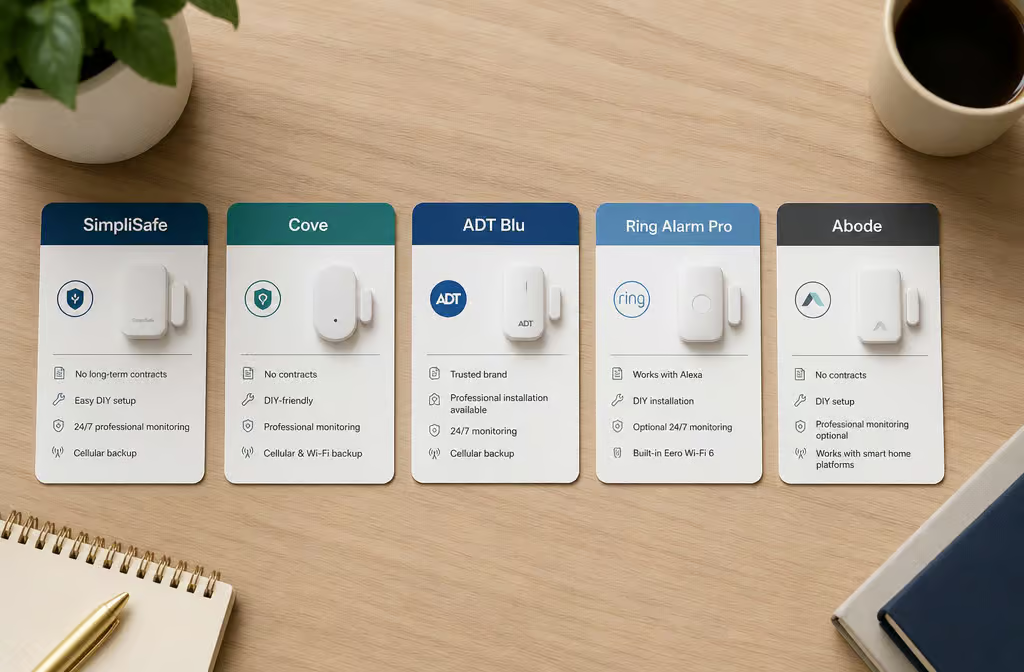
SimpliSafe — Best overall for flexibility, response time, and no-contract freedom
SimpliSafe is the system that keeps popping up as the top pick across nearly every review site, and for good reason. The headline number is that 10-second response time: when a sensor trips, a monitoring agent can talk to you (or an intruder) through the Wireless Indoor Camera within ten seconds. If you don’t respond, they call within 30. That’s not just marketing — SafeHome.org tested it in a real home, and that’s what they recorded.
Equipment starts at $250, but you can scale it up as needed with no contracts. The real win is the free self-monitoring tier: you get push alerts and app control for $0/month. If you want professional monitoring, the Standard plan is $22.99. For most people, the Core plan at $32.99 is the sweet spot — it adds Intruder Intervention (two-way talk with a live agent) and Video Verification, which lets the monitoring center confirm a threat via camera before dispatching police. That cuts false alarms dramatically.
Monitoring plans
SimpliSafe offers five tiers: Free Self ($0), Standard ($22.99), Core ($32.99), Pro ($49.99), and Pro Plus ($79.99). The Pro and Pro Plus add Active Guard Outdoor Protection, which uses outdoor cameras to monitor your yard — Pro covers 8pm-6am, Pro Plus goes 24/7.6am, Pro Plus goes 24/7. If you don’t need outdoor coverage, Core is plenty.
Sensor reliability
Here’s the honest caveat: SimpliSafe’s glass-break sensor failed every single test across multiple reviews (U.S. News, PCMag). It simply didn’t respond to breaking glass. That’s a systemic issue. The entry sensors and motion detectors performed reliably, so skip the glass-break and buy extra door/window sensors instead. That’s the workaround.
Buyer rule: Skip glass-break sensors entirely on any DIY system — tests show they fail repeatedly. Spend that money on extra entry sensors instead.
Smart home integration
Works with Alexa and Google Home for basic commands, but you cannot disarm the system by voice — that’s a deliberate security limitation. No Apple HomeKit support, and third-party device integration is limited. If smart home automation is your priority, you’ll want Abode instead.
Ring Alarm Pro — Best for camera ecosystem and built-in Wi-Fi mesh
Ring’s approach is uniquely clever: the Alarm Pro base station doubles as a dual-band Wi-Fi 6 mesh router (courtesy of Eero). It covers about 1,500 square feet and supports up to 75 devices. If you needed a better router anyway, this is like getting one bundled with your security system. It also has a 113 dB siren (loud enough to be a real deterrent) and a 24-hour backup battery.
The camera ecosystem is unmatched — Ring has more camera options than any other system, and the $20/month Pro plan gives you 180 days of video storage. That’s a huge history buffer for reviewing events.
But the response time is slower: averaging 45 seconds for agent contact. Still within acceptable range, but significantly behind SimpliSafe.
Privacy concerns
Ring has been at the center of multiple privacy controversies: partnerships with thousands of police departments for footage requests (often without warrants), employee spying incidents (unauthorized access to customer feeds), and the “Search Party” feature that critics label as neighborhood surveillance. To their credit, Ring now offers optional end-to-end encryption on select cameras and mandates two-factor authentication. But if privacy is a dealbreaker, the controversy history matters.
Quirky trade-off
The Eero router replaces your current router. You can’t put it in bridge mode without losing the mesh features, so plan your network layout accordingly.
Cove — Best for quick installation and lowest equipment cost, with trade-offs
Cove’s starter kit is $150 — the cheapest entry point among the top five, and installation takes under 30 minutes. Everything is wireless with adhesive backing. U.S. News testers confirmed it’s genuinely plug-and-play: place sensors, connect the hub, and you’re done.
But here’s the catch: you cannot use the Cove mobile app without an active subscription. There is no self-monitoring option at all. Even the $22.99/month Basic plan is mandatory for system use. That makes Cove effectively a subscription-locked system despite the “no contract” label.ly a subscription-locked system despite the “no contract” label. If you cancel, you lose all app access.
Sensor performance
Mixed results. The entry sensor alerted within 10 seconds (good), but the motion sensor took over a minute in one test (bad), and the glass-break sensor failed completely (bad). If you go with Cove, rely on multiple entry sensors and skip the motion and glass-break.
Coverage details
Cove uses RapidSOS to send your address and sensor data directly to 911, which can shave seconds off dispatch. The siren is 85 dB — loud but not as ear-splitting as Ring’s 113 dB.
ADT Blu — Best for brand trust and camera intelligence
ADT Blu is ADT’s first real foray into the DIY no-contract space, and it brings the weight of a brand that Lifestory Research ranked as America’s Most Trusted Home Security System for the sixth straight year (2025). If you’d rather skip the brand and build from scratch, here’s a blueprint for how to make your own home security system. Equipment starts at $194.98, professional monitoring at $24.99/month. Response time averaged 29 seconds — solidly in the middle.
The real standout is the camera performance. In a 30-day real-home test, ADT Blu’s outdoor camera reliably differentiated delivery drivers from pedestrians. That level of person/vehicle/animal detection cuts false alerts drastically. Cameras range from $69.99 to $109.99 and shoot in 2K HDR with smart detection.
The downside: fewer equipment options compared to SimpliSafe or Ring. You can’t get as many specialized sensors. But if brand trust and camera intelligence are your priorities, ADT Blu delivers.
Abode — Best for smart home automation and broad protocol support
Abode is the system for smart home nerds. It’s the only top system that supports Alexa, Google Home, and Apple HomeKit simultaneously. It also speaks Zigbee, Z-Wave, and IFTTT — meaning you can connect practically any smart device. The CUE automation engine lets you create rules like if front door opens after sunset, turn on the hallway lights and send me a notification. It’s a full home automation hub that also does security.
Equipment starts at $150 (tied with Cove for cheapest), and the self-monitoring plan is just $8.49/month — the lowest cost for cloud features without professional monitoring. For those seeking to avoid any monthly fees, our guide to DIY home security systems no monthly fee covers local storage and self-monitoring tips. Professional monitoring is $26.99/month. App alerts arrived within 10 seconds in testing.
The trade-off: Abode’s native hardware catalog is limited. There’s no dedicated smoke detector — just a listener that hears your existing alarm. And while the SecureScore of 8.0 is decent, it’s not top of the pack for raw security. But for automation flexibility, it’s unmatched.
CUE automation engine specifics
You can set up rules, schedules, and routines without a subscription, but you’ll need a paid plan to use the full CUE platform. Smart notifications distinguish between people, packages, and pets — fewer false cat alerts.
Other notable DIY systems: Wyze, Arlo, Eufy, Frontpoint
These systems didn’t make the top five but fill specific niches.
Wyze ($100-$180 starter kit) is the absolute budget king, but reliability suffers. CNET testing found its motion sensor both flagged false positives (motion in an empty room) and missed actual motion. You get what you pay for.
Arlo ($200 or less starter kit) has a brilliant all-in-one sensor that detects motion, entry, tilt, temperature, light, water leaks, and listens for smoke/CO alarms. One sensor does the work of many. It’s also adhesive-mount friendly — great for renters who don’t want to drill holes.
Eufy (starter kit under $200) offers professional monitoring at $100/year — the lowest annual cost. Good for budget-conscious users who still want real monitoring.
Frontpoint is the contract-based comparator. More expensive than SimpliSafe, which uses wireless components and no-contract monitoring, and requires a long-term commitment. Useful as a reference point if you’re considering traditional systems.
Contract vs. no-contract: Which is right for you?
The simple “contracts are evil” narrative misses the full picture. Professional monitoring can reduce your home insurance premiums by 5–20%, regardless of contract type — and that discount can offset or exceed the monthly monitoring fee.
When a contract makes sense
Contracts typically last 2–5 years and lock in your monthly rate. In an era of rising fees, that price stability can be valuable. They also often include free or discounted equipment upfront. If you plan to keep the system for 3+ years, a contract might save you money.
Alarm permits — the hidden gotcha
Some municipalities require an alarm permit for professionally monitored systems. Yonkers, N.Y., requires a permit but no fee; Dallas charges $50/year. Check your local laws before activating monitoring, or you risk fines.
Reliability comparison
DIY systems with professional monitoring are as reliable as professionally installed systems. Response times (10–45 seconds) are comparable or faster than many traditional companies, and the equipment quality is identical. The difference is you install it yourself, with no expertise or tools required.
Performance and reliability — what the tests reveal
The response time gap is the biggest differentiator. Here’s the test data from SafeHome.org and U.S. News:
- SimpliSafe: 10 seconds agent contact via camera, 30 seconds call if no response
- ADT Blu: 29 seconds average
- Ring Alarm Pro: 45 seconds average
- Cove: app notification within 20 seconds, call under45 seconds
Video Verification is the feature that speeds dispatch: when the monitoring center can see the threat via camera, they send police without waiting for you to confirm. Systems with Video Verification (SimpliSafe Core and up, ADT Blu, Ring Pro, Cove Plus and up) get faster responses. Industry experts like Bob Dolph, Kirk MacDowell, and Mark Hayes have all noted that consistent sensor placement and real-world testing are critical to achieving reliable response times.
Sensor reliability — the ugly truth
Glass-break sensors are uniformly unreliable. SimpliSafe’s and Cove’s failed every test. The Cove motion sensor took over a minute. Wyze motion sensor had false positives and missed detections.
The pattern is clear: don’t rely on glass-break sensors; invest in multiple entry sensors and motion detectors instead. Testing sources used real occupied homes with identical equipment placements — not lab conditions, so these results reflect real-world performance.
Smart home integration and automation — what each system supports
If you want your security system to also control your lights, locks, and thermostat, here’s how they stack up:
- Abode: Alexa, Google Home, Apple HomeKit, Zigbee, Z-Wave, IFTTT, CUE automation engine. Full trifecta.
- SimpliSafe: Alexa and Google Home (no voice disarm, limited third-party). No HomeKit.
- Ring: Alexa, limited Google Home, no HomeKit. But extensive Ring-branded accessories.
- ADT Blu: Alexa, Google Home, SmartThings integration, Trusted Neighbor facial recognition.
- Cove: No smart home integration at all.
Matter and future-proofing
Matter is the emerging smart home standard that promises universal compatibility. Many security companies support it, but no DIY system has adopted it yet. Don’t delay your purchase waiting for Matter — Abode already covers the major protocols (Zigbee, Z-Wave, IFTTT) and is future-proof enough for most users.
Privacy and data security — what each system shares
Ring’s privacy controversies are well-publicized, but every system has tradeoffs.
- Ring: Police partnerships, employee spying incidents, “Search Party” criticism. Mitigations: optional end-to-end encryption, mandatory two-factor auth.
- SimpliSafe: Uses third-party analytics (Google Firebase, Heap) and shares your service address with the monitoring provider. Less discussed but still worth knowing.
- Cove: Limited transparency on data practices.
- ADT Blu: Google-owned — data practices tied to Google’s privacy policy.
- Abode: Less public controversy, but review the policy.
No system is fully private. The question is which tradeoffs you accept. Check for end-to-end encryption, mandatory two-factor auth, and police partnership policies.
Installation and ease of use — what to expect
DIY installation is genuinely easy. Most systems are wireless with adhesive-backed sensors — no drilling required. U.S. News testing completed all five DIY installations in under an hour.
Installation gotchas
- SimpliSafe: Cameras arrive with no charge and take6 hours to charge before first use. Plan ahead.
- Cove: Fastest — under30 minutes, sensors pre-paired. But the app is locked behind a subscription.
- Ring: The Eero router replaces your existing router. May require repositioning your network.
- Abode: Requires hub setup and Wi-Fi connection before sensor pairing.
Yes, you can install a security system yourself and still get professional monitoring — that’s exactly what these systems are designed for.
How to choose — matching a system to your priorities
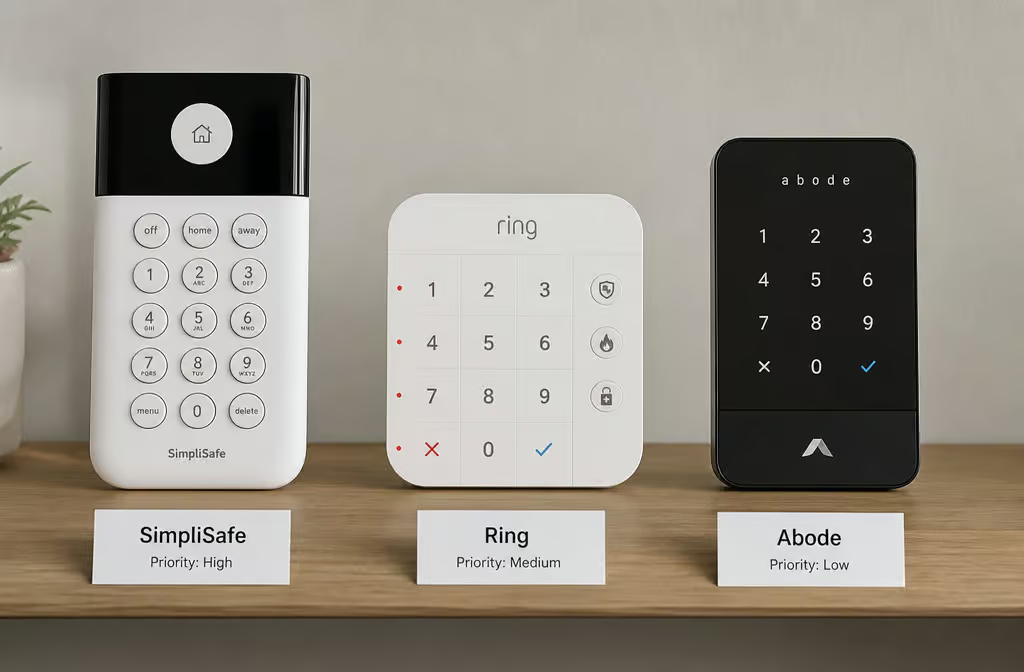
- Response time and no forced fees: SimpliSafe
- Best camera ecosystem and built-in mesh Wi-Fi: Ring Alarm Pro
- Budget-first and you don’t mind a subscription: Cove
- Smart home integration above all: Abode
- Brand trust and camera intelligence: ADT Blu
Total cost of ownership
Don’t just look at the starter kit price. Equipment can exceed $1,000 with add-ons. Monthly monitoring ranges from $0 (self) to $79.99 (SimpliSafe Pro Plus). Battery replacements every1-2 years.
Cloud storage costs are included in some plans (Ring’s 180 days) or separate. Permits and professional installation (if you want it, $100-200+) add up. Factor in the insurance discount (5-20% off premiums) — that often offsets the monthly fee.
Cost check: Before committing, add up equipment, monitoring, permits, and battery replacements over 3 years — then subtract your insurance discount to see the real annual cost.
Closing Thoughts
SimpliSafe is the best all-around system: fastest response, flexible monitoring from free to full-featured, and true no-contract freedom. But if you’re an Apple HomeKit user, Abode is your only choice. If you need a router upgrade and love Ring’s camera ecosystem, the Alarm Pro is a smart bundle. If budget is everything and you’re okay with mandatory subscription, Cove works. And if brand trust and killer camera detection matter, ADT Blu delivers.
Before you buy, check your local alarm permit requirements — and ask your insurance agent about that 5-20% discount. That could make professional monitoring effectively free.
The data says DIY security with professional monitoring is just as reliable as a pro-installed system, and often faster. Pick the one that matches your priority, and you’ll sleep better knowing someone’s watching.
People Also Ask
What is the best DIY surveillance system for home use?
SimpliSafe is the top overall pick due to its consistently fastest response time of 10 seconds, the option for a genuinely free self-monitoring tier, and flexible month-to-month plans with no contracts. The right system also depends on your priorities: Ring is unmatched for camera selection and built-in Wi-Fi mesh, Abode leads in smart home automation with Apple HomeKit support, and ADT Blu offers reliable camera detection backed by a trusted brand name.
Is DIY home monitoring a good idea?
Yes, DIY systems with professional monitoring are just as reliable as professionally installed systems, and response times are often faster — ranging from 10 to 45 seconds depending on the brand. You can install everything yourself in under an hour with no drilling required, and you still get a live agent to dispatch emergency services when an alarm triggers. The trade-off is you handle setup and some systems have hidden costs, like mandatory subscriptions to use the mobile app.
Why do glass-break sensors fail in DIY security systems?
Glass-break sensors from multiple brands, including SimpliSafe and Cove, have failed every test across several independent reviews, meaning they simply do not detect breaking glass in real-world conditions. The technology relies on sensing the specific frequency of shattering glass, but interference from ambient noise and the sensor’s placement often cause misses. The practical workaround is to skip glass-break sensors entirely and invest that money in more entry sensors and motion detectors, which are far more reliable.
How much does a DIY home security system cost per month?
Monthly costs range from $0 for SimpliSafe’s self-monitoring tier up to $79.99 for SimpliSafe’s Pro Plus plan with 24/7 outdoor camera monitoring. Most professional monitoring plans fall between $22.99 and $32.99 per month, while Ring’s Pro plan is $19.99 and includes 180 days of video storage. The equipment itself starts around $150 to $250, but can exceed $1,000 with add-ons, and you should factor in battery replacements every 1–2 years and potential alarm permit fees from your local municipality.
What is the best DIY home security system without a subscription?
SimpliSafe is the best option for a subscription-free system because its free self-monitoring tier includes push alerts and full app control with no monthly fee. Abode also offers a low-cost self-monitoring plan at $8.49/month if you want cloud features without professional monitoring. Cove requires a mandatory subscription just to use the app, so it is not a viable choice if you want to avoid monthly payments.