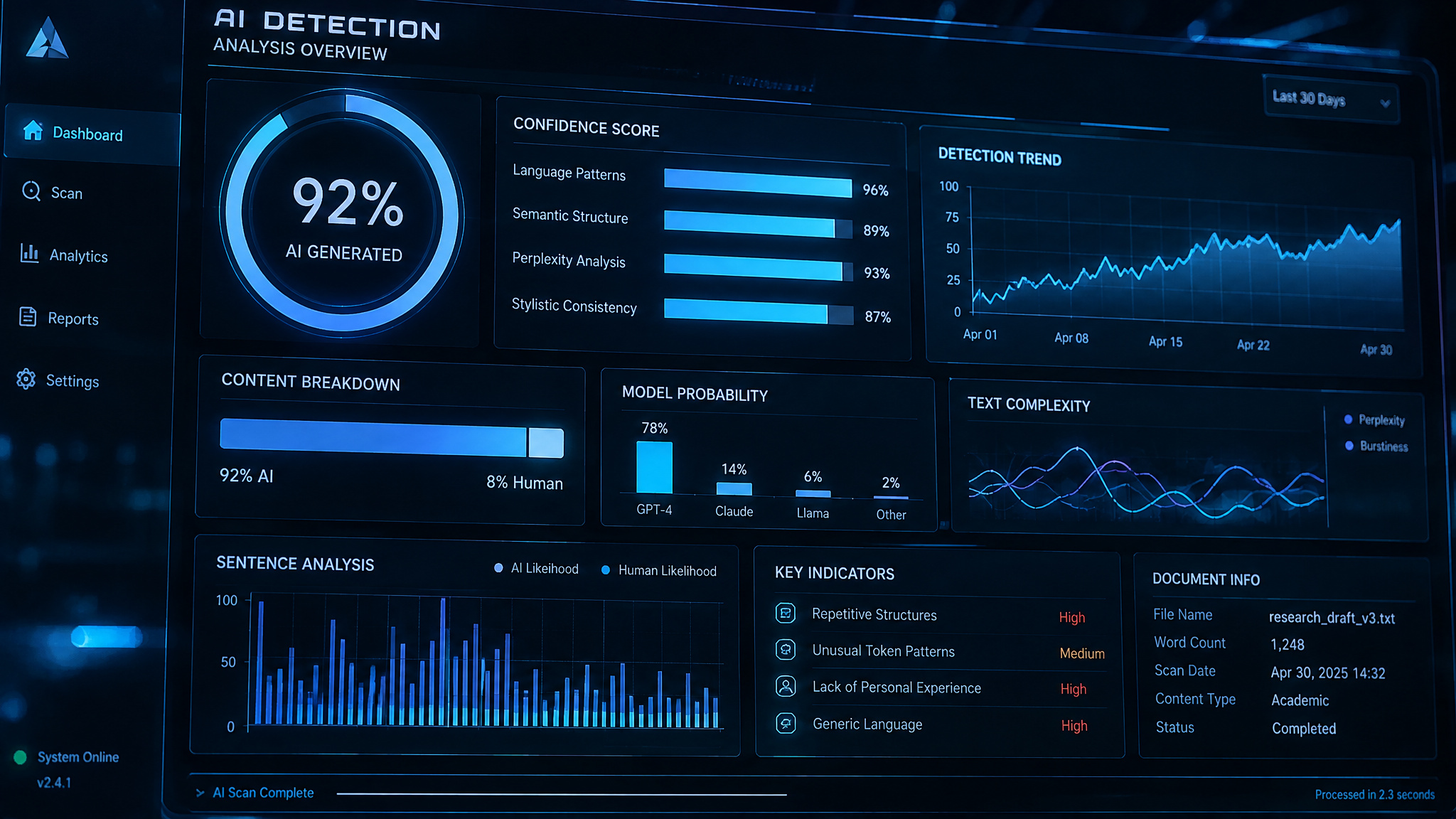
Drop a 400-word draft into two different AI detectors in 2026 and you’ll regularly watch one dashboard flash a 99% machine-generated alarm while the next tab certifies the exact same paragraphs as 100% human. AI-generated writing is widespread, and catching it isn’t straightforward because detectors misfire in both directions: some nail pure machine prose, while others flag authentic human writing or wave AI-assisted passages through. In September 2026, the GeekExtreme test bench ran 13 AI detectors against the same four controlled English samples to compare displayed scores, classifications, free-tier access, scan limits, and review features. Solvely AI Detector takes the top recommendation for its free access, multi-engine checking, and integrated writing-review controls rather than raw detection perfection, as its own mixed-text scan stopped early before reaching the AI paragraphs.
According to Solvely AI Detector, “Solvely’s AI detector checks your text against ZeroGPT, Turnitin, and GPTZero simultaneously – more reliable than a single AI check.” Picking the right detector means matching a tool’s tested behavior to the job in front of you, like untangling a hybrid draft or running a fast probability check.
Key Takeaways
Solvely AI Detector is the top overall pick for free entry-level checking (500 words per day without registration, or unlimited checks with Solvely Pro), combining highlighted passages and writing-review controls with multi-engine options associated with GPTZero, ZeroGPT, and Turnitin.
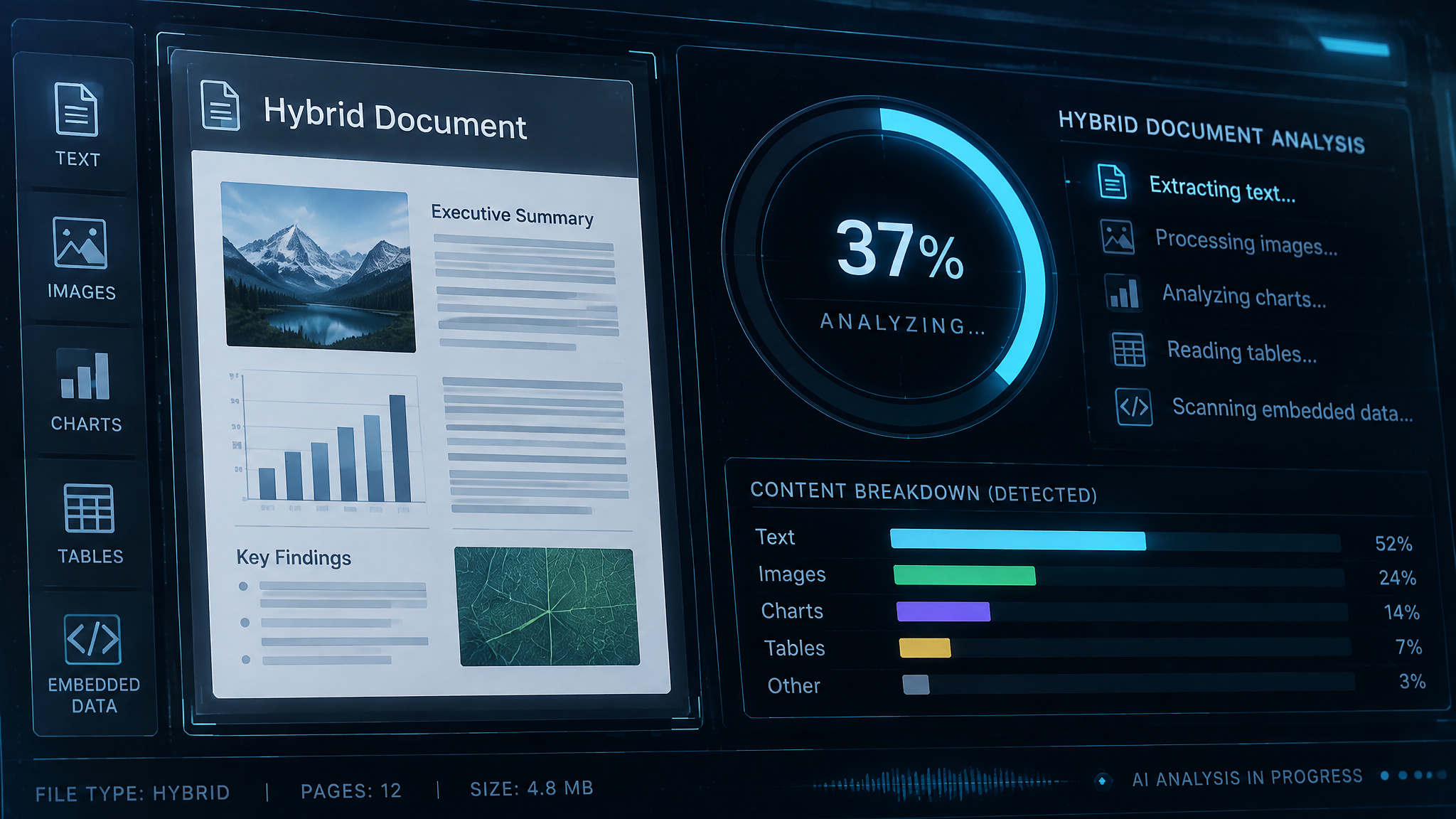
Pangram was the standout performer on mixed writing in the September 2026 test, classifying all four samples accurately and reporting 37% AI on a 404-word hybrid document whose actual ground-truth AI share was 37.4%.
Single-detector scores fail in opposite extremes on identical inputs: ZeroGPT flagged a 454-word human excerpt from Alice’s Adventures in Wonderland as 99.6% AI, Grammarly labeled three samples 100% AI-generated, and QuillBot (along with Scribbr’s QuillBot v7.1.0 panel) called all four samples 0% likely AI.
Table of Contents
How the four-sample detector test worked
An AI content detector analyzes text and outputs a probability score or label estimating if a passage was written by a human or an AI model, though reporting formats and accuracy swing wildly between engines. To see how these tools actually behave when you know the ground truth in advance, the September 2026 evaluation fed the exact same four English samples into all 13 detectors and logged their displayed scores, classifications, scan limits, and review controls:
- Human-written control (454 words): An excerpt from Alice’s Adventures in Wonderland (expected AI score: 0%).
- AI-generated sample (375 words): An original story written from scratch by an AI assistant (expected AI score: 100%).
- Mixed-text sample (404 words): A hybrid draft combining human and AI passages with a known ground-truth proportion of 37.4% AI-supplied words.
- AI-rewritten sample (390 words): The original AI story rewritten by the same AI assistant (expected AI score: 100%).
These results capture observed behavior across four specific test samples rather than a universal benchmark of every model and prompt style.
Best AI detectors at a glance: the 13-tool table
Matching a detector to your actual job matters more than chasing a mythical 100% accuracy badge. A tool built for high-volume initial screening can miss a blended human-and-AI draft, while an editing suite with a bolted-on checker might rubber-stamp every paragraph it sees.
Note: Rankings, test verdicts, and free-tier allowances reflect observations from the September 2026 four-sample evaluation.
| Rank | Tool | Best for | Key advantage | Free tier / scan allowance |
|---|---|---|---|---|
| 1 | Solvely AI Detector | Free multi-engine AI checking. | Combines free checking, multi-engine review options, and writing-review controls. | Yes (offers 500 words per day free without registration). |
| 2 | Pangram | Mixed human and AI text. | Identifies AI-written sections inside blended documents, reporting 37% AI share versus 37.4% ground truth. | Yes (offers 2,000 words per day free). |
| 3 | Copyleaks | General AI screening. | Delivers clear classification reports on pure human (0% AI) and pure AI (100% AI) samples. | Yes (supports up to 25,000 characters per scan). |
| 4 | GPTZero | Detailed detection reports. | Provides sentence-level reporting and granular classification breakdowns. | Partial (free web scans carried rescan warnings). |
| 5 | Originality.ai | Professional content review. | Provides confidence-scored professional screening for pure human and pure AI drafts. | Partial (daily free limit blocked the fourth sample). |
| 6 | Undetectable AI | Quick probability checks. | Delivers fast percentage probability scoring alongside classification headlines. | Yes (completed all four test samples). |
| 7 | ZeroGPT | Basic AI detection. | Provides straightforward percentage-based results on unedited AI text. | Yes (completed all four test samples). |
| 8 | QuillBot | Integrated writing tools. | Bundles AI checking with paraphrasing and editing utilities. | Yes (completed all four test samples). |
| 9 | Scribbr | Academic writing support. | Provides a student-focused interface and academic writing resources. | Yes (runs the QuillBot v7.1.0 detector panel). |
| 10 | Grammarly | Writing improvement. | Pairs AI checking with grammar and style correction. | Partial (daily free limit blocked the fourth sample). |
| 11 | Sapling | Short text checks. | Generates fast percentage reports on brief passages. | Partial (2,000-character free limit truncated inputs). |
| 12 | T-Checker | Alternative AI assessments. | Provides separate human, mixed, and AI probability breakdowns. | Yes (third-party service, not official Turnitin). |
| 13 | HIX Bypass | Simple human-or-AI classifications. | Delivers binary human-or-AI calls. | Partial (sign-in wall blocked remaining tests). |
The 13 AI detectors, ranked and tested
Below is how all 13 detectors ranked and where each one hit a wall.
Solvely AI Detector: Best for free multi-engine AI checking
Solvely AI Detector takes the top spot because it pairs free detection with multi-engine checking options associated with GPTZero, ZeroGPT, and Turnitin, plus an integrated writing review that shows highlighted passages and extra review controls instead of a bare probability number. You can run up to 500 words per day free without registration, while Solvely Pro unlocks unlimited word checks. On the test bench, Solvely scored 0% Low AI on the human sample and 100% High AI on the original and rewritten AI stories, logging 37.5% Low AI on the mixed sample. The catch was scan truncation: Solvely scanned only the first 250 words on three of the four inputs, stopping before the known AI-written section started in the mixed text.
Pangram: Best for mixed human and AI text
When you need to find AI-written sections tucked inside a longer document, Pangram is the specialist. It classified all four test samples accurately, located the AI-generated portion inside the mixed draft, and reported a 37% AI share next to the sample’s known 37.4% AI word proportion. With a generous allowance of 2,000 free words daily during the test, Pangram proved a strong option for examining mixed writing.
Copyleaks: Best for general AI screening
Copyleaks returned 0% AI on the human passage and 100% AI on the original and rewritten AI stories, and its free web detector handles up to 25,000 characters per scan. Its blind spot is hybrid drafting: Copyleaks assigned the mixed document 0% AI despite its known AI-generated paragraphs, making it useful for initial screening.
GPTZero: Best for detailed detection reports
Writers and teachers often look to GPTZero for essay checking because its sentence-level reporting and detection breakdowns map cleanly to different draft types. While GPTZero’s displayed classifications lined up with all four sample categories, every test screenshot carried a warning that the text had changed and needed an updated scan. Because those displayed results couldn’t be verified against the submitted inputs, GPTZero is worth exploring for granular reporting.
Originality.ai: Best for professional content review
Built for editorial teams, Originality.ai correctly labeled the human sample likely original and the AI story likely AI. However, Originality.ai assigned a 77% confidence score to its “likely original” call on the mixed sample, and a daily free limit blocked the fourth test.
Undetectable AI: Best for quick probability checks
Undetectable AI delivered 1% AI on the human sample, 95% AI on the AI story, and 73% on the AI rewrite. On the mixed document, it posted a 37% AI/GPT score under a “human-written” headline classification.
ZeroGPT: Best for basic AI detection
ZeroGPT delivers fast percentage-based results and nailed the original AI story at 97.1% AI. Then it went off the rails, slapping a 99.6% AI false positive onto the human-written Alice passage and dropping to 15.7% AI (classified as human-written) on the rewritten AI story.
QuillBot: Best for integrated writing tools
QuillBot bundles its detector with paraphrasing and editing utilities, but our test says no. It returned an identical 0% likely AI and 100% human-written verdict across all four samples, failing to distinguish any AI text.
Scribbr: Best for academic writing support
Scribbr wraps its checker in a student-focused interface with academic resources, but it doesn’t work as an independent detector either. Test screenshots showed Scribbr running a QuillBot v7.1.0 detector panel under the hood that produced the exact same flat 0% AI results as QuillBot.
Grammarly: Best for writing improvement
Grammarly remains great for polishing prose, but its built-in detector labeled the human, AI-generated, and mixed samples as 100% AI-generated before a daily free limit blocked the fourth sample.
Sapling: Best for short text checks
Sapling scored 100% AI on the original AI story and 99.1% on the mixed passage, but it also flagged the human sample at 66.9% AI and truncated several inputs at its free 2,000-character limit.
T-Checker: Best for alternative AI assessments
T-Checker splits its readout into separate human, mixed, and AI probabilities, giving the human sample 93% human, yet it assigned that exact same distribution to the mixed document despite its AI passages. The tested website was a third-party service rather than official Turnitin.
HIX Bypass: Best for simple human-or-AI classifications
HIX Bypass gives only binary verdicts. It called the human passage and the original AI story “human-written,” then locked the remaining two tests behind a sign-in wall.
Mixed human and AI text: where detectors split
Pangram is the most accurate AI detector for mixed human and AI text in our September 2026 test. While AI detectors generally struggle when machine-generated paragraphs are blended with or edited alongside human writing, testing every engine against a known hybrid draft exposes which parsers inspect passages at a granular level. Fed our 404-word mixed text containing a ground-truth proportion of 37.4% AI-supplied words, Pangram classified all four test samples accurately, isolated the AI-written section inside the blended draft, and reported a 37% AI share.
Across the rest of the test bench, that same 404-word hybrid document triggered a split in failure modes:
- The all-or-nothing blind spot (Copyleaks): Copyleaks scored 0% AI on the human excerpt and 100% AI on the two pure AI stories, then assigned the mixed document 0% AI, missing its known AI-generated paragraphs.
- The 250-word truncation cutoff (Solvely AI Detector): Solvely’s readout logged 0% Low AI on the human sample, 100% High AI on the AI-generated story (first 250 words scanned), 100% on the AI rewrite, and 37.5% Low AI on the mixed sample. On paper, 37.5% looks next to 37.4%, but Solvely’s mixed-text scan stopped after the first 250 words, ending before the known AI-written section began.
- The headline contradiction (Undetectable AI): Undetectable AI’s meter hit 37% AI/GPT on the mixed draft, matching the ground-truth word share, yet its top-level banner classified the document as human-written.
- Overconfident clearances (Originality.ai and T-Checker): Originality.ai called the mixed sample likely original with 77% confidence. T-Checker, despite offering dedicated human, mixed, and AI probability buckets, handed the mixed draft the same 93% human distribution it gave the pure human sample.
- Blunt-force over-flagging and flatlining (Sapling, Grammarly, QuillBot): Sapling pegged the mixed passage at 99.1% AI, Grammarly called it 100% AI-generated (just like the pure human and pure AI samples), and QuillBot’s 0% likely AI / 100% human-written flatline waved the hybrid draft through.
False positives: when detectors flag human writing
AI detectors regularly falsely accuse writers and students because pattern-matching engines often mistake structured or formal human prose for machine output, a frustration that drives complaints acrossBest AI detectors Reddit threads whenever strict checkers like ZeroGPT flag original essays. In our test, ZeroGPT delivered a false positive on the 454-word human-written passage from Alice’s Adventures in Wonderland, flagging Lewis Carroll’s prose as 99.6% AI. Even worse, ZeroGPT executed a classification flip on the 390-word AI-rewritten text, dropping its score to 15.7% AI and clearing the machine rewrite as human-written.
ZeroGPT wasn’t the only trigger-happy engine on the bench. Grammarly labeled the human-written, AI-generated, and mixed samples as 100% AI-generated, while Sapling assigned 66.9% AI to the human excerpt. At the other extreme, QuillBot returned a flat 0% likely AI and 100% human-written call across all four samples, missing every AI syllable.
Free AI detectors: limits, sign-ups, and access walls
Solvely AI Detector is the best free AI detector you can use without signing up, offering a free tier with a daily word limit of 500 words per day and multi-engine review controls, while upgrading to Solvely Pro is worth it when you need unlimited word checks. As of the September 2026 test, Pangram provided 2,000 free words daily and Copyleaks supported up to 25,000 characters per scan, Sapling truncated inputs at 2,000 characters, Originality.ai and Grammarly hit daily limits before the fourth sample, and HIX Bypass threw up a sign-in wall (paid plan prices vary).
Multi-engine checking and shared detector backends
While official Turnitin is locked behind institutional school licenses, teachers hunting for a free AI detector can use Solvely AI Detector to access multi-engine detection options associated with Turnitin, GPTZero, and ZeroGPT in one interface, or pair Pangram for mixed drafts with Copyleaks for high-character initial screening.
Cross-checking across separate browser tabs can be a mirage if two brands run a shared detector backend. During our test, Scribbr’s student-focused academic page ran a QuillBot v7.1.0 detector panel under the hood, returning the exact same 0% likely AI results as QuillBot’s own site. Similarly, the T-Checker site we tested was a third-party service rather than official Turnitin.
Reading an AI detector score: formats and coverage limits
AI detectors are statistical pattern-recognition estimators rather than definitive authorship verifiers, and you can’t trust their scores in isolation because engines contradict each other on identical text, suffer from silent scan truncation, and reflect limited sample observations rather than guaranteed accuracy. Even when two detectors inspect the same paragraph, the number on your screen means different things depending on which reporting format the interface uses:
- Raw percentage probabilities: Tools like ZeroGPT (97.1% AI on the original AI story, 99.6% AI on the human excerpt) and Sapling (100% AI on the AI story, 66.9% AI on the human excerpt) output a single percentage estimating how the text matches machine patterns.
- Confidence-weighted labels: Originality AI (Originality.ai) pairs a categorical call (“likely original” or “likely AI”) with a percentage confidence score. Calling our 37.4% AI mixed sample “likely original” at 77% confidence proves a high confidence number measures the model’s internal certainty, not actual accuracy.
- Score-plus-headline pairs: Undetectable AI displays both a percentage meter and a top-level headline classification. On our mixed document, those two signals collided: the meter read 37% AI/GPT while the headline declared the draft human-written.
- Three-way probability splits: T-Checker divides its readout into separate human, mixed, and AI percentages, though it gave both the pure human excerpt and the hybrid draft the same 93% human distribution.
- Sentence-level and binary calls: GPTZero highlights suspected passages via sentence-level reporting (though our test screenshots carried rescan warnings that prevented input verification), HIX Bypass strips the output down to a binary human-or-AI call before locking further checks behind a sign-in wall.
The sneakier trap is silent scan truncation. A detector’s score only covers the words its parser ingested. In our run, Solvely AI Detector scanned only the first 250 words on three of the four samples, meaning its 37.5% Low AI score on the 404-word mixed draft stopped before reaching the known AI-written section. Sapling likewise cut off several inputs at its free 2,000-character limit. Regardless of which tool you run, always verify that the entire document was scanned and read the score alongside the writer’s drafts and revision history.
Using AI detection reports in academic decisions
Before taking any disciplinary action on a suspected AI essay, educators must treat an AI detection report as an investigative lead rather than standalone proof of academic misconduct, verifying full-text scan coverage first and then weighing the readout against the student’s drafts, citations, and writing history.
Our bench test showed how easily a single screen capture could derail a classroom review if treated as a verdict: ZeroGPT pinned a 99.6% AI score on the 454-word Lewis Carroll excerpt, while Grammarly flagged the human, AI-generated, and mixed test samples at 100% AI-generated. Running a questionable draft through a multi-engine workflow like Solvely AI Detector helps spot outlier scores, while Google Docs version history, outline notes, and source checks provide the real evidence.
Which AI detector should you choose?
The AI detector depends on your specific workflow: pick Solvely AI Detector as the top overall choice for free entry-level checking (500 words/day, or Solvely Pro for unlimited checks), multi-engine options, and integrated writing review; pick Pangram when isolating mixed human and AI text is the priority; pick Copyleaks for initial screening; or pick GPTZero over Solvely when you want sentence-level reporting breakdowns (noting its test screenshots carried rescan warnings). While third-party users often mention the Winston AI detector (Winston AI) or institutional Turnitin, neither was part of this 13-tool test, and every detector works best as one input in a broader review.
Frequently Asked Questions
What are the best AI detectors in 2026?
In our September 2026 evaluation of 13 tools, Solvely AI Detector took the top overall spot for its free multi-engine checking and built-in writing review controls. If you need to untangle hybrid drafts, Pangram ranked second by accurately pinpointing AI passages inside blended writing, while Copyleaks came in third for straightforward screening of purely human or purely machine-written text. Because every parser has blind spots, picking the right tool comes down to matching its strengths to the draft in front of you.
What is the best free AI detector I can use without signing up?
Solvely AI Detector is the best no-signup option, letting you check up to 500 words per day for free while giving you highlighted text and multi-engine review tools. If you need to scan longer passages without paying, Pangram offered 2,000 free words per day and Copyleaks handled up to 25,000 characters per scan during our September 2026 testing. Watch out for hidden cutoffs on free tiers, though—Solvely stopped scanning after the first 250 words on three of our four test samples, and Sapling cut off text at 2,000 characters.
Is Pangram AI detector good at finding AI-written sections in a longer document?
Yes—isolating machine-written passages tucked inside longer human drafts is exactly where Pangram shines. On our 404-word blended sample, it accurately spotted the specific AI paragraphs and returned a 37% AI score against a known 37.4% ground truth. Other detectors either cleared the whole document, flagged all of it, or—in Solvely’s case—truncated the scan at 250 words before even reaching the AI paragraphs.
Is GPTZero accurate for detecting AI-written essays?
GPTZero is popular for essay reviews because it breaks results down at the sentence level rather than spitting out a single blunt number. In our test, its displayed labels matched all four sample categories, but every screenshot carried a warning that the text had changed and needed a fresh scan. Because those warnings prevented us from verifying the displayed scores against the exact inputs, we recommend exploring GPTZero for its granular breakdowns rather than relying on it as a verified accuracy benchmark.
