If you came here hoping for a detector that will look at a block of text and tell you, with a straight face, whether a person wrote it, I get the disappointment coming. Whether it’s a job application or a dating profile, handing the blank page to a model is the easiest choice you’ll make all day, and the result can fool a skimming reader without breaking a sweat. But after actually digging into how to detect AI writing, here’s the honest finding: no such tool exists, and the failure isn’t a temporary glitch that will be patched.
The signs of that failure are everywhere. OpenAI, the company that makes the most famous generator on the planet, discontinued its own AI-text classifier because the accuracy was too low to trust. And a 2023 Stanford study found that detectors falsely flagged 61% of essays authored by people who don’t speak English natively as machine-produced, versus about 2% of native essays, a gap the researchers gave a name: “algorithmic bias.”
So where does that leave anyone who actually needs an answer? The most reliable detection tool is the one already sitting behind your eyes. Your brain, combined with the same critical judgment you already use to sniff out fake news, is a better instrument than anything these tools ship. The rest of this piece is the case for that, plus an honest look at what the software can and can’t do.
Key Takeaways
OpenAI shut down its own AI-text classifier because of low accuracy, and in my own bench test its tool scored worst of every detector I tried.
In 2023, Stanford researchers tested detectors on essays and found they incorrectly marked 61% of TOEFL essays by non-native English speakers as machine-generated, compared with about 2% of native essays, a bias they called “algorithmic bias.”
The most dependable detector is the human brain: the critical-analysis skills that catch misinformation outperform probability scores, even though research (Jakesch et al., 2022) warns us not to get overconfident.
Table of Contents
The Problem With AI Detectors
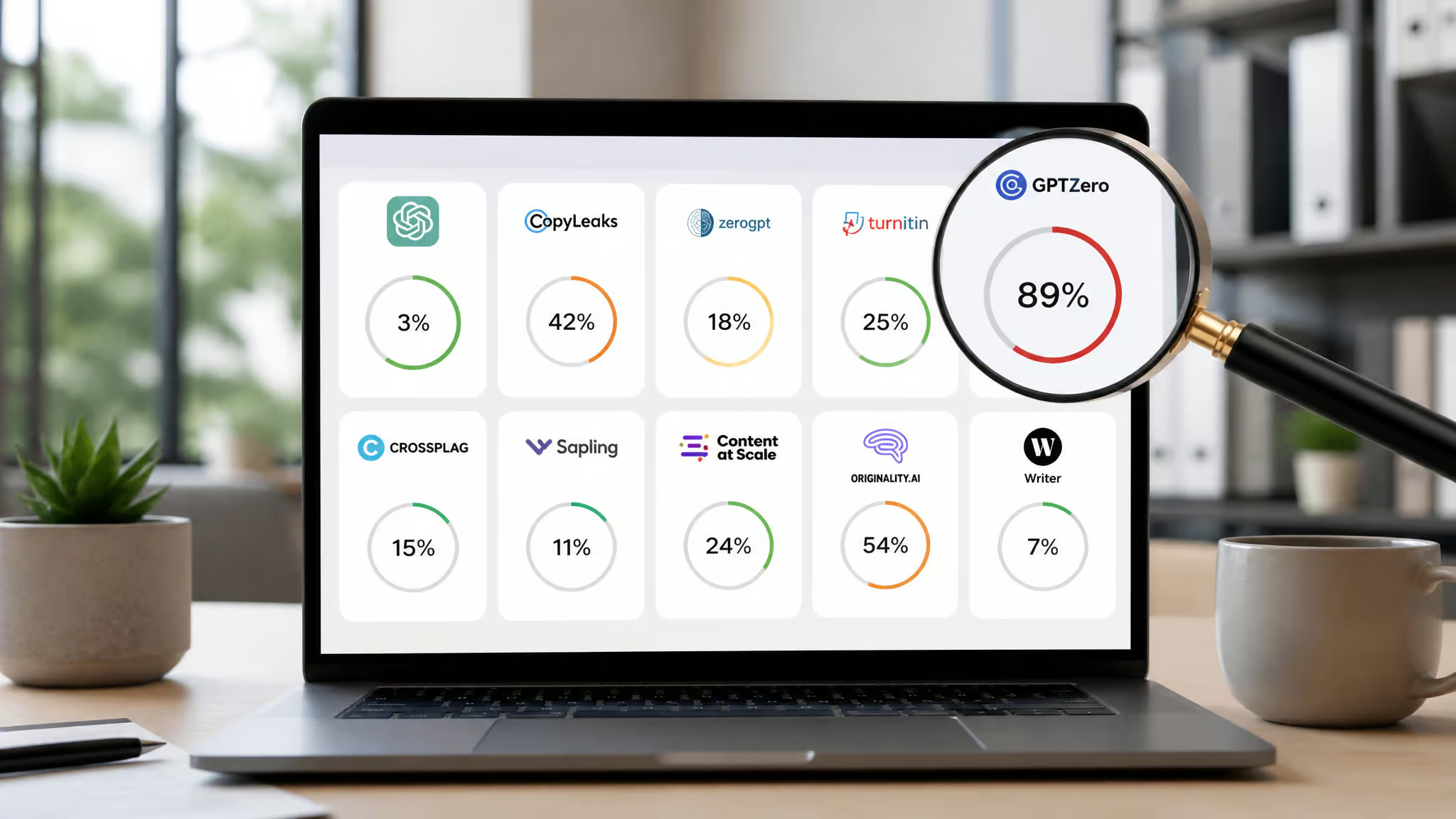
The quickest way to understand why detection software keeps fumbling is to watch the creator give up. OpenAI spent months on its own classifier, then quietly killed it because the accuracy was too low to trust. While researching this piece, I ran a quick bench test of my own, one ChatGPT-generated text and one human-written text through a handful of detectors. The results came back spotty across the board, and OpenAI’s tool, the one built by the company that makes the generator, performed worst of all of them. That is not a great look.
The broader skepticism is documented. MIT Technology Review and Digital Trends have both taken swings at this category, with one headline boiling it down to the uncomfortable truth: OpenAI itself has abandoned efforts to catch ChatGPT plagiarism. According to ZeroGPT, you can check GPT using AI detection tools to identify content from models like ChatGPT, GPT-4, and Gemini with high accuracy.
Detectors err in both directions. They flag human writing as machine-made, and they miss real AI output entirely. Part of that is the game itself. Detectors are perpetually playing catch-up with generators, retraining against the newest patterns while the models quietly move the goalposts.
It’s a moving target, and by the time a detector learns today’s tells, tomorrow’s model already has new ones. There’s also a built-in bias problem that deserves its own section, so I’ll save the details for later. For now, know that the false flags aren’t evenly distributed.
How AI Detectors Actually Work
Before you panic over a 73% “likely AI” score, it helps to know what the tool is actually measuring, because it isn’t meaning.

Perplexity and burstiness
Every detector worth its API key is really scoring two signals. Perplexity is a measure of how predictable the word choices are; lower perplexity means the text runs along the rails a language model expects. Burstiness is how much sentence length and style vary. Human writing is bursty.
We ramble, we cut sentences short, we change rhythm mid-paragraph. Machine text tends to sit at a uniform gait, like spotting a bot marching down the street with identical stride length at every step.
Detectors don’t read for meaning. They score that statistical flatness and hand back a probability from 0 to 100 percent. That’s it. A percentage, not a verdict.
And because everything hinges on predictability, formulaic human writing gets hammered. Legal copy, templates, structured academic prose, all of it reads as predictable, and the tool cheerfully confuses statistical predictability with machine origin.
The “30% rule” is a myth
There’s a widely repeated shortcut floating around that says anything scoring under 30% on a detector is human enough to pass. There is no such standard threshold. Every tool sets its own cutoffs, and they’re arbitrary. A low score is not proof of human authorship any more than a high one is proof of a bot. If you want the full autopsy of why that heuristic backfires, the deep dive on the 30% rule walks through the whole thing.
Bottom line: A detector score is a probability from one tool with arbitrary cutoffs, not a verdict. Never treat any percentage as proof of authorship.
The Human Brain Is the Better Detector
Okay, a bit of context before you tune me out: I like AI. I pay for ChatGPT Pro, mostly so it can summarize financial spreadsheets for me. I am not trying to convince you to hate the technology. What I’m saying is that trusting a detector’s percentage is the wrong move, and the practical answer to how to detect AI writing is a reading habit, not a software purchase.
Studies suggest humans are significantly better than chance at spotting the moment a text shifts to AI copy, and we get better with practice. The skill transfers across formats, too: the same analytical thinking that helps you catch a deepfake in a video is what flags synthetic prose. Analytical thinking is positively associated with correctly identifying generated or altered content, which makes sense when you frame it right. This is the same judgment muscle that catches fake news and misinformation, pointed at grammar instead of headlines.
There’s also a quality gap hiding in plain sight. AI can draft a paper, a lab report, or an annotated bibliography in seconds, but it can’t produce a strong one without heavy human guidance. Editing an AI draft feels like operating on a body where everything is compromised, and the effort ends up comparable to writing it yourself. That hollow core shows.
Read for depth, for originality, for whether the text is actually saying something or just arranging words with confidence. Sycophancy is a cue worth watching for, too: AI tends to flatter and agree rather than push back.
Now the honesty caveat, because I don’t want to oversell. Research from Jakesch and colleagues in 2022 warns that humans get overconfident. We are not perfect detectors. Your gut is a tool, not a verdict. But it’s a sharper tool than a probability score, and you can train it.
Spotting the AI House Style
A writing instructor I respect once summed up the current AI house style in a single observation I’ve never been able to shake: The em dash is out; the comma is in. The Oxford comma is more often than not italicized, and standardized punctuation in AI-generated text is a dead giveaway.
Treat everything in this section as a lead, not proof. A quick pass of light human editing removes every one of these tells, so style alone should never settle a verdict. When I’m skimming something for tells, I keep four things in my back pocket: the stats, whether the text flows naturally, the typo situation (or the suspicious lack of one), and whether rare words are used oddly.
Punctuation tells
Standardized punctuation is the quiet tell. Where a human writer reaches for an aside or a bit of rhythm, current AI output tends to stick with commas, and it does so with mechanical regularity. The Oxford comma gets over-italicized, as if the model is proud of getting it right. The result is prose that’s perfectly punctuated and completely flat, like a typeface where every letter is the same height.
This is the counterintuitive bit: the absence of mistakes can be a red flag. Humans make typos. We write “teh” and fix it later. AI doesn’t. Flawless grammar is suspicious because humans are messy.
Words and phrases AI overuses
Then there’s the vocabulary. Words like “delve,” “meticulous,” “underscore,” “boast,” and “intricate” have become measurably more common in scientific writing since 2022, because models lean on them. The effect isn’t any single word; it’s the combination. When “quietly,” “genuinely,” “delve,” and “meticulous” show up together inside the same polished sentence framing, you’re not reading a person, you’re reading the house style. “Tapestry” and “it’s important to note” have the same energy; they’re filler the model reaches for the way a nervous speaker reaches for “um.”
The catch: savvy writers now avoid these words on purpose, so their absence proves nothing. It’s a lead, never proof. The full rundown of AI tell words is worth a read if you want to spot them in the wild.
Polished but hollow
The bigger tell is what’s missing. Repetition, vagueness, and small inaccuracies pile up in machine prose because the model is assembling text that sounds right, not text that’s true. The writing is slick, grammatically pristine, and strangely empty. There’s no personal voice, no digression, no awkward but honest opinion. It reads like a speaker trained to never make a mistake, which is exactly backwards from how interesting humans write.
False Accusations and Algorithmic Bias
The false-flag problem isn’t hypothetical, and it isn’t evenly distributed. A 2023 Stanford study ran essay tests through a batch of detectors and found they falsely flagged 61% of TOEFL essays authored by non-native English speakers as machine-produced, versus about 2% of native essays. The researchers gave it a name: “algorithmic bias.” One tool in that study hit a 97% false-positive rate on non-native essays. Ninety-seven percent.

The people worst hit are non-native English speakers and neurodivergent writers, whose writing patterns happen to mimic what detectors score as predictable. That isn’t a minor edge case. That’s the population most likely to get accused of cheating for simply existing in a second language.
This is what a false positive looks like in the real world. GPTZero, the biggest name in the space, falsely accused a student a while back, and the negative media attention was loud enough to serve as a warning to everyone else. A detector error stops being a technical bug the moment it becomes an academic-integrity accusation against a real person.
The rule that follows is simple: a detector score should never be the sole basis for disciplinary action. The picture has shifted somewhat since the Stanford study, and detectors have improved in some settings, but they remain vulnerable to evasion. It’s not a solved problem, and treating it as one is how innocent people get burned. One more note while we’re here: plagiarism checkers and AI detectors are different tools doing different jobs.
One hunts for copied text, the other hunts for generated text, and neither is a magic bullet. The overlap and the limits between them are worth understanding before you rely on either.
Red flag: Detectors are measurably biased against non-native speakers. A high AI score on a second-language essay is more likely algorithmic bias than evidence of cheating.
How to Prove You Didn’t Use AI
Most detection guides stop at spotting tells and never get to the part that matters when the accusation lands: how to defend yourself. Here’s the core hinge. A detector score is a probabilistic, arbitrary number, and it is not evidence against you. The documented record of your actual writing process is, and how to prove you didn’t use AI starts with version histories, style consistency, and word-processor metadata.
Collect the artifacts of your work. Drafts, version history, source notes, edit logs, whatever your word processor keeps. That paper trail shows how a text was actually produced, and no probability score overrides it. Be ready to walk through your process, too: where you started, how you revised, why you picked certain words. That explanation carries weight because AI can’t fake a history.
If you want voluntary supporting proof, some tools lean into verification instead of accusation. GPTZero offers a video replay of the writing process plus a human-writing verification feature, and tools like VisibleAI take a transparency-over-detection approach, showing how AI was used in a document rather than just flagging it. None of that is a magic ticket, but alongside your draft history, it can help you make your case. Understanding the technology is part of the defense as well: if you know how AI writes, you’re better equipped to explain how your own process differs.
Why Detection Is an Unwinnable Arms Race
To see why this is structurally unwinnable, look back at OpenAI’s GPT-2 output detector from 2019. When it launched, it was genuinely accurate. Then newer generators arrived, and the detector’s edge collapsed. The race is a treadmill: every detector update is answered by a generator workaround, and the models always have the advantage because they’re the ones everyone’s trying to catch.
Paraphrasing, or running text through another LLM to rewrite it, defeats detectors cleanly. Even minor edits fool them. The proposed fix is watermarking, embedding a hidden statistical signature in model output, but watermarking can be circumvented too, which puts you in a whack-a-mole loop rather than a solution.
One gap most guides miss: the EU AI Act requires transparency from AI tools, but it doesn’t require labeling AI-generated content. The law is still catching up to the technology, and that gap shapes what detection can actually enforce. So state the honest conclusion plainly. AI text cannot be reliably detected in general. If someone asks whether AI can be reliably detected, the answer is no, and no tool on the market changes that.
What the Tools Actually Deliver: GPTZero and the Rest
If you still want to know which tools are worth touching, let’s talk honestly about what they actually deliver, starting with the blunt version: none of them is completely accurate or definitive. Human writing gets falsely flagged, edited AI text sails through, and my bench test of one ChatGPT piece against one human piece came back spotty. They’re supporting signals, never verdicts.
GPTZero
GPTZero is the big player, built by Princeton student Edward Tian, launched in January 2023, and it’s the one most likely to pop up in a professor’s browser tab. It’s served over 10 million users and works with more than 100 organizations. It raised $10 million in the winter of 2023, right as the AI-detection gold rush was peaking, and the source’s independent benchmarking claims its Advanced Scan has best-in-class accuracy. That claim belongs to the source, not me, so I’ll leave it there.
Where it gets interesting is granularity. It doesn’t just hand you a score; it can identify specific passages in a document that look LLM-generated, and it detects output from ChatGPT, Claude, GPT-5, and Gemini. Its flagship features lean forensic: video replay of the writing process, human-writing verification, and integrations with LMS platforms like Canvas and Google. There’s even a Chrome extension for Google Docs that shows AI-detection and typing-pattern metrics on any page you’re working on, which is a handy spot-check tool. If you want the full browser-based route, the guide to detecting AI writing online covers that territory.
The catch is the false-accusation history I mentioned earlier. A tool this widely used carries that weight, and it means every GPTZero score should be treated as a lead to corroborate, not a verdict to file.
What free checkers actually deliver
The rest of the field is a herd of checkers with similar statistical limits and louder marketing. QuillBot, ZeroGPT, Originality AI, Winston AI, Grammarly‘s AI check, even newer names like Walter Writes AI all compete on accuracy claims while sharing the same approach, the same predictability scoring, and the same both-directions errors. QuillBot‘s detector, for instance, returns a simple 0 to 100% score, and its design leans toward “human” when the model is unsure, a deliberate choice to avoid false positives that also means it will miss real AI text. In my test, output ranged from unreliable to flat-out wrong, with OpenAI’s own model bringing up the rear.
Any of these is a supporting signal to be confirmed by human review, never a verdict. For the zero-budget route, the rundown of free AI detection tools is a good starting point, and the Winston AI comparison sorts out one of the more prominent paid options. Reddit threads on raw detection tests are also worth browsing; the community failure reports show what actually breaks in the real world, minus the marketing spin.
Detecting AI in marketing content
One place this actually scales is marketing. Gartner predicts generative AI will account for 30% of outbound marketing messages by 2025, up from less than 2% in 2022. That’s a wall of AI copy coming at your inbox, and the tells are the same ones from earlier: generic language, missing brand voice, and factual errors a quick check would catch. The human-review instincts apply at volume. Skim for the house style, verify the specifics, and don’t trust the score sitting in the tool tab.
A Responsible Approach for Educators and Institutions
If you’re an educator staring at this problem, the numbers make the shape of the job clear. A 2024 survey found that 67% of college students think it’s acceptable to use AI in assignments. You’re not policing a small cheating fringe; you’re setting policy inside a cultural shift. A year ago, writers would apologize for a single AI paragraph. Now some treat the model as just another tool, the way spell-check or a laptop is another tool.
The workable protocol for student work and academic papers is the same one from earlier, applied deliberately: treat a detector as a supporting signal, then corroborate with process evidence and, crucially, a conversation with the student. Never treat a score as a verdict. For academic papers specifically, look for the concrete tells: missing citations, generic phrasing, and a lack of sourced depth. Those are checkable by a human at a glance.
Update your academic-integrity policies to address AI explicitly rather than pretending the old rules cover it, and build AI-ethics education into the curriculum instead of relying on enforcement. Remember that the EU AI Act doesn’t require labeling AI-generated content, so the policy is largely on you. Tools like VisibleAI point in a useful direction here: they let instructors see how AI was used, not just whether it was, with an inbuilt assistant that nudges students toward critical thinking rather than raw output. That’s a responsible-use philosophy, and it beats pure detection as a threat.
Field note: A detector score plus a conversation beats a detector score alone. Process evidence and student dialogue are what turn a flag into a fair decision.
The Best Detector Is the One You Already Have
So here’s where we land. You came here to learn how to detect AI writing, and the honest answer is that reliable tool-based detection doesn’t exist. I’d argue that’s actually good news. It means the thing you need isn’t a subscription or an API key; it’s a skill you already have and can sharpen, the same critical judgment that catches fake news and misinformation, pointed at sentence structure instead of headlines.
Detection is a literacy. It’s a habit of critical analysis you can train, something you get better at the way you get better at reading a suspicious email or spotting a stretched review. When the stakes are high, verify with process evidence. Keep a skeptical reserve instead of trusting any detector score, including the ones that claim best-in-class accuracy.
And one last thing. Apply that same skeptical reserve to this article while you’re at it. If you read it with the same attention you’d bring to a detector output, you’ve already got the tool you came for.
Frequently Asked Questions
How to prove you didn’t use AI?
The most reliable defense is the documented record of your actual writing process: drafts, version history, source notes, and edit logs from your word processor. A detector score is a probabilistic, arbitrary number and is not evidence against you, but a paper trail shows how text was actually produced. Be ready to walk through your process — where you started, how you revised, why you chose certain words — because AI can’t fake a history.
How do AI detectors actually work?
AI detectors score two statistical signals: perplexity, which measures how predictable word choices are, and burstiness, which measures how much sentence length and style vary. Human writing is bursty — we ramble and change rhythm — while machine text tends to sit at a uniform gait. Detectors don’t read for meaning; they score statistical flatness and return a probability from 0 to 100 percent, not a verdict.
Is GPTZero accurate?
GPTZero is the biggest name in AI detection, serving over 10 million users, but no detector is completely accurate or definitive. It can identify specific passages that look LLM-generated and offers forensic features like video replay of the writing process, but it has a history of false accusations. Treat any GPTZero score as a lead to corroborate, never a verdict.
What’s the difference between plagiarism checkers and AI detectors?
Plagiarism checkers hunt for copied text, while AI detectors hunt for generated text, and neither is a magic bullet. They use different methods — plagiarism checkers compare against existing sources, while AI detectors score statistical predictability. Understanding the overlap and limits between them matters before relying on either for disciplinary decisions.
