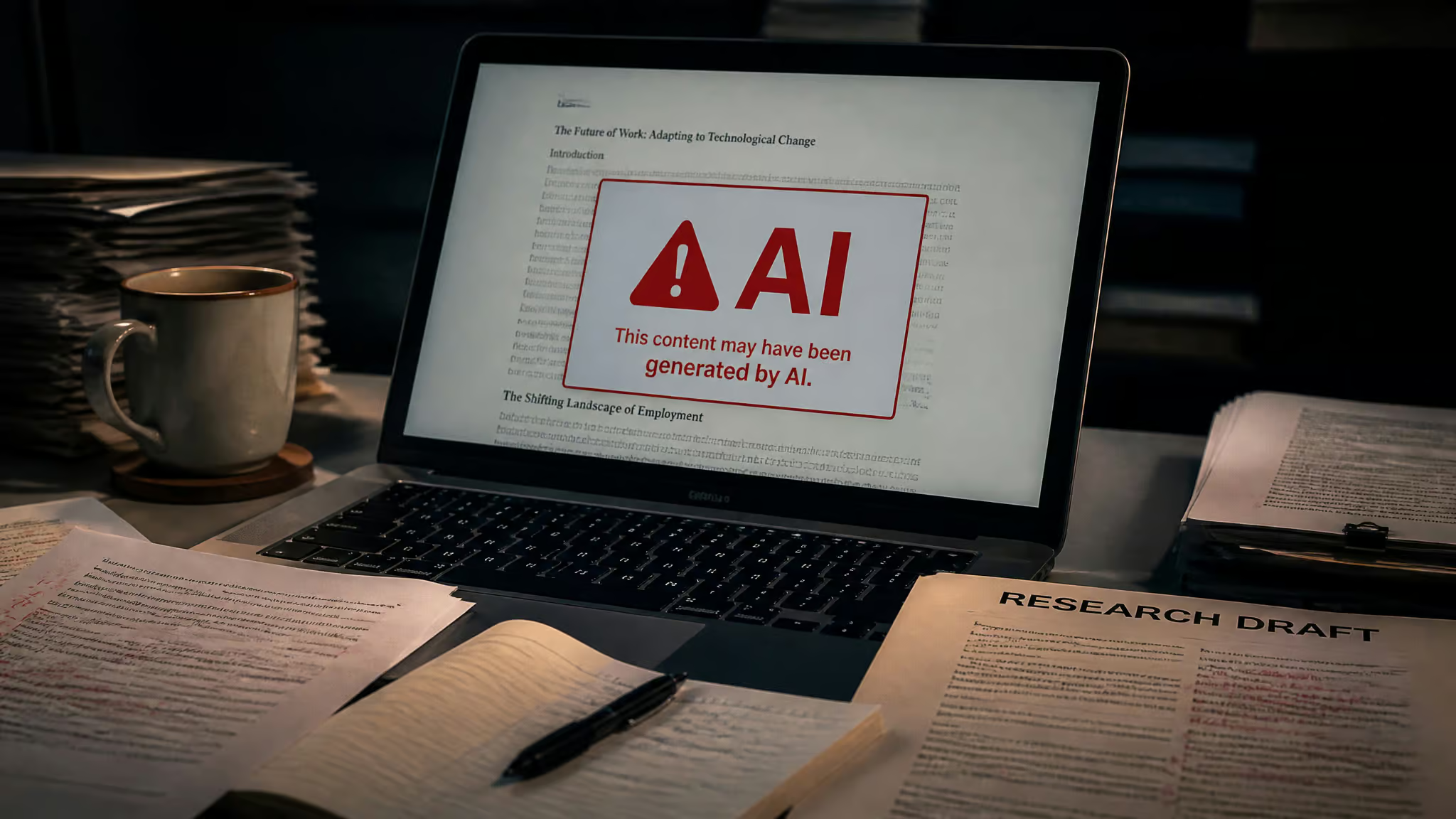
Picture the scene. You’re halfway through your coffee when the email lands: your professor wants to talk about your essay, and the word “AI” is in the subject line. Maybe Turnitin slapped a 100% AI score on work you actually slaved over. It’s the kind of moment that makes your stomach drop, and it’s happening to more students than you’d think.
Here’s the thing that should defuse the panic before it fully sets in: AI detectors are genuinely, hilariously unreliable. The same tools built to catch cheaters have flagged the Declaration of Independence as machine-written. Yes, really. And honestly, this is exactly the kind of thing we get properly nerdy about here, because a tool that can’t tell Thomas Jefferson from a chatbot is a system worth understanding.
Independent analyses put false-positive rates between 5% and 20%, and even Turnitin, the vendor whose score just ruined your morning, warns that its AI score shouldn’t be the sole basis for any action against a student. Vanderbilt went further and turned the tool off entirely, publishing the reasoning for the whole internet to read.
Which means the tool that accused you can be flipped into your strongest evidence of innocence. The catch is knowing how. That’s what we’re digging into here.
Key Takeaways
Independent analyses put AI-detector false-positive rates between 5% and 20%, and even Turnitin warns its score alone must not trigger action against a student; Vanderbilt turned the tool off entirely.
Google Docs version history is timestamped and stored on Google’s servers, so the proof you typed the essay yourself existed before the accusation did.
AI fabricates page and paragraph numbers in citations almost every time, which makes accurate, properly sourced citations a genuinely strong marker of human writing.
Why the detector flagged your clean essay
Let’s start with how these things actually work, because once you get that, the whole situation stops feeling like a mystery and starts feeling like a bug you can work around.
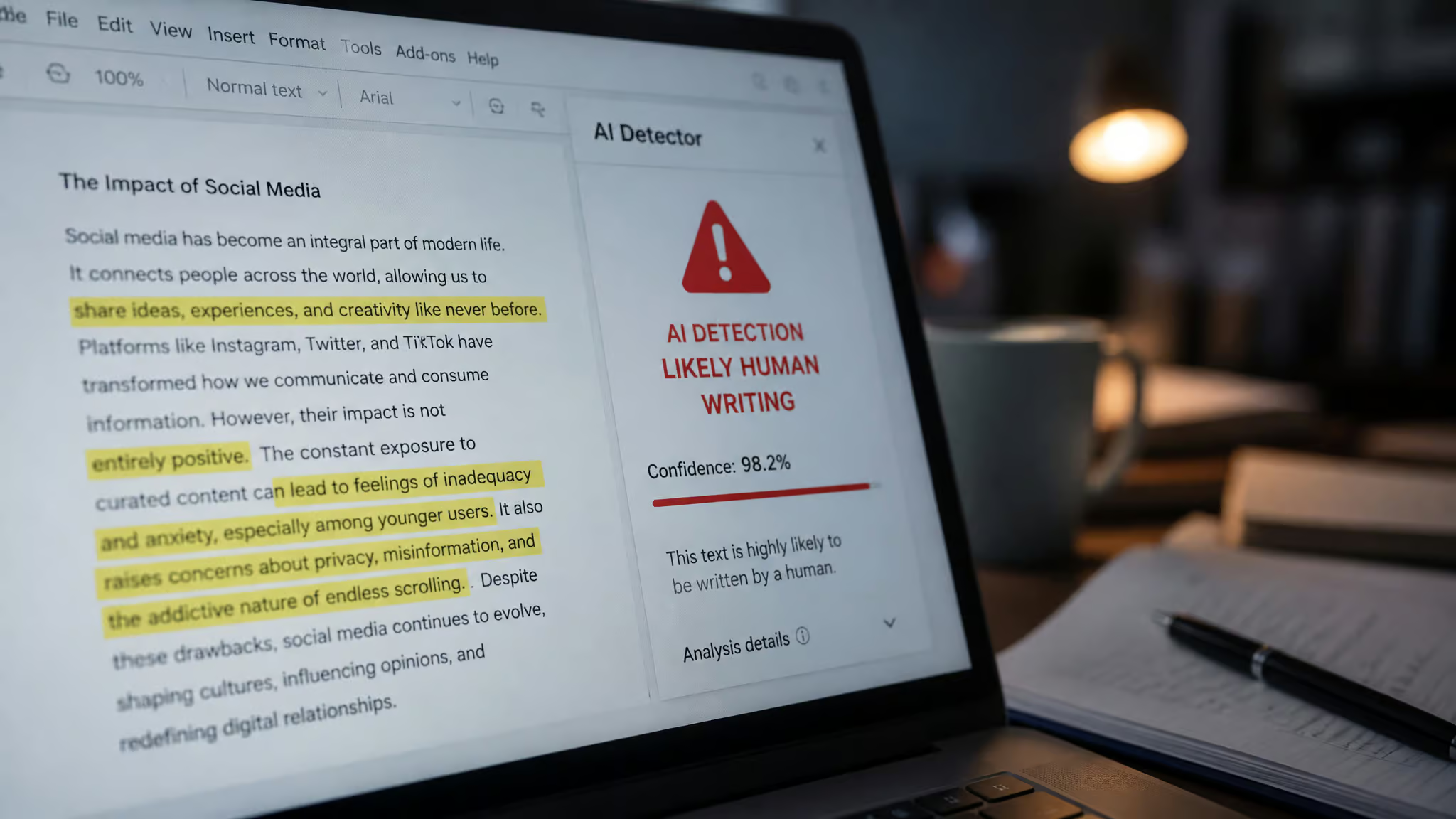
AI detectors don’t compare your text against a database the way plagiarism checkers do. They analyze the text’s characteristics using natural language processing, looking for two signals in particular. Perplexity measures how predictable your word choices are. Burstiness measures the variation in your sentence length and structure.
Human writing tends to be bursty and unpredictable. AI output tends to be smooth and consistent.
Here’s the honest catch: clear, consistent human writing can match that AI statistical profile. That’s why a clean, well-edited essay gets flagged. The Declaration of Independence has been flagged as AI-written. So have 19th-century books.
The detector isn’t finding evidence of cheating; it’s finding statistical fingerprints that overlap with machine output. If you want the full tour of what machine prose actually looks like, we’ve got a separate guide on detecting AI writing, including the telltale words that give it away.
And the reliability numbers back this up. Independent analyses put false-positive rates between 5% and 20%. That means many innocent students get flagged. Even Turnitin, the vendor whose score you’re fighting, cautions that its AI score shouldn’t be treated as conclusive evidence of misconduct. Vanderbilt University turned Turnitin’s AI detection tool off entirely, which is about as strong a statement as an institution can make. Even with proof, detectors can produce false positives, so be prepared to explain limitations.
There’s also a bias problem that makes this worse for some students. Stanford research found that detectors often flag essays by non-native English speakers as AI-generated, because predictable, formulaic phrasing is common in that writing and it maps onto the machine profile. Follow-up reporting from Education Week, Advanced Science News, and TechXplore confirmed the pattern. If English is your second language, the detector was the problem, not you.
Then there’s the black-box problem. Most detectors are proprietary, with algorithms you can’t inspect or verify. And they’re unstable. A text flagged today might not be flagged in two weeks, because the algorithms keep changing.
That’s not a stable foundation for an accusation. Tools like Scribbr’s AI Detector claim to tell human-written, AI-generated, and AI-refined text apart, and it supports German, French, and Spanish, which is genuinely useful for non-English work. But it makes the same claim every detector makes, and the same caveat applies: none of them are perfect.
Here’s a concrete example of how messy this gets. A first-year seminar essay received a 100% Turnitin AI score. The instructor’s stated reasons for suspicion included that it read like a professional document, had no spelling mistakes, didn’t quote from the readings, and didn’t connect to the student. Those are human tells about style and effort, not evidence from a reliable detector. It’s the kind of case that makes you want to check the detector’s math yourself.
Bottom line: A detector score is a statistical guess, not a finding of fact. The vendor itself says it shouldn’t trigger action alone — and independent testing puts the false-positive rate as high as one in five.
Your document has been keeping receipts
Here’s the part that feels like finding money in an old jacket: you almost certainly already have the evidence you need. Your word processor has been silently documenting your authorship for years. You just never learned how to export it.
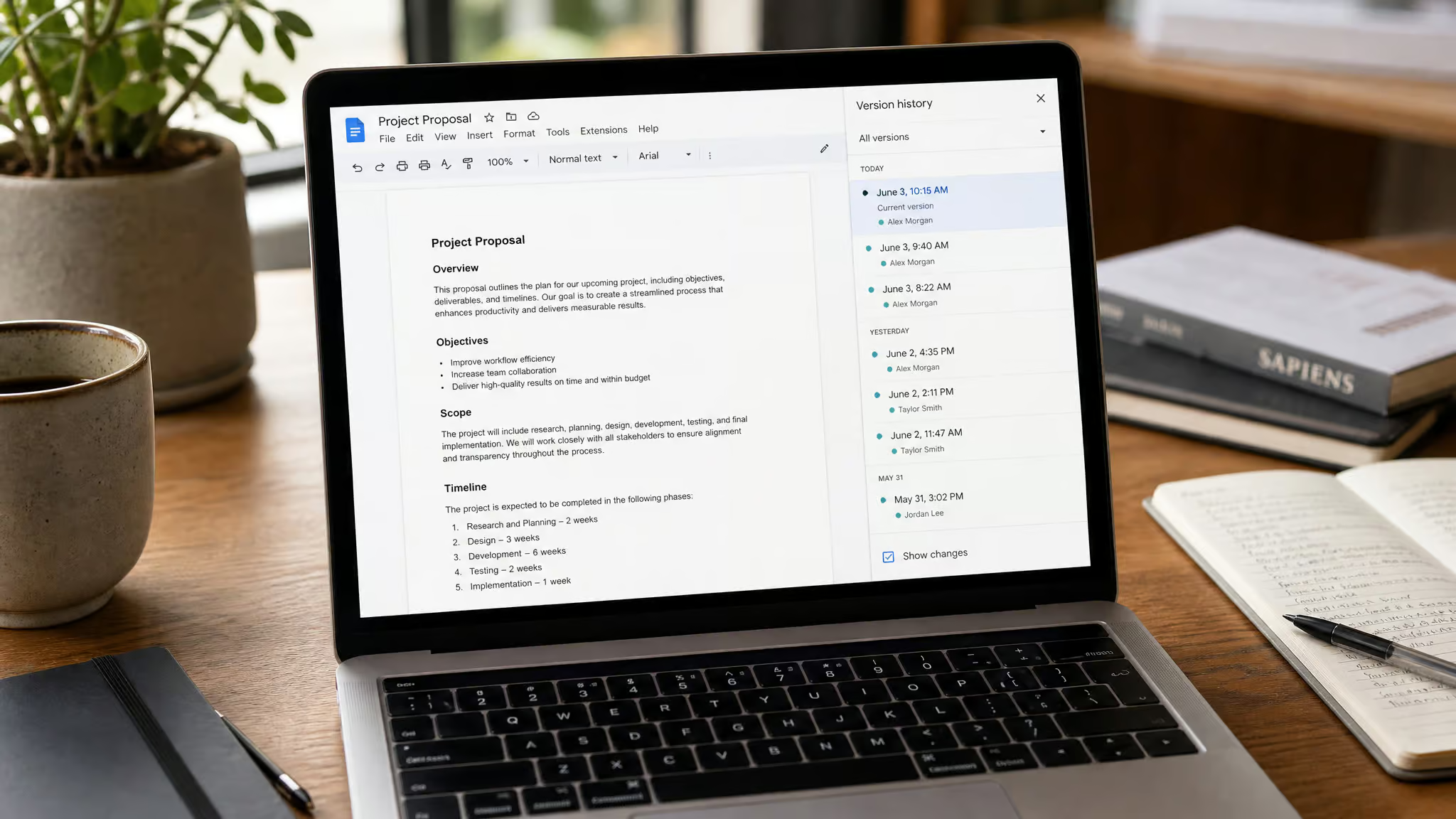
If you wrote in Google Docs, you’re sitting on a goldmine. The version history is automatic and timestamped. Open File, then Version history, then See version history, and you’ll get a full timeline of the document’s creation, showing the gradual build of the text from first draft to final submission. It’s the writing process, captured.
Microsoft Word has version history too, under File, then Info, then Version History, but it’s the weaker evidence tool. It relies on AutoSave and OneDrive snapshots, which are less granular than Google Docs’ continuous history. If you know you might be scrutinized, Google Docs is the better drafting choice. Word does leave other artifacts, like Track Changes, document metadata, and backup and temporary files, but they’re messier to present.
Here’s the key advantage that makes version history meaningful: it’s stored on third-party servers. Google’s or Microsoft’s. The evidence existed before the accusation. You didn’t create it after the fact, which is exactly what makes it credible. A timestamped trail of gradual edits on someone else’s infrastructure is about as close to an alibi as digital writing gets.
Version history proves how you typed. To prove where the ideas came from, you want the research trail: notes, outlines, source files and PDFs with your annotations, research screenshots, chat logs. Together they tell the full story. The version history shows the typing; the research trail shows the thinking.
The dedicated process-tracking toolkit
If version history is the baseline, there’s a whole cottage industry of tools built specifically to capture the writing process. I spent way too long looking at these so you don’t have to. The honest finding: no single tool covers all bases, so the right choice depends on your technical comfort, document length, and whether you want a public audit trail.
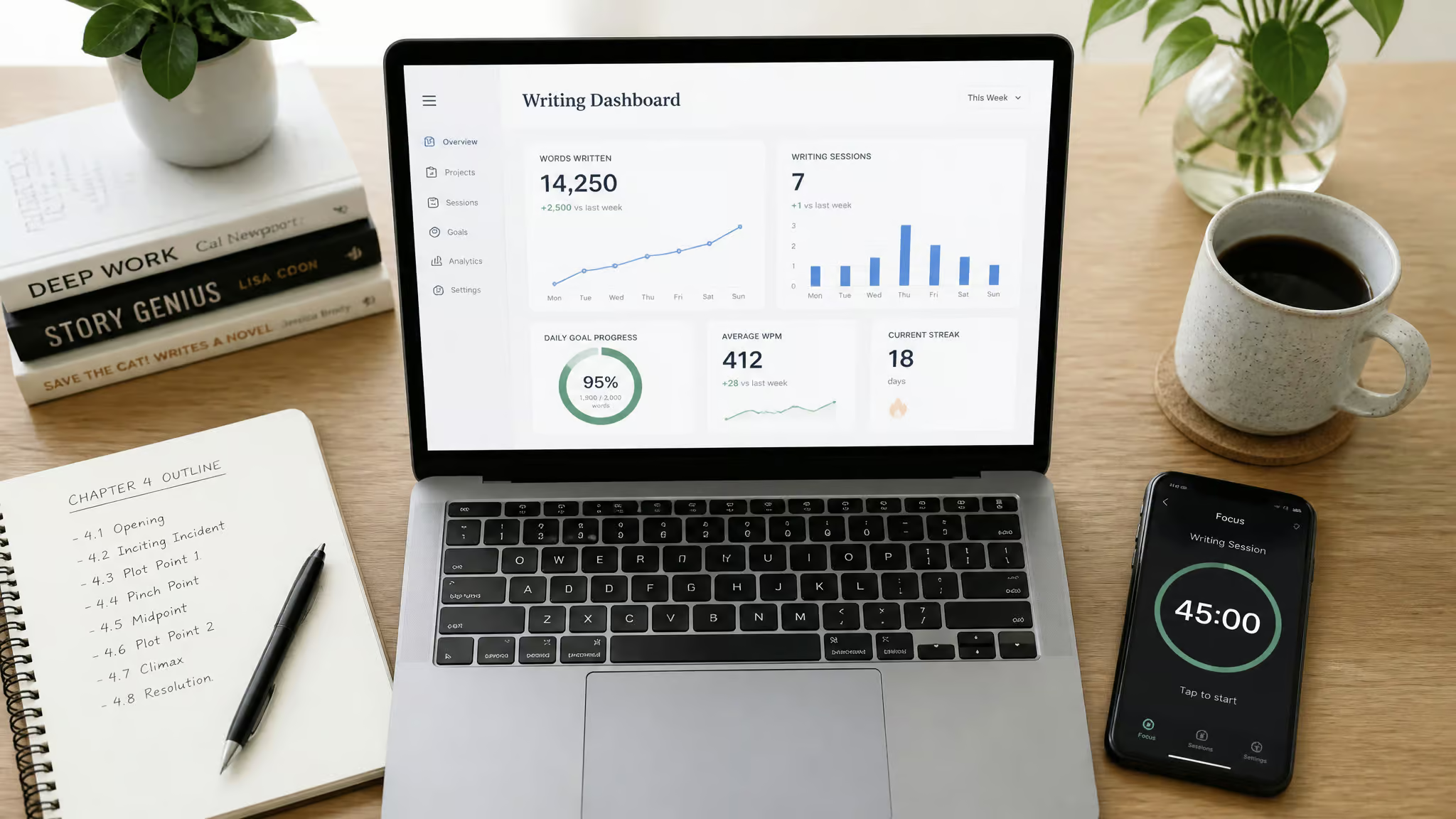
The most established is Draftback, a Google Docs extension that plays back the writing process like a time-lapse of your document. It’s used by over 500,000 people, mostly teachers, and the data it shows is stored by Google, which gives it third-party verification. It doesn’t collect new data; it just gives you a clean interface to see what Google Docs already stores.
Grammarly Authorship tracks changes and content origin, distinguishing human typing from pasted or AI content. It works with both Google Docs and Word, which makes it a solid choice if you’re stuck in the Microsoft ecosystem.
GPTZero’s Writing Report goes beyond a score. It includes Writing Replay, which shows exactly how a piece was written, edited, and pasted, plus activity insights that surface behaviors like frequent edits and writing bursts, and built-in AI detection that flags large pastes and unnatural text.
Vellumproof offers timestamp verification and a built-in editor that tracks typing and pasting, with documents automatically saved to a chain. It’s a blockchain-style audit trail, which sounds fancier than it needs to, but the timestamp verification is the useful part.
ValidDraft is a web editor that tracks typing, mouse movements, and edits. Its honest limitation: it’s focused on shorter documents, so longer ones may need to be verified section by section. As of August 2026, it added a downloadable app for longer documents, which closes some of that gap.
OkHuman tracks typing cadence only and never reads the text, which is a genuinely clever privacy approach. It’s still in early development and not publicly available, so file it under future options.
LyteWriter is for the analog writers among us. You scan and upload handwritten or typed documents to verify they weren’t AI-generated.
Verify My Writing and Authortegrity take a different route: post-writing verification using self-attestation and AI-detector-based checks. You write, then verify after the fact.
And for the technical crowd, there’s Git. The programmer’s standard for over 20 years, Git gives you a clear audit trail in a standardized format, and it works with GitHub, GitLab, or self-hosting. The catch is real: it has a serious learning curve and it’s primarily for plain text, so it’s not great for Word docs. If you’re already a writer who lives in plain text, tools like Zettlr, which has built-in Git integration, or Obsidian with its Git plugin, make this route more approachable. It’s the same version-control discipline you’d use for code, applied to prose.
Quick test: Open your Google Docs version history. If you can see the essay grow from a blank page through multiple dated edits, you’re holding the strongest proof you can get without a dedicated tracking tool.
Build your proof before you need it
The best defense is built before the accusation lands. And the cleanest preventive lever is one you might not expect: citations.
AI is genuinely terrible at creating valid citations. It makes up convincing-looking ones. Page and paragraph numbers are fabricated nearly 100% of the time, and they rarely point to real sources. That means accurate citations with correct page numbers are evidence of something AI can’t reliably do.
They’re a marker of human work, sitting right there in your bibliography. If your instructor requires page or paragraph numbers, AI’s weakness becomes your defense.
The other piece of prevention is habit. Write in cloud platforms with version history enabled, and keep your drafts, notes, and outlines as a matter of routine, not as a crisis response. If you want the process documented before any accusation exists, GPTZero’s Writing Report can be used proactively, building the record from the start.
There’s also a clever low-tech trick worth knowing about, because it can work in your favor. Some instructors hide specific words in the assignment, like “Frankenstein” or “banana.” If the AI output contains those hidden words, it’s a strong signal the assignment was fed into the AI, especially since quotation marks make the trap more likely to spring. Flip that logic around: if your instructor used hidden words and you never included them, their absence is evidence you never pasted the assignment into AI. It’s an alibi you didn’t know you had.
What to do when accused, step by step
Okay, the accusation has landed. Here’s the playbook, in order. The first rule matters more than the rest: don’t panic, and don’t falsely confess.
Students often admit wrongdoing the moment they’re confronted, even when they’re innocent. A false confession is the real danger here. The accusation is a starting point for a conversation, not a verdict, and you get to treat it that way.
Step 1: Get clear on the accusation. Ask for a written explanation of what triggered the accusation and whether a detector score was involved.
Which section is in question? Is this an isolated incident or part of a pattern? Don’t guess at any of this.
Step 2: Round up your evidence. Version history, drafts, outlines, research trail, chat logs. The version history shows timestamps and gradual changes. This is your defense.
Step 3: Create a detailed defense. Write a short, professional email to the instructor or committee. Stick to facts, stay cooperative, and offer your evidence without demanding anything. There’s a useful model for this kind of message from Amanda C. Egan, Ph.
D., of Marian University, and it has a constructive angle worth noting: it offers to restore points if the student discusses their process. A calm conversation is often the whole resolution.
Step 4: Ask for a meeting. Face-to-face usually resolves misunderstandings better than email chains. Bring your evidence.
Step 5: Prepare for a formal hearing. Treat it like a professional presentation. Rehearse your statement, organize your evidence chronologically, practice answering questions, and avoid getting into an argument. It’s like prepping for a technical interview, but for your academic defense.
Step 6: Go to the hearing. You have a right to a fair process, and you may be able to bring a support person if the institution permits it. Stay calm and walk through the process step by step.
Step 7: Appeal if you need to. Most institutions allow appeals. Include a summary of the accusation, your authorship evidence, any procedural concerns, like a detector being treated as conclusive despite its known unreliability, and a respectful request for review.
Step 8: Seek support. Academic advisors and integrity officers know this process. For serious cases, legal support can matter, and there are attorneys who work specifically in this space, like Richard Asselta. And don’t skip the psychological support. False accusations take a real emotional toll, and it’s okay to ask for help.
Your legal rights, in plain terms
If this goes formal, you’re not just hoping for fairness. At public colleges, you have actual constitutional due-process rights under the Fourteenth Amendment. That means notice of the charges, access to the evidence, and a meaningful opportunity to respond before serious sanctions. It’s a real legal protection, not a policy hope.
The case law backs this up. Goss v. Lopez, from 1975, established the basic requirement of notice and an opportunity to respond. *Doe v.
University of Cincinnati, from 2017, held that due process is required before suspension or expulsion and that the decision-maker must be unbiased. Flaim v. Medical College of Ohio, from 2005, clarified that hearings don’t need to mirror criminal trials but must still be meaningful and fundamentally fair. And Plummer v. University of Houston*, from 2017, balanced the school’s educational goals against your interest in your reputation and continued enrollment.
Private colleges work differently. Your protections come through contract law and the school’s own policies. But the baseline still holds: private schools must be fundamentally fair and follow their own handbooks and promises. *Z.J. v.
Vanderbilt, from 2018, established a duty of good faith and fundamental fairness. Doe v. Rector & Visitors of George Mason, from 2016, reinforced the contract-based protections. And Furey v. Temple*, from 2012, noted that cross-examination may be necessary to avoid mistaken outcomes.
None of this guarantees a specific result. What it does is establish the framework: you have rights, the school has obligations, and a detector score treated as conclusive evidence is itself a procedural problem you can raise.
Why this matters beyond your grade
This isn’t just about grades. False accusations carry real career and reputational costs, and the stakes can be enormous.
Consider Jerry Falade. His debut crime novel, “Call Me, I’ll Hide the Body,” was picked up by Minotaur Books in a deal worth at least $2 million. Then AI allegations emerged. His agents pulled the book because they said they could no longer substantiate how it was written.
Falade denies using AI to write it, though he admitted using AI for research. His manuscript was run through Pangram, which “proved” most of his writing was inauthentic. A $2 million deal, gone. And to be clear: nobody claims any verification tool would have saved that deal. It’s a cautionary tale about how fast things can collapse.
Other authors have faced similar fallout. Mia Ballard’s “Shy Girl” was pulled from publishers in March after discussions on Goodreads and Reddit. H.M. Wolfe’s “Daggermouth” drew criticism over potential AI use after its March publication. Meanwhile, Coral Hart admitted to using AI to write romance novels under multiple pen names on Amazon, a reminder that the real thing does happen out there.
And there’s a fairness problem underneath all of it. James Frey admitted to using AI to assist with his writing and faced less backlash than authors of color. That double standard mirrors the Stanford finding that non-native English speakers are disproportionately flagged by detectors. This is a fairness problem, not just a technology one.
The context matters too. ChatGPT launched in 2022, and AI can now generate text moments after a prompt. Companies have destroyed millions of books to feed AI training data, cutting off spines to scan pages faster. Author Emily McIntire is being paid out of the Anthropic settlement because her works were used without permission. In response, many authors now include a statement at the start of their books asserting the work was written without AI. It’s a practical model worth copying: declare your process, up front, and let the record speak.
What works, what doesn’t
Stepping back, here’s the honest state of the art. The tools that enable collaboration also enable verification. Git and Google Docs are the models. Third-party-verified version history is the strongest evidence available, because it’s a record that existed before the accusation, stored on infrastructure you don’t control.
What doesn’t work is trying to beat the detector. They’re black boxes with changing algorithms, so there’s no stable target to optimize against. AI watermarking isn’t the answer either, because it doesn’t verify human content. And there’s a fundamental asymmetry here: proving a work was not AI-generated is far harder than proving human-to-human plagiarism, because plagiarism leaves a matching trail while AI authorship leaves only a statistical impression.
The ideal solution would be free or low-cost, track typing and editing, provide a public audit trail, work with existing tools, and be accessible to non-technical users. Nobody’s built that yet. The honest finding is that no single tool covers all bases, so the best defense combines layers: version history, process-tracking tools, a research trail, and accurate citations.
If you want to see how this plays out in the wild, the communities on Reddit are doing raw testing of these tools and sharing failures and workarounds that the marketing never mentions. It’s worth a browse before you bet your defense on any single product.
The evidence speaks for itself
You can’t control whether you get accused. You can control how well you respond.
The toolkit is straightforward: write in cloud platforms so your process is documented by third-party servers. Keep your research trail. Understand why detectors fail, so you can explain it calmly. Respond professionally.
Know your rights. And seek support when you need it.
The inversion of justice here is worth holding onto. The burden of proof should rest on the accusation, not on the accused. A detector score is a hint, not a verdict. Your version history is the evidence that speaks.
The detector says your writing looks like AI. Your version history says you typed it yourself at 2 AM. Present the evidence clearly, and let it do the work.
Frequently Asked Questions
How do I prove I’m not AI?
The strongest proof is a timestamped version history from a cloud platform like Google Docs, which shows your writing process from first draft to final submission and is stored on third-party servers. You can also use process-tracking tools like Draftback or GPTZero’s Writing Report, and keep your research trail—notes, outlines, and annotated sources—to demonstrate where your ideas came from.
How does one prove they didn’t use AI?
You prove it by showing evidence that predates the accusation: version history, drafts, and a research trail. Accurate citations with correct page numbers are also strong markers, since AI fabricates page and paragraph numbers nearly 100% of the time. If you used a process-tracking tool like Grammarly Authorship or ValidDraft, that record can serve as direct evidence of human typing.
Why does Turnitin flag my essay as AI when I wrote it myself?
Turnitin’s AI detector looks for statistical fingerprints—low perplexity and low burstiness—that overlap with machine output. If your writing is clean, well-edited, and consistent, it can match that profile. Even Turnitin cautions that its AI score shouldn’t be treated as conclusive evidence, and Vanderbilt turned the tool off entirely.
What’s the difference between AI detection and plagiarism detection?
Plagiarism checkers compare your text against a database of existing sources to find matches. AI detectors, on the other hand, analyze the text’s characteristics using natural language processing, looking at perplexity (word predictability) and burstiness (sentence variation). That’s why AI detection is far less reliable—it’s a statistical guess, not a finding of fact.