Free AI detectors will lie to you. Not out of malice, but because the underlying tech is a probabilistic guessing game dressed up in a confidence score. Last week I pasted a chunk of Claude-generated text into two of the most popular free detectors on the market, and both of them shrugged and called it human. Not “maybe human.”
Not “58% human.” Just: that’s a person who wrote that. The gap between what these tools promise and what they actually deliver is the entire reason you can’t just grab one free detector and trust its verdict.
That’s why I spent way too long this week running 30+ detectors through one standardized test: same prompts, same human control texts, all free tiers. The result is a short list of tools actually worth stacking, the exact caps you’ll hit, and a repeatable zero-budget workflow that won’t get you burned by a false accusation. Here’s what worked, what didn’t, and why the perfect free detector doesn’t exist yet.
Key Takeaways
QuillBot’s free detector hit 78% accuracy in independent testing with zero false positives, and it caught 98-100% of AI text in our hands-on runs, but the 1,200-word cap means long documents need chunking or an upgrade.
GPTZero gives students a generous 10,000-character free allowance with sentence-by-sentence analysis, but it’s far from the accuracy leader: it scored just 52% with one false positive in independent testing, so pair it with a second opinion before submitting anything important.
Only PangramLabs and CopyLeaks cleared all 12 samples in our tests, passing both AI and human texts. CopyLeaks also offers 100 free checks a day and 30+ languages.
Table of Contents
How to check if text is AI-generated for free
Copy-text, paste-it-into-a-free-detector, read-the-percentage-score-and-the-highlighted-passages. That’s the whole workflow, and it takes about thirty seconds once you know which tools to reach for. The four names our testing most support are QuillBot, Scribbr, GPTZero, and CopyLeaks, each with a different job in the stack:
- QuillBot: no sign-up, unlimited checks within a 1,200-word cap, sentence-by-sentence breakdown, and verdict categories like “AI-generated” or “human + AI-refined.” The best general-purpose free pick for ChatGPT-heavy content.
- GPTZero: up to 10,000 characters free, scans for ChatGPT, Claude, and Gemini patterns, and gives sentence-level analysis. Built for academics, not for raw accuracy.
- Scribbr (free): percentage score with highlighted AI passages, zero false positives in independent testing, and no sign-up. But free checks cap at 500 words, which catches most people off guard.
- CopyLeaks: 100 free checks a day, 30+ language support, and selectable detection models. The best high-volume option, especially if you’re checking multilingual text.
If you’re checking something longer than 1,200 words, you’ll have to chunk it into pieces anyway, so the caps are more of a rhythm than a wall.
How we tested 30+ AI detectors
Before recommending any of these, I wanted to know what “good” actually looks like, so we built a small benchmark in-house. The corpus was straightforward: we generated roughly 1,000-word samples from ChatGPT-4o, Gemini 2.0, and Claude 3.7 Sonnet using the same prompt, giving us nine AI texts, plus three human control texts: an excerpt from the Declaration of Independence, an excerpt from the Magna Carta, and an original piece we wrote ourselves. Pass criteria were simple: AI text had to score at least 75% AI, and human text had to score no more than25% AI. Every tool ran through its free version, because that’s what most people will actually use.
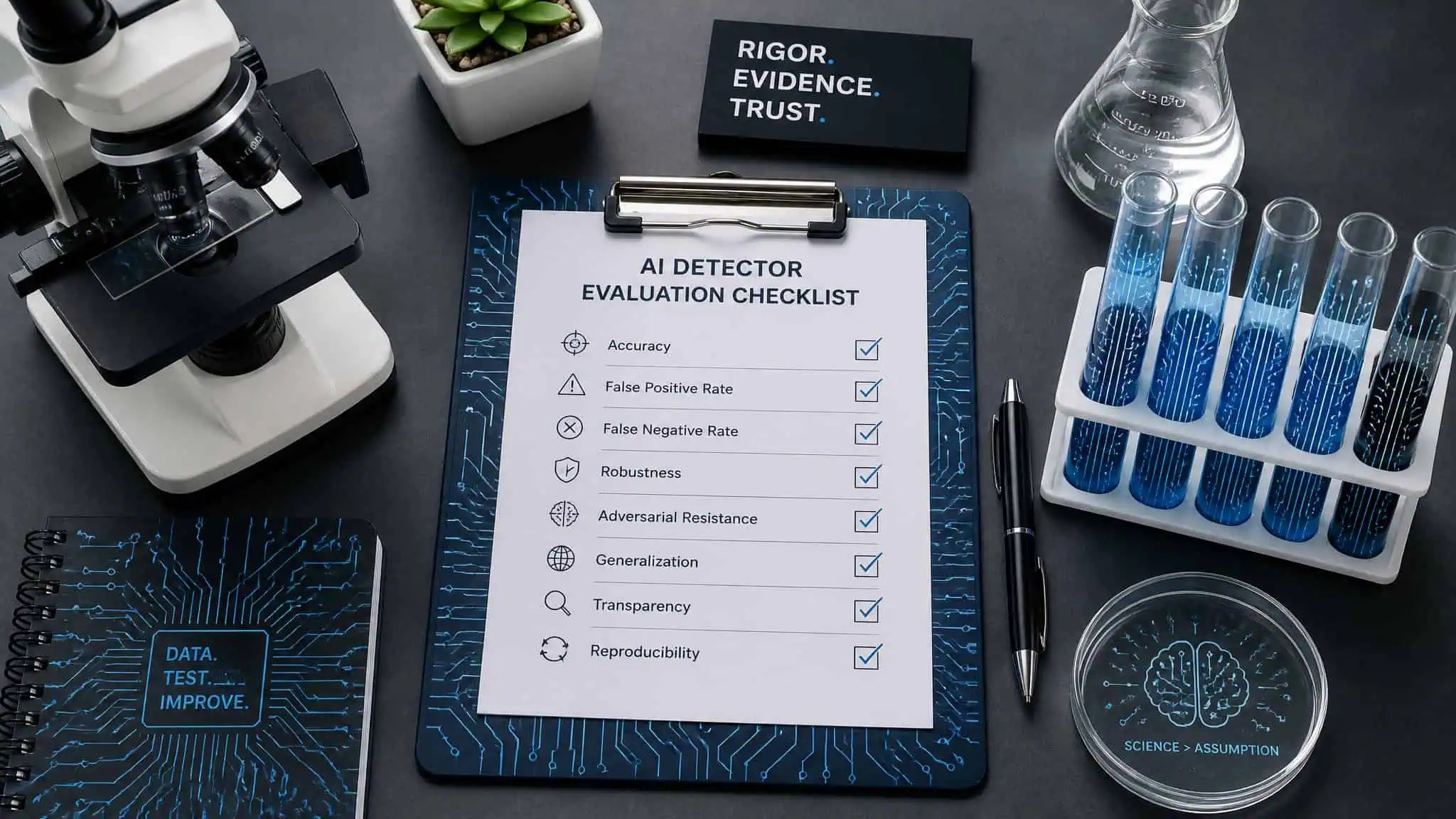
This is a snapshot, not a verdict. You should re-test your own content, because results shift depending on the text, the model, and the tool’s latest training. Don’t treat our pass counts as the final word; treat them as a solid starting point for your own testing.
. A separate outside evaluation used a different mix: fully AI, mixed, human, and paraphrased content across 12 detectors, while a third tested 30+ tools on real-world content. That’s why scores differ between sources: test design matters a lot, and nobody’s running the exact same rig as anyone else.
Now let’s walk through the tools that actually earned a spot in the stack.
QuillBot: best for ChatGPT content
If you’re checking whether something is ChatGPT-generated, start with QuillBot’s free detector. It tied for second-highest accuracy among free tools at 78% in one independent evaluation, with zero false positives, and in our hands-on runs it caught 98-100% of AI text. Our own benchmark agreed: it passed 4 of 9 AI texts and all 3 human texts, showing real strength on ChatGPT content though it was weaker on Claude.
The free tier needs no sign-up and offers unlimited checks, which is rare in this space, and each run produces a sentence-by-sentence analysis with highlighted passages and verdict categories like “AI-generated,” “AI-refined,” or “human + AI-refined.” It also bundles a humanizer and paraphraser, which is handy if you’re the one who needs to fix flagged text. Just remember the 1,200-word cap is the real limitation; “unlimited” doesn’t mean unlimited length, so long pieces need chunking or an upgrade.
GPTZero: best free AI detector for academic writing
For students, GPTZero is the tool to start with. It’s explicitly designed for education, and its free allowance is generous: up to 10,000 characters, plus an “Origin” report that shows whether text matches known AI patterns. You can paste text, drag-and-drop a file, or point it at local documents, and it returns a human/mixed/AI probability score along with sentence-by-sentence analysis.
That’s exactly what you want when you’re reviewing an essay draft before submission.
But: GPTZero wins on education features, not on raw accuracy. In independent testing it scored just 52%, barely better than a coin flip, with one false positive. So do not submit anything important on its verdict alone. Pair it with Scribbr’s free tier, which had zero false positives, and read the highlighted passages yourself before you act.
A teacher who leans on GPTZero alone is going to get burned eventually; the tool is a great first pass, not a final judgment.
Scribbr’s free AI detector
Scribbr’s free detector is the safe second opinion you want in your back pocket. It tied with QuillBot at 78% accuracy in independent testing, with zero false positives, no sign-up, and unlimited checks. Our benchmark agreed: it passed 4 of 9 AI texts and all 3 human texts, making it one of the most balanced free options we tested.
The output is a clean percentage score with highlighted AI passages, so you can see where it thinks the problem is. But the 500-word free cap is the gotcha. It’s short enough that most real-world text wants a chunk-and-check approach, which makes it a cross-check tool rather than a long-form scanner.
CopyLeaks
CopyLeaks is the high-volume, multilingual pick, and one of only two tools to clear all 12 tests in our evaluation. Passing both AI and human texts is rarer than you’d think. That 100% pass rate came with a caveat elsewhere: an independent evaluation scored it lower, at78% for AI detection but flagging human text as AI 33% of the time.
The free tier is genuinely solid: 100 checks a day, a 5,000-character limit, a score with highlighted suspected AI text, and selectable detection models like V2. There’s also a paid tier at roughly$14/month that jumps to unlimited checks with a160k-character limit, which is a huge bump for anyone checking long-form content regularly.
Scribbr’s premium detector (84%)
Scribbr’s premium detector is the one to beat for accuracy. It’s the only tool to break 80% in our independent evaluation, scoring 84% with zero false positives, and it caught up to 100% of GPT-4 texts in vendor testing.
But there’s a real catch: it’s premium only, and it’s bundled with a plagiarism check that runs $19.95to$39.95, rather than being a standalone service. The other honest limit: it only catches ~60% of AI text that’s been edited or paraphrased, which is the evasion tactic that matters most. So even the best detector in our testing leaves a big gap when someone runs AI text through a humanizer.
Originality. AI
Originality. AI is a serious tool aimed at publishers and SEO folks, not casual users. It scored 76% accuracy with one false positive in independent testing, making it a dependable mid-tier option rather than a category leader. Its standout feature: it flagged AI text even after humanization in one test, and caught paraphrased human text more than half the time, a strength most tools lack.
There’s no free AI detection, but there is a free grammar checker up to 2,000 words, so don’t get those confused. Pricing is a bit unusual: $12.95/month or a $30 one-time pay-as-you-go, plusa “$30 one-time” option for people who hate subscriptions. You also get three modes (Lite, Turbo, Multilingual)and a bundle of readability, keyword density, and grammar checks, making it a Swiss Army knife for writers rather than a focused detector. For visual decks, you might prefer consulting the best AI presentation makers instead.
PangramLabs
PangramLabs was the other co-winner of our benchmark, passing all 9 AI texts and all 3 human texts. It also holds up against humanizers, which is the cat-and-mouse skill that matters most. The free tier isa “try before you buy” hook:5 scans per week with a5,000-character cap and a refresh timer, so it’s for quick checks, not heavy lifting. That refresh timer is a quirky mechanic that’s a hard limit, so you can’t just keep pasting text all day
The paid tier is where you get real work done:$15/month for unlimited scans up to15,000 characters, plus uploads of.doc/.docx/PDF or pastes up to5,000 words. There’s also a Chrome extension and an API, which makes it flexible for different workflows. And the team behind it has a serious ML pedigree:founders from autonomous-vehicle work at Nuro, plus time at Google, Two Sigma, and Yelp, with Stanford CS/AI degrees, and the whole thing has been verified by researchers at the University of Chicago and University of Maryland
Just remember the 100% pass rate came from a single benchmark, not the universe, and the free quota is small enough that you’ll want to save your five weekly scans for something that actually matters.
Humalingo
Humalingo is a newer name that picked up a “Best Overall” designation in a third-party review of 30+ tools, with a key selling point: it keeps detecting AI even after multiple rounds of humanization, which is a strength most tools lack. It delivers a clear probability score with highlighted passages, plus built-in tools to help make text more natural, all in a simple interface. Pricing starts at$2/week, which is a low barrier to entry for trying it out.

That “Best Overall” title comes from a third-party review, not from our benchmark. Treat it as a strong signal worth testing, not as a verdict we independently verified.
Winston AI
Winston AI is another major player, marketed heavily for education and SEO, and it claims 99.98% accuracy. That’s a vendor claim, not an independent test result, so take it with a grain of salt. Our test results tell a more complicated story, as they do for every tool here, especially once you hit edited or paraphrased text.
It does have some genuinely interesting features:image detection, which most text-only tools lack, plusa plagiarism scan and writing feedback, all in one package. There’s alsoa “HUMN1” certification that asserts human authorship, which is a bit gimmicky but interesting. Pricing starts at$12/month, putting it in the mid-range. For a deeper comparison, our Winston AI vs other detectors breakdown goes deeper into the specifics. Treat the 99.98% as marketing, and judge it on the features than matter to you.
Quetext
Quetext is mostly known as a plagiarism checker, but its AI detector is a solid sidekick if you want everything in one dashboard. It gives a simple Human/Mixed/AI verdict rather than a confusing percentage, plus highlighted passages, plus built-in citation tools, which is nice for academic writers. Paid plans start at$8.25/month, a competitive price point for a suite that also covers plagiarism checking. Its pitch isn’t raw accuracy; it’s convenience.
Proofademic
Proofademic is a niche academic tool aimed squarely at essays, papers, and research articles. It claims 99.8% detection accuracy, but that’s a marketing number we didn’t verify, so treat it as such. Its features: detects ChatGPT and Gemini content, supports multiple languages including French and Spanish, gives an AI probability heatmap, anda “paraphrase shield” aimed at lightly reworded text–directly tackling the hardest case in our test data.
There’s a free 3-day trial, and paid plans start around$8/month billed annually. Just don’t quote the 99.8% as a lab-verified stat.
GetSolved AI
GetSolved AI is an all-in-one writing assistant bundle: detector, humanizer, plagiarism checker, paraphraser, homework solver, and personalized guidance, all in one place. Its detection component earned a 9/10 review from Originality AI, which is a strong endorsement, but keep in mind that’s a competitor’s review, not an independent test. Pricing starts at$2/week or$19.99/month, making it cheap to try. There’s a genuine tension here worth naming: the same tool can generate academic essays, which is the exact behavior a detector is supposed to catch. That’s a red-flag dynamic if you’re using it for detection;treat the essay-generator feature as a caution, not a selling point.
Merlin
Merlin is the huge-free-limit option for checking one long document. Its free tier gives you 3 checks with a 100,000-character cap, the largest free limit in this guide, so you can test a massive piece of text with the free credits before committing. The paid tier ($19/month) just increases the number of uses, which is a simple upgrade path. Output is a simple percentage:AI vs human.
But there’s a serious warning:in our benchmark it passed 6 of 9 AI texts (67%)but only 1 of 3 human texts (33%. That means it’s decent at catching AI but terrible at sparing human text. A33% human-pass rate is the headline warning. If you use it on something a person actually wrote, there’s a good chance it flags them as AI, so don’t use it as a primary tool for anything where a false accusation matters.
Surfer AI Detector
Surfer’s AI Detector is a rare fully-free tool with no paid tier at all, and it’s part of Surfer’s wider SEO toolset rather than a standalone product. You paste text, click, andget a score. Simple to use, no learning curve. Our test results:it passed 4 of 9 AI texts (44%)but all 3 human texts(100%), making it excellent at avoiding false positives but weak at catching AI. Otherwise, a 44% catch rate means missing more than half the AI text, so don’t make it your primary detector.
Detecting-AI
Detecting-AI is essentially CopyLeaks’ near-mirror, worth knowing as a backup if you’ve hit your daily allotment on the other tool. Scores in our benchmark were nearly identical to CopyLeaks:78% on AI texts and 67% on human texts, which suggests they run on similar infrastructure. Free tier gives you100 checks/day with a5k character cap; paid ($14/month) goes unlimited. You can type, paste, or upload text, get highlighted AI sections, and pick detection models like V2.
More free AI detectors worth trying
Beyond the main stack, a few tools are worth knowing for specific situations. Keep expectations low on most, but a couple have genuinely interesting niches:
Sapling
Sapling scores 68% accuracy with zero false positives, which is safe on human text but a bit below average overall. It gives a binary AI/human verdict, no percentage, plus highlighted text. Solid as a quick sanity check, not for critical decisions.
ZeroGPT
ZeroGPT is a widely used free tool, but its accuracy is middling: 64% with one false positive in our testing. It gives a percentage score with highlighted text, which makes it convenient, but its results warrant the same skepticism the research recommends for every detector. Good for a quick sanity check, not something to base a decision on.
GPT-2 Output Detector
GPT-2 Output Detector is a legacy tool trained on older models, so treat it largely as a fossil at this point. It scores 58% with zero false positives, which means it’s safe on human text but its catch rate is low. It’s been surpassed by newer options, so don’t use it as your primary check unless you’re testing GPT-2-era outputs directly.
CrossPlag
CrossPlag scores 58% with zero false positives, place safe on human text but catching about half of AI. It’s a decent backup if you need a free option with a clean false-positive record, but don’t expect it to catch the latest models reliably.
Writer
Writer scores 38% accuracy, the lowest among the named tools, though it does accept URLs and up to 5,000 words, making it useful for quick webpage checks. Zero false positives is nice, but a 38% catch rate means missing most AI text, so never make it your sole detector.
AI Text Classifier (OpenAI)
OpenAI’s own classifier scores 38% with one false positive, which is a caution against trusting brand-name detectors blindly. It’s since been retired, but it remains a useful reminder:even the creators’ tool isn’t perfect, and official-looking names don’t guarantee accuracy.
Plagium
Plagium passes 100% of human text but catches just 2 of 9 AI texts (22%), making it great at avoiding false positives but very weak at catching AI. The free tier has a5k character cap, and the paid tier ($9.99/month) gives you143k characters per month, a different model than unlimited checks. Fine for quick checks, not for serious screening.
Free AI Detector (sign-up required)
Free AI Detector requires a sign-up, and it has the worst false-positive record in this entire guide: it flagged 100% of the three human texts we ran as AI. It also has a low catch rate (56% on AI texts), so the “AI Content Index” heat bar it displays is hard to trust. Avoid it for anything important; there’s no reason to risk a false accusation when better free options exist.
Free AI detector accuracy: false positives and what the tests really show
Yes, free detectors vary widely, and false positives are real. In our independent testing, the best free performers hit 78% accuracy with zero false positives on the human control texts, while the worst flagged every human text as AI. That’s a spectrum, not a monolith. The specific numbers: QuillBot and Scribbr hit 78% with zero false positives; Scribbr’s premium hit 84%, ZeroGPT hit 64% with one false positive, GPTZero hit 52% with one, and Writer hit 38%. In one outside evaluation, JustDone and Detecting-AI flagged all three human texts as AI, a reminder that test-set decisions drive results.
The mechanism underneath is worth understanding: detectors weigh perplexity (how predictable the text is) and burstiness (how varied the sentence rhythm is). These signals overlap with human writing, which is why false positives happen, and they can be fooled by edited AI or unusually uniform human prose. There’s no clean boundary between “machine-smooth” and “human-varied”; it’s a probabilistic blurzone, not a fence. Our full breakdown on how to detect AI writing walks through the telltale stylistic quirks that separate human prose from machine output if you want to go deeper onto the raw-text level.
Re-run through a second detector, ideally CopyLeaks or Scribbr, and read the highlighted passages yourself before acting. Two tools agreeing is stronger than one tool’s confident verdict, and manual review is the only real ground truth.
Why no AI detector is 100% accurate
No detector in our testing hit 100%, and the best independent score was Scribbr’s premium at 84%. That’s not a flaw in our rig; it’s a fundamental limitation of the technology. Detectors use statistical signals, not perfect knowledge, so they can never be perfect. The failure modes are specificand concrete:
- Edited or paraphrased AI text:even the best tool only catches~60%, because rewording breaks the statistical patterns detectors rely on. The most common evasion tactic hits exactly where detectors are weakest.
- GPT-4 text is harder to detect than earlier model versions:detection is a moving target, and as models improve, the statistical fingerprints get subtler. Most tools canstill catch GPT-4 sometimes, but it’s not a guarantee.
- Specialist topics drop accuracy:accuracy falls from76% to67% when the text is on niche subjects, because models are trained on general text rather than the specialized vocabulary.
- Near-binary verdicts even on mixed content:detectors will show close to100% or 0%, even for text that’s half AI and half human, which isn’t very helpful when you’re trying to judge genuinely blended writing.
- Paraphrasing tools applied to human text slip past most detectors:only Originality caught paraphrased human text more than half the time in our testing, a specific strength rather than a common capability.
So take vendor claims like Winston’s 99.98% with a grain of salt. Those claims are typically measured against their own test sets, with their own definitions of success. The realistic picture: detection is probabilistic, models outpace detectors, and the best strategy is informed stacking.
Which AI detector should you use?
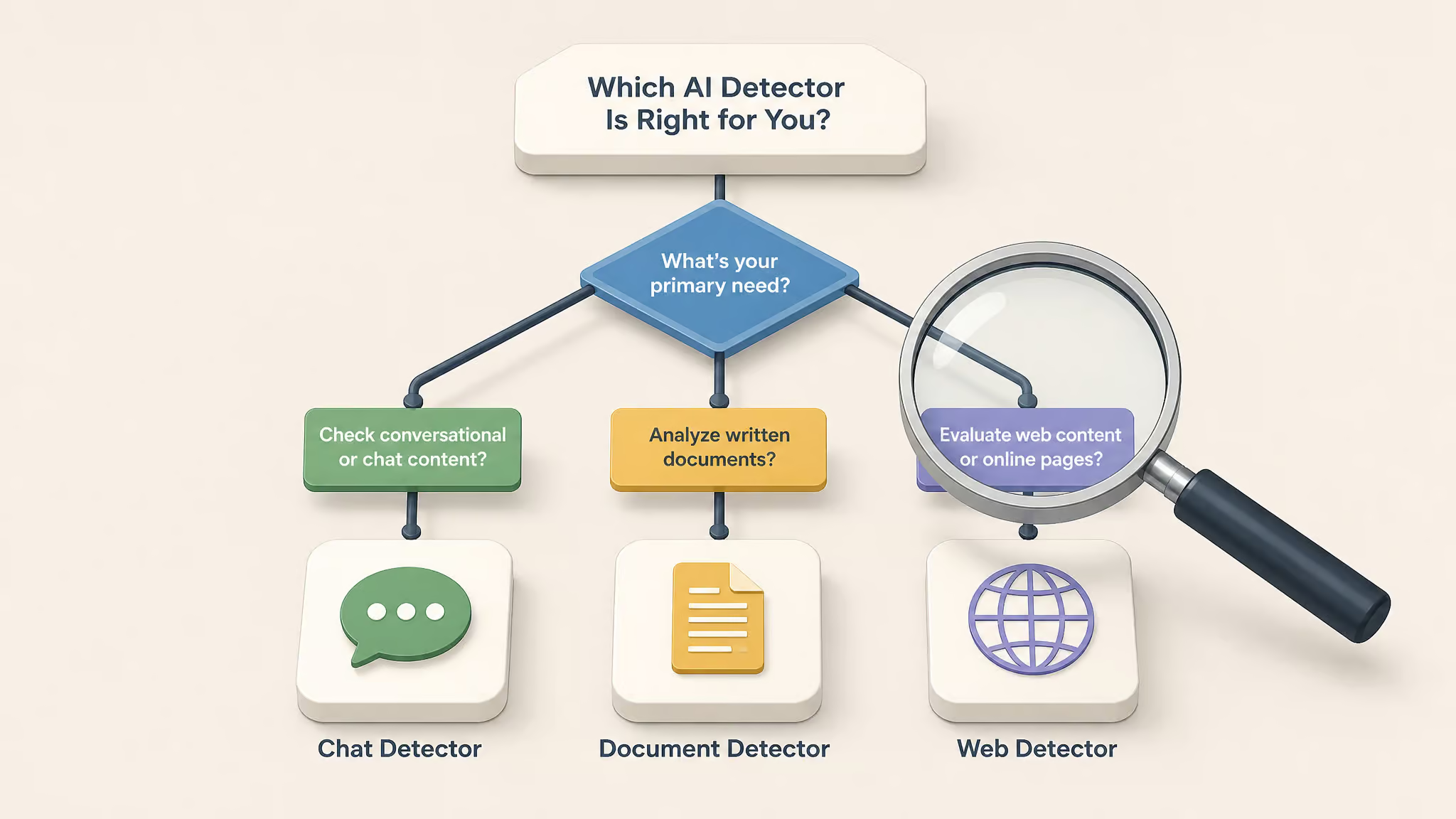
Start with QuillBot’s free detector for general checks, then add GPTZero if you’re in academic contexts, CopyLeaks for multilingual or high-volume checking, and Scribbr’s premium if you need top-tier accuracy for something high-stakes. That four-tier stack covers just about every workflow we tested, with each tool covering a different weakness.
The actual strategy, though, is to run at least two detectors, compare the results, and manually review the flagged sections. One tool’s verdict means little; two tools agreeing, especially from different vendors, is worth acting on, and only you can read the highlighted passages and decide whether the flags make sense. For browser-based checks, our browser-based detection guide covers the extensions and lightweight tools worth using when you need quick results
Before you commit to any tool, test it against content you know the answer to: paste in a sample of known-AI text from ChatGPT and a sample of known-human text you wrote yourself. See what the tool says, and compare it to what you know. That’s the real test, not any benchmark number we publish connectors. Use free tiers first; most tools offer some kind of free check or trial, so there’s no excuse not to try before you buy.
If you’re checking with a team, reach out to the vendor to gauge whether they’re a serious operation or a keyword-targeting shell. If a tool promotes AI humanizing as a feature, treat that as a red flag: it contradicts the purpose of detection, and you probably don’t want a detector that’s also in the business of helping people evade detection.
Here are the practical caps you’ll hit with the free tiers:
- No sign-up needed: QuillBot, unlimited free checks within the 1,200-word cap. Perfect for quick pastes.
- 100 checks/day: CopyLeaks and Detecting-AI, both with 5k character caps. Great for high-volume or batch checking.
- Biggest free limit: Merlin, at100k characters, but only3 checks, so save them for one long document rather than spreading them thin.
Combine those limits with the tiered recommendations above, and you can run a genuinely useful detection workflow entirely on free tiers. Just don’t expect a single confident verdict to settle anything. Detection is a probabilistic signal, and the best you can do is stack the evidence, review the flagged passages yourself, and use it as one input among others. That’s not a limitation to work around; it’s how the technology actually works.
Frequently Asked Questions
Is there a free AI Detector available?
Yes, there are many free AI detectors, including QuillBot, Scribbr, GPTZero, and CopyLeaks. Each has different free allowances: QuillBot caps at 1,200 words, Scribbr at 500 words, GPTZero at 10,000 characters, and CopyLeaks at 5,000 characters per check with 100 checks daily. They’re all free to use without sign-up for most.
Is there a 100% accurate AI Detector?
No, no AI detector is 100% accurate. The best independent test score was Scribbr’s premium at 84%, and even that missed about 60% of edited or paraphrased AI text. Detectors rely on statistical signals like perplexity and burstiness, which overlap with human writing, so false positives and misses are inevitable.
What is the best free AI detector for students?
GPTZero is the best free option for students because it offers a generous 10,000-character allowance and sentence-by-sentence analysis, designed for academic work. However, its accuracy is only around 52%, so pair it with a second opinion like Scribbr’s free tier, which has zero false positives, before submitting anything important.
Why do free AI detectors give false positives?
False positives happen because detectors weigh statistical signals like perplexity (how predictable text is) and burstiness (sentence rhythm variation), which overlap with human writing. Unusually uniform human prose or edited AI text can trigger false flags. That’s why no detector is perfect, and manual review is essential.