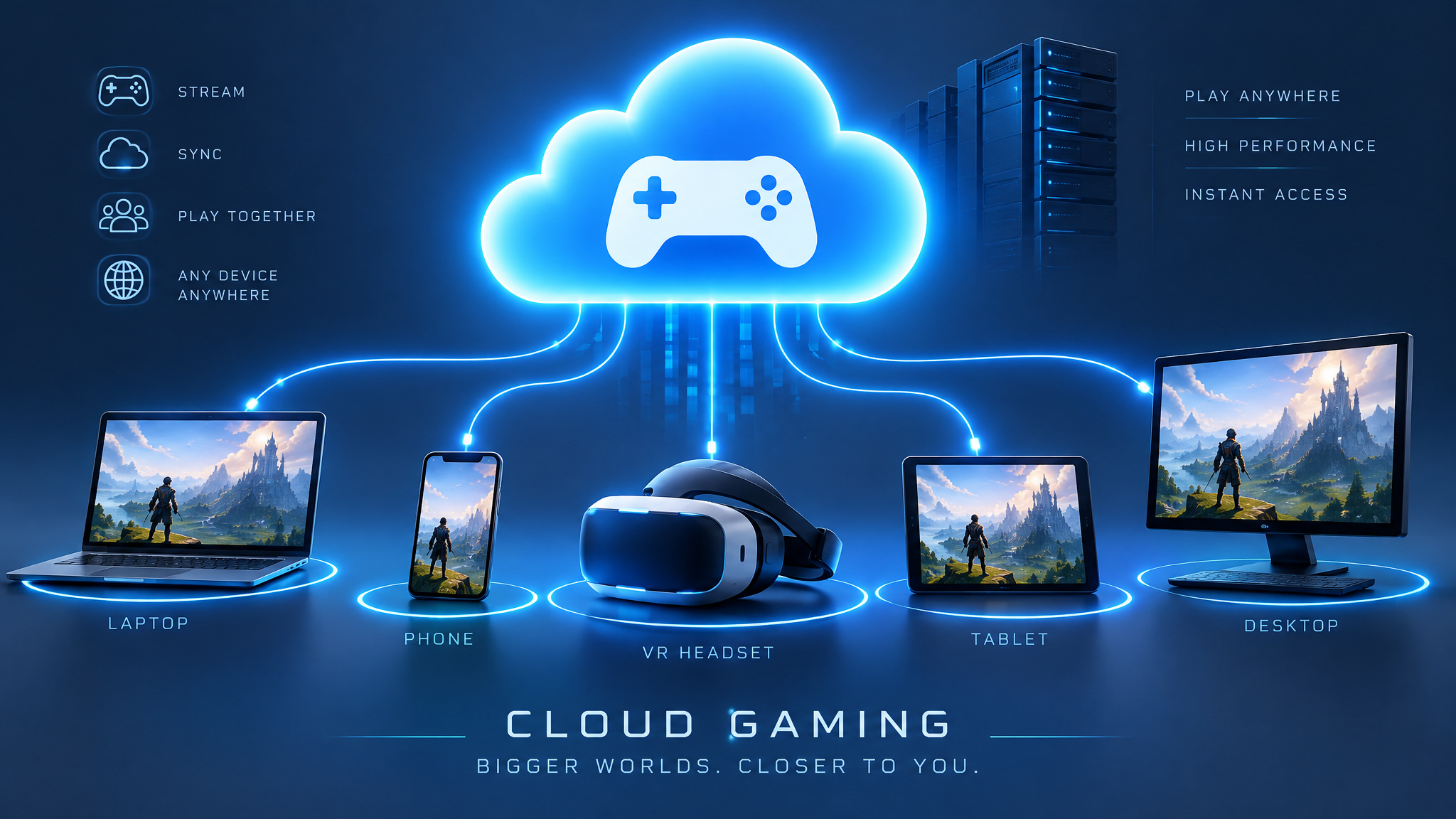
Nvidia GeForce NOW Ultimate is the best game streaming service overall for high-end performance and existing PC libraries, while Xbox Cloud Gaming is the best choice for built-in catalog value, and Shadow PC is the best pick for a full remote Windows rig. Picking between GeForce NOW, Xbox Cloud Gaming, and their specialized rivals comes down to a simple split: you’re either renting a rotating subscription catalog or streaming the games you already own. GeForce NOW Ultimate ($19.99/month) leads on raw server specs with up to 4K resolution at 120fps on NVIDIA RTX rigs, whereas Xbox Cloud Gaming comes bundled inside Xbox Game Pass Ultimate ($22.99/month) and pairs a 400+ game library with day-one first-party releases at up to 2K and 60fps. Other cloud gaming services win specific niches: Boosteroid delivers budget European bring-your-own-library (BYOL) streaming, Shadow PC and AirGPU rent full Windows computers, Blacknut serves families with young kids, PlayStation Plus Premium holds the lock on PlayStation classics, Amazon Luna fits casual and Prime players, and CloudDeck caters to newcomers. Steam itself is a free digital storefront with no monthly fee; BYOL platforms simply rent you the remote GPU to run the Steam titles you already bought.
That distinction changes how you shop for hardware. In PCWorld’s account, writer Jared Newman ditched a $1,000 desktop gaming tower for a $300 mini PC wired to an office ultrawide monitor, letting remote servers handle the heavy rendering instead of buying a new graphics card every two years. Although game streaming promised to make playing modern titles simpler, the crowded field of platforms has made picking the right plan genuinely confusing. The secret is choosing your service model before comparing brand names, because a Steam collector using a BYOL platform and a Game Pass catalog subscriber are shopping in completely different markets. Subscription tiers and prices also shifted repeatedly through 2026 (documented across cloudloadout.com’s guide from June 20 of 2026 and its October 19, 2026 free-tier update), making dated tier comparisons far more useful than a single static price quote.
Key Takeaways
Nvidia GeForce NOW Ultimate ($19.99/month) and Boosteroid (€9.89 to €17.89/month) are the only fixed-tier services that stream owned PC games at up to 4K and 120fps, while full cloud PCs like Shadow PC ($34.19 to $54.99/month) and AirGPU ($0.65 to $1.20/hour) reach 4K at 240fps.
Xbox Cloud Gaming (included with Game Pass Ultimate at $22.99/month) provides 400+ games and acts as a mild-hybrid by letting subscribers link their Microsoft account to stream supported titles on GeForce NOW and Boosteroid.
Smooth 4K/HDR streaming requires 40 to 50+ Mbps of bandwidth and a ping under 40ms over wired Ethernet, and even full Windows rigs like Shadow PC can be blocked by anti-cheat software in competitive shooters like Valorant.
Table of Contents
How cloud gaming works
Cloud gaming runs your games on remote data-center servers instead of your own hardware: your laptop or phone sends your button presses upstream, and the server streams a compressed video feed back to you in real time. Instead of needing a local graphics card or waiting on massive installs, cheap laptops, tablets, phones, and smart TVs can launch AAA titles almost instantly, much like streaming a movie on Netflix. Because the server is doing the rendering miles away, every cloud platform charges two permanent physics taxes: input lag (the delay between pressing a button and seeing the frame respond) and video compression artifacts. Your distance from the data center and your paid subscription tier dictate how much of both you’ll notice. On a stable connection, the loop feels close to local play, and most major platforms now work on iOS via web browsers or native apps after Apple updated its App Store rules to allow cloud gaming apps.
Three cloud gaming models: library, BYOL, cloud PC
Bring-your-own-library (BYOL) cloud gaming services let you stream your existing Steam games without buying them again, operating as remote-hardware platforms where services like GeForce NOW and Boosteroid connect directly to your digital storefronts. If you’re weighing streaming vs owning games across digital ecosystems, the market splits cleanly into three architectures: library-based subscriptions that rent a rotating catalog, BYOL platforms that run titles you already bought on Steam, Epic Games, GOG, Ubisoft, Battle.net, or the Xbox Store, and cloud computers that rent a persistent Windows PC. BYOL setups do carry real setup friction: you have to authenticate each storefront individually, and third-party tools like the Cloud Gaming Catalogue are essential for checking which of your owned games are actually supported.
| Service Model | How You Get Games | Example Services | Resolution Ceiling | Best For |
|---|---|---|---|---|
| Library-based streaming | Included in rotating subscription catalog | Xbox Cloud Gaming, Blacknut, Amazon Luna, PlayStation Plus Premium, Utomik | 1080p/60fps to 2K/60fps (4K expanding on Xbox) | Players wanting instant access to a curated catalog |
| Bring-your-own-library (BYOL) | Link existing Steam, Epic, GOG, Xbox, Battle.net, or Ubisoft accounts | GeForce NOW, Boosteroid | 4K/120fps (up to 1080p/240fps on GeForce NOW Ultimate) | PC gamers who already own a digital library |
| Cloud computer | Install any game or software on a remote Windows VM | Shadow PC, AirGPU | 4K/240fps | Power users wanting a full Windows PC and persistent storage |
GeForce NOW: the BYOL gold standard
Yes, GeForce NOW’s free tier is worth using as a zero-cost connection diagnostic, while regular players should pay for Performance ($9.99/month) or Ultimate ($19.99/month) to unlock real session lengths and RTX hardware. Built for PC gamers who already own titles on Steam, Epic Games, GOG, the Xbox Store, Ubisoft, and Battle.net, GeForce NOW includes no games itself and instead streams 1,500 to 1,800+ supported titles from NVIDIA RTX servers, with a 100-hour monthly play cap enforced on paid plans.
GeForce NOW pricing and tiers
The 2026 lineup spans Free ($0), Performance ($9.99/month, also listed as Priority at $9.99/month or $49.99 for six months), and Ultimate ($19.99/month), whereas older sources cite $10/month for 6-hour sessions and $20/month for 8-hour sessions.
Is the GeForce NOW free tier worth using?
The Free tier is ad-supported and caps play at 1080p/60fps with 1-hour sessions on weaker rigs behind standard queues. That makes it ideal for testing local latency before paying, but too cramped for a daily driver.
Storefront linking and publisher pull-outs
First-time setup typically stalls at authentication because all six supported storefronts must be linked individually. Publishers also occasionally pull their titles from the service, shrinking your playable list overnight.
GeForce NOW performance and device reach
Ultimate rivals a mid-to-high-end gaming PC on RTX 3080-class servers (with RTX 4080-class hardware expected around May), hitting 4K at 120fps, ultrawide resolutions, and 1080p at 240fps with DLSS, ray tracing, and NVIDIA Reflex. Apps cover Windows, Mac, browsers, Android, iOS, Shield TV, Samsung and LG TVs, Amazon Fire TV Sticks (1080p/60fps with no HDR at launch), and a beta Linux app for PCs and notebooks with limitations.
Xbox Cloud Gaming and Game Pass
Yes, Xbox Game Pass Ultimate is worth it just for cloud gaming if you want instant access to a massive rotating library and day-one Xbox releases without buying individual titles. Bundled into Game Pass Ultimate, Xbox Cloud Gaming (formerly Project xCloud) is the premier library-based service, though its 2026 pricing and tier structure shifted enough across sources that you need to look at the full breakdown before subscribing:
- 2026 tier pricing: The updated 2026 breakdown lists Essential at $9.99/month (which includes cloud streaming, online multiplayer, and a changing catalog, though it excludes day-one releases), Premium at $14.99/month (cut from $29.99 in April 2026), and Ultimate at $22.99/month.
- Catalog and resolution: Subscribers get 400+ games including day-one first-party Xbox titles, streaming at 1080p/60fps standard and 2K (1440p) at 60fps on upgraded plans, with 4K expanding.
- 2026 perk and trial experiments: In 2026 updates reported by PCMag, Microsoft also tested an Ultimate price cut saving up to $7/month while removing the Call of Duty perk, opened an Xbox Insider test for ad-supported cloud streaming without a Game Pass requirement, and bundled a 50+ game Game Pass slice (including Day Z, Fallout 4, and Stardew Valley) into Discord Nitro.
- Free entry point: Fortnite is the only title playable for free on Xbox Cloud Gaming without a subscription.
Is Game Pass Ultimate worth it just for cloud gaming?
Older reviews still quote $14.99/month (IGN) or $20/month (PCWorld) for Ultimate’s 400+ games, so always check which 2026 tier promotion is active on your account. If you play two or three first-party releases a year on hardware you already own, the subscription pays for itself without touching a console.
Xbox Cloud Gaming catalog, quality, and devices
Xbox has the widest device reach in cloud gaming: Xbox consoles, PCs, web browsers, phones, tablets, handhelds like the Logitech G Cloud, the Fire TV Stick 4K, and Samsung smart TVs and monitors. The interface is primarily controller-based, and in IGN’s hands-on testing, streaming Game Pass Ultimate directly to a Samsung TV held up smoothly even in fast-paced first-person shooters.
GeForce NOW vs Xbox Cloud Gaming: complements, not substitutes
GeForce NOW is the better pick for an existing Steam library, while Xbox Cloud Gaming is built for players who want an all-you-can-eat subscription catalog. When you line them up in a direct cloud gaming services comparison, the two platforms target completely different parts of your gaming budget:
- Service model: GeForce NOW is a pure BYOL platform that links to Steam, Epic Games, GOG, Ubisoft, Battle.net, and the Xbox Store, whereas Xbox Cloud Gaming is a library subscription built around Game Pass.
- Resolution and hardware: GeForce NOW Ultimate hits 4K at 120fps and 1080p at 240fps on NVIDIA RTX servers, while Xbox Cloud Gaming runs at 1080p/60fps standard and 2K/60fps on upgraded plans.
- Device reach and input: Xbox leads in smart TV and handheld reach with a controller-first setup, while GeForce NOW supports full keyboard and mouse play across PC and Mac browsers.
- The mild-hybrid bridge: Xbox Cloud Gaming also operates as a mild-hybrid because Microsoft partners directly with GeForce NOW and Boosteroid. A valid Game Pass subscription lets you link your Microsoft account and stream supported Game Pass and Microsoft Store titles on NVIDIA or Boosteroid servers, making them complements rather than an either/or choice.
Boosteroid: budget BYOL from Europe
Boosteroid is a strong cheap alternative to GeForce NOW in Europe because it matches GeForce NOW Ultimate’s 4K and 120fps ceiling at a lower price, trading away some storefront compatibility and regional consistency to get there. Alongside GeForce NOW, the European underdog is the only other fixed-tier service on the market that exceeds 1080p at 60fps. Pricing depends on active promotions and sources: cloudloadout.com lists Ultra at €12.89/month, Ultra Pro at €14.89/month, and an Ultra Special Offer at €7.49/year, while PCWorld notes entry plans starting at €9.89/month with 4K/120fps streaming on a €17.89/month plan. Boosteroid functions as a BYOL and catalog hybrid covering 1,700+ titles across Steam, Xbox, Epic Games, Battle.net, and Wargaming.net accounts. That’s a slightly smaller storefront roster than GeForce NOW, and real-world performance varies by server region, though its device support spans browsers, PC, Mac, full Linux, Android, Android TV, and LG TVs.
PlayStation Plus Premium: the PS3 classics lock-in
PlayStation Plus Premium is worth it for streaming old PS3 and PS4 games because it’s the only current way to play PS3 titles on modern PlayStation hardware, though it blocks PS5 game streaming and mobile devices entirely. Sony builds its cloud gaming directly into the top PS Plus Premium tier, priced at $17.99/month, $49.99 for three months, or $119.99 for 12 months (with tiers spanning $9.99 to $17.99/month, and IGN rounding Premium to $18/month or $160/year). According to the Cloud Gaming Catalogue, the library holds 1,200+ streamable classic PS1, PS2, PS3, and PS4 games. Streams cap at 1080p and 60fps, requiring a minimum of 15 Mbps for 1080p or 5 Mbps for lower resolutions. Hardware lock-in is the catch: you can only stream on a PS5 console or on a PC via the PS Plus app (which restricts you to PS4 games only), leaving phones and tablets completely unsupported.
Amazon Luna: channels instead of one catalog
Amazon Luna is worth using at no extra cost if you already have Amazon Prime ($14.99/month), and it fits casual gamers best thanks to its à-la-carte channel structure. Prime members automatically get a small rotating selection of free games, and Amazon folded Luna games directly into Prime Video, launching on Fire TV in the US and UK. If you want more titles, Luna skips the single mega-subscription in favor of add-on channels: Luna+ costs $9.99/month for 100+ games, Jackbox Games runs $4.99/month for 50+ party titles, and Ubisoft+ costs $17.99/month for 45+ games. Prime and Luna+ subscribers can also link their accounts to stream select games they already bought on Ubisoft and GOG. Stacking multiple channels gets expensive quickly, and streams cap at 1080p and 60fps across web browsers, Android, Fire TV, Samsung TVs, and LG TVs.
Shadow PC: a full Windows PC in the cloud
Shadow PC is worth roughly $34 a month if you want a full, unthrottled Windows 11 desktop with persistent storage and zero upfront hardware cost, provided your favorite multiplayer games don’t use virtual-machine-blocking anti-cheat. Built by Blade, Shadow rents you an entire cloud computer rather than a locked-down game launcher.
Shadow PC pricing and tiers
Shadow PC’s 2026 lineup uses Neo (~$34.19/month) and Power ($54.99/month) tiers, replacing the older $29.99/month starter and $44.98/month 4K/ray-tracing plans.
What a cloud PC does that streaming can’t
Because you get a dedicated virtual machine, a real GPU, persistent storage, and full keyboard and mouse support up to 4K at 240fps, you can install anything. It even doubles as a workstation; in PCWorld’s report, a co-worker edited work videos over a Shadow connection because the virtual machine’s internet upload and download speeds were so fast.
Shadow PC vs a $1,000 gaming PC
Renting Shadow skips the $600 to $1,000+ upfront bill of a gaming PC or console (the exact math behind swapping a $1,000 desktop tower for a $300 mini PC), though you never own the hardware. Raw power also loses to software permissions when anti-cheat intervenes: Shadow PC can’t run Valorant at all because its anti-cheat blocks virtual machines.
AirGPU: hourly billing for sporadic gamers
AirGPU flips cloud gaming economics by ditching monthly subscriptions for hourly pay-as-you-go billing, making it the smartest cloud PC option for sporadic gamers who only play a few evenings a month. Like Shadow PC, AirGPU gives you a full Windows machine with complete keyboard and mouse support and a ceiling of 4K at 240fps, but you pick your exact NVIDIA server GPU and pay only while the rig is running. Hourly rates start at $0.65/hour on an NVIDIA Tesla T4 and scale through L4 and A10G cards up to $1.20/hour on an L40S. One of the easiest ways to waste money in cloud gaming is paying $20 to $55 every month for a fixed subscription that sits idle for three weeks at a time. At $0.65 to $1.20 an hour, a handful of weekend gaming hours costs just a few dollars a month, whereas daily grinders will blow past flat-rate subscription prices in days.
Blacknut: built for families
Blacknut is the best cloud gaming service for families with young kids, pairing a 1,000+ title family-friendly catalog with built-in parental controls for $15.99/month on its Standard plan. While Amazon Luna works well as a lighter casual option for households that already pay for Prime or want a $4.99/month Jackbox party channel, Blacknut is purpose-built around kid-safe browsing without violent marquee shooters cluttering the home screen. Parents who want to bolt on bigger third-party catalogs for themselves can add publisher channels on top of the base plan, priced at $9.99/month for Focus Entertainment, $23.98/month for Ubisoft+ Classics, and $33.98/month for Ubisoft+ Premium. All streams on Blacknut cap at 1080p resolution, keeping bandwidth demands modest when multiple screens are active in the house.
CloudDeck: the newcomer with full PC access
CloudDeck is an up-and-coming cloud service designed for newcomers who want full PC access inside a clean, approachable interface, provided they live close to its limited server regions. Priced at $19.99/month (listed as $19.19 in one source comparison table) or $14.99/month if you lock in a 6-month commitment, it sits right alongside mid-tier BYOL pricing while handing over broader desktop control. The platform supports 1080p+ streaming along with modern upscaling and ray tracing features, removing much of the configuration friction that intimidates first-time cloud PC renters. That regional server footprint is the deciding caveat: if you live near a supported data center, the 6-month rate is a bargain, but players outside its core coverage zones will run into too much distance latency to make it work.
Utomik: the cheap catalog with a no-card trial
Utomik delivers a budget catalog of nearly 400 games with cloud streaming included in its ~$9/month Personal + Cloud subscription, backed by a seven-day free trial that requires no credit card. In a market where most platforms hide their performance behind immediate billing or throttled hardware queues, being able to test a full subscription catalog for a week without typing in payment details makes Utomik the lowest-risk test drive for newcomers. The service runs across PC, Android devices, and Samsung and LG smart TVs, letting you check how your living-room television and home Wi-Fi handle real-time video decoding before you spend a dime.
Nintendo’s per-purchase cloud versions: the fourth model
Nintendo skips the subscription wars entirely and operates a fourth cloud model by selling individual, per-purchase cloud versions of heavy third-party games exclusively on the Nintendo Switch. When a game is too demanding for the Switch’s mobile processor, such as select Resident Evil titles, Marvel’s Guardians of the Galaxy, and Kingdom Hearts 3, unlike lightweight browser games such as Bingo Philippines on GameZone, you buy a dedicated cloud edition that renders on remote servers and streams the video feed to your handheld. You don’t need a Nintendo Switch Online subscription to launch them. The catch is wild quality variance: frame pacing and image clarity swing hard depending on your local connection stability, time-of-day network congestion, and a docked wired Ethernet setup versus handheld Wi-Fi.
Internet speed requirements for cloud gaming
4K cloud gaming without lag requires 40 to 50+ Mbps of download bandwidth and a latency ping under 40ms, paired with a subscription tier that actually unlocks 4K rendering. Bandwidth and ping work as independent checks, and paying your ISP for gigabit fiber won’t sharpen the picture on a service capped at 1080p like Amazon Luna, Blacknut, or PlayStation Plus Premium:
- 720p streaming: 15 Mbps minimum (PlayStation Plus Premium cites 5 Mbps for sub-1080p streams).
- 1080p at 60fps: 25 to 35 Mbps.
- 4K with HDR: 40 to 50+ Mbps.
- Latency target: Under 40ms ping to the nearest server, with wired Ethernet strongly preferred over Wi-Fi for competitive titles.
A home Wi-Fi connection that feels almost local at midday can easily develop blocky compression artifacts and mushy input lag during evening peak congestion, which is why running an Ethernet cable to your mini PC or smart TV dock is the single best upgrade you can make.
Device support and controls across services
How you play, keyboard and mouse at a desk versus a controller on the couch, splits the cloud gaming field just as sharply as resolution caps. After Apple relaxed its App Store rules to allow cloud gaming apps, most major platforms now work on iOS alongside Android and desktop browsers, but smart TV and Linux support still vary wildly by provider.
| Service | Supported Devices | Keyboard & Mouse Support |
|---|---|---|
| Xbox Cloud Gaming | Consoles, PCs, browsers, phones, tablets, Logitech G Cloud, Fire TV Stick 4K, Samsung TVs/monitors | Partial (primarily controller-based) |
| GeForce NOW | Windows, Mac, Linux (beta), browsers, Android, iOS, Shield TV, Fire TV Sticks, Samsung/LG TVs | Yes (supported on PC and Mac browsers and desktop apps) |
| Boosteroid | Browsers, PC, Mac, full Linux, Android, Android TV, LG TVs | Yes (supported on PC and Mac browsers and desktop apps) |
| PlayStation Plus Premium | PS5 consoles and PC via PS Plus app (PS4 games only; no phones or tablets) | No (controller required for PlayStation catalog) |
| Amazon Luna | Browsers, Android, Fire TV, Samsung TVs, LG TVs | Partial (supported on desktop browsers) |
| Shadow PC and AirGPU | Full Windows 11 client apps across desktop and mobile devices | Yes (full native Windows keyboard and mouse support) |
What cloud gaming still can’t fix
The main cloud gaming downsides are unavoidable network latency, video compression artifacts, sudden publisher game removals, virtual-machine anti-cheat blocks, and the physics limits of high-twitch competitive genres. Even on a fast connection, streaming can’t repeal how remote rendering works:
- Competitive shooter limits: High-twitch games like Valorant, Counter-Strike 2 (CS2), and Apex Legends remain poorly suited to streaming over Wi-Fi, making wired Ethernet mandatory.
- The power-versus-permission trap (best for competitive shooters): GeForce NOW Ultimate (equipped with NVIDIA Reflex and 1080p/240fps support) and Shadow PC (up to 4K/240fps) offer the strongest low-latency hardware for competitive shooters. However, Shadow PC’s full Windows 11 rig is blocked from running Valorant by anti-cheat software, making GeForce NOW Ultimate the actual working pick for Valorant and CS2 players.
- Vanishing libraries: On BYOL services like GeForce NOW, publishers can pull their games at any time, leaving you unable to stream titles you bought for that exact purpose.
pricing changes and annual lock-in risk
Locking into an annual cloud gaming subscription carries real risk because platform pricing, tier names, and included perks shifted repeatedly across 2026. As documented in cloudloadout.com’s guide from June 20 of 2026 and its October 19, 2026 free-tier update alongside PCMag’s 2026 reporting, almost every major player repriced or restructured its lineup within months. Xbox Game Pass Ultimate climbed from older $14.99/month and $20/month rates to $22.99/month while Microsoft slashed the Premium tier from $29.99 to $14.99 in April 2026; Microsoft also tested an Ultimate price cut of up to $7/month paired with removing the Call of Duty perk, launched its Xbox Insider ad-supported streaming test, and added the 50+ game Game Pass bundle to Discord Nitro. Meanwhile, Shadow PC replaced its $29.99/month and $44.98/month plans with Neo (~$34.19/month) and Power ($54.99/month), and GeForce NOW enforces a 100-hour monthly play cap on paid tiers while prepping its RTX 4080-class rollout. Month-to-month billing protects you when a service changes the rules mid-year.
Free tiers and trials: test before you commit
Most cloud gaming platforms don’t offer free tiers or commitment-free trials, so you should use the market’s few free cloud gaming services as a local network diagnostic before handing over a credit card. Free access always comes with a hard ceiling on either session length or catalog size. GeForce NOW’s free tier is ad-supported and drops you into standard queues on weaker server rigs with a strict 1-hour session limit at 1080p/60fps, but it uses the same data-center routing you’ll get on paid plans. Xbox Cloud Gaming skips a general free trial and instead makes a single title.
Fortnite, playable for free without a Game Pass subscription, letting you test controller latency in a browser or on a phone. If you want to test a full multi-game launcher without entering payment info, Utomik’s seven-day free trial requires no credit card at all.
Check your library first with Cloud Gaming Catalogue
Before paying for a BYOL or catalog subscription, search your favorite titles on the Cloud Gaming Catalogue, a third-party database that filters supported games across major cloud services far more efficiently than clicking through each provider’s own list. PCWorld’s Jared Newman used the database to build his cross-service free-tier comparison and recommends running your Steam or Epic library through it first so you never subscribe to a platform that can’t launch your games.
The best game streaming service for your situation
GeForce NOW Ultimate leads overall for raw performance on games you already own, while Xbox Cloud Gaming wins for built-in catalog value. Here’s how the full lineup shakes out by use case:
- Best overall & Steam/Epic owners: GeForce NOW Ultimate (or Boosteroid and AirGPU).
- Best catalog value & Game Pass subscribers: Xbox Cloud Gaming (or Boosteroid for budget European BYOL).
- Most flexible: Shadow PC (full Windows rig) or AirGPU (hourly pay-as-you-go).
- Best for families: Blacknut.
- Best for PlayStation classics: PlayStation Plus Premium.
- Best for casual & Prime members: Amazon Luna.
- Best newcomer: CloudDeck.
Frequently Asked Questions
Is Steam a monthly fee?
No, Steam is a free digital storefront that does not charge a monthly subscription fee. You only pay for the individual games you purchase on the platform. If you lack a gaming PC, bring-your-own-library (BYOL) services like GeForce NOW and Boosteroid charge a monthly fee to rent remote server hardware so you can stream those purchased Steam titles.
what’s the best game streaming service?
Nvidia GeForce NOW Ultimate ($19.99/month) takes the crown for raw performance and existing PC libraries, delivering up to 4K resolution at 120fps or 1080p at 240fps on RTX servers. If you don’t own a pile of PC games and want an all-you-can-eat library instead, Xbox Cloud Gaming via Game Pass Ultimate ($22.99/month) is the smartest buy for its 400+ game catalog and day-one first-party releases. Power users who want an unthrottled Windows 11 desktop should look at Shadow PC or hourly billing on AirGPU.
is GeForce NOW free tier worth using or should I pay for Performance or Ultimate?
The free tier is strictly worth using as a connection diagnostic to see how your home internet handles streaming to NVIDIA’s data centers. With ad breaks, queue waits, weaker rigs, and a 1-hour session cap at 1080p/60fps, it is far too restrictive for regular play. Dedicated players should upgrade to Performance ($9.99/month) or Ultimate ($19.99/month) for longer sessions and RTX hardware, keeping in mind that paid plans enforce a 100-hour monthly play cap.
is Shadow PC worth $34 a month compared to a regular gaming PC?
Shadow PC’s Neo tier (~$34.19/month) is worth the cost if you want to skip the $600 to $1,000+ upfront bill of a local gaming rig while still getting a full Windows 11 desktop with persistent storage. Unlike locked-down launchers, it lets you install any software or mod and streams at up to 4K and 240fps, though you never build hardware equity. Be careful if you play competitive shooters, as anti-cheat software blocks virtual machines from running titles like Valorant.
is Xbox Game Pass Ultimate worth it just for cloud gaming?
Yes, if you want instant access to 400+ rotating games and day-one Xbox first-party releases without buying console hardware. Even at its $22.99/month rate, playing just two or three major releases a year on a laptop, phone, or Samsung smart TV easily covers the subscription cost. If you don’t care about day-one launches, you can also check Microsoft’s lower-cost Essential ($9.99/month) and Premium ($14.99/month) plans.
