
You want a simple number, right? Something like “X hours per day is normal.” That’s what I was searching for when I first dug into the data. But when researchers (Zsidó et al., 2023) analyzed data from 14,740 highly engaged Hungarian gamers, they found something that broke the easy answer.
Over 41% of people playing more than 26 hours a week showed zero signs of psychological distress. Meanwhile, a small group playing about 33 hours a week reported serious depression and stress. So the answer to “how much gaming is too much?” is… complicated.
Key Takeaways
41.9% of gamers playing more than 26 hours per week reported the highest life satisfaction and no psychological distress—time alone doesn’t predict harm.
The at-risk group for gaming disorder averaged about 42 hours per week, but the study’s own profile analysis found that the high-distress group (4.2% of the sample) played only 33 hours—less than the at-risk average.
A single daily average masks huge variation: mobile sessions average 5–6 minutes, console/PC sessions run 2–4 hours, and cross-platform gamers blend both patterns.
Table of Contents
The Problem With Averages
The global average gaming time sits around 8.45 hours per week. A 10-year-old on Roblox might play five short mobile sessions totaling 2–3 hours a day. A 16-year-old on a console might do one marathon session of 4 hours.
A 45-year-old parent might play two 30-minute sessions after work.
The study with 14,740 participants found a positive near-linear association between time spent gaming and gaming disorder symptoms: ANOVA for APA framework F(7, 14,235) = 208.224, p < 0.001, ?² = 0.09. The effect size for the APA framework was ?² = 0.09; for the WHO framework it was ?² = 0.06. The researchers identified four distinct profiles via Latent Profile Analysis based on psychological distress (life satisfaction, depression, perceived stress). Profile 1 (no PD), comprising 41.9% of the sample (N = 5,421), played more than 26 hours a week and reported no distress at all. They had the highest life satisfaction in the study, with no depression or stress symptoms.
So the moment you hear “average gaming time,” your brain should add a flashing asterisk: which platform, which age, which context, and is the person actually struggling? Let’s break it down by age bracket.
Gaming Time Benchmarks Across the Lifespan
How much time people spend gaming shifts dramatically from childhood through retirement, shaped by platform preferences, life responsibilities, and social context.

Children 4–12
Kids in this age group tend to play short, frequent sessions. A typical session runs 45–60 minutes, and they average about 5.1 sessions per day. That’s a lot of individual play periods, but the total per session is modest. Mobile is the dominant platform here, and Roblox is a major draw—kids average about 140 minutes per day on that platform alone.
Teenagers 13–17
Teenagers switch to longer, less frequent sessions. Console and PC sessions run 2–4 hours, and weekend sessions often exceed 3 hours. Weekly totals land between 10 and 15 hours.
In the US, 85% of teens play video games, and 41% play daily.
Young Adults 18–29
The average for this group is about 10.8 hours per week, slightly above the global average. North American young adults aged 18–24 report even higher numbers—around 16 hours per week.
But the 8% playing over 20 hours are worth watching for potential red flags.
Adults 30–50
Adults 30–50 average 5–7 hours per week, with about 2.4 sessions per day. 36–40% of console and PC gamers in this age bracket play less than 5 hours per week. The average PC gamer is 36 years old, which completely undercuts the teenage stereotype.
The data suggests that for most adults, gaming time is moderate and well within healthy ranges.
Seniors 50+
The fastest-growing gaming demographic is people over 50. They average 4.6 hours per week, up 1.4% from 2024. 49% of Boomers (ages 61–79) play at least once a week, and 36% of the Silent Generation (80–90) do too. Sessions tend to be under one hour, and the games lean toward word puzzles, brain training, and casual card games. 29% of US gamers are over 50, up from 17% in 2004.
The teenage gamer stereotype? While the average time spent playing video games per day 2020 vs 2021 vs 2022 reflects pandemic spikes and a return to normal, the demographic shift shows that stereotype has been outdated for years.
Platform Fragmentation – Why “Average” Doesn’t Tell the Whole Story
A “5-minute mobile session” and a “2-hour console session” are not the same thing, but both get added to the same daily average. If you’re trying to understand what’s normal, you need to split by platform to see the average time spent playing video games per day, where we crunch the numbers across age groups, years, and global regions.
Mobile
The median mobile session is just 5–6 minutes. The top 25% of games (by engagement) get around 8–9 minutes per session. People play 4–6 sessions per day on average. The total daily time can add up, but it’s fragmented and low-commitment.
Console/PC
They run 2–4 hours per session, and players average 9.7–10 hours per week. A PC/console player spends about 30 minutes more per day than a mobile-only player.
Cross-Platform
Here’s where it gets messy. 72% of gamers worldwide use two or more platforms, and 25% play on all three (mobile, console, PC). Cross-platform titles show 25% higher retention and 40% more time spent than single-platform games. Today, gaming fans average 8.5 hours per week watching gaming videos on Twitch and YouTube, which is more than the 7.4 weekly hours spent playing.
The Truth About “Too Much” Gaming – Time Is Not the Full Story
The study’s finding is that hours played alone cannot predict who is struggling — the relationship between time and harm is real but far from straightforward.
Notably, the ICD-11 (the WHO framework) dropped the ‘preoccupation’ criterion for gaming disorder after criticism that it pathologized normal passionate engagement. This means that under the ICD-11, a score of 4 or more on the adapted IGDT-10 indicated risk of gaming disorder. The APA’s DSM-5, by contrast, retains preoccupation as a symptom, creating a key difference in how gaming time is interpreted across frameworks.
The Linear Association Exists, But It’s Weak
Other factors—individual psychology, motivation, social context—play a much bigger role.
The Four Profiles Tell the Real Story
The researchers used Latent Profile Analysis (LPA) to group participants by psychological distress: satisfaction with life, depression symptoms, and perceived stress.
- Profile 1 (no distress): 41.9% of the sample. They played more than 26 hours per week and reported the highest life satisfaction, with no depression or stress. These are the heavy gamers who are thriving.
- Profile 2 (low distress): 38.8% of the sample — occasional mild distress, but nothing alarming. Most gamers fall here.
- Profile 3 (moderate distress): 15.1%. More depression and stress, but still not at crisis levels.
- Profile 4 (high distress): Only 4.2%. They reported depression “often,” stress “fairly often,” and life satisfaction around 4 out of 10. Their average gaming time was approximately 33 hours per week—less than the at-risk group from the GD symptom analysis (42.1 h for APA, 42.6 h for WHO).
That’s the key insight: the most distressed gamers played less than the at-risk GD-threshold group.
What This Means for You
Context is everything.
Bottom line: The 41.9% of heavy gamers thriving at 26+ hours prove that high playtime alone isn’t the problem; the 4.2% in distress at 33 hours show that low playtime doesn’t guarantee safety either.
The New Face of Gaming – Seniors Are Playing More Than Ever
The average PC gamer is 36 years old.
Adults over 50 average 4.6 hours weekly, up 1.4% from 2024. 49% of Boomers (61–79) play weekly, and 36% of the Silent Generation (80–90) do too. That’s nearly half of Boomers picking up a controller or tapping on a tablet regularly.
The share of US gamers over 50 has risen from 17% in 2004 to 29% today.
The one-size-fits-all average fails to capture this diversity.
Do Time Limits Work? The Debate Over Gaming Regulation
China’s 2021 law is the most famous attempt to cap gaming time by age: minors are limited to one hour on Fridays, weekends, and public holidays, and only between 8 PM and 9 PM.
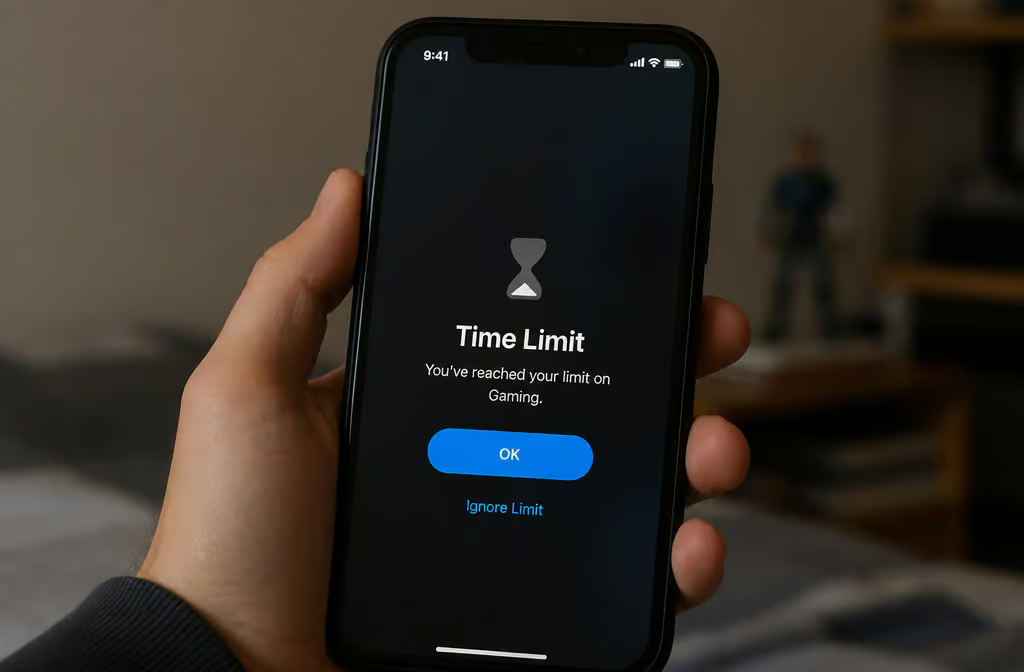
They can stigmatize gaming itself, prevent the positive effects of gaming (social connection, cognitive engagement, stress relief), and—perhaps most practically—encourage kids to bypass the rules through black-market accounts or VPNs. There’s evidence that time-based restrictions don’t necessarily reduce heavy gaming in practice.
Alternative approaches are more nuanced. In-game notifications that remind players to take breaks have shown promise. Education and counseling programs that focus on building awareness of problematic patterns are another route. The most effective interventions seem to be small-scale: personal limits set by the player or family, rather than top-down government mandates.
The study’s findings align with this: since time alone isn’t a good predictor of harm, a blanket time cap misses the point. The fix is helping people recognize when gaming is interfering with their lives, not just counting the clock.
Important Caveats – What Every Gaming Time Statistic Hides
Every number in this article comes with a “but.” The big study—the one with 14,740 participants—collected data during March and April 2020 (first COVID-19 quarantine period). After data cleaning, the final sample included 14,740 valid responses (from an initially larger pool). During the pandemic lockdown, gaming time and GD symptoms were likely inflated relative to pre-pandemic baselines.
So the thresholds are likely higher than they would be under normal conditions.

The sample itself is specific: 89.3% male, mean age 24 (SD not reported explicitly), all playing at least 20 hours per week (inclusion criterion for highly engaged gamers). That’s a highly engaged, mostly young male cohort. It doesn’t represent casual gamers, children, or seniors well. The data was collected via an online survey promoted on a Hungarian gaming site, so self-selection bias is real. Self-reported gaming time may also differ from actual playtime—people tend to underestimate or overestimate.
Regional averages vary widely. China averages 12.39 hours per week, India about 6 hours, and the global average is 8.45 hours. The cross-sectional design means we can’t infer causality—more gaming time might be a symptom of underlying distress, not a cause. And the upper limit of 12 hours per day in the survey could have capped extreme players.
None of this makes the data worthless. It means you should interpret the numbers with context. The study is still a massive, well-powered investigation that challenges the simple “hours = harm” narrative. But it’s not a universal truth.
Field note: The COVID-era data likely inflated thresholds by 4–6 hours per week compared to pre-pandemic baselines, so adjust any comparisons accordingly.
Beyond the Average – What Really Matters
So after all this data, the answer to “how much gaming is too much?” is: it depends. Not a satisfying soundbite, but a more useful one.
Instead of watching the clock, watch for changes in sleep, mood, and priorities. If a gamer is meeting their responsibilities, maintaining relationships, and feeling good, high playtime is likely fine. If not—even moderate playtime may be a concern. The study’s 41.9% of heavy gamers with no distress prove that time alone isn’t the villain. The 4.2% of high-distress gamers show that even 33 hours a week can be part of a larger problem.
The next time you search for average time spent playing video games per day by age, remember: the number you find is a starting point, not a verdict. The question isn’t “how many hours?” It’s “in what context?”
People Also Ask
What is the 20 rule in gaming?
There isn’t a formal ’20 rule’ in gaming research, but the idea often refers to the 20-hour mark as a threshold where some studies see increased risk of gaming disorder symptoms. However, the data shows that time alone is a weak predictor—over 41% of people playing more than 26 hours per week reported no psychological distress and high life satisfaction.
What’s the difference between mobile and console gaming time?
Mobile sessions are short and frequent—the median is just 5–6 minutes, with 4–6 sessions per day. Console and PC sessions are much longer, typically 2–4 hours, and players average 9.7–10 hours per week. A PC or console player spends about 30 minutes more per day than a mobile-only player, so comparing raw hours without platform context can be misleading.