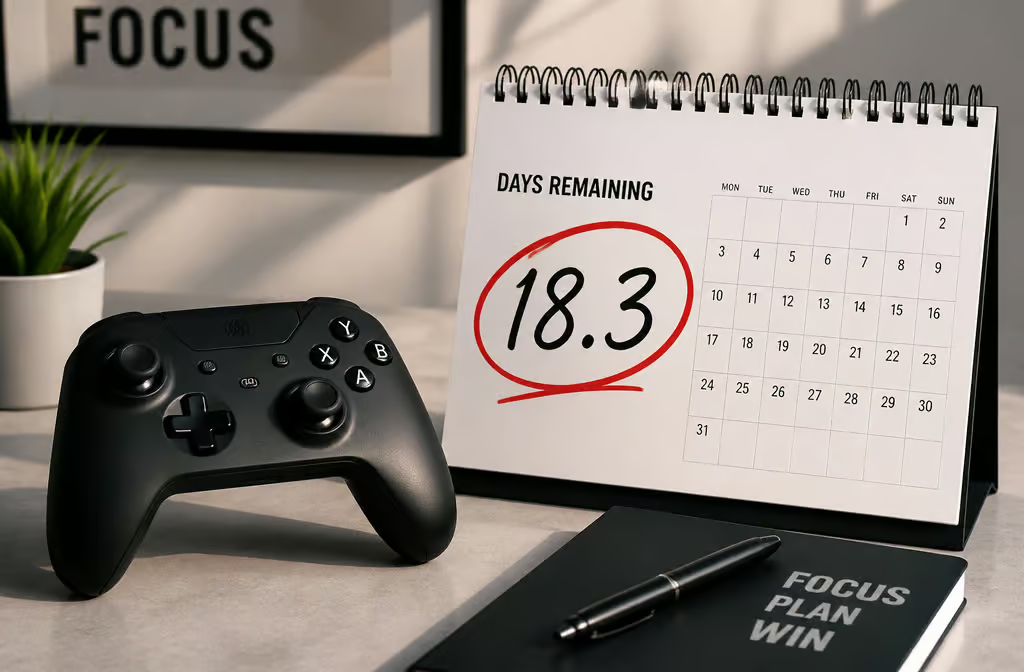
You’ve probably seen the weekly averages floating around — the “average gamer plays 8.45 hours per week” stat that gets cited whenever someone wants to make a point about gaming habits. And 8.45 hours sounds… manageable. That’s roughly one evening of Elden Ring or a couple of Marvel Rivals sessions. Nothing wild.
But then you multiply by 52.
Eight point four five hours per week times fifty-two weeks equals 439.4 hours per year. Divide that by 24, and you get 18.3 full days. That’s more than the typical two-week vacation most Americans get. It’s more time than it takes to watch the entire Lord of the Rings extended trilogy sixty-one times. It’s the equivalent of setting aside nearly three full weeks of your year to doing nothing but playing games.
That 18.3 days number is a global average across 3.42 billion players as of 2025. It’s up 4.5% from the previous year. But the “average gamer” doesn’t actually exist. The gap between a teenager grinding MMOs and a senior playing Wordle is wider than you’d think — we’re talking a 25-day-per-year difference.
Let’s dig into where those hours actually go.
Key Takeaways
The global average of 8.45 hours per week annualizes to 439.4 hours or 18.3 full days per year in 2025, up 4.5% from 2024
Teenagers aged 13-17 play the most at 15.2 hours per week (32.9 days per year), while adults over 50 average just 4.6 hours per week (10 days per year)
Platform choice dramatically changes your annual total: mobile “snacking” adds up to 5-7 days per year, while console/PC “immersive” sessions hit 21-22 days
Table of Contents
Age Group Breakdown — Who Actually Plays How Much
Break this down by age and that tidy 18.3-day average shatters. Each demographic doesn’t just play different amounts — they play differently, in distinct patterns that reveal how gaming fits into their actual lives.

Children aged 4-12 — 15.2 to 21.7 days per year
Kids this age don’t play in long sittings. They snack. The average child in this bracket logs 45-60 minutes per session but does that 5.1 times a day. That’s not a gaming session — that’s a habit.
A quick round while waiting for a ride. A few minutes between homework and dinner. Another short burst before bed.
It adds up to 7-10 hours per week total, which annualizes to 364-520 hours or 15.2-21.7 full days per year. A 4-year-old picking up an iPad for 15-25 minute bursts throughout the day has a fundamentally different relationship with gaming than a 12-year-old settling in for a console session.
The outlier here is Roblox. Kids in this age group spend roughly 140 minutes daily on Roblox through their phones. That’s the one platform that breaks the “short session” rule for younger players — it’s sticky in a way that casual mobile games aren’t. The rest of their mobile gaming stays in that 15-25 minute sweet spot, but Roblox pulls them into longer, more invested sessions.
Teenagers aged 13-17 — 32.9 days per year (nearly one month)
Teenagers average 15.2 hours per week in 2025, which is the highest of any age group. That’s 790.4 hours per year, or 32.9 full days. Nearly an entire month.
What’s notable is the trend line. That 15.2 hours is up 6.4% from 2024, and it’s a sign that gaming isn’t just a pastime for teens — it’s the default social infrastructure. 85% of US teens play games, and 41% play daily. Weekend sessions regularly exceed 3 hours because that’s when they really dig in — no school, no schedule, just the game and their friends.
It’s not just about the game itself. 44% of teen gamers use Discord as part of their gaming ecosystem, and 30% use Twitch. When a teen spends 15.2 hours per week gaming, a significant chunk of that is social time — talking to friends, watching together, building the kind of shared experience that used to mean hanging out at the mall or the arcade. It’s community, not isolation.
Teens (15-19) averaged 112.8 minutes per day during the peak lockdown period. By 2024, that had normalized to 78.6 minutes per day. The 2025 increase to 15.2 hours per week (about 130 minutes per day) isn’t a return to pandemic levels — it’s a new baseline that’s higher than pre-pandemic norms but well below the lockdown spike.
Young adults aged 18-29 — 23.4 days per year
This group averages 10.8 hours per week, which works out to 561.6 hours per year or 23.4 days.
8% of young adults game more than 20 hours per week. That’s the “serious hobbyist” crowd — people for whom gaming isn’t just entertainment but a primary leisure activity. Meanwhile, 21% are in the 6-10 hour range, the solid mid-range regulars who aren’t casual but aren’t hardcore either. The rest of the demographic spreads across lower bands, but today, gaming fans average 8.5 hours per week watching gaming videos on Twitch and YouTube, more than the 7.4 weekly hours spent playing. This isn’t a monolith.
North American young adults (18-24) are notably higher at 16 hours per week, or about 137 minutes daily. That’s a regional bump worth paying attention to — it suggests that local factors (work culture, social norms, broadband infrastructure) shape playtime as much as age does.
Gen Z is the true multi-platform generation here: 69% game on mobile, 42% on PC, and 38% on console. They don’t choose one platform — they stack them. A quick mobile session on the train, a PC session after work, a console session on the weekend. The annual total is the sum of all those across all screens.
Adults aged 30-50 — 10.8 to 15.2 days per year
Adults in this range average 5-7 hours per week, translating to 260-364 hours per year or 10.8-15.2 full days.
The key stat here is 2.4 sessions per day. That’s still regular gaming — it’s not a once-a-week hobby, but the sessions are compressed. Work, family, and responsibilities limit the available windows. 36% of console gamers and 40% of PC gamers in this age range play less than 5 hours per week. They’re still showing up, but the time they can commit is constrained, raising the question of how many hours of video games is healthy for adults.
When you have less time, you tend to play games that respect that constraint. Casual games, simulation titles, and strategy games that can be saved and resumed fit around a schedule in ways that long-form RPGs or competitive shooters sometimes don’t. The passion isn’t lower — the available time just looks different.
Adults over 50 — 10 days per year and growing
Here’s the story that doesn’t get told enough: 29% of all players are now 50+, up from 17% in 2004. The average age of US players is 36. The stereotype of the teenage gamer is increasingly outdated.
This group averages 4.6 hours per week, or 239.2 hours per year — about 10 full days. Sessions typically run under one hour, more like a daily crossword or a quick TV episode than a gaming marathon. 36% of the Silent Generation (80-90) game weekly, and 49% of Boomers (61-79) do. The growth is modest — 1.4% year-over-year, but steady.
The games they play reflect a different set of preferences: word puzzles, brain training, casual card games, and simulation titles that reward familiarity over speed. But don’t mistake “different” for “lesser.” Many of these players have been gaming for decades. The kid who played Pac-Man in 1980 is now in their 50s, and they’re still playing — just on different terms.
By Platform — Mobile vs. Console/PC Annual Totals
The how matters as much as the who. Your platform choice fundamentally shapes how much time you accumulate, even if you feel like you’re playing “the same amount.” The session patterns are that different.
Mobile Gaming Annual Totals
Mobile gaming is the snacking model. Median session length is 5-6 minutes, and the top 25% of mobile games stretch to only 8-9 minutes. Players pick up their phones 4-6 times per day for these quick hits, which accumulates to 20-30 minutes daily.
Annualized: 121.7-182.5 hours per year, or 5.1-7.6 full days.
Mobile gaming feels like a lot because you’re constantly picking up your phone. The frequency is high — the 4-6 daily sessions create the impression of constant play. But the short session length means the annual total is surprisingly modest compared to other platforms.
The regional leader here is Oceania, where mobile sessions average 6.85 minutes — still short, but stickier than the global average of around 5 minutes. Indonesia, Brazil, Saudi Arabia, Singapore, and South Korea all saw mobile gamers averaging over 5 hours per day in 2024, which is a different tier of engagement entirely.
Globally, total gaming sessions rose 12% in 2024, hitting 3.5 trillion hours. Mobile generated $92.6 billion in 2024 — 49% of the total gaming market. The numbers are large, but the per-player annual total is lower than you’d expect from the revenue.
Console and PC Gaming Annual Totals
Console and PC gaming is the immersive model. Sessions run 1-4 hours, with players averaging 9.7-10 hours per week. Annualized: 504-520 hours per year, or 21-21.7 full days.
That’s roughly triple the mobile annual total, despite mobile having far more sessions. The difference is session depth: a single console session can exceed an entire week’s worth of mobile play.
The global console average is about 1 hour daily, but some regions go much higher. Egypt leads at 1 hour 55 minutes per day on console, with Saudi Arabia close behind at 1 hour 36 minutes. These aren’t outliers — they’re indicators of regional gaming cultures where console is the primary entertainment platform.
Steam reached 41.2 million concurrent users at its peak in March 2025, which is a staggering number. That’s 41 million people simultaneously playing PC games at one moment. The PC gaming market was worth $76.73 billion in 2024 and is projected to hit $86.12 billion in 2025 — 8.47% year-over-year growth.
The key insight: 72% of gamers play on two or more platforms, and 25% play on all three major platforms (mobile, console, PC). Most people aren’t choosing one ecosystem — they’re accumulating time across multiple. Your annual total is the sum of mobile snacking plus console immersion plus PC sessions, and those stack in ways that individual platform averages don’t capture.
Field note: If you play on all three platforms, your annual total likely sits between 26 and 29 days — not because you’re a power user, but because each platform fills a different time slot in your day.
Holiday Multiplier — When Gaming Time Jumps
School breaks and holidays can push a gamer’s yearly total 10-15% higher than the weekly averages suggest.

Regular weekdays average about 1.3 hours of gaming daily. During holidays, that jumps to 2.5-3.5 hours per day — a 50-75% increase. More free time equals more playtime in a pretty direct linear relationship. A two-week break can add 15-23 extra hours to a teen’s annual total, which is roughly another full day of gaming.
The seasonal pattern is strongest for students, which makes sense. Kids and teens on Roblox during holidays play roughly 140 minutes daily — that’s the platform’s peak engagement window. Daily active users among kids and teens during holidays can stretch to 2.4-2.6 hours per session. When there’s no school, the sessions get longer and the frequency stays high.
For context, teens (15-19) averaged 78.6 minutes daily in 2024, down from the pandemic peak of 112.8 minutes. The holiday spikes don’t reach pandemic lockdown levels, but they’re significant enough to meaningfully shift annual totals. A teen who plays 15.2 hours per week during the school year might hit 20+ hours per week during breaks.
This isn’t a “kids are disappearing into their screens” warning — it’s just a quantification of something obvious: when people have free time, they spend more of it doing the things they enjoy. The holiday multiplier is consistent across age groups, though it’s most pronounced for students because their baseline (school days) has built-in time constraints that adults don’t necessarily share.
Putting It in Perspective
The 18.3-day global average is a useful headline, but it’s the spread that tells the real story.
A teenager playing 32.9 days per year and a senior playing 10 days per year aren’t on the same spectrum — they’re in different worlds. The teen is devoting roughly 9% of their total annual hours to gaming, while the senior is at about 2.7%. Both are valid, but they’re different activities.
Genre choice adds another layer. An MMORPG player at 3 sessions per week (2-4 hours each) can log 13-26 days per year just from that one game. A casual puzzle player at 5 sessions per day (5-15 minutes each) might hit 6-19 days per year from that same genre. The session structure within a genre matters as much as the genre itself.
And here’s the part that should give you pause before drawing any conclusions: 67% of American gamers play for fun as their primary motivation, and 74% play with others. The social benefits are real — 55% of players say games help them find new friends. The average player age has gone from 20 in 2004 to 26 in 2024. The player base is getting older, more diverse, and more social.
The “average gamer” is a statistical fiction that hides a much more interesting reality: gaming time is deeply personal, shaped by age, platform, genre, geography, and the simple fact of how much free time your life allows you. The 18.3-day average masks a spectrum that runs from a few hours of Wordle per week to nearly a month of dedicated play — and every point on that spectrum is someone choosing how to spend their leisure time.
If you want to dig deeper into the daily breakdowns, check out our piece on average time spent playing video games per day, or if you’re wondering about the weekly picture, we’ve covered average time spent playing video games per week for a more granular view.
People Also Ask
Which age group plays the most video games per year?
Teenagers aged 13-17 play the most, averaging 15.2 hours per week, which annualizes to 32.9 full days per year. That’s nearly an entire month and is up 6.4% from 2024, making them the highest-playing demographic by a significant margin.