You’ve seen the question a hundred times in gaming forums, Discord servers, and subreddits: “I play about 30 hours a week — is that too much?” Usually the replies are a mix of “you’re fine” and “bro, touch grass.”
But a study of 14,740 gamers published in the Journal of Behavioral Addictions gives us the closest thing we’ve got to a data-driven answer. The most counterintuitive finding? 41.9% of people who game more than 26 hours a week show zero psychological distress — no depression, no stress, and the highest life satisfaction in the whole sample. Meanwhile, the groups flagged as at-risk for gaming disorder average about 42 hours per week.
So the same number of hours can be fine for one person and part of a real problem for another. Let’s dig into the data and figure out what matters.
Key Takeaways
The largest study on this question (N=14,740) found that gamers showing signs of gaming disorder average ~42 hours/week, while 41.9% of those playing >26 hours/week report no psychological distress at all.
Gaming time is a weak predictor of problems — effect sizes between distress groups are small (Cohen’s d between 0.10 and 0.30), meaning why you play and what’s getting displaced matter far more than the raw hours.
Practical self-assessment tools like the Red Box/Green Box method (King, Billieux, & Delfabbro, 2024) and checking your gaming motivation (social connection vs. escapism) give you a clearer picture than any hour-based limit.
Table of Contents
What the Research Actually Says: The 26, 33, and 42 Hour Thresholds
The researchers recruited highly engaged gamers — you had to play at least 20 hours a week to even be in the sample. The study confirmed a positive near-linear association between weekly gaming hours and gaming disorder symptoms (ANOVAs: APA ?²=0.09, WHO ?²=0.06).
The average participant was 24 years old, 89.3% male, and they came from Hungary, Romania, Slovakia, Serbia, and Ukraine. Data collection ran during the first COVID-19 quarantine (March-April 2020) — right when lockdowns began.
So yes, the numbers are probably inflated compared to pre-pandemic norms.
What they found, after running a Latent Profile Analysis on psychological distress, were four distinct groups:
- No PD (41.9% of the sample) — These players averaged about 26 hours of gaming per week. They scored the highest on life satisfaction, essentially zero on depression (average score=0), and low on perceived stress. They’re the I’m fine, my life is fine, I just game a lot crowd.
- Low PD (38.8%) — Roughly 28 hours per week. Occasional low distress, but still doing pretty well overall.
- Moderate PD (15.1%) — About 30 hours per week. Life satisfaction drops noticeably, depression and stress start climbing. This is the group where you’d start asking questions.
- High PD (4.2%) — Averaged 33 hours per week. Depression scores hit ‘often’ (average depression score 2.965), stress levels averaged 4.3, and life satisfaction bottomed out at 4 out of 10. These folks are genuinely struggling.
The researchers also looked at two diagnostic frameworks — the APA’s DSM-5 (which lists 9 criteria for Internet Gaming Disorder) and the WHO’s ICD-11 (which uses only 3 core criteria for Gaming Disorder). Both frameworks converged on the same at-risk threshold: about 42 hours per week. That’s the average for people who meet the criteria for a potential disorder.
So we’ve got three key numbers: 26 hours/week (typical for gamers with no distress), 33 hours/week (average for the most distressed group, which is actually below the disorder threshold), and 42 hours/week (the ballpark where disorder symptoms cluster).
The standard deviation for the at-risk group was 19 hours. Some people in the disorder range played way less than 42 hours; some played way more. And when you compare the psychological distress profiles, the effect sizes for gaming time differences were small — Cohen’s d ranging from 0.10 to 0.30. That’s statistician-speak for “hours alone barely tell you anything.”
Red flag: Standard deviation of 19 hours at the at-risk threshold means one heavy gamer’s 60 hours looks the same in the data as another’s 23. Hour totals without context are noise.
Why Time Alone Doesn’t Tell the Full Story
So if raw hours aren’t the smoking gun, what is? The study’s own conclusion is direct: Gaming time is not sufficient or suitable for determining problematic gaming. To cut through the hype, we crunched the numbers on the typical time spent playing video games per day across age groups, years, and global regions, revealing how it has changed from 2020 to today. Context, motivation, and individual psychology are the real drivers.
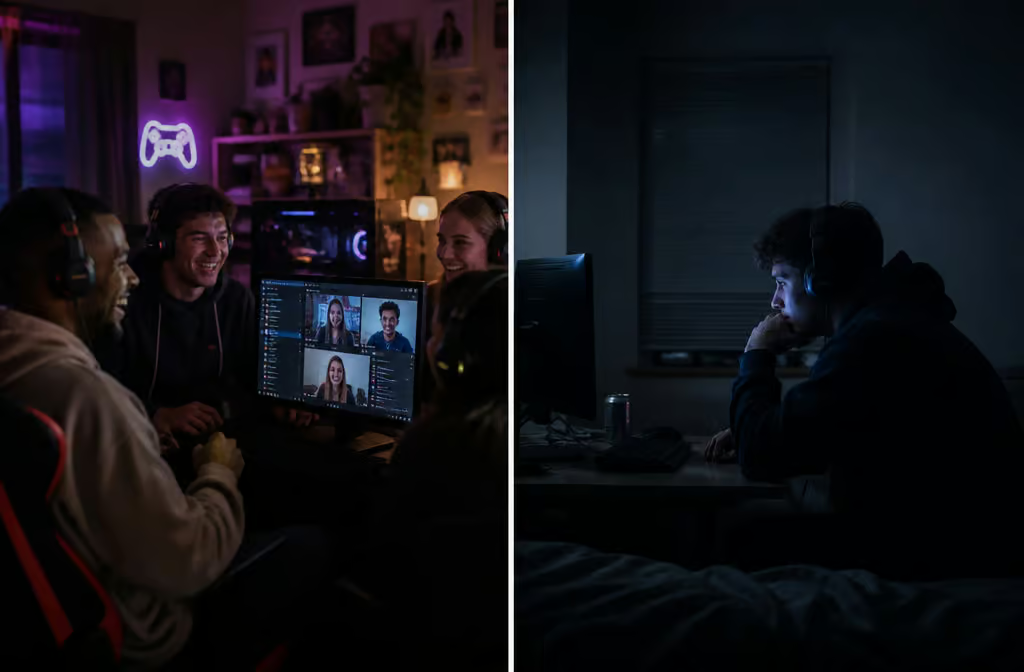
The I-PACE model (Brand et al., 2016, 2019) explains this. It stands for Person-Affect-Cognition-Execution, and the core insight is that predisposing factors — stress, depression, anxiety, low self-esteem, typically precede the excessive gaming, not the other way around. The game becomes a coping mechanism, not the cause of the problem.
This is where the why matters. Researchers like Griffiths (2010) and Billieux et al. (2019) have emphasized that why you play changes everything. Are you gaming to:
- Connect with friends (social bonding, cooperative play, shared experiences)?
- Master a skill (competitive ranking, speedrunning, learning a complex system)?
- Escape from problems (avoiding stress, numbing out, procrastinating on responsibilities)?
The first two motivations are generally protective or neutral — you’re getting real social or cognitive value. The third is the warning light. If you notice yourself reaching for a game specifically because you don’t want to deal with something else, that’s worth paying attention to regardless of whether you hit 20 or 40 hours that week.
There’s also a simpler, more practical framework called the Red Box / Green Box method (King, Billieux, & Delfabbro, 2024). Imagine your life divided into two boxes: the Green Box is your spare time — leisure, hobbies, relaxation. The Red Box is your responsibilities, work, sleep, exercise, relationships, chores. Gaming belongs in the Green Box.
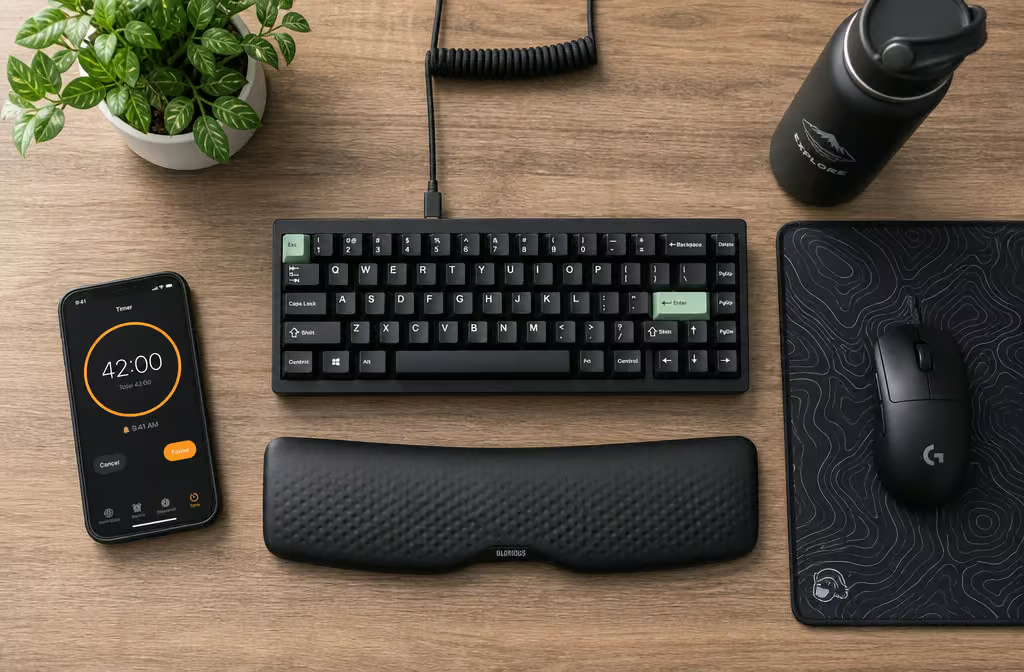
The moment you start pulling time out of the Red Box to game — skipping sleep, blowing off commitments, letting relationships slide, that’s a real warning sign, no matter how few hours you’re logging. To keep that line clear, track your daily game time with a simple timer app, since it’s easy to lose hours in intense gameplay and drift toward burnout.
What is gaming pushing out of your life? If it’s replacing mindless scrolling on social media, you’re probably making a net positive trade. But consider the typical time spent playing video games per year: if that time is replacing sleep, physical activity, or time with real people, the equation flips.
The Problem With Blanket Time Limits
China tried exactly that. In 2021, they passed a law limiting minors to one hour of gaming on Fridays, weekends, and public holidays — and only between 8 and 9 PM. It’s one of the strictest government interventions in gaming anywhere.
Studies by Zendel et al. (2023) and Colder Carras et al. (2021) argue that broad, rigid limits can backfire.
For one thing, they’re easily bypassed — kids share accounts, use parents’ IDs, or just find unregulated platforms. More importantly, they can stigmatize gaming and keep people from experiencing its genuine benefits. Remember, even moderate gaming (7–10+ hours per week) has been associated with better mental health outcomes than not gaming at all (Johannes, Vuorre, & Przybylski, 2021). A hard cap that lumps all gaming together throws the baby out with the bathwater, but experts do suggest you avoid gaming for more than six consecutive hours, as this can hurt your performance and health.
What works instead? Evidence points to education, counseling, early detection (Czakó et al., 2023), and family-based collaborative approaches. Involving kids in setting their own limits, for example, avoids the “forbidden fruit” effect — when something is totally restricted, it becomes more attractive. The same principle explains why unrestricted access to candy can actually be less appealing than a locked cabinet.
This isn’t an argument against any structure — it’s an argument against one-size-fits-all rules that ignore why people play and what they’re getting out of it.
Physical Health Risks and Simple Solutions
I’m not going to pretend there aren’t real physical downsides to long gaming sessions. They’re well-documented and they have names you’ve probably heard of: carpal tunnel syndrome, de Quervain’s tenosynovitis, trigger finger, and tennis elbow — and yes, “nintendinitis” is a real term that physicians actually use for repetitive strain injuries in gamers.
Eye strain is another big one. Staring at a screen for hours without a break can cause dry eyes, headaches, and blurred vision. Harvard Health recommends the 20-20-20 rule: every 20 minutes, look at something 20 feet away for at least 20 seconds. It sounds too simple to work, but it gives your eye muscles a break from focusing at a fixed distance.
Sleep deprivation and sedentary behavior are the other concerns. When your gaming sessions push past midnight consistently, your sleep schedule takes a hit, and that cascades into mood, focus, and long-term health.
An ergonomic setup — decent chair, wrist rest, proper monitor height, prevents repetitive stress issues. Timer apps or in-game notifications (more games are adding these now) can remind you to stretch every 30 minutes. And treating gaming like any other hobby: it’s fine in the Green Box, but don’t let it swallow the Red Box.
Practical Takeaways: Your Action Plan
So after all that data, what do you actually do with it? Here’s my framework, synthesized from the research and from watching the “is this normal?” question come up in our communities.
The three numbers to keep in your head:
- ~26 hours/week — This is typical for gamers who show no psychological distress. If you’re in this range and feeling fine, you’re in the “no worries” zone.
- ~33 hours/week — This is where the high-distress group averaged. If you’re here, check in with yourself, but remember that 42 hours is the disorder-at-risk average.
- ~42 hours/week — This is the at-risk threshold from the study. It’s an average, not a hard line, but if you’re regularly above this, it’s worth a deeper look.
Quick test: Set a timer for one session and stop when it goes off — no “one more round.” If that feels stressful or impossible, that’s a signal than any hour total.
The real checklist (not a quiz, just honest questions):
- What am I displacing? What would I be doing with this time if I weren’t gaming? If the answer is “something equally fun or productive,” great. If it’s “sleeping” or “hanging out with my partner,” reconsider.
- Why am I playing right now? Am I excited to play, or am I avoiding something? If you can’t think of a positive reason, that’s a flag.
- Can I stop? Try setting a timer for one session and stopping when it goes off — no “one more round.” How does that feel? If it’s stressful or impossible, that’s a signal than any hour total.
- Where’s the fun? Are you still enjoying it, or is it habit? Games should be fun. If they’re not, the number of hours doesn’t matter — something’s off.
One more thing: remember that gaming is active screen time. You’re solving problems, reacting, strategizing, and often communicating. That’s different from passive scrolling or watching TV. Researchers distinguish between the two, and gaming consistently lands on the healthier side of that divide. The 7–10+ hour sweet spot from Johannes et al. suggests that moderate gaming might actually be better for your mental health than skipping it entirely.
A big caveat: All these numbers come from a study conducted during the COVID-19 era of highly engaged, predominantly young male gamers. They aren’t universal cutoffs. If you’re older, or female, or playing different genres, your mileage will vary. This is a compass, not a GPS.
The Bottom Line
The question “how many hours is healthy?” doesn’t have a single answer, but the evidence gives us real guideposts. The answer is that ~26 hours/week is typical for gamers doing great, ~42 hours/week is the average where disorder symptoms cluster, and the 41.9% of heavy gamers with zero distress proves that time alone is a terrible metric.
What matters: what are you displacing, and why are you playing? If gaming is stealing from your sleep, your relationships, or your responsibilities — that’s the red flag, regardless of the Steam yearly recap. If it’s filling your spare time with joy, challenge, and connection, then 30, 40, or even 50 hours a week might be fine for you.
The reader who plays 30+ hours and feels fine? They are probably in that 41.9%. The goal isn’t to hit some arbitrary hour target — it’s to make sure your gaming is adding to your life, not subtracting from it.
People Also Ask
What is the 20/20/20 rule for gaming?
It’s a simple eye-strain prevention technique recommended by Harvard Health: every 20 minutes, look at something 20 feet away for at least 20 seconds. This gives your eye muscles a break from focusing at a fixed distance and helps prevent dry eyes, headaches, and blurred vision during long sessions.