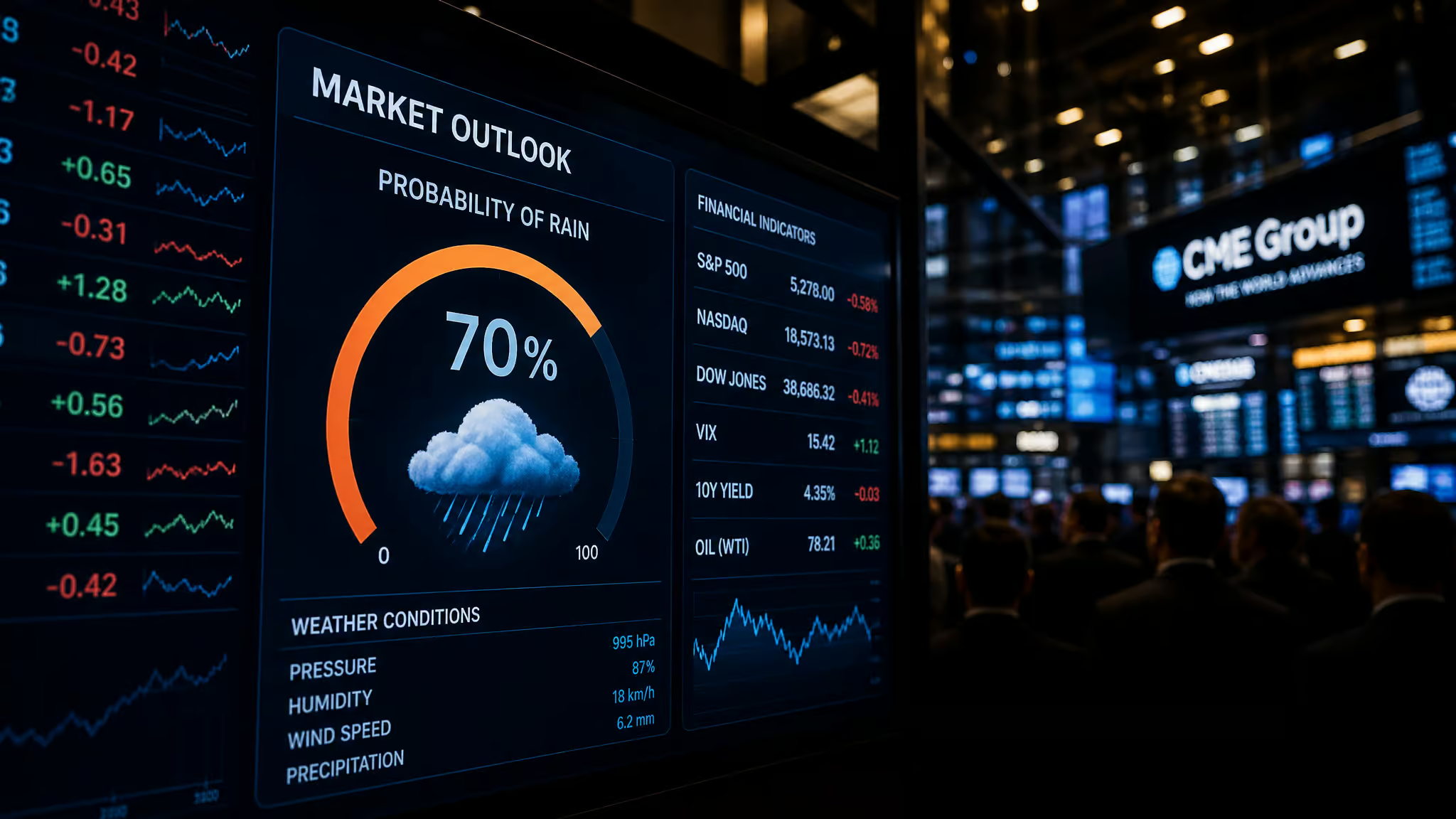
Here’s the mental shift that makes prediction markets click: they look like betting apps, but they’re structurally closer to a derivatives exchange. You’re not placing a wager with a bookmaker who sets odds. You’re buying and selling contracts on a market, and the price tag on each contract is the probability estimate. A “Yes” contract on “Will it rain tomorrow?” that costs $0.70 doesn’t mean you’re getting good odds. It means the market, collectively, thinks there’s a 70% chance of rain.
That single mechanic changes everything. It turns a bunch of strangers with opinions into a live forecasting instrument that often beats polls and experts. It’s also, as we dug into the data, a remarkably reliable way to lose money. The crowd is smart.
Being in the crowd doesn’t mean you get paid. That tension is the whole story, and it’s why prediction markets are one of the most fascinating systems to come out of the intersection of financial engineering and game theory.
Key Takeaways
Prediction markets are exchange-traded markets where participants buy and sell event contracts, with the market price acting as a real-time probability estimate. The CFTC treats regulated ones as designated contract markets offering binary options, not casinos.
Evidence on accuracy is mixed but strong: markets beat 74% of opinion polls in US presidential elections from 1988-2004, yet a 2016 experiment found them 12% less accurate than prediction polls.
A study of over 300,000 Kalshi contracts found average returns of -20% pre-fees, with market makers losing -9.64% and market takers losing -31.46%. Contracts priced under $0.10 lost over 60% on average.
Table of Contents
What Is a Prediction Market?
Prediction markets belong to the crowdsourcing family. They’re a way to aggregate beliefs across a large number of people, but with a twist: the people involved have financial skin in the game. That’s what separates them from a poll. You can say you think a candidate has a 60% chance of winning; putting money on it at 60 cents is a different kind of statement. The financial incentive is what forces people to commit to their beliefs rather than just vibing in a survey.
The product being traded is an event contract. The “underlying” isn’t a stock or a commodity, it’s the outcome of a real-world event. Will it rain? Will this bill pass?
Will this actor win the Oscar? The contract’s value depends entirely on what happens in the world, and the market price expresses the crowd’s collective probability estimate. That’s the core loop: people trade, prices move, and the price you see at any moment is the market’s best guess at the odds.
This is also where prediction markets separate from gambling apps. In a casino or a sportsbook, the odds are set by an operator with a built-in margin. The contract price is the forecast. You’re not trying to beat a bookmaker’s line; you’re participating in a market where the price itself is the signal. That’s why regulators in the US, specifically the Commodity Futures Trading Commission (CFTC), treat regulated prediction markets as designated contract markets offering binary options. It’s a derivatives-exchange structure, not a casino. That tension between “market” and “betting” is baked into the entire ecosystem, even as platforms like betting on world events blur the line for users.
What Exactly Is an Event Contract?
Technically, event contracts are structured as swaps. Practically, they’re the simplest financial instruments you’ll ever encounter. Here’s the canonical example that makes the whole thing click.
Take a binary yes/no question: “Will it rain tomorrow?” There are two possible outcomes at expiration, and the payout is fixed at $1. If you buy the “Yes” contract at $0.70 and it rains, you get $1, a profit of $0.30 per contract. If it doesn’t rain, you get nothing and lose your $0.70.
The same math works in reverse: buy “No” at $0.30, and you profit if the event doesn’t happen. The price is the market’s probability estimate. Seventy cents for “Yes” means the crowd thinks there’s a 70% chance of rain.
That’s the whole mechanism. It’s elegant, it’s direct, and it’s the reason the concept clicks for people immediately. But there’s a layer of complexity underneath. Beyond the simple all-or-nothing structure, contracts can be built for more complicated questions.
Some offer a menu of choices, “Who will win?” with several candidates as options. Some use outcome ranges, where you get a partial payout based on how close the result lands to a specified band. Others bundle multiple yes/no questions into a single contract for multi-part predictions.
The trade-off is real: more complex contracts are genuinely cooler, but they attract fewer traders. That means less liquidity and wider bid-ask spreads. A simple “Will it rain?” market might have tight pricing because dozens of people are trading it. A five-way contract on the exact vote share of a third-party candidate in a local race will have maybe a handful of participants, which means you’re paying more to get in and out. The market mechanics stay the same, the price still reflects the odds, but the execution quality degrades.
One more thing worth flagging before we move on: the headline price isn’t the whole story. Fees and taxes eat into returns. Buy a “Yes” at $0.70, get your $1 at payout, and you’re not actually up $0.30 once the platform takes its cut. We’ll get to the fee structures later, but keep that in mind.
Field note: The headline contract price is a probability estimate, not a payout promise. Fees and spreads always sit between the quoted price and your actual return.
Why Do People Trade Prediction Markets?
Strip away the jargon, and there are two reasons anyone trades anything: hedging or speculation.
Hedging is using a contract to offset a real-world risk. The classic example is a citrus farmer in Florida buying a contract that pays out if a freeze hits the growing region. The farmer’s core business is at risk from cold weather, so a weather contract acts as insurance. If the freeze comes, the contract pays out, softening the blow to the crop. If the weather’s fine, the farmer loses the premium but makes full money on the harvest. The contract doesn’t change the weather; it changes the financial exposure.
Speculation is the other side. You’re taking on risk because you think you know something the market hasn’t fully priced in. Maybe you’ve been following polling data more closely than the average trader, or you have domain expertise in a niche event. You’re not protecting an existing position; you’re trying to profit from being right. This is the side that draws retail traders, and it’s also the side where most money gets lost.
Hedging and speculation aren’t just academic categories, they distort how markets function. When traders use contracts as insurance, they’re not expressing a pure probability belief; they’re buying protection. That pushes prices away from what a neutral forecast would look like. Researchers have documented this in election markets, where traders buy shares in a candidate not because they think the candidate will win, but because they’re hedging against the real-world consequences of that outcome. The price starts reflecting insurance demand, not just information.
The corporate world has noticed. Prediction markets have been used internally for forecasting, with some genuinely impressive results. Eli Lilly ran internal markets to predict which drug candidates would make it through clinical trials, a high-stakes guess published in a 2005 Nature article. Google used them in 2005 to forecast product launch dates.
HP and Microsoft ran private markets too. There have even been public experiments: a pilot study used prediction markets to forecast an Iowa influenza outbreak two to four weeks ahead of official clinical data, and Best Buy ran a virtual market that correctly predicted a Shanghai store opening would be delayed, preventing losses.
The reason these work is simple: financial incentives make people think harder and share what they know. A poll asks for an opinion; a market asks for a commitment. People with money on the line do better research, and that collective effort gets baked into the price.
How Prediction Markets Set Prices: Order Books vs. Automated Market Makers
Under the hood, prediction markets run on one of two pricing engines. Each has its own trade-offs, and the difference matters more than most casual observers realize.
The central limit order book (CLOB) is the classic structure, the one traditional stock exchanges use. Traders place limit orders: buy at a specific price, sell at another. The exchange matches buyers with sellers, and prices emerge from supply and demand. No formulas, no interpolation, just a direct match between people who disagree about an outcome. Kalshi runs a fully centralized CLOB, and it’s regulated by the CFTC as a designated contract market.
The alternative is the automated market maker (AMM), a protocol that guarantees liquidity by always being willing to take the other side of a trade. The specific formula Polymarket originally used was the Logarithmic Market Scoring Rule (LMSR), developed by economist Robin Hanson. The market maker keeps a probability distribution over all possible outcomes and offers trades at prices defined by a cost function that adjusts as people buy and sell. The price calculation involves exponentiation of the ratio between shares outstanding and a liquidity parameter, then normalized, but the concept matters more than the math.
The liquidity parameter is the key knob. A higher value means prices move less per trade, which makes the market more stable but less responsive to new information. A lower value makes prices jump around more, which attracts arbitrageurs but can feel erratic. The operator’s maximum loss is bounded by the liquidity parameter times the natural log of the number of outcomes, a safety feature that caps the downside of running an AMM.
The trade-off between the two approaches is straightforward. A CLOB needs counterparties. In a thin market, you get wide bid-ask spreads, and getting in or out of a position costs you. An AMM guarantees tradability even with low activity, but the liquidity guarantee has a cost baked into the pricing. The bid-ask spread in a prediction market arises from the matching process, not from administrative pricing, it’s the cost of finding someone willing to take the other side, and it’s a key part of how do prediction markets make money.
Polymarket’s history shows how platforms navigate this. The exchange used an AMM based on Hanson’s scoring rule until late 2022, then switched to a “hybrid-decentralized” model: trades are matched off-chain but settled on-chain on Polygon. Kalshi, meanwhile, has stayed with the fully centralized CLOB. Neither approach is universally better; it depends on the market’s activity level and the platform’s regulatory posture.
How Accurate Are Prediction Markets?
Here’s where the picture gets genuinely interesting, because the data pulls in two directions at once. And both are true.
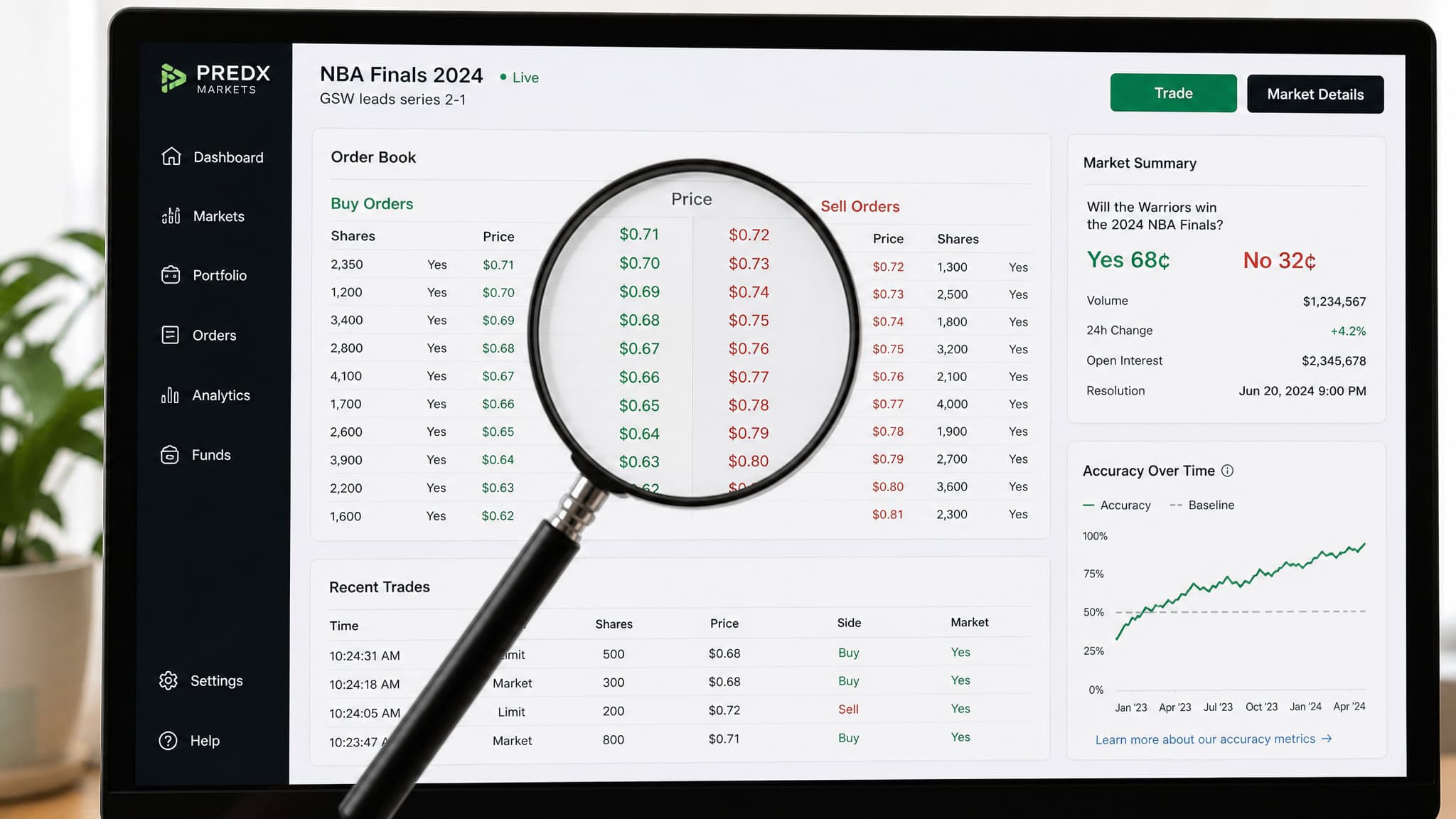
On one hand, prediction markets have a strong track record of beating traditional forecasting tools. For five US presidential elections from 1988 to 2004, prediction markets beat 74% of the opinion polls studied. That’s not a fluke, it’s a pattern. The theory of operation is that financial incentives create a weighted average of opinions, where the weight is the willingness to bet.
People who know more bet more, and the price reflects that aggregation. Financial markets tend to be efficient, and research indicates prediction markets behave similarly, which is why what are prediction markets in sports betting is a question worth exploring, as the boundary between these markets and traditional betting grows increasingly blurred.
But then comes the 2016 randomized experiment that found prediction markets were 12% less accurate than prediction polls. That’s a meaningful counterpunch. The simple “markets are smart” story doesn’t hold up cleanly.
The nuance comes from a massive study of Kalshi’s transaction-level data, over 300,000 contracts. The findings are illuminating. Prices were informative and became more accurate as the closing date approached, with the mean absolute pricing error dropping sharply on the last day. The market really does zero in on the truth as the event gets closer.
But the study also found a systematic favorite-longshot bias: contracts priced at $0.10 or lower lost over 60% on average, while contracts priced above $0.50 actually earned some profit. Longshots are overpriced relative to true probability; favorites are underpriced.
The dramatic finding is the returns distribution. Across those 300,000+ contracts, average returns were -20% before fees. Market makers lost -9.64%, and market takers lost -31.46%. That’s the paradox in a single set of numbers: the market itself is informative, but most participants lose money. The crowd is smart, but being in the crowd doesn’t mean you get paid.
There’s also a subtle point about what the price actually means. Under certain conditions, the market clearing price approximates the mean trader belief. But prices can be biased estimates of those beliefs, they’re not a perfect mirror. Risk aversion, time preferences, and the distribution of opinions all skew the price.
One useful observation comes from Eric Zitzewitz: there’s no virtue-signaling in an anonymous market when you’re betting. People say what they mean when money is on the line. For the collective wisdom to work, though, you need varied information sources, independent decision-making, and decentralized organization. When those conditions break down, the market breaks down.
When Prediction Markets Fail
The 2016 EU referendum and the US presidential election are the textbook cases. In both, prediction markets failed to predict the eventual outcome. Market prices leaned heavily toward Remain in the Brexit vote, and they gave Trump a low probability on election night. The failure mode is now well understood: traders used the market odds themselves as an anchor.
The market price became the consensus, and that consensus suppressed the incorporation of new information. The London bookmaker odds and market prices became an echo chamber, circulating the same information without genuinely testing it.
Manipulation is another failure mode, though the evidence suggests it’s usually short-lived. In 2004, an anonymous trader on Tradesports engaged in a “bear raid” on Bush contracts, flooding sell orders to drive the price to zero. The price rebounded quickly, and subsequent research by Hanson, Oprea, and Porter showed that manipulation attempts can actually increase accuracy, because the artificially low price creates a profit incentive for others to buy and correct it. Manipulation is real, but the market’s incentive structure often self-corrects.
Speculative bubbles happen too. The 2000 Iowa Electronic Markets presidential futures market showed apparent inaccuracy driven by Election Day buying, as traders piled in for sentimental rather than informational reasons. The crowd wisdom also breaks down when the question requires specialized knowledge most participants lack. Peer pressure, panic, and bias can all distort the price.
That said, there’s a self-correcting mechanism: the marginal-trader hypothesis. There will always be individuals seeking out market errors, and their arbitrage pulls prices back toward accurate levels. It’s not guaranteed, but it’s a persistent force.
Resolution and Oracles: Who Decides the Outcome?
For all the talk about pricing, the biggest risk in prediction markets isn’t the prediction itself. It’s how the contract resolves, and that’s exactly where how are prediction markets different from gambling comes into play. The moment of truth, when the event happens and contracts pay out, is where the system can break in spectacular ways.

On regulated exchanges, resolution follows a rulebook filed with the regulator before trading starts. Kalshi’s contracts are bound by rulebooks filed with the CFTC that identify authoritative data sources and the exact Payout Criterion for a “Yes” resolution. When the event happens, Kalshi’s team checks the official results stated by those source agencies. No subjective calls, no interpretation. The rulebook was filed before anyone traded, so there’s no room for post-hoc rationalization.
Decentralized systems are messier. Polymarket uses UMA, an “optimistic oracle.” The proposed outcome is considered true unless someone challenges it within a dispute window. If challenged, the Data Verification Mechanism (DVM) kicks in: UMA stakers vote in secret for 24 hours, then reveal in the next 24 hours.
Resolution needs at least 65% of staked UMA to vote and agree on one outcome. The system resolves 99.8% of cases without escalation, but that remaining 0.2% can be a disaster.
The Zelenskyy suit contract is the perfect example. The question: would a photo or video of Volodymyr Zelenskyy wearing a suit appear between March 22 and June 30, 2025? The resolution rule was based on the “consensus of credible reporting”, which turned out to be a dangerously fuzzy standard. The contract attracted over $237 million in trading volume.
Zelenskyy did appear at a NATO summit in June in attire described as a suit by many media outlets. But on July 1, 2025, UMA’s oracle resolved the market “No,” reversing an initial “Yes” outcome. The basis: the “consensus of credible reporting” hadn’t been established. Chaos, and a lot of angry traders.
The Khamenei death contract shows how even regulated markets can get weird. In February 2026, Kalshi listed a contract on whether Ali Khamenei would step down as Supreme Leader of Iran by March 1, 2026. Khamenei was killed in US and Israeli strikes on February 28. The event happened.
But Kalshi applied a “death carveout” in the contract rules, and the market settled at the pre-death trading price rather than paying $1 to “Yes” holders. Given roughly $540 million in positions, that made a massive difference. A proposed class action covering about $54 million was filed in March 2026, alleging the carveout wasn’t adequately disclosed and that the exchange kept accepting “Yes” trades while reports of strikes were accumulating.
This is the “oracle trilemma” in action: the intrinsic trade-off among decentralization, truthfulness, and scalability when transferring off-chain information onto a blockchain. You can’t optimize all three simultaneously. The mechanisms built to navigate thisUMA’s DVM, Kalshi’s rulebooks, are attempts to solve an inherently messy problem. They usually work. When they fail, it’s not pretty.
Red flag: Resolution rules matter as much as the prediction itself. A fuzzy standard like “consensus of credible reporting” can turn a winning contract into a losing one.
A Brief History of Prediction Markets
Betting on future events predates modern polling by centuries. The first recorded papal bet was in 1503, and even then it was considered an old practice. Wall Street was betting on election outcomes in 1884, with researchers Rhode and Strumpf finding that betting turnover per presidential election was over half of what campaigns spent. That’s serious money.
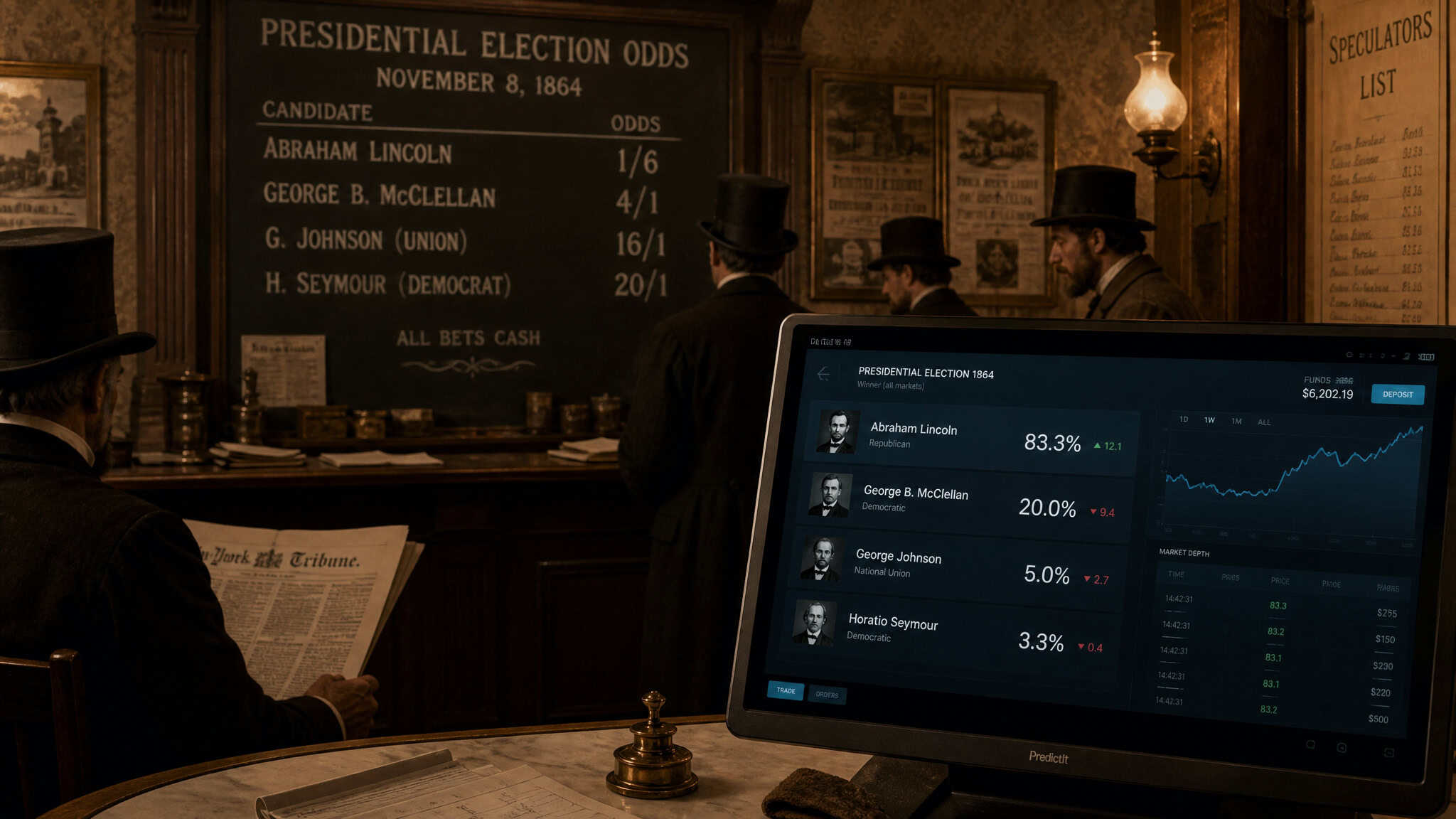
The economic theory behind prediction markets goes back to Hayek’s 1945 paper “The Use of Knowledge in Society” and von Mises’s earlier argument about economic calculation, the idea that markets are extraordinarily good at aggregating dispersed knowledge. Popular books like Surowiecki’s The Wisdom of Crowds (2004), Sunstein’s Infotopia (2006), and Hubbard’s How to Measure Anything brought the concept to a mainstream audience.
The modern era starts with the Iowa Electronic Markets (IEM), created in 1988 as an academic program at the University of Iowa. The CFTC issued no-action letters in 1992 and 1993, allowing it to operate as a not-for-profit research tool with limits on traders and money. It eventually expanded to include up to 20 other universities.
Commercialization came with HedgeStreet, the first prediction market to seek CFTC approval as a designated contract market. The CFTC approved it in 2004, making it the first regulated exchange for binary options. It later rebranded as Nadex (sources differ on whether it was 2007 or 2009) after the UK’s IG Group acquired it, then Crypto.com acquired Nadex (sources differ on 2021 vs. 2022).
The 2003 Policy Analysis Market is the cautionary tale. Publicized by the US Department of Defense in July 2003, it was pitched as a way to predict geopolitical events. The speculation that it might include terrorist attack scenarios sparked a firestorm, and it was denounced as a “terrorism futures market.” The Pentagon canceled it before it ever launched.
Corporate adoption followed: Eli Lilly’s drug trial predictions, Google’s product launch forecasts, and internal markets at HP and Microsoft. The real mainstream turning point was 2022, when Polymarket and Kalshi brought prediction markets to a wide audience. The 2024 Kalshi court victory over the CFTC, a DC District Court ruling that narrowly interpreted the Commodity Exchange Act’s mention of “gaming”, opened the door for election markets on regulated exchanges.
Are Prediction Markets Legal? The Regulatory Patchwork
The short answer: it depends on where you are, which platform you’re using, and who’s currently winning the legal battles.
At the federal level, the CFTC claims exclusive jurisdiction over prediction markets as derivatives under the Commodity Exchange Act. The Dodd-Frank Act (2010) gave the CFTC authority to prohibit certain event contracts, terrorism, assassination, war, gaming, and related categories. The 2024 Kalshi case was a major blow to that authority: the DC District Court ruled in Kalshi’s favor, narrowly interpreting “gaming,” and the CFTC dropped its appeal under the Trump administration. As of mid-2026, the CFTC’s exclusive jurisdiction claim is being challenged in multiple venues, and states aren’t waiting for the federal system to sort itself out.
The state-level actions tell a wild story. Minnesota enacted a ban on prediction market trading in May 2026, and the DOJ sued to block it. Arizona’s Secretary of State blocked prosecution. Wisconsin’s Election Commission warned election workers.
New Jersey’s 3rd Circuit ruled in Kalshi’s favor. The CFTC even sued Wisconsin to reaffirm its exclusive jurisdiction. Proposed federal legislation, the STOP Act and the Campaign Funds Integrity Act, would criminalize using campaign funds for prediction market bets.
Globally, it’s a patchwork. The UK classifies prediction markets as betting, requiring a Gambling Commission license. The EU has no unified structure: Belgium, France, Italy, Poland, and Romania have banned Polymarket as unlicensed gambling, and the MiCA regulation (effective July 2026) will apply to crypto-based prediction markets. Spain banned Kalshi and Polymarket for three to four months in May 2026 for operating without a gambling license.
Singapore and Thailand blocked Polymarket. Canada banned binary options in 2017, and Ontario banned Polymarket in 2025. The conflict is active, unresolved, and likely to get messier.
The Platform Landscape
The prediction market ecosystem runs from academic research tools to heavily gamified commercial apps. Here’s the lay of the land.
Kalshi is the CFTC-regulated designated contract market with a centralized order book. Its fee formula is 0.07 × P × (1-P) per taker, a percentage of the notional value that scales with the contract’s ambiguity. Contracts near 50 cents (maximum uncertainty) cost more than contracts at extremes.
Polymarket is the hybrid-decentralized exchange settled on Polygon. It uses the UMA oracle and charges just 0.01% on take orders. It was fined $1.4 million in 2022, moved offshore, and is re-entering the US market as QCX LLC after acquiring a regulated exchange.
Robinhood entered the sports prediction market space with NFL and college football prediction markets. Underdog Predict is a newer fantasy/prediction hybrid. PrizePicks offers Team Picks in 33 states and Culture Picks in 48 states. Fanatics Markets has a $1,000 minimum wire deposit and a 40% rebates promotion.
Novig offers a $10 deposit and $25 sign-up bonus. DraftKings Predictions charges $0.01 per share per side.
On the academic/research side, you have PredictIt (the university research platform), SciCast, Good Judgment Open, Metaculus, Manifold, Augur, and IPredict. The crypto infrastructureEthereum, Polygon, USDC, and MetaMask integration, is foundational to the decentralized options.
There’s no “best” platform without a clear criterion. Regulated exchanges like Kalshi offer legal protection and clear resolution rules. Decentralized options like Polymarket offer lower fees and global access but come with oracle risk. The promotional offers from the newer sports-focused platforms are aggressive but should be read as customer acquisition costs, not generosity.
Consumer Protections and Responsible Trading
The CFTC has a specific list of customer rights for prediction market participants, and it’s worth knowing what you’re entitled to. You have the right to clear, complete information about risks, obligations, commissions, fees, and penalties associated with any trade. You have the right to prompt, clear details about event contracts, such as trading rules and terms. Designated contract markets must protect against fraud, manipulation, and unfair practices. You have the right to access your funds, and you’re protected from high-pressure sales practices.
If something goes wrong, you can file a complaint at CFTC.gov/complaint. Whistleblowers have incentive programs at Whistleblower.gov. The National Futures Association (NFA) has its own complaint mechanism for brokers.
The CFTC’s do-and-don’t list is refreshingly practical. Do review market rules, understand risks, monitor positions or use stop-losses, understand fees, and trade only risk capital. Don’t trade with unregistered entities, don’t fall for promises of big payoffs, and don’t trust celebrity endorsements.
It’s also worth being honest about the gambling dimension. Many governments classify prediction markets as gambling, and it’s legal to do so. If you’re concerned about problem gambling, the official guidance points to the National Council on Problem Gambling, selfexclude.io, and a helpline at 1-800-MY-REMIT. Regulated prediction markets aren’t “safe” investments, they’re markets with real financial risk.
Buyer rule: Trade only risk capital, review the resolution rulebook before entering a position, and treat platform bonuses as acquisition costs, not edge.
The Bottom Line
Prediction markets are one of those systems that’s genuinely elegant in theory and genuinely messy in practice. The core mechanism, a price that encodes a probability estimate, is beautiful. The empirical record on accuracy is real, though contested. The case studies of failure are instructive. And the regulatory environment is a live conflict that will shape the industry for years.
From our perspective at GeekExtreme, the fascinating part is how well the mechanics hold up under scrutiny. A market price is just a number, but it’s a number that aggregates thousands of individual judgments, weighted by financial commitment and constantly corrected by arbitrageurs looking for mispricing. When it works, it’s one of the best forecasting tools we have. When it breaks, it breaks in fascinating, teachable ways.
But the honest takeaway is this: the crowd is smart, and you’re part of the crowd. That means you get the benefit of collective wisdom, but you also get the average outcome, which is a net loss. The model is brilliant; the expected value for individual traders is not. If you’re going to participate, understand the mechanics, respect the fees, and only trade money you can afford to lose. And above all, remember that a 70-cent “Yes” on a rain contract isn’t a promise, it’s a probability.
Frequently Asked Questions
How does a prediction market set prices?
Prices are set either through a central limit order book (CLOB) where buyers and sellers match, or via an automated market maker (AMM) that uses a formula to adjust prices based on trading activity. The price of a contract reflects the market’s collective probability estimate of the event occurring.
Why do prediction markets fail sometimes?
They fail when traders anchor on the market price itself, creating an echo chamber that suppresses new information—as seen in the 2016 Brexit vote and US election. Manipulation and speculative bubbles can also distort prices, though markets often self-correct through arbitrage.
How much money can you lose on a prediction market contract?
You can lose your entire investment. If you buy a ‘Yes’ contract at $0.70 and the event doesn’t happen, you lose the full $0.70 per contract. Fees and spreads add to the cost, and longshot contracts priced under $0.10 have historically lost over 60% on average.