People were betting on papal succession in 1503. Wall Street ran organized election betting in 1884, with turnover so heavy it dwarfed campaign spending. In 2003, the US government tried to build a futures market for terrorist attacks and got it canceled within a week. And now, in 2025, you can open the same app you use for stock trades, buy a binary contract on whether the Thunder win the NBA Finals at 93 cents, and sell it before the series even starts.
That’s the strange, centuries-old, suddenly-mainstream world of prediction markets. They’ve spent most of their existence as an academic curiosity and a crypto-native obsession, but a wave of court victories and platform launches has pulled them into the same apps you already use for trading stocks and placing sports bets. The machinery is genuinely clever. The hype around it deserves some side-eye.
Key Takeaways
Prediction markets work like a stock exchange for events: you buy Yes or No contracts priced from a penny to a dollar, and the price reflects the crowd’s real-money estimate of probability, not a bookmaker’s opinion.
The real costs aren’t always obvious: Kalshi’s taker fee runs about $1.75 per 100 contracts at a 50¢ price, and the bid-ask spread in a thin market can quietly erase the “no vig” advantage versus a sportsbook.
Most traders lose money: across 300,000+ Kalshi contracts, the average return before fees was roughly -20%, with contracts priced at 10¢ or lower losing over 60% on average.
Table of Contents
What a prediction market actually is
Strip away the blockchain chatter and the regulatory drama and the basic unit is almost aggressively simple. A prediction market is an exchange where you trade binary options on real-world events. Each event has two sides: Yes and No. A contract that resolves at one dollar if you’re right, zero if you’re wrong. Buy the “Yes” on the Cavaliers winning the Finals at 93 cents and the market is telling you there’s roughly a 93% chance.
That’s it. The price is the probability.
The twist is that the price isn’t a bookmaker’s opinion, it’s a live, money-weighted consensus that moves with every trade. It behaves like a stock ticker, not a fixed sportsbook line. If a star player gets injured during warmups, the contract drops in real time. If a wave of news hits, the price adjusts before any analyst has finished typing a take.
This family of mechanisms goes by a lot of names. Betting markets, information markets, decision markets, idea futures, event derivatives. The intellectual foundation dates back to Friedrich Hayek’s 1945 paper “The Use of Knowledge in Society” and Ludwig von Mises’ work on economic calculation, both arguing that markets are the best mechanism we have for aggregating dispersed information. The idea: nobody holds the full picture, but everyone holds a piece, and prices are how those pieces get stitched together.
The modern era started with the Iowa Electronic Markets in 1988, an academic project with positions capped at $500 and a CFTC no-action letter from 1993. HedgeStreet became the first CFTC-approved designated contract market in 2004, later rebranding to Nadex and eventually landing under Crypto.com. Even corporations got in on the action: Eli Lilly, Google, HP, and Microsoft all ran internal prediction markets starting around 2005.
One caveat worth carrying into the rest of this. The “price equals probability” framing is a strong practical rule of thumb, not a mathematical certainty. The academic literature is genuinely split. Justin Wolfers and Eric Zitzewitz showed that the market-clearing price equals the mean trader belief under specific assumptions like logarithmic utility and symmetric beliefs, but Charles Manski argues that prices only partially identify mean beliefs.
Steven Gjerstad found prices land very close to mean beliefs when traders are risk-averse and beliefs are spread out. So the 93¢ number is the crowd’s best guess, and it’s usually a good guess, but it’s not a law of physics.
How the trading machinery works
The intellectual ideas are great, but the plumbing is where prediction markets get interesting. There are two dominant market structures at play, and they solve the same problem in very different ways.
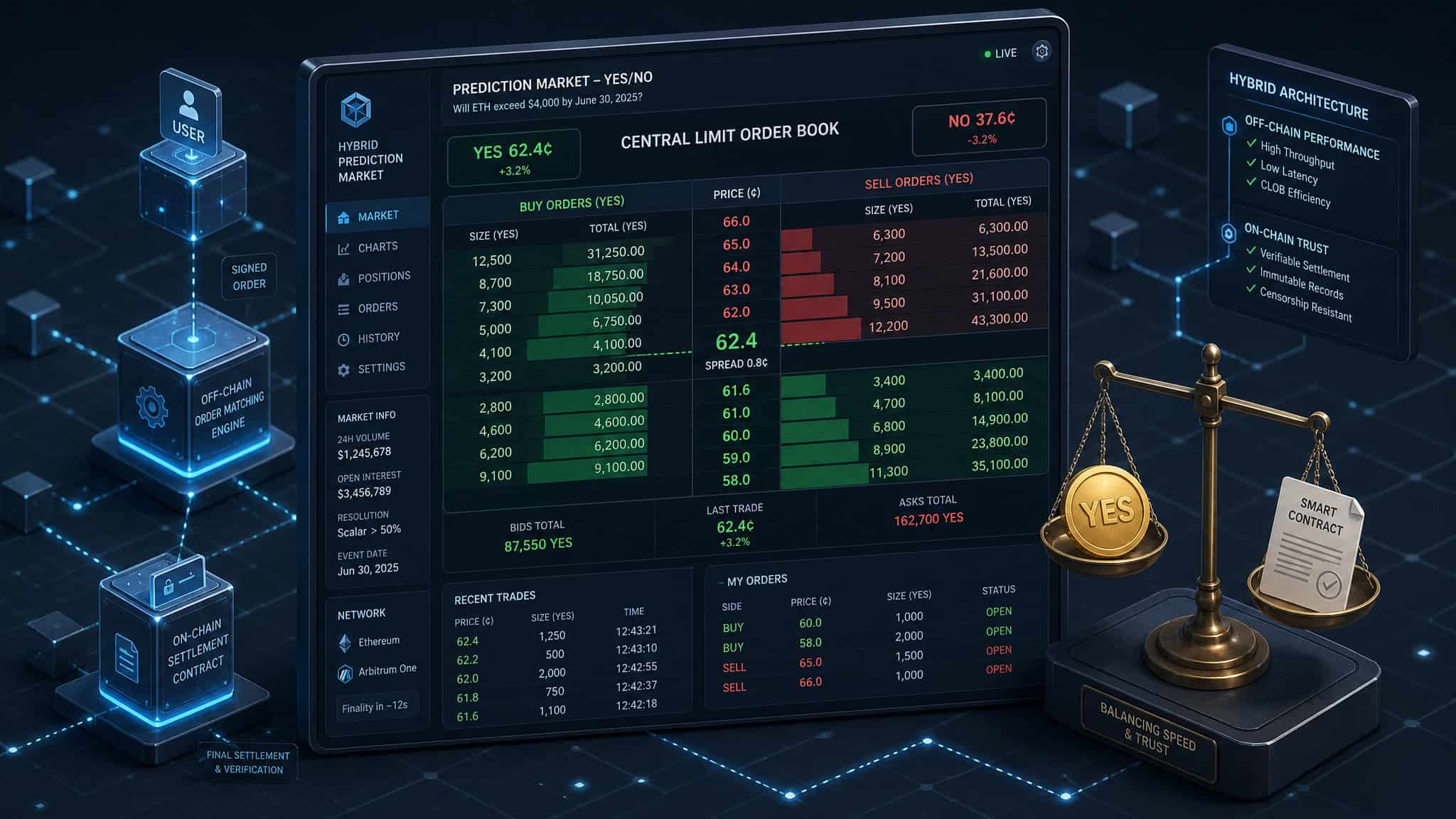
Kalshi runs a fully centralized central limit order book, or CLOB, regulated by the CFTC as a designated contract market. You place limit orders, other traders accept them, and supply and demand set the price. It’s the same structure as a stock exchange, just with event contracts traded instead of shares.
Polymarket runs something hairier. It uses a hybrid-decentralized architecture: orders are matched off-chain, then settled on-chain on Polygon. But it didn’t always work that way. Originally, Polymarket ran on an automated market maker, or AMM, built around Robin Hanson’s Logarithmic Market Scoring Rule.
The LMSR is a clever piece of machinery: it maintains a probability distribution over all possible outcomes and offers trades at prices defined by a cost function. The operator’s maximum loss is bounded at b ln n, where n is the number of outcomes, which means the platform can guarantee liquidity even when trading is dead quiet.
Polymarket switched to a full order book in late 2022 when the AMM outgrew its usefulness. Volume got too heavy, and an order book handles deep markets better. It’s a great example of the space evolving in real time: the economist-designed mechanism was elegant, but the platform needed something more scalable.
Settlement is where the two architectures really diverge. Regulated exchanges like Kalshi settle per a rulebook filed with the CFTC. The rulebook names the authoritative data sources and the payout criterion, and winning contracts settle at one dollar. Decentralized markets like Polymarket rely on an oracle, specifically UMA’s optimistic oracle. A proposed resolution is considered true unless someone challenges it within a dispute window.
Disputes go to the Data Verification Mechanism, where UMA stakers commit votes in secret over a 24-hour period. The dispute resolves when at least 65% of staked UMA votes agree on a single outcome.
This is the oracle trilemma in action: there’s an inherent trade-off between decentralization, truthfulness, and scalability when you’re trying to move off-chain information onto a blockchain. You can’t have all three perfectly, so platforms have to pick their poison.
The real costs live in the fee structure and the spread. Kalshi’s standard taker fee works out to about $1.75 per 100 contracts at a 50¢ price. A resting maker order can be cheaper, but a wide spread in a thin market can wipe that advantage out. If a market has a 50¢ bid and a 51¢ ask, buying at 51¢ means paying half a cent above the midpoint. That’s the hidden tax on trading in any market, and prediction markets are no exception.
There’s also a field pattern worth knowing: new users often assume the price is a fixed line like at a sportsbook, then watch a contract they bought at 60¢ drop to 55¢ after a few large trades. The thing they’re missing is that they can sell at a loss before the event resolves. The market isn’t just a ticket you hold to expiration, it’s a position you can exit.
Prediction markets vs sportsbooks on the real costs
Here’s the head-to-head that actually matters. Same bet, two venues, real dollars. Prediction markets also cover far more than sports. Kalshi has hosted markets on criminal charges and even war events, raising ethical questions about what should be tradeable.
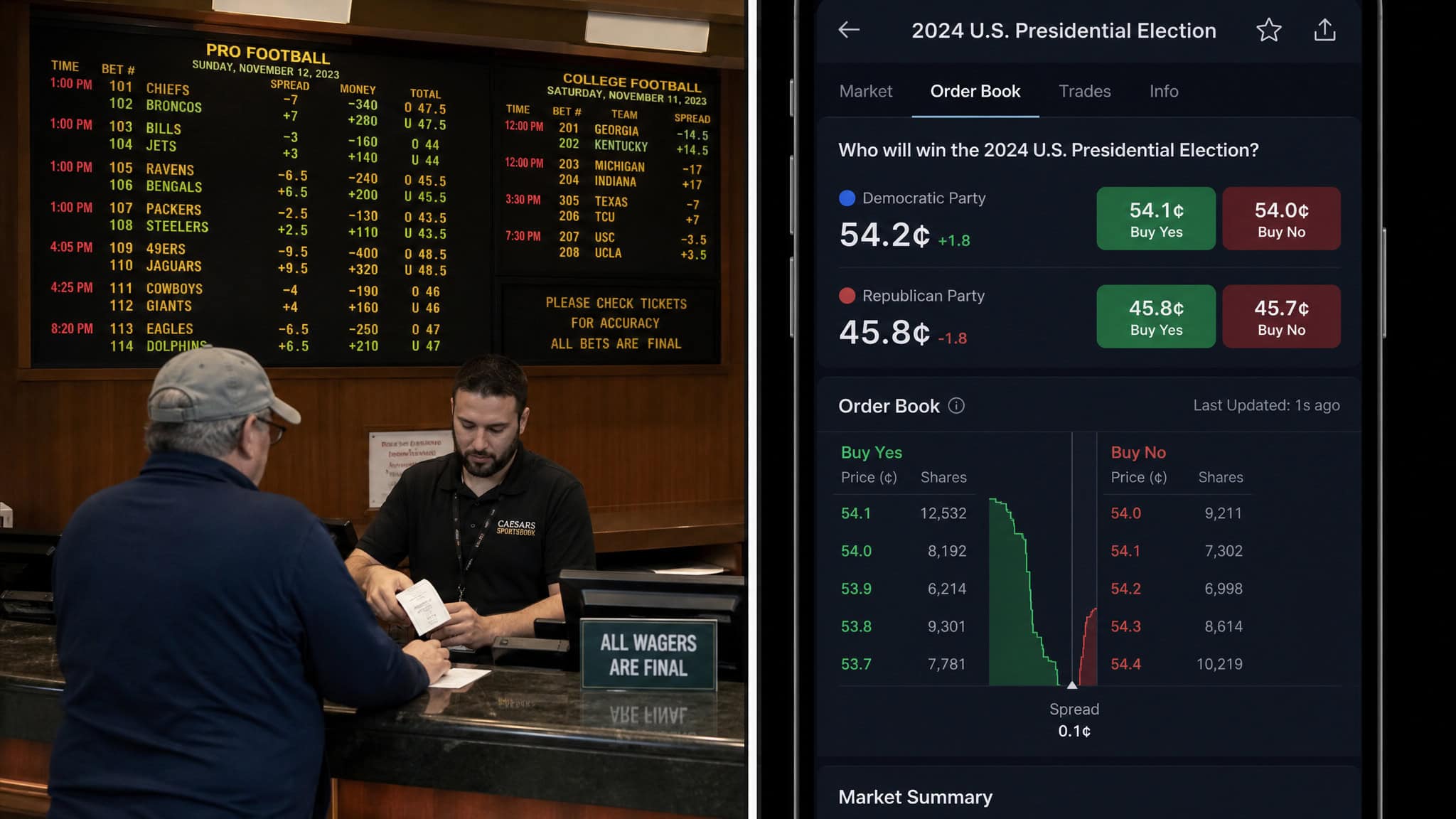
Take the Detroit Lions moneyline. Action Network compared prices across platforms and found Kalshi trading it at 28¢, which implies roughly a 28% win probability. DraftKings had the same bet at +220, and BetMGM at +250. So the prediction market is pricing a lower implied probability than the sportsbook, which is another way of saying the payout is better if the Lions win. Kalshi has also listed markets like ‘Who will be the Chicago Bears next coach: Ben Johnson or Mike Vrabel?’, a reminder that these platforms extend well beyond traditional sports.
But the structural difference runs deeper than the odds. Prediction markets are peer-to-peer exchanges where you trade against other users. Sportsbooks are house-banked: the book is your counterparty, and the vig is built into the odds, typically around 4.5% at -110. Prediction markets charge explicit trading fees on top of the bid-ask spread.
They publish their order books publicly; sportsbooks don’t show you volume or demand data. So, what are prediction markets? They’re the ultimate geeky intersection of economics, game theory, and real-world data.
The event scope is different too. Prediction markets cover sports plus elections, economic data, tech launches, crypto prices, and culture. Regulated sportsbooks restrict politics, the Oscars, and scripted events. You can bet on the Fed’s interest rate decision on Kalshi, but not on DraftKings.
Age rules vary, which creates a real regulatory inconsistency. Prediction markets are generally 18+, while sports betting is commonly 21+ in states that allow it. If you want to understand the mechanics behind these wagering systems, how to build a sports prediction model offers a practical starting point. Some states ban prediction markets outright.
The long math is where the “no vig” claim falls apart. Take a 15¢ contract versus +550 odds. Once you add the taker fee and the bid-ask spread, the sportsbook can actually be cheaper. The bottom line on cost depends on what you’re trading, but do people make money on prediction markets? For favorites, prediction markets often win on price; for longshots, the fees and spread eat the advantage.
There’s also a behavioral angle that the industry doesn’t love to talk about. The “information market” label is increasingly a marketing and regulatory distinction rather than a behavioral one. The National Council on Problem Gambling has said the risks are similar to sports betting. Commercial prediction platforms trigger the same cycle of anticipation, action, and reaction you’d find at a sportsbook.
But the deeper question is are prediction markets gambling? The answer hinges on whether the wisdom of crowds truly differs from the house edge. Unlike licensed sportsbooks, which are required to offer deposit limits, cooling-off periods, and self-exclusion as a condition of their license, prediction markets aren’t held to that standard. Protections vary wildly from platform to platform, and some have only started building them out recently.
The legal landscape is a genuine mess
The single event that explains why these markets suddenly exploded is Kalshi’s October 2024 court victory over the CFTC. The CFTC had deemed Kalshi’s contracts on party control of Congress contrary to the public interest, but Kalshi won in court, relisted its election markets, and the floodgates opened.
The US framework is built on the Commodity Exchange Act, which classifies event contracts as derivatives rather than wagers. The CFTC regulates prediction markets as designated contract markets. The Iowa Electronic Markets got a no-action letter in 1993 with restrictions on traders and amounts. The Commodity Futures Modernization Act of 2000 required self-certification. Dodd-Frank in 2010 added a public-interest review for contracts involving terrorism, assassination, war, gaming, or activity violating state or federal law.
The current situation is a turf war. CFTC Chairman Michael S. Selig asserts exclusive federal jurisdiction, while states including Nevada, Arizona, Massachusetts, and New York have sued Kalshi and Polymarket or taken enforcement action. Nevada won a restraining order against Kalshi. New York Attorney General Letitia James put it bluntly: “Prediction markets like Kalshi are gambling platforms, plain and simple.”
Utah and Minnesota have banned prediction markets outright, and the DOJ sued to block Minnesota’s ban. The American Gaming Association estimates that unregulated prediction markets divert roughly $1.2 billion in gaming tax revenue nationwide, and a bigger legislative shift likely waits for the 2028 election cycle.
Internationally, it’s even messier. The UK classifies prediction markets as betting platforms requiring Gambling Commission licenses. Belgium, France, Italy, Poland, and Romania have banned Polymarket as an unlicensed gambling platform. Spain’s Ministry of Consumer Affairs banned Kalshi and Polymarket in May 2026 for operating without a gambling license.
Singapore blocked Polymarket in December 2024, and Thailand announced a block in January 2025. Australia, New Zealand, and Argentina have blocked or banned platforms.
Polymarket’s saga is its own case study. The platform was banned in the US from 2022 to 2025, then re-entered after acquiring a designated contract market called QCEX. The landscape is genuinely unsettled, and the answer doesn’t just vary by state, it varies by platform and by week. Michael Selig, the CFTC chairman, has filed briefs in the Ninth Circuit appeal over state versus federal authority, signaling the fight is far from over.
The major platforms right now
The mainstreaming moment arrived when the big apps got involved. Robinhood entered football prediction markets in August 2025 through its Kalshi partnership. DraftKings Predictions offers Combos up to 6 legs. MetaMask integrated with Polymarket in late 2025, putting prediction markets into a crypto wallet that millions of people already use.
- Kalshi is the regulated, centralized route. CFTC-regulated, available to US residents, runs a CLOB. Sports markets include NBA Finals contracts on the Thunder, Celtics, and Cavaliers, the Super Bowl, and a single Masters market with over $15 million in contracts. Signing up requires a valid email, a photocopy of your ID, and possibly your Social Security number or a live selfie for KYC verification. Funding can be done via Apple Pay, Google Pay, ACH, debit cards, Venmo, or PayPal, though withdrawals traditionally require having deposited through that same method. Deposited funds are safe thanks to encryption technology, and you must be 18 or older to participate.
- Polymarket is the crypto-native, decentralized route. Polygon-based, uses USDC, settlement handled by UMA’s optimistic oracle. Has deals with MLB, MLS, and NHL, and re-entered the US market after acquiring QCEX.
- DraftKings Predictions and FanDuel Predicts bring the feature to existing sportsbook audiences.
- ProphetX and Novig are sports-focused order-book platforms.
- PredictIt and the Iowa Electronic Markets remain the academic/research options.
- Manifold, Metaculus, and Good Judgment Open are play-money or hybrid platforms.
Mainstream adoption began around 2022, and Kalshi and Polymarket both topped app stores during the 2024 election cycle. The through-line is consolidation: prediction markets are moving from academic experiment to consumer fintech at a speed that regulators are struggling to match. More platforms launch seemingly every week.
So, are they actually accurate and can you make money
These are two different questions, and conflating them is how you lose money.
On accuracy, the record is genuinely mixed. For five US presidential elections between 1988 and 2004, prediction markets beat 74% of the opinion polls studied. But a 2016 randomized experiment found prediction markets 12% less accurate than prediction polls. The famous failures are instructive.
During Brexit, markets leaned heavily toward Remain, and traders self-reinforced their initial beliefs instead of updating. In 2016, traders anchored on current odds and treated market prices as correct probabilities, which turned the market into an echo chamber.
The favorite-longshot bias is well documented in Kalshi’s transaction-level data across over 300,000 contracts. Contracts priced at 10¢ or lower lost over 60% on average. Contracts above 50¢ earned some profit. Prices became systematically more accurate as the resolution date approached.
On profitability, the data is sobering. The average return before fees across all Kalshi contracts was roughly -20%. Market makers lost 9.64%, and takers lost 31.46%. Most traders lose money after fees.
Manipulation attempts have historically been short-lived. In the 2004 Tradesports bear raid, an anonymous trader shorted enough Bush contracts to drive the price to zero, implying a 0% chance of reelection. The price rebounded quickly. Counterintuitively, a 2005 paper by Hanson, Oprea, and Porter found that manipulation attempts can actually increase accuracy, because they create a profit incentive to bet against the manipulator. The marginal-trader hypothesis captures this: there will always be individuals seeking out places where the crowd is wrong.
Prediction markets have also scored genuine non-sports wins: gauging Google’s IPO valuation before it happened, predicting an Iowa influenza outbreak 2-4 weeks in advance from health care workers’ data, and flagging that Best Buy’s Shanghai store would open late.
The honest verdict is that the crowd is smart but not magical. Market prices are informative, they beat many alternatives, and they get more reliable as resolution approaches. But the market’s accuracy is not your profitability. Twenty-one percent of takers losing 31% after fees is the reality check.
The closing tension is worth sitting with. The same mechanism that aggregates knowledge can also manufacture incentives. The line between forecasting an outcome and betting on making it happen is thinner than most coverage admits. If a market on a world leader’s death can settle on a vague criterion like “consensus of credible reporting,” and if markets on wildfires create a financial incentive for arson, then the “information market” framing is doing real work that deserves scrutiny.
The mechanism is genuinely clever. The packaging is where it gets complicated.
People Also Ask
Are prediction markets a good idea?
Prediction markets are a clever way to aggregate dispersed information into a live probability, often beating polls and expert forecasts. But they’re not a magic bullet: they can be manipulated short-term, and the accuracy of the crowd doesn’t guarantee you’ll make money. The real question is whether the forecasting benefits outweigh the gambling risks, which regulators and researchers are still debating.
Are prediction markets better than sportsbooks?
It depends on what you’re trading. For favorites, prediction markets often offer better prices because they’re peer-to-peer with no built-in vig, but they charge explicit fees and have bid-ask spreads. For longshots, the fees and spread can make a sportsbook cheaper. Prediction markets also cover more event types, like politics and economic data, but sportsbooks are regulated with consumer protections that prediction markets often lack.
How does a prediction market determine the probability of an event?
The price of a Yes contract, ranging from $0.01 to $1.00, reflects the crowd’s money-weighted estimate of the event’s likelihood. Buyers and sellers place orders on an exchange, and the market-clearing price moves with each trade, updating in real time as new information hits. This price is a practical consensus, not a mathematical certainty, and it tends to become more accurate as the resolution date approaches.