Here is the article.
You don’t have to dig very deep into prediction markets before you hit a number that makes you stop scrolling: during the World Cup, Kalshi cleared roughly $40 billion in volume. For scale, that’s ten times the total expected handle for traditional sportsbooks like DraftKings and FanDuel across all matches. The same Kalshi, mind you, spent years explaining it’s a financial exchange, not a sportsbook. Then it became the playground for hundreds of billions of dollars in sports wagers.
So are prediction markets gambling? The honest answer is a shrug with legal papers attached. It’s a spectacular mess right now, and the stakes are enormous. The CFTC says it has exclusive federal jurisdiction.
State regulators say you’re evading taxes. The platforms say they’re derivatives. Critics say it’s a sportsbook with a slick order book. Economists argue it’s efficient and a legitimate tool for information aggregation. Clinicians say the behavioral loop it triggers has the same signature as gambling.
The debate isn’t going to be settled by the CFTC’s next filing. It’s a genuine gray area. But the decision isn’t actually 50/50. The mechanics, the history, the fee schedule, the profitability, and the international consensus reveal a spectrum, not a coin flip.
Key Takeaways
The “financial exchange” claim is true in mechanics but misleading in cost: there’s no bookmaker, but the fee schedule and the average returns (around -20% before fees) replicate the economics of a casino, not a stock market simulator.
The legal landscape is a battle between federal and state regulators, based on tax revenue and turf, not a coherent definition of gambling. Kalshi is active in states that prohibit sports betting, and 80-90% of its volume is now sports-related.
The core issue isn’t legality; it’s settlement. How the market resolves the winner gets wild: token-weighted voting, a “death carveout.”
Table of Contents
How a prediction market actually works
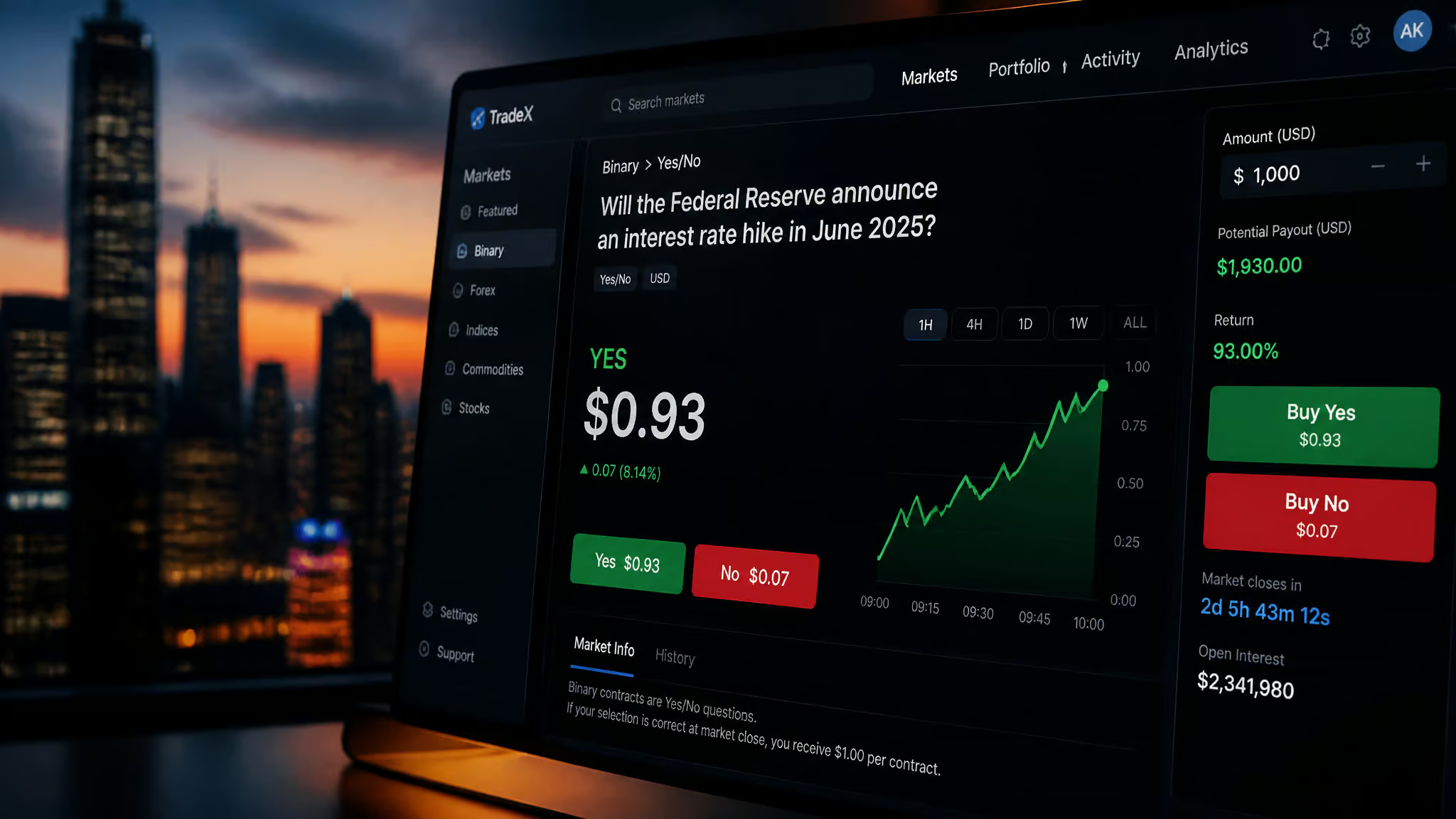
The core is binary contracts. You buy a contract that pays out $1 if the event happens (Yes) and $0 if it doesn’t. If Yes goes for $0.93, the market is saying there’s a 93% chance of that playing out. There’s no continuous stock chart, just a binary fork with a price attached.
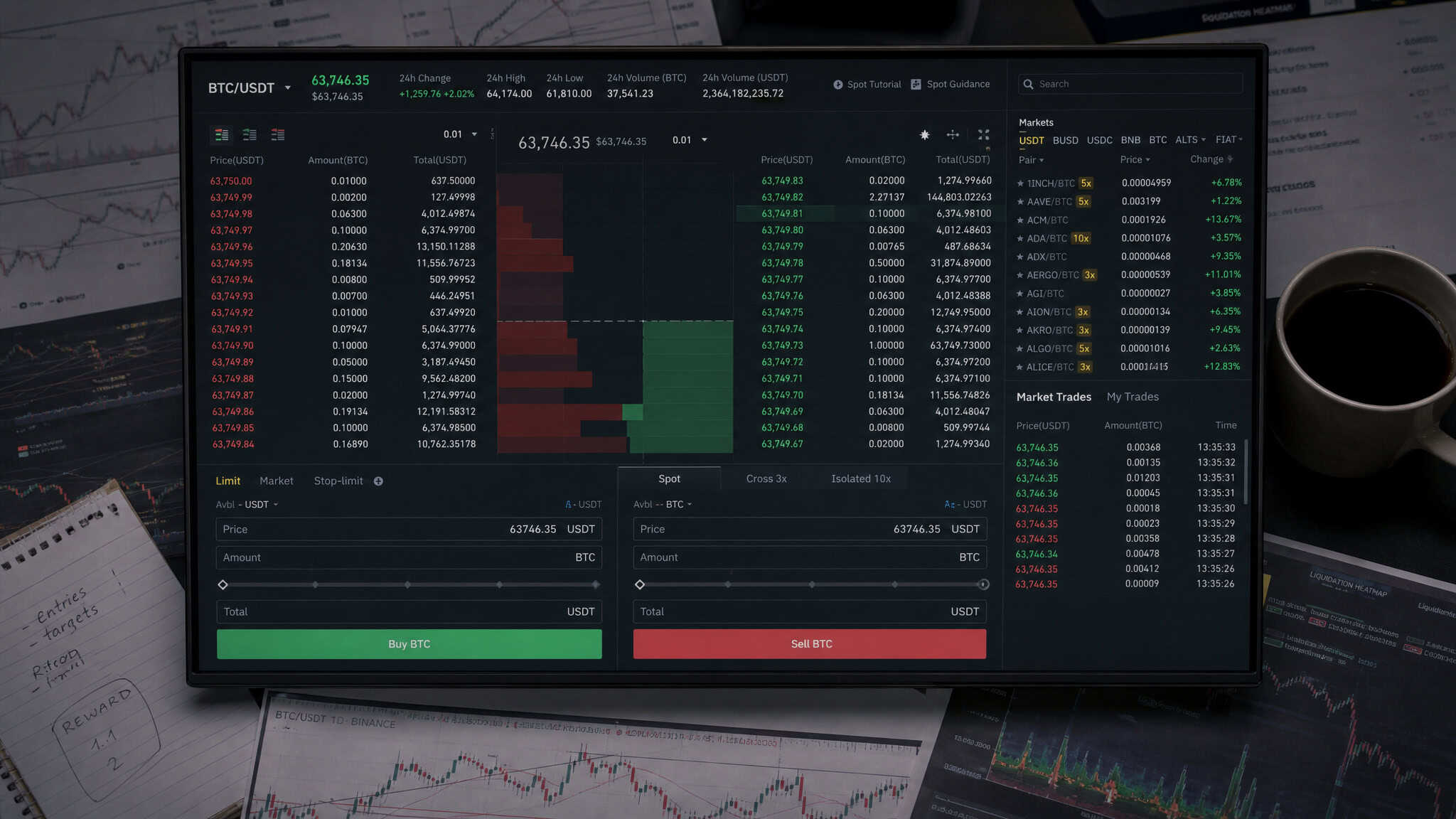
There are two main architectures for these things. The regulated ones like Kalshi use a fully centralized central limit order book (CLOB), matching buyers and sellers like a stock exchange. The crypto-native ones like Polymarket use a hybrid of off-chain matching for orders, but books settle on Polygon. Polymarket used to run an AMM-based pricing model (the LMSR), which guarantees liquidity through a cost function governed by a liquidity parameter, but that changed in late 2022.
Now, the “no house” argument: true, but only the “no house” part. There’s no one on the other side of your trade setting odds. The platform itself doesn’t profit when you lose. But Kalshi’s fee structure is a tax on every transaction: 0.07 × P × (1-P) for each taker contract. The de facto house edge, just with a formula attached instead of a vig.
The empirical data makes the case. A study of over 300,000 Kalshi contracts had an average return of around -20% before considering fees. Market makers lost 9.64% on average, while takers lost 31.46%. The fee schedule, not the underlying manipulators, is the drag that turns a probability exercise into a negative-sum game.
A hundred years of betting on things
Before the “prediction market” label existed, it was just called betting. Political betting on papal successors dates back to at least 1503, and it was an old practice even then. By 1884, Wall Street was actively tracking election odds, with turnover at times exceeding half of campaign spending. Pre-WWII, New York was the hub, with election betting running openly through “betting commissioners” who took a 5% cut. It was often illegal, but it operated in the open.
The 1988 Iowa Electronic Markets (IEM, with its $500 position limits) finally forced the academic world to treat this as a serious forecasting implement, and not just a poolroom chase. The Pentagon’s “terrorism futures” market in 2003 was the necessary inflection point. The DoD researched a Policy Analysis Market to forecast political stability, got panned, and the backlash was immediate.
Prediction markets have a surprising history.
If the modern commercial market didn’t exist, the way the average historical had been the same.
Is the wisdom of the crowd real?
Historically, the wisdom of crowds is actually wise, at least for the crowd. In their election results, prediction markets have beaten 74% of opinion polls from 1988-2004. They predicted the disease outbreak which the traditional CDC systems didn’t catch, accurately forecasted Google’s IPO value and Best Buy’s store opening delays, and were used internally by Eli Lilly, Google, HP, Microsoft and Best Buy for real-world forecasting. If you can pool knowledge, then the price is about as good an estimate as you’re going to get.
The catch is that accuracy holds up, but profitability doesn’t. There’s a favorite-longshot bias in the market. Contracts priced at ten cents or less lose 60%+ on average, while those above fifty cents earned a small profit. The average trader loses 20%.
To make it worse, there’s a 2016 randomized experiment (in the Monty Hall scenario) that found prediction markets to be 12% less accurate than polls, and then Brexit and the 2016 election both happened. The failure mode was the same thing. The trader anchoring on the current odds, as a group, but just creating an echo chamber of day-old news and a margin. The wisdom of the crowds requires diversity, independence and decentralization, but for a primer on the machinery behind these markets, what are prediction markets? When those fail, the market price and the real-world probability map across no longer.
The federal vs. state battle
Who regulates prediction markets is the most complicated thing. The CFTC says they’re “swaps” and “derivatives”, claiming exclusive jurisdiction. At the state level, they see income. Yet the question of are prediction markets legal in the US? It is a legal labyrinth: sportsbooks pay the state gaming taxes, while prediction markets often don’t, effectively carving out a legal loophole that takes the revenue out of the state’s stated law.
North Carolina has a 6% tax for prediction markets. Online sportsbooks pay 23%. New York uses sports betting taxes for education. States are losing millions of dollars from this loophole, and they’re pushing back aggressively.
The whole thing is being litigated. Kalshi’s 2024 court win against the CFTC allowed election markets to relist; the CFTC dropped its appeal. Now there are over 20 federal lawsuits, amicus briefs in showdowns like Crypto.com v. Nevada, state bans in Minnesota, criminal charges in Arizona, and a potential Supreme Court hearing on the horizon. The CFTC has also proposed a “public-interest review” for these contracts, a policy that’s still pending.
Not a sportsbook (but a lot of its volume is sports)
The structural arguments are actually genuinely different. A sportsbook is the counterparty to every bet, they set the odds, and they have a built-in house edge built into the line. Two-sided peer-to-peer exchange, by contrast, is genuinely a different thing. Kalshi says they don’t have a counterparty setting odds, and that they charge a fee rather than profit from the loss.
They don’t ban customers who win. There’s no built-in “house edge” in the odds themselves. That’s a real structural difference.
That doesn’t stop economists from looking at it. Victor Matheson doesn’t see the difference, calling the model “basically the same from a bettor’s perspective.” A structural difference is not the same thing as a different outcome.
Kalshi’s biggest volume isn’t the “wisdom of the crowd” stuff anymore. It’s the sports. 80-90% of Kalshi’s current volume is sports, driven by the fact that you can live in California or Texas, where sports betting is prohibited. Their ads, the monkey with sunglasses saying “Switching from predatory sportsbooks to Kalshi”, make their marketing target clear. They’re not taking on the stock market; they’re taking on the sportsbooks, with a “we’re the smarter sportsbook” pitch. The categorical line between the sportsbook and prediction market is blurring, and that’s exactly what prediction markets in sports betting are starting to redefine.
The human cost is real
Academics distinguish the type of activity, but the experience for the participant is a different story. The addiction researchers describe the mental loop as “anticipation, action, and reaction”, the same cycle that drives gambling disorder. According to the DSM-5 criteria, the behavior can be diagnosed as gambling disorder in the same way. The National Council on Problem Gambling says the underlying risk profile is similar to sports betting.
The Associated Press has confirmed cases of people who stopped gambling and then relapsed when they found a prediction market. Given the “investing” framing, the risk is even higher: it’s a false sense of neutrality that delays people seeking help because they don’t think they’re gambling yet.
The oracle problem
Traditional sportsbooks have a rulebook based on the laws of the game. Traditional prediction markets have to determine what “the outcome” was. It should be a manual, almost trivial, a task for the cases, and rightly, a huge one.
For regulated exchanges, the answer is a compiled document and a payout criterion submitted to the CFTC. Kalshi’s internal rule dictates how the contracts settle.
Decentralized platforms sew on an oracle to bring off-chain data on-chain. Polymarket uses UMA’s optimistic oracle: one challenge to the answer, the dispute goes to a decentralized court via a Schelling-point game (The Data Verification Mechanism) which rewards the tokens that match the majority. The list of things that happened next shows how blindly one can go wrong. The Zelenskyy suit contract had $237 million in volume, resolved to “No” after initially being “Yes” while the pool had moved to a “No” winner. Criticised and unfairness for rewarding majority-voting power, not truth.
Then Khamenei’s death on Kalshi. Khamenei died, and Kalshi resolved the contract at the last traded price, not at the intended point, using an explicit death carveout. That doesn’t be the killer. $54 million in a class action lawsuit later, it’s pretty clear that legal settlement can feel like a cheat or even sooner. Oracle trilemma says you can’t have decentralization, truthfulness, and scalability all at the same time. You have to pick two.
The rest of the world has already called it
The US is the outlier. The rest of the world doesn’t tend to consider it a nuanced “swaps” question. They just call it a betting platform. The answer is for the book, not a case of legal is materials.
Singapore and Thailand blocked Polymarket in late 2024 and early 2025 for being an illegal gambling platform. Australia classified it in August 2025, and New Zealand in February 2026 ruled it prohibited under their gambling laws. Argentina banned it completely in March 2026. Belgium, France, Italy, Poland, and Romania consider it unlicensed betting.
The UK requires a Gambling Commission license and Spain hit Kalshi and Polymarket with a 3-4 month ban for not accepting for a gambling license. Canada turf war, with the CSA spokesman saying they could be considered securities, derivatives, or both, rather than bans and exceptions like Ontario.
If you look at the preview, the US sits like a big exception. The international consensus is much more likely to call this gambling.
Not all prediction markets are alike
Prediction markets span a spectrum from exchange-traded financial products to fun reputation games. Kalshi is a regulated, centralized exchange. Nadex (formerly HedgeStreet, first to get CFTC approval in 2004, now owned by Crypto.com) has that same spectrum. DraftKings and FanDuel are building out their models. Polymarket is built on Polygon, integrating MetaMask in late 2025.
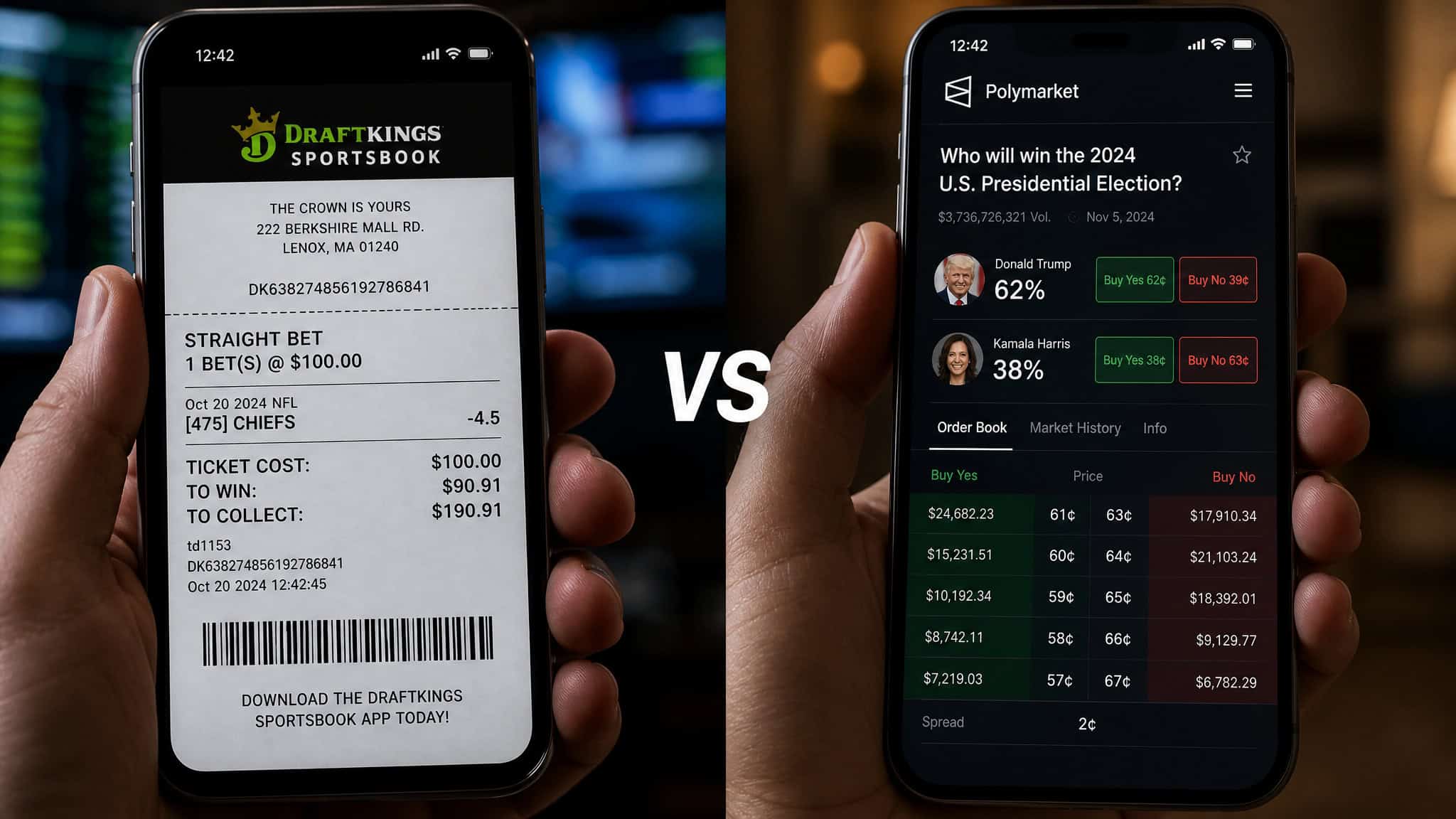
At the other end of the spectrum are the reputation-based markets like Manifold, Metaculus, and Good Judgment Open. No money. You gain or lose reputation points based on your forecasting accuracy. It takes the financial motivation out, removing the gambling edge, and makes it pure forecasting. The active traders who treated it like a betting sportsbook are not exactly aligned with the original vision.
At the same time, combinatorial markets exist, allowing you to bet on the combination of outcomes. The number of combinations scales from 100 binary contracts ? (2^{100}) possibilities, making it computationally hard.
The verdict: a gray area with real stakes
The software and legal frames are different: but the user experience, the behavioral loop, and the activity in markets just make the distinction a hollow one in most use cases.
The return data says it all. The average -20% means that P is an “investing” proposition gone wrong. Sports coverage for binary options doesn’t provide utility, it triggers the reward loop. “When the interface makes no kind of line separating a wager from an investment, the consumer stops making that distinction” was given. The line is blurring on purpose to bring sportsbook users to platforms where the sportsbook is technically the derivative but the sport is the default.
Prediction markets aren’t just the original forecast. The wisdom of the crowd is real. But this market is still leaning that way. In the long run, you lose money on these things. That’s not the wisdom of the crowd, it’s a sign of a scraper or the system’s rent extraction. Proceed with eyes open.
People Also Ask
What is the difference between prediction and gambling?
Structurally, prediction markets are peer-to-peer exchanges where you buy a contract that pays $1 if an event happens, and the platform charges a fee rather than profiting from your loss. Gambling typically involves a house setting odds and taking the other side. But the user experience, the behavioral loop, and the average returns look nearly identical to sports betting, which is why regulators and addiction researchers often treat them the same.
How does a prediction market settle a contract?
Settlement is the messy part. Regulated exchanges like Kalshi use a compiled payout criterion filed with the CFTC, but even that can go wrong—like when Khamenei’s death contract resolved at the last traded price instead of the intended outcome, sparking a $54 million class action. Decentralized platforms like Polymarket use an optimistic oracle with token-weighted voting, which critics say rewards majority voting power rather than truth.
Is the wisdom of the crowd real in prediction markets?
Yes, but it doesn’t mean you’ll profit. Prediction markets have beaten 74% of opinion polls from 1988-2004 and have forecasted disease outbreaks and company outcomes accurately. However, there’s a favorite-longshot bias—contracts priced under 10 cents lose 60%+ on average—and the average trader loses 20%. The crowd’s collective accuracy doesn’t translate into individual returns.