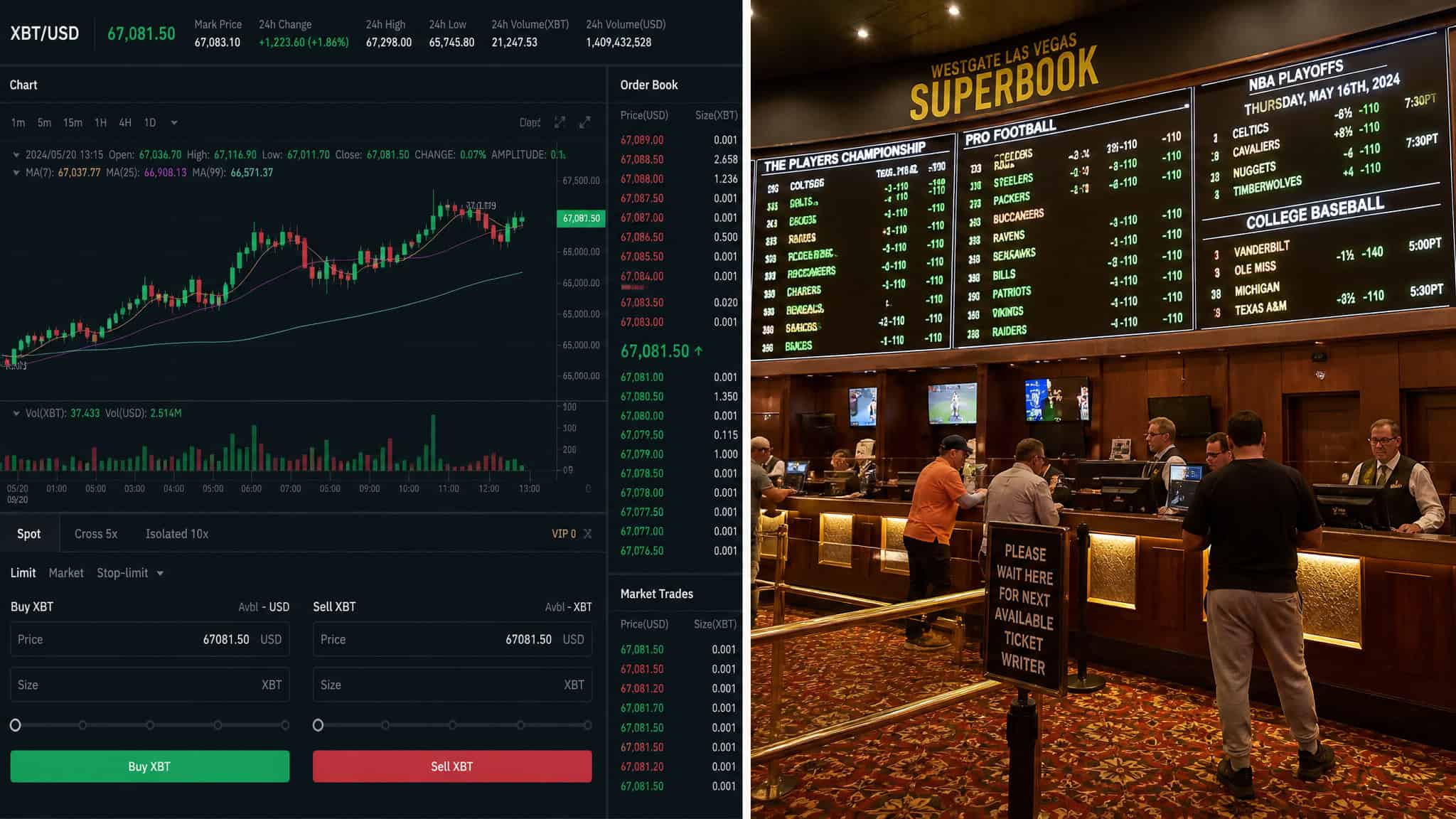
Look, I get it. On the surface, a prediction market looks exactly like a sportsbook with better branding. You put money down on an uncertain outcome, you wait, you either win or you don’t. The person explaining it to you sounds like they’re splitting hairs about whether a hot dog is a sandwich while your wallet is on the line.
But here’s the thing: the people who’ve been arguing about this distinction aren’t just splitting hairs. They’ve been doing it for over 500 years. The first recorded political bet was on the papal successor in 1503, and even then, people called it “an old practice.” By 1884, Wall Street was running full-blown election betting markets where turnover exceeded 50% of campaign spending.
This debate isn’t new, and it’s not academic. Governments have banned these platforms as gambling, regulators have claimed them as derivatives, and users have reported addiction. The line between prediction markets and gambling is structural, legal, and psychological, and every single one of those lines is contested.
So let’s dig into the mechanics, the history, and the messy reality of what separates these two machines, and why that separation might not protect you the way you’d hope.
What a Prediction Market Actually Is
A prediction market is an exchange-traded market where you trade on the outcome of future events. Think of it like a stock exchange, but instead of trading shares in companies, you’re trading contracts on whether something will happen. If a contract costs $0.65, the market is saying there’s a 65% chance that event occurs. That’s the whole trick distilled: the price is the crowd’s probability estimate.
These contracts are binary. They’re priced between $0.01 and $1, and they settle at either $1 (the event happened) or $0 (it didn’t). There’s no gradation, no partial credit. The price tag, though, is the magic. As traders buy and sell, the price moves, and that movement is the market’s collective guess updating in real time.
Now, how do these markets actually operate? There are two dominant structures.
The first is the central limit order book (CLOB), which is basically how a stock exchange works. Buyers and sellers place limit orders, and the price is set by supply and demand. Kalshi runs a fully centralized CLOB as a CFTC-regulated designated contract market. It’s vetted, it’s regulated, and it behaves like a proper exchange.
The second is the automated market maker (AMM), specifically the Logarithmic Market Scoring Rule (LMSR), introduced by economist Robin Hanson. This is a mathematical model that guarantees liquidity even when trading activity is thin. The market maker keeps a probability distribution and offers trades at prices defined by a cost function. The math ensures the market maker’s maximum loss is bounded (specifically, b ln(n) for n outcomes), which means someone is always willing to take the other side of your trade. Polymarket used this model until late 2022 before shifting to a hybrid-decentralized order book, but LMSR remains the intellectual foundation for how liquidity gets bootstrapped in these markets.
Here’s the structural fact that matters most: prediction markets are peer-to-peer exchanges. The platform isn’t the counterparty to your trade. Another trader is. There’s no house edge baked into the odds because there’s no house taking a position against you. The platform makes money through fees, typically 1-2% per trade, and that’s it.
How Sports Betting and Gambling Work in Contrast
Now let’s look at the other side of the table, where the sportsbook is the table.
When you place a bet on FanDuel, you’re not trading with another bettor. You’re wagering against the sportsbook itself, at odds the operator has set. The sportsbook builds a margin, called the vig, into every line to guarantee it profits over time. On a standard -110 line, that vig is about 4.5%. On parlays and futures, the margin routinely exceeds 10%.
The pricing structure is completely different. Prediction markets use cents and percentages that represent implied probability, and those prices shift moment to moment based on supply and demand. Sportsbooks use American odds (or decimal or fractional, depending on your region) that are set by the operator and only adjust when the sportsbook decides the risk profile has changed. For moneyline odds, negative odds imply a probability of Odds/(Odds+100)*100, and positive odds imply 100/(Odds+100)*100.
Consider the side-by-side experience: on Kalshi, you might see an Oklahoma City Thunder contract priced at $0.34, meaning the market thinks there’s a 34% chance they win. On FanDuel, the Chicago White Sox are listed at +200, which looks like a 33.3% implied probability, but the actual probability is lower because the vig is built in. The same divergence shows up in combat sports: at UFC 314, a prediction market might price a fighter at $0.55, implying a 55% chance of victory, while a sportsbook lists the same fighter at -130, implying a 56.5% probability but with the vig pushing the true break-even higher. The gap between the two prices is the house edge in action.
The fee structure tells the real story. On a prediction market, you pay a 1-2% trading fee, and then you’re trading with other people at a price everyone agreed to. On a sportsbook, you’re paying a 4.5%+ vig baked into every single line, and your counterparty is a company with a risk model designed to make sure that, over time, you lose. For instance, a winning $100 bet at -110 returns $90.90, and the sportsbook keeps the rest. In futures, the prices can be stark: the Boston Celtics might be listed at $0.30 to win the NBA Finals, while the Cleveland Cavaliers are at $0.13, and the Guardians might be at -245.
The sportsbook is house-banked and licensed state by state. The bettor wagers against the operator itself.
That’s the core structural difference: peer-to-peer exchange with a small fee versus house-banked counterparty with a built-in margin. It matters for the long-term math. Most prediction market traders still lose money, averaging around -20% before fees, but the casino doesn’t have a guaranteed edge over you in a prediction market. The sportsbook always does.
The Historical Roots: This Debate Is Older Than You Think
The idea that markets can aggregate information isn’t a crypto-era novelty. It’s older than the United States.
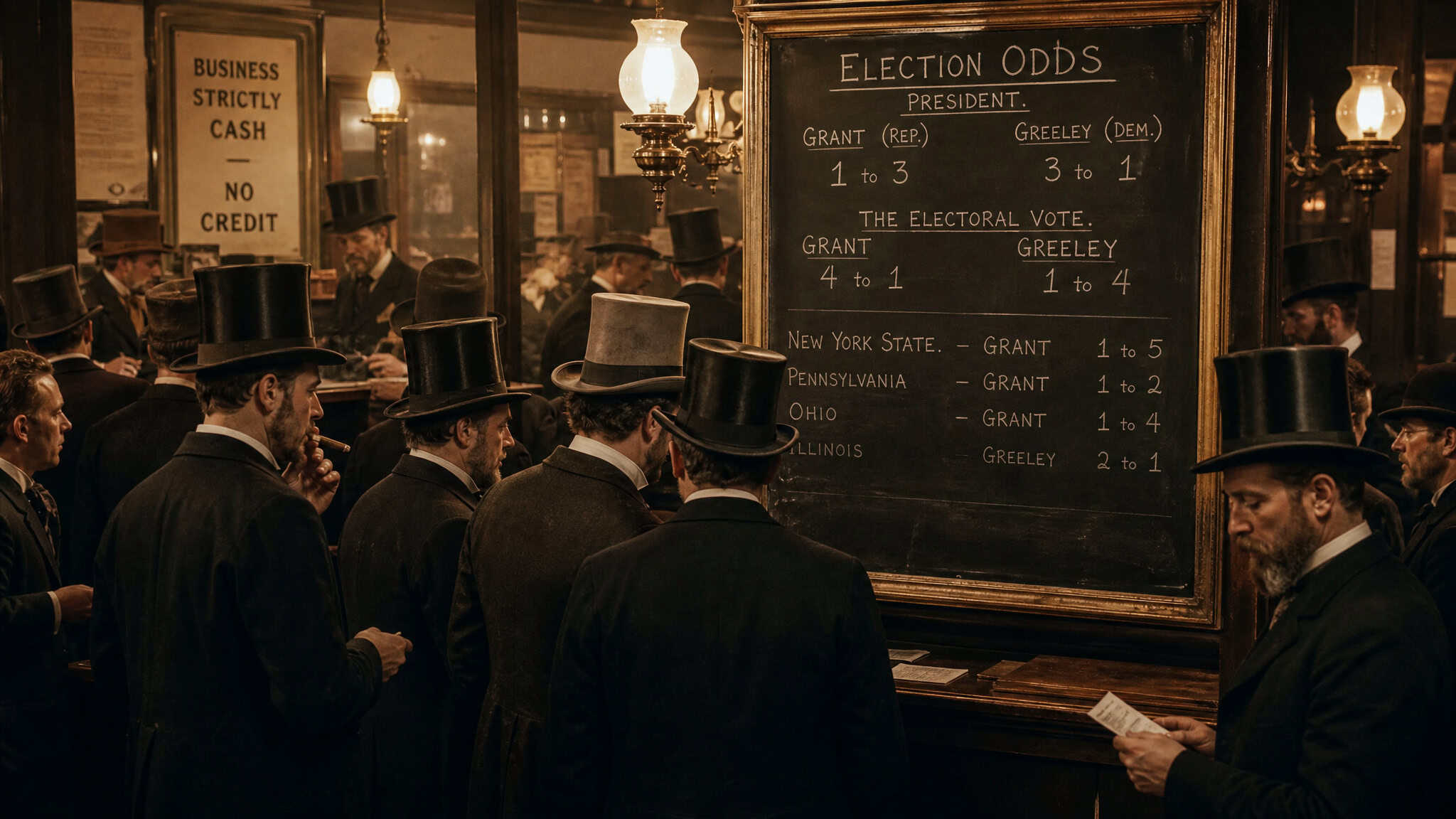
The 1503 papal succession bet is the earliest recorded political wager, and even then, chroniclers noted it was an old practice. In modern times, prediction markets have been used to forecast influenza outbreaks with a lead time of 2-4 weeks in advance. By 1884, Wall Street had formalized election betting with betting commissioners who charged a 5% commission on trades. According to economists Paul Rhode and Koleman Strumpf, the average turnover per US presidential election in those days exceeded 50% of campaign spending. This wasn’t a fringe activity; it was a massive financial market.
The intellectual foundation for why these markets work traces to Friedrich Hayek’s 1945 essay “The Use of Knowledge in Society” and Ludwig von Mises’s “Economic Calculation in the Socialist Commonwealth.” Both argued that markets aggregate dispersed knowledge better than any central planner could. Individual traders don’t need to know everything; they just need to know something, and the market combines those fragmented pieces into a single price.
Modern economists generally agree the argument holds. James Surowiecki’s “The Wisdom of Crowds” (2004) popularized it for a mainstream audience, and Cass Sunstein’s “Infotopia” (2006) made the case for markets as information-aggregation machines. Douglas Hubbard’s “How to Measure Anything” even treats prediction markets as a practical tool for measuring intangibles in business.
The adoption story is just as telling. The Iowa Electronic Markets (IEM) launched during the 1988 US presidential election and got a no-action letter from the CFTC in 1993, allowing it to operate with positions limited to $500 as an academic research market. HedgeStreet became the first to seek CFTC approval after the Commodity Futures Modernization Act of 2000, received it in 2004, and was later acquired by IG Group and rebranded as Nadex before Crypto.com bought it in 2021.
Corporate America got in on the act too. Eli Lilly used internal markets to forecast drug development and published a 2005 Nature paper about it. Google used them for product launch dates and office openings. HP, Microsoft, and Best Buy all ran private markets for operational forecasting.
Best Buy famously used one to predict whether its Shanghai store would open on time. These aren’t gambling platforms; they’re internal forecasting tools at some of the biggest companies in the world, which raises the question: how do prediction markets make money?
The theory has legs, and the practice has pedigree. But that doesn’t mean the crowd is always right, and it definitely doesn’t mean the debate over legality has been settled.
Are Prediction Markets Actually Accurate?
Here’s where the “wisdom of crowds” claim gets interesting: the evidence is real, but it’s conditional.
The strongest data comes from the Berg, Nelson, and Rietz study covering five US presidential elections from 1988 to 2004. Prediction markets beat 74% of the studied polls in accuracy. That’s a genuinely impressive track record. Markets have a structural advantage: people put their money where their mouth is, and prices incorporate new information faster than a pollster can publish an update. As economist Eric Zitzewitz put it, there’s no virtue-signaling in an anonymous market when you’re betting.
But here’s the catch: a 2016 randomized experiment found prediction markets were actually 12% less accurate than prediction polls. Twelve percent. That’s not a rounding error. The accuracy advantage is real, but it’s not automatic, and it depends heavily on context.
Part of the problem is a systematic bias called the favorite-longshot bias. Longshots are systematically overpriced in prediction markets. Contracts priced at ten cents or below lost more than 60% on average, whereas contracts above fifty cents generated some profit. Cheap bets are, in aggregate, terrible bets. The same bias shows up in Kalshi data, so it’s not a one-market quirk.
There’s also a time-horizon problem. Predictions are better for events close in time. Page and Clemen found that for events far in the future, prices tend to gravitate toward 50%, which is the market’s way of saying “we genuinely have no idea.” The further out you get, the more the contract price looks like a “don’t know” signal.
And then there’s the academic debate over what prices actually mean. Justin Wolfers and Eric Zitzewitz argue that market prices equal the mean trader belief under reasonable assumptions about risk preferences. Charles Manski counters that prices only partially identify mean beliefs, meaning the signal is always fuzzy. The Bürgi, Deng, and Whelan microstructure study on Kalshi analyzed over 300,000 contracts and found prices were informative and became more accurate as closing dates approached, with mean absolute pricing error decreasing dramatically on the final day. So the market does learn, but the learning curve is real and the error never fully disappears.
When Prediction Markets Fail: Crowds and Echo Chambers
The uncomfortable truth is that prediction markets can fail spectacularly, and they’ve done so on the biggest stages.
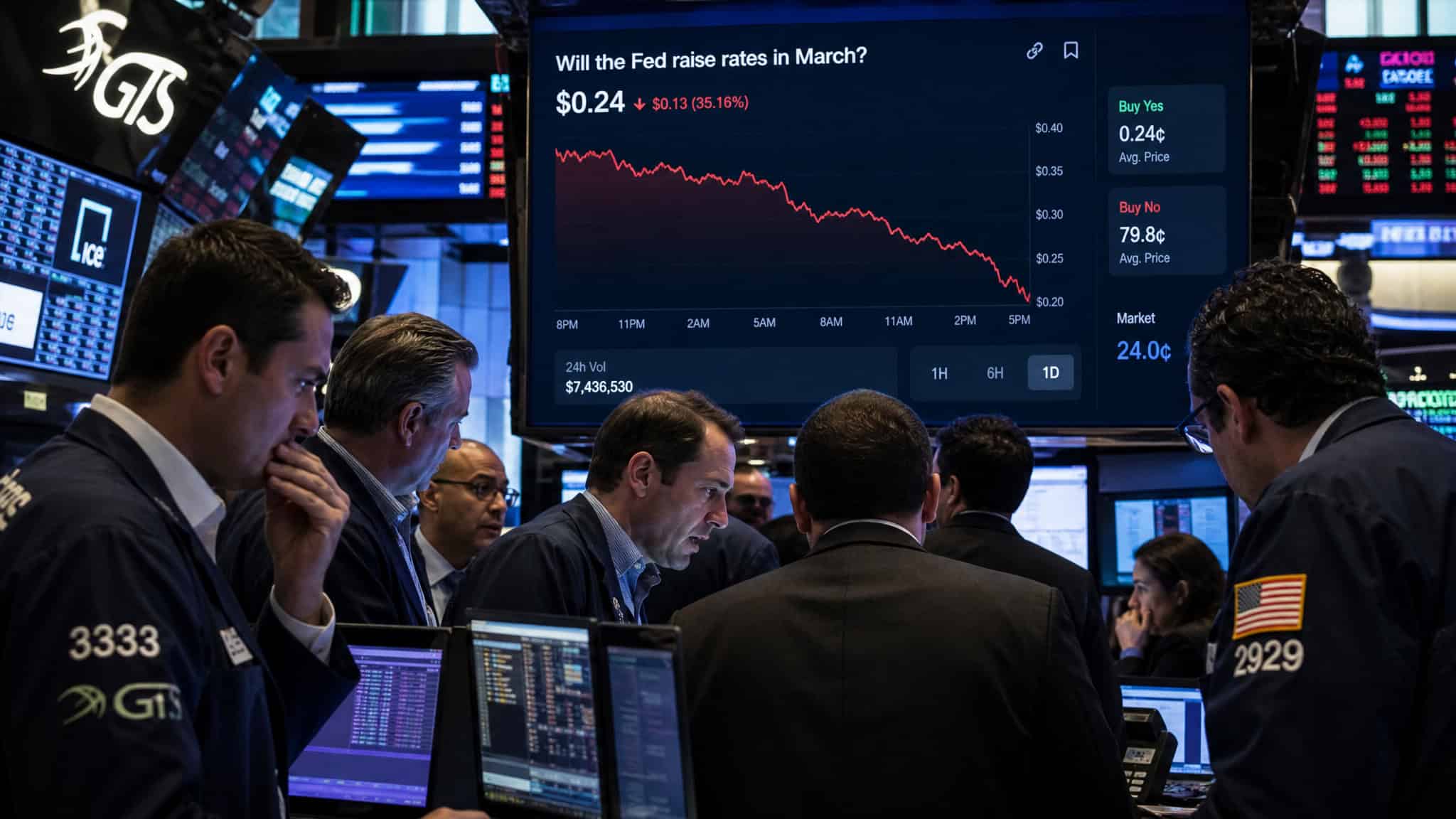
Brexit in 2016 is the canonical example. Prediction markets leaned heavily toward “remain” and stayed there right up until the vote. Traders treated the current odds as a reference point and dismissed incoming information that contradicted the market consensus. The market became a self-reinforcing echo chamber, as Koleman Strumpf described it: the crowd was unwilling to believe the UK would leave, so it kept betting against the possibility.
The 2016 US presidential election was worse. Prediction markets failed to predict Donald Trump’s victory, and the failure mode was the same. Traders anchored on the existing odds and treated the market itself as the authoritative source, discounting polls and other signals that suggested the race was closer than the prices indicated. Michael Traugott’s analysis of the Brexit failure identified the same pattern: traders relied on the market price as ground truth instead of incorporating new information.
Why does this happen? It’s the mirror image of the wisdom of crowds. Surowiecki’s conditions for collective wisdom are diversity of information, independence of decision, and decentralization of organization. When traders anchor on the same price and use it to discount outside information, they stop being an independent crowd and become a feedback loop. The market gets stuck.
Manipulation attempts are another stress test, and these actually reveal a coping mechanism. The 2004 Tradesports bear raid saw an anonymous trader short-sell so many Bush contracts that the price dropped to zero before rebounding rapidly. Hanson, Oprea, and Porter’s 2005 research found that manipulation attempts can actually increase accuracy by creating a profit incentive for other traders to bet against the manipulator. The market self-corrects because someone always sees an opportunity to make money by pushing the price back toward reality.
But self-correction only works when there’s information to correct toward. If the crowd doesn’t have specialized knowledge, the answer can be very wrong. The marginal-trader hypothesis says someone will always be looking for where the crowd is wrong, but that only helps if such a person exists and has the skills to identify the error. Some questions require expertise so niche that the crowd simply doesn’t know, and when the crowd doesn’t know, it guesses.
The Regulatory Landscape: A Messy, Unresolved Battle
So who decides whether prediction markets are gambling? As it turns out, everyone, and no one.
The pivotal event was Kalshi’s court victory over the CFTC in October 2024. The CFTC had deemed Kalshi’s congressional control contracts contrary to the public interest, but Kalshi sued, won, and was allowed to relist election markets. The CFTC dropped its appeal. That single ruling opened the floodgates, and the range of prediction markets expanded dramatically.
But the CFTC’s claim to exclusive jurisdiction under the Commodity Exchange Act is being challenged from all sides. States like New Jersey, Washington, and Minnesota have taken action to block prediction markets as gambling, and the DOJ actually sued to block Minnesota’s ban. The legal argument hinges on preemption: does the Commodity Exchange Act supersede state gambling laws, or did Congress not clearly intend that? The “major questions doctrine” is the other battleground, which asks whether an agency can assert authority over something this significant without explicit congressional direction.
Crypto.com v. Nevada is the test case, and the outcome is genuinely unresolved.
Internationally, the picture is a patchwork. The UK classifies prediction markets as betting and requires Gambling Commission licenses. The EU has no unified structure, but several countries, among them Belgium, France, Italy, Poland, and Romania, have prohibited Polymarket as unlicensed gambling, and the MiCA regulation, effective July 2026, will cover prediction markets that use crypto assets. Spain’s Ministry of Consumer Affairs banned Kalshi and Polymarket for 3-4 months in May 2026, citing lack of a gambling license.
Singapore blocked Polymarket in December 2024, calling it an illegal online gambling platform, and Thailand announced similar plans in January 2025. Australia’s ACMA blocked Polymarket in August 2025, and New Zealand ruled prediction markets prohibited under its Gambling Act and Racing Industry Act in February 2026. In South America, Argentina banned Polymarket in March 2026, while Brazil regulators haven’t decided whether prediction markets fall under the Securities Commission or the Ministry of Finance’s betting secretariat, a matter that may hinge on the quirks of each platform, as detailed in a list of prediction markets.
The CFTC claims exclusive jurisdiction. States are challenging it. In 2010, the Dodd-Frank Act amended the law, adding another layer to the regulatory tangle. Minnesota’s ban and the DOJ lawsuit highlight the ongoing conflict, and Polymarket’s offshore move and fine show how platforms navigate the gray areas.
Some countries say it’s clearly gambling. Others say it’s clearly finance. All of them are right, depending on which lens you use.
The Risks: What Structure Doesn’t Solve
Here’s where the structural differences stop protecting you.
The most glaring risk is insider trading, and it’s not theoretical. Polymarket’s anonymity can facilitate national security leaks, as seen in the Maduro case. A US Special Forces soldier wagered over $400,000 on Nicolás Maduro’s removal using classified information. He was arrested.
The precision of these contracts makes them uniquely vulnerable: when you can trade on “will X specifically happen by Y date,” you’re creating a financial incentive for exactly the kind of information that should never be tradeable. By 2026, regulators were already worried that markets could create financial incentives for starting wildfires, the logical extension of this problem.
The psychological risk is even more uncomfortable. Gambling addiction clinicians say prediction markets generate the same “cycle of anticipation, action, and reaction” as traditional gambling. The DSM-5 criteria for gambling disorder don’t care what platform you’re using. The National Council on Problem Gambling rates the risk of prediction markets as similar to sports betting, and the Associated Press has documented cases of individuals relapsing with prediction trading.
The user experience doesn’t help. Researchers note that commercial prediction market platforms are gamified and optimized for engagement over epistemic rigor. They’re designed to keep you hooked, and they’re succeeding. The psychological profiles of users differ, though: prediction market traders are often driven by information-seeking and a desire to test their forecasting skills, while gamblers are typically motivated by entertainment and the thrill of risk. The platform design amplifies this: real-time price updates and leaderboards cater to the information-seeker’s need for feedback, but they also trigger the same dopamine loops that keep gamblers engaged, blurring the line between intellectual curiosity and compulsive behavior.
Then there are the ethical risks baked into the contract design itself. Kalshi’s “death carveout” from February 2026 is the canonical mess. The exchange listed a contract asking whether Ali Khamenei would no longer be Supreme Leader by March 1, 2026. When Khamenei was killed in US/Israeli strikes on February 28, Kalshi applied the carveout and resolved the market at the last traded price before death instead of paying $1 to “Yes” holders. A proposed class action covering roughly $54 million in positions was filed in March 2026, alleging the carveout wasn’t adequately disclosed and the exchange kept accepting “Yes” trades while reports accumulated.
CEO Tarek Mansour defended the provision by saying Kalshi doesn’t list contracts settling directly on a person’s death, which is technically true and philosophically absurd. The assassination market concern is not hypothetical; it’s the logical endpoint of making specific, dated, tradeable contracts on political violence.
The Platforms: Where You Can Actually Trade
If you want to see the different incentive models in action, the platforms themselves tell the story.
Kalshi is the regulated, CFTC-approved designated contract market. It uses a CLOB, it’s US-only, and it settles according to a rulebook filed with the CFTC that identifies authoritative data sources and payout criteria. Robinhood has partnered with Kalshi to offer prediction markets, which is a significant legitimacy signal.
Polymarket is the crypto-native, decentralized alternative. It operates with a hybrid-decentralized order book, matching trades off-chain and settling them on-chain via Polygon, and it pays out in USDC. It’s blocked in many countries and operates in a gray area everywhere else. It was hacked for $2.9 million in its early days and compensated users, which tells you something about the trust model. Despite these risks, the platform has seen explosive growth: by early 2025, Polymarket had processed over $3 billion in cumulative trading volume, and monthly volumes regularly exceeded $500 million during peak election cycles, signaling a market that is scaling rapidly.
The academic and reputation-based tier is where prediction markets get interesting as research tools. The Iowa Electronic Markets is the pioneer, with positions limited to $500 and a no-action letter from the CFTC. Good Judgment Open is a reputation-based prediction website. Manifold allows users to create markets and bet with fake money. PredictIt is another academic-style market.
The theoretical frontier is combinatorial markets, where you trade on combinations of outcomes. The problem is exponential scaling: 100 contracts create 2^100 possible combinations. The math is elegant, the implementation is intractable, and that’s why combinatorial markets remain theoretical.
Settlement: Who Decides Whether You Win?
Here’s the part people forget when they compare prediction markets to sports betting: someone has to decide what actually happened.
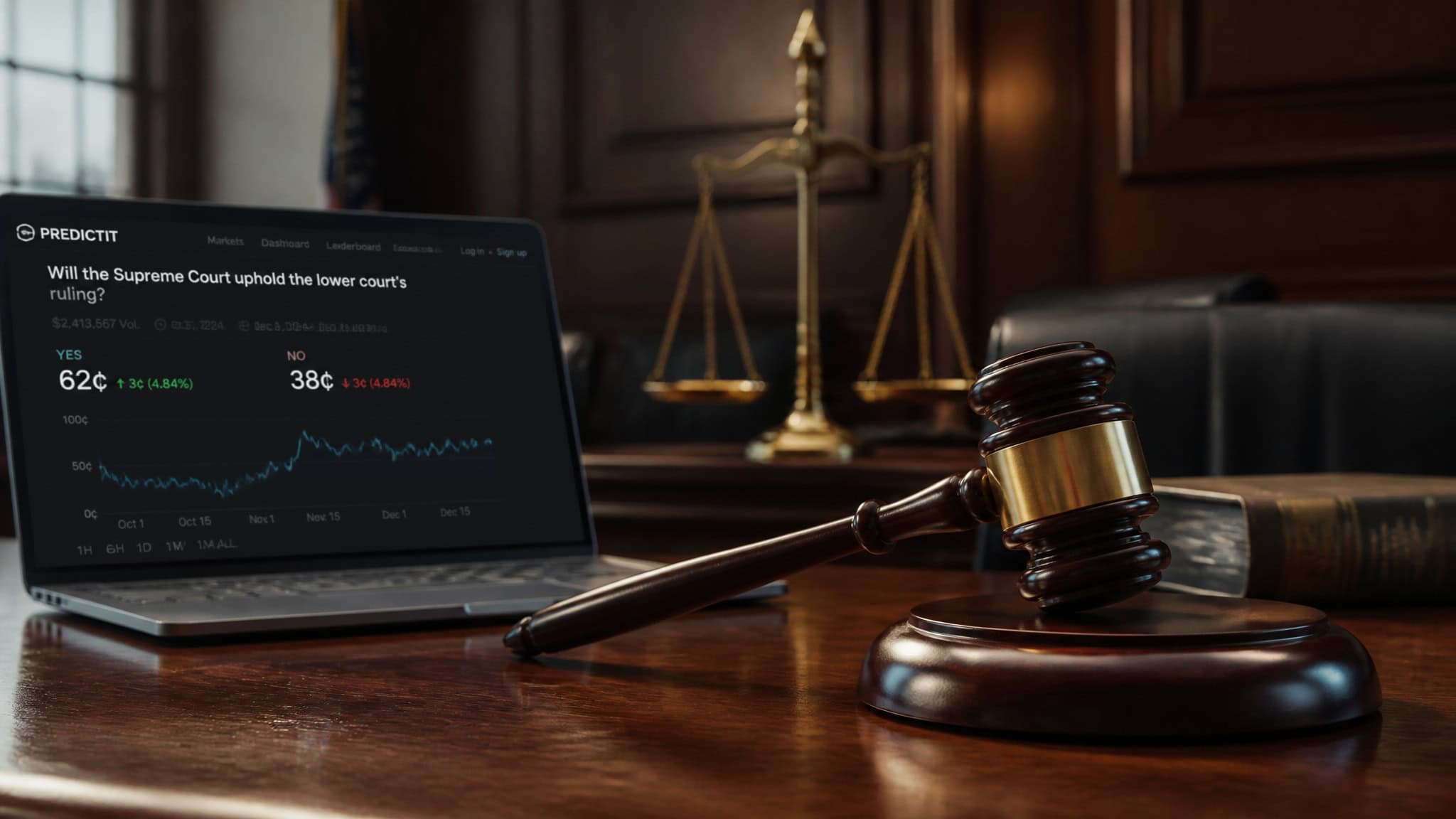
On regulated exchanges like Kalshi, settlement follows a rulebook filed with the CFTC. The markets team relies on official results from source agencies, and the rulebook identifies the authoritative data sources and payout criteria. It’s transparent and regulated, but it’s also bureaucratic and slow. The Khamenei death carveout shows that even the regulated path can produce results that feel like a bait-and-switch.
Decentralized platforms like Polymarket use oracles. Specifically, UMA’s Data Verification Mechanism (DVM), which is an optimistic oracle. A proposed resolution is considered true unless challenged within a dispute window. If there’s a dispute, the DVM kicks in: stakers vote in secret for 24 hours, then reveal for 24 hours.
The dispute resolves when at least 65% of staked UMA votes agree on a single outcome. Stakers who abstain or side with the minority face slashing, with their stake redistributed to majority voters. UMA reports that 99.8% of requests resolve without escalation, but the 0.2% that do escalate are where things get spicy.
The Zelenskyy suit contract from July 2025 is the perfect case study. It was a $237 million market asking whether a photo or video showing Volodymyr Zelenskyy in a suit would surface between March 22 and June 30, 2025. The contract was resolved according to “consensus of credible reporting,” which is a fuzzy standard, and the UMA oracle initially resolved “Yes” before reversing to “No” on July 1.
Critics argued that token-weighted voting has structural weaknesses, especially when the UMA market cap is small relative to contract volume. No manipulation was substantiated, but the design creates a vulnerability: whoever controls the most tokens effectively controls the outcome of disputed resolutions. The “oracle trilemma,” as described by economists Lin William Cong, Liam Fox, Siguang Li, and Luofeng Zhou, captures the trade-off among decentralization, truthfulness, and scalability. You can’t have all three, and the design choices reveal which one each platform prioritizes.
The Bottom Line: Different Mechanics, Similar Psychology
So is a prediction market gambling?
Structurally, no. Prediction markets are peer-to-peer exchanges with no house edge. The price is an implied probability, the platform is a facilitator rather than a counterparty, and the fee structure is dramatically lower than a sportsbook’s vig. They’re designed for information aggregation, not risk-for-reward entertainment.
But the line blurs immediately. The psychology is identical, and clinicians will tell you the addiction risk is the same. The law, depending on where you live, classifies them as gambling, as futures, or as something so ambiguous that regulators are still fighting over who has jurisdiction. And the user experience on commercial platforms is gamified for engagement, which means the structural differences might not protect you from the behavioral outcomes.
The honest answer is that it depends on who’s asking. A regulator sees a legal question with no clear answer. A clinician sees an addiction risk that’s indistinguishable from gambling. A trader sees a forecasting tool with real information aggregation power.
Here are the key similarities and differences at a glance:
- Similarity: Both involve risking money on uncertain outcomes, with similar psychological hooks and addiction potential.
- Similarity: Both can be subject to manipulation and insider trading, though prediction markets have unique vulnerabilities due to contract specificity.
- Difference: Prediction markets are peer-to-peer with no house edge; sportsbooks are house-banked with a built-in vig.
- Difference: Prediction market prices reflect implied probability; sportsbook odds are set by the operator and adjusted for risk.
- Difference: Regulation varies: prediction markets are often classified as derivatives or gambling depending on jurisdiction, while sports betting is licensed state-by-state.
If your goal is forecasting or hedging, a prediction market serves that purpose. You can use it to test your hypotheses about the world, and the data will tell you whether your judgment is calibrated. If your goal is entertainment or making money, the structural differences won’t protect you. Most traders lose money, with average returns around -20% before fees. The favorite-longshot bias will eat your lunch if you chase cheap contracts, and the liquidity risk can turn a large trade into a market-moving event that gives you a misleading price.
The structural machinery is genuinely different from a sportsbook. The human experience is not. Check the legal status in your jurisdiction, understand the fee structure, and know going in that the odds are against you, regardless of which machine you’re using. Use it to test forecasts, not as an income source. The market might be smarter than you, but it’s not smarter than the biases that make you human.
Frequently Asked Questions
How are prediction markets not considered gambling?
Structurally, prediction markets are peer-to-peer exchanges where you trade contracts with other users, not against a house. The platform charges a small fee (1-2%) and has no built-in edge, unlike a sportsbook’s vig. Legally, it’s a contested area: some regulators classify them as derivatives or futures, while others treat them as gambling, so the answer depends on jurisdiction.
What’s the difference between a prediction market and a sportsbook?
The core difference is the counterparty. In a prediction market, you trade with other users on a peer-to-peer exchange, and the platform only charges a fee. At a sportsbook, you bet against the house, which builds a vig (typically 4.5% or more) into every line to guarantee its profit. This means the sportsbook always has an edge, while prediction markets don’t.
Why do prediction markets fail sometimes, like with Brexit?
Prediction markets can fail when traders anchor on the current price and ignore outside information, creating an echo chamber. In the 2016 Brexit vote, traders kept betting on ‘remain’ because they treated the market consensus as ground truth, dismissing polls that suggested a closer race. This happens when the crowd loses independence and becomes a feedback loop.
How accurate are prediction markets compared to polls?
Prediction markets have beaten 74% of polls in US presidential elections from 1988 to 2004, but a 2016 experiment found they were 12% less accurate than prediction polls. Accuracy depends on context: markets are better for near-term events, but prices for far-future events tend to drift toward 50%, signaling uncertainty. The market learns as the event approaches, but errors never fully disappear.