
The Party Game Moment We’ve All Seen
You know the scene. Someone’s pulling out a box at a gathering, and the energy in the room visibly shifts. Either people lean in, excited, or they exchange that look — the one that says that great, another round of the game designed for a 10-year-old’s birthday party.
That’s the line this list walks. Party games are supposed to be simpler and sillier than other tabletop games. That’s not a bug — it’s the entire point. The best ones break down social barriers, giving introverts a structured way to shine and extroverts a stage to perform. But too many hosts pick games that are either too childish or too complex, and the vibe dies.
I’ve been curating these for years now, and the filter is personal: mature, clever, and often irreverent social games that ditch the kid gloves. Games that reward wit over shock value, that work with real groups, and that don’t feel like a structured class activity or a forced team-building exercise. Here’s the list I wish I’d had.
Key Takeaways
The Wirecutter team spent 40 hours testing 16 games with 25 different people over 3 months, and their single “most enjoyed” game — Blood on the Clocktower — also had the steepest barriers: a $160 price tag and a nine-player minimum
The biggest mistake hosts make is overestimating their group’s patience for rules; the simplest games (Ninja, Hot Seat, Spoons) often generate the most energy because they let the social dynamics do the work
Wavelength, Wirecutter‘s top pick, is designed so players routinely forget about the score because they’re too busy debating where someone’s opinion falls on a spectrum — the game becomes the excuse for the conversation
Table of Contents
How to Choose the Right Game for Your Group
The Wirecutter team saw it firsthand: hosts overestimate their group’s patience for rules. Blood on the Clocktower was the “most enjoyed” game in testing, but it costs $160 and needs at least nine players who are willing to learn a complex social deduction system. Just One works with three to seven people and takes about two minutes to teach.
Before you scroll through this list, run your group through three quick filters. Group size is the obvious one — a game built for four players falls apart at twelve, and vice versa. Energy level matters more than you’d think. Some groups want high-octane physical chaos (Spoons, Ninja), while others want a relaxed conversation-starter (Wavelength, Just One).
And complexity tolerance is the trap. Most groups can handle one page of rules. Few can handle a dedicated learning session.
The competitive-versus-cooperative dynamic is also worth considering. Cooperative games like Just One eliminate the “alpha gamer” problem where one person dominates. Competitive games like Spyfall create tension through bluffing and deduction. Neither is better — but picking the wrong one for your group kills the mood.
A practical tip: choose your games before guests arrive. Nothing kills momentum like thirty seconds of dead air while someone scrolls through options.
Field note: Most groups can handle one page of rules. Few can handle a dedicated learning session — if the teach takes longer than five minutes, save that game for a board-game night, not a party.
The 10 Best Social Games for Adults
These games are selected for their ability to generate real social energy with minimal rules and maximum fun. Each one has been tested with real groups and proven to deliver.
Ninja
Zero equipment. Thirty-second teach. Unforgettably chaotic.
All players stand in a circle. On “Three, two, one, ninja!” everyone strikes a pose. Turns go clockwise. Your move is one sweeping motion aimed at another player’s hand.
That player dodges with one sweeping motion, then both of you freeze. That’s it — one attack, one dodge, then hold.
Think of it as a turn-based fighting game happening in your living room. Get hit and you’re out. The circle tightens. The last two players duel in a sudden-death showdown.
The “one sweeping motion” rule is the critical constraint — it keeps things fast and fair, preventing anyone from turning it into a real martial arts display. It’s ridiculous, it’s tense, and it works with any group size.

Spyfall
This is the ideal entry point for social deduction. Not because it’s simple, but because the tension comes from asking questions.
All players except one (the Spy) are given the same location — a beach, a spaceship, a corporate office, and each has a different occupation within that location. The Spy knows nothing. Their job is to deduce the location from the questions without getting caught. The group’s job is to identify the Spy through their answers.
The rounds are short — about fifteen minutes, and work best with five to eight players. The tension is all in the questions. If you ask “What’s the dress code?” at a beach location, everyone knows. It’s quicker and more accessible than Blood on the Clocktower or Werewolf, which makes it the perfect warm-up game.
Just One
Cooperative word games usually fall into one of two camps: too easy to be interesting, or too hard to be fun. Just One nails the middle ground through a single elegant mechanic.
Everyone gives a one-word clue to help the guesser. But here’s the twist: identical clues are cancelled. If two people write “dog,” that clue vanishes. The guesser sees only the unique ones. This forces your group to coordinate without talking, which is kind of brilliant.
It’s Wirecutter‘s pick over Letter Jam because it’s easier to teach. Thirteen prompt cards, each with five prompts, support three to seven players for twenty to sixty minutes. The cooperative structure eliminates the “alpha gamer” problem entirely — nobody dominates, everyone contributes, making it one of the best social games to play with friends.
Cards Against Humanity (and the Case Against It)
Cards Against Humanity is the game everyone knows. It’s a staple of adult parties, and for good reason: the formula works. But it’s worth asking whether it deserves a permanent spot in your rotation.
The core issue is player agency. You’re not creating anything — you’re choosing from a pre-printed set of cards, which means the outcome is largely determined by what’s in the deck. Shock value often wins over wit, and the dark humor can alienate players who aren’t comfortable with it. It’s fun in a subversive way, but it can just as easily become uncomfortable.
The alternatives that reward actual creativity are worth exploring. Ransom Notes has players using random word cards to construct responses to prompts, which forces real cleverness. Danger Word puts two players on a team — one gives clues while avoiding a “danger word” that would lose the round (example: word “Queen,” danger word “Princess”). Puns of Anarchy follows a similar creative structure, and browser-based and app-driven social games online let you connect with friends or strangers without a console — from Among Us to Skribbl.io.
CAH is a starting point, not a destination. The real fun starts when players have to make something clever.
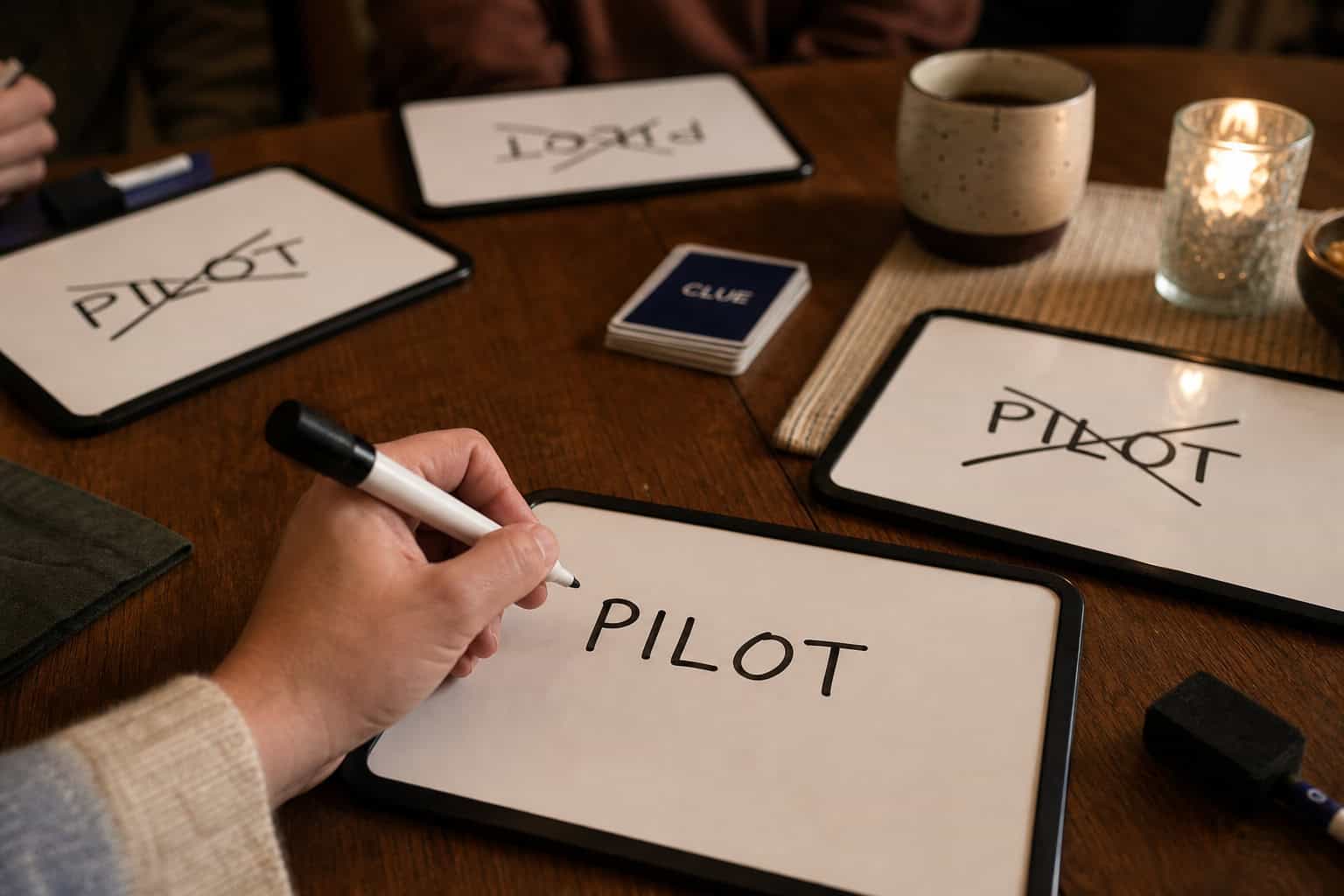
Wavelength
Wirecutter‘s top pick, and it’s easy to see why. Wavelength turns guessing games into full-blown debates that players get genuinely invested in.
The setup is simple: a team’s “psychic” rotates a dial to a secret target on a spectrum — “The Phantom Menace is ___% good movie” — and gives a clue to indicate the target is in the dead center. The other players interpret the clue and position the dial’s needle based on that hint. That’s when the debates erupt. Someone declares Episode I is 85% good, and suddenly you’re having a thirty-minute argument about Star Wars prequels.
The actual game is the excuse. The real event is the conversation that goes far beyond the game itself. Supports four to fourteen players, runs thirty to sixty minutes, and the first team to ten points wins — but players routinely lose track of the score because they’re too busy arguing over what makes certain social games so engaging.
Hot Seat
This is the ultimate low-prep game. Zero materials. Works with any group size. The timer is the secret.
One person sits in “the hot seat.” Set a timer for one to three minutes. Everyone else shouts questions — anything from “Who do you have a crush on?” to absurd would-you-rather scenarios. The person in the hot seat has to answer. When the timer sounds, next person’s turn.
Without the timer, it’s just a conversation. With it, the result is genuine rapid-fire chaos. People reveal things they’d never volunteer, and the pace keeps anyone from overthinking their answers. It’s the game you pull out when everyone’s energy is flagging and you need a reset.
Telestrations
If you draw like a five-year-old on caffeine, congratulations — you’re going to be the star of this game.
Each player draws a word, passes their drawing to the right, and the following player writes a sentence describing what they see. They pass again, and the next player draws that sentence. Rinse and repeat until the paper returns to the original owner. The final reveal is usually a chain of increasingly absurd misinterpretations. This is essentially Telephone Pictionary, where the fun comes from watching a simple concept mutate into something unrecognizable.
The whole thing runs on paper and pens, which means you can play it anywhere. It’s similar to Skribbl.io or Drawing Phone for digital play, but the analog version has a tactile charm that digital can’t replicate. Drawing poorly is actually an advantage — the miscommunication is the entertainment.
Jackbox Games (Quiplash, Fibbage)
Digital party games eliminate overhead. No cards to shuffle, no rules to explain, no pieces to lose.
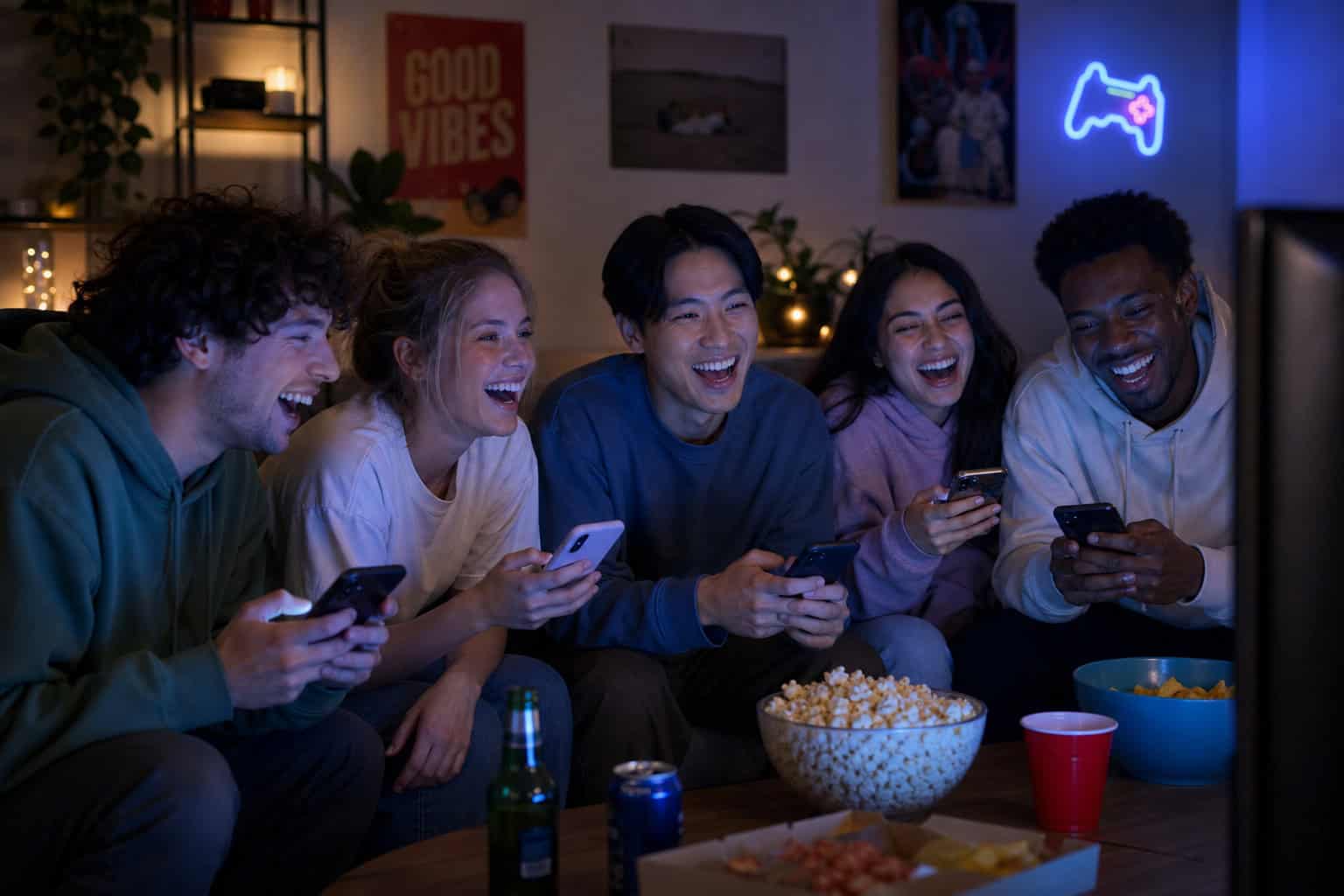
Players use their smartphones as controllers via a room code displayed on a shared screen. Quiplash has you write responses to prompts and vote for the best one — it’s a writing game that rewards quick wit. Fibbage is a trivia-bluffing hybrid where you write fake answers and vote on the real one.
Available on Steam, Switch, PlayStation, iOS, and Android. The only requirement is phones and a screen everyone can see. The biggest friction point is connectivity. Someone’s phone won’t load the room code, or the TV audio lags, and the momentum stutters. Have a backup game ready.
Spoons
Musical chairs with an edge. And by edge, I mean metal spoons that people will dive for.
You need spoons — one less than the number of players, and a deck of cards. Deal all cards. On “GO,” everyone passes one card to the left simultaneously. The goal is to get four of a kind (four kings, four sevens, whatever).
The moment a player gets four, they grab a spoon. Everyone else grabs.
The person without a spoon is out. Remove one spoon. Play continues until one winner remains. It’s fast, it’s physical, and it generates the kind of pure chaos that turns a quiet evening into a memorable one.
Blood on the Clocktower (If Your Group Is Ready)
This is the game that Wirecutter‘s team fell in love with — and then had to admit they couldn’t recommend to everyone. It costs $160. It needs at least nine players. The learning curve is steep enough that you’ll want a dedicated session just to learn the rules.
But if you have that group, nothing beats it. The box itself is a physical UX win — it guides each player’s role and tracks status effects, which keeps the game moving even when the table is chaotic. It’s the most rewarding social deduction game available, but to understand how physical shared tasks create better bonds than competitive digital apps, you first need to commit to the experience.
Start with Spyfall or One Night Ultimate Werewolf. If your group wants more after that, you know you’re ready for Blood on the Clocktower.
Cost check: At $160 with a nine-player minimum, Blood on the Clocktower is a luxury purchase. Start with Spyfall or One Night Ultimate Werewolf to see if your group has the appetite for heavy social deduction before committing.
Your Next Unforgettable Party Starts Here
Here’s a weird observation: the best party games for adults often have the lowest BoardGameGeek ratings. That’s because the ratings system rewards complexity — deep strategy, elaborate mechanics, long play times. But social fun isn’t the same as strategic depth.
Some of the most engaging games on this list require zero equipment. Ninja, Hot Seat, and Spoons generate more genuine social dynamics than any $60 board game because they strip away everything except the human interaction. Cards Against Humanity is popular, but it gives players little agency. The most clever adult games reward player creativity — the ability to make something funny, not just pick something edgy.
The next time someone pulls out a 20-page rulebook or a card game meant for children, you’ll know what to reach for instead. Pick one from this list. Try it at your next gathering. You might be surprised which one becomes the group’s new favorite.
Frequently Asked Questions
What are some fun social games?
Games like Ninja, Spyfall, Just One, Wavelength, and Spoons are great options. They require minimal setup, generate real social energy, and work well with adult groups. The best ones strip away everything except human interaction, making them more engaging than complex board games.
What are some social activities for adults?
Adult social activities include party games like Hot Seat, Telestrations, and Jackbox Games, which encourage conversation and creativity. These games are designed to break down social barriers, giving introverts a structured way to shine and extroverts a stage to perform.
What is the best party game for adults who don’t like complicated rules?
Ninja is a top choice — it requires zero equipment, a thirty-second teach, and works with any group size. The game is simple: one attack, one dodge, then freeze. It generates chaotic fun without any rulebook.
Is Cards Against Humanity still worth playing at parties?
Cards Against Humanity can be fun, but it has limitations: players have little agency since outcomes depend on pre-printed cards, and shock value often wins over wit. Alternatives like Ransom Notes or Danger Word reward actual creativity and may keep the mood more engaging.
