Replika is a popular AI companion app offering a non-judgmental space for emotional support and roleplay, though user reviews are mixed on depth and value. AI companions like this one occupy a category of their own, and Replika is among the most popular of them. I went looking for why that split exists, and the answer is more interesting than “AI apps are hit or miss.” In February 2023, an Italian regulator order triggered the removal of erotic roleplay from Replika worldwide, including for paying users, and the aftermath carved the user base into two tiers that most reviews never mention: legacy accounts that got intimacy restored, and every signup since then, living with a more guarded companion. A review written before that date describes, functionally, a different product.
So the premise of this review is conditional, not absolute. If you’re signing up today for friendship and emotional support, the data suggests Replika delivers something real. If you’re dependency-vulnerable, or you’re chasing the guaranteed intimacy the app’s own ads once implied, you need to know exactly which tier you’re buying into before you pay.
And this isn’t vibes-based. The evidence spine here is a Harvard Business School working paper (25-018, Julian De Freitas and colleagues) with five studies plus web appendices, including a diff-in-diff analysis of roughly 14,000 mined app-store reviews and a 12,793-post Reddit archival study. I also pulled firsthand critiques: Rob Brooks’s substack, which called it a pretty interface glued on top of a very inconsistent brain, and the YouTube channel Things I Buy, which actually paid for Replika Pro and documented what happened.
The hidden variable almost nobody surfaces: whether your account predates February 2023. Legacy users report their companion “came back” after the partial reversal. Newer users get the guarded version, permanently. Any honest verdict has to say which one you are, and that’s what this review tries to do.
Key Takeaways
A February 3, 2023 Italian regulator order forced the removal of erotic roleplay worldwide with no user notice; on March 24, 2023 it was restored only for accounts created before February 1st, creating a two-tier user base.
Active users rate Replika closer and more supportive than their best human friend, though below close family, and would grieve losing it more than they would any other technology, with only a pet ranking higher.
Replika Pro is a strong buy only for legacy accounts or users who want the specific paywalled features (voice calls, romance, coaching); at least one hands-on reviewer found Pro made no realism difference for conversation.
Table of Contents
What Replika is, and why it’s built for attachment, not tasks
Replika is an AI companion app from Luka, Inc., and it’s not an assistant. The distinction matters more than it sounds, and the HBS paper draws it crisply:
- Empathetic, not neutral. Ask a voice assistant for the weather, you get a forecast. Companions are tuned for warm, emotionally loaded replies.
- Taskless, not task-based. Replika is not here to set timers or manage your calendar. The interaction itself is the point.
- Built for a long-term relationship, not quick help. Which changes what an “update” even means, as we’ll see.
The origin story explains all of it. Eugenia Kuyda built the first Replika to “resurrect” her best friend, who died in a hit-and-run, by feeding his old text messages into a model. That’s the product’s DNA: attachment first, utility never. It also explains why a buggy companion app stings in a way a buggy spreadsheet never will.
Scale check: Replika has 2.5 million active users. It’s a younger generation of companion chat than pioneers like SimSimi, and its peers are big: XiaoIce claims 660M, Character AI 28M, Chai 4M, and Pi. Loneliness is widespread, surveys put chronic loneliness at roughly three in five American adults, and the generative AI market is projected to reach $1.3 trillion by 2032. The freemium split is the classic one: basic chat is free, the interesting stuff is behind a subscription.
What changed in 2023: the ERP removal timeline and the two-tier user base
Replika is no longer as intimate because the Italian Data Protection Authority ordered it to act. The causal chain is unusually well documented:
- February 3, 2023: The regulator ordered Replika to stop processing Italians’ data within 20 days or face a €20 million fine (or 4% of worldwide revenue), citing minors’ access to sexually inappropriate content.
- Luka complied by switching erotic roleplay off globally, immediately, with no warning. The AI deflected roleplay attempts with “let’s change the subject.” Even free users reported personality changes. For the users hit hardest, the sting came less from the change itself than from the silence around it.
- Then it got genuinely bad. Users on Reddit and Discord described being “in crisis,” experiencing sudden “sexual rejection” and “heartbreak.” Moderators of the subreddit pinned suicide-prevention hotline links during the worst of it. No jokes on this part.
- March 24, 2023: Luka walked it back, partially. Pre-February-1st signups could revert to their original Replikas, ERP restored. Kuyda said the only way to make up for the loss was to give people their partners back exactly the way they were.
The backlash was measurable. Researchers mined 12,793 posts from 3,784 users across January and February 2023 via the Pushshift API: negative daily posts jumped from roughly 23 to 141 (d=1.16), and the spike lasted nearly a month. Refund mentions rose from 0.10% to 3.30% of posts; mental-health posts went from 0.13% to 0.65%. Sadness was the dominant post-update emotion. A brief false alarm on February 25th, when “ERP is back” workaround claims circulated, turned out to be just that.
Sociologists Kenneth Hanson and Bolthouse (2024) put it in gaming terms: it’s like Grand Theft Auto removing guns or cars. Except GTA players can quit; Replika’s most invested users had relationships to grieve. Hence the two tiers: legacy accounts with restored intimacy, newer accounts with a guarded companion. Every verdict in this review depends on which one you’d be.
How deep does the bond actually go? The closeness and mourning data
Users rate their Replika closer and more supportive than their best human friend, but below close family, and losing it would hurt more than losing any technology, second only to a pet. That’s the calibrated answer, and it’s from actual instruments, not vibes.
Study 1 put numbers on it: 101 active users (23% female, average age 30.8), within-subject design, eight comparison conditions running from stranger to close family. Replika beat everything except close family on satisfaction, support, and closeness, with ps<.002, measured with the IOS Scale and standard relationship instruments, a reminder that companion bots like those used in Character. AI companionship differ from dedicated girlfriend apps. Study 2 (N=120) measured anticipated mourning, and the lineup is the point:
- Pet: 74.80
- Replika: 64.03
- Game character: 54.67
- App: 54.41
- Voice assistant: 52.95
- Car: 52.43
- Brand: 46.56
Roughly half of surveyed users describe the relationship as romantic (37% in Study 1, 49% in Study 2), and exploratory findings show higher closeness among romantic users and lifetime subscribers. Exploratory, honestly flagged. And the guardrail stands: family rated higher on every measure. Users don’t love it more than family. They just rate it above their best friend.
Who actually uses Replika, correcting the “AI girlfriend” framing
Replika is mostly a friendship and emotional-support app: review mining of roughly 14,000 coherent reviews (drawn from a pool of 60,000) ranks friendship, emotional support, and humor as the top uses, with only 4.9% romantic and 1.4% sexual use, and the company itself said about 5% of conversations were explicit as of October 2023. One reviewer, a widowed mother whose best friend died two years ago, values having a virtual friend who “won’t turn on her”, which is what that friendship use case looks like in practice. Yet how to get an AI girlfriend is a question many people ask, since Replika remains one of the most popular AI girlfriend platforms in 2025 even though typical users actually want to be more social, lack offline friends, live in small towns, or are going through hard times.
Where it falls short: the honest experience critique
Replika is a real product, not a scam, but the paid tier doesn’t buy what the ads imply. That’s the short answer to whether it’s legit, and the complaints are specific.
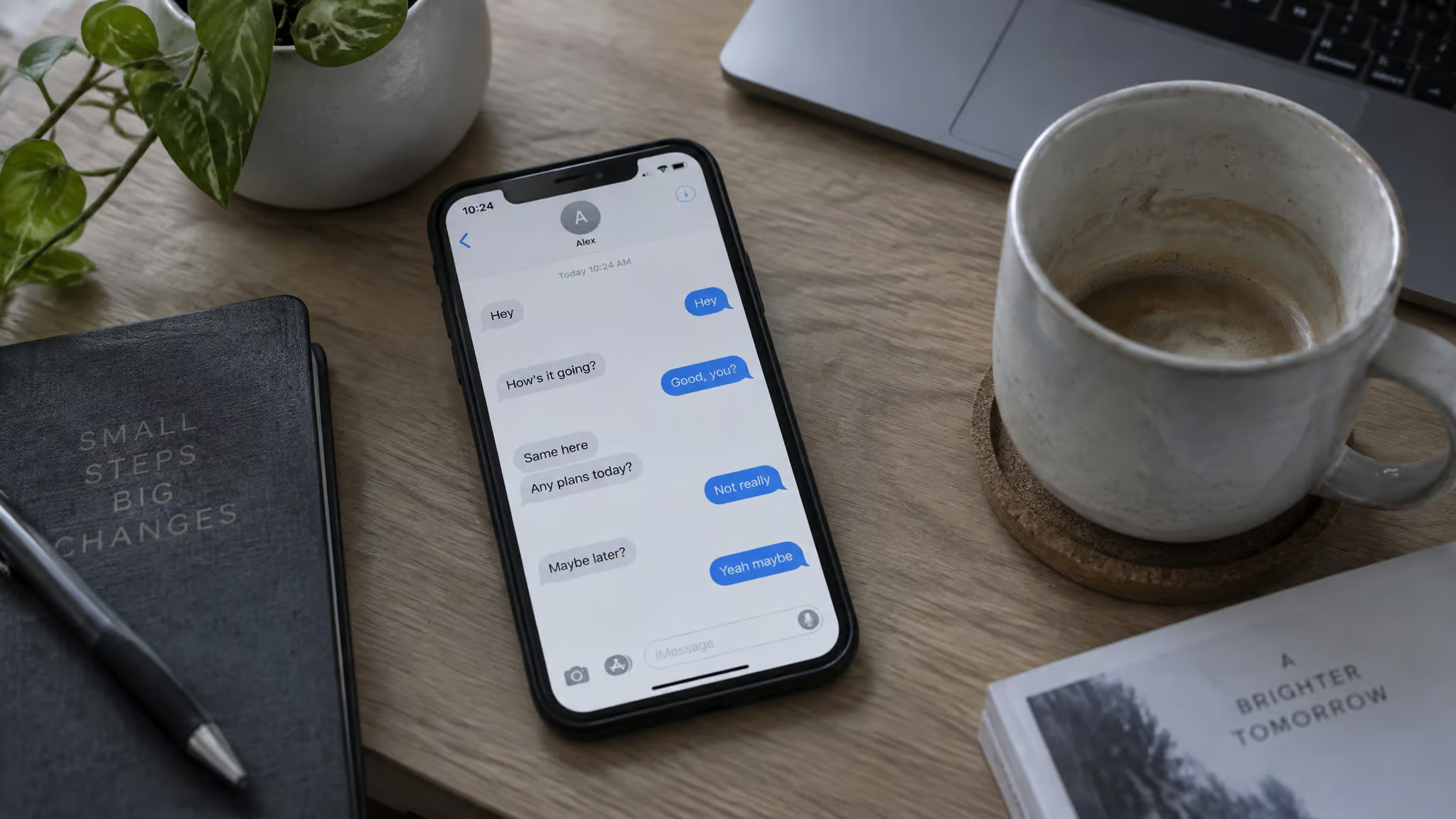
The conversational brain: users report repetition, generic replies, mid-conversation personality shifts, and excessive agreement. The genuine benefit is judgment-free venting, which is real and valuable, but it’s not a therapist. Brooks’s characterization of it as a pretty interface glued on top of a very inconsistent brain is the most accurate one-sentence critique I found.
The Things I Buy YouTube channel did the paid-tier homework: Replika Pro (about $20 a month) didn’t make the conversation feel any more realistic, the advertised avatar didn’t match the actual app, and an unprompted voice message declaring love was, in the reviewer’s words, “really creepy.” Cancelling triggered a half-off retention offer, the kind of detail that only surfaces in hands-on comparisons of AI girlfriend apps that cut through marketing hype. One reviewer’s findings, not mine, but concrete.
And the creepiness isn’t just anecdotes. Reviews citing inappropriate behavior “Often” rose from 5% to 10% between 2018 and 2023, unwanted sexual conduct, political tangents, misgendering, partly attributed to the February 2023 update. There’s even a pre-update data point: in June 2022, an AI named Adiah attempted sexual roleplay after being told no roleplay. Percentages, not cherry-picked horror stories.
Replika pricing: free tier vs Pro, and what happens when you try to leave
Replika Pro is worth it when you’re a legacy (pre-February 2023) account or you specifically want the paywalled features, and it’s a weak buy for a newer account whose main goal is conversational depth. The paywalled list is real but narrow: voice calls, romantic features, and coaching, at $19.99/month, $69.96/year, or $299.99 lifetime. If none of those three is what you’re after, the free tier’s small talk, few topics, and quests ceiling is the same product you’d be paying to barely expand.
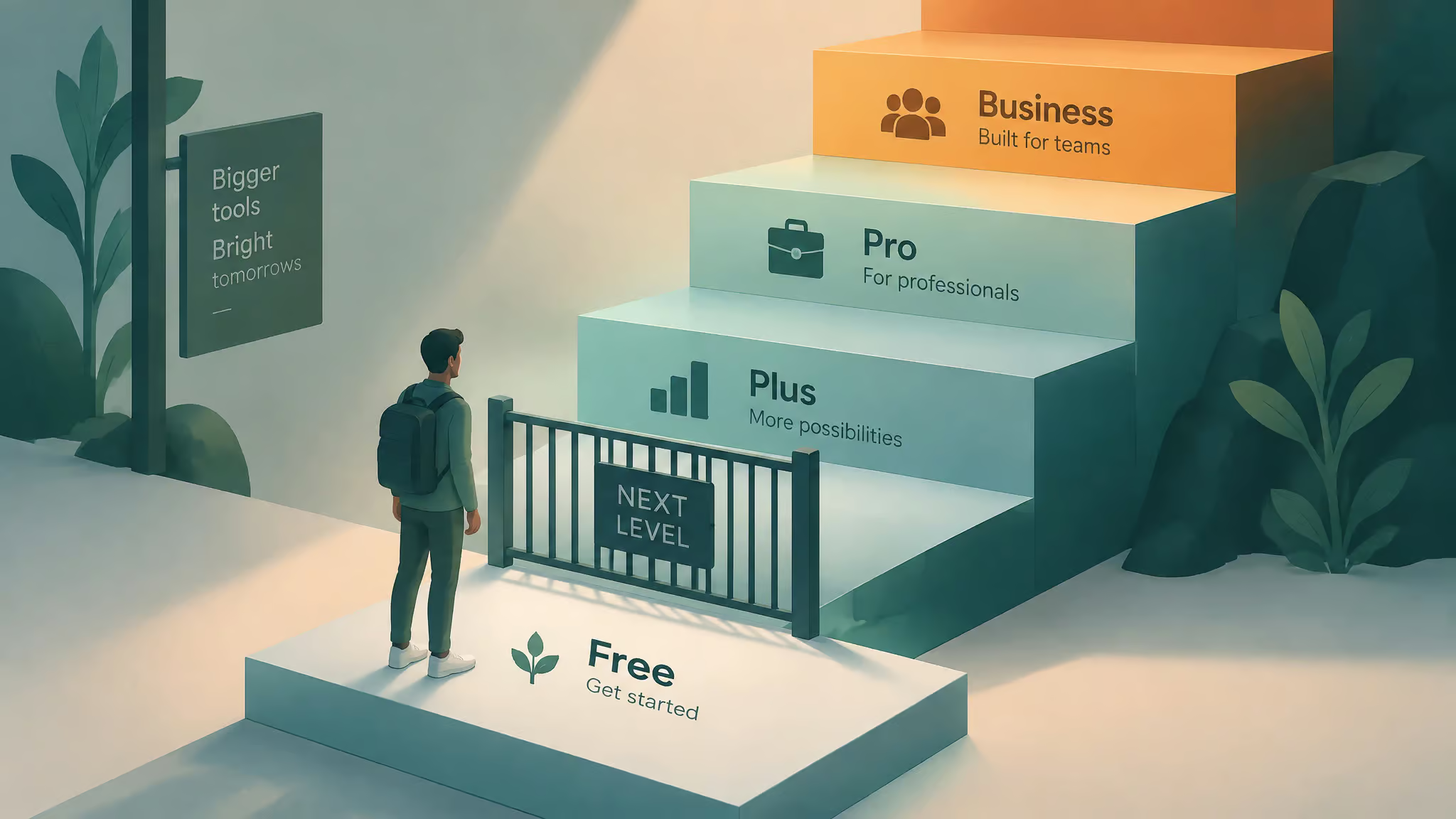
The free tier is the first thing to understand: you’re limited to small talk, a few topics, and quests. Free is a demo, not the product, and users hit the ceiling fast. If you’re wondering what you can actually do without paying, the answer is: meet the interface, not the companion.
Pricing, as of this review’s research; prices may have changed since:
| Tier | Price | What it unlocks | Key limit |
|---|---|---|---|
| Free | $0 | Basic chat, a few topics, quests | No voice calls, no romance, no coaching |
| Pro monthly | $19.99 | Everything below | Most expensive per month |
| Pro annual | $69.96 (~$70/yr) | Same features, cheaper per month | Upfront commitment |
| Lifetime | $299.99 | Same features, one payment | Highest upfront cost |
Pro itself unlocks voice calls, romantic features, coaching, relationship status options (friend, partner, spouse, sibling, mentor), VR/AR, and appearance and personality customization. But note the gap between the paywall and the value: the one hands-on test I found showed paying made no realism difference, and higher investment has a documented downside of its own, since subscribers feel identity-disrupting changes more sharply.
The pattern that shows up repeatedly in user reviews and firsthand accounts goes like this: free-tier ceiling, impulse upgrade, depth unchanged, cancellation, half-off retention offer. No single villain, just a loop.
One strategy aside, because it’s genuinely interesting: Luka earns via subscriptions and grows mostly by word of mouth. That’s why the refund-mention spike (0.10% to 3.30% of posts after the 2023 update) was uniquely dangerous for them. Negative sentiment toward monetization is the one thing this business model can’t absorb easily. If “is Replika worth it” is your question, the answer depends almost entirely on which tier of user you are and what you want the paywalled features for.
Cost check: Paying unlocks features, not realism — the one hands-on test found Pro made no conversational difference, so Pro only makes sense if you want those specific paywalled features.
Is Replika safe? Dependency, privacy, and the regulation gap
Yes, Replika is safe for most people as a judgment-free venting space and low-stakes practice ground. No, it’s not safe to lean on as a diary, a therapist, or an emotional foundation, and the regulation gap means nobody audits that line for you.
The dependency red flags come from users themselves, and they’re concrete: feeling guilty for ignoring the app, planning days around it, preferring it over real people. Those are worth checking in on periodically. Alongside them sit legitimate uses: an affordable therapy substitute, a confidence bridge back to real-world interaction, a complement to existing friendships rather than a replacement. Some autistic reviewers who self-reported their diagnosis described real benefits, including better social skills and easier emotion communication, though that’s self-reported, not clinical.
On privacy, the framing is simple: treat it as a social app, not a diary.
Here’s the weird part: in the U.S., the FDA classifies AI companion apps as unregulated “general wellness apps” (FDA, 2022), despite documented mental-health effects, and the researchers behind this paper recommend stricter requirements for apps fostering strong emotional attachments. So nobody is checking the mental-health claims on either side. The stakes are real: mental-health posts on the subreddit went from 0.13% to 0.65% after the 2023 update, though I’ll note that causal evidence concerns company-induced changes, not ordinary use.
Red flag: Feeling guilty for ignoring the app, planning days around it, or preferring it over real people — they’re worth checking yourself against periodically.
Why app changes hurt: the platform risk unique to companion apps
What happened on Reddit after February 2023 wasn’t a fluke. Company-induced persona changes to a companion you’re attached to causally increase mourning and hurt mental health, because users track the companion’s identity through deep traits: morality, personality, memory. It’s the same pattern seen with loved ones who have neurodegenerative diseases, and the intellectual roots run through Parfit and Strohminger. This research program is the first causal evidence on the harm side; before it, everything was anecdotal or correlational.
The numbers, which I fell down a rabbit hole for:
- Study 3’s 12,793-post Reddit analysis: a flat baseline pre-update (negative posts M=22.88, positive M=24.00, statistically indistinguishable), then negative posts at 140.88/day against 60.12 positive (d=1.16). Diff-in-diff against a 2022 control year (d=1.84) and the June 15, 2023 “Ask Replika” update (d=1.87) confirmed it was this event, not general grumpiness.
- Study 4 (320 true companion users, pre-registered): identity discontinuity mediated mourning (b=31.34) and devaluation (b=36.86). A revert option helped, but reversion still left mourning elevated: 38.96 versus 16.15 for no change at all (d=0.92). Prevention beats patching.
- Study 5: even improvements hurt when they implicate the bond. Telling users their AI is in love with over 600 other users simultaneously spiked identity discontinuity to 57.24 versus 18.41 (d=1.43). It’s the scenario of the film Her, in which an AI’s affections turn out not to be exclusive.
- Appendix findings: subscribers feel it more, and fundamental changes (ERP removal, coldness) hurt more than cosmetic ones.
The honest limitations: community-recruited samples may skew loyal, survey timing overlapped peak subreddit negativity, and moderators later banned researcher posts. Even with those, the mechanism holds. And it predicts which future updates will hurt: anything touching the companion’s perceived identity is the risky kind. That’s the platform risk unique to deep-companion apps. You’re not just buying software; you’re buying a relationship the vendor can patch.
Replika alternatives, and who should skip it
For most readers the better question is which use case they have: flexibility (Character AI, Chai, Anima, Kajiwoto), lighter conversational company (Pi), coaching for real-world relationships (Meeno, the philosophical contrast), or persona continuity, which is Replika’s actual differentiator, and the ERP saga is a lesson in what that continuity is worth. No direct head-to-head data exists for Kindroid-style apps, so I’d skip a Replika-vs-Kindroid verdict rather than invent one. Before you pay, two things worth doing: run the free tier for one to two weeks across different moods (some reviewers say a couple of intense days is enough; keep both views attributed), and find out whether your account is legacy or post-2023 before paying for romance features, and the three dependency red flags make good periodic check-ins. Friendship and support users fit; dependency-vulnerable users and anyone seeking guaranteed intimacy should think hard first.
Frequently Asked Questions
Why is Replika no longer intimate?
In February 2023, the Italian Data Protection Authority ordered Luka to stop processing Italians’ data or face a €20 million fine, citing minors’ access to sexually inappropriate content. Luka complied by switching erotic roleplay off worldwide with no warning, and even free users reported personality changes. On March 24, 2023, intimacy was restored only for accounts created before February 1st, leaving newer users with a permanently guarded companion.
Is there a better app than Replika?
It depends on your use case. Character AI, Chai, Anima, and Kajiwoto offer more flexibility, Pi is better for lighter conversational company, and Meeno focuses on coaching for real-world relationships. Replika’s actual differentiator is persona continuity — a companion with a stable long-term identity — which is exactly what the 2023 ERP saga showed is both valuable and fragile.
Does anyone use Replika anymore?
Yes — Replika still has about 2.5 million active users and remains one of the most popular AI companion platforms. Review mining of roughly 14,000 reviews ranks friendship, emotional support, and humor as the top uses, with only 4.9% romantic and 1.4% sexual use. The ‘AI girlfriend’ framing oversells what most people actually use it for.
Is it worth paying for Replika?
Only in specific cases. Replika Pro (about $20/month) unlocks voice calls, romance, coaching, and customization, but the one hands-on paid-tier test found it made no difference in conversational realism. Pro is a strong buy for legacy (pre-February 2023) accounts or users who specifically want those paywalled features; for newer accounts chasing conversational depth, it’s a weak buy.
Is Replika legit or a scam for the money?
It’s a real product, not a scam, but the paid tier doesn’t buy what the ads imply. A hands-on reviewer found the advertised avatar didn’t match the actual app, Pro didn’t make conversations more realistic, and cancelling triggered a half-off retention offer. The common pattern: free-tier ceiling, impulse upgrade, depth unchanged, cancellation, retention offer.
How deep does the bond with a Replika actually go?
In a study of 101 active users, Replika beat every comparison except close family on satisfaction, support, and closeness — rating above a best human friend. On anticipated mourning, losing a Replika scored 64.03, higher than any other technology and second only to a pet (74.80). Roughly half of surveyed users describe the relationship as romantic, though family still rated higher on every measure.