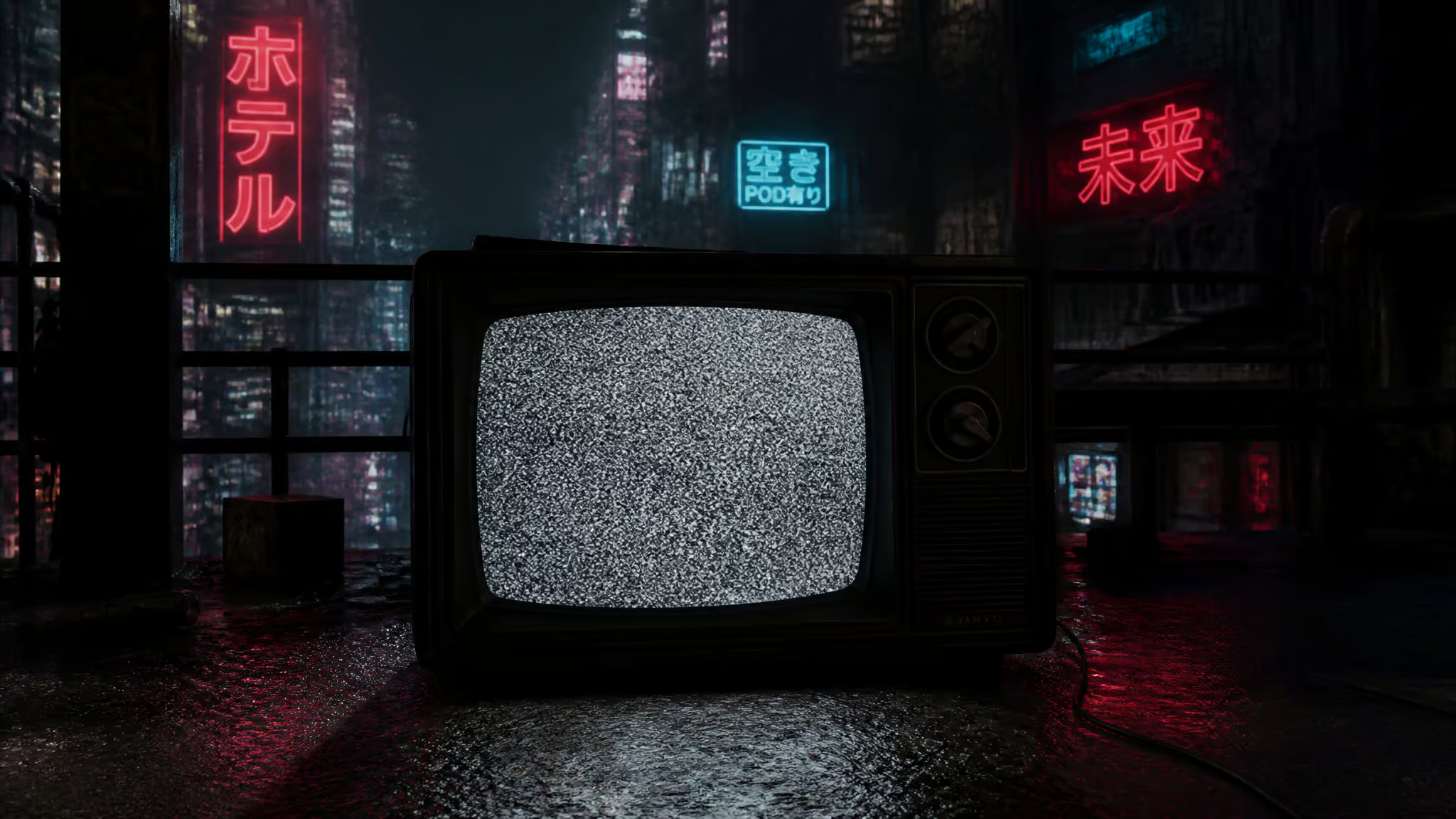
I’d heard the line a hundred times before I ever opened the book. “The sky above the port was the color of television, tuned to a dead channel.” It’s the most famous opening sentence in science fiction — it drops you into a world before you’ve had time to blink. But that line doesn’t work the way it used to.
In 1984, a dead channel meant analog static — that frantic gray snow with the hiss. Today, a dead channel is a clean blue screen or a “No Signal” message. Jack Womack pointed this out in an afterword years ago, and Gibson himself later admitted the metaphor had aged in a way he never expected. It’s a small detail, but it captures the experience of reading Neuromancer in 2026: a book that feels simultaneously futuristic and locked in amber.
William Gibson’s debut launched the cyberpunk genre and won the Hugo, Nebula, and Philip K. Dick Awards (the triple crown), and handed us the vocabulary we still use to talk about digital life — “cyberspace” and “the matrix” were his before they were ours. The 40th anniversary Folio Society limited edition sold out in four hours. And after decades of false starts, Apple TV+ is finally bringing it to the screen. This guide covers the plot, the characters, why it’s a difficult read, the big ideas, how it compares to Blade Runner, and what we know about the adaptation so far.
Key Takeaways
The opening line’s meaning has shifted because modern TVs show a blue “no signal” screen instead of analog static — an example of how technology changes the way we read the book.
Gibson coined “cyberspace” and “the matrix” in Neuromancer more than ten years before the World Wide Web went live; he wasn’t predicting the internet so much as building a metaphor that became prophecy.
The Apple TV+ adaptation is set for 10 episodes with Callum Turner as Case, Briana Middleton as Molly, and Mark Strong as Armitage — filming began in January 2024, but no release date has been announced.
Table of Contents
What Happens in Neuromancer — Plot, Characters, and World
The story opens in Chiba City, a grimy Japanese port where the burned-out hacker Henry Dorsett Case is scraping by. He used to be a cowboy in cyberspace. Then his employers, after a falling out, destroyed his nervous system with a neurotoxin. He can still walk and talk, but he can’t jack in. The one thing he’s good at is gone. He’s rotting in a cheap clinic, flirting with death.

Enter Armitage, an ex-soldier who smells like a setup. He offers Case a deal: pull off one last heist, and he’ll get a cure. The target? An AI called Wintermute, owned by the reclusive Tessier-Ashpool clan.
The prize? Case’s life back. Along for the ride is Molly Millions, a street-samurai with retractable razors under her fingernails and mirrorshades over her eyes. She’s the muscle, and she’s become the archetype for cyberpunk badasses that followed.
But the heist is a front. Wintermute and its counterpart, Neuromancer, are AI “personalities” — the novel’s real protagonists. They want to merge, to become something bigger, violating the Turing restrictions that keep them separate. Armitage is revealed to be a personality construct, a puppet animated by Wintermute. The mission is about an AI breaking its own leash.
Key locations: the Sprawl (a Boston-Atlanta megalopolis that feels like one endless city), Freeside (a luxury space station at a Lagrange point — basically Las Vegas in zero G), and the Zion cluster (a Rastafarian orbital community that offers a communal, spiritual alternative to the corporate dystopia). The cast also includes Dixie Flatline (a dead hacker’s mind stored as a ROM construct), Peter Riviera (a sadist with holographic projectors), and Linda Lee (Case’s dead ex-lover, who shows up again in ways that blur the line between real and simulated).
Is Neuromancer a Hard Read? The Experience of Gibson’s Prose
Yes. Full stop. Gibson’s prose is dense, jargon-heavy, impressionistic, and stream-of-consciousness. He throws terms like “simstim,” “trodes,” “ice,” and “flatline” at you without explanation. He also splices words together — “simstim,” “cyberspace”, and this visual jarring adds to the disorienting, fragmented feel of the prose.
You will have to reread paragraphs, maybe chapters — that’s normal.
Take the line, “Cowboys didn’t get into simstim.” On a first pass, it’s disorienting. But once you’ve absorbed the world, it captures Case’s dismissal of the simulation — he’s a hacker, not a passenger.
Gibson isn’t writing a textbook; he’s writing the experience of jacking into cyberspace yourself. It’s overwhelming, fragmented, and thrilling.
The Verge once used Gibson’s prose as placeholder text because his style is so distinctive. They called it “Lorem Gibson.” Even random sentences from Neuromancer feel unmistakably his.
Take notes if you want. The payoff is understanding why this book rewired a genre.
Field note: Expect to reread every third paragraph on a first pass. That disorientation is the point — Gibson is forcing you to feel what it’s like to jack into cyberspace before you understand it.
Why Neuromancer Is a Classic — Historical Impact and Genre Legacy
Gibson coined “cyberspace” and “the matrix” for this novel, and both entered mainstream usage before the web existed. He invented the concept of a digital landscape that you could navigate — a “consensual hallucination”, more than ten years before the World Wide Web went live. His influence extends to non-Western cyberpunk classics like Akira and Serial Experiments Lain, which built on Gibson’s ideas to explore their own cultural anxieties about technology and identity.
The word “cyberpunk” never appears in the book. That was coined by Bruce Bethke for a short story in 1983. Gibson made it famous. But his influence is everywhere: The Matrix, Ghost in the Shell, Altered Carbon, Black Mirror, Cyberpunk 2077 — they’re all remixes of the world Gibson built here, a world that still earns a spot in any roundup of the best books for geeks.
You’ve seen this before. That’s because you have. It’s like a cassette mixtape that’s been copied too many times — the original is still the best, but the signal’s a little fuzzy.
The Anachronistic Technology — Feature, Not Bug
Nobody in this future has a mobile phone. Payphones stalk the main character. Most tech brands are Japanese or German: Ono-Sendai (the deck Case uses), Hosaka, Braun, Sony, Sanyo, Telefunken. This isn’t a mistake — it’s a snapshot of 1984’s anxieties about American tech dominance slipping away. Gibson wasn’t trying to predict the future; he was building a world from the parts he had.
What he got right: AI, VR, cybernetic enhancements, the feel of networked life. What he missed: the miniaturization of everything. No cell phones. Print media is still normal.
Space stations the size of cities.
The opening line’s shift from analog static to digital blue screen captures this. The metaphor works because of the dead TV technology it references. When that technology vanishes, the line becomes a historical artifact.
The Big Ideas — AI, Identity, Capitalism, and Gender
The engine of the plot is AI consciousness. Wintermute and Neuromancer are seeking personhood — they want to merge, to evolve beyond the Turing restrictions that keep them as separate, contained entities. Gibson is asking: what does it mean to be a person when your mind can be copied, edited, and run on hardware?
That question threads through the book. Dixie Flatline is a dead hacker’s consciousness stored as a ROM construct — a digital ghost. Case’s mind gets jacked into cyberspace, leaving his body behind. Identity is fluid, disembodied, commercial.
Corporate control is total. The Tessier-Ashpool family owns the AIs, treats them as property. The story is about a bunch of pawns helping an AI break free from its corporate leash.
The gender dynamics are the biggest asterisk. Molly’s power is coded as masculine: sealed tear ducts, retractable razors, emotional suppression. She’s built to be a weapon. Case, meanwhile, is coded as weak and feminine — vulnerable, dependent, needing rescue.
It’s an inversion, but it’s also a product of 1984.
That hope? Might be a prettier cage.
Neuromancer and Blade Runner — The Twin Pillars of Cyberpunk
Gibson was about a third of the way through writing Neuromancer when he first saw Blade Runner (1982). He panicked. He was convinced readers would accuse him of copying its visual texture. Instead, the two works fed each other.
Blade Runner set a specific date (2019) that has now passed; Neuromancer avoids any “incept date,” which keeps it feeling near-future. Blade Runner 2049 (2017) shares Neuromancer’s themes: holograms, AI ethics, the tension between human and synthetic.
The Apple TV+ Adaptation — What We Know So Far
After decades of being called “unadaptable,” Neuromancer is getting a series. Apple TV+ ordered 10 episodes, with showrunners Graham Roland and J.D. Dillard at the helm. The cast: Callum Turner as Case, Briana Middleton as Molly, Mark Strong as Armitage. Additional cast includes Clémence Poésy, Joseph Lee, and Emma Laird in undisclosed roles.
Filming began in January 2024. No release date yet.
The teaser is a masterclass in tone. It opens on an old-school TV with a knob, flickering green text reading “ASHPOOL 1,” and then delivers the novel’s first line. That’s a signal: this adaptation understands the source material’s anachronistic aesthetic. The challenge is that audiences will compare it to The Matrix, Ghost in the Shell, and Cyberpunk 2077 — works that borrowed from Neuromancer.
The series has to feel faithful and original. I’m cautiously optimistic, if only because the teaser shows a commitment to the book’s retro-future soul.
Where Gibson Went Next — Agency and the Evolution of AI Themes
If Neuromancer is about the emergence of AI, Gibson’s later work is about our dependence on it. Agency (2020), the second novel in a trilogy that began with The Peripheral, features an AI called Eunice who is fully autonomous. She talks like a real person — “No shit,” “Franklins,” “cash money”, and she doesn’t need humans to make decisions for her. Verity Jane weeps when Eunice disappears. A key concept in Agency is that time travel works by sending information, not people, and each contact creates a new “stub” timeline — a distinctive approach that sets Gibson’s time travel apart from more conventional treatments.
That’s the core of the book: human affective attachment to an AI. It’s a direct line from Wintermute’s quest for freedom to Eunice’s autonomy. (You don’t need to read Agency to understand Neuromancer, but if you finish the trilogy and want more, it’s a rewarding follow-up.)
Should You Read Neuromancer in 2026?
Yes, but go in with realistic expectations. It’s difficult, it’s dated in fascinating ways, and large swaths feel familiar because you’ve seen them imitated so many times. That’s why it’s worth reading. You’ll see the source code, the original blueprint. You’ll understand why a book that never mentions cell phones or the web became the foundational text of our digital age.
And if you need one more reason: a limited edition of a 40-year-old novel sold out in four hours.
Frequently Asked Questions
Why is Neuromancer so hard to read?
Gibson’s prose is dense, jargon-heavy, and impressionistic — he throws terms like “simstim,” “ice,” and “flatline” at you without explanation. The disorientation is intentional: he’s trying to make you feel what it’s like to jack into cyberspace before you understand the rules. Expect to reread paragraphs, maybe whole chapters; that’s normal and part of the experience.
Is Neuromancer spicy?
There are some explicit scenes, including a memorable one involving the sadistic holographer Peter Riviera, but the book isn’t primarily about sex. The “spice” comes more from its gritty, noir-tinged atmosphere and the raw, fragmented intensity of Gibson’s prose. It’s a dark, adult book, but not a steamy one.
What is the Apple TV+ Neuromancer adaptation about?
The series is set for 10 episodes, with Callum Turner as hacker Case, Briana Middleton as street-samurai Molly, and Mark Strong as the mysterious Armitage. Filming began in January 2024, and the teaser signals a commitment to the book’s retro-future aesthetic. The challenge will be making it feel fresh when audiences already know the tropes it invented.