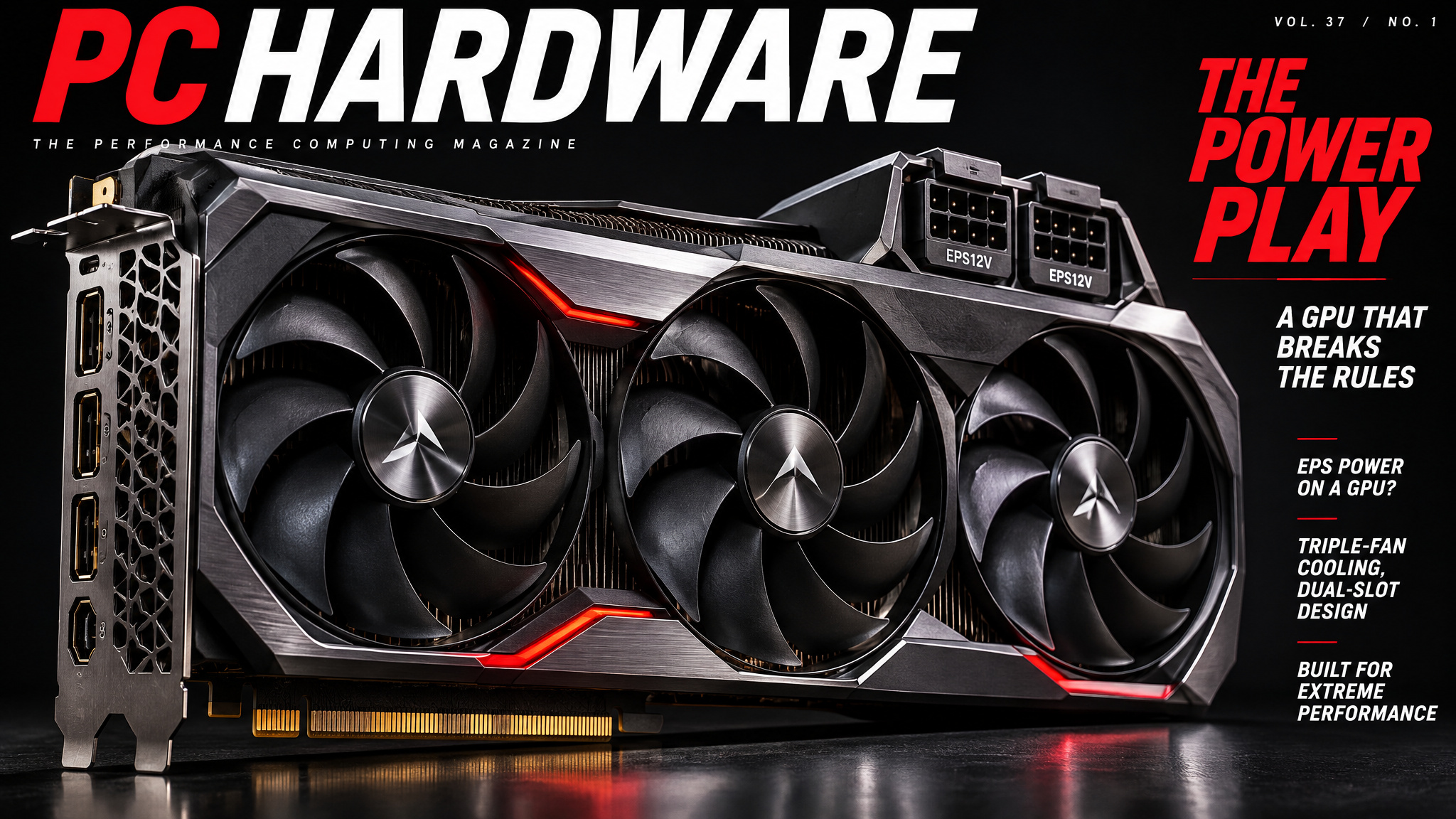
On paper, the Moore Threads MTT S80 looks like a mid-range contender with a party trick: it launched as the first graphics card with a PCIe Gen 5 interface, backed by 14.7 TFLOPS of FP32 compute and 16GB of GDDR6 memory. Plug it into a gaming PC, though, and independent tests show it performing in the neighborhood of an $80, 30W Nvidia GT 1030 while pulling around 250W from the wall.
That gap has turned Moore Threads, the Beijing-based fabless GPU designer founded by the former head of Nvidia’s China business and now listed on the Shanghai Stock Exchange, into one of the strangest hardware stories in recent memory. Explaining how a card can sit between an RTX 3060 and an RTX 3060 Ti in raw compute yet stumble in older DirectX games requires looking at the silicon, the driver stack, the U.S. Entity List sanctions, and an upcoming card called Lushan that points away from gaming altogether.
Key Takeaways
3 of 4 spec pages and reviews we checked list 16GB of GDDR6 for the MTT S80, while the fourth writes 16 GB, putting its memory capacity on par with modern workstations even as gaming frame rates lag.
Independent testing placed the MTT S80’s raw compute between an RTX 3060 and RTX 3060 Ti, yet early software limits restricted it to 17 motherboards, DirectX 9 and partial DirectX 11, and GT 1030-class gaming performance.
Teased on November 18, 2026 ahead of a December 29 unveiling, the upcoming Lushan GPU targets local AI inference where an 8-bit quantized Qwen3.8-27B model requires 27 to 30GB of VRAM.
Table of contents
Table of Contents
What is Moore Threads and who founded it
Moore Threads Technology Co. Ltd is a public Chinese fabless GPU designer headquartered in Beijing, trading on the Shanghai Stock Exchange under ticker 688795 and operating at mthreads.com under CEO Zhang Jianzhong, also known as James Zang. While a ground-up GPU architecture typically takes around ten years to build, Moore Threads shipped its first products in roughly two years.
That timeline reflects the pedigree of its leadership: Zhang Jianzhong, who previously served as Nvidia’s global vice president and China general manager, founded the company in October 2020 alongside co-founder Zhang Yubo. Before going public, Moore Threads raised roughly $500 million, including a US$313 million Series A in November 2021 from investors including ByteDance, Tencent, GGV Capital, Sequoia Capital China, and Shenzhen Capital Group.
MUSA architecture and the MTT S-series lineup
Moore Threads’ MTT S-series lineup spans five desktop, workstation, and server GPUs, the S60, S80, S90, S2000, and S3000, all built on the company’s proprietary MUSA architecture. Short for Moore Threads Unified System Architecture, with a first generation codenamed “??”, MUSA serves as the common silicon and software foundation across every card the company ships. Moore Threads announced its first two products on March 31, 2022: the desktop-focused MTT S60, which it demoed running League of Legends at 1080p, and the server-oriented MTT S2000.
Across the lineup, the cards share a 12nm manufacturing process and scale up from entry workstation duties to data-center compute:
- MTT S60: Single-slot desktop and workstation card with 2,048 FP32 ALUs, 6 TFLOPS of compute, and 8GB of LPDDR4X memory.
- MTT S80: Dual-slot desktop flagship built on 4,096 ALUs and 16GB of GDDR6 memory.
- MTT S90: Newer desktop card that later beat Nvidia’s RTX 4060 in gaming tests via optimized drivers.
- MTT S2000: Server card pairing 4,096 ALUs and 12 TFLOPS with 32GB of GDDR6 memory.
- MTT S3000: Server GPU whose core count and clock speeds mirror the silicon inside the desktop MTT S80.
| Model | Process | FP32 ALUs | FP32 Compute | Memory | Form Factor |
|---|---|---|---|---|---|
| MTT S60 | 12nm | 2,048 | 6 TFLOPS | 8GB LPDDR4X | Single-slot |
| MTT S80 | 12nm | 4,096 | 14.4 TFLOPS | 16GB GDDR6 | Dual-slot |
| MTT S2000 | 12nm | 4,096 | 12 TFLOPS | 32GB GDDR6 | Server card |
Platform support is unusually wide by Western PC standards. The MUSA stack handles DirectX, Vulkan, OpenGL, and OpenGL ES across Windows and Linux, running on x86, x86-64, Aarch32, Aarch64, and China’s domestic LoongArch processors, paired with HDMI 2.1 and DisplayPort 1.4 display outputs. Supporting LoongArch alongside x86 and ARM with HDMI 2.1 and DisplayPort 1.4 display outputs, while dropping server-class core counts into consumer gaming shrouds, makes the priority clear: Moore Threads built this hardware for China’s domestic compute ecosystem first, and global PC gaming second.
MTT S80 specs: what the flagship claims on paper
The Moore Threads MTT S80 is a 255W desktop graphics card built on the ChunXiao GPU, packing 4,096 MUSA cores clocked at 1.8GHz, 16GB of GDDR6 memory on a 256-bit bus, and a PCIe Gen 5 x16 interface. On paper, that puts its memory bandwidth at 448GB/s and its bidirectional bus speed at 128GB/s, allowing Moore Threads to market the S80 as the first graphics card with PCIe Gen 5.
Physically, it’s a substantial 285x112x49mm dual-slot board wrapped around four distinct marketing pillars: graphics rendering, multimedia, AI computing, and physical simulation. Digging through official listings and third-party databases turns up a few discrepancies worth sorting out before the benchmarks.
ChunXiao chip and memory subsystem
Across the spec sheets and reviews checked for this breakdown, the MTT S80 delivers from 14.4 to 14.7 TFLOPS of FP32 compute power. Moore Threads’ official product page claims 14.7 TFLOPS, while Wikipedia’s comparison table lists 14.4 TFLOPS, a 2% variance that doesn’t change the card’s theoretical tier at all.
The memory configuration is even more consistent: of 4 spec pages and reviews, 3 say 16GB of GDDR6 and 1 says 16 GB. That’s purely a formatting quirk rather than a hardware revision, meaning every buyer gets the same 16GB pool. One spec error you can safely ignore, however, is a widely circulated “496 MUSA cores” figure, which was simply a transcription typo for the chip’s actual 4,096 cores.
Display, multimedia, and the spec-sheet discrepancies
On the display side, the ChunXiao chip drives up to four 8K (7680×4320) monitors simultaneously, handles 1080p at 360Hz, and supports Multi-Stream Transport (MST) over a single DisplayPort link. Official documentation specifies three DisplayPort 1.4a ports alongside HDMI 2.1, whereas some third-party spec tables flatten that to DisplayPort 1.4. Inside the silicon sits a second-generation intelligent multimedia engine built for hardware-accelerated encode and decode across AV1, H.264, H.265 (HEVC), VP9, and HDR10.
Moore Threads pitches this hardware as a “universal GPU” through its PES Control Center companion app, which handles driver updates, telemetry monitoring, display settings, screenshots, and future feature rollouts. The company claims the card can train classic computer vision and natural language processing models alongside 4K DirectX gaming on Windows, though those AI training claims haven’t been independently verified in hands-on testing.
MTT S80 real-world performance: specs vs games
The Moore Threads MTT S80 falls far short of its spec sheet in games because its driver stack and API support can’t keep the ChunXiao silicon fed. Independent synthetic testing places the card’s raw FP32 compute right between an Nvidia RTX 3060 and an RTX 3060 Ti, and its 16GB of memory on a 256-bit bus matches the RTX 3060 Ti’s bandwidth with twice the capacity.
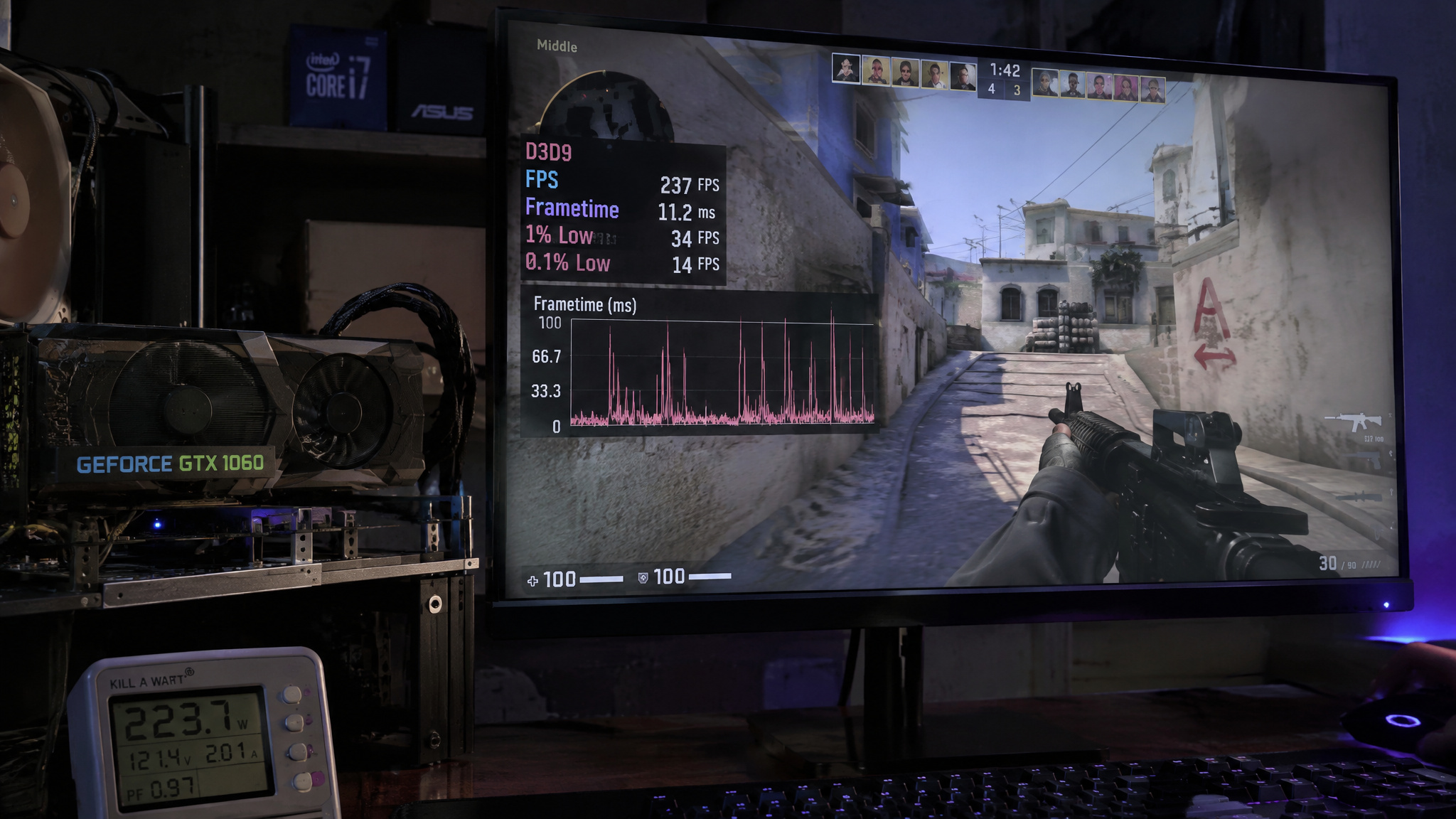
In actual gaming benchmarks, however, real-world frame rates hovered around an $80, 30W Nvidia GT 1030 while the card pulled roughly 250W from the power supply. All of the hands-on benchmarks and teardown observations below come from a presenter at Linus Tech Tips in the video China doesn’t want me to have this GPU – Moore Threads MTT S80, who acquired a retail card through a lottery purchase-code system after they didn’t respond to Western media requests.
How the MTT S80 performs in games
When the software actually cooperates, the card hints at what the underlying silicon can do. League of Legends ran at over 100 FPS at 4K on high settings, staying rock solid and quiet throughout testing.
Other older esports titles fell apart on frame pacing. Counter-Strike (CS:GO) swung wildly between 30 and 200 FPS with severe frame-time inconsistency, making it rough to play despite a decent average. Team Fortress 2 hit anywhere from 90 to 400 FPS in that presenter’s run, though another user reportedly saw peaks near 1,000 FPS, and a second reviewer who explicitly advised against buying the card saw dips to 70 to 100 FPS during firefights.
Compatibility and failure modes
Getting games to launch at all proved as frustrating as chasing stable frame times. The early consumer hardware, carrying 16GB of VRAM and drawing around 250W on what appears to be the Chan Shia architecture variant, officially supported only 17 motherboards and was sold as part of a hardware bundle.
API coverage stopped at DirectX 9 and partial DirectX 11, leaving out DirectX 12, tessellation, and HDR entirely. That missing DirectX 12 support locked Doom Eternal out from launching, Shadow of the Tomb Raider locked up the test system outright, and Factorio failed driver checks. Even the hardware AV1 encoder hit a wall, as OBS couldn’t recognize or use it. Together, immature drivers and missing APIs explain why 14.7 TFLOPS of theoretical power translates into GT 1030 gaming results.
What the teardown reveals
Opening the triple-fan cooler showed a board full of odd engineering choices that builders don’t see on typical consumer cards. Instead of standard PCIe power headers, the S80 uses a dual 8-pin PCIe-to-8-pin EPS power adapter, taking advantage of the 300W EPS rating versus a standard 8-pin PCIe cable’s 150W spec. That 8-pin EPS connector passes power through to a 4-pin header on the PCB, drawing around 250W alongside 75W from the motherboard slot.
Inside, that presenter found a custom fan connector splitting PWM and 12V lines, voltage regulator modules (VRMs) lined along the top edge, and Samsung-labeled memory chips surrounding a confirmed Moore Threads die. Most tellingly, the core count and clock speeds match the MTT S3000 server GPU, confirming the S80 is essentially data-center silicon dressed in a desktop gaming shroud.

Why launch reviews of Moore Threads cards age poorly
If you’re wondering whether to buy a Moore Threads GPU today or wait for software fixes, the short answer is to hold off, even though historical driver updates have been dramatic. Early reviewers explicitly advised consumers against buying the MTT S80 at launch because of its 17-motherboard limit, missing DirectX 12 support, and broken OBS encoder integration.
About a year after release, driver optimizations roughly doubled the MTT S80’s graphics performance. Later on, the newer MTT S90 used optimized drivers to beat Nvidia’s RTX 4060 in gaming tests. That track record shows Moore Threads can unlock substantial performance over time through software alone, though it doesn’t guarantee future cards will repeat the jump on day one.
Sanctions, IP provenance, and the ‘fully domestic’ question
Moore Threads occupies a complicated middle ground: U.S. trade sanctions treat it as a strategic Chinese semiconductor champion, yet external investigations suggest its architecture didn’t start from a blank sheet of paper.

The October 2023 Entity List addition
The U.S. Department of Commerce placed Moore Threads on the Entity List maintained by the Bureau of Industry and Security in October 2023. That designation restricts the company’s access to U.S.-origin technology and manufacturing tools, while simultaneously cementing its importance inside Beijing’s push for domestic silicon self-sufficiency.
The Imagination licensing chain
The claim that Moore Threads built a fully homegrown GPU from scratch runs into trouble under closer scrutiny. According to an investigation by Bull Labs cited in the Linus Tech Tips coverage, the company licensed GPU intellectual property from Imagination Technologies, the company behind PowerVR graphics. Because Canyon Bridge Capital Partners, a private equity fund backed by the Chinese central government, owns Imagination Technologies, a “fully Chinese” ownership label is technically arguable, even if the underlying IP licensing chain undercuts the “built from nothing in two years” narrative.
The stock story: IPO surge, lockup crash, Hong Kong plan
Moore Threads’ December 5, 2025 IPO on the Shanghai Stock Exchange raised over US$1 billion and delivered a massive first-day pop, surging 468% according to SCMP and Wikipedia, or 425% according to Huileng Tan, writing at businessinsider.com. DeepSeek and High-Flyer founder Liang Wenfeng ranked as the offering’s largest institutional backer, and by August 2026, shareholders approved a plan for a secondary listing on the Hong Kong Stock Exchange after the company posted a 147% revenue jump.

A month later, the stock hit a mechanical wall. In September 2026, a nine-month lockup expired on 25.8 million shares, representing 5.5% of the company and nearly doubling the tradable free float.
Within minutes, shares dropped 20% to hit the Star Market’s daily down-limit of 415.48 yuan, their lowest point since the December debut, though early lockup investors who bought in at 114.28 yuan remained up over 260%. That volatility sits inside a broader mainland AI chip rally sparked by DeepSeek’s early-2025 breakout and U.S. Nvidia export curbs, which also saw CXMT raise $8.6 billion in Shanghai and close 466% higher on day one, while Z.ai traded at roughly nine times its January IPO price.
Lushan: the VRAM-first GPU built for local AI
Lushan is Moore Threads’ upcoming desktop GPU aimed at both AAA gaming and local large language model (LLM) inference, scheduled for a full unveiling on December 29, 2026 at MUSA Developer Conference 2026. Rather than chasing raw rasterization charts against mid-range GeForce cards, the Lushan teaser leans heavily into memory capacity as its primary hook. Product manager AIR_FORCE teased the card on November 18, 2026, in posts spotted on X by Alexey Fateev and covered by Omar Sohail, writing at wccftech.com. Because every detail so far comes from pre-release teaser materials rather than independent benchmarks, the hardware claims remain unverified until December’s reveal.
What the Lushan teaser claims
According to the November teaser, Lushan will feature the largest consumer GPU VRAM capacity in history, though Moore Threads hasn’t published the exact gigabyte figure yet. The teaser also promises a 64x AI performance improvement, a new UNITE rendering architecture, a self-developed hardware ray tracing engine, and AI generative rendering. Given how much the MTT S80 and S90 improved through post-launch software updates, Moore Threads could deliver a surprise at the December 29 unveiling, though teaser numbers deserve skepticism until third-party testers get hold of the silicon.
The VRAM math behind the teaser
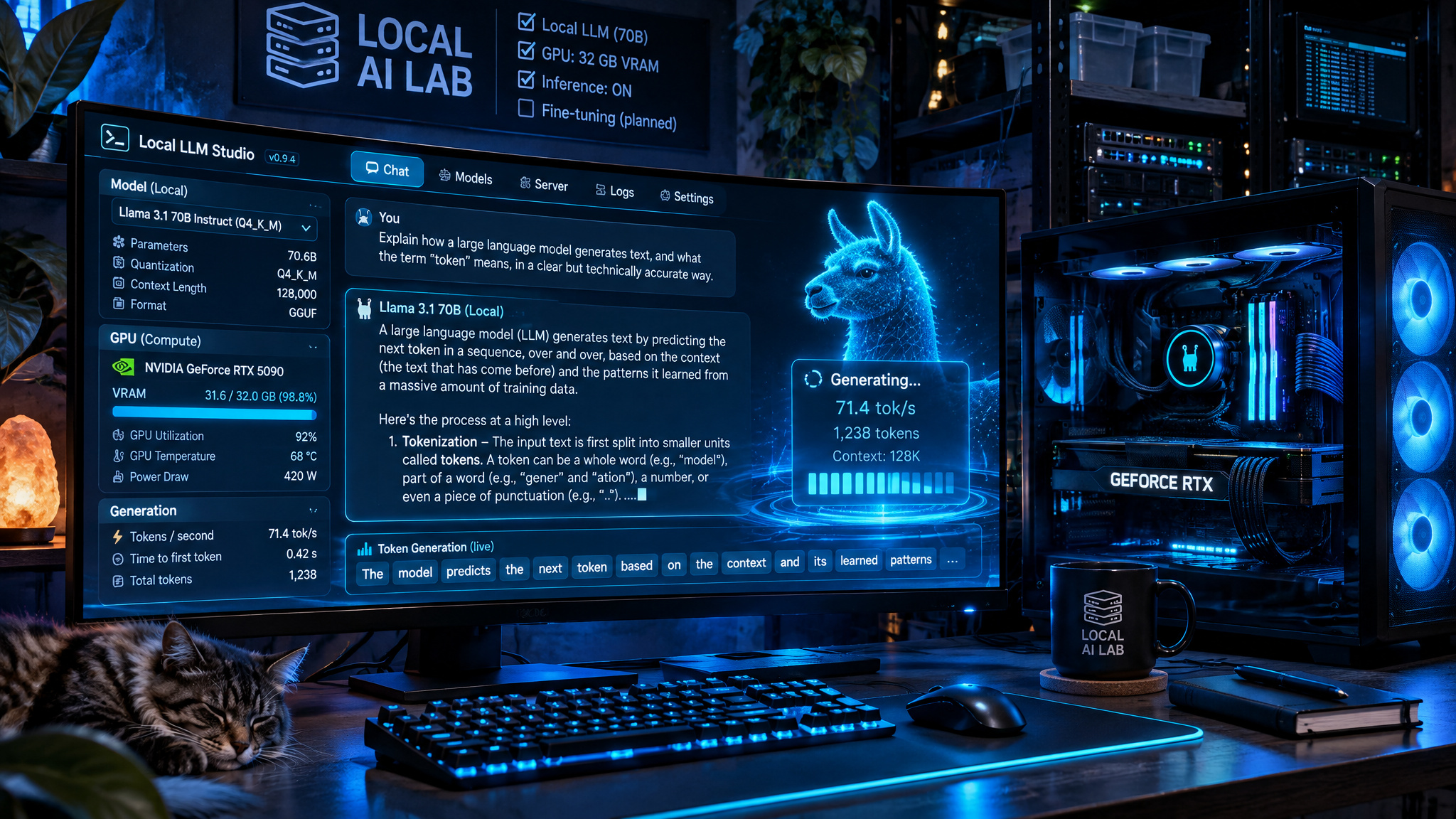
Running an 8-bit quantized Qwen3.8-27B model locally requires 27 to 30GB of VRAM, pushing it past what standard consumer cards like Nvidia’s RTX 5090 can hold comfortably in memory. Fitting those weights onto a single desktop card, even one with more headroom than Nvidia’s RTX 5090, is only half the equation, though: Lushan has to pair that capacity with high memory bandwidth, or prompt processing speed and token-per-second generation will hit a severe bottleneck.
AI play or gaming play: the analyst debate and China’s compute race
Whether Moore Threads can challenge Nvidia in China’s AI compute market splits Wall Street and regional analysts right down the middle. JPMorgan forecasts China’s domestic AI compute demand growing at roughly an 80% compound annual growth rate, projecting that local chips will meet 80% of the country’s AI infrastructure demand by 2028, up from 40% in 2025. Maybank Securities pushes back hard on that optimism, arguing that Moore Threads faces insurmountable competitive hurdles over the medium term due to persistent software and hardware challenges.
Moore Threads isn’t running this race alone, sharing the domestic field with rivals like Biren Technology and Lisuan Tech. Still, the company’s own hardware choices tell the clearest story: reusing MTT S3000 server silicon for the S80 and pivoting Lushan toward local-LLM VRAM pools show that data-center and AI inference are the prize.
Who Moore Threads GPUs are actually for
If you’re looking to buy an MTT S80 outside China, neither retail pricing nor international availability is confirmed, and the Linus Tech Tips presenter speculated that Chinese GPUs may never reach North American shelves given ongoing U.S.-China trade tensions and competing subsidy pushes like China’s $1.4 trillion tech investment versus the U.S. $53 billion CHIPS Act. AI compute on the S80 also remains untested in independent reviews, though that same reviewer noted the card looks far more like an AI play than a gaming card and flatly advised consumers not to buy it.
For PC gamers, missing DirectX 12 support and erratic frame pacing make current Moore Threads cards an easy skip. Local-AI builders, however, have a legitimate reason to watch the December 29, 2026 Lushan unveiling for verified VRAM capacity and memory bandwidth numbers, while industry observers should treat launch-day gaming benchmarks as a poor measure of where Moore Threads is actually taking its silicon.
Frequently Asked Questions
What is Moore Threads and who founded the Chinese GPU company?
Moore Threads Technology Co. Ltd is a publicly traded, Beijing-based fabless GPU designer listed on the Shanghai Stock Exchange under ticker 688795. Former Nvidia global vice president and China general manager Zhang Jianzhong (also known as James Zang) founded the company in October 2020 alongside co-founder Zhang Yubo, backed by roughly $500 million in pre-IPO funding from investors including ByteDance and Tencent. Thanks to that leadership pedigree, the company shipped its first MUSA-architecture silicon in about two years—a fraction of the decade it usually takes to build a GPU from scratch.
What are the specs of the Moore Threads MTT S80 GPU?
Built on the 12nm ChunXiao die, the MTT S80 is a 255W dual-slot desktop card packing 4,096 MUSA cores at 1.8GHz, 16GB of GDDR6 memory on a 256-bit bus (448GB/s bandwidth), and a PCIe Gen 5 x16 interface. Official specs peg its FP32 compute at 14.7 TFLOPS (though some comparison tables list 14.4 TFLOPS), alongside three DisplayPort 1.4a ports, HDMI 2.1, and hardware encode and decode for AV1, H.264, H.265, VP9, and HDR10. Under the hood, its core count and clock speeds mirror the MTT S3000 server GPU, making it essentially data-center silicon in a consumer shroud.
How much does the Moore Threads MTT S80 cost and can you buy it outside China?
Neither official retail pricing nor international availability is confirmed for the MTT S80 outside China. Early buyers in China could only get the card through hardware bundles or a lottery purchase-code system, and ongoing U.S.-China trade tensions make it unlikely that Moore Threads GPUs will ever hit North American store shelves. Even if you manage to track one down via import, reviewers have flatly advised PC gamers against buying it.
Is the Moore Threads MTT S80 actually good for gaming in real-world tests?
No—despite its 14.7 TFLOPS spec sheet, real-world gaming performance hovers near an $80, 30W Nvidia GT 1030 while pulling around 250W from your power supply. While League of Legends cleared 100 FPS at 4K, esports staples like CS:GO and Team Fortress 2 suffered erratic frame pacing, and missing DirectX 12 support locked out Doom Eternal and crashed Shadow of the Tomb Raider. Driver updates roughly doubled the card’s graphics performance about a year after launch, and early compatibility was limited to just 17 motherboards, making it a frustrating choice for gaming.
How does the Moore Threads MTT S80 compare to an Nvidia RTX 3060?
In synthetic compute tests, the MTT S80 actually lands between an Nvidia RTX 3060 and an RTX 3060 Ti, and its 16GB memory pool matches the 3060 Ti’s 256-bit bandwidth with twice the capacity. Once you launch an actual game, though, immature drivers and missing APIs like DirectX 12 bottleneck the silicon so badly that frame rates drop to GT 1030 territory. Interestingly, Moore Threads’ newer MTT S90 later proved its driver stack can catch up, eventually beating Nvidia’s RTX 4060 in gaming benchmarks after software optimizations.
Why was Moore Threads added to the US Entity List and how does it affect the company?
The U.S. Department of Commerce placed Moore Threads on the Bureau of Industry and Security’s Entity List in October 2023 as part of trade sanctions targeting strategic Chinese semiconductor champions. That designation cuts off the company’s access to U.S.-origin technology and manufacturing tools. At the same time, the sanctions cemented Moore Threads’ status inside Beijing’s push for domestic silicon self-sufficiency, with JPMorgan projecting local chips will meet 80% of China’s AI compute demand by 2028.
Is Moore Threads really China’s Nvidia or a fully domestic GPU maker?
The ‘fully domestic’ label is more complicated than the marketing suggests. While Moore Threads built its MUSA software stack to run on China’s homegrown LoongArch processors and serves as a key pillar of Beijing’s domestic chip push, an investigation by Bull Labs found that the company licensed GPU intellectual property from Imagination Technologies, the creator of PowerVR graphics. Because Imagination is owned by Canyon Bridge Capital Partners—a private equity fund backed by the Chinese central government—its ownership is technically Chinese, even if the IP licensing undercuts the narrative that Moore Threads built a clean-sheet GPU from nothing in two years.