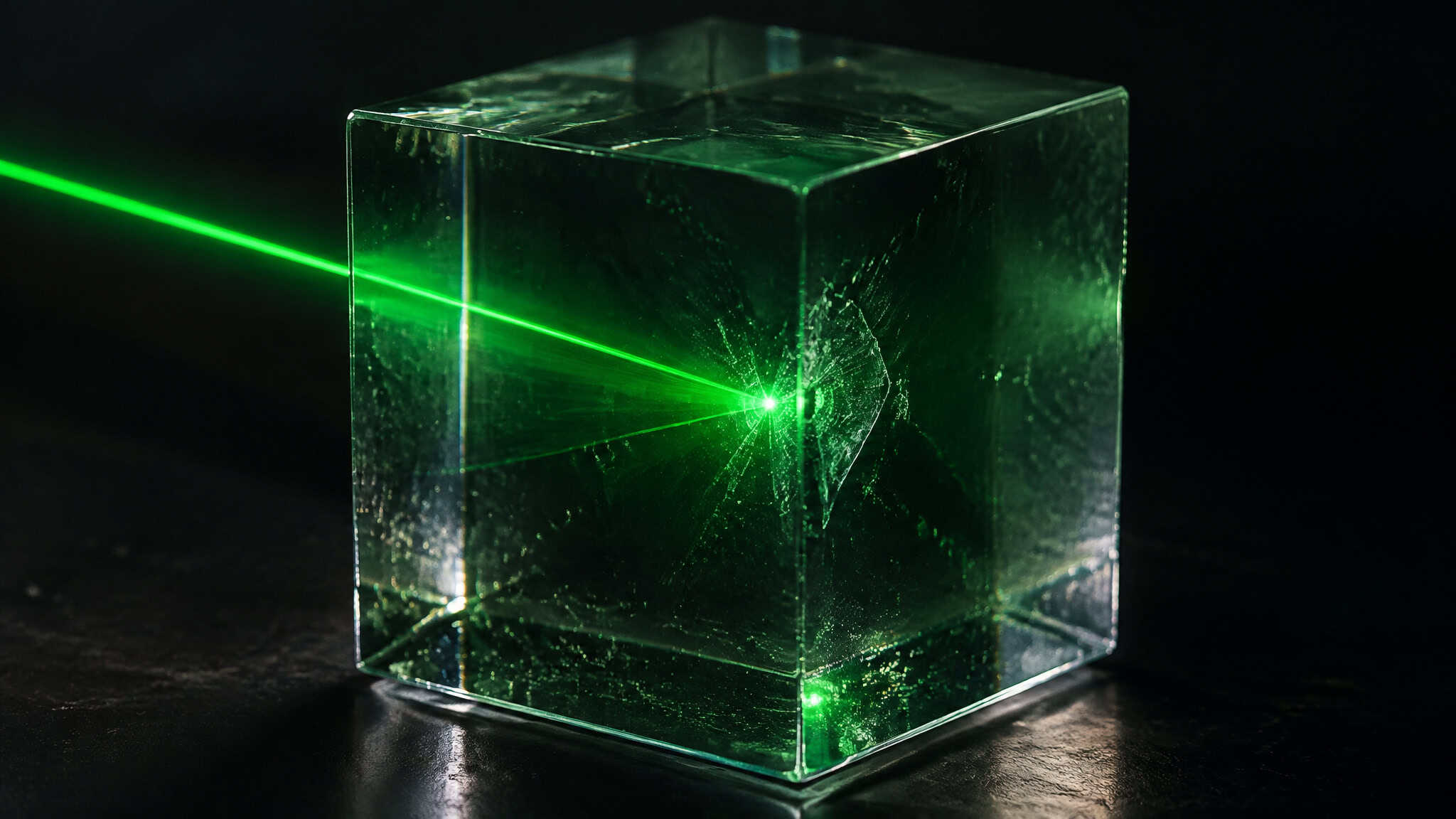
I’ve held one of those glass cubes with a face floating inside it and done the thing everyone does: ran a finger across the surface, expecting something. Nothing. Perfectly smooth. The image is fully enclosed in solid glass and the outside is untouched, which feels like it should be impossible.
It’s not adhesive, not a hollow cavity, not a trick. It’s subsurface laser engraving, and the mechanism is beautifully blunt: the beam passes straight through the glass harmlessly and only does damage where it converges to a point inside. That’s the whole game, and everything else, the dotted look, the machine prices, the photo rules, falls out of it. So in this piece I want to walk the full chain: the physics of the 532 nm beam, why the image has to be dots, how a JPEG becomes a 3D point cloud, what the gear costs, and where the honest line sits for hobbyists. The question underneath all of it is surface versus inside, because engraving on glass and engraving inside glass are two different processes that share almost nothing but the word laser.
Key Takeaways
A green ~532 nm beam from a diode-pumped Nd:YVO4 or Nd:YAG laser passes through the glass undamaged and only fractures material at its internal focal point, where each pulse leaves a micro-fracture that reads as a tiny bubble.
The dotted look is physics, not style: solid internal edges would wreck the glass, dots placed too close merge into a crack called a “clash,” and software layers dots automatically to avoid it.
Dedicated SSLE machines start around $20,000 (per Maker’s Muse), with the laser diode accounting for up to a third of that cost; a desktop CO2 laser can produce frosted surface engraving on glass but cannot place marks inside it.
Table of Contents
What subsurface laser engraving actually is
Subsurface laser engraving produces 2D and 3D images inside transparent crystal without marking or scratching the exterior. A focused laser places microscopic fractures at precise depths throughout the material, thousands to millions of them, while the outside surface stays factory-smooth. The defining property is that energy passes through the surface and only deposits at internal focal points, and everything else about the technique follows from that one fact.
If you go shopping for one of these, you’ll meet the same process under several names:
- Subsurface laser engraving (SSLE), the proper name
- 3D crystal engraving, the mall-sign version
- Bubblegram, which describes what each dot looks like
- Vitrography, sometimes spelled vetrography
- Laser photo crystal, the gift-shop listing term
All of these point at the same technique. Maker’s Muse, a Patreon-funded explainer channel run by a maker named Angus, devoted a video to the subject, “What is Sub-surface Laser Engraving or a Bubblegram?”, and spends a good chunk of it side-eyeing the looser names in favor of SSLE. Honestly, fair. When five names describe one process, somebody has to pick a canonical term, and SSLE at least tells you what’s actually happening: engraving, subsurface.
How a laser fractures glass from the inside
The counterintuitive part is that the surface survives completely, and the reason has nothing to do with careful handling.
Why the surface stays untouched
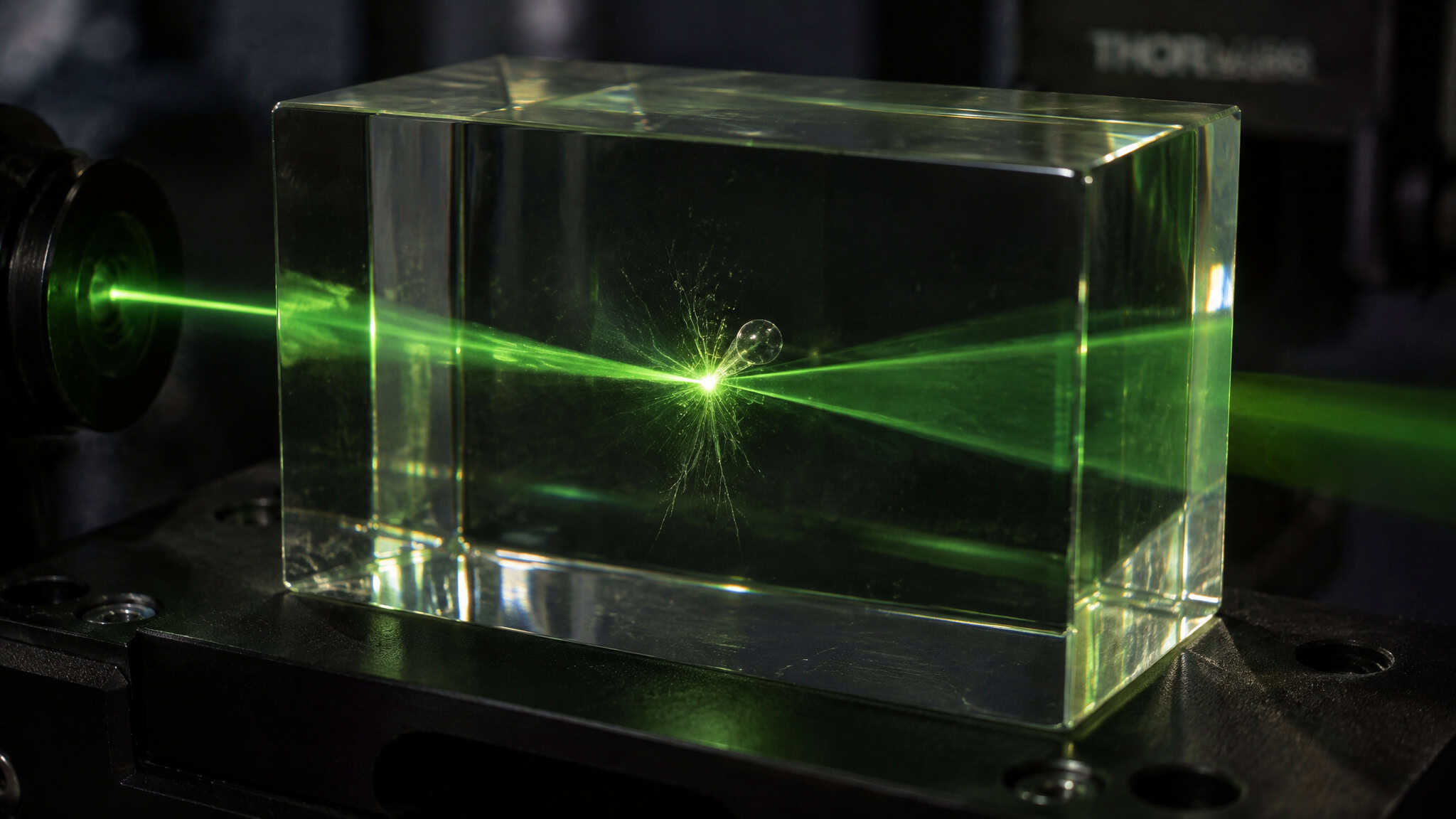
The surface stays untouched because the laser’s energy only concentrates at the internal focal point. Everywhere the beam travels before and after that point, its intensity is simply too low to do anything to transparent glass. That’s the entire trick, and it’s physics rather than finesse.
Here’s the chain in order. The beam comes from a diode-pumped solid-state unit built around an Nd:YVO4 or Nd:YAG crystal (say the acronym once, nod, move on), and it comes out green at a wavelength of roughly 532 nanometers. Transparent glass is, well, transparent to it, so the beam crosses the surface and travels through the block without leaving a mark. Inside the crystal, optics converge that beam to a tight focus at an exact depth.
At the focal point, the energy density finally crosses the threshold where the material fails, and the glass fractures on a microscopic scale. Each fracture is small enough to read as a tiny bubble, which is where the bubblegram name comes from. The machine then steps to the next coordinate and does it again, thousands of times, until the pattern exists. The beam is never a threat anywhere except at the one point where it’s designed to converge.
The numbers: point size, dot rate, and coordinates
The specs make it concrete. Modern SSLE systems place points measuring 40 to 80 micrometers, and they fire more than 4,000 dots per second. An image gets built point by point across thousands to millions of X, Y, Z coordinates, and a single engraving can contain tens of thousands of these micro-points. If you’ve spent any time with 3D printing or voxel editors, the mental model clicks fast: this is a point cloud, plotted voxel by voxel inside the glass.
That Z axis is what separates this from every surface process. Surface engraving follows paths across a plane; SSLE fills a volume.
Why the image is made of dots
The dot grid is a physical necessity, not a style choice. You can’t blast solid internal edges inside glass without wrecking the piece, so the image gets built from a grid of tiny discrete fractures instead. The dots carry the shape the way pixels carry a screenshot.
And the failure mode has a name, which I love. Place two dots too close together and they merge into an internal crack called a clash. Nerds name their failure modes, and this one has earned it. The fix is boringly elegant: the software layers the dots automatically to keep spacing safe. The toolchain already solved this, so you’re not going to clash your way into a cracked cube by accident.
One shopper’s observation, though: if a finished cube looks sparse, the dot density may be a cost decision rather than artistic minimalism. The laser diode is expensive and lifespan-limited, and every dot spends a little of it. More on that economics shortly.
From photo to point cloud: how a flat image becomes 3D
The best source photos are high-resolution, well-lit, and high-contrast, with clear facial features, a clean background, and strong depth cues. That checklist exists because of what the software actually does with your file.
The software pipeline: clean, depth-assign, convert
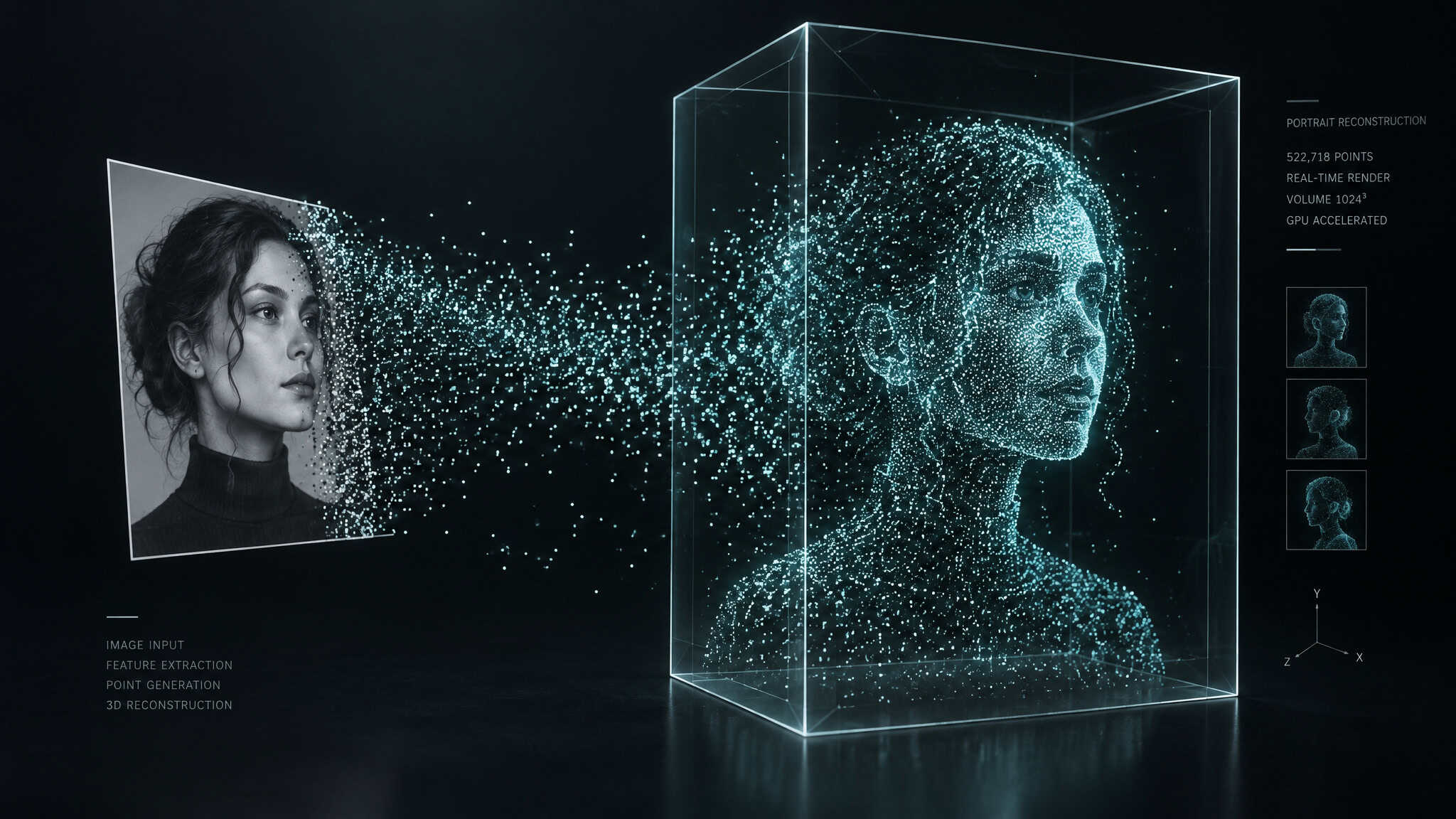
The pipeline is refreshingly honest. First the software cleans the image: brightness and contrast adjustments, background removal. Then it assigns depth data, deciding what’s foreground and what’s background, and uses that to build a 3D model or point cloud. Finally the image gets cropped and positioned, then converted into the dot pattern the machine fires. That’s it.
No mystery, and notably no “AI-powered” hand-waving needed to describe any of it. The inputs are generous too: mesh files don’t need to be manifold or watertight the way 3D printing slicers demand, and a plain JPEG gets 3Dified without ceremony. Compared to most digital fabrication workflows, the post-processing here is genuinely simple.
Why some photos convert badly
A portrait that looks fine on your phone screen can still convert into a muddy point cloud if it lacks depth cues: flat lighting, no shadow separation, no subject-background contrast. Blurry, low-resolution, or noisy photos are out entirely; garbage in, cube out. The kinder news is that many services screen and optimize your photo before engraving anyway, so the worst case is usually a conversation with the vendor, not a ruined keepsake.
2D, 2.5D, and 3D engraving: a data distinction, not a marketing tier
The decisive difference is where the points go: 2D and 2.5D engraving place points roughly on a single plane, while 3D engraving uses full volumetric data across X, Y, and Z. That’s a data-structure distinction, not a marketing tier.
2D/2.5D gives you a shallow relief, essentially a flat photo suspended inside the glass. For logos and flat artwork, that’s exactly right, and it’s faster and cheaper to produce. No condescension required; it’s the correct tool for that job.
3D uses the full coordinate volume, so the result is sculptural and shifts as you move around it. For portraits and group photos it’s clearly superior: you get facial definition and subject separation, plus the following effect where the image tracks your viewing angle. The honest tradeoff is price. Depth processing plus thousands of points at varying depths is more technically involved, and that cost passes through to you.
Why the image appears to float, and why lighting decides whether it does
The floating look has a mechanism, and it’s neater than the marketing version. Each internal micro-fracture has a different refractive index than the crystal surrounding it, so every dot scatters and refracts light passing through the block. That scattered light is what your eye receives. The image is a cloud of tiny optical discontinuities catching whatever light you give them, nothing projected, nothing glowing.
Because the dots sit at different depths, the image shifts slightly as your viewing angle changes. It’s called the following effect, and it’s delightful: the portrait subtly tracks you around the cube. Bonus engineering point: the smooth, untouched exterior isn’t just cosmetic. An unmarred surface minimizes distortion and keeps the scattered light arriving cleanly.
Lighting is a first-order variable, not an afterthought. Natural light, ambient room light, or a purpose-built LED base all work. But improper lighting makes a great crystal look dull or flat, so if your cube disappoints, blame the setup before you blame the artifact. Orientation and display location matter too.
Can a laser engraver engrave on glass? The hobbyist boundary
Yes, a laser engraver can engrave on glass, but only the surface. A low-cost CO2 laser produces genuinely legible frosted letters and logos on glass: the beam’s intense heat gradient micro-fractures the surface, leaving that characteristic pale, sandblasted-looking mark you’ve seen on barware and awards. What no setting change will ever do is place a mark inside the glass. Surface ablation and subsurface fracturing share almost nothing mechanically; they’re different processes that happen to share the word laser, which is exactly why the confusion persists.
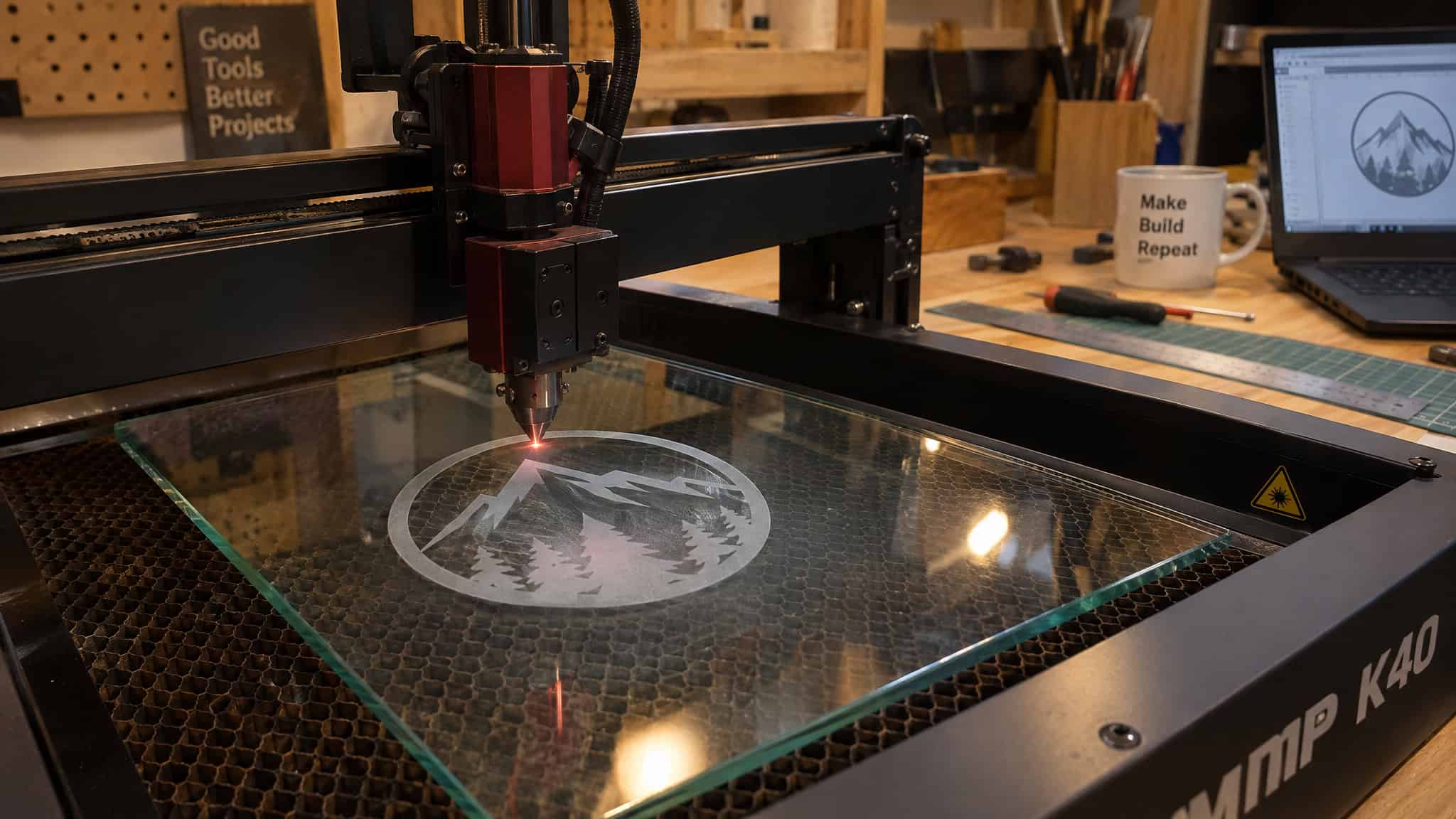
This is a recurring pattern across hobbyist forums: a desktop CO2 owner sees a 3D crystal, assumes it’s a settings problem, and discovers the hard way that their machine can frost the outside but never reach the inside. It’s not a skill issue. The beam physically cannot concentrate at an internal point the way an SSLE system’s optics do.
| What you’re after | Desktop CO2 laser | Dedicated SSLE machine |
|---|---|---|
| Frosted letters or logos on the surface | Yes (heat-gradient micro-fractures) | No (built for internal points) |
| An image suspended inside the glass | No (no setting change gets you there) | Yes (thousands of internal focal points) |
| Entry cost | Low enough for a hobby bench | Starts around $20,000 |
One honest gap: between the hobbyist CO2 tier and the industrial SSLE machines, there’s no well-documented mid-tier desktop SSLE segment in the material I dug through. Search interest in kits and lower-cost machines clearly exists; the evidence for describing that market doesn’t, so I’ll leave it at the boundary rather than invent a product category.
The legitimate version of what your bench machine can do is surface work, and it’s genuinely good work. Frosted marks are real engraving, and there’s a whole craft to dialing in glass without chipping it, including the failure modes worth knowing before you run a test tile. If you want the broader decision tree of which laser classes actually engrave glass and what each one physically does to the material, that’s its own piece. There’s also a quieter sub-world of UV glass marking, plus a rundown of the downsides of laser etching glass, from cleanup to edge sharpness.
What a subsurface laser engraving machine costs
Subsurface laser engraving machines start around $20,000, per Maker’s Muse, which is the only source putting a figure on this; no vendor pricing is published, so treat it as an approximate starting point rather than a market survey, and know that prices may vary. The number explains a lot.
Cost check: No vendor publishes SSLE pricing; the ~$20,000 figure is one source’s estimate, so treat it as a floor, not a survey.
The causal chain that commodity articles never make starts with the laser diode. Diodes account for up to one third of overall machine cost, and they have limited lifespans. That single fact drives two things at once. It drives the entry price: the diode plus the optics that focus its beam to a micrometer-scale point inside a solid are where your money would actually go.
And it drives the pulsing economy: when the expensive, consumable part of your machine is the diode, pulsing tiny dots beats blasting solid vectors, because every pulse is metered wear against a finite-lifetime component. That’s also why sparse dots in a finished cube read as cost-saving rather than artistic minimalism.
No, you can’t do 3D subsurface laser engraving at home with hobby gear, it needs a dedicated SSLE machine, and those start around $20,000. That price floor, driven largely by the laser diode and optics (the diode alone can be up to a third of the machine’s cost), explains why the technique lives in commercial shops rather than hobbyist garages, and why machine availability is low. Your local mall has exactly one of these operations, if it has one at all, and now you know why. Even if your CO2 tube could focus inside a solid, the component costs don’t work at hobby scale at anything like these prices.
Why “crystal” means optical-grade glass like K9 or BK7
Yes, quality matters, and the decisive condition is optical purity. “Crystal,” in this context, is marketing language for specified optical glass, typically K9 or BK7, with lens-grade clarity and none of the inclusions, bubbles, or cracks that ordinary glass tolerates. Satisfying, right? The fancy word dissolves into a materials spec.
The purity requirement is a focusing specification, not a luxury upsell. The whole technique depends on the beam converging at an exact internal point, and refractive-index inconsistency deflects energy away from that target. Bad crystal means diffusion, blurriness, or unwanted fracturing; cause, effect, done. If you want the intuition for refraction, it’s the straw in a glass of water: the straw looks bent at the surface because light changes speed crossing between media.
Now imagine focusing a beam to a precise point through a material that does that unevenly. Clear plastics can technically be used, but they perform poorly, which is one honest line and all it deserves.
Shape and size: what the block itself contributes
Engraving works regardless of the block’s external shape, so shape is a taste call, not an engineering constraint. With one caveat.
Does shape matter? The arch question
“Arch-shaped crystal” is not a standard technical term; it’s a stylistic label. The technique works in any shape, so choosing an arch is purely a taste call. But feasibility and optical quality are different questions. Curved surfaces change how light enters, refracts, and exits, which can add perceived depth and sparkle, so the arch isn’t pure vanity.
The counterweight: highly curved shapes can complicate internal laser focusing, so confirm curved work with your supplier. Rectangular blocks are the predictable choice for engraving and display. The usual roster, browsed quickly: blocks, cubes, hearts, pyramids, and custom shapes.
Size, dot count, and detail
Size is physics, not upsell: a larger crystal holds more engraving dots, and more dots means more detail. Medium blocks suit a single-person portrait. Larger blocks handle group photos and detailed scenes. Smaller ones suit simple images. Pick the size that matches the content, and the dot math takes care of itself.
Durability and care: what actually destroys a crystal engraving
No, the engraving won’t fade or wear, as long as the crystal stays intact. The durability follows directly from the mechanism: the image consists of internal fractures, with no pigment, ink, or surface layer that can fade, scratch, peel, or discolor. These are real physical changes to the crystal, not a coating. Vendors like Crystal Sensations and 3D Crystal UK claim stability for decades, and that claim is consistent with the physics, though it’s vendor-sourced rather than an independently verified lab result. The comparison that lands it: printed photos yellow and warp. This doesn’t, because there’s nothing on the surface to degrade.
The one real failure mode is breaking the glass. It’s glass. Don’t drop the cube. Care is external-only and fun-sized: a soft microfiber cloth, the same kind you use for eyeglasses, and a standing policy against abrasives, sharp objects, and gravity.
What it’s used for, where you get it, and what the market looks like
This is a proven technique with a real retail model, and that retail model has already collapsed once, which is the context the gift-shop framing tends to omit.
Use cases and customization options
Subsurface laser engraving machines produce corporate awards, personalized gifts, memorial tributes, and artistic decor, with occasions spanning weddings, anniversaries, graduations, memorials, and family portraits. The customization menu is broad: photos of people, pets, groups, or scenes, plus names, dates, messages, logos, and backgrounds. Almost any image works if the source photo is good, which is the single gate. A wedding portrait with names and a date is the classic two-person piece; a corporate award with a logo and a name is the B2B version of the same machine. Vendors make quality claims, and they stay claims: Crystal Sensations positions itself around hand-crafted pieces with a design team optimizing each image for depth and contrast. That’s their statement, attributed as such, and the resolution those 40-to-80-micron dots enable is at least the kind of spec that could back it.
The commercial reality: named shops, a factory visit, and a closed store
Laser Xpressions operates on the lower level of Freehold Raceway Mall, next to Macy’s, and an NJ1015.com writer visited and filmed behind the scenes; 3D crystal engraving is the store’s most popular item, serving both corporate and personal gifting. Maker’s Muse‘s Angus visited Shiny 3D in Hangzhou in 2016, where his face was 3D-scanned and engraved into crystal on a machine the company also sells. And a futuristic fifth-floor photo-to-crystal store at the Westfield centre, which opened in 2003, later went out of business. Early-adopter retail graveyard, right on schedule.
No source gives per-piece service pricing, so I won’t invent one. What drives cost is clear from the mechanism: crystal size means dot count, 3D processing costs more than 2D, and the diode economics touch everything. As for the future, Angus jokingly predicted a spread of ugly 3D selfies and glass cubes containing wisps of tourist destinations. One creator’s playful take, and honestly, plausible enough to be funny.
Four buyer mistakes, each traced to the mechanism
Four mistakes, each traceable to something above:
- Choosing impure crystal: scattering defeats the focusing everything depends on.
- Supplying a weak source photo: the depth-assignment step starves, and the point cloud goes muddy.
- Neglecting display lighting: scattered light needs a source, or the image sits flat.
- Assuming all shapes engrave equally: curves complicate focusing, so check before you commit.
Things I’d want someone to have told me, basically.
Everything distinctive about a 3D crystal, the dots, the floating look, the permanence, even the machine price, follows from one fact: energy is deposited only at internal focal points. If you’re buying, choose true 3D volumetric engraving on optically pure stock, and have a lighting plan before the cube arrives. If you’re a hobbyist, treat surface CO2 engraving as the legitimate version of what your machine does. Both are honest answers; they’re just answers to different questions.
Frequently Asked Questions
What is subsurface laser engraving and how does it put a 3D image inside glass?
Subsurface laser engraving (SSLE) places microscopic fractures at precise depths throughout transparent crystal, building images from thousands to millions of tiny points that each read as a bubble. A green ~532 nm beam from a diode-pumped Nd:YVO4 or Nd:YAG laser passes through the glass harmlessly and only deposits energy where it converges to a tight internal focus. The machine steps point by point across X, Y, and Z coordinates, effectively plotting a point cloud inside the solid.
Why doesn’t the laser damage the surface when engraving inside glass?
Because the beam’s energy only concentrates at the internal focal point. Everywhere the beam travels before and after that point, its intensity is too low to affect transparent glass, so the surface stays factory-smooth. At the focal point, the energy density finally crosses the threshold where the material fails and micro-fractures on a scale small enough to look like a tiny bubble.
How much does a 3d crystal laser engraving machine cost?
Dedicated subsurface laser engraving machines start around $20,000, per Maker’s Muse — the only source putting a figure on it, since no vendor publishes pricing. Treat that as an approximate floor rather than a market survey, as prices may vary. The laser diode alone accounts for up to a third of the machine cost, which is a big part of why the technique lives in commercial shops rather than hobbyist garages.
What is the difference between 2D, 2.5D, and 3D crystal engraving?
The difference is where the points go: 2D and 2.5D engraving place points roughly on a single plane, producing a shallow relief — essentially a flat photo suspended inside the glass. 3D engraving uses full volumetric data across X, Y, and Z, so the result is sculptural and shifts as you move around it. 2D/2.5D is faster and cheaper and fine for logos and flat artwork; 3D is superior for portraits because it delivers facial definition and subject separation, at a higher price.
Do laser engravings inside glass fade or wear out over time?
No, as long as the crystal stays intact. The image consists of internal micro-fractures with no pigment, ink, or surface layer that can fade, scratch, peel, or discolor — unlike printed photos, which yellow and warp because there’s something on the surface to degrade. Vendors claim stability for decades, which is consistent with the physics, though it’s vendor-sourced rather than independently verified. The only real failure mode is breaking the glass itself.