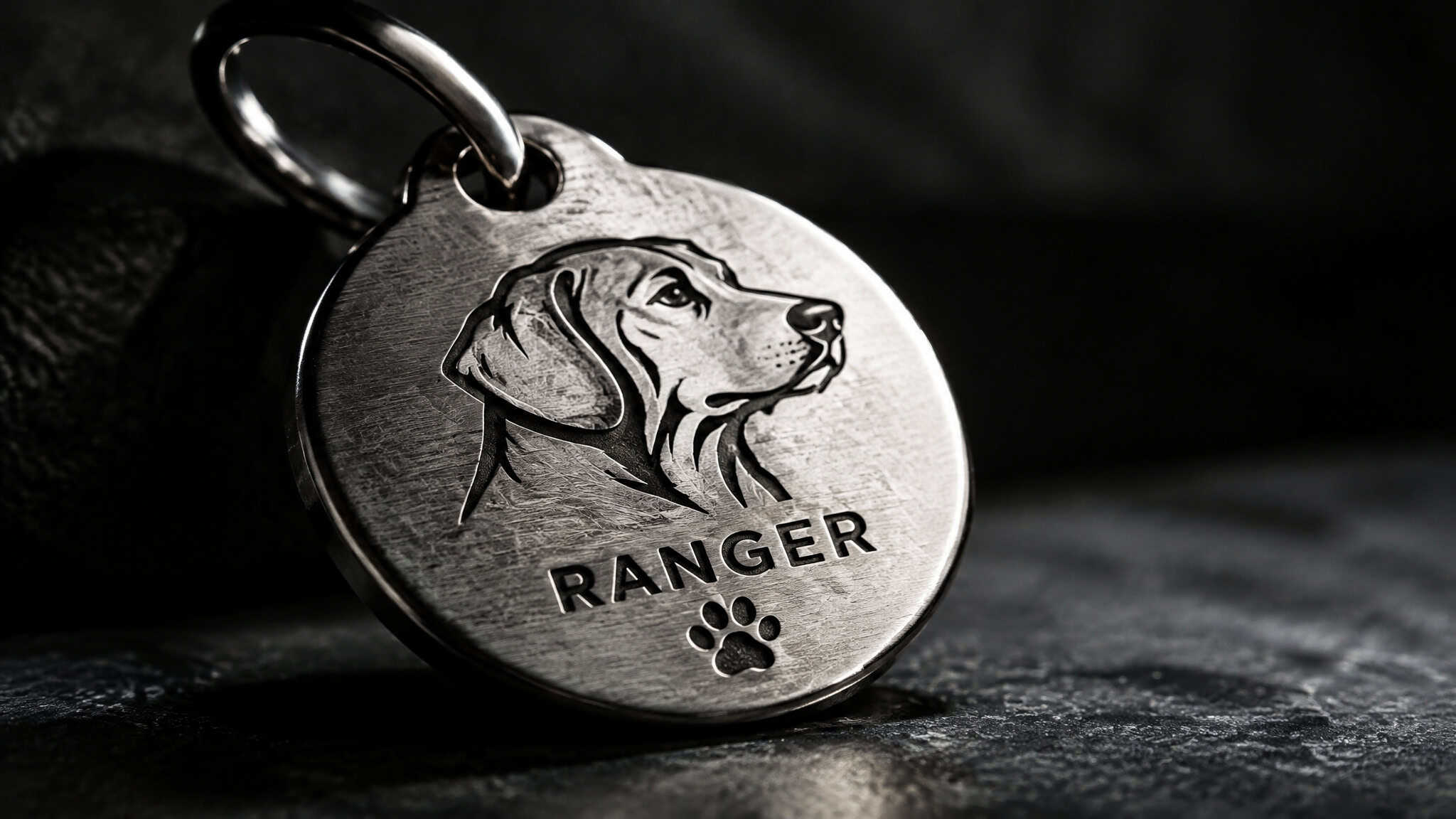
Ask the internet how long a laser engraving lasts and you’ll get the same word everywhere: decades. Pet tags, garden signs, machine plates, that one flask you want to mark forever. The problem is that almost every “decades!” answer out there is an assertion, not a measurement. Almost nobody actually tested the thing they’re claiming.
So we went looking for the people who did. What we found is better than a single number: CNCKing.com blasted sample tags with beach sand at 80 psi to compress years of wear into minutes. A 2006 engraving forum produced two outdoor sign accounts in open conflict, roughly six months of fade life versus six-plus years. And there’s a UV-sprayed sign line with an honest 3-4 year expectation and a fade-replacement guarantee attached.
Assemble those and the real answer shows up: mark depth matters, laser type matters, and above all the material matters. There’s no single lifespan number. Once you see the matrix, you can predict what will survive your specific deployment, and you’ll never trust another unmeasured “permanent” claim again.
Key Takeaways
Laser engravings on hard metals like stainless steel and titanium are effectively permanent, lasting decades, while marks on wood, leather, and plastics soften and fade from handling, skin oil, sweat, and sun.
CNCKing.com’s 80 psi beach-sand blast test ranked deep-etched 304 stainless as the most durable marking method, with annealing failing abrasion first and anodized aluminum stripping off completely in a follow-up blast.
Anodized aluminum’s outdoor life is genuinely contested: one engraver reported a black anodized Memorial Garden sign faded to silver-gray in about 6 months, while another reported 6-plus-year outdoor signs still looking good.
Table of Contents
How long laser engravings last by material
Laser engravings on hard metals such as stainless steel and titanium are effectively permanent, lasting decades. This is the substrate you pick when you want the mark to die with the part. The buy-once-versus-consumable framing holds up: metal marking is closer to buy-once permanence, while the soft stuff behaves more like a consumable.
On the other side of the matrix sit wood, leather, and plastics. Their marks soften or fade through friction, UV, moisture, and aggressive cleaning. Frequent handling, skin oil, sweat, and sunlight don’t erase the mark so much as blunt it: edges soften, contrast drops, and one day the tag you made reads like it needs a firmware update. Wood’s char layer lightens on its own.
Leather loses contrast mostly to skin oil. Plastics vary widely, with ABS and acrylic holding marks but surrendering surface or color under intense UV or heat. Nobody has published measured year counts for most of these, which is itself worth knowing.
Anodized aluminum deserves its own asterisk in the middle of this picture. It holds marks well when the anodic layer is thick, but its outdoor track record is genuinely contested, and that contest is interesting enough that it gets a full section below. Brass and copper belong in the metal conversation too: same decades-class permanence logic applies, though the durable-sources we checked don’t attach specific numbers to them.
The honest headline: permanent on metals, temporary on soft organics, and depth plus environment as the two qualifiers that swing everything in between.
Stainless steel: what the sandblast test proved
Laser engravings on stainless steel and titanium last for decades, and controlled abrasion testing ranks deep etching as the most durable marking method you can put on them. That ranking comes from someone actually testing instead of asserting, which is exactly why we love it.
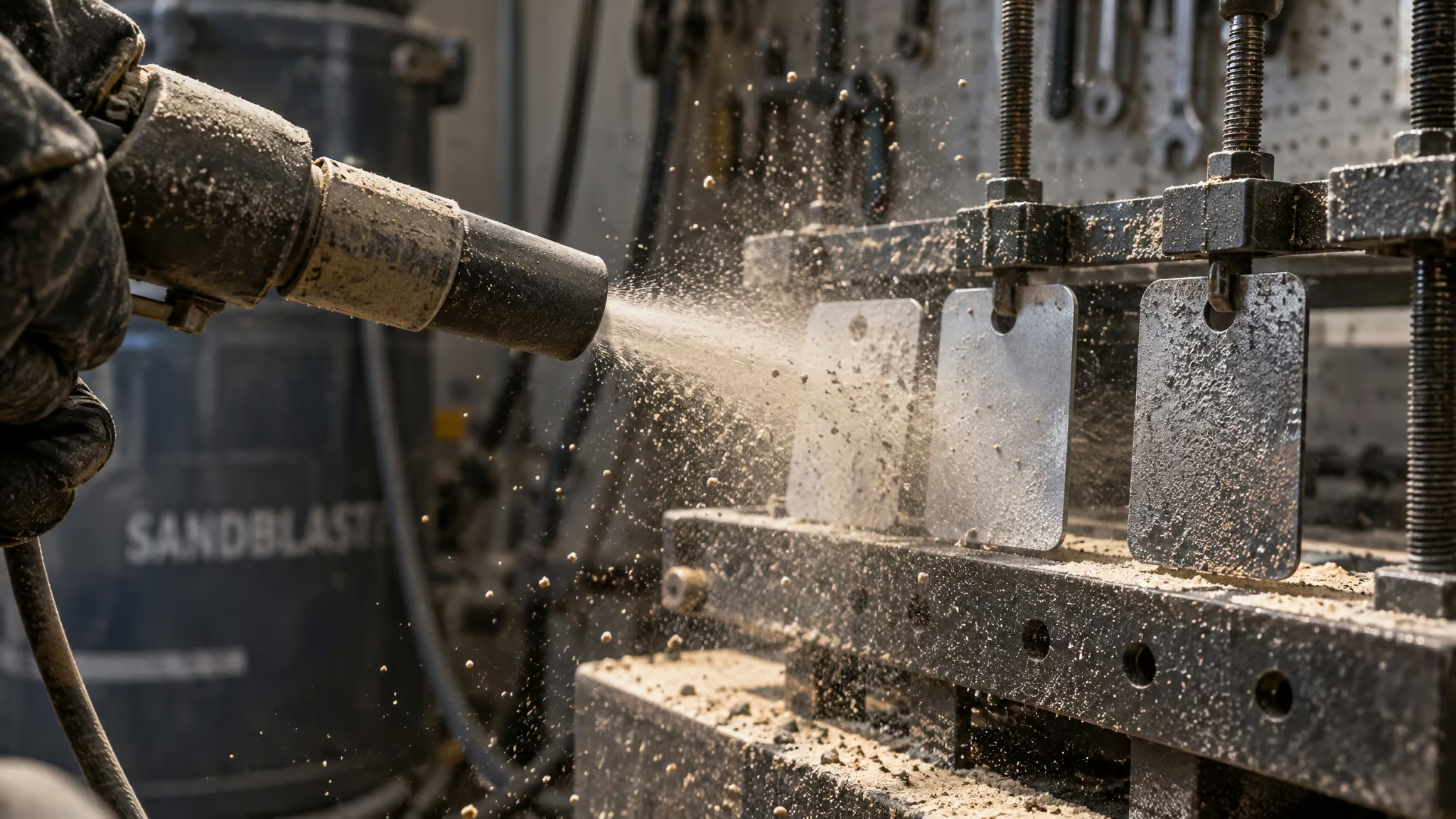
Okay, check this out. CNCKing.com pointed a sand blaster at sample tags, set to 80 psi, using ordinary beach sand, from about 1.5 inches away. That’s absurd overkill by their own admission; if a bare hand had been in the blast path doing what those tags did, there wouldn’t be any skin left on it. Untouched control tags sat alongside the blasted ones for comparison. It’s a proxy test, not a time machine, but it compresses years of real-world abrasion into minutes, which is more than most durability claims can say.
The ranking that fell out:
- Deep-etched 304 stainless outlasted everything.
- Lightly etched 304 stainless came second.
- Anodized aluminum finished last, and in a follow-up blast the anodized plate’s coating was completely stripped while the 304SS marks survived intact.
- Annealing failed first among the stainless methods, etching second, deep etching last.
Our favorite detail, though, is the counterintuitive one: side-by-side with the untouched controls, the blasted 304SS tags’ Z/N lettering actually looked better after the blast. The sand scoured the surrounding surface and made the marks pop. That’s the kind of result no marketing copy would ever predict.
There’s also a starting recipe worth stealing for that clean black on steel: fiber laser at 5-8 W, around 100 mm/s, with negative defocus of 2-5 mm. Yes, the wattage is low, and that surprises people who assume black means burning power. The color comes from oxide-film thickness, a mechanism we’ll come back to. Treat it as a starting card from a named source, not gospel.
One scope guard before anyone screenshots the ranking: this is one proxy test, at 80 psi, with beach sand. Rank within it. Don’t recite it as a universal law without pairing the claim with the test conditions, because that pairing is the whole credibility.
Annealing vs deep etching: choosing the right stainless mark
Here’s the number that frames the whole trade-off: about 9 of 10 CNCKing.com clients preferred annealing over etching for their tags. Annealing gives a smooth surface, is quicker, and costs less. Etching is rougher, loses fine resolution, and deep etching costs significantly more.
Then the sandblast test flipped the marketing. Annealing, the customer favorite, failed the abrasion test first. Deep etching outlasted everything on the board. But going deep has its own catch: the deep passes can warp thin 304SS plates, which is exactly why welding tags get annealed in real shops. You take the less durable mark because the more durable one would ruin the part. Thicker tags get planned for more etch coverage instead.
Permanence proof while we’re here: neither annealed nor etched 304SS marks could be removed with a sharp knife. That’s a satisfying, low-tech verification.
Now the contrarian move, stated plainly: losing the abrasion test doesn’t make annealing wrong. The right mark is the least durable one that survives its actual environment. A machine tag that never meets a sandblaster doesn’t need deep-etch money. Over-specifying durability is its own kind of waste, and the 9-of-10 client preference is real shop economics, not ignorance.
Bottom line: Pick the least durable mark that survives the part’s real environment — over-specifying permanence is wasted money, not extra safety.
Anodized aluminum: why one sign faded in 6 months and another lasted 6 years
How long do anodized aluminum engravings last outdoors? One engraver watched a sign fade in about 6 months; another has 6-plus-year-old signs still looking fine. Not “varies”, contested, with two attributed accounts pointing in opposite directions, and we’re not going to average them for you.
First, the mechanism, because it’s honestly kind of elegant. Anodized aluminum gets its color from dye trapped in a porous anodic oxide layer on the surface. A laser marking anodized aluminum bleaches or vaporizes that dye, revealing the reflective raw aluminum underneath. It’s a magic trick once you know how it’s done: you’re not adding pigment, you’re deleting it.
Dark plate colors, black, navy, crimson, give the best contrast, and honestly anodized aluminum is one of the most fun things to engrave. Keycaps and keyboard plates, dice, flasks, laptop lids, all of it works. There’s a durability wrinkle built into the trick: superficial color removal preserves the oxide layer and its corrosion resistance, while deep engraving exposes raw metal that can slowly oxidize in damp conditions.
Now the contested evidence, both accounts in the same breath:
- One engraver, posting as the Stunt Engraver in a 2006 forum thread, reported a black anodized Memorial Garden sign that faded to silver-gray after roughly 6 months outdoors, while the routed engraving inside it stayed legible.
- Mike reported 6-plus-year-old outdoor black anodized signs with only slight fading, still reading as dark gray.
There’s a third data point that refuses to pick a side: the Missouri Botanical Garden uses anodized aluminum signage exclusively. That’s a real-world vote of confidence, and we’ll name it without over-interpreting it. The same 2006 thread also referenced a 25-year outdoor engraving standard, posted on 23 Feb 2006, with stock in play from Gravograph. That’s the industry benchmark on record, vintage intact. Old data, but it’s the reference point.
So what explains the divergence? Dye batch, alloy grade, seal quality, climate, and mark depth. “Anodized lifespan” is really several questions wearing one trench coat, and any article that collapses it into a single average is selling you a number nobody measured.
Mitigation exists, though, and it comes with receipts. Mike’s gold Alumamark garden signs got a UV-spray post-treatment, carried a 3-4 year life expectation, and came with a fade-replacement guarantee to the buyer, per his post dated 12 May 2006. A vendor backing a coating with money is rarer than it should be, the downsides of laser engraving being the honest counterweight here, upfront machine cost, fume extraction, materials you must never hit, and a real learning curve. And if maximum wear durability is the goal, there’s a deep-engraving recipe built for it: around 400 mm/s at 80% power with alternating 0°/90° hatch passes. On day-to-day care, one clause: isopropyl on a microfiber is safe, wire brushes are not, and the full protocol comes later.
Which laser produces the most durable marks
Fiber lasers produce the most durable marks on metal; UV lasers produce the most durable marks on delicate materials. The answer isn’t a champion, it’s a matching problem, and the receipts behind laser engraving’s claimed advantages make it concrete.
- Fiber (1064 nm). The industry standard for metal marking, with minimal daily maintenance and thousands of hours from a solid-state source. MOPA variants add black and gray on anodized aluminum and a full color spectrum on stainless and titanium via precision annealing, which works by tuning oxide-film thickness. Fiber’s home turf also includes deeper stone marks through heat fracturing, rust removal, and plain high-speed production: a 60 W MOPA finished a PCB prototype in 2 minutes.
- UV (355 nm). This is the tiny wizardry of the lineup. Cold ablation means a smaller focal spot and no heat-affected zone: crack-free marks embedded inside glass (frosted work that beats sandblasting), wood and leather with no charring, and rubber-stamp fine detail that fiber heat destroys. It also handles textiles, cardboard, and ceramic cups.
The great failure case goes to fiber, though: in JT Makes It’s head-to-head, the fiber laser vaporized metal instantly but left no mark on denim, while the UV laser ablated the dye and left the fibers intact. Limits, stated honestly: UV can’t match MOPA color and can’t cut metal.
- Picosecond. Virtually no heat-affected zone, line widths down to 0.1 mm and detail resolved at the micron level. It earns its keep in electronics, medical UDI codes, anti-counterfeiting, and smartphone frames, at a higher upfront cost. Note the boundary: the evidence covers mark quality and heat damage, not measured lifespan in years, so we won’t claim that.
- Diode. Diodes lack the peak power and pulse control to bleach anodized dye cleanly, so the results come out slower, less even, with heat-warping risk on thin stock. That’s not a dunk on budget gear, it’s a wrong-tool-for-the-job situation. For laser engraving anodized aluminum specifically, fiber is the right tool.
- CO2, in one line: the organics-and-many-plastics workhorse, the garage-starter laser.
The concept that ties this together: the laser sets the mark’s starting quality, and starting quality sets its lifespan ceiling. A mark born with a heat-damaged baseline ages from a worse place than one born clean, regardless of how good the substrate is.
Engraving depth and parameters: why some marks are born weak
Depth is the difference between a mark that shrugs off abrasion and one that fades: deep marks resist wear because you have to remove material to remove the mark, while shallow marks on soft substrates are the first to go. The exception to respect is that deep passes can warp thin stock, so depth isn’t a free dial.
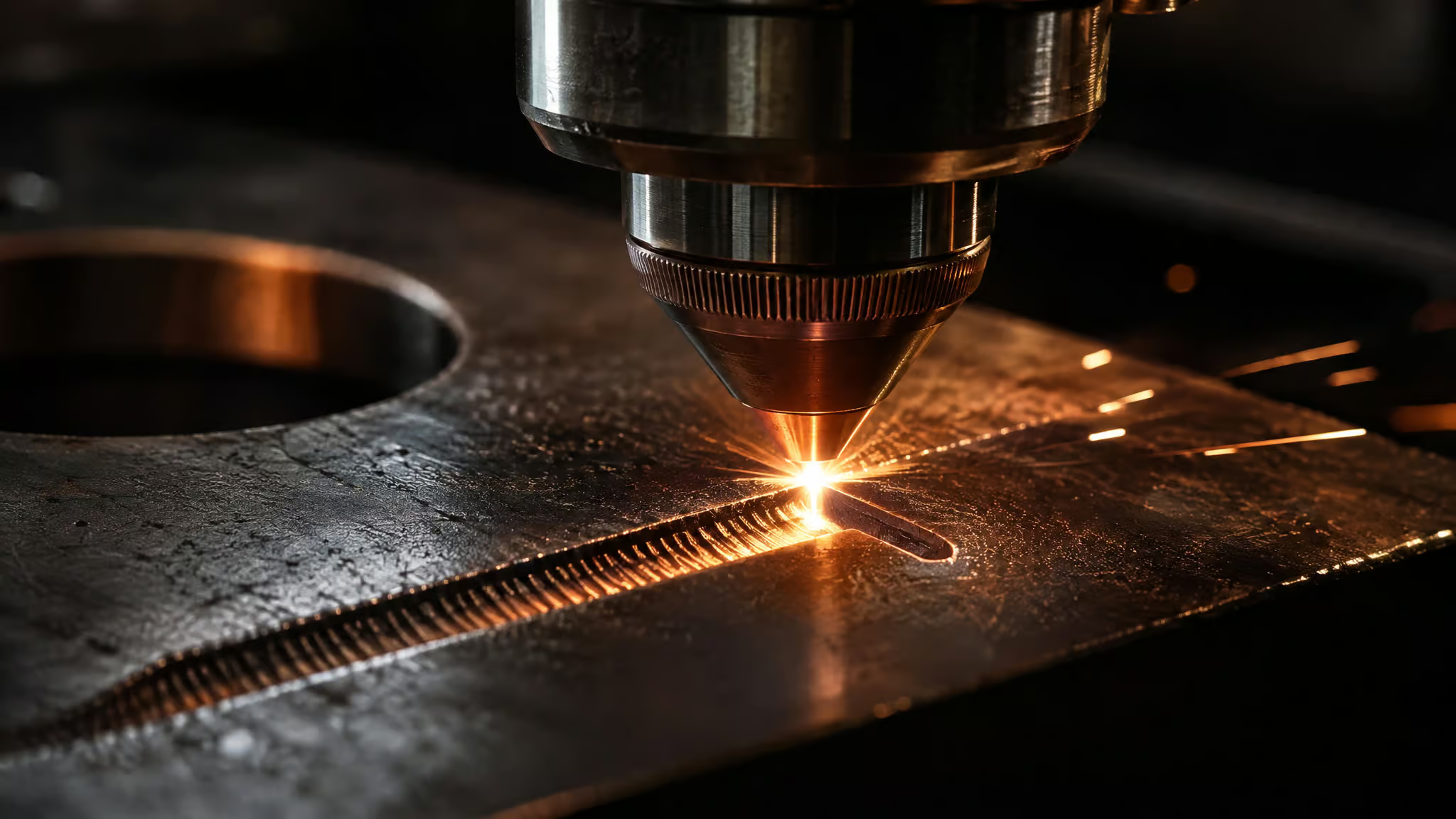
Depth trades initial crispness for survival, and there’s a failure pattern worth naming here. A shallow, high-contrast mark on a frequently handled item loses contrast long before the groove goes anywhere, because the surface sheen that made it readable wears away first. That single mismatch is the story behind most “my engraving faded” complaints, and the fix is choosing depth before the part is made, not after it comes back.
Then the black-and-white mechanism pair, told once: black marks come from dense oxide layers, which build at higher power. White marks come from lower power creating micron-scale roughness that scatters light. So yes, power up for black. It’s backwards from what you’d guess, and it’s the same thin-film physics behind MOPA color.
Parameter recipes, attributed and separate, because these sources don’t agree and pretending otherwise is the fake-consensus move this article exists to reject. Think of them as screenshot-able starting cards.
- xlaserlab color-removal set: 1000-1500 mm/s at 30-40% power; 60-80 kHz for white, 20-30 kHz for deep; 0.03-0.05 mm hatch spacing. Their speed cheat-sheet: whitening 1200-1800 mm/s, deep 300-600 mm/s, fine detailing 800-1000 mm/s.
- dplaser deep-engraving technique: ~400 mm/s at 80% power with alternating 0°/90° hatch-angle passes for an even flat bottom and maximum wear durability, the same recipe flagged above for outdoor anodized work.
- dplaser anodized table: black at 60-80% power, 800-1200 mm/s, 50-80 kHz, 0.02-0.05 mm hatch pitch, with several passes layered over each other. White at 20-40% power, 2000-3000 mm/s, 20-30 kHz, 0.1-0.15 mm pitch, a single quick scan. The general black-marking envelope runs 20-50 W at 100-500 mm/s, and ±0.5 mm of defocus can sharpen edge definition.
All of this runs in EzCad or whatever marking software you use, and all of it is a starting point, not a guarantee. The stainless black-marking recipe lives back in the sandblast section, so we won’t re-table it.
When marks come out wrong: a yellow or brown tint means too much heat, so cut power or raise speed. Patchy marks get a second low-power pass with the hatch angle shifted 45°, and it works so well it feels like cheating. White marks are contamination-prone, so apply a protective layer after marking. Expect to retune per alloy grade, and pre-clean with alcohol and dry before anything.
The point underneath all the numbers: hatch angle, spacing, and defocus aren’t cosmetic preferences. They’re durability inputs you decide before the part leaves the bed.
Wood, leather, acrylic, and glass: how each one ages
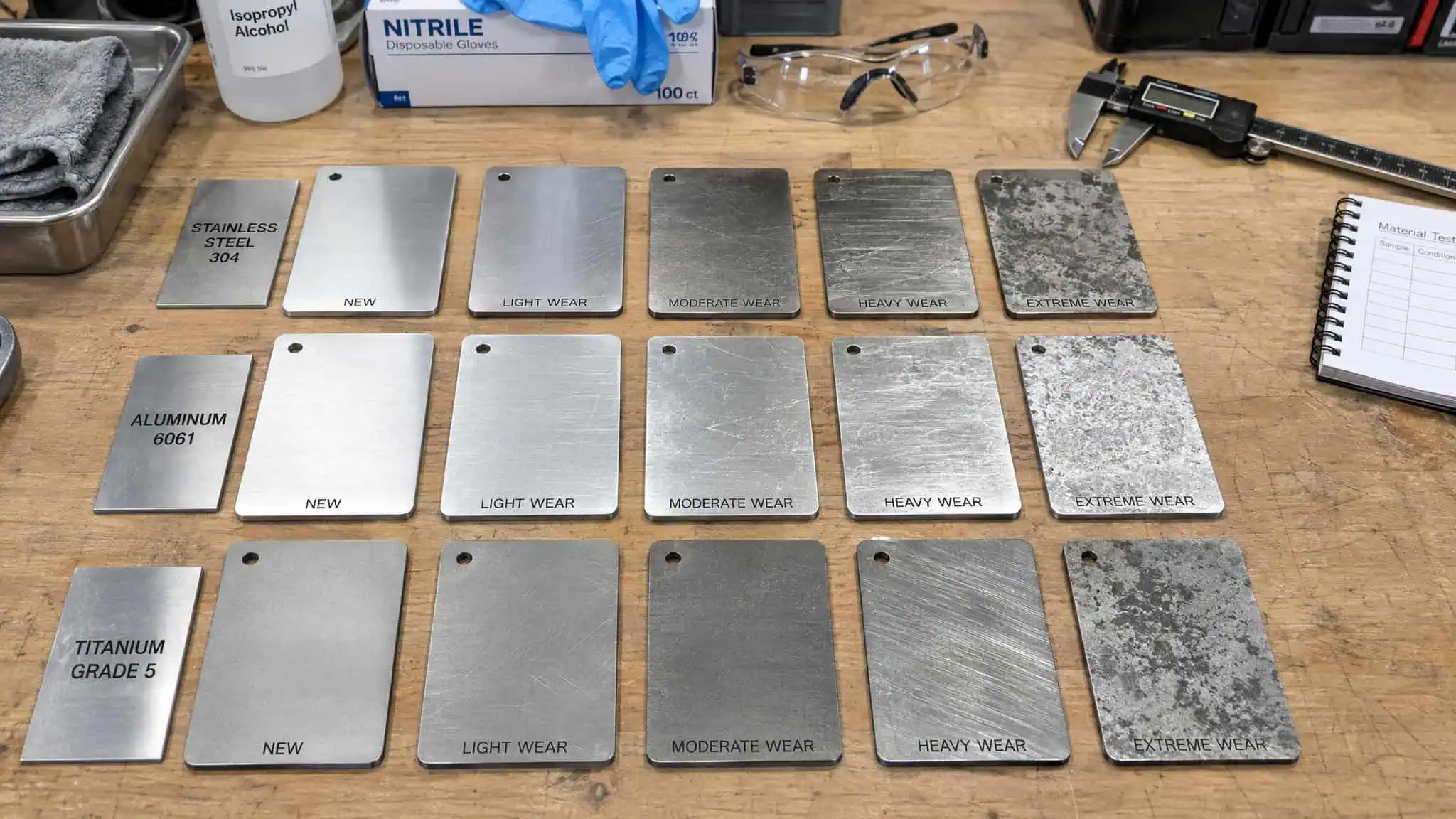
Marks on wood, leather, acrylic, and glass fade or degrade, but through completely different mechanisms, and nobody has published measured lifespans for any of them. So: mechanisms only, no invented year ranges. No source supports them, and “wood engravings last 2-5 years” is exactly the kind of assertion this piece exists to dismantle.
Wood and leather look great on day one, and that’s the trap. Frequent handling, skin oil, sweat, and sunlight quietly soften edges and reduce contrast, the way a sticker peels: not a dramatic event, just steady attrition. Wood has char fading as its own pathway, where the charred layer itself lightens over time. Leather contrast mostly dies from skin oil working into the surface. Sealing or coating either one extends its life.
Plastics and acrylic hold their marks better than organics, but intense UV or heat causes color change or surface wear, and acrylic has a failure mode all its own: edge-glare. That’s distinct from fading. The mark doesn’t lose contrast so much as the surrounding surface changes how it catches light, and suddenly the design reads wrong even though the mark is physically intact. It’s the kind of degradation you only learn about from someone who’s seen it, which is the recurring theme here.
The laser still sets the starting line, and this is where UV feels like cheating, the same way it does when picking the best laser machine for jewelry engraving on delicate metals. Cold ablation leaves wood and leather uncharred, keeps denim fibers intact where fiber heat failed entirely, and embeds crack-free marks inside glass. A fiber-heated mark on these materials starts with more damage baked in and ages from a worse baseline. Same design, same file, very different ten-year trajectory.
So retire “fade” as one phenomenon. Wood char fading, acrylic edge-glare, and leather contrast loss are three different failure modes with three different fixes, and treating them as one vague problem is how marks get made that were doomed on the bed.
UV, moisture, salt, and the dishwasher question
Yes, deep metal engravings survive dishwashers, sweat, and daily handling, but shallow marks, anodized dye layers, and coated surfaces are the wear risks. That’s the verdict, with the condition attached, because a bare “it depends” is useless and a bare “yes” is dishonest.
The question comes from a real place: pet tags, tumblers, anything that goes through hands and cycles daily. The accelerants to think about are concrete, not abstract. Moisture, salt, grit, UV, and caustic cleaners are the enemies. Salt spray and gritty handling, specifically, not a vague cloud of “environmental factors.”
The cleaning protocol is two sentences long, which is most of its charm. Isopropyl alcohol on a microfiber cloth, gentle wipe, safe. Abrasive cleaners and wire brushes permanently scratch the anodized coating, which is catastrophic and irreversible. Done.
Here’s the honesty flag, inside the same passage: nobody has published a tested dishwasher-cycle result for engraved items. We haven’t run one either. Dishwasher exposure is a wear-risk condition to reason about, meaning detergent chemistry, heat, and jets, not a documented pass/fail. Anyone selling you “dishwasher-safe with proper settings” is blurrying into fake certainty. The risk framing is the information: deep marks in hard metal have the material to shrug off the cycle, while shallow marks and dyed coatings are gambling with the chemistry, and we’d want sample testing before promising either.
Red flag: Any “dishwasher-safe engraving” promise without tested cycle data is fake certainty — deep marks in hard metal are the only confident case.
How to make a laser engraving last longer
You make a laser engraving last longer by choosing a hard material, increasing depth, using higher-contrast settings, and sealing or coating the surface. Four levers, and every one of them gets pulled before the laser fires, which is the whole point: permanence is a design decision, not an afterthought.
- Hard material first. Stainless steel, or anodized aluminum with a thick anodic layer. Obvious in hindsight, still skipped constantly.
- Go deeper. You’re trading some initial crispness and more time and power for abrasion resistance, and the sandblast data says that trade pays off.
- Higher-contrast settings. Readability is the real metric as the mark wears, not depth alone. A worn deep mark you can still read beats a crisp shallow mark you can’t.
- Seal or coat where possible. The cheap-insurance move. Think of it like clear-coating a cosplay prop: same instinct, same payoff.
The coating lever comes with a warranty-grade receipt, and we want to be precise about the vintage. Mike’s gold Alumamark garden signs got a UV-spray post-treatment, carried a 3-4 year life expectation, and came with a fade-replacement guarantee, per his post dated 12 May 2006. A vendor putting money behind a coating claim is rarer than it should be, which is exactly why the receipt is worth keeping twenty years later.
Aftercare rounds it out: avoid harsh cleaners, abrasives, and constant UV exposure. Care instructions in normal-person language, like caring for a nice tool. That’s the whole stack, and no, we’re not inventing a fifth lever about proprietary sealants, because no source backs one.
Removing laser engraving: removability as a durability metric
Yes, laser engravings can be removed, the method depends on the substrate, and how hard removal turns out to be tells you more about permanence than any “years” claim. Flip the question: instead of asking how long the mark lasts, ask what it would take to remove it. The answer is a durability reading.
On metals, the menu is polish, sand, or machine it away, or run a laser re-pass. Work through fine abrasives and progressive grits to avoid waves and glare, the detail everyone learns the hard way. Measure thickness before and after when tolerances matter. Anodized aluminum is a different game entirely: you strip the coating and re-anodize, because you’re not removing a mark so much as resetting the surface.
Plastics take light abrasion, then flame-polish or buff, and you go gentle because aggressive work hazes or deforms the surface. Wood is the forgiving one: sand back and refinish, a genuine low-stakes do-over. Leather is the stubborn case: removal without changing the texture is impractical, so masking over with a new design is usually the smarter move. Chemical methods only suit certain finishes, and test a small area first, always.
Now tie the inverted metric back to the evidence. A sharp knife couldn’t touch the annealed or etched 304SS marks in CNCKing.com’s testing, while a shallow mark on a soft surface can often be buffed away by hand. That spread, knife-proof to hand-buffable, is a more honest permanence scale than any adjective in a product listing.
Disadvantages, machine lifespan, and maintenance as durability inputs
The honest trade-offs, in what you’re-signing-up-for energy. Real setup cost is the first one: fiber and CO2 machines with big beds and safety enclosures add up fast, so talk total setup cost, not sticker price. Color is limited: standard engraving is monochrome, annealing on stainless and plastic color-change are neat-but-niche tricks with narrow windows, and MOPA oxide-film color is the genuinely wild exception. Even then, it’s not as vibrant or consistent as printing.
This isn’t a printer, and calibrating for that up front saves disappointment. Plastics and rubber smoke and stink, so exhaust and filtration aren’t optional parts of the hobby. And the material range is restricted: some things reflect too much, melt too fast, or give weak contrast, and those combos just don’t work.
Class 4 in one clear beat, maker to maker: these lasers demand eye protection against reflected IR and UV, and the reflected beam is the sneaky part since it doesn’t need to hit your face directly to find your retina. Interlocks and fume handling are required kit, not accessories, the same way a case fan is part of the build.
Here’s the scope split that captures half the confused search traffic: engraver lifespan is a machine question, engraving lifespan is a mark question, and they have different answers. On the machine side, a maintained engraver serves for years, and a fiber source runs thousands of hours with minimal daily upkeep. The hour-count tier tables for diodes and CO2 tubes floating around other results? Our sources don’t back them, so we won’t repeat them as fact.
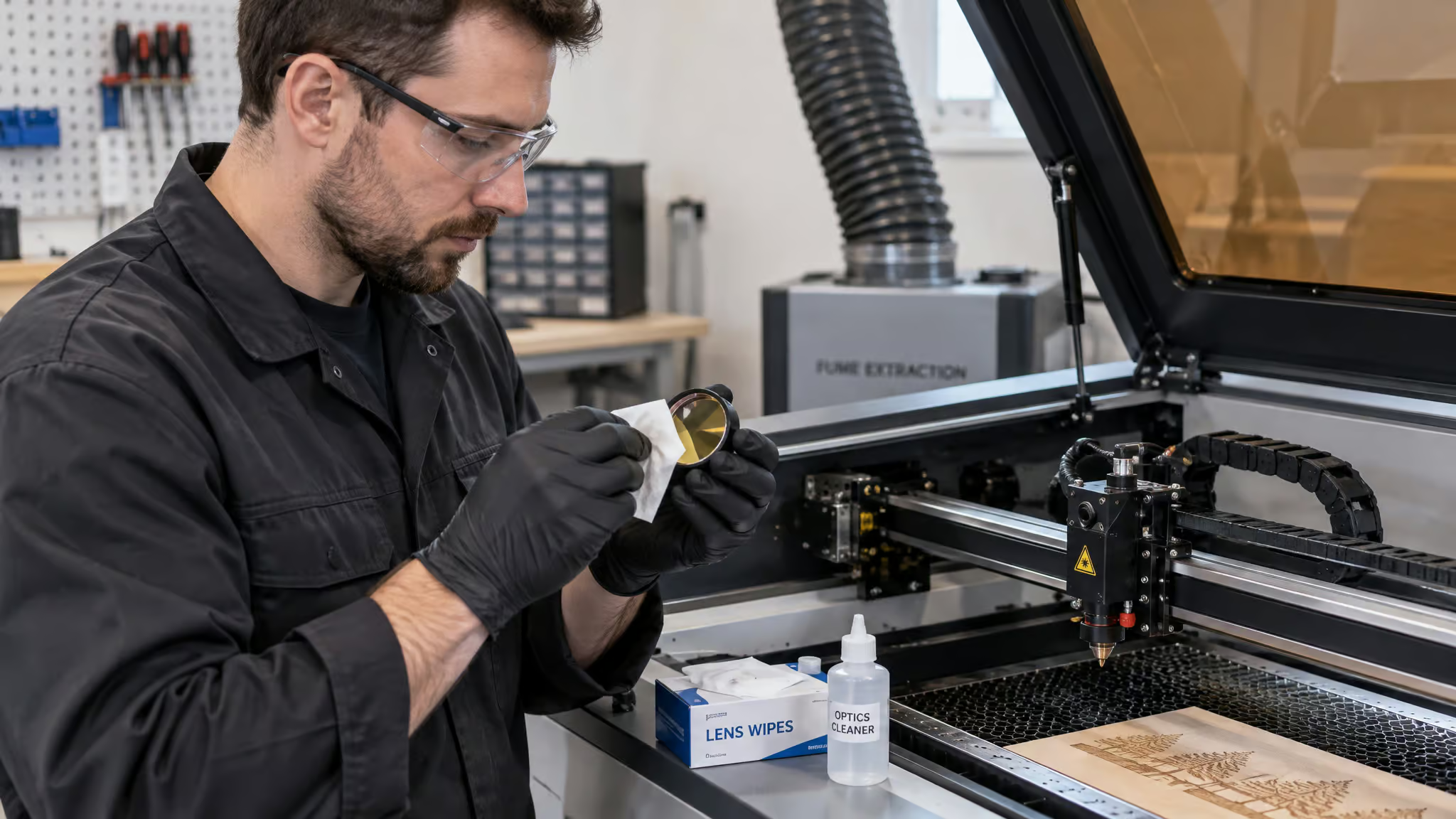
Maintenance matters because it protects mark quality, which is a durability input. Weekly lens and mirror cleaning with approved wipes. Focus verification with a gauge or camera. A calibration pattern to check beam alignment and scale.
Exhaust and filter checks. Log source hours and follow the maker’s service timeline, including annual laser source service. Update firmware and software, then re-validate your saved settings, because the update-broke-my-profile experience is universal. The failure pattern to recognize: marks come out light or fuzzy, the operator blames the material or the file, and the actual culprit is dirty optics or drifted focus.
The tell is that the same file ran perfectly last week. A weak mark is less durable before it ever leaves the machine.
Two more threads worth pulling. Commercially, laser engraving is replacing silk-screen printing and EDM in electronics, automotive, and medical because the marks resist abrasion and corrosion and the process is environmentally friendly. Part ID is where durability pays: serial numbers, traceability, medical UDI codes, scannable QR codes, anti-counterfeit micro-marks. And on the powder-coat comparison, we’ll reason rather than rank, because powder coat has no measured lifespan in our sources.
Laser marks modify the material itself, while powder coat and printed labels sit on top where scratches and UV attack them. The sandblast test is suggestive here: it stripped an anodized coating while the substrate marks survived. But an anodized coating isn’t powder coat, so that’s a data point, not a verdict.
Test it before you promise it
The protocol fits in four moves: mark samples, stress them under the conditions the real part will face, rank the results, write it down. Adjust one variable at a time and build a per-alloy parameter library, the discipline every tinkerer resists and then adopts. If you’re designing the sign, prep work counts too; Kittl’s 1,400+ free commercial-use fonts are handy for layout, and that’s a sponsorship disclosure doing its job quietly at the end of the section.
Shop reality backs this up. Test samples before full production, and abuse the prototype the way the customer will abuse the product. Scrap plates double as durability test beds whenever new lenses go in. Credit where it’s due: CNCKing.com ran this kind of test at their shop, and JT Makes It put the fiber-vs-UV head-to-head on video.
The sandblast rig is the template, and you don’t need a sandblaster to copy the mindset: 80 psi of beach sand at 1.5 inches is decades of abrasion compressed into minutes. Your version needs standardized stress, a control specimen, and a ranked result. Those three ingredients fit on a desk.
Which is the whole so-what. Most published lifespan figures are unmeasured, and GeekExtreme’s read on durability claims is the same as its read on spec sheets: check them against reality. Your own ranked evidence beats any vendor’s adjective, and it’s the only lifespan number you’ll ever be able to defend.
People Also ask
How long does laser engraving last on metal like stainless steel and titanium?
Marks on hard metals like stainless steel and titanium are effectively permanent, lasting decades. Controlled abrasion testing supports this: deep-etched 304 stainless survived an 80 psi beach-sand blast that stripped other coatings, and neither annealed nor etched 304SS marks could be removed with a sharp knife.
How long does laser engraving last on wood, leather, and other organic materials?
No one has published measured year counts for these materials, so honest answer: the marks soften and fade rather than vanish. Frequent handling, skin oil, sweat, and sunlight blunt edges and drop contrast — wood’s char layer lightens on its own, and leather loses contrast mostly to skin oil. Sealing or coating either material extends its life.
Which laser type produces the most durable marks: fiber, CO2, UV, or diode?
Fiber lasers produce the most durable marks on metal, while UV lasers produce the most durable marks on delicate materials — it’s a matching problem, not a champion. Fiber is the industry standard for metal and the right tool for anodized aluminum; UV’s cold ablation leaves wood, leather, glass, and textiles uncharred and intact. Diodes lack the peak power to bleach anodized dye cleanly, and CO2 is the workhorse for organics and many plastics.
What environmental factors shorten laser engraving life — moisture, salt, UV, and abrasion?
Moisture, salt, grit, UV, and caustic cleaners are the concrete enemies, and they hit hardest at shallow marks, anodized dye layers, and coated surfaces. Deep metal engravings shrug off sweat, dishwashers, and daily handling because there’s material to remove before the mark is gone. Care matters too: isopropyl on a microfiber is safe, but abrasive cleaners and wire brushes permanently scratch anodized coatings.
How do I remove or cover up a laser engraving if I need to?
It depends on the substrate. On metals you can polish, sand, machine it away, or run a laser re-pass; anodized aluminum requires stripping and re-anodizing; plastics take light abrasion plus flame-polishing; wood can be sanded and refinished; leather is the stubborn case, so masking over with a new design is usually smarter. How hard removal turns out to be is itself the most honest permanence scale — sharper than any ‘years’ claim.
What are the disadvantages of laser engraving?
The honest trade-offs: real setup cost for fiber and CO2 machines with big beds and enclosures adds up fast, marks are essentially monochrome (MOPA color being the narrow exception), plastics and rubber smoke and stink so exhaust isn’t optional, and some materials reflect too much or melt too fast to mark at all. Class 4 machines also demand eye protection, interlocks, and fume handling as required kit.