
GUNNAR Optiks, the yellow-lens computer-glasses company, just announced something that isn’t glasses. It’s called the Ojai Vision Recovery System, and it’s a face mask: air compression, heat, blackout, vibration, and Bluetooth audio wrapped into a roughly 10-minute post-screen ritual where you step away from visual demands, disconnect, and reset. No screens for ten minutes. Announced September 30, 2026 from Oceanside, Calif., at $99. The obvious question is whether the pilot-study numbers mean anything, and the more interesting one is why the glasses company thinks the ten minutes after your screen time is the product.
Key Takeaways
The Ojai Vision Recovery System is a recovery mask combining air compression, ~43°C/109°F heat, full blackout, vibration, and Bluetooth audio into a 10-minute post-screen ritual, launched September 30, 2026 at $99.
Pilot participants reported feeling better (94% high physical relaxation, 89% more-relaxed eyes, ~56% lower discomfort ratings), but the data is self-reported perception, not clinical evidence, and Ojai is not a medical device.
GUNNAR’s own framing splits the problem in two: eyewear for the hours you’re on, Ojai for the minutes you’re off. They’re complements, not competitors.
Table of Contents
What Is the GUNNAR Optiks Ojai Vision Recovery System?
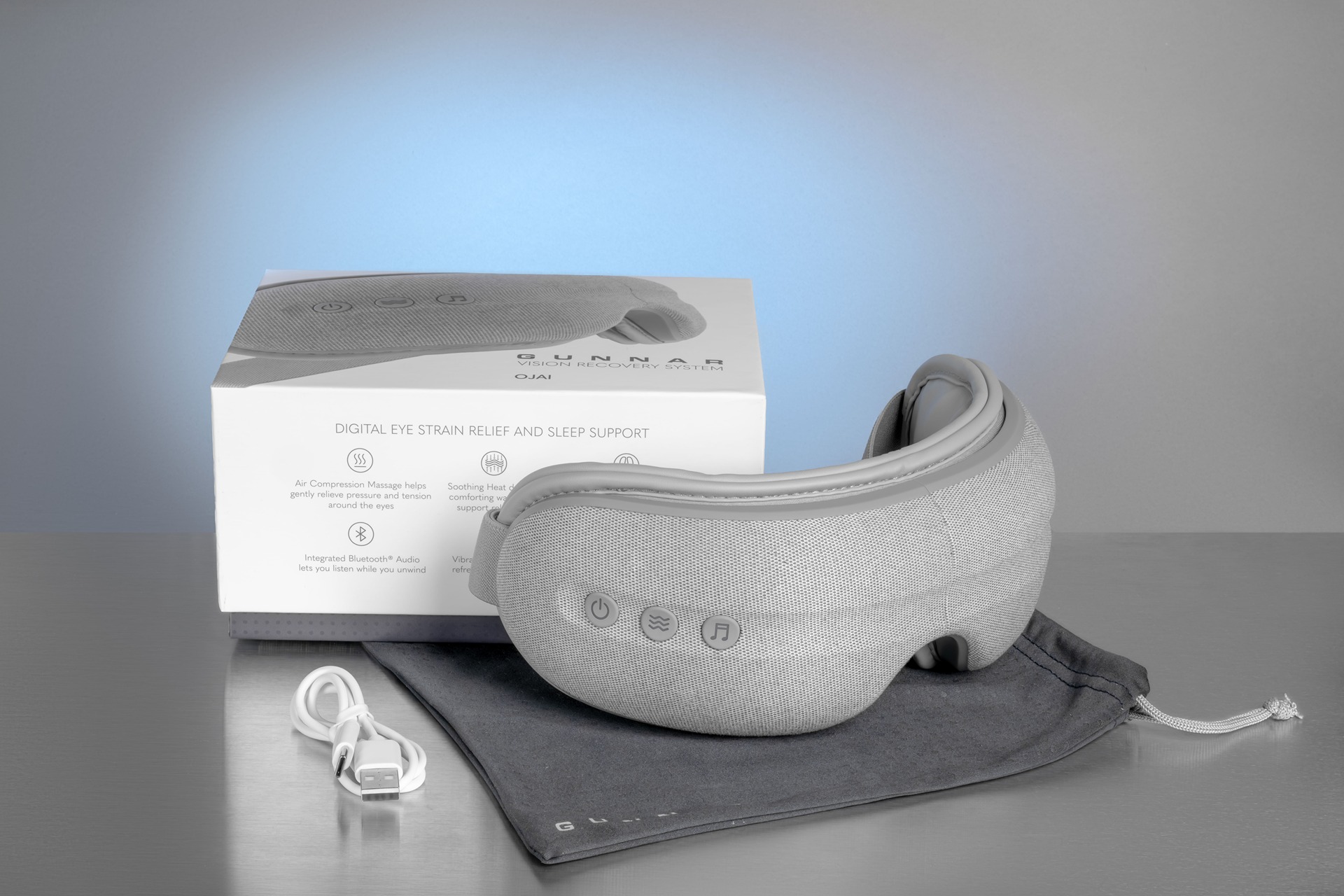
The Ojai Vision Recovery System is a recovery device that packs all five of those features into one portable system built around a roughly 10-minute post-screen ritual. That ritual is the actual product. Any single feature here is something you can buy elsewhere; the ten-minute structure, where you deliberately step away from visual demands and reset, is the thing GUNNAR is selling. The company calls it “Take 10,” with the campaign copy reading “Relax. Restore. Reset.”, marketing language, but it does describe the mechanic accurately.
The maker matters: GUNNAR Optiks has been building computer and gaming eyewear since it was founded in 2006, and says the technology here draws on roughly two decades of optical research. The practical anchors: $99 MSRP, available September 30, 2026 through GUNNAR.com and select retail partners.
Why GUNNAR Built Ojai: From Eye Protection to Recovery

This is mission expansion, not a pivot. GUNNAR says outright that it isn’t moving away from eyewear, and co-founder and CEO Joe Croft frames Ojai as the natural next step. The founding premise, per Croft: the world went digital, but eyes weren’t designed for the screen time that was coming. Twenty years went into protecting eyes during screen time; Ojai extends that to what happens after, with the stated goal of covering the entire digital visual experience. That’s a big swing for a $99 mask, but a company founded in 2006 and still launching new categories in 2026 is demonstrably not coasting.
How the Ojai 10-Minute Ritual Works: The Six Technologies
A session works like this: blackout removes visual input entirely, heat and compression relax the physical stuff around your eyes, and audio gives your brain something to do that isn’t a screen. You pick from five recovery modes and let it run about ten minutes. Here’s the stack:
Air Compression Massage Technology
Rhythmic compression around the eye area, designed to feel immersive and relaxing. I have honest questions about what this actually feels like on a face, and the launch material doesn’t answer them. It describes the mechanism, not the sensation.
Soothing Heat Therapy
Warmth at approximately 43°C / 109°F, positioned as supporting relaxation after long screen sessions. That’s a real, specific spec, which is more than most wellness gadgets give you.
Multi-Mode Smart Recovery System
The system offers five modes that combine compression, heat, and vibration. No AI-powered anything, thankfully, just mix-and-match across three axes. The mode count matters because of what pilot participants said: they didn’t single out individual features, they singled out combination modes as the most compelling part. The mix is the design, not an afterthought.
Integrated Bluetooth Audio
Built-in wireless audio you can load with whatever helps you wind down, whether that’s playlists, meditation tracks, podcasts, ambient soundscapes, or guided sessions. The point is that you bring your own wind-down audio instead of GUNNAR shipping a meditation app.
Full Blackout Recovery Design
Blocks ambient light for a true screen-off environment. Honestly kind of elegant. Total darkness as a listed feature is the simplest thing on the spec sheet and possibly the most important one.
Foldable, Travel-Ready Design
Adjustable, rechargeable, and usable at home, at work, or traveling. It packs down, which matters if your screen day happens in more than one place. No battery-life numbers were published, so I won’t invent any.
Does the GUNNAR Ojai Actually Work? What the Pilot Study Shows, and Doesn’t
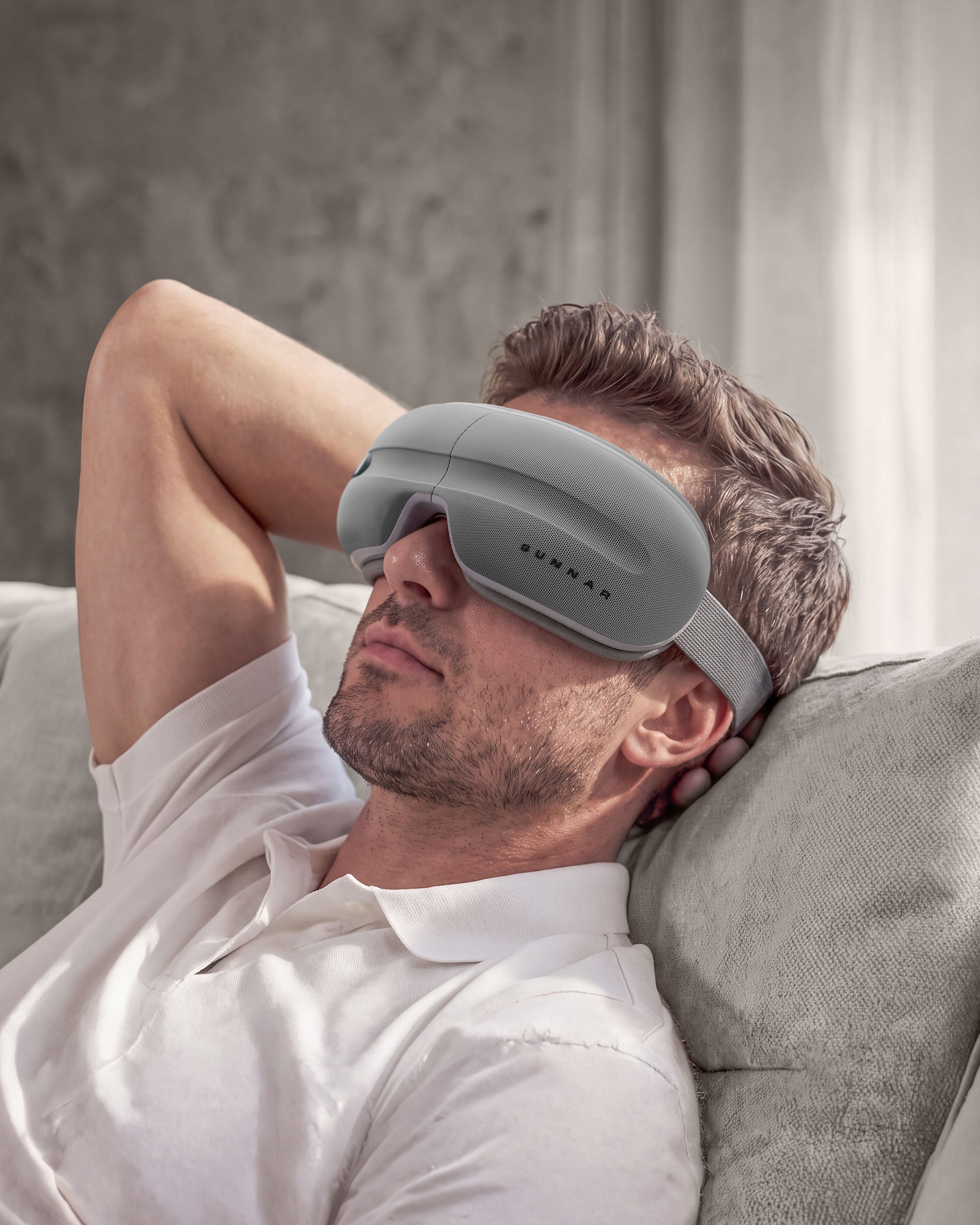
Short answer: pilot participants said they felt better, and the numbers are 94% reporting high physical relaxation after a session, 89% saying their eyes felt more relaxed, and roughly 56% lower average discomfort ratings immediately post-session. But these are self-reported perceptions, not clinical evidence, and that distinction is the whole ballgame.
What the pilot study measured
GUNNAR ran a structured real-world pilot before launch with screen-intensive users, measuring self-reported symptoms including tired eyes, dryness, irritation, tension around the eyes and temples, and blurred or fatigued vision, along with how physically relaxed, mentally refreshed, and ready to get back to work participants felt. That matters because reducing eye strain is a core part of staying healthy as a software developer. The 56% figure spans five dimensions: eye fatigue, dryness/irritation, pressure/tension, temple discomfort, and blurry or tired vision. So the headline number has real content behind it. It was a real study with real people, which is more than some launches manage.
What the numbers can’t tell you
There’s no sample size, methodology detail, or control group in the launch material, and I’m not going to invent any. What we know is that people filled out before/after self-reports and felt better. GUNNAR’s own disclaimer says the findings reflect personal perceptions and shouldn’t be viewed as clinical or medical efficacy data, and that Ojai is not a medical device and isn’t intended to diagnose, treat, cure, or prevent anything. Translated: people said they felt better; nobody’s claiming this cures anything.
It’s a comfort device. Most coverage will blur that line; it’s worth not blurring.
The Missing 10 Minutes: Will People Actually Keep Using It?
“The Missing 10 Minutes” is the name of GUNNAR’s new brand platform, anchored by the slogan “Perform Hard. Recover Smart.” and aimed at gamers, creators, designers, developers, athletes, streamers, and professionals. Slogans are cheap, so the interesting part is what the pilot actually showed about behavior.
The telling number: among Day 30 respondents, 87% used Ojai for precisely 10 minutes, and post-work and pre-bedtime became the standard session times. One participant called it a “daily fixture,” which is a single voice and not a verdict, but the comment themes were consistent: disconnecting, closing their eyes, having a defined relaxation period.
Here’s my read. Wellness rituals usually collapse within weeks because they’re open-ended; “relax more” has no stop condition. This data suggests the fixed, bounded duration anchored to existing transition points, logging off, winding down, is what made it stick. Open-ended relaxation devices drift into drawer storage.
Devices with a defined endpoint actually get used. The campaign name came from observed behavior, not the other way around, and that’s the right order. The campaign itself runs across digital video, social, creator partnerships, retail, ecommerce, and experiential activations, but the device is the part worth your attention.
GUNNAR Ojai vs. GUNNAR Gaming Glasses: Which One Do You Need?
They’re not competing. GUNNAR Eyewear addresses strain during screen hours; Ojai addresses recovery after them. The real question is whether your routine has any recovery stage at all, because most screen-heavy routines don’t.
Croft’s framing is the decisive line, and it’s the one sentence in the announcement that actually explains the product: eyewear is for the hours you’re on, Ojai is for the minutes you’re off.
If you’ve been searching “gaming glasses,” “blue light glasses,” or GUNNAR’s Amber Max lenses and wondering whether Ojai replaces them, it doesn’t. Those searches conflate two different stages of the same problem. Whether the glasses help your eyes during a session is a separate question from whether the mask helps you recover after one, and neither product’s claims vouch for the other.
And if you already own the glasses: they’re not going anywhere. GUNNAR is explicit that this expands the lineup rather than replacing it.
Who the Ojai Is For, and Why GUNNAR Priced It at $99
The target list is gamers, creators, designers, developers, athletes, streamers, and professionals, which is to say basically everyone reading this. The $99 MSRP is the positioning story: GUNNAR is pricing Ojai as an accessible add-on to the digital-performance toolkit, an on-ramp rather than a high-ticket wellness splurge. For an eye-massage-adjacent device, that’s a genuinely notable number.
The pilot session patterns show where it fits a working day: after work, before bed, ten minutes at each seam. One honest limitation: comparing Ojai against other eye massagers on the market requires external research the launch material doesn’t supply, so all I can give you is GUNNAR’s side of the ledger. Whether $99 is a good deal relative to competitors is homework I can’t do from the announcement alone.
Price, Launch Date and Where to Buy the Ojai
The Ojai Vision Recovery System launched September 30, 2026 (launch day as of publication) at MSRP $99, available through GUNNAR.com and select retail partners.
| Detail | Status |
|---|---|
| MSRP | $99 |
| Launch date | September 30, 2026 |
| GUNNAR.com | Yes (primary purchase destination) |
| Select retail partners | Partial (announcement doesn’t name which retailers) |
| Foldable, rechargeable form factor | Yes |
| Medical device | No (comfort device, per GUNNAR’s disclaimer) |
On “select retail partners”: that’s the entire phrase the announcement gives. No retailers are named, so I won’t guess at which stores will stock it. If you want it on day one, GUNNAR.com is the certain answer. Prices may vary by retailer, and this article reflects the launch-day availability as stated in the announcement rather than a fresh check of every storefront.
What makes the $99 price worth dwelling on: recovery and massage hardware in this general space often lands well north of that, and GUNNAR clearly wants Ojai to be an impulse-adjacent purchase for the same audience already buying its glasses. The form factor supports the impulse: it folds down, recharges, and travels, so the ten minutes can happen at your desk, on a couch, or in a hotel room after a convention day. And the cost in time is fixed by design: about ten minutes, five modes, one blackout mask. That’s the whole transaction.
The Recovery Gap: Why Screen Time Is the Last Unoptimized Block
Ojai launched September 30, 2026 at GUNNAR.com and select retail partners, but the bigger pitch underneath it is that screen recovery is the one block in the performance stack nobody optimizes. Croft’s observation, quoted from the announcement: “We live in a culture obsessed with performance and optimization,” and yet recovery from the hours we spend looking at screens almost never makes the list. Look at your own setup and check it against that claim. We spec our GPUs, tune our monitors, buy ergonomic chairs, track our sleep, program our workouts. The ten minutes after eight hours of screens gets whatever’s left over, which is usually nothing.
GUNNAR’s reframing is that recovery is part of sustaining performance, not time away from it. I don’t think that’s proven, and the pilot data doesn’t prove it, since feeling relaxed after a session is a long way from demonstrating that recovery improves your next session. But as a design thesis it’s coherent, and it’s the same logic that turned sleep tracking from a novelty into an industry. The claim is testable in the only way that matters here: wear the mask for a month and see whether your evening sessions feel different.
There’s also the brand-trajectory question worth closing out, because search results are full of people asking whether GUNNAR is still around. A company founded in 2006, after three years of R&D, that pioneered computer eyewear with patented lens technology for digital eye strain, and that is still actively expanding into a new hardware category in 2026, is by definition not a dead brand. The announcement puts it plainly: “The future of GUNNAR is bigger than eyewear,” with a stated goal of becoming the company for the entire digital visual experience, and the launch of an entirely new device type is the evidence backing that sentence.
So here’s where the arc lands. Everything in the modern performance stack has been measured, optimized, and monetized except the block that comes right after the screens turn off. GUNNAR spent twenty years on the hours you’re on, and Ojai is its bet that the ten minutes you’re off are worth engineering too. At $99, finding out whether they’re right is a cheap experiment.
Frequently Asked Questions
What is the GUNNAR Optiks Ojai Vision Recovery System?
It’s a recovery mask, not glasses: a wearable that combines air compression, ~43°C/109°F heat, full blackout, vibration, and Bluetooth audio into a roughly 10-minute post-screen ritual. You step away from visual demands, disconnect, and reset. It launched September 30, 2026 at $99 from GUNNAR, the computer-eyewear company founded in 2006.
How much does the GUNNAR Ojai Vision Recovery System cost and where can I buy it?
MSRP is $99, positioned as an accessible add-on rather than a high-ticket wellness splurge. It’s available through GUNNAR.com, which is the certain day-one answer, plus select retail partners that the announcement doesn’t name. Prices may vary by retailer.
Does the GUNNAR Ojai actually work for eye strain and fatigue?
Pilot participants said yes: 94% reported high physical relaxation after a session, 89% said their eyes felt more relaxed, and average discomfort ratings dropped roughly 56% across five dimensions including eye fatigue, dryness, tension, and blurry vision. But these are self-reported perceptions, not clinical evidence — people felt better, and nobody’s claiming the device cures anything.
What are the limitations of the GUNNAR Ojai pilot study findings?
The launch material includes no sample size, methodology detail, or control group — just before/after self-reports from screen-intensive users. The data measures how people felt, not clinical outcomes, and there’s no evidence yet that feeling relaxed after a session improves your next one. It’s a real study with real people, but perception isn’t proof.