Tracking an unreleased 3D printer that officially doesn’t exist yet is an exercise in reading between regulatory lines. Over September and October 2026, a Bambu Lab model called the P3C quietly surfaced in US and Japanese certification databases, and by November 5 to 12, a forum thread was knee-deep in teardowns of test-lab photos and circuit-board headers.
I haven’t used or tested the P3C. Like everyone else following the trail, I’m reading these leaks online, piecing together what FCC paperwork, Japanese Giteki records, patent filings, and community forensics establish. Because Bambu Lab has said nothing official about the P3C, every claim circulating right now traces back to those public filings and forum interpretations. Even after the H3C had a reveal scheduled for November 3, 2026, it remained an open question whether Bambu held the P3C back for a separate launch.
Key Takeaways
Three of the four leak reports and forum discussions we checked expect the P3C to be a cheaper, reduced-feature H3C, while one notes the certification documents themselves don’t make that clear.
FCC ID 2A6J8-PF006P (filed September 15, 2026) and Japanese Giteki certificate 211-260730 (October 8, 2026) confirm a compact, enclosed P-series chassis with seven front tool docks, 2.4 GHz and 5 GHz Wi-Fi, and a 100 to 120 V, 8 A US electrical rating, while leaving build volume and filament feeding unconfirmed.
Forum forensics comparing the P3C’s shared AC board to the H3C’s show no chamber-heater connector on the P3C, keeping ABS and PC suitability unresolved alongside euro forum price guesses ranging from €1,000 to €1,400.
Table of contents
Table of Contents
What the Bambu Lab P3C leaks confirm
The certification filings prove the Bambu Lab P3C exists, lock in its model name and radio compliance, and confirm nothing more. Everything else about its printing specs is still inference or speculation.
How to check the primary FCC records yourself
If you want to look at the raw paperwork instead of secondhand summaries, start with the filer: Shenzhen Tuozhu Technology, Bambu Lab’s parent company, submitted the P3C application on September 15, 2026 under FCC ID 2A6J8-PF006P and model number PF006P.
The public package tied to test report 2604V73211E-RF is sparse. It contains a model number plate, Wi-Fi test reports covering 2.4 GHz and 5 GHz bands, radio exposure data, and a US electrical label rated at 100 to 120 V, 8 A. Build volume, nozzle configuration, and multi-material architecture aren’t public in the FCC records.
The September filing cluster and press corroboration
The P3C didn’t show up alone. Four days earlier, on September 11, 2026, Shenzhen Tuozhu Technology filed two other FCC applications: the H3C under 2A6J8-PF008P and the X2D Pro under 2A6J8-PF004E. Three filings in four days looks like a broader lineup refresh, though nothing in the paperwork confirms the X2D Pro shares multi-nozzle hardware.
Carolyn Schwaar, writing at All3DP on October 27, 2026, brought the certification photos into wider view, describing the P3C as a seemingly compact, enclosed P-series printer with a seven-head tool-changing system, while noting that pricing and launch timing remain unknown.
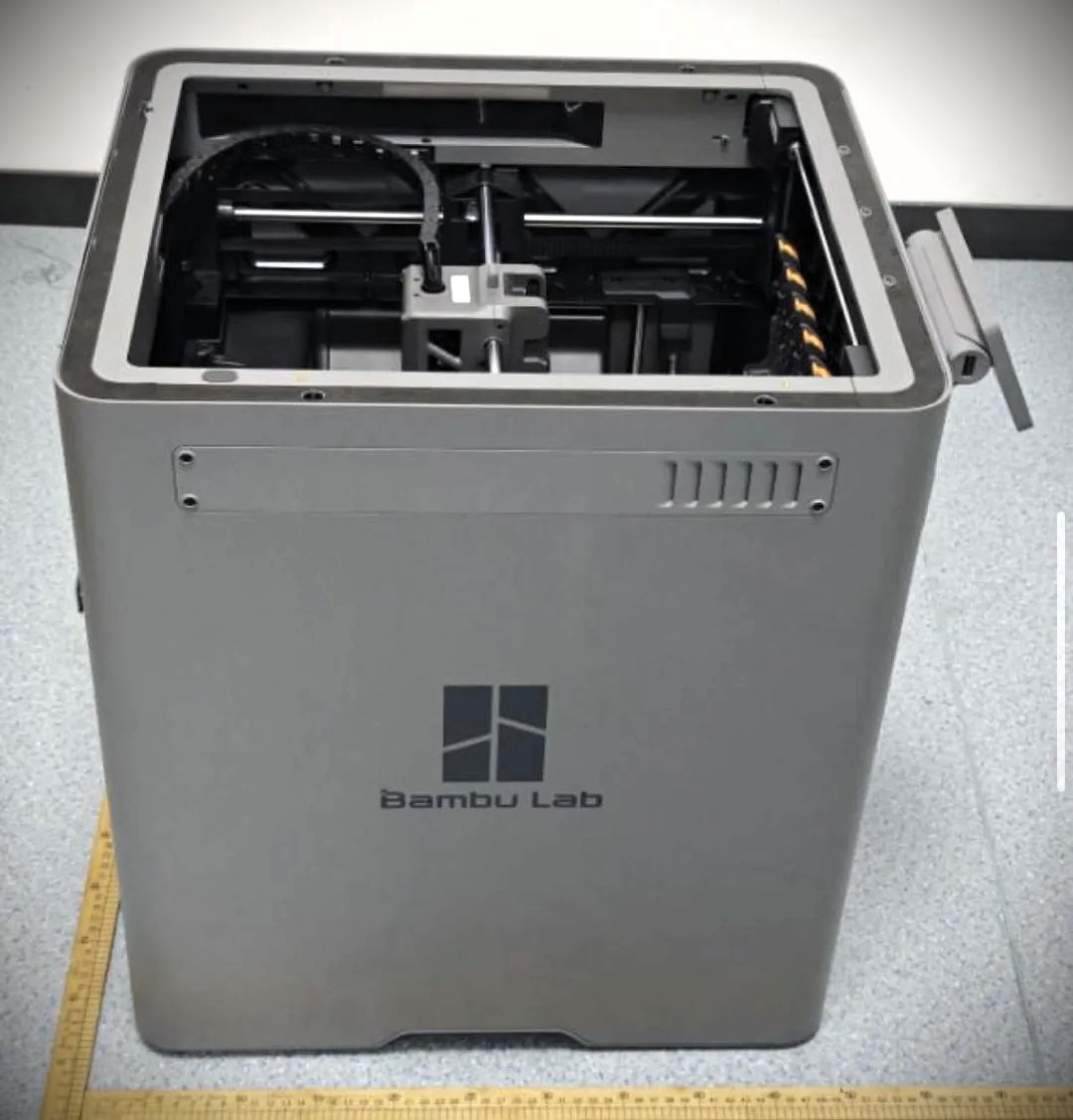
Seven tool docks: what the leaked photos show
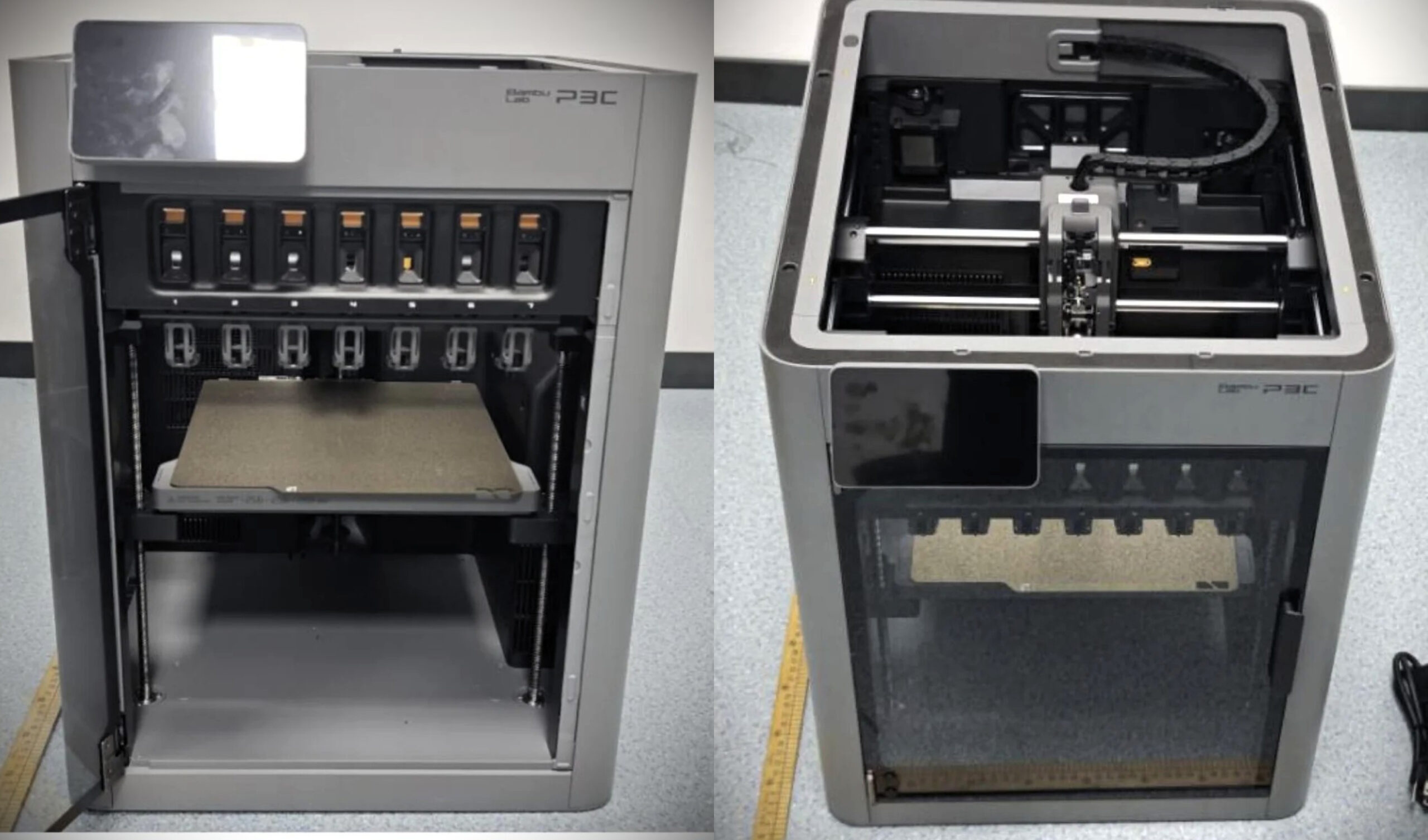
Certification photos show seven tool docks arranged at the front of the P3C’s build chamber, which puts early four-head and five-tool rumors to rest. Still, test-lab snapshots are built to document radio shielding and chassis enclosures, not to answer every mechanical question a maker cares about.
Inside the chassis and seven-dock layout
Japanese Giteki certification photos from Japan’s Ministry of Internal Affairs and Communications give the clearest look at the hardware. P3C certificate 211-260730, dated October 8, 2026, shows seven tool docks with orange latches, compared with nine tool holders on H3C certificate 211-260728, dated September 30, 2026. Bay Area Compliance Laboratories in Guangming, Shenzhen shot the photos for both units.
The FCC hardware images show a gray, fully enclosed chassis with a glass door, a touchscreen in the upper-left corner of the front panel, flanked on the right by a P3C logo, and a textured print plate inside. You can also make out a guide-rod gantry with a single carriage riding on round rods, a cable drag chain, and seven mounts in an upper row with a second row of seven mounts below at the front of the build chamber, matching the H3C’s front-mounted layout. A US label in the shots also lists a 100 to 120 V, 8 A input.
What the lab photos leave out
Even with the door open, the photos have hard limits. A folding ruler resting on the floor is the only scale reference in the shots, leaving exact chassis dimensions and build volume unspecified.
More importantly, seven docks is photographic fact, while seven full toolheads is an inference. The images don’t show whether each dock holds a complete toolhead with its own extruder or only a swappable hotend, nor do they show how filament gets fed from the outside.
P3C vs H3C: the predicted sacrifice list
The decisive difference between the two leaked machines comes down to dock count and likely thermal hardware: the H3C pairs nine tool holders with an actively heated chamber for pro-grade printing, while the P3C drops to seven docks and is widely expected to trim high-end features to hit a lower price tier. Across the four leak write-ups and forum discussions checked for this article, three expect the P3C to be a cheaper, reduced-feature H3C, while one notes the certification documents themselves don’t make that clear. For buyers, that split means you’re likely looking at a mid-range multi-tool machine with deliberate guardrails to keep it from cannibalizing Bambu’s flagship.
What forum users expect Bambu to cut
In the November 5 to 12, 2026 Bambu forum thread, bacchus94 predicted Bambu will strip out the actively heated chamber, the toolhead camera (eliminating the vision encoder), the exhaust filter, and double chamber part cooling, while lowering hotend and bed temperatures and shipping an unheated AMS to hit roughly €1,000. (bacchus94 had earlier guessed five tools standard, a figure superseded by the seven-dock photos.)
Impman66 broke down the expected tradeoff between what a seven-dock P-series machine gains and what it loses compared with the H3C:
- Potential P3C advantages include seven nozzles running CMYKW multicolor, mixed nozzle sizes in a single print, faster printing, less purge waste, easier maintenance access, dedicated bypass slots for flexible or brittle filament, and a filament buffer for additional AMS units.
- Predicted P3C drawbacks include the complete absence of AMS drying, the lack of automated spool unloading and a heated chamber, lower peak temperatures, and no SwapTek expansion such as DRAW or CUT nozzles.
Counter-evidence from leaked documents
Not everyone in the thread bought a scorched-earth cut list. Samilton reasoned that 2.85 mm filament support, multitool support, active chamber heating, and top speed would be the logical features to remove on a cheaper model. However, Samilton noted that leaked documents point toward an active chamber and identical toolheads, which would leave 2.85 mm support and slower speeds as the open differentiators.
How the community frames the value tradeoff
If the predicted cuts hold, the community still sees a compelling sweet spot. Forum user krellboy summed up the P3C’s expected positioning as half the price, two-thirds the plate size, three-quarters the capability, and one and a half times the value.
Will the Bambu Lab P3C have a heated chamber?
Whether the P3C includes an actively heated chamber is still an unresolved debate, though internal board comparisons currently tilt the evidence against it. In the forum thread, bacchus94 argued the P3C lacks an actively heated chamber based on FCC photos of the open printer, and user_2855723386 pointed out that Bambu has restricted heated chambers to the X and H series so far.
The most telling twist came from abdbeg, who initially argued for a heated chamber by citing leaked specs and an H3C-style bottom vent, then reversed position on November 10 after comparing H3C wiki photos against the P3C filings. On the H3C, the shared AC board carries a blue cable running to the chamber heater, whereas the P3C filing shows no heater connector at all. abdbeg reinterpreted the P3C’s bottom vents as a filtration compartment and an auxiliary fan air intake. Meanwhile, user_3211927740 posted images argued as hints of a chamber heater, leaving the question open, with the missing connector as the stronger evidence.
SwapTek, Vortek, and the toolchanger patents
A true toolchanger swaps complete extrusion assemblies that keep their filament loaded, whereas a hotend-swapping system exchanges only the nozzle and heating block and still requires filament unload and reload between swaps. The P3C may use the same SwapTek tool-changing system as the H3C, but there is no official information confirming that the P3C will use a toolchanger, and Bambu’s published patents have no confirmed link to either machine.
The R&D case for shared SwapTek hardware
From an engineering-budget standpoint, user_2855723386 argued that Bambu wouldn’t duplicate R&D to build a second multi-tool mechanism, pointing toward shared SwapTek hardware with seven tools and a new unheated AMS. That setup could still offer filament drying that can’t run while printing, potentially relying on a power-adapter arrangement similar to the P2S.
The Vortek baseline and Shenzhen Tuozhu patents
Bambu already ships multi-hotend hardware in the H2C Vortek Hotend Change System, a US$2,199 Combo that pairs one fixed nozzle with six swappable hotends for seven-filament printing with minimal purge. Because Vortek swaps hotends rather than full extrusion assemblies, it still has to unload and reload filament, making it proof of multi-hotend capability rather than a true toolchanger.
Meanwhile, Shenzhen Tuozhu Technology patents CN122560412A and CN122560413A (the latter claiming priority from a November 6, 2025 Chinese filing) describe automated placement and retrieval of replaceable print units from parking stations, with some drawings showing nine positions. That architecture looks closer to an advanced Vortek partial-exchange system than a full toolhead changer. Neither the patents nor the H3C FCC documents reference each other, there’s no official link to the H3C or P3C, and patent drawings don’t equal commercial product specs, while community guesses that the “C” in P3C and H3C stands for a changer system remain unconfirmed by Bambu Lab.
The sub-$1,000 toolchanger race
Every sub-US$1,000 toolchanger shipping in 2026 carries four tools, so a seven-dock P3C priced near P-series levels would nearly double the tool count of rivals like the Snapmaker U1 and Creality K3, though that competitive pressure depends entirely on unconfirmed pricing. Toolchangers beat single-nozzle AMS setups because each tool keeps its own filament loaded, skipping long purge cycles, and 2026 competition has shifted away from raw color count toward switch time, waste reduction, multi-material reliability, and long-term stability.
| Printer | Architecture | Tools | Price |
|---|---|---|---|
| Snapmaker U1 | SnapSwap (preheated toolheads) | 4 | US$899 (€849) |
| Flashforge Creator 5 | FlashSwap (parked toolheads) | 4 | US$799 (US$949 Pro / €679) |
| Creality K3 | KliTek (nozzle-unit swap) | 4 | US$849 |
| Prusa INDX + CORE One+ | Multi-tool kit on CORE One+ | Up to 8 | US$999 kit + €1,049 printer |
On claimed performance, Snapmaker rates the U1 at roughly 5-second tool changes and up to 85% filament waste reduction in its own testing. Creality’s K3, which began US deliveries on November 2, 2026, claims nozzle-unit swaps under 5 seconds and color or material changes under 15 seconds, supporting mixed 0.4 mm and 0.8 mm nozzles, mixed TPU hardness, PVA supports, and engineering filaments in a single print. Creality also fields the SPARKX i8 with QuarTeks, feeding four channels into one nozzle with sub-second switching, while Prusa’s INDX hits eight tools only in H-series price territory. (All competitor speed and waste figures are manufacturer claims.)
For broader price context, beginner FDM machines span €199 for the Creality SPARKX i7, €259 for the Bambu Lab A1, €279 for the Anycubic Kobra X, €299 for the Elegoo Centauri 2, €499 for the QIDI Q2, and €629 for the Bambu Lab X2D. Bambu’s earlier 2026 launches, the dual-nozzle X2D in April and the large-format A2L in June, disappointed toolchanger seekers, leaving plenty of pent-up demand if a seven-dock P3C lands near mid-range money.
How much will the Bambu Lab P3C cost?
Neither the P3C’s price nor its release date is official. Every figure circulating right now is either a forum estimate or an anchor borrowed from Bambu’s existing P-series and H-series pricing.
Euro forum guesses versus US list-price anchors
Pre-launch forum guesses routinely anchor on predecessor pricing and miss once official MSRP lands, and euro-denominated forum speculation isn’t directly comparable to US dollar list prices. On the Bambu forum, bacchus94 estimated the P3C at roughly €1,000 (alongside a potential X3C at roughly €1,600), while Lucky_prints favored a €1,250 to €1,400 target.
Beyond forum speculation around €1,000 (or €1,250 to €1,400), which isn’t directly comparable to US dollar list prices. US pricing anchors give a different set of guardrails for the Bambu Lab P3C. The P2S launched in October 2025 at US$549 (or US$799 with the AMS 2 Pro), matching what the P1S had cost; if the P3C follows that pattern, it could land somewhat above the P2S. At the top of the lineup, the H3C is reported at US$2,499 including the AMS 3H, leaving a wide bracket between entry enclosed machines and the flagship changer.
Release timing around the November 3 checkpoint
No P3C launch date is public. The H3C had a November 3, 2026 reveal scheduled for 10 PM Malaysia time (3:00 p.m. CET) that may or may not have included the P3C. Even if Bambu held the P3C back for a separate announcement, the September and October FCC and Giteki filings point to a near-term launch window.
Who should wait for the P3C and who shouldn’t
The P3C’s rumored cuts split the community cleanly along material and budget lines. Based on what’s surfaced so far, it looks tailored to PLA and PETG multicolor buyers priced out of the H3C, risky for ABS and PC printers who require active chamber heat, and ambiguous for longtime X1C owners waiting on a direct successor.
New and average users wanting multicolor without H3C cost
Impman66 framed the H3C as built for print farmers and experienced operators, versus the P3C for average buyers. As a new P2S owner printing mainly PLA and PETG with plans for TPU and maybe ABS, Impman66 wants multicolor printing without paying H3C prices, and for that profile the rumored omissions may barely get in the way.
ABS and PC printers who need chamber heat
Lucky_prints requires an actively heated chamber for ABS and PC printing to justify upgrading from a P2S. That turns the unresolved AC-board connector debate into an immediate dealbreaker until Bambu publishes real thermal specs.
X1C-successor waiters weighing space and price
senordeveloper, after waiting a year for an X1C successor, found the H3C tempting but deterred by its space requirements and price, and questioned what an X3C would even offer if the P3C ends up heavily stripped down.
The X3C question and software-locked features
Two alternative explanations for how Bambu could separate the P3C from higher-tier machines go beyond simple parts removal. Lucky_prints noticed the P3C shares the P2S’s mounting points where the X2D’s chamber heater installs, which abdbeg reads as pointing more likely to a future X3C model (€1,250 to €1,400 per Lucky_prints, or roughly €1,600 per bacchus94) than a user-wired AC heater addon, since Bambu avoids having owners handle AC wiring themselves. Taking a more cynical view, user_3176213208 suggested Bambu could intentionally software-block multi-nozzle features on the P3C to keep it segmented from the H3C, similar to Tesla locking battery capacity below what’s physically installed.
What the P3C leaks cannot tell you
Certification photos structurally can’t reveal the P3C’s filament feeding method, whether drying works during printing, how spools are handled, what the build volume measures, or how seven parked units hold up over long-term use. Claims that the H3C will ship with nine nozzles, that the P3C is definitely a full toolchanger, or that Shenzhen Tuozhu’s patented parking system appears in either machine remain unconfirmed, leaving only the P3C’s existence, 2.4 GHz and 5 GHz Wi-Fi, and 100 to 120 V, 8 A US electrical rating as established fact.
Frequently Asked Questions
What has leaked about the Bambu Lab P3C so far?
Regulatory filings in the US and Japan confirm the P3C is an enclosed, compact P-series printer featuring a glass door, an upper-left touchscreen, dual-band Wi-Fi (2.4 GHz and 5 GHz), and a 100 to 120 V, 8 A US power rating. Lab photos also show seven front-mounted tool docks with orange latches and a single carriage riding on round guide rods. Everything else—including build volume, filament feeding, pricing, and whether it uses a true toolchanger—remains unconfirmed by Bambu Lab.
How many toolheads does the Bambu Lab P3C have according to certification photos?
Test-lab photos show seven front tool docks with orange latches, which puts earlier rumors about four or five tools to rest. Still, seeing seven docks isn’t proof of seven full toolheads. The images don’t reveal whether each slot holds an independent extruder assembly or just a swappable hotend, so the exact mechanism is still guesswork.
When will the Bambu Lab P3C be released?
There is no official release date yet. While the H3C had a reveal scheduled for November 3, 2026, Bambu Lab didn’t publicly commit to unveiling the P3C alongside it and may have held it back for its own announcement. Given that its US and Japanese regulatory filings cleared in September and October 2026, a launch shouldn’t be far off.
Will the Bambu Lab P3C have a heated chamber?
It’s not officially settled, but the hardware evidence currently leans against it. Comparing the shared AC board across filings shows a blue chamber-heater cable on the H3C that is completely missing—along with its connector—on the P3C. Even though the chassis appears to share mounting points with the P2S where an X2D heater fits, Bambu Lab doesn’t let users wire AC heaters themselves, pointing instead toward either no chamber heater or a separate X3C model down the road.
Is the Bambu Lab P3C worth it for printing ABS and PC filaments?
Hold off before buying it for engineering filaments like ABS and PC. Because the P3C’s leaked AC board appears to lack a chamber-heater connector—and rumored cuts include lower peak hotend and bed temperatures—its thermal chops are a big question mark. Until Bambu Lab publishes real temperature specs, anyone relying on active chamber heat shouldn’t treat the P3C as a safe upgrade.